
Preparing for the Graduate Aptitude Test in Engineering (GATE) requires more than simply studying textbooks and memorising formulas. For Electronics and Communication Engineering (ECE) students, the examination covers multiple technical subjects, along with Engineering Mathematics and General Aptitude. Because of this wide syllabus, students need a clear preparation plan that combines conceptual understanding, regular practice, previous year question analysis, revision, and mock tests.
For students looking for GATE ECE Coaching in Bangalore, choosing the right preparation environment can make the learning process more structured and focused. Bangalore is a major education and technology hub, with many engineering students preparing for higher studies, research opportunities, and technical career pathways. However, the availability of multiple coaching options also makes it important for students to carefully evaluate their learning requirements before choosing a preparation approach.
A well-planned GATE ECE preparation strategy can help students divide the syllabus into manageable sections, understand important concepts, practise different types of questions, and track their progress over time. Instead of trying to study every topic at once, students can follow a systematic process that includes learning, problem-solving, previous year question practice, revision, and performance analysis.
This guide provides a detailed overview of GATE ECE preparation, including the syllabus, exam pattern, preparation strategy, study plan, mock test approach, common mistakes, and important factors to consider while choosing a coaching institute in Bangalore. Whether you are starting your preparation or looking for a more organised approach, understanding the complete preparation process can help you plan your studies more effectively.
Why GATE ECE Preparation Requires a Structured Approach
GATE ECE includes several subjects that require different types of preparation. Some topics require strong theoretical understanding, while others require regular numerical practice and the ability to apply concepts to different problems.
For example, a student may understand the basic theory of Network Theory but still need extensive practice to solve numerical questions accurately. Similarly, subjects such as Signals and Systems, Analog Circuits, Digital Circuits, Control Systems, Communications, and Electromagnetics require both conceptual clarity and problem-solving ability.
This is why preparation without a proper plan can sometimes become difficult. Students may spend too much time on one subject, postpone revision, or leave previous year questions and mock tests until the final stage.
A structured approach can help students manage different aspects of preparation more effectively.
Understand the Complete Syllabus
The first step in GATE ECE preparation is understanding what needs to be studied. Students should carefully go through the official syllabus and divide it into smaller topics.
A syllabus checklist can help students:
- Track completed topics
- Identify weak areas
- Plan revision
- Avoid missing important subjects
- Set realistic preparation goals
Instead of studying randomly, students can follow a clear sequence and gradually move from fundamental concepts to advanced problem-solving.
Build Strong Conceptual Fundamentals
A strong foundation is important for preparing for technical subjects. Students should focus on understanding the basic principles behind each topic instead of only memorising formulas.
Conceptual understanding can help students:
- Apply formulas correctly
- Solve unfamiliar questions
- Understand different problem-solving methods
- Connect related topics
- Reduce dependency on memorisation
For this reason, students should spend sufficient time understanding the fundamentals before moving to advanced-level questions.
Practise Questions Regularly
GATE preparation requires consistent problem-solving practice. After learning a concept, students should solve questions related to that topic.
A useful preparation cycle can be:
Learn the Concept → Solve Practice Questions → Attempt PYQs → Analyse Mistakes → Revise
This process helps students understand whether they can apply what they have studied.
Use Previous Year Questions Effectively
Previous year questions are an important part of GATE preparation. They help students understand how concepts are tested in the examination.
Students can use PYQs to:
- Understand question patterns
- Identify important concepts
- Practise application-based questions
- Improve problem-solving ability
- Recognise frequently tested areas
Instead of simply checking the correct answer, students should try to understand the concept and approach behind each question.
Include Revision from the Beginning
Revision should not be postponed until the last few weeks. With multiple subjects and a large syllabus, students may forget topics that were studied several months earlier.
Regular revision can include:
- Short notes
- Important formulas
- Difficult concepts
- Previous mistakes
- Frequently tested topics
A revision schedule can help students retain information for a longer period.
Evaluate Preparation Through Tests
Tests and mock tests help students understand their current preparation level. They can also help identify problems related to time management, accuracy, and question selection.
After a test, students should analyse:
- Incorrect answers
- Unattempted questions
- Questions that took too much time
- Silly mistakes
- Conceptual mistakes
The purpose of a test is not only to obtain a score. The analysis that follows the test can help students understand how to improve.
What is GATE ECE?
The Graduate Aptitude Test in Engineering, commonly known as GATE, is a national-level examination that evaluates a candidate’s understanding of undergraduate-level subjects in engineering and related disciplines.
For Electronics and Communication Engineering students, the GATE ECE paper focuses on important technical areas along with Engineering Mathematics and General Aptitude. The examination tests not only theoretical understanding but also the ability to apply concepts to solve different types of questions.
GATE preparation can be relevant for students who are interested in:
- Higher education
- Postgraduate technical programmes
- Research and academic opportunities
- Advanced technical learning
- Technical career development
- Public sector opportunities, where applicable
The examination requires students to prepare across multiple subjects. Therefore, preparation should be based on a balanced combination of concept learning, question practice, previous year questions, revision, and mock tests.
Students exploring structured preparation options can also learn more about GATE Coaching in Bangalore to understand the available guidance and preparation support.
Why is GATE Important for ECE Students?
Electronics and Communication Engineering is a broad field that includes electronics, communication systems, signal processing, control systems, digital technology, and other technical areas.
Preparing for GATE can help ECE students strengthen their understanding of these subjects and explore different academic and professional pathways.
A well-planned preparation journey can help students:
- Strengthen their technical fundamentals
- Develop problem-solving skills
- Prepare for postgraduate education
- Understand core ECE concepts in greater depth
- Build a stronger academic foundation
However, the preparation approach should be based on the student’s individual goals. Some students may focus on higher education, while others may be interested in research or technical career opportunities.
GATE ECE Preparation Requires Consistency
One of the most important factors in GATE preparation is consistency. Studying for long hours occasionally is usually less effective than following a realistic study schedule regularly.
Students should focus on:
- Daily learning
- Regular problem-solving
- Weekly revision
- Consistent PYQ practice
- Periodic mock tests
A preparation plan should be realistic enough to follow for several months. Students should avoid creating schedules that are too difficult to maintain.
What Should Students Consider Before Starting GATE ECE Preparation?
Before beginning preparation, students should understand their current academic level, available study time, and preparation goals.
A useful starting point can include:
Assess Your Current Preparation Level
Identify the subjects and topics you already understand well and those that require more attention.
Create a Realistic Study Schedule
Divide your available time between:
- Concept learning
- Problem-solving
- PYQ practice
- Revision
- Test analysis
Select Reliable Study Resources
Avoid using too many resources for the same topic. Choose reliable study material and use it consistently.
Track Your Progress
Maintain a record of:
- Completed topics
- Pending topics
- Test scores
- Mistakes
- Areas requiring revision
Tracking progress can help students remain aware of their preparation level.
For students preparing through GATE ECE Coaching in Bangalore, a structured learning environment can provide additional support through planned study, faculty guidance, practice, and regular evaluation. However, self-study and consistent effort remain important parts of the overall preparation process.
GATE ECE Syllabus
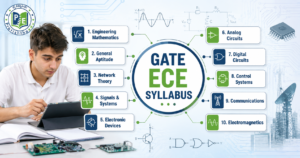
Understanding the GATE ECE syllabus is one of the first steps towards building an effective preparation strategy. The syllabus helps students understand the subjects and topics that need to be covered before the examination. Since Electronics and Communication Engineering includes several technical areas, preparing without a clear understanding of the syllabus can make it difficult to manage time effectively.
The GATE ECE syllabus generally includes General Aptitude, Engineering Mathematics, and core Electronics and Communication Engineering subjects. Students should carefully review the latest official syllabus before beginning their preparation and divide the topics into smaller sections.
A clear syllabus checklist can help students track their progress and ensure that important topics are not missed during preparation.
Major Areas Covered in the GATE ECE Syllabus
The main areas generally include:
- General Aptitude
- Engineering Mathematics
- Network Theory
- Signals and Systems
- Electronic Devices
- Analog Circuits
- Digital Circuits
- Control Systems
- Communications
- Electromagnetics
Each subject requires a different preparation approach. Some topics require more conceptual understanding, while others require regular numerical practice.
General Aptitude
General Aptitude is an important part of the GATE examination and is common to different engineering papers. The section generally tests a candidate’s ability in areas such as verbal reasoning, numerical ability, and logical understanding.
Students should practise:
- Reading comprehension
- Basic grammar and vocabulary
- Numerical reasoning
- Data interpretation
- Logical reasoning
- Analytical thinking
Although the syllabus may appear different from core ECE subjects, regular practice can help students improve speed and accuracy.
Students should not completely ignore General Aptitude during preparation. A consistent practice schedule can help them become familiar with different question types.
Engineering Mathematics
Engineering Mathematics forms an important part of technical preparation for GATE ECE. The subject includes mathematical concepts that are also useful for understanding and solving problems in engineering subjects.
Important areas may include:
- Linear Algebra
- Calculus
- Differential Equations
- Probability
- Statistics
- Complex Variables
Students should focus on understanding the basic concepts and then practise different types of questions. Maintaining a formula sheet can also help during revision.
A good approach is to study Mathematics regularly instead of leaving the entire section for the final stage of preparation.
Network Theory
Network Theory is one of the fundamental subjects for Electronics and Communication Engineering students. It focuses on the analysis and behaviour of electrical circuits and networks.
Important areas may include:
- Circuit Analysis
- Network Theorems
- Transient Analysis
- AC Circuit Analysis
- Resonance
- Two-Port Networks
Students should understand the fundamental principles of circuit analysis and practise numerical problems regularly.
While preparing Network Theory, students should focus on understanding the logic behind different methods instead of memorising only the steps.
Signals and Systems
Signals and Systems is an important technical subject that deals with the analysis of different types of signals and systems.
Important topics may include:
- Continuous-Time Signals
- Discrete-Time Signals
- Linear Time-Invariant Systems
- Fourier Series
- Fourier Transform
- Laplace Transform
- Z-Transform
This subject requires both conceptual clarity and problem-solving practice. Students should understand the properties of different transforms and practise their application to different types of problems.
Regular practice can help students become more comfortable with numerical questions.
Electronic Devices
Electronic Devices focuses on the basic principles and operation of semiconductor devices.
Important areas may include:
- Semiconductor Fundamentals
- Semiconductor Materials
- Diodes
- Transistors
- Device Characteristics
- Basic Semiconductor Concepts
Students should understand how different devices work and how their characteristics are represented.
Strong fundamentals in Electronic Devices can also help students while studying other areas of electronics.
Analog Circuits
Analog Circuits is an important core subject in GATE ECE preparation. It involves the analysis and design of circuits that process continuous signals.
Important topics may include:
- Amplifiers
- Operational Amplifiers
- Feedback
- Oscillators
- Frequency Response
- Basic Analog Circuit Analysis
Students should focus on understanding circuit behaviour and practise different types of numerical problems.
A systematic approach can help students connect theoretical concepts with practical circuit analysis.
Digital Circuits
Digital Circuits focuses on digital systems and logic-based circuit design.
Important areas may include:
- Number Systems
- Boolean Algebra
- Logic Gates
- Combinational Circuits
- Sequential Circuits
- Flip-Flops
- Counters
- Registers
Students should understand the fundamentals of logic design before moving towards more complex topics.
Regular practice can help improve accuracy, especially in questions involving Boolean expressions and digital circuit analysis.
Control Systems
Control Systems deals with the analysis and behaviour of systems that are designed to control or regulate processes.
Important areas may include:
- System Representation
- Block Diagrams
- Signal Flow Graphs
- Stability
- Time Response
- Frequency Response
Students should understand the relationship between different concepts and practise numerical problems regularly.
Topics related to stability and system response often require careful application of concepts, so students should avoid relying only on memorisation.
Communications
Communication Engineering covers the principles used for transmitting information through different communication systems.
Important areas may include:
- Analog Modulation
- Digital Communication
- Noise
- Information Theory
- Communication Systems
Students should understand the fundamental concepts behind modulation, signal transmission, noise, and communication systems.
Regular practice can help students improve their ability to apply formulas and concepts to numerical problems.
Electromagnetics
Electromagnetics is another important area of the GATE ECE syllabus. It focuses on electric and magnetic fields and their interaction.
Important topics may include:
- Electromagnetic Fields
- Maxwell’s Equations
- Electromagnetic Waves
- Transmission Lines
- Waveguides
Students should focus on understanding the fundamental principles and practise questions based on different concepts.
Because some topics can be conceptually challenging, students may benefit from creating concise notes for revision.
GATE ECE Subject-Wise Overview
The following table provides a broad overview of the major subjects and important areas covered during preparation:
| Subject | Important Areas |
| General Aptitude | Verbal Ability, Numerical Ability, Logical Reasoning |
| Engineering Mathematics | Linear Algebra, Calculus, Probability, Statistics |
| Network Theory | Circuit Analysis, Network Theorems, Transient Analysis |
| Signals and Systems | Continuous and Discrete Signals, Fourier Analysis, Transforms |
| Electronic Devices | Semiconductor Fundamentals, Diodes, Transistors |
| Analog Circuits | Amplifiers, Op-Amps, Feedback, Oscillators |
| Digital Circuits | Logic Gates, Boolean Algebra, Sequential Circuits |
| Control Systems | Stability, Time Response, Frequency Response |
| Communications | Modulation, Noise, Information Theory |
| Electromagnetics | Fields, Waves, Transmission Lines, Waveguides |
How to Study the GATE ECE Syllabus Effectively?
Simply completing the syllabus does not guarantee effective preparation. Students should follow a process that combines learning and practice.
Students can also use reliable academic resources such as NPTEL Electronics and Communication Engineering courses to strengthen their understanding of important technical concepts.
A useful approach is:
Start with Conceptual Understanding
Begin by understanding the basic concepts of a topic. Avoid rushing through chapters only to mark them as completed.
Practise Questions After Each Topic
Once you have studied a topic, solve practice questions to check your understanding.
Solve Relevant Previous Year Questions
After completing the fundamentals, practise previous year questions related to that topic.
Maintain Short Notes
Write down:
- Important formulas
- Key concepts
- Common mistakes
- Difficult topics
These notes can be useful during revision.
Revise Completed Topics
Do not move forward and completely forget previously studied topics. Include weekly and monthly revision in your study plan.
Track Your Syllabus Progress
Maintain a checklist with different stages such as:
- Concept Completed
- Practice Completed
- PYQs Completed
- Revision Completed
This can help you understand your overall progress in preparation.
How Should Students Prioritise GATE ECE Subjects?
Every student may have different strengths and weaknesses. Therefore, there is no single order that is perfect for everyone.
However, students can consider the following factors while planning:
- Existing understanding of the subject
- Difficulty level of topics
- Time available for preparation
- Personal strengths and weaknesses
- Practice requirements
Students should avoid ignoring difficult subjects completely. Instead, they can divide difficult topics into smaller sections and study them gradually.
A balanced preparation strategy should include both strong and weak subjects.
Importance of the Official GATE Syllabus
Students should always refer to the latest official GATE syllabus while preparing. The syllabus provides a clear outline of the topics that need to be studied.
Using the official syllabus can help students:
- Avoid unnecessary topics
- Organise study resources
- Create a preparation checklist
- Track progress
- Plan revision
The syllabus should be treated as a roadmap throughout the preparation journey.
Once students understand the complete syllabus, the next step is to understand the examination pattern and the types of questions they may encounter. Knowing the exam structure can help students plan their preparation, practice, and test strategy more effectively.
GATE ECE Exam Pattern
Understanding the GATE ECE exam pattern is an important part of preparation. Students should know the different sections of the examination, the types of questions, and the importance of accuracy and time management before beginning intensive practice.
The examination generally includes questions from General Aptitude, Engineering Mathematics, and the core Electronics and Communication Engineering syllabus. The paper may include different question formats, and students should understand how to approach each type.
The latest examination pattern, marking scheme, and other official details may change from one examination cycle to another. Therefore, students should always check the latest information released by the official GATE authorities before finalising their preparation strategy.
General Aptitude
General Aptitude is a common component of the GATE examination. It generally tests a candidate’s verbal, numerical, analytical, and logical reasoning abilities.
Regular practice can help students improve:
- Reading comprehension
- Verbal reasoning
- Numerical ability
- Logical reasoning
- Data interpretation
- Problem-solving speed
Students should include General Aptitude in their regular study schedule instead of leaving it entirely for the final stage of preparation.
Engineering Mathematics
Engineering Mathematics is an important part of the GATE ECE paper. Students should prepare the relevant mathematical topics and practise questions regularly.
Mathematics can also support the understanding of different technical subjects. For this reason, students should focus on both conceptual clarity and numerical practice.
Core ECE Subjects
The core section covers the major technical subjects related to Electronics and Communication Engineering.
These subjects generally include:
- Network Theory
- Signals and Systems
- Electronic Devices
- Analog Circuits
- Digital Circuits
- Control Systems
- Communications
- Electromagnetics
Students should create a subject-wise preparation plan and divide each subject into smaller topics.
Types of Questions in the GATE Examination
The GATE examination may include different question formats, such as:
Multiple Choice Questions
MCQs generally include multiple options, from which the candidate selects the most appropriate answer.
Students should read the question carefully and avoid making guesses without understanding the marking rules.
Multiple Select Questions
MSQs may have more than one correct option. Students need to carefully analyse all the given options before selecting their answer.
Numerical Answer Type Questions
NAT questions require students to enter a numerical answer rather than selecting an option.
These questions require careful calculation and attention to accuracy.
Why Time Management Matters in GATE ECE?
The GATE examination includes questions from different subjects and may require candidates to switch between conceptual and numerical problems.
Time management can help students:
- Avoid spending too long on one question
- Attempt easier questions first
- Leave sufficient time for difficult questions
- Review calculations when possible
Students can improve time management through regular timed practice and mock tests.
Importance of Accuracy in GATE Preparation
In a competitive examination, accuracy is an important part of preparation. Attempting a large number of questions is not always useful if many answers are incorrect.
Students should focus on:
- Understanding the question
- Selecting the right approach
- Checking calculations
- Avoiding careless mistakes
Regular practice and test analysis can help improve accuracy over time.
How to Choose the Right GATE ECE Coaching Institute in Bangalore?
Choosing the right coaching institute is an important decision for students preparing for the GATE ECE examination. A coaching institute can influence the way students study, practise, revise, and evaluate their preparation. Students looking for GATE Coaching in Bangalore can compare different preparation options based on their learning requirements, academic goals, and preferred study approach.
Students searching for GATE ECE Coaching in Bangalore should compare different factors before making a decision. The most suitable institute may differ from one student to another, depending on their learning style, preparation level, and goals.
1. Check Faculty Experience and Subject Knowledge
Faculty guidance can be valuable when preparing for technical subjects.
Students should consider:
- Faculty experience
- Subject knowledge
- Teaching methodology
- Ability to explain difficult concepts
- Approach towards student doubts
A good learning environment should help students understand concepts clearly instead of focusing only on completing chapters.
2. Look for Structured Course Planning
A structured course plan can help students understand how the syllabus will be covered over time.
Students should consider whether the preparation plan includes:
- Subject-wise classes
- Topic-wise learning
- Practice sessions
- Revision
- Previous year question practice
- Mock tests
A planned approach can help students avoid studying topics randomly.
3. Evaluate the Quality of Study Material
Study material should support both learning and revision.
Students can look for resources that include:
- Clear concept explanations
- Important formulas
- Solved examples
- Practice questions
- Revision material
Students should also avoid depending on too many resources at the same time.
4. Check Regular Test and Mock Test Practice
Tests are important for evaluating preparation.
A structured test approach may include:
- Topic-wise tests
- Subject-wise tests
- Mixed-topic tests
- Full-length mock tests
Students should also check whether proper test analysis is encouraged.
5. Consider Doubt-Solving Support
Doubt-solving support can help students clarify difficult concepts during preparation.
Students should consider whether they have an opportunity to:
- Ask questions
- Discuss difficult topics
- Understand alternative solutions
- Correct conceptual mistakes
Unresolved doubts can create difficulty when students move to more advanced topics.
6. Look for Previous Year Question Practice
Previous year questions help students understand how concepts are tested in the examination.
A good preparation approach should encourage students to practise PYQs regularly.
Students should learn to analyse:
- The concept behind the question
- The method used to solve it
- Common patterns
- Mistakes made while solving
7. Consider the Learning Environment
The learning environment can influence consistency.
Students may prefer an environment that provides:
- Focused preparation
- Regular academic activities
- A systematic schedule
- Opportunities for practice
- Guidance during preparation
A positive learning environment can help students remain disciplined.
8. Understand the Preparation Approach
Before choosing a coaching institute, students should understand the overall preparation approach.
Ask yourself:
- Is the syllabus covered systematically?
- Are concepts explained clearly?
- Is there regular question practice?
- Are PYQs included?
- Are mock tests conducted?
- Is revision included?
- Is doubt-solving support available?
These questions can help students make a more informed decision.
Is Coaching Necessary for GATE ECE Preparation?
Coaching is not compulsory for every student. Many students prepare through self-study using books, online resources, practice questions, and test series.
However, structured coaching can be useful for students who prefer:
- A planned study schedule
- Faculty guidance
- Organised study material
- Regular practice
- Doubt-solving support
- Test-based evaluation
The right choice depends on the student’s learning style, preparation level, available time, and goals.
Students who choose coaching should still dedicate sufficient time to self-study. Classroom or guided learning can provide direction, but regular individual practice is essential for improving performance.
Classroom Coaching, Online Learning, or Self-Study?
Students may follow different preparation methods.
Classroom Coaching
Classroom learning can provide a structured schedule and direct interaction with faculty.
Online Learning
Online preparation may offer flexibility and access to digital learning resources.
Self-Study
Self-study allows students to create an individual preparation schedule based on their own strengths and weaknesses.
Students may also choose a preparation programme based on their engineering discipline and individual academic goals. For example, students from different technical backgrounds may explore specialised options such as GATE Computer Science Coaching in Bangalore, GATE Mechanical Coaching in Bangalore, or GATE Civil Engineering Coaching in Bangalore.
Some students may also combine different methods. For example, they may use structured coaching for guidance and self-study for additional practice and revision.
The most suitable approach depends on individual requirements.
What Makes a GATE ECE Preparation Approach Effective?
An effective preparation approach should combine multiple activities rather than focusing on only one.
A balanced approach includes:
Concept Learning + Problem Solving + PYQs + Revision + Mock Tests + Test Analysis
If a student only studies theory but does not practise questions, preparation may remain incomplete. Similarly, taking mock tests without analysing mistakes may not lead to meaningful improvement.
The goal should be to create a preparation cycle that continuously identifies weaknesses and works on improving them.
For students searching for GATE ECE Coaching in Bangalore, understanding these factors can help them evaluate different preparation options more carefully and choose an environment that supports their individual learning requirements.
Once the syllabus and examination pattern are understood and the right preparation environment has been selected, the next step is to create a practical preparation strategy. A clear strategy can help students decide what to study, how to practise, when to revise, and how to evaluate their progress.
GATE ECE Preparation Strategy
A clear and practical preparation strategy can help students manage the GATE ECE syllabus more effectively. Since the examination includes multiple technical subjects, students should avoid studying randomly or changing their preparation approach frequently.
A good strategy should combine conceptual learning, regular problem-solving, previous year question practice, revision, and performance analysis. The aim should not be to simply complete the syllabus but to understand the concepts and develop the ability to apply them while solving different types of questions.
The following steps can help students create a more organised approach to GATE ECE preparation.

Step 1: Understand the Complete GATE ECE Syllabus
Before beginning serious preparation, students should carefully review the complete syllabus. This helps them understand the subjects and topics that need to be covered.
Start by dividing the syllabus into smaller sections. You can create three categories:
- Topics you already understand well
- Topics that require additional practice
- Topics that are completely new or difficult
A syllabus checklist can help you track your progress. After completing a topic, do not simply mark it as finished. Consider tracking it through different stages:
Concept Learning → Practice → PYQs → Revision
This approach provides a clearer picture of your actual preparation.
Step 2: Build Strong Conceptual Fundamentals
Strong fundamentals are essential for preparing for technical subjects. Students should first focus on understanding the basic principles before attempting difficult questions.
For each topic, try to understand:
- The basic concept
- Important formulas
- The relationship between different concepts
- The application of the concept
- Common question patterns
For example, simply memorising a formula may not be enough if you do not understand when and how to use it.
A strong conceptual foundation can help students solve unfamiliar questions and reduce their dependence on memorisation.
Step 3: Create a Subject-Wise Study Plan
The GATE ECE syllabus includes several subjects, and each subject may require a different amount of time.
A subject-wise study plan can help students organise their preparation.
While creating the plan, consider:
- Your current understanding of the subject
- The number of topics to be covered
- Your strengths and weaknesses
- The amount of practice required
- The time available for preparation
Students should avoid spending all their preparation time on only their favourite subjects. A balanced approach should include both strong and weak areas.
Step 4: Study One Topic at a Time
Studying too many unrelated topics at the same time can make it difficult to retain information.
A focused study cycle can be:
Understand → Practise → Review → Revise
For example, after studying a topic in Network Theory, solve questions related to that topic before moving to another area.
This approach can help students identify whether they have actually understood the concept.
Step 5: Practise Questions Regularly
Conceptual learning should always be followed by problem-solving practice.
After completing a topic:
- Review the basic concept
- Solve simple questions
- Attempt moderate-level questions
- Practise application-based problems
- Review incorrect answers
Regular practice can help improve:
- Speed
- Accuracy
- Confidence
- Problem-solving ability
Students should not wait until the entire syllabus is completed before starting question practice.
Step 6: Solve GATE ECE Previous Year Questions
Previous year questions are an important part of GATE preparation. They help students understand how concepts are applied in the actual examination.
Students can practise PYQs in different stages.
Topic-Wise PYQ Practice
After completing a particular topic, solve the relevant previous year questions.
This helps you understand how that specific concept has been tested.
Subject-Wise PYQ Practice
After completing an entire subject, solve questions from different topics within that subject.
This helps you identify connections between different concepts.
Full Paper Practice
During the later stage of preparation, students can solve complete previous year papers under timed conditions.
This can help improve:
- Time management
- Question selection
- Exam strategy
- Mental focus
While solving PYQs, do not focus only on the final answer. Analyse:
- Which concept was tested?
- What approach was used?
- Why was the answer correct?
- Why did you make a mistake?
This type of analysis can provide more value than simply solving a large number of questions.
Step 7: Maintain a Mistake Notebook
A mistake notebook can be a useful revision tool.
Whenever you make a mistake, write down:
- The question or topic
- The mistake you made
- The correct concept
- The correct approach
Mistakes can happen because of:
- Lack of conceptual understanding
- Incorrect formula
- Calculation error
- Misreading the question
- Time pressure
Reviewing these mistakes regularly can help reduce the chances of repeating them.
Step 8: Take Regular Mock Tests
Mock tests provide an opportunity to practise under examination-like conditions.
Students should gradually include tests in their preparation schedule.
A possible testing progression can be:
- Topic-wise tests after completing individual topics
- Subject-wise tests after completing a subject
- Mixed-subject tests during the middle stage
- Full-length mock tests during the final stage
Mock tests can help students understand:
- Their preparation level
- Time-management ability
- Accuracy
- Weak subjects
- Question-selection strategy
However, taking a mock test is only the first step.
Step 9: Analyse Every Mock Test
Test analysis is one of the most important parts of preparation.
After completing a test, divide your performance into different categories.
Correct Answers
Understand which topics you are comfortable with.
Incorrect Answers
Find out whether the mistake occurred because of:
- Conceptual confusion
- Calculation error
- Incorrect interpretation
- Carelessness
Unattempted Questions
Understand whether you did not attempt the question because:
- You did not know the concept
- You were unsure about the answer
- You ran out of time
Time-Consuming Questions
Identify questions that took longer than expected.
This analysis can help you improve your future test strategy.
Step 10: Revise Consistently
Revision should be included throughout the preparation journey.
Students can revise through:
- Short notes
- Formula sheets
- Important concepts
- Previous mistakes
- Difficult questions
A useful revision cycle may include:
Daily Revision → Weekly Revision → Monthly Revision
Daily revision can focus on recently studied topics. Weekly revision can cover topics studied during the week, while monthly revision can help refresh older concepts.
Step 11: Focus on Weak Areas
Many students prefer studying topics they already understand well. However, improvement often comes from working on weaker areas.
After analysing your tests and practice sessions, identify:
- Topics with low accuracy
- Subjects with poor test performance
- Concepts that require repeated revision
Break difficult topics into smaller sections and work on them gradually.
Do not expect to master every difficult topic in one sitting.
Step 12: Avoid Constantly Changing Your Preparation Resources
One common mistake is continuously changing books, notes, courses, or study resources.
Students who prefer a focused study environment can also explore the Pratishtha Library for a dedicated space for regular study and preparation.
Before changing a resource, ask:
- Is the current resource actually insufficient?
- Have I completed it properly?
- Have I practised questions from it?
- Am I changing resources because of genuine difficulty or lack of consistency?
In many cases, completing and revising one reliable resource is more useful than collecting several incomplete resources.
How to Balance Concept Learning and Practice?
GATE ECE preparation should include both learning and application.
A simple approach can be:
First: Learn the Concept
Understand the theory and fundamental principles.
Second: Solve Basic Questions
Check whether you can apply the concept.
Third: Attempt Advanced Questions
Practise more challenging problems.
Fourth: Solve Previous Year Questions
Understand how the concept has appeared in the examination.
Fifth: Revise
Review the concept and mistakes after some time.
This cycle can help students gradually improve their understanding.
How to Stay Consistent During GATE ECE Preparation?
Long-term preparation requires discipline. Students may sometimes experience a lack of motivation or feel overwhelmed by the syllabus.
To maintain consistency:
- Set weekly goals
- Avoid unrealistic daily schedules
- Track your progress
- Take short breaks
- Review your improvements
- Focus on regular effort
A realistic study plan that can be followed consistently is generally more useful than an extremely demanding plan that is abandoned after a few days.
A Balanced GATE ECE Preparation Formula
A successful preparation approach can be built around:
Concepts + Practice + PYQs + Revision + Mock Tests + Analysis
Each part supports the others.
- Concepts help you understand the subject.
- Practice improves problem-solving.
- PYQs help you understand question patterns.
- Revision improves retention.
- Mock tests develop exam readiness.
- Analysis helps identify areas for improvement.
For students preparing through GATE ECE Coaching in Bangalore, this structured approach can be combined with faculty guidance, study resources, regular practice, and self-study.
Once a preparation strategy has been created, the next step is to convert it into a practical daily routine and long-term study plan. A realistic schedule can help students manage their time and maintain consistency throughout their GATE ECE preparation.
Recommended Daily Study Plan for GATE ECE
A consistent daily study routine can help students manage the GATE ECE syllabus and maintain steady progress. However, a study plan should be realistic and based on the student’s available time, academic responsibilities, and current preparation level.
There is no single timetable that is perfect for every student. Some students may be preparing full-time, while others may be managing college or other responsibilities. The most important factor is to create a schedule that can be followed consistently.
A balanced daily routine can include concept learning, problem-solving, previous year question practice, revision, and test analysis.
Sample Daily Study Schedule
| Study Activity | Suggested Time |
| Concept Learning | 2–3 Hours |
| Problem Solving | 2 Hours |
| Previous Year Questions | 1–2 Hours |
| Revision | 1 Hours |
| Test or Test Analysis | 1 Hours |

This is only a sample structure. Students can adjust the timings according to their individual requirements. A focused study environment can also help students maintain consistency during their daily preparation routine. Students can learn more about the Pratishtha Library for a dedicated space for regular study and preparation.
Concept Learning
Use one of the main study sessions to understand new concepts. Focus on quality rather than simply spending a fixed number of hours with books or notes.
During this session:
- Study one topic carefully
- Understand important concepts
- Note down key formulas
- Identify areas that require further clarification
Avoid studying multiple unrelated topics at the same time.
Problem-Solving Practice
After learning a concept, solve relevant questions.
Problem-solving helps students understand whether they can apply the theory in practical situations.
Start with basic questions and gradually move towards more challenging problems.
Previous Year Question Practice
Include PYQs in your regular study schedule.
You can solve:
- Topic-wise PYQs
- Subject-wise PYQs
- Mixed questions
Regular PYQ practice can help you become familiar with different question patterns.
Revision
Daily revision does not have to take several hours. Even a short revision session can help refresh previously studied concepts.
You can revise:
- Important formulas
- Short notes
- Difficult concepts
- Previous mistakes
Test Analysis
If you take a test, spend time analysing it.
Ask yourself:
- Which questions did I get wrong?
- Why did I make the mistake?
- Which topics require more practice?
- Did I spend too much time on any question?
This analysis can help you improve your future performance.
How to Create a Weekly GATE ECE Study Plan?
A daily plan becomes more effective when it is supported by weekly goals.
At the beginning of each week, decide:
- Which topics will be completed?
- Which questions will be practised?
- Which PYQs will be solved?
- Which topics will be revised?
- Will a test be taken?
For example, a weekly plan may include:
Monday to Thursday: Concept learning and problem-solving
Friday: PYQ practice
Saturday: Revision and practice test
Sunday: Test analysis and weekly revision
Students can adjust this schedule according to their own preparation needs.
The goal should be to complete realistic targets instead of creating an overloaded timetable.
6-Month GATE ECE Study Plan
A six-month preparation plan can help students divide their preparation into different stages. The exact schedule may vary depending on the student’s academic background and preparation level.
The following roadmap provides a general framework.
Month 1–2: Build Strong Fundamentals
The first two months should focus on building a strong foundation.
During this stage:
- Understand the basic concepts
- Start with important subjects
- Create short notes
- Solve basic and moderate-level questions
- Begin topic-wise PYQ practice
Students should focus on understanding the fundamentals instead of rushing through the syllabus.
If a topic is difficult, divide it into smaller sections and study it gradually.
What Should You Focus on During the First Two Months?
- Understanding basic concepts
- Developing a regular study routine
- Completing important foundational topics
- Starting formula revision
- Identifying strong and weak areas
By the end of this stage, students should have a clear understanding of their preparation progress.
Month 3–4: Complete Core Subject Preparation
The third and fourth months can focus on completing the remaining core subjects and increasing question practice.
During this stage:
- Complete important topics
- Solve subject-wise questions
- Practise previous year questions
- Revise previously studied subjects
- Take subject-wise tests
Students should gradually move from learning concepts to applying them in different types of questions.
Focus on Connecting Concepts
Many technical subjects are connected. Understanding these relationships can help students develop stronger conceptual understanding.
Students should avoid treating every topic as completely separate. Reviewing related concepts can help improve retention.
Month 5: Previous Year Questions and Intensive Practice
The fifth month can focus primarily on question practice and performance improvement.
Students should:
- Solve previous year questions
- Take subject-wise tests
- Attempt mixed-topic tests
- Identify weak areas
- Revise important formulas
- Review mistakes
At this stage, students should focus on improving both speed and accuracy.
Maintain a Mistake List
Continue updating your mistake notebook.
Review mistakes related to:
- Conceptual understanding
- Calculations
- Formula application
- Question interpretation
- Time management
This can help reduce repeated errors.
Month 6: Revision and Mock Tests
The final month of this six-month plan should focus on revision and test practice.
Students can:
- Revise the complete syllabus
- Take full-length mock tests
- Analyse test performance
- Review short notes
- Revise important formulas
- Practise difficult topics
Avoid starting too many new resources during the final stage.
The focus should be on strengthening what you have already studied.

How to Balance Multiple Subjects During Preparation?
GATE ECE preparation includes multiple technical subjects. Students should avoid focusing on only one subject for too long without revising previously completed topics.
A balanced approach can include:
- One primary subject for detailed study
- Regular revision of completed subjects
- Weekly PYQ practice
- Periodic mixed-topic tests
This approach can help prevent older topics from being forgotten.
Common GATE ECE Preparation Mistakes to Avoid
Even students who study regularly can face difficulties because of common preparation mistakes.
1. Starting Preparation Without Understanding the Syllabus
Without a clear understanding of the syllabus, students may spend time on unnecessary topics or miss important areas.
Always begin by reviewing the latest official syllabus.
2. Using Too Many Study Resources
Collecting multiple books, notes, courses, and videos can create confusion.
Choose reliable resources and complete them properly before moving to something else.
3. Ignoring Previous Year Questions
PYQs help students understand the nature of the examination.
Do not wait until the final weeks to start solving them.
4. Studying Only Theory
Reading concepts without solving questions can create a false sense of preparation.
Always follow theory with practice.
5. Avoiding Revision
Students may forget topics that were studied several months earlier.
Include revision from the beginning.
6. Taking Too Few Mock Tests
Mock tests provide an opportunity to practise under time limitations.
Regular testing can help identify preparation gaps.
7. Not Analysing Test Performance
A test score alone does not explain the reason behind mistakes.
Always analyse your performance after a test.
8. Creating an Unrealistic Timetable
A timetable with too many study hours may be difficult to maintain.
Create a realistic schedule that fits your daily routine.
9. Comparing Your Preparation Constantly with Others
Every student has a different academic background and preparation journey.
Focus on your own progress and identify areas for improvement.
10. Ignoring Health and Rest
Long-term preparation requires concentration and consistency.
Students should maintain a balanced routine that includes proper rest and breaks.
How to Stay Consistent During a Long Preparation Journey?
GATE preparation can continue for several months, and maintaining consistency is important.
Students can stay on track by:
- Setting weekly goals
- Tracking completed topics
- Reviewing progress regularly
- Maintaining a realistic schedule
- Taking short breaks
- Learning from mistakes
Instead of focusing only on the final result, focus on completing the next realistic target.
For students preparing through GATE ECE Coaching in Bangalore, a structured study plan combined with regular self-study can help create a more organised preparation routine.
The next important step is understanding how a coaching institute can support the preparation journey and what students should expect from a focused learning environment.
Why Choose Pratishtha Edu for GATE ECE Coaching in Bangalore?
Choosing the right preparation environment can make the GATE ECE preparation journey more structured and focused. Students preparing for a competitive examination need a combination of conceptual learning, regular practice, revision, and performance evaluation.
For students searching for GATE ECE Coaching in Bangalore, Pratishtha Edu can provide a focused learning environment to support a systematic approach to preparation.
The preparation journey can include different stages, from understanding fundamental concepts to practising questions and evaluating performance through tests.
Structured Subject-Wise Preparation
A structured approach can help students study different subjects in a planned manner.
Instead of preparing randomly, students can follow a systematic process that includes:
- Understanding concepts
- Practising questions
- Solving previous year questions
- Revising important topics
- Taking tests
A subject-wise approach can help students track their progress and identify topics that require additional attention.
Faculty Guidance
Technical subjects may sometimes require additional explanation and guidance. Faculty support can help students understand difficult concepts and improve their approach to problem-solving.
Guidance can be useful for:
- Understanding complex concepts
- Clarifying doubts
- Learning problem-solving approaches
- Identifying areas that require more practice
Students should also combine faculty guidance with regular self-study and individual practice.
Study Resources and Learning Support
Organised study resources can help students focus on relevant concepts and practice.
Students can benefit from resources that support:
- Conceptual learning
- Question practice
- Revision
- Formula review
The objective should be to use study resources systematically rather than continuously switching between different materials.
Regular Practice and Previous Year Questions
Regular practice is an important part of GATE ECE preparation.
Students should gradually practise:
- Topic-wise questions
- Subject-wise questions
- Previous year questions
- Mixed-topic questions
PYQ practice can help students understand how concepts are tested and improve their familiarity with different question patterns.
Mock Tests and Performance Evaluation
Mock tests can help students practise under examination-like conditions.
Through regular tests, students can work on:
- Time management
- Accuracy
- Question selection
- Speed
- Exam preparation
Test analysis can help students identify their strengths and areas requiring improvement.
Doubt-Solving Support
Students may encounter doubts while studying different technical topics.
Proper doubt-solving support can help students:
- Clarify difficult concepts
- Understand different approaches
- Correct mistakes
- Build confidence
Resolving doubts at the right time can make the learning process more effective.
A Systematic Learning Environment
A focused preparation environment can help students remain consistent during their preparation journey.
A systematic approach can support:
- Regular learning
- Practice
- Revision
- Test preparation
- Performance evaluation
However, students should remember that coaching is only one part of GATE preparation. Individual effort, self-study, discipline, and consistency also play an important role.
Frequently Asked Questions About GATE ECE Coaching in Bangalore
What is GATE ECE Coaching in Bangalore?
GATE ECE Coaching in Bangalore refers to structured preparation support for students preparing for the Electronics and Communication Engineering paper of the GATE examination.
Depending on the preparation programme, students may receive support through subject preparation, study resources, practice questions, faculty guidance, doubt-solving, and test-based evaluation.
Which subjects are important for GATE ECE?
Important areas generally include:
- General Aptitude
- Engineering Mathematics
- Network Theory
- Signals and Systems
- Electronic Devices
- Analog Circuits
- Digital Circuits
- Control Systems
- Communications
- Electromagnetics
Students should always refer to the latest official syllabus while planning their preparation.
Is coaching necessary for GATE ECE preparation?
Coaching is not compulsory for every student. Some students may prepare independently through self-study, books, online resources, previous year questions, and test series.
However, structured coaching can be helpful for students who prefer planned preparation, faculty guidance, organised study resources, regular practice, and performance evaluation.
The right choice depends on the student’s preparation level, learning style, available time, and individual goals.
How long does it take to prepare for GATE ECE?
The preparation duration depends on several factors, including the student’s academic background, understanding of core subjects, available study time, and target.
Some students may prepare for several months, while others may begin much earlier.
Rather than focusing only on the number of months, students should focus on:
- Completing the syllabus
- Practising questions
- Solving PYQs
- Revising regularly
- Taking mock tests
How should I choose a GATE ECE coaching institute in Bangalore?
Students should consider several factors before choosing a coaching institute.
Important factors include:
- Faculty experience
- Subject expertise
- Study material
- Course structure
- Regular practice
- Previous year question preparation
- Mock tests
- Doubt-solving support
- Learning environment
Students should choose a preparation environment that matches their individual learning requirements.
Are mock tests important for GATE ECE preparation?
Yes, mock tests can help students practise under time limitations and evaluate their preparation.
Mock tests can help identify:
- Weak subjects
- Time-management issues
- Accuracy problems
- Question-selection difficulties
However, students should always analyse their test performance after completing a mock test.
How important are previous year questions for GATE ECE preparation?
Previous year questions are an important preparation resource because they help students understand the types of concepts and questions that may be tested.
Students should solve PYQs topic-wise during preparation and full papers during the later stages.
How can I improve my GATE ECE preparation?
Students can improve their preparation by following a consistent approach that includes:
- Strong conceptual understanding
- Regular problem-solving
- Previous year question practice
- Revision
- Mock tests
- Test analysis
Identifying weak areas and working on them consistently can also help improve overall preparation.
Conclusion
Preparing for GATE ECE requires a combination of conceptual understanding, regular practice, previous year question solving, revision, and performance evaluation. Since the syllabus covers multiple technical subjects, students should begin their preparation with a clear understanding of the syllabus and create a realistic study plan.
A structured preparation strategy can help students gradually build their fundamentals, practise different types of questions, identify weak areas, and improve their performance through regular tests and analysis.
For students searching for GATE ECE Coaching in Bangalore, choosing the right learning environment can make the preparation journey more organised and focused. A supportive preparation environment can provide structure, guidance, study resources, practice opportunities, and test-based evaluation.
At the same time, students should remember that consistent self-study and individual effort remain essential. Coaching can provide direction, but regular practice, revision, discipline, and the willingness to learn from mistakes are important parts of long-term preparation.
Whether a student chooses classroom coaching, online learning, self-study, or a combination of different methods, the most important factor is consistency. A clear preparation plan followed with regular effort can help students work towards their academic and career goals through focused GATE ECE preparation.
Students looking for structured guidance and preparation support can explore GATE ECE Coaching in Bangalore at Pratishtha Edu to understand the available learning and preparation options. Students looking for guidance about GATE ECE Coaching in Bangalore can contact Pratishtha Edu to learn more about the available preparation options.
Leave a Reply