
Introduction
Pursuing a Master of Business Administration (MBA) is one of the most effective ways to develop managerial skills, expand career opportunities, and improve professional growth. For graduates in Karnataka who wish to secure admission to reputed MBA colleges, the Karnataka Post Graduate Common Entrance Test (PGCET) serves as an important gateway. Every year, thousands of aspirants appear for this examination to obtain admission to government, university, aided, and private management institutions across the state.
Preparing for the Karnataka PGCET MBA examination requires much more than solving aptitude questions a few weeks before the exam. Candidates need a clear understanding of the examination pattern, syllabus, eligibility criteria, important topics, and an organised study plan. Consistent preparation, regular revision, and mock test practice play a significant role in achieving a competitive score.
Many students also choose PG-CET MBA Coaching in Bangalore to receive structured guidance from experienced faculty, access comprehensive study materials, and participate in regular practice sessions. A well-designed coaching programme, combined with dedicated self-study, can help aspirants strengthen conceptual understanding, improve problem-solving speed, and build confidence before the examination.
Whether you are a final-year undergraduate student, a recent graduate, or a working professional planning to pursue an MBA, understanding every aspect of the Karnataka PGCET MBA examination is the first step towards effective preparation. This comprehensive guide explains the eligibility criteria, examination pattern, syllabus, subject-wise preparation strategy, recommended books, six-month study plan, mock test strategy, time management techniques, and practical tips to help you prepare systematically.
If you are searching for reliable PG-CET MBA Coaching in Bangalore, this guide will also help you understand how structured classroom coaching can support your preparation and improve your chances of securing admission to a reputed MBA college in Karnataka.
What is Karnataka PGCET MBA?
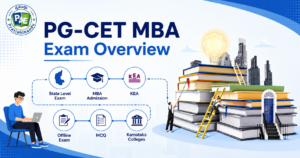
The Karnataka Post Graduate Common Entrance Test (PGCET) MBA is a state-level entrance examination conducted for graduates seeking admission to Master of Business Administration (MBA) programmes offered by participating colleges and universities across Karnataka. The examination is conducted by the Karnataka Examinations Authority (KEA) as part of the admission process for postgraduate professional courses.
The primary objective of the examination is to assess candidates’ aptitude, analytical ability, logical reasoning, quantitative skills, English language proficiency, and general awareness. Based on their performance in the entrance examination and the subsequent counselling process, eligible candidates can secure admission to MBA programmes in various institutions across the state.
Unlike many national-level MBA entrance examinations, Karnataka PGCET MBA offers students an opportunity to pursue quality management education within Karnataka through a transparent and merit-based admission process. Because of its affordability and wide acceptance among colleges, it remains one of the most preferred MBA entrance examinations for graduates in the state.
Students preparing through PG-CET MBA Coaching in Bangalore generally benefit from structured classroom sessions, regular assessments, experienced mentors, and systematic study plans that help them cover the entire syllabus efficiently while improving their examination skills.
Why Should You Choose Karnataka PGCET MBA?
Karnataka PGCET MBA has become one of the preferred entrance examinations for students who wish to pursue management education without the high costs often associated with private admissions. The examination provides access to several recognised institutions that offer quality MBA programmes across different specialisations.
Some of the major advantages of appearing for Karnataka PGCET MBA include:
- Opportunity to pursue an MBA from recognised institutions across Karnataka.
- Admission through a transparent and merit-based counselling process.
- Comparatively affordable tuition fees in many participating colleges.
- Multiple MBA specialisations, including Finance, Marketing, Human Resource Management, Operations, Business Analytics, and Entrepreneurship.
- Better career opportunities in corporate organisations, start-ups, government sectors, banking, consulting, and multinational companies.
- Suitable for fresh graduates as well as working professionals who wish to enhance their managerial skills.
With proper planning and consistent preparation, candidates can improve their performance and maximise their chances of securing admission to a college that matches their academic and career aspirations.
Objectives of Karnataka PGCET MBA
The Karnataka PGCET MBA examination is designed to identify candidates who possess the aptitude and analytical abilities required for postgraduate management education. Rather than testing only academic knowledge, the examination evaluates a combination of reasoning, numerical ability, communication skills, and decision-making potential.
The major objectives of the examination include:
- Providing a common entrance examination for MBA admissions across Karnataka.
- Assessing candidates’ aptitude for management education.
- Ensuring a fair, transparent, and merit-based admission process.
- Offering equal opportunities to graduates from different academic disciplines.
- Selecting candidates who demonstrate strong analytical and problem-solving abilities.
- Supporting institutions in admitting students capable of succeeding in management programmes.
Understanding these objectives helps aspirants prepare with the right mindset instead of focusing only on memorising concepts.
PG-CET MBA 2027 Exam Highlights
| Particular | Details |
| Examination Name | Karnataka PGCET MBA |
| Examination Level | State-Level Entrance Examination |
| Conducting Authority | Karnataka Examinations Authority (KEA) |
| Course Offered | Master of Business Administration (MBA) |
| Mode of Examination | Offline (Pen-and-Paper Based) |
| Question Type | Multiple Choice Questions (MCQs) |
| Medium of Examination | English |
| Admission Process | Entrance Examination followed by Counselling |
| Participating Institutions | Government, University, Aided, and Private MBA Colleges in Karnataka |
The official examination schedule, application dates, and counselling process are announced through the official notification each admission cycle. Candidates should regularly check official updates while planning their preparation.
PG-CET MBA Eligibility Criteria
Before beginning your preparation, it is important to understand the eligibility requirements for the Karnataka PGCET MBA examination. Meeting the prescribed eligibility conditions is essential for participating in the admission process.
Educational Qualification
Applicants should possess a recognised bachelor’s degree from a recognised university or institution. Graduates from Commerce, Science, Engineering, Arts, Management, Pharmacy, Architecture, Agriculture, and other recognised disciplines are generally eligible to apply, subject to the latest admission guidelines.
Final-Year Students
Candidates who are currently studying in the final year of their undergraduate programme may also apply, provided they complete their qualifying degree within the timeline specified during the admission process.
Minimum Qualifying Marks
The minimum qualifying marks required for eligibility may vary depending on the candidate’s category and the prevailing admission regulations. Aspirants should verify the latest eligibility conditions before submitting their application.
Reservation Policy
Reservation benefits are available according to the rules prescribed by the Government of Karnataka. Candidates claiming reservation should ensure they possess the necessary certificates and supporting documents during the counselling and admission process.
Who Can Apply?
The Karnataka PGCET MBA examination is suitable for:
- Final-year undergraduate students planning to pursue an MBA.
- Graduates seeking higher education in management.
- Working professionals aiming to improve career prospects.
- Entrepreneurs looking to strengthen business management skills.
- Candidates preparing for managerial and leadership roles across various industries.
Why Start Preparing Early?
Many aspirants postpone their preparation until the examination notification is released. However, management entrance examinations reward candidates who prepare consistently over several months rather than relying on last-minute study.
Starting your preparation early provides several advantages:
- Sufficient time to complete the entire syllabus.
- Better conceptual understanding of every subject.
- Regular practice through sectional and full-length mock tests.
- Time to identify and improve weak areas.
- Reduced examination stress during the final weeks.
- Improved speed and accuracy through continuous revision.
Students enrolled in PG-CET MBA Coaching in Bangalore often follow structured study plans that divide the syllabus into manageable sections. This systematic approach helps candidates maintain consistency, monitor progress, and prepare with greater confidence throughout their preparation journey.
PG-CET MBA 2027 Exam Pattern
Understanding the examination pattern is one of the most important steps in preparing for the Karnataka PGCET MBA examination. Before starting the syllabus, every aspirant should know how the paper is structured, how many questions are asked, the marking scheme, and how much time is available to complete the examination.
A clear understanding of the exam pattern helps students prepare strategically instead of studying randomly. Candidates preparing through PG-CET MBA Coaching in Bangalore generally begin with the examination pattern because it allows them to prioritise subjects and develop an effective preparation plan.
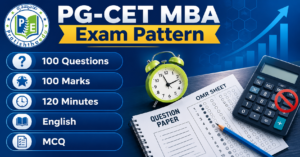
The Karnataka PGCET MBA examination is conducted in offline mode and consists of multiple-choice questions (MCQs). The paper assesses candidates’ aptitude in English language, quantitative analysis, reasoning, general knowledge, and, in some recent years, computer awareness is also reflected in the syllabus framework. Aspirants should always verify the latest official notification for the applicable pattern of their examination year.
PG-CET MBA 2027 Exam Pattern Overview
| Particular | Details |
| Examination Mode | Offline (Pen and Paper Based) |
| Question Type | Multiple Choice Questions (MCQs) |
| Total Questions | 100 |
| Total Marks | 100 |
| Duration | 120 Minutes |
| Medium | English |
| Marking Scheme | 1 Mark for Every Correct Answer |
| Negative Marking | No Negative Marking |
The absence of negative marking allows candidates to attempt every question. However, intelligent guessing should only be used after eliminating incorrect options.
Section-wise Exam Pattern
The examination evaluates different skills required for management education. Students should prepare each section systematically instead of concentrating only on one subject.
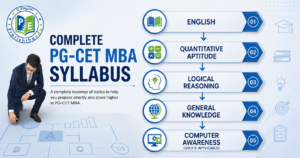
| Section | Skills Tested |
| English Language | Vocabulary, Grammar, Reading Ability |
| Quantitative Analysis | Numerical Ability, Mathematics |
| Logical Reasoning & General Intelligence | Analytical Thinking, Logical Ability |
| General Knowledge | Current Affairs & Static GK |
| Computer Awareness* | Basic Computer Knowledge (refer to latest official notification) |
Since every section contributes to the overall score, balanced preparation is essential. Ignoring any section may reduce the overall rank even if performance in other sections is good.
Complete PG-CET MBA Syllabus
The Karnataka PGCET MBA syllabus is designed to evaluate a candidate’s aptitude rather than academic specialisation. Students from engineering, commerce, science, arts, pharmacy, and other educational backgrounds appear for the same examination.
A systematic understanding of the syllabus helps candidates divide their preparation into smaller and manageable portions. Students attending PG-CET MBA Coaching in Bangalore usually follow a subject-wise preparation strategy that ensures complete syllabus coverage before revision begins.
English Language
The English Language section evaluates communication skills, vocabulary, grammar, and comprehension ability. Since English is widely used in management education and the corporate world, candidates should develop a strong foundation in language skills.
Important topics include:
- Reading Comprehension
- Vocabulary
- Synonyms
- Antonyms
- One Word Substitution
- Idioms and Phrases
- Sentence Improvement
- Sentence Correction
- Error Detection
- Fill in the Blanks
- Para Jumbles
- Cloze Test
- Active and Passive Voice
- Direct and Indirect Speech
- Grammar Rules
- Articles
- Prepositions
- Conjunctions
- Tenses
Preparation Tips
- Read newspapers regularly.
- Learn 10–15 new words every day.
- Practise grammar exercises daily.
- Solve comprehension passages within a fixed time.
- Revise vocabulary weekly.
Quantitative Analysis
Quantitative Analysis tests mathematical aptitude and numerical problem-solving skills. Most questions are based on school-level mathematics but require speed and accuracy.
Important topics include:
- Number System
- Percentage
- Profit and Loss
- Ratio and Proportion
- Average
- Time and Work
- Time, Speed and Distance
- Simple Interest
- Compound Interest
- Partnership
- Mixture and Alligation
- Pipes and Cisterns
- Permutation and Combination
- Probability
- Data Interpretation
- Data Sufficiency
- Simplification
- Quadratic Equations
- Algebra
- Geometry
- Mensuration
Preparation Tips
- Memorise important formulas.
- Solve calculations without a calculator.
- Practise previous questions daily.
- Focus on accuracy before increasing speed.
Logical Reasoning and General Intelligence
This section measures analytical thinking and decision-making ability. Regular practice is the most effective way to improve performance.
Important topics include:
- Blood Relations
- Coding-Decoding
- Direction Sense
- Seating Arrangement
- Puzzles
- Statement and Conclusion
- Statement and Assumption
- Cause and Effect
- Syllogism
- Analogy
- Classification
- Series Completion
- Ranking
- Alphabet Test
- Clock Problems
- Calendar Problems
- Data Sufficiency
- Logical Sequence
- Verbal Reasoning
- Non-Verbal Reasoning
Preparation Tips
- Practise puzzles daily.
- Solve reasoning questions with a timer.
- Learn shortcut approaches.
- Analyse mistakes after every mock test.
General Knowledge
General Knowledge is one of the scoring sections for candidates who remain updated with current events and static facts.
Important topics include:
- National Current Affairs
- International Current Affairs
- Economy
- Indian Constitution
- Indian Polity
- Geography
- History
- Science and Technology
- Sports
- Awards and Honours
- Books and Authors
- Important Days
- Government Schemes
- Budget
- Business News
- Banking Awareness
- Famous Personalities
Preparation Tips
- Read newspapers daily.
- Revise monthly current affairs.
- Follow business and economic news.
- Solve GK quizzes regularly.
Computer Awareness
Recent exam resources also include Computer Awareness as an important area for MBA aspirants. Candidates should check the latest official notification applicable to their admission cycle.
Important topics include:
- Computer Fundamentals
- Input and Output Devices
- MS Office
- Internet Basics
- Networking
- Operating Systems
- Computer Hardware
- Computer Software
- Database Basics
- Cyber Security
- Cloud Computing
- Digital Banking
- Information Technology Basics
Subject-wise Preparation Strategy
Instead of studying all subjects together, divide your weekly schedule according to subject difficulty.
| Subject | Daily Study Time |
| Quantitative Analysis | 2 Hours |
| Logical Reasoning | 1.5 Hours |
| English Language | 1 Hour |
| General Knowledge | 45 Minutes |
| Computer Awareness | 30 Minutes |
| Revision | 1 Hour |
Following this routine consistently over several months helps complete the syllabus comfortably while leaving enough time for revision and mock tests.
Subject-wise Weightage (Approximate)
Although the exact distribution may vary depending on the examination year, candidates should give equal importance to every subject because the examination is designed to assess overall aptitude.
| Subject | Preparation Priority |
| Quantitative Analysis | Very High |
| Logical Reasoning & General Intelligence | Very High |
| English Language | High |
| General Knowledge | High |
| Computer Awareness | Moderate to High |
Students preparing through PG-CET MBA Coaching in Bangalore should avoid focusing only on mathematics or reasoning. Consistent preparation across all sections generally leads to better overall performance and improves the chances of securing a competitive rank.
Best Books for PG-CET MBA 2027 Preparation

Choosing the right study material is just as important as following a disciplined study schedule. Many aspirants purchase several books but are unable to complete even half of them before the examination. Instead of referring to multiple resources for the same topic, candidates should select a few reliable books and revise them repeatedly.
Students preparing through PG-CET MBA Coaching in Bangalore often receive structured study materials that cover the complete syllabus. However, referring to standard aptitude books can further strengthen conceptual understanding and improve problem-solving ability.
The ideal preparation strategy is to combine coaching notes, standard reference books, previous year question papers, and regular mock tests.
Recommended Books for PG-CET MBA Preparation
| Subject | Recommended Book | Author/Publisher | Purpose |
| Quantitative Aptitude | Quantitative Aptitude for Competitive Examinations | R.S. Aggarwal | Build numerical concepts and improve calculation speed |
| Quantitative Aptitude | Quantitative Aptitude for CAT | Arun Sharma | Advanced practice and shortcut techniques |
| Logical Reasoning | A Modern Approach to Logical Reasoning | R.S. Aggarwal | Improve logical thinking and reasoning skills |
| Logical Reasoning | How to Prepare for Logical Reasoning | Arun Sharma | Higher-level reasoning practice |
| English Language | Objective General English | S.P. Bakshi | Grammar, vocabulary and comprehension |
| Vocabulary | Word Power Made Easy | Norman Lewis | Improve vocabulary systematically |
| General Knowledge | Manorama Yearbook | Malayala Manorama | Static General Knowledge |
| Current Affairs | Monthly Current Affairs Magazine | Various Publications | National and international current affairs |
Rather than completing every chapter from every book, focus on the topics mentioned in the syllabus and revise them multiple times.
How to Choose the Right Study Material
A common mistake made by aspirants is collecting too many books and online resources. This often creates confusion and wastes valuable preparation time.
While preparing for the examination, keep the following points in mind:
- Use one standard book for each subject.
- Complete one book before starting another.
- Avoid changing study material frequently.
- Revise important formulas and concepts regularly.
- Solve practice questions after every chapter.
- Maintain separate notes for difficult topics.
- Focus on understanding concepts instead of memorising solutions.
Students enrolled in PG-CET MBA Coaching in Bangalore should make full use of classroom notes and practice assignments before purchasing additional books.
Six-Month Preparation Strategy for PG-CET MBA 2027
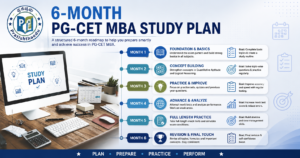
Preparing over six months allows candidates to complete the syllabus comfortably, revise multiple times, and improve examination confidence through continuous practice.
The following study plan is suitable for beginners as well as students balancing college or work with preparation.
Month 1 – Build Strong Fundamentals
The first month should focus on understanding the syllabus and strengthening basic concepts.
Objectives
- Understand the complete syllabus.
- Learn the examination pattern.
- Build mathematics fundamentals.
- Improve English grammar.
- Start reasoning practice.
- Read current affairs daily.
Weekly Targets
- Study Quantitative Aptitude for two hours daily.
- Practise reasoning for one hour daily.
- Read English editorials for thirty minutes.
- Learn ten new vocabulary words every day.
- Solve one sectional test every weekend.
By the end of the first month, candidates should have a clear understanding of the examination structure and their strengths and weaknesses.
Month 2 – Complete Core Topics
During the second month, students should begin covering the major topics from every subject.
Focus Areas
- Percentage
- Profit and Loss
- Ratio and Proportion
- Time and Work
- Reading Comprehension
- Seating Arrangement
- Coding-Decoding
- Blood Relations
- Current Affairs
Weekly Goals
- Complete at least three quantitative chapters.
- Solve reasoning practice questions daily.
- Revise grammar rules.
- Attempt one full-length mock test every two weeks.
At this stage, accuracy should be given more importance than speed.
Month 3 – Strengthen Concepts Through Practice
The third month should focus on solving a large number of practice questions.
Students should gradually increase their daily question-solving capacity.
Weekly Plan
- Quantitative Aptitude – 150 to 200 questions
- Logical Reasoning – 150 questions
- English – 80 to 100 questions
- General Knowledge – Daily revision
- Computer Awareness – Basic concepts and MCQs
Candidates should also begin maintaining an error notebook to record frequently repeated mistakes.
Month 4 – Mock Tests and Performance Analysis
By the fourth month, most of the syllabus should be completed.
The focus should now shift towards improving examination performance.
Activities
- Attempt one full-length mock test every week.
- Analyse every incorrect answer.
- Revise weak topics.
- Improve speed without compromising accuracy.
- Practise time-bound sectional tests.
Many students attend PG-CET MBA Coaching in Bangalore specifically during this phase because regular mock tests and faculty feedback help identify areas that need improvement.
Month 5 – Intensive Revision
The fifth month should be dedicated to revision and continuous practice.
Revision Strategy
- Revise quantitative formulas.
- Practise reasoning puzzles daily.
- Read current affairs every morning.
- Revise grammar concepts.
- Solve previous year questions.
Candidates should increase the frequency of mock tests to two per week and analyse each test carefully.
Month 6 – Final Examination Preparation
The final month should focus entirely on revision, confidence building, and examination readiness.
Avoid starting completely new topics during this stage unless they are very small and easy to understand.
Final Month Checklist
- Revise complete notes.
- Solve previous year papers.
- Attempt two to three mock tests every week.
- Revise vocabulary.
- Practise mental calculations.
- Focus on weak areas.
- Improve time management.
The objective of the last month is to maximise accuracy and minimise careless mistakes.
Weekly Study Plan
Following a consistent weekly routine helps candidates cover the syllabus efficiently.
| Day | Primary Focus |
| Monday | Quantitative Aptitude + English |
| Tuesday | Logical Reasoning + General Knowledge |
| Wednesday | Quantitative Aptitude + Computer Awareness |
| Thursday | English + Reasoning |
| Friday | Quantitative Aptitude + Current Affairs |
| Saturday | Full Revision + Sectional Test |
| Sunday | Full-Length Mock Test + Performance Analysis |
This routine provides balanced coverage of every subject while ensuring enough time for revision.
Daily Study Plan for PG-CET MBA Preparation
Students often ask how many hours they should study each day. The answer depends on their academic background, available time, and preparation level. However, consistency is more important than studying for very long hours occasionally.
A balanced daily schedule may look like this:
| Time | Activity |
| 6:30 AM – 7:00 AM | Read Current Affairs |
| 7:00 AM – 8:30 AM | Quantitative Aptitude |
| 10:00 AM – 11:00 AM | English Language |
| 2:00 PM – 3:30 PM | Logical Reasoning |
| 5:00 PM – 5:45 PM | General Knowledge / Computer Awareness |
| 8:00 PM – 9:00 PM | Revision of Topics Studied |
| 9:00 PM – 9:30 PM | Practice MCQs and Error Analysis |
Candidates enrolled in PG-CET MBA Coaching in Bangalore can adjust this timetable according to their class timings while ensuring that self-study and revision remain a regular part of their daily routine.
Tips to Complete the Entire Syllabus on Time
Many students struggle because they keep postponing difficult subjects. A disciplined approach can help complete the syllabus well before the examination.
Follow these practical tips:
- Divide the syllabus into weekly goals.
- Complete one topic before starting another.
- Revise every Sunday.
- Solve topic-wise MCQs after every chapter.
- Keep a notebook of important formulas and shortcuts.
- Analyse mistakes instead of repeating them.
- Avoid spending too much time on a single difficult question.
- Maintain consistency rather than studying irregularly.
- Track your progress every week.
- Reserve the final month exclusively for revision and mock tests.
Candidates who prepare consistently and revise regularly are generally better equipped to perform confidently in the examination than those who rely on last-minute preparation.
Mock Test Strategy for PG-CET MBA 2027
Mock tests are one of the most effective tools for improving your performance in the Karnataka PGCET MBA examination. They not only help you assess your preparation level but also familiarise you with the actual examination environment. Many students complete the syllabus but fail to score well because they do not practise enough full-length mock tests.
Students preparing through PG-CET MBA Coaching in Bangalore generally receive regular mock tests as part of their preparation programme. These tests help them understand their strengths, identify weak areas, and improve their speed and accuracy before the actual examination.
Rather than attempting mock tests only during the final weeks, candidates should gradually include them in their study schedule after completing the basic concepts of every subject.
Why Are Mock Tests Important?
Mock tests provide much more than a score. They help candidates evaluate their overall preparation and improve their examination strategy.
Some major benefits include:
- Improve speed and accuracy.
- Build confidence before the examination.
- Identify weak subjects and topics.
- Improve time management.
- Reduce examination anxiety.
- Develop the habit of solving questions under time pressure.
- Enhance decision-making skills while choosing questions.
Students who analyse every mock test carefully usually perform better than those who simply attempt tests without reviewing their mistakes.
When Should You Start Taking Mock Tests?
The timing of mock tests plays an important role in preparation.
During the First Two Months
- Focus on understanding concepts.
- Attempt sectional tests after completing every topic.
- Do not worry too much about scores.
During the Third and Fourth Months
- Start taking one full-length mock test every week.
- Analyse every incorrect answer.
- Identify repeated mistakes.
During the Final Two Months
- Increase the frequency to two or three full-length mock tests every week.
- Simulate actual examination conditions.
- Improve speed without compromising accuracy.
Candidates attending PG-CET MBA Coaching in Bangalore often benefit from scheduled mock test series that provide regular performance reports and comparative analysis.
How to Analyse a Mock Test Effectively
Attempting a mock test alone is not enough. The real improvement comes from analysing your performance after every test.
Follow these steps:
Step 1: Calculate Your Accuracy
Find out how many questions you attempted correctly.
For example:
- Questions Attempted: 92
- Correct Answers: 80
- Incorrect Answers: 12
Analyse whether your mistakes were due to lack of knowledge, calculation errors, or poor time management.
Step 2: Identify Weak Subjects
Prepare a list of topics where you lost the most marks.
For example:
- Percentage
- Data Interpretation
- Reading Comprehension
- Seating Arrangement
Spend additional study time improving these areas.
Step 3: Review Every Incorrect Question
Never ignore incorrect answers.
Ask yourself:
- Did I misunderstand the concept?
- Was it a calculation mistake?
- Did I read the question incorrectly?
- Was I running out of time?
Understanding the reason behind every mistake helps prevent similar errors in future tests.
Step 4: Maintain an Error Notebook
One of the best habits of successful aspirants is maintaining an error notebook.
Include:
- Difficult formulas
- Frequently repeated mistakes
- Shortcut methods
- Vocabulary words
- Important reasoning tricks
- General Knowledge facts
Revise this notebook every week.
Previous Year Question Paper Strategy
Previous year question papers provide valuable insight into the examination pattern, difficulty level, and frequently asked topics. Solving them regularly helps candidates understand the type of questions likely to appear in the examination.
Benefits include:
- Understanding question trends.
- Identifying high-weightage topics.
- Improving confidence.
- Enhancing speed and accuracy.
- Learning effective problem-solving techniques.
Students preparing through PG-CET MBA Coaching in Bangalore are encouraged to solve previous year papers after completing each major section of the syllabus rather than waiting until the last month.
Last 30 Days Revision Strategy
The final month before the examination is crucial. This is not the time to begin multiple new topics. Instead, focus on revising what you have already studied and improving your examination performance.
A well-planned revision schedule can significantly improve confidence and reduce stress.
Week 1
Objectives
- Revise Quantitative Aptitude formulas.
- Revise English grammar rules.
- Practise Logical Reasoning questions.
- Read monthly current affairs.
- Attempt one full-length mock test.
Week 2
Objectives
- Revise Data Interpretation.
- Revise Reading Comprehension.
- Solve previous year papers.
- Improve weak topics identified during mock tests.
- Attempt two mock tests.
Week 3
Objectives
- Complete second revision of all subjects.
- Practise high-scoring topics.
- Revise vocabulary.
- Solve reasoning puzzles daily.
- Attempt two to three mock tests.
Week 4
Objectives
- Revise short notes.
- Review the error notebook.
- Solve one or two final mock tests.
- Avoid studying completely new concepts.
- Focus on confidence and accuracy.
By the end of the final week, your emphasis should be on staying calm and reinforcing concepts you already know.
Time Management Strategy During Preparation
Many aspirants study for long hours but fail to utilise their time efficiently. Effective time management helps complete the syllabus on schedule while leaving sufficient time for revision.
Follow these practical strategies:
- Prepare a realistic daily timetable.
- Divide study sessions into manageable blocks.
- Complete the most difficult subject during your most productive hours.
- Avoid distractions while studying.
- Take short breaks between sessions.
- Revise every day before starting new topics.
- Track weekly progress.
- Set achievable study goals.
Consistency is more valuable than studying for very long hours occasionally.
Time Management During the Examination
Managing time effectively during the examination is equally important.
Consider the following approach:
First 20 Minutes
- Attempt easy English and General Knowledge questions.
- Build confidence with quick answers.
Next 45 Minutes
- Solve Logical Reasoning questions.
- Avoid spending too much time on a single puzzle.
Next 40 Minutes
- Attempt Quantitative Aptitude questions.
- Focus on accuracy while maintaining speed.
Final 15 Minutes
- Review unanswered questions.
- Recheck calculations where necessary.
- Ensure every question has been attempted if appropriate.
Candidates following this structured approach often manage their time more effectively during the examination.
How to Improve Speed and Accuracy
Speed without accuracy can reduce your overall performance, while accuracy without speed may leave several questions unanswered. The key is to develop both simultaneously.
Practical ways to improve include:
- Solve questions using a timer.
- Learn shortcut calculation techniques.
- Revise formulas regularly.
- Practise mental mathematics.
- Read questions carefully before answering.
- Avoid unnecessary guesswork.
- Analyse mistakes after every practice session.
- Attempt sectional tests regularly.
Students enrolled in PG-CET MBA Coaching in Bangalore often improve these skills through continuous classroom practice, timed assignments, and faculty guidance.
Exam Day Preparation Tips
Proper preparation on the examination day can help you remain calm and perform confidently.
Follow these recommendations:
- Sleep well the night before the examination.
- Reach the examination centre well in advance.
- Carry all required documents.
- Read every instruction carefully.
- Begin with questions you find easier.
- Do not panic if you encounter difficult questions.
- Stay focused throughout the examination.
- Manage your time wisely.
- Avoid discussing difficult questions during the test.
- Maintain a positive and confident attitude until the examination ends.
Remember that every candidate faces a few challenging questions. What matters most is how effectively you manage your time and maintain composure under pressure.
Quick Revision Checklist Before the Examination
Before appearing for the Karnataka PGCET MBA examination, ensure that you have completed the following:
- Revised all important formulas.
- Solved multiple full-length mock tests.
- Practised previous year question papers.
- Revised grammar and vocabulary.
- Read recent current affairs.
- Reviewed the error notebook.
- Improved weak subjects.
- Prepared all required examination documents.
- Planned your examination-day strategy.
Following this checklist can help you enter the examination hall with confidence and a clear plan of action.
Common Mistakes to Avoid During PG-CET MBA Preparation
Many aspirants spend months preparing for the Karnataka PGCET MBA examination but fail to achieve their expected score because of avoidable mistakes. These mistakes often have a greater impact than the difficulty level of the examination itself. Understanding these common errors and correcting them early can significantly improve your overall performance.
Students preparing through PG-CET MBA Coaching in Bangalore often receive regular feedback from mentors, which helps them identify these mistakes before they become major obstacles.
Below are some of the most common preparation mistakes and practical ways to avoid them.
1. Starting Preparation Too Late
One of the biggest mistakes is waiting for the official examination notification before beginning preparation. The syllabus covers multiple subjects, and mastering each one requires time and consistent practice.
How to Avoid It
- Start your preparation at least six months before the examination.
- Prepare a monthly study plan.
- Set realistic weekly targets.
- Revise regularly instead of postponing revision.
2. Ignoring the Exam Pattern and Syllabus
Some students begin solving random aptitude questions without understanding what the examination actually tests. This often leads to unnecessary effort on less important topics.
How to Avoid It
- Understand the complete examination pattern before starting.
- Prepare according to the official syllabus.
- Prioritise frequently tested topics.
- Focus on concept-based learning.
3. Studying Without a Proper Plan
Random preparation usually results in incomplete syllabus coverage and poor revision.
How to Avoid It
- Prepare a daily timetable.
- Allocate time to every subject.
- Keep one day every week for revision.
- Track your progress regularly.
Students attending PG-CET MBA Coaching in Bangalore generally follow structured study schedules that help them maintain consistency throughout their preparation.
4. Ignoring Weak Subjects
Many candidates spend most of their time studying subjects they already enjoy while avoiding difficult topics.
For example:
- Good at English but avoiding Mathematics.
- Strong in Quantitative Aptitude but ignoring General Knowledge.
- Comfortable with Reasoning but skipping Reading Comprehension.
This imbalance can reduce the overall score.
How to Avoid It
- Identify weak subjects early.
- Spend additional time improving them.
- Practise topic-wise questions daily.
- Seek guidance whenever concepts are unclear.
5. Not Revising Regularly
Revision is one of the most important parts of preparation. Without regular revision, candidates often forget concepts they studied weeks earlier.
How to Avoid It
- Revise daily.
- Conduct weekly revision sessions.
- Prepare short notes.
- Maintain a formula notebook.
- Review important vocabulary regularly.
6. Taking Very Few Mock Tests
Many students complete the syllabus but attempt only one or two mock tests before the examination.
This limits their ability to manage time effectively during the actual examination.
How to Avoid It
- Attempt regular sectional tests.
- Take full-length mock tests every week.
- Analyse every test carefully.
- Improve speed and accuracy gradually.
7. Ignoring Previous Year Question Papers
Previous year papers help students understand the difficulty level and commonly asked topics.
Ignoring them means missing an important source of practice.
How to Avoid It
- Solve previous year papers after completing the syllabus.
- Analyse repeated question patterns.
- Revise important topics identified from previous papers.
8. Depending Only on Coaching
Coaching provides guidance, but classroom learning alone is not enough.
Success depends on consistent self-study and practice outside the classroom.
Students enrolled in PG-CET MBA Coaching in Bangalore should use classroom sessions as a foundation while dedicating sufficient time to independent study, revision, and mock tests.
9. Collecting Too Many Books
Buying multiple books for the same subject often creates confusion.
Better Approach
- Choose one standard book per subject.
- Complete it thoroughly.
- Revise multiple times.
- Practise additional MCQs only after mastering the basics.
10. Lack of Consistency
Studying for ten hours one day and skipping preparation for the next three days rarely produces good results.
Better Approach
Study consistently every day.
Even four to six focused hours daily are generally more effective than irregular long study sessions.
Preparation Tips for Final-Year Students
Final-year undergraduate students often need to balance college classes, semester examinations, projects, internships, and Karnataka PGCET MBA preparation simultaneously.
Managing these responsibilities requires careful planning.
Some practical suggestions include:
- Begin preparation early.
- Prepare a weekly study timetable.
- Use weekends for mock tests.
- Revise topics immediately after completing them.
- Read current affairs daily.
- Avoid postponing difficult subjects.
- Utilise travel time for vocabulary or current affairs revision.
- Maintain concise notes for quick revision.
Students planning are usually able to balance academics and entrance examination preparation more effectively.
Preparation Tips for Working Professionals
Working professionals often face additional challenges because of limited study time.
However, many candidates successfully clear the Karnataka PGCET MBA examination while working full-time.
Some useful strategies include:
- Study early in the morning or late in the evening.
- Allocate at least three to four focused study hours each day.
- Utilise weekends for longer study sessions.
- Listen to educational podcasts during travel.
- Solve one sectional test every week.
- Attempt regular mock tests.
- Revise daily instead of studying only on weekends.
- Maintain consistency throughout the preparation period.
Students seeking PG-CET MBA Coaching in Bangalore may benefit from classroom schedules or mentoring options that can be balanced with professional commitments.
Career Opportunities After MBA Through Karnataka PGCET
An MBA opens doors to a wide range of career opportunities across industries. Graduates develop skills in leadership, strategic thinking, communication, problem-solving, and decision-making, making them valuable in both the private and public sectors.
Some popular career options include:
- Marketing Manager
- Financial Analyst
- Human Resource Manager
- Operations Manager
- Business Development Executive
- Project Manager
- Product Manager
- Business Analyst
- Sales Manager
- Supply Chain Manager
- Banking Professional
- Consultant
- Entrepreneur
- Digital Marketing Manager
- Retail Manager
With experience, professionals may progress to senior management and leadership positions across various industries.

Popular MBA Specialisations
Students admitted through Karnataka PGCET MBA can generally choose from several management specialisations, depending on the college and programme offered.
Some of the most popular specialisations include:
- Marketing Management
- Finance Management
- Human Resource Management
- Business Analytics
- Operations Management
- International Business
- Supply Chain Management
- Retail Management
- Healthcare Management
- Information Technology Management
- Entrepreneurship
- Digital Marketing
Candidates should choose a specialisation based on their interests, strengths, and long-term career goals.
Essential Skills Every MBA Aspirant Should Develop
Success in management education depends not only on examination performance but also on professional skills.
Every MBA aspirant should focus on developing:
- Communication Skills
- Analytical Thinking
- Leadership Qualities
- Teamwork
- Decision-Making Ability
- Time Management
- Presentation Skills
- Problem-Solving Ability
- Business Awareness
- Adaptability
- Critical Thinking
- Interpersonal Skills
Developing these skills during the preparation phase can make the transition into an MBA programme smoother and contribute to long-term career success.
Why Many Students Prefer PG-CET MBA Coaching in Bangalore
Preparing independently is possible, but many aspirants choose PG-CET MBA Coaching in Bangalore because structured guidance can make preparation more organised and efficient.
A coaching programme typically offers:
- Experienced faculty with entrance exam expertise.
- Structured classroom sessions covering the complete syllabus.
- Comprehensive study materials.
- Topic-wise and full-length mock tests.
- Regular doubt-clearing sessions.
- Performance tracking and personalised feedback.
- Time management strategies.
- Continuous motivation and disciplined preparation.
When combined with dedicated self-study and consistent revision, coaching can help students strengthen concepts, improve examination temperament, and prepare with greater confidence.
Why Choose Pratishtha Edu for PG-CET MBA Coaching in Bangalore?

Choosing the right coaching institute can make a significant difference in your Karnataka PGCET MBA preparation. While dedication and self-study remain the foundation of success, expert guidance, a structured study plan, and continuous performance evaluation can help students prepare more efficiently and confidently.
Pratishtha Edu has been guiding students preparing for various competitive examinations through a systematic learning approach. For aspirants looking for PG-CET MBA Coaching in Bangalore, the institute focuses on building strong fundamentals, improving aptitude skills, and helping students develop effective examination strategies.
Rather than encouraging rote learning, the coaching programme emphasises conceptual understanding, regular practice, and consistent revision so that students are well-prepared for every section of the examination.
Experienced Faculty
Quality teaching plays an important role in competitive examination preparation. Experienced faculty members can simplify complex topics, explain shortcut techniques, and help students understand the most effective approach for solving different types of questions.
At Pratishtha Edu, students receive guidance from experienced mentors who focus on concept clarity while encouraging regular practice and continuous improvement.
The faculty also assists students in identifying their strengths and weak areas, enabling them to prepare more strategically.
Comprehensive Study Material
Well-designed study material saves valuable preparation time by covering the complete syllabus in a structured manner.
Students enrolled in PG-CET MBA Coaching in Bangalore at Pratishtha Edu receive study resources that are organised topic-wise and aligned with the examination pattern.
The study material focuses on:
- Complete syllabus coverage
- Concept-based learning
- Practice exercises
- Topic-wise multiple-choice questions
- Revision notes
- Important formulas and shortcut techniques
This allows students to revise efficiently without referring to multiple resources for the same topic.
Structured Classroom Programme
A disciplined classroom environment helps students maintain consistency throughout their preparation journey.
The coaching programme is designed to ensure that every subject is covered systematically, allowing sufficient time for revision and practice.
The classroom approach includes:
- Concept-based teaching
- Topic-wise explanations
- Regular classroom discussions
- Practice sessions after every major topic
- Weekly revision classes
- Interactive learning environment
Following a structured schedule helps students complete the syllabus on time without feeling overwhelmed.
Regular Mock Tests and Performance Analysis
Mock tests are an essential part of Karnataka PGCET MBA preparation. They help students evaluate their progress, improve time management, and become familiar with the examination pattern.
At Pratishtha Edu, students preparing for PG-CET MBA Coaching in Bangalore participate in regular mock tests that simulate the actual examination environment.
Performance analysis helps students:
- Identify weak subjects
- Improve speed and accuracy
- Reduce careless mistakes
- Build examination confidence
- Develop better time management strategies
Detailed feedback after every test allows students to understand where improvement is needed and how they can strengthen their preparation.
Personalised Doubt-Clearing Sessions
Every student learns at a different pace. Some concepts require additional explanation and practice before they become clear.
To support individual learning needs, Pratishtha Edu conducts regular doubt-clearing sessions where students can discuss difficult topics directly with faculty members.
These sessions help students:
- Clarify concepts immediately
- Avoid repeating mistakes
- Strengthen problem-solving techniques
- Build confidence before examinations
Prompt doubt resolution ensures that small learning gaps do not become major obstacles later in the preparation process.
Individual Performance Monitoring
Regular evaluation enables students to measure their progress objectively.
Instead of relying only on examination scores, Pratishtha Edu tracks performance through continuous assessments, classroom participation, practice tests, and mock examinations.
This approach helps students:
- Monitor improvement over time
- Focus on weaker subjects
- Adjust study strategies when necessary
- Stay motivated throughout preparation
Continuous performance tracking encourages disciplined preparation and helps students remain accountable to their study goals.
Focus on Conceptual Understanding
Competitive examinations are becoming increasingly application-oriented. Simply memorising formulas or shortcuts is rarely enough to achieve a competitive score.
The coaching methodology emphasises:
- Strong conceptual foundations
- Logical thinking
- Analytical reasoning
- Practical problem-solving
- Smart examination strategies
Developing these skills enables students to solve unfamiliar questions with greater confidence during the examination.
Balanced Approach to Coaching and Self-Study
Successful preparation requires a balance between classroom learning and independent practice.
Students are encouraged to:
- Revise classroom topics daily.
- Complete practice assignments on time.
- Attempt sectional tests regularly.
- Analyse mistakes after every mock test.
- Maintain concise revision notes.
- Practise previous year questions consistently.
This balanced approach helps reinforce classroom learning and ensures long-term retention of concepts.
Supportive Learning Environment
A positive learning environment motivates students to remain consistent and focused throughout their preparation.
Studying alongside like-minded aspirants encourages healthy competition and creates opportunities to exchange ideas, discuss problem-solving methods, and stay motivated during the preparation journey.
Regular interaction with faculty and peers also helps students maintain confidence and overcome examination-related stress.
Key Benefits of Joining PG-CET MBA Coaching in Bangalore at Pratishtha Edu
Students preparing at Pratishtha Edu benefit from:
- Experienced and supportive faculty
- Structured classroom learning
- Comprehensive study materials
- Topic-wise practice sessions
- Regular mock tests
- Detailed performance analysis
- Personalised mentoring
- Doubt-clearing sessions
- Revision programmes
- Examination-oriented preparation strategy
- Disciplined learning environment
- Continuous academic support
By combining these resources with dedicated self-study, students can prepare more effectively for the Karnataka PGCET MBA examination.
Frequently Asked Questions (FAQs)
1. What is the Karnataka PGCET MBA examination?
The Karnataka PGCET MBA is a state-level entrance examination conducted for admission to MBA programmes offered by participating colleges and universities in Karnataka.
2. Who can apply for the Karnataka PGCET MBA examination?
Candidates who have completed or are pursuing the final year of a recognised bachelor’s degree and satisfy the prescribed eligibility requirements may apply according to the latest admission guidelines.
3. Is coaching necessary for Karnataka PGCET MBA preparation?
Coaching is not compulsory. However, many students prefer PG-CET MBA Coaching in Bangalore because structured guidance, regular mock tests, and expert mentoring can help them prepare more systematically.
4. How many months are sufficient for preparation?
A preparation period of approximately six months is generally considered adequate for candidates who study consistently and follow a structured study plan.
5. Which subjects should I focus on the most?
Candidates should prepare every section of the examination. Quantitative Aptitude, Logical Reasoning, English Language, and General Knowledge require balanced preparation to achieve a competitive score.
6. How many mock tests should I attempt?
After completing the basic syllabus, students should attempt regular sectional tests and full-length mock tests. During the final two months, attempting two to three mock tests per week can be beneficial.
7. Can working professionals prepare for Karnataka PGCET MBA?
Yes. With a well-planned timetable and consistent daily study, working professionals can successfully prepare while managing their professional responsibilities.
- Are previous year question papers useful?
Yes. Previous year papers help candidates understand the examination pattern, identify important topics, and improve confidence before the examination.
9. What is the best way to improve accuracy?
Regular practice, careful analysis of mock tests, revision of concepts, and solving timed practice questions can gradually improve both accuracy and speed.
10. Why should I choose Pratishtha Edu for PG-CET MBA Coaching in Bangalore?
Pratishtha Edu provides experienced faculty, structured classroom programmes, comprehensive study material, regular mock tests, performance analysis, personalised mentoring, and a supportive learning environment to help aspirants prepare effectively for the Karnataka PGCET MBA examination.
Conclusion
The Karnataka PGCET MBA examination offers graduates an excellent opportunity to pursue management education and build a successful career in business, finance, marketing, human resources, operations, consulting, and many other fields. Achieving a competitive score requires a combination of clear concepts, disciplined preparation, consistent revision, regular mock tests, and effective time management.
A well-planned study strategy, supported by reliable study materials and continuous practice, can significantly improve your performance. Candidates should begin preparation early, systematically complete the syllabus, analyse their mistakes, and revise regularly to build confidence before the examination.
For students seeking PG-CET MBA Coaching in Bangalore, structured guidance can complement self-study by offering expert mentoring, organised classroom learning, and continuous performance evaluation. With determination, consistency, and the right preparation strategy, you can maximise your chances of securing admission to a reputed MBA college in Karnataka and take a confident step towards your future management career.
Your MBA journey begins with disciplined preparation. Start early, stay consistent, believe in your abilities, and work towards achieving your goal with confidence.
Leave a Reply