Introduction
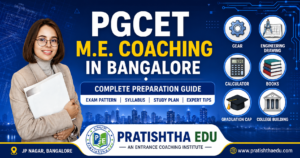
PGCET ME Coaching in Bangalore is the ideal choice for engineering graduates preparing for the Karnataka PGCET examination. Pratishtha Edu in JP Nagar, Bangalore provides expert faculty, structured classroom coaching, comprehensive study material, regular mock tests, and personalized mentorship to help students secure admission to top M.E./M.Tech colleges in Karnataka. Whether you are targeting admission to leading engineering colleges or aiming for a high PGCET rank, our result-oriented coaching program helps you prepare with confidence through expert guidance and systematic learning.
Pursuing a Master of Engineering (M.E.) or Master of Technology (M.Tech) is an excellent way for engineering graduates to strengthen their technical knowledge, specialise in their chosen discipline, and improve career opportunities in both industry and academia. In Karnataka, admission to many government, aided, and private engineering colleges offering postgraduate engineering programmes is conducted through the Karnataka Post Graduate Common Entrance Test (PGCET). Every year, thousands of engineering graduates appear for this examination to secure admission to reputed institutions across the state.
The Karnataka PGCET Engineering examination evaluates candidates on the core subjects of their engineering discipline. Since the competition for admission to top colleges is increasing every year, aspirants need a well-planned preparation strategy that combines conceptual learning, regular practice, revision, and effective time management. Understanding the examination pattern, syllabus, marking scheme, and previous years’ question trends can significantly improve preparation.
Although many students prepare independently, others prefer guided learning to maintain consistency and receive expert support throughout their preparation journey. PGCET MECoaching in Bangalore can provide structured classroom sessions, topic-wise study plans, experienced faculty guidance, mock tests, and personalised mentoring to help students prepare systematically.
This comprehensive guide explains the Karnataka PGCET M.E. examination, eligibility, exam pattern, syllabus, preparation strategy, recommended books, common mistakes to avoid, and practical tips to improve performance. Whether you are a final-year engineering student or a graduate planning to pursue higher education, this guide will help you prepare with confidence and clarity.
Students preparing for postgraduate engineering admissions often look for PGCET ME Coaching in Bangalore to improve conceptual understanding, practise regularly, strengthen problem-solving skills, and develop effective examination strategies
What is Karnataka PGCET M.E.?
The Karnataka Post Graduate Common Entrance Test (PGCET) is a state-level entrance examination conducted by the Karnataka Examinations Authority (KEA) for admission to various postgraduate professional courses in Karnataka. For engineering graduates, the examination serves as a gateway to Master of Engineering (M.E.) and Master of Technology (M.Tech) programmes offered by participating institutions.
The examination is designed to assess a candidate’s understanding of the core subjects studied during the undergraduate engineering programme. Questions are generally based on the candidate’s chosen engineering branch, making conceptual clarity and subject knowledge essential for achieving a competitive score.
Candidates who qualify in Karnataka PGCET can seek admission to numerous engineering colleges affiliated with recognised universities across Karnataka, subject to eligibility criteria, seat availability, reservation policies, and the counselling process conducted by KEA.
Students preparing through PGCET ME Coaching in Bangalore often follow a structured study plan that includes syllabus completion, topic-wise practice, mock examinations, and continuous performance evaluation.
Why is Karnataka PGCET Important?
The Karnataka PGCET examination plays a significant role for engineering graduates who wish to continue their education through postgraduate programmes. A good score can open opportunities for specialised technical education and enhance long-term career prospects.
Admission to M.E. and M.Tech Programmes
One of the primary objectives of Karnataka PGCET is to facilitate admission to postgraduate engineering courses offered by participating institutions in Karnataka. Candidates can pursue specialisations in disciplines such as Civil Engineering, Mechanical Engineering, Computer Science, Electronics and Communication, Electrical Engineering, Information Science, Biotechnology, and several other branches.
Opportunity to Study in Reputed Institutions
Many engineering colleges in Karnataka participate in the PGCET counselling process. Securing a competitive rank can increase the chances of obtaining admission to reputed institutions offering quality postgraduate engineering education.
Better Career Opportunities
Completing an M.E. or M.Tech degree enables students to develop advanced technical knowledge and specialised skills relevant to their chosen field. These qualifications can support career growth in engineering industries, research organisations, public sector enterprises, consulting firms, and technology-driven companies.
Higher Education and Research
Postgraduate engineering programmes also prepare students for research-oriented careers. After completing an M.E. or M.Tech degree, candidates may pursue doctoral studies (Ph.D.), contribute to research projects, or explore academic positions in higher education institutions.
Improved Professional Growth
A postgraduate engineering qualification often enhances technical expertise, analytical thinking, and problem-solving abilities. Depending on the industry, organisation, and role, these skills may contribute to broader career opportunities and long-term professional development.
Career Opportunities After M.E./M.Tech
Completing a postgraduate engineering degree opens diverse career paths across technical, managerial, and research domains.
Some popular career options include:
- Design Engineer
- Research and Development Engineer
- Project Engineer
- Structural Engineer
- Software Engineer
- Embedded Systems Engineer
- Data Engineer
- Manufacturing Engineer
- Quality Assurance Engineer
- Production Engineer
- CAD/CAM Specialist
- Technical Consultant
- Assistant Professor (subject to applicable qualifications and regulations)
- Research Associate
- Ph.D. Scholar
- Public Sector Engineering Roles (subject to recruitment criteria)
The exact career opportunities depend on the engineering specialisation, individual skills, industry demand, and recruitment requirements.
Students preparing through PGCET ME Coaching in Bangalore often seek guidance not only for the entrance examination but also for selecting suitable specialisations aligned with their long-term career goals.
Karnataka PGCET M.E. Exam Highlights
| Particular | Details |
| Examination Name | Karnataka Post Graduate Common Entrance Test (PGCET) |
| Course | M.E. / M.Tech |
| Conducting Authority | Karnataka Examinations Authority (KEA) |
| Examination Level | State Level |
| Mode of Examination | Offline (OMR-based) (subject to official notification) |
| Question Type | Multiple Choice Questions (MCQs) |
| Duration | As per the latest KEA notification |
| Medium | English |
| Admission Process | Entrance Examination + KEA Counselling |
| Participating Institutes | Government, Aided, and Private Engineering Colleges in Karnataka |
Since examination dates, eligibility criteria, paper pattern, and counselling schedules may change, candidates should regularly refer to the official KEA website for the latest notifications and updates.
Karnataka PGCET M.E. Exam Pattern
Understanding the examination pattern is one of the first steps towards effective preparation. Before beginning topic-wise study, candidates should understand the paper structure, question format, duration, and marking scheme. This helps aspirants create a realistic preparation strategy and improve time management during the examination.
Students preparing through PGCET ME Coaching in Bangalore are usually introduced to the latest examination pattern during the initial stages of classroom training so that they can prepare in a structured manner.
The Karnataka PGCET Engineering examination generally consists of objective-type multiple-choice questions (MCQs) based on the candidate’s undergraduate engineering discipline.
Karnataka PGCET M.E. Exam Pattern Overview
| Particular | Details |
| Examination Mode | Offline (OMR-based)* |
| Question Type | Multiple Choice Questions (MCQs) |
| Medium | English |
| Duration | As per the latest KEA notification |
| Total Questions | As notified by KEA |
| Subjects | Based on the candidate’s engineering branch |
| Answering Method | OMR Answer Sheet |
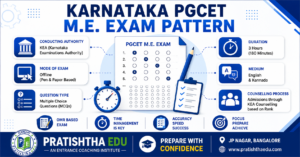
Note: Candidates should always verify the latest examination pattern in the official KEA notification because the authority may revise the examination format, duration, or instructions.
Karnataka PGCET M.E. Marking Scheme
A clear understanding of the marking scheme helps students attempt the examination more confidently.
Although candidates should always refer to the latest official notification, the examination generally follows an objective-type evaluation process where each question carries equal weight.
Students should:
- Read every question carefully.
- Avoid filling incorrect responses on the OMR sheet.
- Practise OMR-based mock tests.
- Improve accuracy before increasing speed.
- Develop effective question-selection strategies.
Students enrolled in PGCET ME Coaching in Bangalore often practise through OMR-based mock examinations that simulate the actual examination environment.
Complete Karnataka PGCET M.E. Syllabus
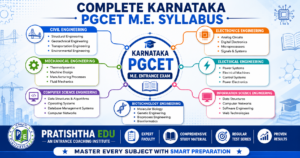
The Karnataka PGCET Engineering syllabus is primarily based on the undergraduate engineering curriculum of the respective branch. Therefore, candidates should prepare the core technical subjects studied during their B.E. or B.Tech programme.
While the exact syllabus differs across engineering branches, most candidates are expected to have a strong understanding of the fundamental concepts related to their chosen discipline.
Civil Engineering Syllabus
Major topics include:
- Engineering Mathematics
- Strength of Materials
- Structural Analysis
- Reinforced Cement Concrete (RCC)
- Steel Structures
- Geotechnical Engineering
- Surveying
- Fluid Mechanics
- Hydraulics
- Water Resources Engineering
- Environmental Engineering
- Transportation Engineering
- Construction Management
- Concrete Technology
Mechanical Engineering Syllabus
Major topics include:
- Engineering Mathematics
- Engineering Mechanics
- Strength of Materials
- Theory of Machines
- Machine Design
- Fluid Mechanics
- Thermodynamics
- Heat Transfer
- Manufacturing Processes
- Production Engineering
- Industrial Engineering
- Refrigeration and Air Conditioning
- Automobile Engineering
Computer Science Engineering Syllabus
Important topics include:
- Programming and Data Structures
- Algorithms
- Database Management Systems
- Operating Systems
- Computer Networks
- Computer Organization
- Digital Electronics
- Software Engineering
- Compiler Design
- Theory of Computation
- Artificial Intelligence
- Web Technologies
Electronics and Communication Engineering Syllabus
Core subjects include:
- Electronic Devices
- Analog Circuits
- Digital Electronics
- Signals and Systems
- Network Analysis
- Control Systems
- Microprocessors
- Communication Systems
- Electromagnetic Theory
- VLSI Design
- Embedded Systems
Electrical and Electronics Engineering Syllabus
Important topics include:
- Electrical Machines
- Power Systems
- Power Electronics
- Control Systems
- Electrical Measurements
- Network Theory
- Analog Electronics
- Digital Electronics
- Electromagnetic Fields
- Utilisation of Electrical Energy
Information Science and Engineering Syllabus
Candidates should prepare:
- Programming Languages
- Data Structures
- Algorithms
- DBMS
- Computer Networks
- Operating Systems
- Software Engineering
- Cloud Computing
- Cyber Security
- Artificial Intelligence
Biotechnology Engineering Syllabus
Major topics include:
- Cell Biology
- Molecular Biology
- Biochemistry
- Genetics
- Microbiology
- Bioprocess Engineering
- Immunology
- Plant Biotechnology
- Animal Biotechnology
- Genetic Engineering
Subject-wise Preparation Strategy
Instead of studying randomly, candidates should divide the syllabus into manageable sections and prepare systematically.
A practical strategy includes:
- Complete one subject at a time.
- Revise important formulas weekly.
- Solve topic-wise MCQs.
- Maintain short revision notes.
- Attempt branch-specific mock tests.
- Analyse mistakes after every practice session.
Students attending PGCET ME Coaching in Bangalore usually receive a structured study plan that helps them complete the syllabus within the available preparation time.
Subject-wise Weightage Strategy
Since the official question distribution may vary, students should focus more on subjects that carry significant conceptual importance in their engineering discipline.
| Priority | Preparation Focus |
| High | Core Technical Subjects |
| High | Engineering Mathematics (where applicable) |
| Medium | Frequently Asked Topics |
| Medium | Numerical Problems |
| Medium | Concept-Based Questions |
| Revision | Previous Year Topics |
| Final Stage | Full-Length Mock Tests |
Rather than attempting to memorise every topic, candidates should aim to understand concepts thoroughly and solve a large number of practice questions.
Importance of Previous Year Question Papers
Previous years’ papers provide valuable insights into the examination pattern, question trends, frequently tested concepts, and overall difficulty level. Solving them under timed conditions helps candidates improve speed, accuracy, and confidence before the actual examination.
Students preparing through PGCET ME Coaching in Bangalore should include previous year question papers in their regular study schedule along with topic-wise practice and mock tests.
Tips for Completing the Syllabus on Time
Completing the syllabus requires proper planning and consistent effort. Some practical suggestions include:
- Prepare a monthly study plan.
- Divide subjects into weekly targets.
- Revise completed topics every weekend.
- Solve practice questions after every chapter.
- Avoid studying multiple difficult subjects on the same day.
- Attempt regular mock tests.
- Keep short notes for quick revision.
- Track daily progress.
A disciplined approach helps students finish the syllabus comfortably while leaving sufficient time for revision and mock examinations.
Best Books for Karnataka PGCET M.E. Preparation
Selecting the right study material is an important part of Karnataka PGCET preparation. Since the examination is based on the undergraduate engineering syllabus of the respective branch, candidates should primarily revise their B.E./B.Tech concepts before referring to multiple additional books.
Students preparing through PGCET ME Coaching in Bangalore are generally advised to use a limited number of high-quality resources and revise them multiple times instead of collecting numerous books. Consistent revision and practice are far more effective than studying from too many sources.
Apart from textbooks, aspirants should solve previous year question papers, topic-wise MCQs, and full-length mock tests to improve conceptual understanding and examination confidence.
Best Books for Civil Engineering
Recommended resources include:
- GATE Civil Engineering – Made Easy Publications
- Civil Engineering Objective by R. Agor
- Engineering Mathematics by B.S. Grewal
- Previous Year Civil Engineering Question Papers
- Standard undergraduate reference books
These books help strengthen both conceptual understanding and objective question-solving skills.
Best Books for Mechanical Engineering
Candidates preparing for Mechanical Engineering can refer to:
- GATE Mechanical Engineering – Made Easy Publications
- Mechanical Engineering Objective by R.K. Jain
- Engineering Mechanics by S.S. Bhavikatti
- Thermodynamics by P.K. Nag
- Previous Year Mechanical Engineering Papers
Best Books for Computer Science Engineering
Useful resources include:
- Objective Computer Science by R.S. Agarwal
- Operating Systems by Galvin
- Computer Networks by Andrew S. Tanenbaum
- Database System Concepts by Korth
- Data Structures and Algorithms by Narasimha Karumanchi
Best Books for Electronics & Communication Engineering
Recommended books include:
- Electronic Devices and Circuits by Boylestad
- Communication Systems by Simon Haykin
- Digital Electronics by Morris Mano
- Network Analysis by Van Valkenburg
- Signals and Systems by Oppenheim
Best Books for Electrical Engineering
Students may refer to:
- Electrical Machines by P.S. Bimbhra
- Power Systems by C.L. Wadhwa
- Control Systems by I.J. Nagrath
- Network Analysis by Van Valkenburg
- Power Electronics by P.S. Bimbhra
Best Books for Information Science & Engineering
Recommended books:
- Data Structures by Narasimha Karumanchi
- Operating Systems by Galvin
- Computer Networks by Tanenbaum
- Software Engineering by Pressman
- Database Management Systems by Korth
Best Books for Biotechnology Engineering
Useful resources include:
- Biochemistry by Lehninger
- Molecular Biology by Watson
- Cell Biology by Cooper
- Microbiology by Prescott
- Bioprocess Engineering by Shuler & Kargi
Additional Study Resources
Along with textbooks, students should regularly practise using:
- Previous Year Karnataka PGCET Question Papers
- Topic-wise Practice Questions
- Branch-specific MCQs
- Mock Test Series
- Formula Notes
- Short Revision Notes
- Error Analysis Notebook
- Performance Tracker
Students attending PGCET ME Coaching in Bangalore usually receive structured study material, chapter-wise assignments, and regular practice tests prepared according to the latest examination pattern.
6-Month Karnataka PGCET M.E. Preparation Strategy
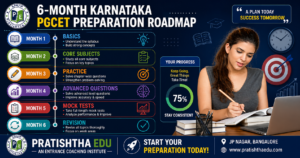
A six-month preparation plan allows sufficient time to build concepts, revise technical subjects, solve practice questions, and improve examination confidence. Candidates who prepare consistently over six months are generally able to complete the syllabus comfortably while leaving adequate time for revision and mock tests.
Students enrolled in PGCET ME Coaching in Bangalore often follow a structured month-wise schedule that balances classroom sessions, self-study, revision, and regular assessments.
Month 1 – Build Strong Fundamentals
The first month should focus on revising undergraduate engineering concepts.
Recommended activities include:
- Understand the complete PGCET syllabus.
- Learn the latest examination pattern.
- Revise core engineering subjects.
- Prepare formula notes.
- Solve basic MCQs.
- Identify strengths and weak areas.
The objective of the first month is to create a solid conceptual foundation.
Month 2 – Strengthen Core Subjects
After revising the basics, candidates should begin detailed subject-wise preparation.
Students should:
- Complete one technical subject at a time.
- Solve chapter-wise MCQs.
- Revise Engineering Mathematics where applicable.
- Practise numerical problems.
- Prepare short revision notes.
Daily revision should become part of the routine from this stage onwards.
Month 3 – Increase Practice and Accuracy
The third month should focus on applying concepts through regular practice.
Students should:
- Solve mixed-topic question sets.
- Attempt branch-specific sectional tests.
- Improve calculation speed.
- Analyse mistakes after every practice session.
- Strengthen weaker subjects.
Students preparing through PGCET ME Coaching in Bangalore generally receive topic-wise assessments during this phase to evaluate progress.
Month 4 – Advanced Practice
By the fourth month, candidates should move towards higher-level problem-solving.
Activities include:
- Solve difficult MCQs.
- Revise previously completed subjects.
- Attempt timed practice sessions.
- Improve question selection.
- Strengthen conceptual understanding.
Rather than memorising answers, students should understand the reasoning behind every solution.
Month 5 – Mock Test Phase
Mock examinations become increasingly important during this stage.
Students should:
- Attempt two or three mock tests every week.
- Analyse every mock carefully.
- Improve time management.
- Revise weak topics.
- Track accuracy and speed.
The objective is to become comfortable with the examination environment before the actual test.
Month 6 – Revision and Final Preparation
The final month should focus almost entirely on revision.
Candidates should:
- Revise all technical subjects.
- Solve previous year question papers.
- Practise full-length mock tests.
- Review formula notes.
- Revise the error notebook.
- Avoid learning completely new topics during the final week.
Maintaining confidence and consistency during the last month often contributes significantly to better examination performance.
Weekly Preparation Schedule
A balanced weekly routine helps students revise all important subjects without neglecting weaker areas.
| Day | Study Plan |
| Monday | Core Subject 1 + MCQs |
| Tuesday | Core Subject 2 + Revision |
| Wednesday | Engineering Mathematics / Numerical Practice |
| Thursday | Core Subject 3 + Topic-wise Test |
| Friday | Mixed Subject Practice |
| Saturday | Sectional Mock Test + Analysis |
| Sunday | Full Revision + Previous Year Questions |
Students should modify this schedule according to their engineering branch, college schedule, or work commitments.
Importance of Revision
Revision is one of the most important aspects of Karnataka PGCET preparation. Without regular revision, students may forget concepts learned during the early stages of preparation.
An effective revision strategy should include:
- Weekly revision of completed subjects.
- Monthly revision of formulas.
- Re-solving previously incorrect questions.
- Reviewing mock test mistakes.
- Revising short notes before examinations.
Students preparing through PGCET ME Coaching in Bangalore are encouraged to maintain concise revision notes that can be reviewed quickly during the final weeks before the examination.
How to Stay Consistent During Preparation
Maintaining consistency is often more important than studying for long hours.
Some practical suggestions include:
- Set daily study targets.
- Follow a fixed timetable.
- Complete weekly goals.
- Take short breaks during study sessions.
- Avoid unnecessary distractions.
- Track daily progress.
- Stay physically active.
- Get adequate sleep.
Consistency over several months is one of the key factors that contributes to successful Karnataka PGCET preparation.
Daily Study Plan for Karnataka PGCET M.E. Preparation
A disciplined daily routine plays an important role in Karnataka PGCET preparation. Many candidates spend several hours studying but fail to achieve the desired results because they do not follow a structured timetable. A balanced study plan should include concept revision, technical subject practice, mock tests, and regular revision.
Students preparing through PGCET ME Coaching in Bangalore generally follow a planned daily schedule that combines classroom learning with self-study. Whether you are a final-year engineering student or a working professional, maintaining consistency is more beneficial than studying for long hours irregularly.
Below is a sample study timetable that can be adjusted according to your college schedule or work commitments.
Morning Session (6:30 AM – 8:30 AM)
Morning hours are generally the most productive for understanding technical concepts.
Recommended activities include:
- Revise one core engineering subject.
- Solve 20–30 technical MCQs.
- Review important formulas.
- Prepare short notes.
- Revise concepts studied the previous day.
Starting the day with concept revision improves retention and builds confidence for the rest of the study schedule.
Afternoon Session (1:00 PM – 2:30 PM)
The afternoon session should focus on strengthening conceptual understanding through practice.
Students should:
- Solve numerical problems.
- Revise difficult chapters.
- Study one technical topic in depth.
- Complete topic-wise assignments.
- Maintain an error notebook.
Candidates enrolled in PGCET ME Coaching in Bangalore often use this time to revise classroom discussions and complete faculty-assigned exercises.
Evening Session (5:30 PM – 7:30 PM)
The evening is an ideal time for practice and assessment.
Activities include:
- Attempt chapter-wise MCQs.
- Solve mixed-topic questions.
- Improve calculation speed.
- Revise weak subjects.
- Analyse previous mistakes.
Daily practice under timed conditions gradually improves examination confidence.
Night Session (9:00 PM – 10:00 PM)
The final study session should focus entirely on revision.
Students should:
- Revise formulas.
- Read short revision notes.
- Review incorrect questions.
- Update the error notebook.
- Plan the next day’s schedule.
Avoid starting completely new topics at night, especially during the final months of preparation.
Weekly Study Schedule
A balanced weekly timetable helps candidates complete the syllabus while leaving sufficient time for revision.
| Day | Primary Activity | Secondary Activity |
| Monday | Core Subject 1 | Formula Revision |
| Tuesday | Core Subject 2 | Topic-wise MCQs |
| Wednesday | Numerical Practice | Revision |
| Thursday | Core Subject 3 | Mixed Questions |
| Friday | Core Subject 4 | Previous Year Questions |
| Saturday | Sectional Mock Test | Performance Analysis |
| Sunday | Full Revision | Weak Topic Improvement |
Students should customise the schedule according to their engineering discipline and preparation level.
Time Management Strategy for Karnataka PGCET
Time management is an essential part of examination success. Even candidates with strong conceptual knowledge may struggle if they spend too much time on a few difficult questions.
Students preparing through PGCET ME Coaching in Bangalore are encouraged to develop a systematic approach for managing examination time effectively.
Read Questions Carefully
Understand the question completely before selecting an answer. Misreading a question often leads to avoidable mistakes.
Attempt Easy Questions First
Begin with questions that you are confident about. This builds momentum and allows you to secure marks quickly.
Avoid Spending Excessive Time on Difficult Questions
If a question appears unusually complicated, move to the next one and return later if time permits.
Improve Accuracy
Rather than attempting every question, focus on answering accurately. Careless mistakes can affect overall performance.
Practise Under Timed Conditions
Regular timed practice improves speed, confidence, and decision-making during the actual examination.
Mock Test Strategy
Mock tests are one of the most valuable tools for Karnataka PGCET preparation. They simulate the actual examination environment and help candidates evaluate their progress.
Students enrolled in PGCET ME Coaching in Bangalore generally attempt regular mock tests followed by detailed performance analysis.
An effective mock test strategy includes:
- Attempt one sectional test every week.
- Take one full-length mock test every weekend.
- Analyse every incorrect answer.
- Identify weak concepts.
- Improve time management.
- Track accuracy regularly.
- Maintain a mock test performance record.
The objective of mock tests is not only to obtain a score but also to understand strengths, weaknesses, and areas requiring additional practice.
Importance of Previous Year Question Papers
Previous year Karnataka PGCET question papers provide valuable insights into frequently tested topics, question styles, and examination difficulty.
Candidates should solve previous year papers under examination conditions to improve both speed and confidence.
Benefits include:
- Understanding question trends.
- Identifying important topics.
- Improving time management.
- Increasing examination confidence.
- Revising multiple concepts simultaneously.
Students preparing through PGCET ME Coaching in Bangalore should combine previous year papers with regular mock tests for the best preparation outcomes.
Common Mistakes Students Should Avoid
Many candidates prepare sincerely but repeat mistakes that reduce their overall score. Avoiding these common errors can significantly improve examination performance.
1. Studying Without a Proper Plan
Random preparation often results in incomplete syllabus coverage. Following a structured study timetable helps maintain consistency and ensures all important topics are covered.
2. Ignoring Revision
Many students continue learning new topics without revising previously studied concepts. Weekly and monthly revision is essential for long-term retention.
3. Avoiding Mock Tests
Mock tests should not be postponed until the final weeks. Regular practice under examination conditions helps reduce anxiety and improves confidence.
4. Neglecting Weak Subjects
Candidates often spend more time on favourite subjects while ignoring weaker areas. Balanced preparation across all major technical subjects is essential.
5. Memorising Without Understanding
The Karnataka PGCET examination primarily tests conceptual understanding. Students should focus on understanding engineering principles rather than memorising answers.
6. Poor Time Management
Spending excessive time on difficult questions leaves insufficient time for easier ones. Practising under timed conditions helps develop better decision-making.
7. Inconsistent Preparation
Studying irregularly often leads to poor retention. Even three to four focused hours every day are generally more effective than studying for very long hours only occasionally.
How to Stay Motivated During Preparation
Preparing for a competitive entrance examination can sometimes feel overwhelming, especially when balancing college, work, or personal commitments. Staying motivated throughout the preparation journey is just as important as completing the syllabus.
Some practical ways to maintain motivation include:
- Set realistic daily and weekly goals.
- Track your progress regularly.
- Celebrate small achievements.
- Take short breaks to avoid burnout.
- Maintain a healthy lifestyle.
- Discuss doubts with mentors.
- Stay connected with positive study groups.
Students attending PGCET ME Coaching in Bangalore often benefit from regular faculty interaction and peer learning, which can help maintain consistency and motivation during the preparation process.
Importance of Performance Analysis
Many students focus only on completing mock tests without analysing their performance. However, detailed performance analysis is often more valuable than the test itself.
After every mock test, candidates should:
- Review incorrect answers.
- Identify frequently repeated mistakes.
- Note time-consuming questions.
- Revise related concepts.
- Update the error notebook.
- Modify the preparation strategy accordingly.
Consistent performance analysis helps students improve steadily and avoid repeating the same mistakes in future tests.
Tips to Crack Karnataka PGCET M.E. in the First Attempt
Cracking Karnataka PGCET in the first attempt requires more than simply completing the syllabus. Successful candidates usually combine conceptual learning, regular revision, mock test practice, and disciplined time management throughout their preparation.
Students preparing through PGCET ME Coaching in Bangalore often benefit from a structured study plan, expert mentoring, and continuous performance analysis. However, consistent self-study remains equally important regardless of whether a candidate prepares independently or through coaching.
The following practical tips can help improve preparation and examination performance.
1. Understand the Complete Syllabus
Before beginning preparation, carefully review the latest Karnataka PGCET syllabus for your engineering branch. Dividing the syllabus into smaller weekly targets makes it easier to complete every important topic without feeling overwhelmed.
2. Build Strong Conceptual Understanding
Rather than memorising formulas and answers, focus on understanding engineering concepts thoroughly. Strong fundamentals help solve unfamiliar questions more confidently during the examination.
3. Follow a Realistic Study Schedule
Create a daily timetable that includes technical subject revision, MCQ practice, previous year questions, and short revision sessions. Following a consistent routine is generally more effective than studying for long hours only occasionally.
4. Solve Previous Year Question Papers
Previous year papers help candidates understand important topics, question patterns, and the expected difficulty level. Attempt these papers under timed conditions to improve both speed and accuracy.
5. Attempt Regular Mock Tests
Mock examinations simulate the actual examination environment and help identify weak areas before the final examination. After every mock test, spend sufficient time analysing incorrect answers and revising related concepts.
6. Revise Regularly
Revision should continue throughout the preparation period rather than being postponed until the last few weeks. Short notes, formula sheets, and error notebooks can make revision more effective.
7. Improve Time Management
Practising under timed conditions helps students develop the ability to complete the paper efficiently while maintaining accuracy. Learn to skip excessively difficult questions and return to them later if time permits.
8. Strengthen Weak Subjects
Many candidates spend more time studying their favourite subjects while neglecting weaker topics. Balanced preparation across all important subjects usually produces better overall results.
9. Maintain Consistency
Studying consistently for a few hours every day is generally more productive than studying intensively for only a few days before the examination.
10. Stay Positive Throughout Preparation
Competitive examinations require patience and discipline. Maintaining a positive attitude, staying healthy, and following a realistic preparation strategy can improve confidence during the examination.
Why Choose Pratishtha Edu for PGCET ME Coaching in Bangalore
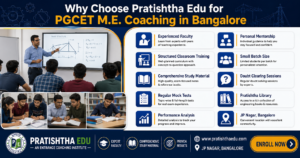
Choosing the right coaching institute can help students prepare in a more organised and disciplined manner. While individual effort remains the most important factor, structured guidance can simplify the preparation process by providing a clear study plan, expert mentoring, and regular assessments.
Students looking for PGCET ME Coaching in Bangalore often evaluate factors such as faculty experience, classroom environment, study materials, mock tests, and personalised guidance before selecting a coaching institute.
At Pratishtha Edu, the focus is on helping engineering graduates build strong technical concepts, improve problem-solving skills, and prepare confidently for Karnataka PGCET through a structured learning approach.
Experienced Faculty
Students learn from experienced faculty members who explain technical concepts clearly and systematically. Regular classroom discussions, concept-based teaching, and practical problem-solving sessions help improve understanding across engineering subjects.
Structured Classroom Training
A planned classroom programme helps students complete the syllabus in an organised sequence without missing important topics. Each subject is covered according to a structured preparation schedule.
Comprehensive Study Material
Students receive carefully prepared study material that includes:
- Topic-wise notes
- Practice questions
- Previous year question discussions
- Short revision notes
- Branch-specific assignments
The study material is designed to support classroom learning as well as independent revision.
Regular Mock Tests
Mock examinations are conducted regularly to help students evaluate their preparation level and improve examination confidence.
Mock tests also provide opportunities to:
- Improve speed
- Increase accuracy
- Identify weak topics
- Practise time management
- Build examination confidence
Detailed Performance Analysis
Every mock test is followed by performance analysis that helps students understand:
- Common mistakes
- Weak technical concepts
- Time-consuming topics
- Revision priorities
- Individual improvement areas
This personalised feedback allows students to continuously improve throughout their preparation journey.
Personalised Mentorship
Every student has different strengths, weaknesses, and learning speeds. Individual guidance sessions help candidates develop preparation strategies based on their current performance and academic background.
Small Batch Size
Smaller classroom batches encourage better interaction between students and faculty members. Candidates receive more opportunities to ask questions, participate in discussions, and clarify doubts during classroom sessions.
Dedicated Doubt-Clearing Sessions
Regular doubt-solving sessions ensure that students can clarify technical concepts before moving to advanced topics. Addressing doubts promptly helps prevent conceptual gaps from affecting future preparation.
Excellent Study Environment
A focused learning environment can improve concentration and productivity. Students preparing for PGCET ME Coaching in Bangalore may also benefit from access to the Pratishtha Library, which offers a quiet space for self-study, revision, and mock test practice.
Convenient JP Nagar Location
Located in JP Nagar, Bangalore, Pratishtha Edu provides convenient access for students from different parts of the city, making it easier to attend regular classes and maintain a consistent preparation schedule.
Frequently Asked Questions (FAQs)
1. What is Karnataka PGCET M.E.?
Karnataka PGCET M.E. is a state-level entrance examination conducted by the Karnataka Examinations Authority (KEA) for admission to Master of Engineering (M.E.) and Master of Technology (M.Tech) programmes offered by participating institutions in Karnataka.
2. Who is eligible to apply for Karnataka PGCET M.E.?
Eligibility requirements are announced by KEA each year. Generally, candidates should possess the required qualifying engineering degree and meet the eligibility criteria specified in the official notification.
3. Is Karnataka PGCET M.E. difficult?
The examination primarily tests concepts studied during B.E. or B.Tech. Candidates with strong fundamentals, consistent practice, and regular revision generally find the examination manageable.
4. How many months are sufficient for Karnataka PGCET preparation?
A preparation period of six months is generally considered sufficient for most students, provided they follow a disciplined study plan, revise regularly, and attempt mock tests consistently.
5. Is coaching necessary for Karnataka PGCET?
Coaching is not mandatory. However, students who prefer structured guidance, expert mentoring, mock tests, and a planned study schedule often choose PGCET ME Coaching in Bangalore to support their preparation.
6. How important are previous year question papers?
Previous year papers help candidates understand question trends, important topics, and the overall examination pattern. They also improve speed, confidence, and time management.
7. Which engineering subjects should I focus on?
Candidates should primarily focus on the core technical subjects of their engineering branch along with Engineering Mathematics wherever applicable.
8. Can working professionals prepare for Karnataka PGCET?
Yes. Many working professionals successfully prepare by following a structured daily timetable, weekend revision schedule, and regular mock test practice.
9. How many mock tests should I attempt?
Candidates should aim to attempt regular sectional tests during the initial stages of preparation and full-length mock tests during the final months before the examination.
10. Why choose PGCET ME Coaching in Bangalore?
Many students choose PGCET ME Coaching in Bangalore because structured classroom learning, experienced faculty, regular mock tests, study material, and performance analysis can help maintain consistency and improve preparation.
Conclusion
Preparing for Karnataka PGCET requires careful planning, conceptual clarity, consistent practice, and disciplined revision. Since the examination evaluates the core technical knowledge gained during undergraduate engineering, candidates should focus on understanding concepts rather than memorising answers. Completing the syllabus systematically, solving previous year question papers, attempting regular mock tests, and analysing performance are all important components of an effective preparation strategy.
Although self-study remains essential, many aspirants benefit from structured guidance that provides a clear roadmap, expert mentoring, and regular assessments. PGCET ME Coaching in Bangalore can support candidates through organised classroom sessions, comprehensive study material, topic-wise practice, and personalised feedback to help them prepare with greater confidence.
Whether you are a final-year engineering student or a graduate planning to pursue postgraduate studies, starting your preparation early and maintaining consistency can significantly improve your chances of success. With the right strategy, regular revision, and dedicated effort, you can approach the Karnataka PGCET examination with confidence and work towards securing admission to your preferred ME or M.Tech programme.
Ready to Begin Your Karnataka PGCET Journey?
If you are looking for PGCET ME Coaching in Bangalore, Pratishtha Edu offers structured classroom guidance, experienced faculty, comprehensive study material, regular mock tests, performance analysis, and personalised mentorship to help engineering graduates prepare systematically for Karnataka PGCET.
You can also visit the Pratishtha Library for a focused self-study environment with comfortable seating, uninterrupted study hours, and resources that support consistent preparation.
Leave a Reply