Introduction
IIT JAM Mathematics is a national-level entrance examination for students who want to pursue postgraduate education in Mathematics and related fields at IITs and other participating institutes. The examination provides an opportunity for eligible graduates and final-year students to seek admission to postgraduate programs through the Joint Admission Test for Masters (JAM).
For students planning higher studies in Mathematics, IIT JAM Mathematics 2027 can be an important step toward gaining admission to reputed institutes and building a strong academic foundation for future research and professional opportunities. The IIT JAM Mathematics Exam evaluates a candidate’s understanding of mathematical concepts, analytical ability, and problem-solving skills.
Before beginning IIT JAM Mathematics Preparation, candidates should understand the examination structure, eligibility requirements, syllabus, important dates, marking scheme, and admission process. A clear understanding of these aspects helps students create a realistic study plan and use their preparation time effectively.
The IIT JAM Mathematics Syllabus 2027 covers important areas of undergraduate-level Mathematics. Candidates need to develop strong conceptual knowledge and regularly practice numerical and analytical problems to perform well in the examination. Along with syllabus coverage, solving previous year question papers, revising formulas, and attempting mock tests can help improve speed and accuracy.
IIT JAM Mathematics is also relevant for students planning MSc Mathematics Admission and higher studies in mathematical sciences. After completing a postgraduate degree, students can explore opportunities in research, teaching, academia, data science, analytics, quantitative fields, and other mathematics-related careers.
In this comprehensive guide, you will learn about IIT JAM Mathematics 2027, including its purpose, eligibility criteria, exam pattern, complete syllabus, subject-wise weightage, recommended books, preparation strategy, previous year cut-off trends, question papers, career opportunities, and frequently asked questions. The guide is designed to help aspirants understand the examination in a simple and structured manner.
Candidates can also make use of reliable Study Material and maintain a consistent study routine in a focused environment such as Pratishtha Library. For students who need additional academic guidance, structured preparation, and mentorship, Pratishtha Edu can also be considered as part of their preparation journey.
What is IIT JAM Mathematics?

IIT JAM Mathematics is the Mathematics paper of the Joint Admission Test for Masters (JAM), an entrance examination used for admission to postgraduate science programs at participating IITs and other institutes. The examination is designed to assess the subject knowledge and analytical abilities required for higher studies in Mathematics and related disciplines.
Students who qualify for the examination can participate in the admission process for eligible postgraduate programs, in accordance with the respective institutes’ admission requirements. Since admission requirements and available programs can vary, candidates should carefully check the official information released for the relevant admission cycle.
Full Form of IIT JAM
IIT JAM stands for Indian Institute of Technology Joint Admission Test for Masters. It is conducted as a national-level entrance examination for admission to postgraduate programs offered through participating institutes.
The examination provides students with an opportunity to continue their academic journey after completing their undergraduate degree and pursue advanced studies in science and related areas.
Purpose of IIT JAM Mathematics
The primary purpose of IIT JAM Mathematics is to provide an entrance route for eligible students seeking admission to postgraduate programs through the participating institutes.
The examination evaluates important skills such as:
- Mathematical understanding
- Conceptual clarity
- Analytical reasoning
- Numerical problem-solving
- Application of mathematical concepts
- Accuracy and time management
A strong performance in the examination can help candidates compete for available seats in their preferred programs, subject to the respective institute’s admission criteria.
Who Conducts IIT JAM Mathematics?
IIT JAM is conducted by the Indian Institutes of Technology on a rotational basis. The organizing institute may change from one examination cycle to another.
Candidates preparing for IIT JAM Mathematics 2027 should always check the latest official notification for information about the organizing institute, registration process, examination schedule, syllabus, eligibility requirements, and admission procedures.
The Official IIT JAM Website should be treated as the primary source for the latest examination-related announcements.
Participating IITs and Institutes
IIT JAM provides opportunities for admission to postgraduate programs offered by participating IITs and other institutes. The list of participating institutes, programs, seat availability, and admission requirements may vary depending on the examination and admission cycle.
Candidates should therefore avoid relying only on previous year information when selecting institutes. Before submitting admission preferences, students should carefully check the latest program-wise eligibility and admission requirements.
The participating institutes provide students with access to advanced academic resources, experienced faculty, research facilities, and opportunities for higher education in specialized areas.
Programs Offered Through IIT JAM Mathematics
The programs available through IIT JAM can vary by institute and admission year. Depending on the institute and the candidate’s eligibility, opportunities may include postgraduate programs in Mathematics and related areas.
Students interested in MSc Mathematics Admission should carefully check:
- Program eligibility
- Required undergraduate subjects
- Minimum educational requirements
- Admission process
- Seat availability
- Institute-specific requirements
- Counselling and admission deadlines
Candidates should remember that qualifying the examination does not automatically guarantee admission to a particular institute or program. Admission depends on the applicable eligibility conditions, merit, seat availability, and other requirements specified by the participating institute.
Why Should Students Choose IIT JAM Mathematics?
IIT JAM Mathematics can be a valuable option for students who want to strengthen their mathematical knowledge through postgraduate education at reputed institutes.
There are several reasons why students consider this examination as part of their higher-study plans.
First, it provides an opportunity to compete for admission to postgraduate programs through a national-level entrance examination. Students who enjoy Mathematics and want to explore the subject beyond undergraduate studies can use the examination as a pathway toward advanced academic learning.
Second, postgraduate education in Mathematics can open doors to different career directions. Students can later pursue research and PhD programs, teaching and academic careers, data science, analytics, quantitative finance, scientific computing, and other fields where mathematical and analytical skills are valuable.
Third, preparing for the examination itself helps students strengthen important skills such as logical thinking, problem-solving, numerical accuracy, and time management. These skills are useful not only for the examination but also for future academic and professional work.
However, success in IIT JAM Mathematics requires consistent preparation. Candidates should understand the complete syllabus, build strong fundamentals, practice questions regularly, revise important concepts, and evaluate their progress through mock tests.
Students can also strengthen their preparation by using quality Study Material, maintaining a regular study schedule, and studying in a distraction-free environment. Those looking for structured academic guidance can explore the learning support available through Pratishtha Edu, while students who prefer a dedicated place for self-study can consider Pratishtha Library.
Before beginning detailed preparation, candidates should understand the examination highlights, eligibility criteria, and important requirements for IIT JAM Mathematics 2027. This will help them plan their preparation more effectively and avoid confusion during the application and admission process.
IIT JAM Mathematics 2027 Highlights
Before starting your IIT JAM Mathematics Preparation, it is important to understand the basic features of the examination. Knowing the exam mode, duration, question types, marking scheme, and other important details helps candidates prepare according to the actual requirements of the test.
The following table provides a quick overview of the major IIT JAM Mathematics 2027 examination details. Candidates should verify the final dates and official information from the latest examination notification before applying.
| Particular | Details |
| Examination | Joint Admission Test for Masters (JAM) |
| Paper | Mathematics (MA) |
| Exam Mode | Computer-Based Test (CBT) |
| Duration | 3 Hours |
| Question Types | MCQ, MSQ and NAT |
| Medium | English |
| Total Marks | 100 |
| Negative Marking | Applicable to specified MCQ questions |
| Examination Level | National Level |
| Conducting Institute | IIT designated for the respective JAM cycle |
| Official Website | Official IIT JAM portal |
The Mathematics paper is designed to test candidates on important undergraduate-level mathematical concepts along with their ability to apply those concepts to different problems. Therefore, preparation should focus not only on memorizing formulas but also on understanding concepts and practicing different types of questions.
Candidates should also understand that the examination pattern, admission rules, and other details may be updated for a particular examination cycle. For this reason, students preparing for IIT JAM Mathematics 2027 should check the official notification before making final decisions regarding registration and admission.
IIT JAM Mathematics Eligibility Criteria 2027
Understanding the eligibility requirements is one of the first steps before applying for the IIT JAM Mathematics Exam. Candidates should carefully check whether they meet the educational and admission requirements applicable to the examination and the postgraduate program they wish to pursue.
Eligibility for the examination and eligibility for a particular postgraduate program may not always be identical. A candidate may be allowed to appear for JAM but may still need to satisfy additional subject or degree requirements for admission to a specific program.
Therefore, students interested in MSc Mathematics Admission should check both the examination requirements and the program-specific eligibility conditions before selecting their preferred institutes.
Educational Qualification
Candidates should have completed an undergraduate degree from a recognized university or institution, subject to the eligibility conditions specified in the official JAM admission information.
For Mathematics-related postgraduate programs, students should pay particular attention to the required undergraduate subjects. Some programs may require candidates to have studied Mathematics for a specified duration or at a particular level during their qualifying degree.
Students from backgrounds such as Mathematics, Applied Mathematics, Physics, Engineering, or other related disciplines may consider IIT JAM Mathematics depending on the eligibility requirements of the program they want to join.
The exact subject requirements can differ between programs. Therefore, candidates should not assume that having a general bachelor’s degree automatically makes them eligible for every Mathematics-related program.
Qualifying Degree
The qualifying degree is an important part of the admission process. Candidates should check the specific degree requirements mentioned for the postgraduate program they wish to apply for.
Depending on the program, an eligible qualifying degree may include a bachelor’s degree in Mathematics or another relevant discipline with the required Mathematics coursework.
Candidates should carefully review the latest admission information before selecting a program. This is particularly important for students whose undergraduate degree is from an interdisciplinary field.
A candidate should confirm:
- Whether the qualifying degree is accepted
- Whether Mathematics is required as a subject
- Whether a minimum number of semesters or years of Mathematics study is required
- Whether any additional academic requirements apply
- Whether the candidate satisfies the program-specific admission criteria
Age Limit
Candidates should check the latest official JAM notification for the applicable age-related rules.
If the examination notification does not prescribe an age restriction for the relevant admission cycle, candidates can focus on satisfying the required educational and program-specific eligibility conditions.
Since rules can change between examination cycles, students should always verify the latest information before submitting the application form.
Nationality
Candidates should check the nationality requirements specified in the official IIT JAM admission notification.
The admission process may include specific requirements for Indian nationals as well as candidates belonging to other eligible categories. Students should provide accurate information in the application form and keep the required documents ready for verification.
If there is any uncertainty regarding nationality or category-related requirements, candidates should refer to the official admission information rather than relying on unofficial websites.
Minimum Marks
The minimum academic requirements can depend on the postgraduate program and participating institute.
Candidates should carefully check the minimum marks, qualifying degree requirements, and subject requirements mentioned for their preferred program.
It is important to distinguish between:
Eligibility to appear for the examination and eligibility for admission to a specific program.
Meeting the basic requirements to appear for the IIT JAM Mathematics examination does not necessarily mean that a candidate meets every program-specific admission requirement.
Students should therefore prepare a shortlist of their preferred programs and check the eligibility criteria for each one before the admission process.
Final-Year Students
Final-year undergraduate students may be eligible to appear for IIT JAM, subject to the conditions specified in the relevant examination and admission notification.
However, appearing in the examination and receiving admission are two different stages. Candidates who are still completing their qualifying degree may need to submit proof of degree completion or other required documents within the prescribed admission timeline.
Final-year students should therefore carefully monitor the admission schedule and ensure that they can satisfy all academic requirements within the specified deadlines.
Before applying, final-year candidates should verify:
- Expected date of completion of their degree
- Required academic documents
- Program-specific eligibility
- Admission deadlines
- Degree completion requirements
- Document verification requirements
Who Can Apply for IIT JAM Mathematics?
Students who have completed or are completing an eligible undergraduate degree and satisfy the applicable admission requirements can consider applying for the Mathematics paper.
Candidates commonly interested in IIT JAM Mathematics 2027 may include students from:
- Mathematics
- Applied Mathematics
- Physics with Mathematics coursework
- Engineering and technology backgrounds
- Other science disciplines with the required Mathematics background
- Related interdisciplinary undergraduate programs
However, the exact eligibility depends on the postgraduate program selected by the candidate.
For this reason, students should not choose an institute or program only based on the Mathematics paper. They should first compare the program requirements and then confirm whether their undergraduate qualification meets those requirements.
Important Documents to Keep Ready
Candidates should keep their academic and personal documents organized before starting the application process. Depending on the application and admission requirements, students may need documents related to their qualifying degree, identity, category, photograph, signature, and other relevant information.
Keeping documents ready can make the application process easier and reduce the possibility of mistakes.
Candidates should also ensure that the information entered in the application form matches their official documents. Incorrect or inconsistent information can create problems during verification or admission.
Eligibility Checklist for IIT JAM Mathematics 2027
Before applying, candidates can use the following checklist:
- Check the latest official JAM notification.
- Confirm that your qualifying degree is acceptable.
- Check the Mathematics subject requirements for your preferred program.
- Verify whether final-year students are eligible under the current rules.
- Check program-specific minimum academic requirements.
- Review nationality and category requirements where applicable.
- Keep academic documents ready.
- Check the admission requirements of each preferred institute.
- Confirm all details before submitting the application.
Eligibility is an important part of the IIT JAM Mathematics Preparation journey because choosing the right program and institute requires more than simply qualifying in the entrance examination.
Once candidates confirm that they meet the applicable eligibility requirements, the next step is to track the IIT JAM Mathematics Important Dates 2027. Knowing the notification, registration, admit card, examination, result, and admission timelines can help students avoid missing important deadlines.
IIT JAM Mathematics Important Dates 2027
Keeping track of the important dates is an essential part of planning your IIT JAM Mathematics Preparation. The examination process includes several stages, starting from the release of the official notification and application form and continuing through the examination, result declaration, and admission process.
The exact dates for IIT JAM Mathematics 2027 should be confirmed from the official notification when the complete examination schedule is released. Candidates should avoid relying on tentative dates from unofficial sources, especially while planning their application and admission activities.
IIT JAM Mathematics 2027 Important Dates
| Event | Expected/Official Date |
| Official Notification | To Be Announced |
| Application Begins | To Be Announced |
| Application Last Date | To Be Announced |
| Admit Card Release | To Be Announced |
| IIT JAM Mathematics Examination | To Be Announced |
| Response Sheet | To Be Announced |
| Result Declaration | To Be Announced |
| Admission Process | To Be Announced |
Candidates should regularly check the Official IIT JAM Website for updates regarding registration, examination dates, admit card, results, and admission announcements.
IIT JAM Mathematics Application Date
The application process generally begins after the release of the official examination notification. Candidates need to complete the online application within the prescribed registration period.
Before starting the application, students should keep their personal details, educational information, photograph, signature, and other required documents ready. Entering accurate information is important because the details provided during registration may be used during subsequent stages of the examination and admission process.
Candidates should also avoid waiting until the final day to submit the application. Technical issues, payment problems, or incorrect information can create unnecessary difficulties close to the deadline.
IIT JAM Mathematics Admit Card
The admit card is an important document for candidates appearing for the examination. It contains essential information related to the examination, such as the candidate’s details, examination information, and other instructions.
Candidates should download their admit card from the official examination portal after it is released and carefully check all the information printed on it.
Before the examination, candidates should verify:
- Candidate name
- Registration details
- Examination information
- Test-related instructions
- Reporting or examination requirements
- Any additional instructions mentioned on the admit card
If a candidate notices an error, it should be addressed through the appropriate official channel as early as possible.
IIT JAM Mathematics Exam Date
The IIT JAM Mathematics examination date will be announced as part of the official examination schedule.
Candidates should begin their revision well before the examination rather than waiting for the final few weeks. Once the exam date is known, students can adjust their study plan and divide their remaining preparation time between revision, previous year questions, mock tests, and weak topics.
IIT JAM Mathematics Result Date
After the examination, the result and qualifying information will be released according to the official schedule.
Candidates should check their results through the official examination portal and keep a copy of their result or score-related information for future admission activities.
IIT JAM Mathematics Admission Process
Qualifying the examination is an important milestone, but candidates must also complete the applicable admission process to secure a seat in a postgraduate program.
After the result, eligible candidates may need to participate in the admission process according to the rules of the participating institutes and programs.
Students should carefully check:
- Available postgraduate programs
- Program-wise eligibility
- Admission requirements
- Seat availability
- Admission application deadlines
- Required documents
- Institute-specific instructions
Candidates should therefore continue checking official admission information even after the examination result is declared.
IIT JAM Mathematics Exam Pattern 2027
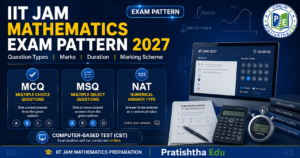
Understanding the IIT JAM Mathematics Exam Pattern 2027 is one of the most important steps before starting intensive preparation. A clear understanding of the question format, duration, marking scheme, and different sections allows candidates to develop a better strategy for solving the paper.
The Mathematics paper is conducted in Computer-Based Test (CBT) mode. The question paper includes different types of questions designed to test conceptual understanding, analytical thinking, numerical ability, and problem-solving skills.
Candidates should understand the characteristics of each question type because the approach required for solving MCQs can be different from MSQs and NAT questions.
Exam Mode
The IIT JAM Mathematics examination is conducted in Computer-Based Test (CBT) mode.
Candidates answer questions using a computer at the allotted examination centre. Since the examination is computer-based, students should become comfortable with reading questions on screen, navigating between questions, entering numerical answers where required, and managing time digitally.
Practising mock tests in a computer-based environment can help candidates become more familiar with the examination interface.
Duration
The examination duration is 3 hours.
Time management is extremely important because candidates need to attempt questions from different sections within the available time.
A good strategy is not to spend too much time on a single difficult question. Candidates should first attempt questions they can solve confidently and return to more time-consuming problems later, wherever the examination interface and question type allow.
Number of Questions
The Mathematics paper contains questions from different sections and question formats.
Rather than focusing only on the number of questions, candidates should understand the marks associated with each type and the applicable marking rules.
This helps students decide how much time they should spend on different questions during the examination.
Total Marks
The IIT JAM paper is designed around a total of 100 marks.
Candidates should focus on maximizing their accuracy rather than attempting every question without considering the marking rules.
A balanced strategy involving easy, moderate, and difficult questions can help candidates use their available time more efficiently.
Section A – Multiple Choice Questions (MCQ)
Multiple Choice Questions provide a set of answer options from which candidates need to select the correct answer.
MCQs require careful reading because similar-looking options can sometimes be designed to test conceptual clarity.
Candidates should:
- Read the complete question carefully.
- Identify the relevant concept.
- Eliminate clearly incorrect options.
- Avoid unnecessary calculations.
- Consider the marking rules before making guesses.
Because negative marking may apply to specified MCQs, candidates should avoid blind guessing.
Section B – Multiple Select Questions (MSQ)
Multiple Select Questions may have more than one correct answer.
Candidates need to identify all the correct options according to the instructions provided in the examination.
These questions require a deeper understanding of the concept because selecting only one correct option when multiple options are required may not result in the expected score.
Students should therefore read the instructions carefully and practice MSQs during their preparation.
Section C – Numerical Answer Type (NAT)
Numerical Answer Type questions require candidates to enter the numerical value of their answer instead of selecting an option from a list.
NAT questions can test calculation skills as well as conceptual understanding.
Candidates should pay attention to:
- Calculation accuracy
- Units where relevant
- Decimal values
- Sign conventions
- Approximation requirements
- The exact answer-entry format mentioned in the examination
Regular numerical practice can help reduce calculation mistakes.
Marking Scheme
The marking scheme can differ according to the type of question. Candidates should therefore understand the official marking instructions before appearing for the examination.
In general, students should focus on maximizing correct answers and minimizing avoidable mistakes.
A preparation strategy based only on attempting a large number of questions is not ideal. Accuracy, question selection, and time management are equally important.
Negative Marking
Negative marking may apply to specified MCQ questions, while the rules for other question types can differ.
Candidates should carefully check the latest official examination instructions for the exact marking scheme applicable to IIT JAM Mathematics 2027.
During preparation, students should develop the habit of distinguishing between questions they can confidently solve and questions where guessing may carry unnecessary risk.
How to Manage Time in the Exam?
Effective time management can significantly improve examination performance.
A practical approach is to divide the paper into multiple rounds.
First Round:
Attempt questions that you can solve quickly and confidently. Avoid spending excessive time on difficult calculations.
Second Round:
Return to moderate-level questions that require some calculation or deeper thinking.
Third Round:
Use the remaining time for difficult questions, checking calculations, and reviewing marked questions wherever appropriate.
Candidates should also reserve a small amount of time for checking numerical entries and avoiding simple calculation or reading mistakes.
Common Mistakes to Avoid in IIT JAM Mathematics
While preparing for the examination, students should also identify mistakes that can reduce their score.
Common mistakes include:
- Spending too much time on one difficult question
- Ignoring the marking scheme
- Making calculation errors
- Not reading questions carefully
- Attempting questions without sufficient confidence
- Neglecting revision
- Avoiding previous year question papers
- Taking too few mock tests
- Focusing only on easy topics
- Starting revision too late
A strong IIT JAM Mathematics Preparation strategy should combine conceptual learning, regular practice, revision, previous year questions, and mock tests.
Once candidates understand the examination pattern, the next and most important step is to study the complete IIT JAM Mathematics Syllabus 2027 and organize the topics according to their preparation level and importance.
IIT JAM Mathematics Syllabus 2027
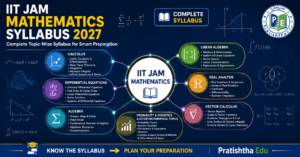
The IIT JAM Mathematics Syllabus 2027 is one of the most important parts of the examination preparation. A clear understanding of the syllabus helps candidates identify the concepts they need to study, organize their preparation, and avoid spending unnecessary time on topics that are outside the prescribed syllabus.
IIT JAM Mathematics primarily tests candidates on fundamental concepts and problem-solving ability in undergraduate-level Mathematics. Instead of relying only on memorization, students should focus on understanding concepts, learning important formulas, practicing numerical problems, and developing the ability to apply mathematical methods to different situations.
Before beginning detailed IIT JAM Mathematics Preparation, candidates should divide the syllabus into manageable sections and create a realistic study schedule. Regular revision and question practice should be included from the beginning rather than being postponed until the final stage.
The major areas covered in the Mathematics preparation include calculus, differential equations, vector calculus, linear algebra, real analysis, algebra, and other relevant mathematical concepts.
Sequences and Series
Sequences and series form an important foundation for mathematical analysis. Candidates should understand the basic concepts related to sequences, convergence, divergence, and different types of series.
Important areas to study include:
- Sequences and their properties
- Convergence and divergence
- Limits of sequences
- Monotonic sequences
- Bounded sequences
- Infinite series
- Tests for convergence
- Power series
- Taylor and related expansions
- Applications of sequences and series
Candidates should practice problems that require them to determine whether a sequence or series converges and understand the conditions associated with different convergence tests.
A strong understanding of sequences and series can also help students while studying topics related to calculus and analysis.
Differential Calculus
Differential calculus is a fundamental area of Mathematics and requires strong conceptual understanding as well as regular problem-solving practice.
Important topics include:
- Functions and limits
- Continuity
- Differentiability
- Derivatives
- Higher-order derivatives
- Mean value theorems
- Taylor expansion
- Maxima and minima
- Applications of derivatives
- Indeterminate forms
- Related mathematical applications
Candidates should understand the difference between continuity and differentiability and practice questions involving limits and derivatives.
Problems based on maxima and minima can require candidates to combine multiple concepts. Therefore, students should practice both direct formula-based questions and application-based problems.
Integral Calculus
Integral calculus is another important part of mathematical preparation. Students should understand both indefinite and definite integration and learn how integration can be applied to solve mathematical problems.
Important areas include:
- Indefinite integrals
- Definite integrals
- Fundamental concepts of integration
- Techniques of integration
- Integration by substitution
- Integration by parts
- Applications of integration
- Properties of definite integrals
- Improper integrals
- Area-related applications
Candidates should solve a variety of integration problems instead of depending only on standard formulas. Regular practice can improve calculation speed and help students recognize the appropriate method for a particular problem.
Differential Equations
Differential equations involve relationships between functions and their derivatives. Candidates should develop a clear understanding of common types of differential equations and the methods used to solve them.
Preparation should cover areas such as:
- First-order differential equations
- Differential equations of standard forms
- Linear differential equations
- Higher-order differential equations
- Complementary and particular solutions
- Initial conditions
- General solutions
- Applications of differential equations
Students should practice identifying the type of differential equation before selecting a method of solution. This can save time during the examination.
Vector Calculus
Vector calculus deals with vector quantities and their derivatives and is useful in several areas of advanced Mathematics and mathematical applications.
Candidates should prepare important concepts such as:
- Vectors
- Vector functions
- Scalar and vector fields
- Gradient
- Divergence
- Curl
- Directional derivatives
- Line integrals
- Surface-related concepts
- Applications of vector calculus
Understanding the geometric meaning of these concepts can make problem-solving easier. Candidates should also practice calculations involving vector operators and their properties.
Linear Algebra
Linear Algebra is a major area of Mathematics preparation and should be studied carefully. It deals with matrices, vectors, linear equations, transformations, and related mathematical structures.
Important topics include:
- Matrices
- Determinants
- Systems of linear equations
- Rank of a matrix
- Inverse of a matrix
- Vector spaces
- Linear independence
- Basis and dimension
- Linear transformations
- Eigenvalues
- Eigenvectors
- Diagonalization
Candidates should practice both conceptual and computational questions.
Eigenvalues and eigenvectors are particularly important concepts because they require students to understand the relationship between matrices, vectors, and transformations.
A strong foundation in Linear Algebra can help candidates solve questions more efficiently and recognize relationships between different mathematical concepts.
Real Analysis
Real Analysis focuses on the rigorous study of real numbers, functions, limits, continuity, differentiation, integration, and related concepts.
Students should develop a clear understanding of:
- Real number properties
- Sequences
- Series
- Limits
- Continuity
- Differentiability
- Convergence
- Functions
- Basic concepts of real-valued functions
- Important theorems and their applications
Real Analysis often requires conceptual thinking rather than straightforward formula application. Candidates should therefore spend sufficient time understanding definitions and practicing problems based on fundamental concepts.
Abstract Algebra
Algebraic concepts form an important part of higher Mathematics preparation. Candidates should understand the basic properties of algebraic structures and learn how different structures are related.
Important areas may include:
- Sets and operations
- Groups
- Subgroups
- Cyclic groups
- Permutations
- Homomorphisms
- Isomorphisms
- Rings
- Fields
- Basic algebraic structures
Students should focus on understanding definitions and properties rather than memorizing them without context.
Practice questions can help candidates identify the properties of a particular algebraic structure and apply relevant results correctly.
Complex Analysis
Complex numbers and functions are important areas for students preparing for higher-level Mathematics.
Candidates should develop familiarity with:
- Complex numbers
- Algebra of complex numbers
- Complex functions
- Limits and continuity
- Differentiability
- Analytic functions
- Basic properties of complex functions
- Elementary complex integration concepts
Students should practice problems involving complex numbers and understand the conditions associated with differentiability and analyticity.
Probability and Statistics
Probability and Statistics introduce candidates to mathematical methods used to analyze uncertainty and data.
Preparation can include:
- Basic probability
- Conditional probability
- Independent events
- Random variables
- Probability distributions
- Expectation
- Variance
- Basic statistical concepts
- Measures of central tendency
- Data interpretation
Candidates should practice numerical problems because probability questions can involve multiple steps and require careful calculation.
Understanding the difference between independent and dependent events is also important for avoiding common mistakes.
Numerical Methods
Numerical methods involve techniques used to obtain approximate solutions to mathematical problems.
Candidates should understand the basic principles behind numerical approaches and their applications.
Preparation may include:
- Approximation
- Numerical solutions
- Error concepts
- Iterative methods
- Root-finding methods
- Numerical integration
- Basic numerical techniques
The focus should be on understanding how a method works, when it can be applied, and how to perform the required calculations accurately.
Other Important Mathematical Topics
Apart from individual topics, candidates should also develop an understanding of how different mathematical concepts are connected.
For example, calculus can be connected with differential equations, linear algebra can involve matrices and transformations, and analysis can build upon concepts related to sequences, limits, and continuity.
Therefore, students should avoid preparing every chapter in complete isolation.
A better approach is to identify relationships between topics and revise them together whenever possible.
How to Complete the IIT JAM Mathematics Syllabus Effectively?
Completing the syllabus does not simply mean reading every chapter once. Candidates should aim to understand concepts, solve problems, revise important formulas, and test their knowledge regularly.
A practical approach can be divided into four stages.
Stage 1: Understand the Concepts
Begin each topic by learning its fundamental concepts. Do not move directly to difficult problems without understanding the underlying theory.
Stage 2: Practice Basic Questions
Once the concept is clear, solve basic questions to check whether you can apply the method correctly.
Stage 3: Solve Advanced Problems and PYQs
After gaining confidence, move toward higher-level problems and previous year questions. This helps candidates understand how concepts may be tested in the actual examination.
Stage 4: Revise and Test Yourself
Regular revision is essential. Candidates should maintain short notes containing important formulas, definitions, theorems, and frequently repeated mistakes.
Mock tests should also be included in the preparation schedule.
How to Prioritize Topics in IIT JAM Mathematics?
Candidates should not treat every topic in the same way. Preparation priorities can depend on the candidate’s existing knowledge, practice level, and previous question trends.
A useful approach is to divide topics into three groups:
Strong Topics:
Topics that you can solve confidently and accurately.
Moderate Topics:
Topics where you understand the concepts but need additional practice.
Weak Topics:
Topics where you struggle with concepts, calculations, or question interpretation.
Begin by strengthening weak and moderate areas while continuing regular revision of strong topics.
Candidates should also avoid completely ignoring difficult chapters. Even when a topic appears challenging, understanding its fundamental concepts can still help improve overall preparation.
Importance of Revision in IIT JAM Mathematics Preparation
Revision should continue throughout the preparation period rather than being reserved for the final few days.
Candidates can maintain separate revision notes for:
- Important formulas
- Definitions
- Theorems
- Common mistakes
- Short calculation methods
- Frequently difficult concepts
- Questions that were answered incorrectly
Regular revision makes it easier to recall concepts during the examination and reduces the time required to relearn previously studied topics.
After completing the IIT JAM Mathematics Syllabus 2027, candidates should move toward systematic practice with previous year questions, mock tests, and regular revision.
A strong preparation process combines syllabus completion with repeated practice. Students can also use reliable Study Material to strengthen their conceptual understanding and maintain a consistent study routine.
Once the complete syllabus is understood, the next step is to analyze the IIT JAM Mathematics Subject-Wise Weightage and identify areas that deserve greater preparation time.
IIT JAM Mathematics Subject-Wise Weightage 2027
After understanding the complete IIT JAM Mathematics Syllabus 2027, the next step is to understand which areas may require greater attention during preparation. Subject-wise weightage can help candidates organize their study schedule and decide how much time to dedicate to different topics.
However, candidates should remember that IIT JAM does not necessarily follow a fixed number of questions from every topic in every examination. The actual distribution can change from year to year. Therefore, the following overview should be used as a preparation guide based on previous examination trends, rather than as a guaranteed question distribution for IIT JAM Mathematics 2027.
Expected Topic-Wise Importance
| Topic | Expected Questions | Difficulty | Importance |
| Calculus | Varies by paper | Moderate to High | Very Important |
| Linear Algebra | Varies by paper | Moderate | Very Important |
| Differential Equations | Varies by paper | Moderate | Important |
| Real Analysis | Varies by paper | Moderate to High | Very Important |
| Algebra | Varies by paper | Moderate to High | Very Important |
| Vector Calculus | Varies by paper | Moderate | Important |
| Probability & Statistics | Varies by paper | Easy to Moderate | Important |
| Complex Analysis | Varies by paper | Moderate | Important |
| Sequences & Series | Varies by paper | Moderate | Important |
| Numerical Methods | Varies by paper | Easy to Moderate | Moderate |
The table is intended to help students prioritize preparation. It should not be interpreted as an official fixed weightage chart because the number and difficulty of questions can vary in each examination.
Calculus
Calculus is a major area that candidates should prepare thoroughly. It includes concepts related to limits, continuity, differentiation, integration, and their applications.
Students should focus on both conceptual understanding and numerical practice. Questions can require candidates to apply multiple concepts rather than simply use a direct formula.
Linear Algebra
Linear Algebra is another important area for IIT JAM Mathematics Preparation. Candidates should develop a strong understanding of matrices, determinants, vector spaces, linear transformations, eigenvalues, and eigenvectors.
Regular practice can improve calculation speed and help students identify the appropriate method quickly during the examination.
Differential Equations
Differential equations should be studied with emphasis on recognizing different forms and selecting the correct solution method.
Candidates should practice both basic and application-oriented questions to improve their confidence.
Real Analysis
Real Analysis can require strong conceptual understanding. Candidates should pay particular attention to definitions, limits, sequences, continuity, differentiability, and important mathematical results.
Students should not rely only on memorization. Understanding why a particular result applies can make problem-solving much easier.
Algebra
Algebra covers important mathematical structures and requires careful study of definitions and properties.
Candidates should practice questions related to groups, subgroups, algebraic operations, and other relevant concepts included in the syllabus.
Vector Calculus
Vector Calculus includes concepts such as gradient, divergence, curl, directional derivatives, and related applications.
Students should practice both formula-based and conceptual questions to build accuracy.
Probability and Statistics
Probability and Statistics can provide opportunities for scoring when the basic concepts are clear.
Candidates should practice probability calculations, random variables, distributions, expectation, and variance along with other prescribed concepts.
How to Use Subject-Wise Weightage for Preparation
Weightage should be used as a planning tool rather than a reason to completely ignore lower-priority topics.
A practical strategy is to divide your preparation into three categories:
High-Priority Topics
These are topics that are important based on previous trends and should receive substantial preparation time.
Candidates should:
- Learn concepts thoroughly.
- Solve topic-wise questions.
- Practice previous year questions.
- Revise formulas and important results.
- Attempt mock questions regularly.
Medium-Priority Topics
These topics should also be prepared properly, but candidates can adjust study time according to their strengths and weaknesses.
Revision-Priority Topics
Once a candidate has completed a topic and performed well in practice tests, regular revision can be used to maintain accuracy without spending excessive time relearning the entire chapter.
The main objective should be to build balanced preparation across the syllabus.
Best Books for IIT JAM Mathematics Preparation
Choosing the right books is an important part of IIT JAM Mathematics Preparation. Students often make the mistake of collecting too many books and trying to study everything from every source.
Instead, candidates should select a limited number of reliable books, understand the concepts thoroughly, and spend sufficient time solving questions.
A good preparation resource should help with three things:
- Understanding mathematical concepts
- Practicing problems
- Revising important concepts before the examination
Recommended Books for IIT JAM Mathematics
| Book | Author | Useful For |
| Mathematical Analysis | S.C. Malik and Savita Arora | Analysis and Calculus |
| Higher Engineering Mathematics | B.S. Grewal | Calculus, Algebra and Mathematical Methods |
| Linear Algebra | Hoffman and Kunze | Linear Algebra |
| Contemporary Abstract Algebra | Joseph A. Gallian | Abstract Algebra |
| Complex Variables and Applications | James Ward Brown and Ruel V. Churchill | Complex Analysis |
| Schaum’s Outline of Calculus | Frank Ayres and Elliott Mendelson | Calculus Practice |
| Problems in Mathematical Analysis | Kaczor and Nowak | Analysis Problem Practice |
Candidates should select books according to their current preparation level. A student with strong fundamentals may prefer books containing challenging problems, while a beginner may need a resource that explains concepts in a simpler and more structured way.
How to Choose the Right Books?
Before purchasing or selecting a book, candidates should consider the following factors:
- Syllabus Coverage
Check whether the book covers the topics relevant to the IIT JAM Mathematics Syllabus 2027.
- Conceptual Explanation
The book should explain concepts clearly rather than simply providing formulas.
- Quality of Problems
Practice questions should include different difficulty levels so that students can gradually improve.
- Solutions
Detailed solutions can help candidates understand their mistakes and learn alternative methods.
- Previous Year Questions
A resource that includes examination-level questions can be useful for understanding the style of problems candidates may encounter.
Should You Study From Multiple Books?
Using multiple books is not always necessary.
One of the most common preparation mistakes is continuously searching for new study resources instead of completing the material already selected.
A better strategy is to use:
- One primary concept book
- One problem-solving resource
- Previous year question papers
- Quality Study Material
- Mock tests and practice papers
Once a candidate becomes comfortable with the syllabus and question style, additional resources can be used selectively for difficult topics.
How to Use Books Effectively for IIT JAM Mathematics Preparation?
Simply reading a book from beginning to end is not enough for entrance examination preparation.
Candidates should follow a structured approach.
Step 1: Study the Concept
Read the relevant theory carefully and make sure you understand the definitions, formulas, theorems, and methods.
Step 2: Solve Basic Problems
Start with easier problems to confirm that you understand the concept.
Step 3: Increase the Difficulty
Once the fundamentals are clear, solve moderate and advanced problems.
Step 4: Practice Previous Year Questions
Previous year questions help you understand how mathematical concepts are tested in the examination.
Step 5: Record Your Mistakes
Maintain a mistake notebook containing questions you answered incorrectly, calculation errors, misunderstood concepts, and formulas you frequently forget.
Step 6: Revise Regularly
Return to previously completed topics at regular intervals rather than waiting until the end of your preparation.
Best Way to Combine Books, Study Material and PYQs
Candidates can organize their resources in the following order:
Concept Book → Study Material → Topic-Wise Practice → Previous Year Questions → Mock Tests → Revision
This approach prevents students from becoming overwhelmed by too many resources.
For example, after completing Linear Algebra from the primary book, a candidate can solve relevant questions from their Study Material, then attempt previous year questions related to the topic. After identifying weak areas, the student can revise those concepts before moving to the next subject.
Students who prefer studying in a dedicated environment can also use a focused study space such as Pratishtha Library while following their preparation schedule.
Common Mistakes While Choosing IIT JAM Mathematics Books
Candidates should avoid the following mistakes:
- Buying too many books
- Following different books for every small topic
- Ignoring the prescribed syllabus
- Studying advanced material without strong fundamentals
- Reading theory without solving questions
- Avoiding previous year papers
- Depending entirely on solved examples
- Changing resources repeatedly during preparation
The best book is not necessarily the one with the greatest difficulty level. The right resource is the one that helps you understand concepts, practice effectively, identify mistakes, and improve your performance.
How Many Books Are Enough for IIT JAM Mathematics?
There is no fixed number of books that every candidate needs.
For most students, a focused combination of one or two main textbooks, relevant study material, previous year question papers, and mock tests can be sufficient.
The quality of practice matters more than the number of resources.
Candidates should remember that IIT JAM Mathematics Preparation is not a resource-collection exercise. It is a process of understanding concepts, solving problems, revising repeatedly, and improving accuracy over time.
After analyzing the subject-wise importance and selecting the right books, candidates should create a structured preparation schedule. The next section explains how to prepare for IIT JAM Mathematics 2027 using six-month, three-month, daily, revision, and mock-test strategies.
IIT JAM Mathematics Preparation Strategy 2027
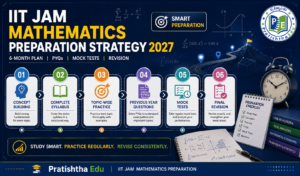
A well-planned preparation strategy is essential for performing well in the IIT JAM Mathematics Exam. Mathematics is a subject where conceptual clarity, regular practice, calculation accuracy, and revision all play an important role. Simply completing the syllabus once is not enough; candidates need to repeatedly solve questions and identify the areas where they make mistakes.
The best IIT JAM Mathematics Preparation strategy depends on how much time a candidate has before the examination, their current level of preparation, and their familiarity with the syllabus. A student starting early can follow a longer preparation cycle, while a candidate with limited time should focus on high-priority topics, revision, previous year questions, and mock tests.
The following strategy can help candidates organize their preparation in a structured manner.
6-Month IIT JAM Mathematics Preparation Plan
Candidates who have around six months for preparation can divide their study into different phases.
Month 1–2: Build Strong Fundamentals
The first two months should focus mainly on understanding concepts and completing the basic portions of the syllabus.
During this phase:
- Read the concepts carefully.
- Understand important definitions and theorems.
- Prepare formula notes.
- Solve basic questions after every topic.
- Identify strong and weak areas.
- Avoid rushing through difficult chapters.
Candidates should focus on developing a strong foundation in areas such as Calculus, Linear Algebra, Differential Equations, Algebra, and Analysis.
The objective during this stage should not be to complete the maximum number of questions. Instead, students should make sure that the concepts they study are actually understood.
Month 3–4: Complete the Syllabus and Increase Practice
Once the fundamentals are clear, candidates should move toward completing the remaining syllabus and increasing the difficulty level of practice.
During these months:
- Complete pending topics.
- Solve topic-wise problems.
- Practice moderate-level questions.
- Start solving previous year questions.
- Revise previously completed chapters.
- Maintain a mistake notebook.
- Take short topic-wise tests.
At this stage, students should gradually reduce their dependence on theory and spend more time solving questions.
Month 5: Previous Year Questions and Mock Tests
The fifth month should focus heavily on examination-oriented practice.
Candidates should:
- Solve previous year question papers.
- Attempt full-length practice tests.
- Analyze incorrect answers.
- Revise weak topics.
- Improve calculation speed.
- Practice time management.
- Revisit important formulas and concepts.
Previous year questions are especially useful because they help students understand how mathematical concepts can be tested in an actual entrance examination.
Month 6: Revision and Final Preparation
The final month should primarily be used for revision and performance improvement.
Candidates should avoid starting large numbers of new resources during this stage.
Focus on:
- Formula revision
- Important concepts
- Weak topics
- Previous mistakes
- Previous year questions
- Mock tests
- Time management
- Accuracy improvement
The final phase should be about strengthening what has already been studied rather than trying to learn everything from the beginning.
3-Month IIT JAM Mathematics Preparation Plan
Students with only three months remaining can still prepare effectively with a focused strategy.
However, they should avoid spending too much time making lengthy notes or studying from multiple resources.
Month 1: Syllabus Coverage and Concept Building
During the first month, identify the most important topics and start systematic preparation.
A practical approach is:
- Review the complete syllabus.
- Identify strong and weak topics.
- Study core concepts.
- Prepare short notes.
- Solve basic and moderate questions.
- Begin topic-wise previous year questions.
Candidates should maintain a realistic daily target instead of trying to complete too many chapters at once.
Month 2: Practice and PYQs
The second month should focus more heavily on problem-solving.
Students should:
- Complete remaining important topics.
- Solve previous year questions.
- Attempt topic-wise tests.
- Revise formulas regularly.
- Analyze mistakes.
- Practice numerical calculations.
If a topic continues to create difficulty, candidates should return to the basic concepts rather than repeatedly attempting difficult questions without understanding the underlying theory.
Month 3: Mock Tests and Revision
The final month should focus on examination-level practice.
Candidates should:
- Take full-length mock tests.
- Analyze test performance.
- Revise weak areas.
- Solve selected previous year questions.
- Review formulas and important results.
- Improve speed and accuracy.
- Follow a consistent sleep and study routine.
The purpose of the final month is to convert knowledge into examination performance.
Daily Study Schedule for IIT JAM Mathematics
There is no single daily timetable that works for every candidate. Students should create a schedule based on their college, work, or other commitments.
A sample study routine can look like this:
| Study Session | Suggested Activity |
| Session 1 | Concept Learning |
| Session 2 | Topic-Wise Problem Solving |
| Session 3 | Previous Year Questions |
| Session 4 | Revision and Formula Practice |
| Session 5 | Mock/Practice Test and Analysis |
Students who are studying full-time may be able to devote more hours, while college students may need a shorter but consistent schedule.
The most important factor is consistency.
Studying for several hours on one day and then taking a long break is generally less effective than maintaining a regular daily routine.
How Many Hours Should You Study?
The required study time depends on the candidate’s current preparation level.
A student with strong fundamentals may need less time to revise concepts and can spend more time on advanced practice. A beginner may need additional time for concept building.
Instead of focusing only on the number of hours, candidates should track measurable progress such as:
- Topics completed
- Questions solved
- PYQs completed
- Mock tests attempted
- Accuracy percentage
- Weak areas identified
- Revision cycles completed
This makes preparation more objective and easier to monitor.
IIT JAM Mathematics Revision Strategy
Revision should be included from the beginning of the preparation.
Many candidates make the mistake of completing the syllabus first and planning revision only during the final weeks. This can make it difficult to remember concepts studied several months earlier.
A better approach is to revise topics at regular intervals.
First Revision
Revise a topic soon after completing it.
Review:
- Important concepts
- Formulas
- Definitions
- Theorems
- Common question types
- Mistakes made during practice
Second Revision
Return to the topic after some time and solve questions without looking at your notes.
This helps determine whether you actually remember the concept or only recognize it after reading the solution.
Final Revision
During the final stage, use short notes and mistake records for quick revision.
Candidates should focus on:
- Frequently forgotten formulas
- Difficult concepts
- Repeated mistakes
- Important results
- Questions that previously took too much time
Previous Year Question Paper Strategy
Previous year question papers should be an important part of IIT JAM Mathematics Preparation.
They help candidates understand:
- The style of questions
- Difficulty level
- Application of concepts
- Time requirements
- Common question patterns
- Areas that require additional practice
How to Solve Previous Year Questions?
Candidates should avoid immediately checking the solution after seeing a difficult question.
Instead:
Step 1: Read the question carefully.
Step 2: Identify the relevant concept.
Step 3: Attempt the problem independently.
Step 4: Check the answer.
Step 5: Analyze the solution.
Step 6: Record the reason for the mistake if your answer was incorrect.
This process provides more learning value than simply reading solved answers.
Maintain a PYQ Mistake Notebook
Candidates can maintain a separate record of questions they:
- Could not solve
- Solved incorrectly
- Took too much time to solve
- Solved using an inefficient method
- Made a calculation error in
Before the examination, this notebook can become a highly useful revision resource.
Mock Test Strategy for IIT JAM Mathematics
Mock tests help candidates evaluate whether their preparation can be converted into actual examination performance.
A mock test should not be treated simply as a test of marks. Its real value comes from analyzing the result afterward.
After every mock test, candidates should check:
- Total score
- Number of correct answers
- Number of incorrect answers
- Questions left unanswered
- Time spent on each section
- Calculation mistakes
- Conceptual mistakes
- Questions that consumed too much time
How to Analyze a Mock Test?
Suppose a candidate gets a question wrong because of a calculation error. That is different from getting it wrong because the underlying concept was not understood.
Therefore, mistakes should be classified.
Conceptual Mistake:
The candidate did not understand the relevant concept.
Calculation Mistake:
The concept was understood, but the calculation was incorrect.
Reading Mistake:
The question was misunderstood.
Time-Management Mistake:
Too much time was spent on a single question.
This classification helps candidates make targeted improvements.
How to Improve Accuracy and Speed?
Accuracy and speed should be developed gradually.
Candidates should not try to solve every question as quickly as possible from the beginning.
A better process is:
Concept Clarity → Correct Solving → Regular Practice → Faster Solving
Once a candidate can consistently solve questions correctly, they can begin working on reducing the time required.
Useful methods include:
- Practicing timed question sets
- Revising formulas regularly
- Learning efficient calculation methods
- Avoiding unnecessary steps
- Identifying familiar question patterns
- Reviewing previous mistakes
Speed without accuracy can reduce the final score, especially when negative marking is involved.
Common IIT JAM Mathematics Preparation Mistakes
Candidates should be aware of common mistakes that can affect their preparation.
1. Studying Without a Plan
Starting random topics every day can make preparation disorganized.
2. Collecting Too Many Books
Using too many resources can create confusion and reduce actual practice time.
3. Ignoring Weak Topics
Students often focus only on subjects they already like. Weak areas should also receive systematic attention.
4. Avoiding Previous Year Questions
PYQs provide valuable examination-oriented practice and should not be postponed until the final days.
5. Taking Too Few Mock Tests
Mock tests help identify problems with speed, accuracy, and question selection.
6. Not Analyzing Mistakes
Simply checking a mock-test score is not enough. Candidates should understand why they lost marks.
7. Leaving Revision Until the End
Regular revision is more effective than trying to revise the complete syllabus at once.
8. Ignoring Time Management
A candidate may know the concepts but still lose marks if too much time is spent on a few questions.
9. Changing Study Material Repeatedly
Once a reliable resource has been selected, candidates should focus on completing and practicing from it instead of continuously switching resources.
10. Focusing Only on Rank or Cut-Off
Candidates should focus on improving their own preparation, accuracy, and consistency rather than constantly worrying about expected cut-offs.
How to Stay Consistent During IIT JAM Mathematics Preparation?
Long-term preparation requires consistency.
Students can maintain consistency by setting weekly goals instead of focusing only on the final examination date.
For example, a weekly target can include:
- Complete two or three topics
- Solve a fixed number of practice questions
- Attempt one or more tests
- Revise completed topics
- Analyze mistakes
- Update short notes
Candidates should also keep one day or a specific time each week for reviewing their progress.
A simple progress tracker can include:
| Preparation Area | Progress |
| Syllabus Completion | ___% |
| PYQs Completed | ___ |
| Mock Tests Attempted | ___ |
| Accuracy | ___% |
| Weak Topics | ___ |
| Revision Cycles | ___ |
This allows candidates to see whether their preparation is actually progressing.
Final Preparation Checklist
Before entering the final stage of IIT JAM Mathematics Preparation, candidates should make sure they have:
- Completed the major syllabus topics
- Revised important concepts
- Practiced previous year questions
- Attempted mock tests
- Analyzed mistakes
- Prepared short revision notes
- Improved calculation accuracy
- Practiced time management
- Identified weak areas
- Revised frequently used formulas and results
The objective of preparation should not simply be to finish the syllabus. The real goal is to reach a stage where you can understand a question, identify the correct approach, solve it accurately, and manage your time effectively.
Candidates who combine structured study, quality Study Material, regular PYQ practice, mock tests, and consistent revision can build a much stronger preparation process.
After completing the preparation strategy, candidates should also understand the previous year IIT JAM Mathematics Cut Off, practice previous year papers, and explore the career opportunities available after postgraduate study in Mathematics.
IIT JAM Mathematics Previous Year Cut Off
The IIT JAM Mathematics Cut Off is an important reference for candidates preparing for the examination. It helps students understand the level of competition and gives them an idea of the minimum qualifying marks required in different categories.
However, candidates should remember that the qualifying cut-off is not the same as the final admission cut-off for every postgraduate program. Admission can depend on factors such as rank, category, program preference, seat availability, institute requirements, and the admission process followed for the particular academic year.
The qualifying cut-off can also change from year to year depending on the difficulty of the examination, candidate performance, and other examination-related factors.
IIT JAM Mathematics Previous Year Cut Off
| Year | General | OBC-NCL / EWS | SC / ST / PwD |
| 2026 | Check Official Result | Check Official Result | Check Official Result |
| 2025 | Check Official Result | Check Official Result | Check Official Result |
| 2024 | Check Official Result | Check Official Result | Check Official Result |
| 2023 | Check Official Result | Check Official Result | Check Official Result |
Candidates should verify the exact category-wise qualifying marks from the official IIT JAM result or admission information before using previous-year cut-off data for preparation decisions.
What Does the IIT JAM Mathematics Cut Off Mean?
The qualifying cut-off represents the minimum marks required to qualify according to the applicable examination rules.
But simply crossing the qualifying cut-off does not guarantee admission to a preferred IIT or postgraduate program.
For example, a candidate may qualify for the examination but still need a considerably better rank or score to obtain admission to a highly preferred program.
Therefore, students should not prepare with the objective of merely crossing the cut-off.
A better approach is to aim for the highest score possible while maintaining accuracy.
How Much Should You Target in IIT JAM Mathematics?
There is no single score that guarantees admission to every Mathematics-related postgraduate program.
The target score should depend on:
- Desired institute
- Preferred postgraduate program
- Category
- Competition
- Examination difficulty
- Previous admission trends
- Seat availability
- Candidate’s overall rank
Instead of setting a target only around the previous qualifying cut-off, candidates should aim to build enough preparation to perform comfortably above the minimum qualifying level.
Regular mock tests can help students establish realistic personal targets.
Qualifying Cut Off vs Admission Cut Off
These two terms should not be confused.
Qualifying Cut Off:
The minimum marks required to qualify according to the applicable examination criteria.
Admission Cut Off:
The level at which candidates may receive admission to a particular program depending on rank, category, seats, preferences, and other admission conditions.
A candidate should therefore consider the complete admission process rather than relying only on the qualifying cut-off.
IIT JAM Mathematics Previous Year Question Papers
Previous year question papers are one of the most valuable resources for IIT JAM Mathematics Preparation.
After completing the syllabus, candidates should regularly solve previous year questions to understand how concepts are applied in an actual examination environment.
PYQs can help students identify:
- Frequently tested concepts
- Different question formats
- Difficulty level
- Calculation requirements
- Time-consuming problems
- Areas where additional revision is required
Solving previous year papers also helps candidates become more comfortable with the style of questions they may face during the examination.
Why Solve IIT JAM Mathematics Previous Year Papers?
Previous year papers provide a practical connection between theoretical preparation and actual examination practice.
A student may understand a chapter from a textbook but still struggle when the same concept appears in an unfamiliar form.
PYQs help bridge this gap.
They can also reveal whether a candidate can:
- Understand the question quickly
- Select the correct method
- Perform calculations accurately
- Manage time
- Avoid unnecessary steps
- Recognize familiar concepts
How to Solve Previous Year Papers Effectively?
Candidates should avoid solving PYQs casually while looking at notes or solutions.
A better approach is to recreate examination conditions as much as possible.
Step 1: Choose a Complete Paper
Select one previous year paper and attempt it as a full test.
Step 2: Set a Time Limit
Try to complete the paper within the prescribed examination duration.
Step 3: Avoid Unnecessary Assistance
Do not immediately check formulas, notes, or solutions while solving.
Step 4: Check the Result
After completing the paper, compare your answers with the correct solutions.
Step 5: Analyze Mistakes
Separate mistakes into conceptual, calculation, reading, and time-management errors.
Step 6: Revise Weak Topics
Return to the relevant chapter and revise the concept behind every repeated mistake.
Step 7: Reattempt Difficult Questions
After revision, solve the difficult questions again without looking at the solution.
This process helps turn previous year papers into a learning resource rather than simply a source of marks.
How Many Previous Year Papers Should You Solve?
There is no fixed number that every candidate must solve.
The objective should be to solve enough papers to understand the examination style and identify recurring weaknesses.
Candidates should prioritize quality of analysis over quantity.
Solving ten papers without analyzing mistakes may be less useful than solving fewer papers carefully and understanding every incorrect question.
Common Mistakes While Solving PYQs
Candidates should avoid:
- Checking solutions too early
- Memorizing answers instead of understanding methods
- Ignoring calculation mistakes
- Not timing themselves
- Skipping difficult questions completely
- Solving papers without analyzing performance
- Repeating the same mistake in multiple tests
A PYQ should be treated as a diagnostic tool. Every paper should tell you something about your current preparation level.
Career Opportunities After IIT JAM Mathematics
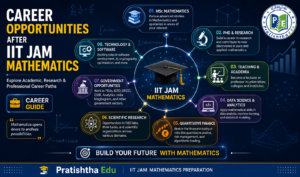
Qualifying IIT JAM Mathematics 2027 can provide an opportunity to pursue postgraduate study in Mathematics and related fields at participating institutes, subject to the applicable admission requirements.
A postgraduate degree can open pathways toward research, teaching, scientific careers, analytics, finance, technology, and other quantitative fields.
The career path ultimately depends on the student’s interests, additional qualifications, skills, and professional goals.
MSc Mathematics
One of the most direct academic pathways after IIT JAM Mathematics is postgraduate study in Mathematics.
An MSc program can help students strengthen their knowledge of areas such as:
- Mathematical Analysis
- Algebra
- Differential Equations
- Geometry
- Mathematical Modelling
- Probability
- Statistics
- Computational Mathematics
Students can use postgraduate study to develop deeper theoretical knowledge as well as research and problem-solving skills.
PhD and Research
Students interested in academic or scientific research can consider pursuing a PhD after completing their postgraduate degree.
Research-oriented careers may involve areas such as:
- Pure Mathematics
- Applied Mathematics
- Computational Mathematics
- Mathematical Modelling
- Statistics
- Interdisciplinary Research
A research career generally requires strong mathematical foundations, analytical ability, research skills, and further academic qualifications.
Teaching and Academia
Mathematics graduates can also explore teaching and academic careers.
Depending on the institution and position, additional qualifications may be required.
Potential areas include:
- School-level Mathematics
- Higher Education
- Competitive Examination Teaching
- Academic Content Development
- Research and Teaching Assistance
Students interested in academia should consider building strong communication skills along with mathematical expertise.
Government Jobs
A Mathematics background can be useful for candidates interested in various government career opportunities.
However, eligibility varies significantly between recruitment examinations and job roles.
Candidates should always check the official eligibility requirements of a particular recruitment examination before applying.
An MSc Mathematics degree can strengthen a candidate’s academic background, but it does not automatically qualify someone for every government position.
Scientific Research
Students with strong Mathematics skills can explore scientific and technical research environments.
Mathematics is widely used in areas such as:
- Mathematical modelling
- Computational research
- Simulation
- Data analysis
- Scientific computing
- Quantitative research
Additional technical skills can make Mathematics graduates more competitive for interdisciplinary opportunities.
Data Science and Analytics
Mathematical concepts such as probability, statistics, linear algebra, and calculus are useful in data-related fields.
Students interested in Data Science or Analytics can combine their Mathematics background with skills such as:
- Python
- Statistics
- Data visualization
- Machine learning
- SQL
- Programming
- Data analysis
An MSc Mathematics degree alone may not be sufficient for every data science role. Candidates should build practical technical skills alongside their academic qualifications.
Quantitative Finance
Mathematics graduates with an interest in finance can explore quantitative areas involving mathematical modelling, probability, statistics, and data analysis.
Potential career areas include:
- Quantitative analysis
- Risk analysis
- Financial modelling
- Statistical analysis
- Investment analytics
Additional knowledge of finance, programming, and statistics can be valuable in this field.
Software and Technology Careers
A Mathematics background can also be useful in technology-related careers, particularly when combined with programming and analytical skills.
Students can develop skills in:
- Programming
- Algorithms
- Data structures
- Machine learning
- Artificial intelligence
- Computational mathematics
- Data analytics
The combination of mathematical reasoning and technical skills can create opportunities across several technology-oriented roles.
Skills to Develop Alongside an MSc Mathematics Degree
Students should not focus exclusively on academic marks. Developing practical and professional skills can improve their career options.
Useful skills include:
Mathematical Skills
- Logical reasoning
- Problem-solving
- Mathematical modelling
- Analytical thinking
Technical Skills
- Python
- R
- SQL
- Data analysis
- Scientific computing
Professional Skills
- Communication
- Presentation
- Research writing
- Teamwork
- Time management
Students should select skills according to their intended career path rather than trying to learn everything at once.
Choosing the Right Career Path After IIT JAM Mathematics
There is no single career path that every Mathematics student should follow.
Students who enjoy theoretical concepts may prefer research or academia.
Those interested in practical applications may explore data science, analytics, technology, modelling, or finance.
Candidates interested in teaching can build communication and subject expertise, while those interested in research can focus on advanced Mathematics and research methodology.
The most important step is to identify your interests early and gradually develop the qualifications and skills required for your chosen path
IIT JAM Mathematics and Long-Term Career Growth
The value of IIT JAM Mathematics goes beyond simply qualifying for an entrance examination.
The preparation process itself can strengthen:
- Logical thinking
- Analytical reasoning
- Problem-solving ability
- Mathematical understanding
- Accuracy
- Time management
These skills can remain useful across academic and professional careers.
However, students should remember that career growth depends on multiple factors, including qualifications, practical skills, experience, specialization, and continuous learning.
After understanding the cut-off, previous year papers, and career opportunities, the next step is to understand how the right coaching and learning environment can support a structured IIT JAM Mathematics Preparation journey.
Why Choose Pratishtha Edu for IIT JAM Mathematics Coaching?
Preparing for a competitive entrance examination requires more than simply completing the syllabus. Candidates need a structured study plan, quality learning resources, regular practice, doubt resolution, and continuous evaluation of their preparation.
Pratishtha Edu provides academic and competitive examination coaching designed to support students through a structured learning approach. For aspirants preparing for IIT JAM Mathematics 2027, the right combination of classroom learning, self-study, practice, and revision can help make preparation more organized and consistent.
Expert Faculty
Experienced faculty can help students understand mathematical concepts in a structured manner and identify the approach required to solve different types of problems.
For a subject such as Mathematics, conceptual clarity is particularly important. Instead of simply memorizing formulas, students need to understand how and when a particular mathematical method should be applied.
Guided teaching can help students identify difficult concepts, understand problem-solving methods, and improve their confidence over time.
Online and Offline Classes
Students have different learning preferences and schedules. Online and offline learning options can provide flexibility depending on individual requirements.
Candidates who prefer classroom interaction can benefit from a structured offline learning environment, while students who require greater flexibility may prefer online learning.
The objective is to maintain consistency in IIT JAM Mathematics Preparation regardless of the learning mode selected.
IIT JAM Mathematics Study Material
Good study material can make preparation more organized by bringing important concepts, explanations, formulas, and practice questions together.
Students can use Study Material alongside their regular classes and self-study routine to revise concepts and strengthen their understanding.
However, study material should be used as a learning resource rather than as a replacement for problem-solving practice.
Test Series and Mock Tests
Regular tests are important for understanding the actual level of preparation.
A good test series can help candidates:
- Evaluate their preparation
- Improve time management
- Identify weak topics
- Improve accuracy
- Practice different question types
- Develop examination confidence
After every test, students should analyze their performance instead of focusing only on the final score.
Previous Year Question Practice
Previous year questions help candidates understand how mathematical concepts are tested in an entrance examination.
Regular PYQ practice can help students become familiar with:
- Question patterns
- Concept application
- Calculation requirements
- Difficulty levels
- Time management
Students should combine previous year papers with their regular study plan rather than leaving them entirely for the final weeks.
Doubt Sessions
Doubt resolution is an important part of Mathematics preparation.
Students may understand a concept partially but struggle when they encounter a difficult problem. Regular doubt sessions can help them clarify these issues before they become repeated weaknesses.
Candidates should make a habit of maintaining a list of difficult questions and discussing them during doubt sessions.
Personal Mentorship
Every candidate has different strengths and weaknesses.
Some students may have strong conceptual knowledge but need to improve speed, while others may require additional support with fundamental concepts.
Personal guidance can help students identify their preparation gaps and make appropriate adjustments to their study schedule.
Supportive Learning Environment
A focused learning environment can help students maintain a regular preparation routine.
Along with coaching and study material, students can also use a dedicated self-study environment such as Pratishtha Library for focused preparation and revision.
Candidates should remember that coaching is only one part of the preparation process. Regular self-study, practice, revision, and consistency remain equally important.
Frequently Asked Questions About IIT JAM Mathematics
1. What is IIT JAM Mathematics?
IIT JAM Mathematics is the Mathematics paper of the Joint Admission Test for Masters (JAM). It is an entrance examination through which eligible candidates can compete for admission to postgraduate programs offered by participating IITs and other institutes, subject to applicable admission requirements.
2. Who is eligible for IIT JAM Mathematics 2027?
Eligibility depends on the applicable examination and postgraduate program requirements. Candidates should have a qualifying undergraduate degree or be completing an eligible degree according to the current rules. Students should also check the specific subject requirements of the postgraduate program they want to join.
3. Is there any age limit for IIT JAM Mathematics?
Candidates should check the latest official IIT JAM notification for the applicable age-related rules. Eligibility conditions can vary depending on the examination and admission requirements.
4. Can final-year students apply for IIT JAM Mathematics?
Final-year undergraduate students may be eligible to appear for IIT JAM, subject to the applicable rules. However, they must satisfy the degree completion and document requirements within the prescribed admission timeline.
5. What is the IIT JAM Mathematics Exam Pattern?
The IIT JAM Mathematics paper is conducted in Computer-Based Test mode and includes different question types, including Multiple Choice Questions, Multiple Select Questions, and Numerical Answer Type questions.
Candidates should check the latest official examination notification for the exact marking scheme and question distribution applicable to their examination cycle.
6. Is there negative marking in IIT JAM Mathematics?
Negative marking can apply to specified Multiple Choice Questions. The exact marking rules may differ according to the question type.
Candidates should carefully review the official examination instructions before attempting the paper.
7. How many questions are asked in IIT JAM Mathematics?
The examination contains questions from different sections and question types. The exact question distribution should be checked in the latest official examination pattern released for IIT JAM Mathematics 2027.
8. What is the total marks of IIT JAM Mathematics?
The IIT JAM paper is structured around a total of 100 marks. Candidates should also understand the marking scheme for individual question types because correct question selection is important for maximizing the score.
9. Which topics are most important for IIT JAM Mathematics?
Important areas of preparation include Calculus, Linear Algebra, Differential Equations, Real Analysis, Algebra, Vector Calculus, Probability and Statistics, and other topics prescribed in the syllabus.
Candidates should prepare the complete syllabus rather than relying only on a few high-priority topics.
10. Which books are best for IIT JAM Mathematics?
The best book depends on the candidate’s preparation level and the topic being studied. Candidates can use reliable Mathematics textbooks for conceptual understanding, problem-solving resources for practice, previous year question papers, and quality Study Material for structured preparation.
Students should avoid collecting too many books and instead focus on completing selected resources thoroughly.
11. How difficult is IIT JAM Mathematics?
The difficulty level can vary from year to year. The examination requires conceptual clarity, mathematical reasoning, numerical accuracy, and effective time management.
Students with consistent preparation, regular practice, and a strong understanding of fundamentals can gradually improve their ability to handle examination-level questions.
12. How many months are enough for IIT JAM Mathematics Preparation?
The required preparation time depends on the candidate’s current mathematical background, available study time, and target performance.
Students starting early may follow a six-month or longer plan, while candidates with limited time can follow a focused three-month strategy involving syllabus prioritization, PYQs, revision, and mock tests.
13. Are previous year papers important for IIT JAM Mathematics?
Yes. Previous year papers are useful for understanding question patterns, difficulty levels, concept application, and time requirements.
Candidates should solve PYQs under timed conditions and analyze their mistakes after completing each paper.
14. How many mock tests should I attempt?
There is no fixed number of mock tests that every candidate must attempt.
The quality of analysis is more important than simply counting tests. Candidates should gradually increase mock-test practice and analyze incorrect answers, calculation mistakes, time-management issues, and weak topics after every test.
15. What is a good score in IIT JAM Mathematics?
A good score depends on factors such as examination difficulty, competition, category, institute preference, program preference, and admission requirements.
Instead of preparing only to cross a particular cut-off, candidates should aim to maximize their score through strong conceptual preparation and accurate problem-solving.
16. What are the career opportunities after MSc Mathematics?
After completing MSc Mathematics, students can explore different academic and professional pathways, depending on their interests and additional qualifications.
Possible areas include:
- Research
- PhD
- Teaching
- Academia
- Data Science
- Analytics
- Quantitative Finance
- Scientific Computing
- Government-related opportunities
- Technology and software-related careers
Additional technical or professional skills can improve opportunities in specialized fields.
17. Is coaching necessary for IIT JAM Mathematics?
Coaching is not compulsory for every student. Some candidates can prepare effectively through self-study using textbooks, study material, PYQs, and mock tests.
However, structured coaching can be useful for students who need expert guidance, regular classes, doubt support, test practice, mentorship, or a disciplined study environment.
18. Can I prepare for IIT JAM Mathematics without coaching?
Yes. Candidates can prepare through self-study if they maintain a structured schedule and use reliable resources.
A self-study plan should include:
- Complete syllabus coverage
- Concept building
- Problem-solving practice
- Previous year papers
- Mock tests
- Revision
- Mistake analysis
Consistency is particularly important for self-study preparation.
19. What is the difference between IIT JAM Mathematics and GATE Mathematics?
IIT JAM and GATE are different entrance examinations with different purposes, eligibility requirements, examination structures, and admission opportunities.
IIT JAM is primarily associated with postgraduate admissions through participating institutes, while GATE serves multiple purposes, including postgraduate admissions and other opportunities depending on the qualifying paper and institute.
Candidates should compare the latest official eligibility and examination patterns before deciding which examination is suitable for their academic goals.
20. How can I improve my IIT JAM Mathematics score?
To improve your score, focus on the following areas:
- Strengthen fundamental concepts
- Complete the prescribed syllabus
- Solve questions regularly
- Practice previous year papers
- Attempt mock tests
- Analyze mistakes
- Improve calculation accuracy
- Revise consistently
- Manage examination time effectively
- Focus on weak topics
The goal should be continuous improvement rather than expecting a major score increase overnight.
Final Thoughts
Preparing for IIT JAM Mathematics 2027 is a long-term process that requires consistency, conceptual clarity, regular practice, and proper revision. Candidates should begin by understanding the complete IIT JAM Mathematics Syllabus 2027, followed by systematic topic-wise preparation.
A strong preparation strategy should include concept building, problem-solving, previous year question practice, mock tests, mistake analysis, and multiple revision cycles. Candidates should also keep track of official examination announcements and verify important information such as eligibility, dates, exam pattern, and admission requirements from reliable sources.
Students should avoid depending entirely on expected cut-offs or shortcuts. Instead, the focus should be on building strong mathematical fundamentals and improving accuracy and speed through regular practice.
If you are looking for structured guidance for IIT JAM Mathematics Preparation, you can explore the academic support available at Pratishtha Edu. Students can combine coaching, self-study, quality Study Material, regular tests, and focused revision to create a disciplined preparation routine.
A dedicated study environment such as Pratishtha Library can also help students maintain consistency and concentrate on their preparation.
Start your preparation with a clear plan, complete the syllabus systematically, practice previous year questions, take regular mock tests, and revise consistently. With disciplined preparation and the right approach, you can move confidently toward your IIT JAM Mathematics goals.
Ready to begin your preparation? Explore the available learning support at Pratishtha Edu, join a suitable preparation program, and start working toward your postgraduate Mathematics goals.
Leave a Reply