
Introduction
Psychology is an important subject for students who want to pursue careers in teaching, research, and higher education. For postgraduate students planning to pursue academic opportunities, the UGC NET Psychology 2027 examination can be an important step towards achieving their career goals. The examination tests a candidate’s understanding of Psychology, as well as general teaching and research aptitude.
The UGC NET Psychology Exam is conducted through two papers. Paper 1 focuses on general areas such as teaching aptitude, research aptitude, reasoning ability, communication, data interpretation, and higher education awareness. Paper 2 is subject-specific and assesses the candidate’s knowledge of Psychology. Therefore, effective preparation requires attention to both papers rather than focusing only on the subject-specific syllabus.
Before beginning preparation, candidates should carefully understand the UGC NET Psychology Syllabus 2027. A detailed understanding of the syllabus helps candidates divide the subject into different units, identify important topics, and create a realistic study plan. It also helps prevent unnecessary preparation outside the prescribed syllabus.
Psychology preparation involves several areas, including research methods, psychological statistics, biological foundations of behaviour, cognitive processes, developmental psychology, social psychology, personality, counselling, clinical concepts, and other important areas. Candidates need to develop conceptual clarity instead of depending only on memorisation.
Along with studying concepts, regular practice is equally important. Solving UGC NET Psychology Previous Year Questions helps candidates understand how questions are framed and how theoretical concepts are tested. Mock tests and revision can further improve accuracy, speed, and confidence.
This complete guide to UGC NET Psychology 2027 covers the major aspects candidates need to understand before starting their preparation. It includes eligibility criteria, important dates, exam pattern, complete syllabus, important topics, preparation strategy, previous year questions, study resources, and career opportunities.
What is UGC NET Psychology 2027?
UGC NET Psychology 2027 is the Psychology subject examination conducted under the University Grants Commission National Eligibility Test framework. It is intended for candidates who want to pursue applicable teaching and research opportunities in higher education, subject to the eligibility conditions and qualification categories specified by the concerned authorities.
The examination evaluates candidates through two papers. While Paper 1 assesses general teaching and research aptitude, Paper 2 focuses on the candidate’s selected subject, which in this case is Psychology.
Candidates preparing for Psychology should develop a strong understanding of both theoretical and research-oriented concepts. The subject is not limited to memorising definitions or names of psychologists. Questions can require candidates to understand theories, compare concepts, interpret research-related information and apply psychological principles.
A structured approach is therefore important from the beginning. Candidates should first understand the syllabus, then divide it into manageable sections and prepare each topic systematically.
UGC NET Psychology Full Form
UGC NET stands for University Grants Commission National Eligibility Test.
The examination is conducted as a national-level eligibility test for applicable academic and research categories. Candidates should always refer to the latest official examination notification for current rules, eligibility conditions, and qualification requirements.
UGC NET Psychology Subject
Psychology is one of the subjects available under the UGC NET examination. Candidates planning to appear for the Psychology paper should verify the latest UGC NET subject list and subject code before completing the application form.
Checking the current official information is important because candidates need to select the correct subject while applying for the examination.
Who Should Appear for UGC NET Psychology?
UGC NET Psychology can be considered by candidates who have the required postgraduate qualification and satisfy the applicable eligibility conditions.
It can be particularly relevant for students and graduates who are interested in:
- Teaching Psychology in higher education
- Academic research
- Junior Research Fellowship, where applicable
- PhD and doctoral research
- University-level academic careers
- Research-oriented opportunities in Psychology
- Developing advanced knowledge of psychological theories and research
However, completing a postgraduate degree alone should not be considered sufficient without checking the current eligibility requirements. Candidates should verify qualifications, minimum marks, category-based relaxation, and other conditions from the latest official notification before applying.
Why is UGC NET Psychology Important?
The UGC NET Psychology Exam can be an important examination for candidates planning an academic or research-oriented career. It provides a structured opportunity to demonstrate knowledge of Psychology and develop a stronger understanding of research and teaching-related concepts.
Preparing for the examination can also help candidates revise important postgraduate-level concepts systematically. Topics such as research methodology, psychological testing, statistics, cognitive processes, personality, social behaviour and developmental psychology require a clear understanding of concepts and their applications.
For candidates interested in higher education, the examination can therefore become part of a longer academic journey involving teaching, research, doctoral studies and professional development.
UGC NET Psychology 2027 Highlights
Before starting detailed preparation, candidates should understand the basic structure of the examination.
| Particular | Details |
| Examination | UGC NET |
| Subject | Psychology |
| Paper 1 | Teaching & Research Aptitude |
| Paper 2 | Psychology |
| Examination Mode | Computer-Based Test |
| Level | National Level |
| Papers | Paper 1 and Paper 2 |
| Eligibility | As per the latest official UGC NET rules |
| Exam Duration | As specified in the latest official notification |
| Marking Scheme | As specified in the latest official notification |
| Negative Marking | Candidates should check the latest official guidelines |
| Official Information | UGC NET/NTA official sources |
Note: Examination dates, eligibility conditions, marking scheme, duration, and other details may be updated by the examination authorities. Candidates should verify the latest official notification before applying for UGC NET Psychology 2027.
Understanding these basic highlights gives candidates a clear starting point. The next step is to check whether they fulfil the eligibility requirements and then study the examination pattern in detail.
What Makes UGC NET Psychology Preparation Different?
Psychology is a broad subject that combines theoretical knowledge with research-based concepts. Candidates may encounter questions related to psychological theories, researchers, experiments, research methodology, statistics, psychological assessment, and practical applications.
Because of this, preparation should not depend on a single method. Candidates should combine:
- Concept-based learning
- Unit-wise syllabus coverage
- Short revision notes
- Previous year question practice
- Mock tests
- Regular revision
- Error analysis
Candidates should also avoid studying randomly from multiple sources without first understanding the prescribed syllabus. A focused preparation plan can make it easier to track progress and identify unfinished topics.
Start With the Syllabus
The first step in UGC NET Psychology Preparation should be understanding the complete syllabus. Candidates should identify every unit and divide larger topics into smaller study sections.
For example, instead of trying to complete an entire unit in one sitting, candidates can divide it into concepts, theories, important psychologists, applications, and research-related areas. This makes revision easier and allows candidates to measure their progress.
Focus on Conceptual Clarity
Psychology includes several theories and concepts that can appear similar at first. Candidates should understand the differences between related concepts rather than memorising isolated definitions.
Creating comparison tables, short notes and concept maps can be useful for topics that involve multiple theories or approaches.
Combine Learning With Practice
After completing a topic, candidates should solve relevant questions. This helps determine whether they can actually apply what they have studied.
If a candidate repeatedly makes mistakes in a particular topic, that area should be added to the revision list rather than simply moving on to the next chapter.
UGC NET Psychology Eligibility Criteria 2027
Before applying for the UGC NET Psychology 2027 examination, candidates should carefully check the eligibility requirements. Meeting the eligibility criteria is important because candidates who do not satisfy the prescribed conditions may not be considered eligible for the relevant qualification category.
The eligibility criteria generally consider factors such as educational qualification, minimum marks, age requirements, and applicable relaxation rules. Since the official requirements can be updated, candidates should always verify the latest information before submitting the application form.
Educational Qualification
Candidates appearing for UGC NET Psychology should have the required postgraduate qualification in accordance with the applicable UGC NET rules.
Candidates who have completed or are pursuing a qualifying master’s degree in Psychology or an eligible related discipline should check the current subject-specific eligibility requirements before applying.
The degree should be obtained from a recognised university or institution as specified under the applicable rules.
Candidates should not assume that every Psychology-related postgraduate qualification automatically makes them eligible for the Psychology subject. The subject and qualification requirements should be checked carefully against the latest official notification.
Minimum Marks Required
Candidates must satisfy the prescribed minimum percentage requirement in the qualifying postgraduate examination.
The minimum marks requirement can vary according to the candidate’s category. Therefore, candidates should check the latest official UGC NET notification for the applicable percentage and category-wise relaxation.
Those who are still pursuing their qualifying postgraduate degree may also be eligible under certain conditions. However, they should carefully read the current notification regarding provisional eligibility and the deadline for completing the required qualification.
Age Limit
The age criteria depend on the qualification category for which a candidate is appearing.
Candidates applying for Junior Research Fellowship (JRF) should pay particular attention to the prescribed age limit and applicable relaxation. The age requirement can be different for candidates seeking only the relevant teaching eligibility.
Since age-related rules can be revised, candidates should not rely on information from old examination cycles. The latest official notification should be treated as the final source for the applicable age criteria.
Age Relaxation
Age relaxation may be available to candidates belonging to eligible categories according to the rules applicable to the examination.
The extent of relaxation depends on the candidate’s category and the qualification category being pursued. Candidates should keep the necessary category or supporting documents ready where applicable.
Instead of assuming eligibility based on general relaxation rules, candidates should verify the exact conditions mentioned in the latest UGC NET notification.
Eligibility for JRF
Candidates who want to be considered for Junior Research Fellowship need to satisfy the applicable JRF eligibility requirements in addition to meeting the general examination conditions.
JRF candidates should pay special attention to the prescribed age criteria and other requirements mentioned in the latest notification.
Qualifying for UGC NET does not automatically mean that every candidate receives JRF. The applicable qualification category depends on the candidate’s performance and the rules used by the examination authorities.
Who Can Apply for UGC NET Psychology?
Candidates who satisfy the prescribed educational qualification, minimum marks, and other applicable conditions can apply for the Psychology subject.
Before filling out the application form, candidates should check:
- Whether their postgraduate qualification meets the eligibility requirements
- Whether they satisfy the minimum marks criteria
- Whether they meet the applicable age requirement for JRF, if relevant
- Whether they qualify for any applicable relaxation
- Whether they are selecting the correct UGC NET subject
- Whether all required documents and information are available
Checking these requirements before applying can help candidates avoid unnecessary mistakes during the application process.
UGC NET Psychology 2027 Important Dates
Important dates help candidates plan their preparation and complete each application-related activity within the prescribed deadline. Since the official examination schedule for 2027 may be announced or updated by the examination authorities, candidates should verify every date through the latest official notification.
| Event | Expected/Official Date |
| UGC NET Notification | To Be Announced |
| Application Form Begins | To Be Announced |
| Last Date to Apply | To Be Announced |
| Application Fee Payment | To Be Announced |
| Application Correction Window | To Be Announced |
| Admit Card | To Be Announced |
| UGC NET Psychology Examination | To Be Announced |
| Provisional Answer Key | To Be Announced |
| Answer Key Challenge Window | To Be Announced |
| Result Declaration | To Be Announced |
| Certificate/E-Certificate | As per official process |
Why Should Candidates Track Important Dates?
Candidates should keep track of the complete examination timeline instead of focusing only on the exam date.
Missing the application deadline or correction window can create unnecessary problems. Similarly, candidates should regularly check official announcements regarding admit cards, examination schedules, answer keys, and results.
A simple preparation calendar can help candidates record important deadlines and allocate sufficient time for revision before the examination.
Note: The dates listed above should be updated after the official UGC NET 2027 notification is released. Do not publish unverified dates as final examination dates.
UGC NET Psychology Exam Pattern 2027
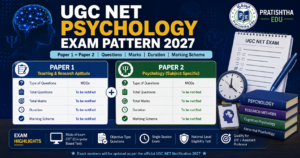
Understanding the UGC NET Psychology Exam Pattern 2027 is essential before starting detailed preparation. The examination consists of Paper 1 and Paper 2, and candidates should prepare for both components according to the latest official examination structure.
Paper 1 tests general teaching and research aptitude, while Paper 2 evaluates subject-specific knowledge of Psychology.
Paper 1 Exam Pattern
Paper 1 is common for candidates appearing for different UGC NET subjects. It focuses on general abilities that are relevant to teaching and research.
Major areas covered under Paper 1 include:
- Teaching Aptitude
- Research Aptitude
- Comprehension
- Communication
- Mathematical Reasoning and Aptitude
- Logical Reasoning
- Data Interpretation
- Information and Communication Technology
- People, Development and Environment
- Higher Education System
Candidates should not ignore Paper 1 simply because their primary subject is Psychology. A balanced preparation strategy should allocate sufficient time to both papers.
Paper 2 Psychology Exam Pattern
Paper 2 is the subject-specific component of the examination.
For Psychology candidates, Paper 2 focuses on concepts and topics prescribed under the UGC NET Psychology Syllabus 2027.
The paper can cover areas related to psychological theories, research methods, biological foundations, cognitive processes, developmental psychology, social psychology, personality, psychological assessment, and other prescribed areas.
Candidates should use the latest official syllabus as the foundation for Paper 2 preparation.
Number of Questions
The number of questions, marks, and detailed examination structure should always be verified from the latest official UGC NET notification before finalising preparation plans.
Candidates should avoid relying on outdated examination information because the authorities may revise examination-related details.
Total Marks
The examination carries marks across Paper 1 and Paper 2 according to the applicable UGC NET examination pattern.
Candidates should understand the distribution of questions and marks before beginning full-length mock tests. This helps them create a suitable time-management strategy.
Examination Duration
Candidates should check the latest official notification for the current examination duration and session structure.
Knowing the available time is particularly important when practising full-length mock tests because candidates should attempt practice tests under conditions similar to the actual examination.
Marking Scheme
Candidates should understand how marks are awarded for correct answers and whether any negative marking applies under the current examination pattern.
Before appearing for the examination, candidates should verify the latest official marking scheme rather than relying on information from previous examination cycles.
Paper 1 vs Paper 2: Quick Comparison
| Feature | Paper 1 | Paper 2 |
| Focus | Teaching & Research Aptitude | Psychology |
| Nature | General | Subject-Specific |
| Preparation | Aptitude, reasoning, teaching and research concepts | Psychology concepts and theories |
| Questions | As per the latest official pattern | As per the latest official pattern |
| Importance | Common component | Core subject component |
| Preparation Approach | Practice + concept building | Detailed subject preparation + revision |
Candidates should prepare both papers simultaneously rather than completing one paper entirely and leaving the other for the final stage.
A practical approach is to dedicate regular study sessions to Psychology while also allocating fixed weekly time for Paper 1.
How to Use the Exam Pattern for Preparation
Once candidates understand the examination structure, they can build a more realistic timetable.
For example, a candidate can divide the weekly schedule into:
- Paper 2: Core Psychology concepts
- Paper 1: Teaching and research aptitude
- Revision: Previously completed topics
- Practice: Previous year questions
- Testing: Topic-wise or full-length mock tests
This approach keeps preparation balanced and reduces the possibility of ignoring Paper 1 until the final weeks.
UGC NET Psychology Syllabus 2027
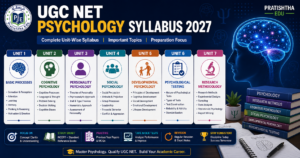
The UGC NET Psychology Syllabus 2027 is the foundation of Paper 2 preparation. Psychology is a broad subject, so candidates should understand the syllabus carefully before creating a study plan. A unit-wise approach makes it easier to organise topics, track progress and revise important concepts systematically.
The syllabus covers major areas of Psychology, including research methodology, psychological statistics, biological foundations of behaviour, cognitive processes, personality, developmental psychology, social psychology, psychological testing and assessment, and other important areas of the discipline.
Candidates should study every unit carefully rather than preparing only a few familiar topics. At the same time, previous year questions and regular mock-test analysis can help identify topics that require additional revision.
Note: Candidates should always compare the topics below with the latest official UGC NET Psychology syllabus before beginning preparation, as the examination authorities may update the syllabus.
Unit 1: Emergence of Psychology
This unit introduces the development of Psychology as a scientific discipline and helps candidates understand the major schools and approaches that influenced the field.
Important areas include:
- Historical development of Psychology
- Major schools of Psychology
- Structuralism
- Functionalism
- Behaviourism
- Gestalt Psychology
- Psychoanalytic approach
- Humanistic approach
- Cognitive approach
- Contemporary perspectives in Psychology
- Major psychologists and their contributions
Candidates should focus on understanding how different approaches developed and how their assumptions differ from one another.
Unit 2: Research Methodology and Statistics
Research methodology is an important area for Psychology aspirants because psychological research depends on systematic methods of collecting, analysing and interpreting data.
Important topics include:
- Scientific method
- Research process
- Research problems and hypotheses
- Variables
- Experimental and non-experimental research
- Correlational research
- Survey research
- Qualitative and quantitative approaches
- Sampling methods
- Research designs
- Data collection methods
- Reliability and validity
- Research ethics
- Descriptive statistics
- Measures of central tendency
- Measures of variability
- Correlation
- Inferential statistics
- Basic statistical concepts
Candidates should combine conceptual understanding with numerical practice wherever required.
Unit 3: Psychological Processes
This area focuses on basic psychological processes involved in how individuals receive, process, store and use information.
Important topics include:
- Sensation
- Perception
- Attention
- Learning
- Memory
- Thinking
- Problem solving
- Reasoning
- Decision making
- Language
- Intelligence
- Creativity
Candidates should understand the major theories and experiments associated with these processes and learn how different concepts are related.
Unit 4: Biological Basis of Behaviour
The biological foundation of behaviour explains the relationship between physiological processes and psychological functioning.
Important topics include:
- Nervous system
- Brain structure and functions
- Neurons
- Neurotransmitters
- Endocrine system
- Hormones and behaviour
- Genetics and behaviour
- Brain and cognition
- Biological basis of emotions
- Biological basis of learning and memory
- Sleep and biological rhythms
- Psychophysiological processes
Candidates should understand the relationship between biological systems and psychological behaviour instead of memorising isolated facts.
Unit 5: Personality
Personality is an important area of Psychology and includes different theoretical approaches explaining individual differences.
Important topics include:
- Concept of personality
- Psychoanalytic theories
- Psychodynamic approaches
- Trait theories
- Type theories
- Behavioural approaches
- Social learning approaches
- Humanistic theories
- Cognitive approaches
- Personality assessment
- Projective techniques
- Objective techniques
- Personality development
Candidates should pay attention to major theorists, their concepts and differences between various approaches.
Unit 6: Developmental Psychology
Developmental Psychology examines changes in human behaviour and psychological functioning across different stages of life.
Important topics include:
- Principles of development
- Prenatal development
- Infancy
- Childhood
- Adolescence
- Adulthood
- Ageing
- Cognitive development
- Emotional development
- Social development
- Moral development
- Language development
- Major theories of development
Candidates should understand developmental theories and the major characteristics associated with different stages of life.
Unit 7: Social Psychology
Social Psychology examines how individuals think, feel, and behave in social situations.
Important topics include:
- Social perception
- Social cognition
- Attitudes
- Attitude formation and change
- Attribution
- Prejudice
- Stereotypes
- Discrimination
- Interpersonal attraction
- Aggression
- Prosocial behaviour
- Group processes
- Leadership
- Conformity
- Obedience
- Social influence
Candidates should understand important theories and research findings related to social behaviour.
Unit 8: Motivation, Emotion and Intelligence
This area deals with psychological factors that influence behaviour, performance and individual functioning.
Important topics include:
- Concept of motivation
- Major theories of motivation
- Achievement motivation
- Intrinsic and extrinsic motivation
- Concept of emotion
- Theories of emotion
- Emotional expression
- Emotional regulation
- Intelligence
- Theories of intelligence
- Measurement of intelligence
- Emotional intelligence
- Creativity
Comparing different theories can help candidates remember their major assumptions and applications.
Unit 9: Psychological Testing and Assessment
Psychological testing is an important area because assessment tools are widely used in research, education, counselling and clinical settings.
Important topics include:
- Meaning and purpose of psychological assessment
- Types of psychological tests
- Intelligence tests
- Aptitude tests
- Personality tests
- Achievement tests
- Interest inventories
- Projective techniques
- Reliability
- Validity
- Norms
- Standardisation
- Test construction
- Ethical considerations in psychological assessment
Candidates should understand the characteristics and applications of different assessment methods.
Unit 10: Applied Psychology
Applied Psychology connects psychological concepts with practical situations and real-world problems.
Important areas may include:
- Educational Psychology
- Industrial and organisational applications
- Health Psychology
- Environmental Psychology
- Community Psychology
- Counselling applications
- Psychological interventions
- Psychology in social and organisational settings
- Application of psychological principles in everyday life
Candidates should focus on understanding how psychological concepts can be applied to practical situations.
How to Study the UGC NET Psychology Syllabus
Candidates should avoid trying to complete the entire syllabus at once. A better approach is to divide each unit into smaller topics and complete them systematically.
A simple unit-wise strategy can include:
- Read the complete unit before beginning detailed preparation.
- Identify major theories, concepts, and researchers.
- Prepare short and revision-friendly notes.
- Practise questions after completing each topic.
- Mark difficult topics for additional revision.
- Revise completed units regularly.
- Use mock tests to evaluate preparation.
- Analyse mistakes and return to weak areas.
The syllabus should remain the central reference throughout preparation. Candidates should periodically review the completed and remaining units so that no major area is ignored.
Important Areas to Prioritise
While every prescribed unit deserves attention, candidates can prioritise areas where they need stronger conceptual understanding and question-solving practice.
Some commonly important areas include:
- Research Methodology
- Statistics
- Cognitive Psychology
- Biological Basis of Behaviour
- Personality
- Developmental Psychology
- Social Psychology
- Psychological Testing
- Motivation and Emotion
- Intelligence
- Applied Psychology
Candidates should not completely ignore other syllabus areas simply because certain topics appear more familiar. A balanced preparation strategy should cover the complete syllabus before moving into intensive revision.
UGC NET Psychology Important Topics 2027

After reviewing the complete syllabus, candidates should identify the topics that require more attention in their preparation. The UGC NET Psychology Important Topics 2027 can help candidates organise their revision and decide which concepts need additional practice.
However, candidates should not prepare only selected topics. The complete syllabus should be covered first, followed by focused revision of important and frequently practised areas.
Research Methodology and Statistics
Research methodology is an important area because it underpins psychological research. Candidates should understand both theoretical concepts and basic statistical applications.
Important areas include:
- Research designs
- Experimental and non-experimental research
- Variables and hypotheses
- Sampling techniques
- Data collection methods
- Reliability and validity
- Research ethics
- Descriptive statistics
- Measures of central tendency
- Measures of variability
- Correlation
- Basic inferential statistics
Candidates should practise numerical and analytical questions regularly wherever required.
Cognitive Psychology
Cognitive Psychology focuses on mental processes involved in acquiring, processing and using information.
Important areas include:
- Attention
- Perception
- Learning
- Memory
- Thinking
- Problem solving
- Reasoning
- Decision making
- Language
- Cognitive development
Candidates should focus on major theories, experiments and differences between related concepts.
Biological Basis of Behaviour
This area requires an understanding of the relationship between biological processes and behaviour.
Important topics include:
- Neurons
- Nervous system
- Brain structures
- Neurotransmitters
- Endocrine system
- Hormones
- Genetics and behaviour
- Sleep and biological rhythms
- Biological basis of emotion
- Biological basis of learning and memory
Diagrams and comparison notes can be useful when revising brain structures and their functions.
Personality
Personality theories are another important area for Psychology preparation.
Candidates should revise:
- Psychoanalytic theories
- Psychodynamic approaches
- Trait theories
- Behavioural approaches
- Social learning approaches
- Humanistic theories
- Cognitive approaches
- Personality assessment
- Projective techniques
- Objective techniques
A useful preparation method is to create a comparison table containing the theorist, major concepts, assumptions and important contributions of each theory.
Developmental Psychology
Candidates should understand development across different stages of life and the major theories associated with psychological development.
Important areas include:
- Prenatal development
- Infancy
- Childhood
- Adolescence
- Adulthood
- Ageing
- Cognitive development
- Emotional development
- Social development
- Moral development
- Language development
Theories should be studied along with their stages, concepts, and major contributors.
Social Psychology
Social Psychology deals with individual behaviour in social contexts.
Important topics include:
- Attitudes
- Social cognition
- Attribution
- Social perception
- Prejudice
- Stereotypes
- Discrimination
- Interpersonal attraction
- Aggression
- Prosocial behaviour
- Group processes
- Leadership
- Conformity
- Obedience
- Social influence
Candidates should understand how different social processes influence individual and group behaviour.
Psychological Testing and Assessment
Psychological testing requires both conceptual understanding and familiarity with different types of assessment.
Important topics include:
- Intelligence tests
- Aptitude tests
- Personality tests
- Achievement tests
- Interest inventories
- Projective techniques
- Reliability
- Validity
- Norms
- Standardisation
- Test construction
- Psychological assessment
Candidates should understand the purpose, characteristics and applications of different psychological tests.
Motivation, Emotion and Intelligence
These topics involve several theories and concepts that can be confusing if studied only through memorisation.
Candidates should revise:
- Major theories of motivation
- Achievement motivation
- Intrinsic and extrinsic motivation
- Theories of emotion
- Emotional regulation
- Intelligence
- Theories of intelligence
- Emotional intelligence
- Creativity
Comparison tables can make it easier to remember different theories and their major concepts.
How to Identify High-Priority Topics
There is no substitute for covering the prescribed syllabus, but candidates can use previous year questions and mock-test performance to identify areas that require more attention.
A simple method is to maintain three categories:
Strong Topics:
Topics where you consistently answer questions correctly.
Moderate Topics:
Topics where you understand the concepts but make occasional mistakes.
Weak Topics:
Topics where concepts are unclear, or question accuracy is low.
Candidates should spend more revision time on weak and moderate topics while continuing regular practice of strong areas.
Best Books for UGC NET Psychology 2027
Choosing the right books can make preparation more organised. Candidates should avoid collecting too many books and attempting to study everything from every source.
Instead, choose resources that:
- Follow the prescribed syllabus
- Explain concepts clearly
- Include practice questions
- Provide previous year questions
- Offer useful explanations
- Are reasonably updated
Psychology Subject Books
A good Psychology preparation book should cover the major areas included in the prescribed syllabus. Candidates should compare the book’s contents with the latest syllabus before purchasing or using it.
Previous Year Question Books
Previous year question books can help candidates understand question patterns and practise applying concepts. Candidates should not use PYQs only at the end of preparation.
A better approach is to solve questions after completing individual units and then revisit them during revision.
Research Methodology and Statistics Books
Candidates who find research methodology or statistics difficult can use a dedicated reference book for additional explanation and practice.
The goal should be to understand the concepts rather than simply memorising statistical formulas.
UGC NET Psychology Study Material
Reliable UGC NET Psychology Study Material can help candidates organise their preparation and reduce the time spent searching for information from multiple sources.
Study material should ideally include:
- Unit-wise notes
- Important concepts
- Theories and researchers
- Previous year questions
- Practice questions
- Revision notes
- Mock tests
- Research methodology concepts
- Psychological statistics practice
Candidates should compare any study material with the latest syllabus to ensure that important topics are not missing.
Using one primary study source along with selected reference books is generally more practical than collecting a large number of resources.
How to Make Effective UGC NET Psychology Notes
Short notes can make revision considerably easier, especially when the syllabus contains many theories, researchers, and concepts.
Make Concept-Based Notes
Instead of copying complete textbook paragraphs, write short explanations in your own words.
Create Comparison Tables
For theories and approaches that are easily confused, create tables containing:
- Psychologist/Theorist
- Theory
- Major concepts
- Key assumptions
- Important contribution
Prepare Researcher and Theory Lists
Psychology includes many important researchers and theorists. Maintain a separate revision list for their major contributions.
Keep Statistics Notes Separate
Maintain a dedicated section for formulas, statistical concepts, and methods that require repeated practice.
Update Notes During Revision
If you make a mistake in a mock test, add the relevant concept to your revision notes. Over time, these notes can become a personalised list of topics that require additional attention.
Common Mistakes to Avoid During Preparation
Candidates can improve their preparation by avoiding some common mistakes.
Studying Without the Syllabus
Starting preparation without checking the complete syllabus can lead to unnecessary study and missed topics.
Depending Only on Memorisation
Psychology requires conceptual understanding. Memorising definitions without understanding their meaning can make application-based questions difficult.
Ignoring Research Methodology and Statistics
Candidates sometimes avoid numerical or research-oriented topics because they appear difficult. Regular practice can make these areas more manageable.
Using Too Many Books
Collecting multiple books does not guarantee better preparation. Too many resources can make revision difficult.
Leaving Revision for the End
Revision should begin while preparation is still ongoing. Regular revision improves retention and helps identify weak areas early.
Not Analysing Mistakes
Simply completing mock tests is not enough. Candidates should review incorrect and doubtful answers and understand why they made the mistake.
UGC NET Psychology Preparation Strategy 2027

A well-planned UGC NET Psychology Preparation Strategy 2027 can help candidates cover the syllabus systematically and make better use of their preparation time. Since Psychology includes several theoretical, research-based, and applied topics, candidates should follow a structured approach instead of studying topics randomly.
Preparation should include syllabus analysis, concept building, note-making, previous year questions, mock tests, and regular revision. Candidates should also track their progress so that weaker areas receive additional attention.
Step 1: Understand the Complete Syllabus
Start preparation by reading the complete UGC NET Psychology Syllabus 2027 carefully.
Divide the syllabus into individual units and then break each unit into smaller topics. Mark topics as:
- Easy
- Moderate
- Difficult
- Need More Practice
This makes it easier to create a realistic study schedule.
Candidates should avoid beginning with random chapters simply because they appear interesting. The syllabus should remain the main reference throughout preparation.
Step 2: Create a Realistic Study Plan
A study plan should match your available time, academic commitments, and current level of preparation.
Instead of creating an unrealistic timetable with too many study hours, decide how much time you can consistently study every day.
Candidates who prefer a dedicated and comfortable environment for focused preparation can consider Pratishtha Library for regular study and revision.
A daily plan can include:
- Psychology concepts
- Paper 1 preparation
- Previous year questions
- Revision
- Practice tests
Candidates preparing for the examination alongside college, work, or other responsibilities should divide their available time into smaller but consistent study sessions.
Step 3: Build Strong Psychology Concepts
Conceptual clarity should be the core of Psychology preparation.
While studying a topic, try to understand:
- What the concept means
- Who proposed the theory
- Main assumptions
- Important characteristics
- Related theories
- Applications
- Differences between similar concepts
For example, when studying personality theories, candidates should understand the basic assumptions and differences between major approaches rather than simply memorising the names of psychologists.
Step 4: Prepare Short Revision Notes
Short notes can make revision faster and more effective.
Instead of copying long paragraphs from books, prepare concise notes containing:
- Definitions
- Important theories
- Major psychologists
- Key concepts
- Important experiments
- Comparisons
- Formulas and statistical concepts
- Difficult points
Use headings, bullet points, and comparison tables wherever possible.
Step 5: Practise Previous Year Questions
UGC NET Psychology Previous Year Questions are useful for understanding how concepts are tested in the examination.
Candidates should solve previous year questions after completing individual units instead of waiting until the end of preparation.
While solving questions, pay attention to:
- Frequently tested concepts
- Question patterns
- Theories and researchers
- Application-based questions
- Topics where mistakes occur repeatedly
Do not focus only on the number of questions solved. Understanding why an answer is correct is more important than simply completing a large question set.
Step 6: Take Regular Mock Tests
Mock tests help candidates evaluate their preparation under examination-like conditions.
Initially, candidates can attempt topic-wise or unit-wise tests. After completing a substantial portion of the syllabus, they can gradually move towards full-length tests.
During mock tests, focus on:
- Accuracy
- Time management
- Question selection
- Concentration
- Revision of incorrect answers
Candidates should maintain a record of their mock-test scores to monitor improvement over time.
Step 7: Analyse Your Mistakes
Mock tests and practice questions are most useful when candidates analyse their mistakes.
After every test, divide incorrect answers into categories:
Conceptual Mistakes
The concept itself was not understood correctly.
Memory-Based Mistakes
The concept was known, but an important fact, researcher, or theory was forgotten.
Calculation Mistakes
The candidate understood the question but made an error while solving it.
Misreading Mistakes
The question or options were not read carefully.
Guessing Mistakes
The answer was selected without sufficient confidence or understanding.
Maintaining a mistake notebook can help candidates avoid repeating the same errors.
Step 8: Revise Regularly
Revision should be part of preparation from the beginning.
A simple revision cycle can include:
Daily Revision:
Review important concepts studied during the day.
Weekly Revision:
Revise the topics completed during the week.
Monthly Revision:
Review completed units and practise related questions.
Final Revision:
Focus on short notes, difficult topics, important theories, researchers, and frequently practised questions.
Candidates should avoid trying to learn completely new topics during the final stage unless they are essential parts of the syllabus.
UGC NET Psychology Study Schedule
Candidates can modify their study schedule according to their preparation level.
| Activity | Suggested Focus |
| Psychology Concepts | Main preparation |
| Paper 1 | Regular practice |
| Previous Year Questions | After topic completion |
| Revision | Daily and weekly |
| Mock Tests | Regularly after sufficient syllabus coverage |
| Mistake Analysis | After every test |
| Difficult Topics | Additional revision |
The exact number of hours required will differ from candidate to candidate. Consistency and effective study are more important than simply counting study hours.
How to Prepare Paper 1 Along With Psychology
Paper 1 should not be ignored while preparing for Paper 2. Candidates can allocate a fixed amount of time each week to teaching and research aptitude, reasoning, communication, data interpretation and other Paper 1 areas.
A balanced schedule can prevent the common problem of completing Psychology preparation while leaving Paper 1 for the final weeks.
Candidates can alternate between Paper 1 and Psychology during the week or study both subjects on the same day depending on their timetable.
How to Improve Accuracy in UGC NET Psychology
Accuracy is particularly important when candidates are attempting a large number of questions under limited examination time.
To improve accuracy:
- Read each question carefully.
- Identify important keywords.
- Eliminate clearly incorrect options.
- Avoid unnecessary guessing.
- Review repeated mistakes.
- Practise questions regularly.
- Improve familiarity with important theories and concepts.
- Take timed mock tests.
Candidates should focus on improving both speed and accuracy rather than trying to answer questions as quickly as possible.
Last-Month Preparation Strategy
During the final month, candidates should focus primarily on revision and practice.
First Priority: Complete Remaining Syllabus
Finish any major topics that are still uncovered.
Second Priority: Revise Short Notes
Use concise notes instead of repeatedly reading complete books.
Third Priority: Solve Previous Year Questions
Practise questions from the topics already studied and review incorrect answers.
Fourth Priority: Take Mock Tests
Attempt timed tests and analyse performance after each test.
Fifth Priority: Revise Weak Areas
Spend additional time on concepts where accuracy remains low.
UGC NET Psychology Previous Year Questions
UGC NET Psychology Previous Year Questions are an important part of exam preparation because they help candidates understand the style, difficulty level and conceptual approach of questions asked in the examination.
Instead of solving previous year questions only after completing the entire syllabus, candidates can use them throughout their preparation. Solving questions after completing individual topics helps identify whether the concepts have been understood correctly.
Why Previous Year Questions Are Important
Previous year questions can help candidates:
- Understand the type of questions asked in Psychology
- Identify repeatedly tested concepts
- Recognise important theories and researchers
- Improve question-solving ability
- Identify weak areas
- Practise applying theoretical concepts
- Understand the level of difficulty
- Improve confidence before the examination
Candidates should not assume that a topic will be repeated in the same way. The same concept can be tested through different question formats or applications.
How to Use Previous Year Questions Effectively
A systematic approach can make previous year question practice more useful.
Solve Questions After Each Unit
After completing a Psychology unit, solve questions related to that unit. This allows candidates to immediately check their understanding.
Mark Difficult Questions
Questions that require additional thinking or contain unfamiliar concepts should be marked for later revision.
Analyse Incorrect Answers
Do not simply check the correct option. Read the explanation and return to the relevant concept in your notes or study material.
Maintain a Question Notebook
Candidates can maintain a separate notebook or digital document containing:
- Incorrect questions
- Doubtful questions
- Important concepts
- Frequently repeated topics
- Important researchers
- Difficult theories
This can become a useful revision resource.
UGC NET Psychology Mock Tests
Mock tests allow candidates to practise answering questions within a fixed time and provide an opportunity to evaluate their preparation.
Candidates should gradually increase the difficulty and length of their practice tests.
Topic-Wise Tests
Topic-wise tests are useful immediately after completing a particular concept or chapter.
Unit-Wise Tests
After completing an entire unit, candidates can attempt a unit-wise test to evaluate their overall understanding.
Full-Length Mock Tests
Full-length tests should be introduced after candidates have covered a substantial portion of the syllabus.
During full-length tests, candidates should follow the prescribed examination conditions as closely as possible.
How to Analyse a UGC NET Psychology Mock Test
Simply checking the score is not enough. Candidates should analyse every test carefully.
Check Correct Answers
Identify the topics where you are consistently performing well.
Review Incorrect Answers
Find out why each incorrect answer was selected.
Check Unattempted Questions
Determine whether the question was left because of lack of knowledge, confusion or lack of time.
Analyse Time Management
Check how much time was spent on different sections and whether some questions consumed unnecessary time.
Maintain an Error Record
Keep a record of repeated mistakes and revise those concepts regularly.
UGC NET Psychology Revision Strategy
Revision plays an important role because Psychology includes a large number of theories, concepts, researchers, and terminology.
Candidates should use multiple revision cycles rather than depending on one final revision.
First Revision
The first revision should be completed soon after finishing a unit. Review the important concepts, theories, and notes without spending excessive time on topics that are already clear.
Second Revision
During the second revision, focus more on difficult topics and concepts that were frequently answered incorrectly in practice questions.
Final Revision
The final revision should focus on:
- Short notes
- Important theories
- Major psychologists
- Key concepts
- Research methodology
- Statistical concepts
- Psychological testing
- Frequently practised questions
- Mistake notebook
UGC NET Psychology Revision Techniques
Active Recall
Try to remember a concept without looking at your notes first. Then check whether the recalled information is correct.
Spaced Revision
Review important topics at regular intervals rather than studying them only once.
Comparison Tables
Use tables to compare similar theories, psychologists, concepts and psychological approaches.
Flashcards
Flashcards can be useful for remembering definitions, researchers, theories and important terminology.
Practice Questions
Question practice should remain part of revision because it allows candidates to test their understanding.
Common Problems During UGC NET Psychology Preparation
Difficulty Remembering Theories
Psychology contains numerous theories and researchers. Candidates should connect each theory with its major concepts and practical applications instead of memorising names separately.
Confusion Between Similar Concepts
Some concepts may appear similar. Comparison tables can help candidates identify their differences.
Weakness in Statistics
Candidates who find statistics difficult should practise regularly rather than leaving numerical topics for the end of preparation.
Low Mock-Test Scores
A low score in an early mock test does not necessarily indicate poor overall preparation. Candidates should analyse the test and identify the specific areas responsible for the low score.
Forgetting Previously Studied Topics
Regular revision and active recall can help candidates retain information for a longer period.
UGC NET Psychology Exam-Day Preparation
Candidates should check all examination-related instructions provided in the latest official notification and admit-card instructions.
Before the examination, candidates should:
- Check the examination centre details
- Read the instructions carefully
- Keep required documents ready
- Reach the examination centre according to the prescribed reporting instructions
- Avoid studying completely new topics at the last moment
- Revise short notes and important concepts
- Maintain a proper sleep schedule before the examination
During the Examination
Candidates should read questions carefully and manage their available time effectively. If a question appears difficult, they can move forward and return to it later where permitted by the examination interface and rules.
They should also carefully check the instructions displayed on the examination screen before beginning the test.
UGC NET Psychology Career Opportunities 2027
Qualifying UGC NET Psychology 2027 can open different academic and research-oriented pathways, depending on the qualification category achieved and the candidate’s career goals. Candidates should understand that qualifying the examination is an eligibility milestone and does not by itself guarantee appointment to a particular post.
Psychology graduates and postgraduates can explore opportunities in higher education, research, doctoral studies, and other areas where advanced knowledge of Psychology is relevant.
Assistant Professor
One of the major academic pathways associated with UGC NET is eligibility for consideration for Assistant Professor positions, subject to the applicable recruitment rules and the requirements of the university or institution.
Candidates interested in teaching Psychology can use their UGC NET qualification as part of their academic profile while applying for relevant positions.
The actual recruitment process, vacancies, eligibility, and selection criteria can vary between institutions.
Junior Research Fellowship
Candidates who qualify under the applicable JRF category may pursue research opportunities and receive fellowship benefits subject to the prevailing rules.
JRF can be particularly relevant for candidates interested in developing a research career in Psychology and pursuing advanced academic work.
Candidates should check the current fellowship rules, validity requirements, and conditions from the relevant official sources.
PhD and Research
UGC NET Psychology can also support candidates who want to pursue doctoral-level research.
A candidate interested in research can explore areas such as:
- Cognitive Psychology
- Social Psychology
- Developmental Psychology
- Clinical and counselling research
- Organisational Psychology
- Health Psychology
- Educational Psychology
- Psychological assessment
- Behavioural research
- Research methodology
Candidates should select a research area based on their academic interests, qualifications and the research opportunities available at the institution.
Academic Career
Candidates interested in academics can gradually build a career through higher education, teaching, research, publications, conferences and doctoral studies.
A strong academic profile generally requires more than qualifying for one examination. Subject expertise, research experience, publications and higher qualifications may also become important depending on the career path.
Research Career
Candidates interested in research can explore opportunities in universities, research institutions, academic projects and organisations involved in behavioural or social research.
Psychology research can involve areas such as human behaviour, cognition, mental processes, social interaction, education, health and organisational behaviour.
Skills That Can Help Psychology Candidates Build an Academic Career
Beyond examination preparation, candidates interested in Psychology-related academic careers can develop skills such as:
- Research methodology
- Statistical analysis
- Academic writing
- Data interpretation
- Psychological assessment
- Presentation skills
- Communication
- Critical thinking
- Literature review
- Research paper reading
These skills can support candidates during higher studies and research-oriented work.
Frequently Asked Questions About UGC NET Psychology 2027
What is UGC NET Psychology?
UGC NET Psychology is the Psychology subject examination conducted under the UGC NET framework for candidates seeking applicable academic and research-related eligibility categories.
What is the UGC NET Psychology syllabus?
The UGC NET Psychology syllabus covers major areas of Psychology and includes topics related to psychological processes, research methodology, statistics, biological foundations, personality, development, social behaviour, assessment and applied areas.
Candidates should always refer to the latest official syllabus before beginning preparation.
Who is eligible for UGC NET Psychology?
Candidates who satisfy the prescribed educational qualification, minimum marks, and other applicable conditions can apply for UGC NET Psychology. Eligibility requirements may differ depending on the candidate’s category and qualification status.
Candidates should check the latest official notification before applying.
Is UGC NET Psychology difficult?
The difficulty level can vary from candidate to candidate depending on their subject knowledge, preparation, and familiarity with the examination pattern.
Psychology has a broad syllabus, so candidates should focus on conceptual clarity, regular revision and question practice.
How should I prepare for UGC NET Psychology?
Begin by understanding the complete syllabus and dividing it into manageable units. Build strong concepts, prepare short notes, practise previous year questions, attempt mock tests and revise regularly.
Candidates should also dedicate sufficient time to Paper 1 along with Psychology Paper 2.
Are UGC NET Psychology Previous Year Questions important?
Yes. Previous year questions can help candidates understand question patterns, identify important concepts and practise applying their knowledge.
However, candidates should not rely only on previous questions. They should cover the complete prescribed syllabus.
Is Paper 1 compulsory for UGC NET Psychology?
Candidates appearing for UGC NET Psychology need to prepare for both Paper 1 and the subject-specific Paper 2 according to the applicable examination structure.
Paper 1 covers general teaching and research aptitude, while Paper 2 focuses on Psychology.
What are the career opportunities after UGC NET Psychology?
Depending on the qualification category and applicable rules, candidates can explore academic and research pathways such as Assistant Professor eligibility, JRF, PhD, and research-oriented careers.
Can I prepare for UGC NET Psychology without coaching?
Yes. Candidates can prepare independently using the official syllabus, reliable study resources, previous year questions, mock tests, and a structured study plan.
The important factors are consistency, conceptual understanding, regular revision, and effective practice.
How many hours should I study for UGC NET Psychology?
There is no single number of study hours that works for every candidate. The required study time depends on the candidate’s existing knowledge, available preparation period, and syllabus coverage.
A consistent daily schedule with focused study sessions is more useful than following an unrealistic number of study hours.
UGC NET Psychology Study Resources
Choosing the right UGC NET Psychology Study Material can make preparation more organised and reduce the time spent searching through multiple resources. Candidates should select study resources that closely follow the latest syllabus and provide clear explanations of important concepts.
Useful resources can include:
- Official UGC NET syllabus
- Standard Psychology textbooks
- Unit-wise study notes
- Previous year question papers
- Practice question sets
- Mock tests
- Revision notes
- Research methodology resources
- Statistics practice material
Candidates should compare study material with the latest syllabus before using it for preparation. This helps ensure that important topics are not missed.
How to Choose the Right Study Material
Good study material should be:
Syllabus-Based
The content should cover the prescribed UGC NET Psychology syllabus rather than unrelated Psychology topics.
Concept-Focused
Resources should explain theories, concepts, and applications clearly instead of providing only short definitions.
Practice-Oriented
Previous year questions and practice questions can help candidates evaluate their understanding.
Easy to Revise
Notes should be organised in a way that makes important concepts, theories, and researchers easy to review before the examination.
UGC NET Psychology Final Revision Strategy

The final stage of preparation should focus on revision and question practice rather than collecting new resources.
Candidates can prioritise:
1. Important Theories
Revise major theories along with their psychologists, assumptions, and key concepts.
2. Research Methodology
Review research designs, variables, sampling, reliability, validity and important statistical concepts.
3. Psychological Testing
Review types of tests, reliability, validity, norms, standardisation and major assessment techniques.
4. Difficult Topics
Return to concepts where mistakes were frequently made during previous year questions and mock-test practice.
5. Short Notes
Use concise notes for quick revision rather than repeatedly reading complete textbooks.
6. Previous Year Questions
Solve selected previous year questions and review incorrect answers.
7. Mock Tests
Attempt timed mock tests to practise question selection, accuracy, and time management.
UGC NET Psychology Preparation Checklist
Before the examination, candidates can use the following checklist:
- Complete UGC NET Psychology syllabus reviewed
- Major Psychology concepts prepared
- Research methodology revised
- Statistics topics practised
- Important theories revised
- Major psychologists reviewed
- Psychological testing revised
- Previous year questions solved
- Mock tests attempted
- Mistakes analysed
- Short notes revised
- Paper 1 preparation completed
- Weak topics revised
How to Stay Consistent During UGC NET Psychology Preparation
Long-term preparation can become difficult when candidates try to complete too much content in a short period. Breaking the syllabus into smaller targets can make preparation easier to manage.
Instead of setting only a large goal such as completing the entire syllabus, candidates can create smaller targets such as:
- Completing one topic
- Revising one unit
- Solving a set of previous year questions
- Taking one mock test
- Reviewing mistakes
- Revising short notes
Tracking these smaller targets can help candidates understand their progress and identify areas that still require attention.
UGC NET Psychology 2027: Final Preparation Checklist
As the examination approaches, candidates should focus on the areas that have the greatest impact on their preparation.
The final preparation should include:
Complete Syllabus Coverage:
Make sure every major prescribed area has been studied.
Conceptual Revision:
Review theories, concepts, researchers, and applications.
Question Practice:
Continue solving previous year questions and practice sets.
Mock Tests:
Attempt timed tests and analyse performance.
Weak Area Revision:
Give additional attention to topics where accuracy remains low.
Paper 1 Preparation:
Continue practising teaching and research aptitude along with Psychology.
Short Notes:
Use concise notes for quick revision.
Conclusion
Preparing for UGC NET Psychology 2027 requires a structured approach because the subject covers a wide range of theoretical, research-based, and applied concepts. Candidates should begin by understanding the eligibility requirements, examination pattern, and complete syllabus before creating their preparation schedule.
A strong preparation plan should include conceptual learning, unit-wise study, short notes, UGC NET Psychology Previous Year Questions, mock tests, and regular revision. Research methodology, statistics, psychological testing, major theories, and important Psychology concepts should receive adequate attention throughout the preparation process.
Candidates should also remember that Paper 1 is an important part of the examination and should be prepared alongside Psychology Paper 2. Regular practice can help improve accuracy, time management and familiarity with different types of questions.
Candidates looking for structured academic guidance and competitive examination preparation can explore Pratishtha Edu and its educational resources.
For candidates interested in teaching, research, doctoral studies and academic careers, qualifying for UGC NET can become an important part of their professional journey. However, candidates should always verify the latest official eligibility criteria, syllabus, examination dates and other requirements before applying.
With systematic preparation, reliable UGC NET Psychology Study Material, consistent revision and regular question practice, candidates can approach the examination with a more organised preparation strategy.
Leave a Reply