
Choosing Commerce after Class 10 is an important academic decision. For many students, Class 11 is the stage where they are introduced to new subjects, concepts, and ways of learning. Unlike earlier classes, Commerce requires students to understand concepts clearly and apply them through regular practice. This is why building a strong Class 11 Commerce Foundation can make a significant difference in academic performance and future preparation.
A good foundation helps students understand subjects such as Accountancy, Business Studies, Economics, and Mathematics or Applied Mathematics in a structured way. Instead of relying solely on memorisation, students learn how concepts work and how to apply them to questions and real-life situations.
For students planning to pursue higher studies in Commerce, Management, Finance, Economics, Accounting, or professional courses, Class 11 provides an important starting point. The concepts learned during this year can support preparation for Class 12 board examinations as well as future entrance and professional examinations.
What Is Class 11 Commerce Foundation?
Class 11 Commerce Foundation refers to the process of developing strong conceptual knowledge, subject understanding, problem-solving ability, and study habits during the beginning of the Commerce stream.
A Commerce foundation is not limited to completing the school syllabus. It focuses on helping students understand the basic principles behind every subject and gradually develop the confidence to solve questions independently.
For example, Accountancy introduces students to concepts such as accounting principles, journal entries, ledgers, trial balance, and financial statements. Economics introduces ideas related to markets, demand, supply, statistics, and economic decision-making. Business Studies helps students understand how businesses operate, while Mathematics or Applied Mathematics develops numerical and analytical skills.
A structured 11th Commerce Foundation approach brings these subjects together and helps students create a balanced academic routine.
Why Is Class 11 Important for Commerce Students?
Class 11 is the transition period between secondary school and higher secondary education. Students are expected to deal with more detailed concepts and longer chapters.
Many students initially find Commerce subjects unfamiliar, particularly Accountancy. However, the difficulty usually becomes manageable when the fundamentals are understood properly, and students practise consistently.
A strong foundation during Class 11 can help students:
- Understand Commerce concepts more clearly
- Develop better Accountancy problem-solving skills
- Improve Economics and Business Studies preparation
- Build regular study habits
- Prepare more effectively for Class 12
- Develop confidence before competitive or professional courses
- Identify subjects and career areas they may want to pursue
Students can also explore relevant educational courses and programs to understand how structured academic support can complement school learning.
Who Should Consider a Commerce Foundation Course?
A Commerce Foundation Course can be useful for students who have recently selected Commerce after Class 10 and want structured academic support.
It can particularly help students who:
- Are new to Commerce subjects
- Find Accountancy difficult
- Want stronger conceptual understanding
- Need regular practice and revision
- Want support alongside school studies
- Prefer learning through structured guidance
- Want to prepare early for future Commerce-related courses
Students do not necessarily need to wait until they face difficulties in examinations. Starting with clear concepts from the beginning can prevent learning gaps from becoming bigger problems later.
Class 11 Commerce Foundation vs Regular Exam Preparation
Regular exam preparation often focuses on completing chapters and practising questions before examinations. Foundation learning takes a broader approach.
The objective is to understand why a concept works, how it is applied, and where it can be used.
For instance, instead of simply memorising an accounting format, a foundation-oriented approach helps students understand the logic behind accounting entries. Similarly, Economics becomes easier when students understand the relationship between concepts rather than memorising definitions alone.
This approach can make future revision easier because students already have a conceptual base.
A strong academic foundation can also be useful for students studying different streams. For example, students interested in understanding foundation-level academic preparation across streams can explore 11th Science Foundation resources as well.
What Can Students Expect From a Class 11 Commerce Foundation?
A well-structured foundation programme generally focuses on four major areas:
Concept clarity: Students learn the fundamentals before moving to advanced topics.
Regular practice: Students solve questions regularly instead of preparing only before examinations.
Revision: Important concepts are revised at regular intervals to improve retention.
Doubt resolution: Students get opportunities to clarify difficult concepts before moving to the next topic.
The goal is to create a learning routine in which students gradually become more confident and independent.
A supportive study environment can also make a difference. Students who prefer a focused place for self-study can explore a dedicated study environment and library facility alongside their regular academic preparation.
Building the Right Foundation From the Beginning
The first few months of Class 11 can have a major impact on how comfortably students progress through the Commerce stream. Instead of treating Class 11 as simply another academic year, students should use it to develop strong fundamentals and consistent study habits.
The right approach is simple: understand the concept, practise it, identify mistakes, revise regularly, and gradually move towards more advanced questions.
Once these habits become part of the daily routine, students can approach their school examinations with greater confidence and build a stronger base for Class 12 and future academic goals.
Why Is Class 11 Commerce Foundation Important?
Class 11 is an important stage for students who choose Commerce after Class 10. The subjects become more detailed, and students need to move beyond simple memorisation. They are expected to understand concepts, apply formulas, analyse information, and solve questions with proper reasoning.
This is where a strong Class 11 Commerce Foundation becomes valuable. A good foundation helps students understand the basics before moving towards more advanced topics. It also makes regular school preparation more organised and reduces the pressure of trying to learn everything just before examinations.
Whether a student plans to pursue Accountancy, Finance, Economics, Management, or professional courses in the future, developing strong fundamentals in Class 11 can provide a useful academic base.
Builds Strong Conceptual Understanding
One of the biggest advantages of a Commerce foundation is that it focuses on conceptual learning rather than rote memorisation.
Subjects such as Accountancy and Economics contain concepts that are connected with one another. If a student does not understand the basics of one topic, later chapters can become difficult.
For example, students learning Accountancy need to understand basic accounting principles before moving towards more complex accounting problems. Similarly, understanding basic economic concepts makes it easier to study topics related to demand, supply, markets, and statistics.
A concept-based approach allows students to understand the reason behind an answer instead of simply remembering it.
Makes Accountancy Easier to Understand
Accountancy is one of the major subjects in Commerce, and it is often a completely new subject for Class 11 students.
At first, terms such as debit, credit, journal, ledger, assets, liabilities, and capital may seem confusing. With regular explanation and practice, however, these concepts can become much easier to understand.
A strong 11th Commerce Foundation gives students the opportunity to:
- Understand basic accounting terminology
- Learn the logic behind accounting entries
- Practise journal and ledger questions
- Understand trial balance concepts
- Improve calculation accuracy
- Identify and correct common mistakes
- Develop confidence in solving numerical questions
Regular practice is particularly important because Accountancy cannot usually be mastered through reading alone.
Improves Economics Understanding
Economics requires students to understand relationships between different concepts.
Instead of memorising definitions, students should understand how economic factors influence individuals, businesses, and markets.
A good foundation can help students understand topics such as:
- Basic economic concepts
- Demand and supply
- Consumer behaviour
- Production
- Markets
- Statistics
- Data interpretation
Developing these fundamentals in Class 11 can make it easier to approach more advanced Economics topics in higher classes.
Strengthens Business Studies Preparation
Business Studies introduces students to the world of business, organisations, management, entrepreneurship, and business activities.
Many students initially assume that Business Studies only requires memorisation. However, understanding the meaning and practical application of concepts can make the subject much easier.
A foundation-oriented learning approach helps students:
- Understand business terminology
- Connect concepts with real-world examples
- Organise answers properly
- Develop better writing skills
- Revise chapters more effectively
- Prepare for school examinations systematically
Using examples from everyday businesses can also make theoretical concepts easier to remember.
Develops Regular Study Habits
Academic success is not only about understanding subjects. It also depends on consistency.
Students entering Class 11 often experience a sudden increase in syllabus and academic responsibilities. Without a proper routine, they may postpone difficult subjects and eventually face a large amount of pending work.
A Commerce Foundation Course can encourage students to follow a more structured routine involving:
- Learning a new concept
- Practising related questions
- Reviewing mistakes
- Revising previous topics
- Taking periodic tests
This cycle helps students develop study habits that can remain useful throughout Class 11 and Class 12.
Helps Students Prepare for Class 12
Class 11 and Class 12 should not be treated as completely separate academic years.
Several concepts introduced in Class 11 can provide the background required for understanding higher-level topics later. If students leave major learning gaps in Class 11, they may have to spend additional time revising old concepts while preparing for Class 12.
A strong foundation allows students to enter Class 12 with greater confidence and focus more on advanced topics, board examination preparation, and future entrance examinations.
Students can later continue their academic preparation through appropriate Class 12 foundation programmes as they progress to the next stage.
Supports Future Competitive and Professional Preparation
Commerce students have several academic and professional opportunities after school. Depending on their interests, they may consider areas such as Chartered Accountancy, Company Secretary, Cost and Management Accountancy, Commerce, Finance, Economics, Business Administration, or other higher-education programmes.
Students may also prepare for entrance examinations such as CUET depending on their chosen course and university.
A Class 11 foundation does not mean that students need to start intensive professional examination preparation immediately. Instead, it helps them develop the conceptual understanding, numerical ability, reading habits, and discipline that can become useful later.
For students who want to explore structured learning resources, relevant study material and learning resources can also support their regular practice and revision.
Improves Problem-Solving Skills
Commerce is not limited to theoretical knowledge.
Accountancy involves numerical problem-solving, Economics involves analysis and interpretation, and Business Studies often requires students to apply concepts to different situations.
Regular practice helps students become more comfortable with unfamiliar questions.
Instead of asking only, “What is the answer?”, students should gradually learn to ask:
- What concept is being tested?
- Which information is important?
- What method should be used?
- Why is this method correct?
- Where did I make a mistake?
This type of thinking can improve both accuracy and confidence.
Reduces Exam-Time Pressure
One of the common mistakes students make is postponing preparation until examinations are close.
When students study consistently throughout the year, the syllabus becomes easier to manage. Revision can then focus on important concepts, practice questions, mistakes, and weak areas rather than learning entire chapters from the beginning.
A strong foundation therefore helps distribute academic work over time instead of creating unnecessary last-minute pressure.
Builds Confidence in Commerce Subjects
Confidence generally develops when students understand what they are studying and can solve questions independently.
A student who initially finds Accountancy difficult may become more comfortable after understanding the basic rules and practising different types of questions. Similarly, Economics and Business Studies can become easier when students learn how to connect concepts with practical examples.
This gradual improvement can make students more willing to attempt challenging questions and participate actively in their studies.
Foundation Learning Is About Progress, Not Perfection
Students should not expect to understand every Commerce topic perfectly on the first attempt. Some concepts may require multiple explanations, examples, and practice sessions.
The purpose of a Class 11 Commerce Foundation is to create a process where students can identify their weaknesses, work on them, and improve over time.
A practical learning cycle can be:
Understand → Practise → Review → Correct → Revise → Improve
Following this process consistently is more useful than trying to achieve perfect results immediately.
What Makes a Good Commerce Foundation?
A good foundation should balance several elements rather than focusing on only one aspect of learning.
It should include:
- Clear conceptual explanations
- Subject-wise learning
- Regular question practice
- Revision sessions
- Doubt resolution
- Periodic assessments
- Performance review
- Appropriate study resources
- A consistent learning schedule
Students can also combine guided learning with independent study in a suitable study environment, allowing them to practise concepts at their own pace.
Key Takeaway
A strong Class 11 Commerce Foundation can help students develop the knowledge, skills, and study habits required to progress confidently through the Commerce stream. It can make new subjects easier to understand, improve regular practice, support Class 12 preparation, and create a stronger base for future academic and professional opportunities.
However, foundation learning should not be viewed as a shortcut. Consistent practice, revision, curiosity, and willingness to learn remain essential for long-term improvement.
Class 11 Commerce Subjects and Important Concepts
Understanding the subjects included in Class 11 Commerce is one of the first steps towards building a strong academic foundation. Students entering the Commerce stream are introduced to subjects that require different types of learning. Some involve numerical practice, while others require conceptual understanding, analysis, and effective answer writing.
A good Class 11 Commerce Foundation should therefore give students enough time to understand each subject instead of focusing only on examination-oriented preparation.
The exact combination of subjects can vary depending on the school and board. However, Accountancy, Business Studies, Economics, and Mathematics or Applied Mathematics are among the commonly chosen Commerce subjects. Students should always check the official CBSE curriculum and academic resources for the latest subject and curriculum information.
Let’s understand the role of each major subject and the areas students should focus on.
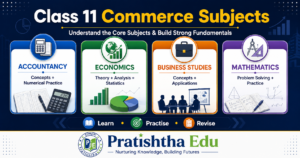
Accountancy
Accountancy is one of the most important subjects for Commerce students. It introduces students to the basic principles of recording, classifying, summarising, and interpreting financial transactions.
For many students, Accountancy is a completely new subject in Class 11. Therefore, understanding the fundamentals is more important than simply trying to complete chapters quickly.
Important Accountancy Concepts
Students should gradually become comfortable with concepts such as:
- Introduction to accounting
- Accounting terms
- Accounting principles
- Accounting equation
- Rules of debit and credit
- Journal entries
- Ledger
- Trial balance
- Cash book
- Bank reconciliation
- Depreciation
- Rectification of errors
- Financial statements
These topics are interconnected. For example, understanding journal entries properly can make the concepts of ledger and trial balance easier to follow.
How to Build a Strong Accountancy Foundation
Accountancy improves primarily through regular practice. Reading the theory is useful, but students also need to solve questions.
A practical approach is to:
- Understand the accounting rule or concept.
- Study a few solved examples.
- Solve basic questions independently.
- Move towards application-based questions.
- Check mistakes carefully.
- Practise similar questions again.
Students should maintain a separate record of common mistakes. Revisiting these mistakes during revision can improve accuracy over time.
Business Studies
Business Studies introduces students to the basic structure and functioning of businesses. It helps students understand how organisations operate and how different business activities are managed.
Although the subject contains theoretical content, students can understand it more effectively when concepts are connected with practical examples.
Important Business Studies Concepts
Depending on the curriculum, students may encounter topics related to:
- Nature and purpose of business
- Forms of business organisation
- Private and public sector
- Business services
- Emerging modes of business
- Social responsibility
- Business ethics
- Sources of business finance
- Small business
- Internal and international business concepts
The purpose of studying these topics is not simply to memorise definitions. Students should understand the meaning, characteristics, advantages, limitations, and practical applications of important concepts.
How to Prepare Business Studies
Students can make Business Studies easier by creating short notes and using real-world examples.
For every important concept, try to identify:
Meaning → Features → Importance → Example
This simple structure can help students organise their thoughts and write clearer answers during examinations.
Students should also revise important terminology regularly because using correct subject-specific terms can improve answer quality.
Economics
Economics is another major subject in the Commerce stream. It helps students understand how individuals, businesses, and economies make decisions regarding limited resources.
Class 11 Economics generally requires both conceptual understanding and analytical thinking.
Important Economics Concepts
Students may study areas related to:
- Introduction to Economics
- Basic economic problems
- Consumer behaviour
- Demand
- Supply
- Production
- Cost and revenue
- Market concepts
- Statistics for Economics
- Data collection and presentation
- Measures of central tendency
- Data interpretation
The numerical and statistical aspects of Economics require regular practice. Students should not leave them for the end of the academic year.
How to Build an Economics Foundation
A useful way to study Economics is to connect theoretical concepts with real-life situations.
For example, when studying demand, students can think about how changes in price may influence the quantity consumers are willing to purchase.
Similarly, concepts related to production and cost can be understood by considering how a business manages its resources.
This approach makes Economics more meaningful and can reduce dependence on memorisation.
Mathematics or Applied Mathematics
Mathematics or Applied Mathematics may be selected by Commerce students depending on their school, board, and future academic goals.
Mathematical ability can be particularly useful for students interested in areas such as Finance, Economics, Business Analytics, Management, or other quantitative fields.
Important Areas to Practise
Depending on the selected subject and curriculum, students may encounter topics such as:
- Algebra
- Sets and relations
- Functions
- Sequences
- Statistics
- Probability
- Financial mathematics
- Data interpretation
- Mathematical reasoning
Students should focus on understanding the method used to solve a problem rather than memorising individual solutions.
How to Improve Mathematical Skills
The best way to improve Mathematics is consistent practice.
Students can follow a simple process:
Learn the concept → Understand the formula → Solve an example → Practise independently → Review mistakes
Keeping a formula sheet can also help during revision. However, students should understand when and why a formula is used instead of relying only on memorisation.
English and Communication Skills
Although Commerce students often focus heavily on their core subjects, English and communication skills should not be ignored.
Good communication can help students write better examination answers, understand academic material, prepare presentations, and communicate effectively in higher education and professional environments.
Students can improve their skills by:
- Reading regularly
- Learning new vocabulary
- Practising writing
- Summarising chapters
- Improving grammar
- Writing structured answers
- Reading business and economic news
Strong communication skills can become particularly useful for students who later enter management, finance, business, or professional courses.
How to Balance Different Commerce Subjects
One of the common challenges faced by Class 11 students is giving too much attention to one subject while ignoring another.
For example, students may spend a lot of time practising Accountancy but postpone Business Studies revision. Others may focus heavily on theoretical subjects and avoid Mathematics or numerical Economics questions.
A balanced timetable can help prevent this problem.
A simple weekly approach could include:
| Subject | Main Focus |
| Accountancy | Concepts + Numerical Practice |
| Business Studies | Concepts + Answer Writing |
| Economics | Concepts + Application + Statistics |
| Mathematics/Applied Mathematics | Formula + Problem Solving |
| English | Reading + Writing + Grammar |
The exact study time should be adjusted according to the student’s school schedule, strengths, and weaknesses.
Focus on Concepts Before Completing the Syllabus
Students sometimes measure their progress only by the number of chapters completed. However, completing a chapter does not always mean that the topic has been understood.
A better approach is to ask:
- Can I explain this concept in my own words?
- Can I solve basic questions without help?
- Can I identify where I made a mistake?
- Can I apply the concept to a new question?
- Can I revise this topic after a few days?
If the answer to these questions is yes, the student is gradually developing a stronger foundation.
Use Study Material Strategically
Good study material and learning resources can support classroom learning, but students should avoid collecting too many books and notes without using them.
A practical study system can include:
School textbook → Class notes → Practice questions → Revision notes → Mock tests
Students should first make their school curriculum and prescribed resources the priority. Additional material can then be used for clarification and extra practice.
This approach prevents unnecessary confusion and keeps preparation focused.
Build Connections Between Commerce Subjects
The subjects in Commerce are not completely independent.
Economics can help students understand business decisions. Business Studies explains how organisations operate. Accountancy provides insight into financial transactions and reporting. Mathematics can support numerical and analytical work.
Recognising these connections can make the Commerce stream more interesting.
For example, a business may need to understand market demand from an Economics perspective, manage its operations through Business Studies concepts, and maintain financial records through Accountancy.
This interconnected understanding is an important part of a strong 11th Commerce Foundation.
Key Takeaway
Class 11 Commerce includes subjects that require different learning methods. Accountancy needs regular numerical practice, Business Studies requires conceptual understanding and structured answer writing, Economics combines theory with analysis and statistics, while Mathematics or Applied Mathematics requires consistent problem-solving practice.
Students who understand these differences can create a more effective study routine instead of using the same method for every subject.
The goal of a Commerce foundation is not simply to finish the syllabus. It is to develop concept clarity, practice, accuracy, confidence, and consistent study habits.
What Do Students Learn in a Class 11 Commerce Foundation Course?
Choosing Commerce after Class 10 is only the beginning. The real difference comes from how well students understand the subjects and develop their learning habits during Class 11.
A structured Class 11 Commerce Foundation Course can help students move from basic classroom learning to a more organised and concept-focused approach. Instead of studying only when examinations are near, students learn to follow a consistent cycle of understanding, practice, revision, and assessment.
The purpose of a foundation course is not to replace school education. Rather, it can complement classroom learning by providing additional explanation, practice, guidance, and academic support where required.
Concept-Based Learning
Concept clarity should be the starting point of any good Commerce foundation programme.
Students should first understand the meaning and logic behind a topic before moving towards advanced questions. This is particularly important in Accountancy, Economics, and Mathematics, where one concept often becomes the foundation for the next.
For example, Accountancy students should understand the basic rules of accounting before attempting more complicated journal or financial statement questions.
Similarly, Economics becomes easier when students understand the relationship between different economic concepts rather than trying to memorise every definition.
A concept-based approach can help students:
- Understand topics more deeply
- Remember information for longer
- Apply concepts to unfamiliar questions
- Reduce confusion between similar topics
- Build confidence in independent problem-solving
Subject-Wise Academic Support
Every Commerce subject requires a slightly different learning method.
Accountancy generally needs regular numerical practice, while Business Studies requires conceptual understanding and organised answer writing. Economics requires a combination of theory, analysis, statistics, and interpretation. Mathematics or Applied Mathematics depends heavily on consistent problem-solving.
Therefore, students benefit from subject-wise preparation rather than using one study method for every subject.
A structured learning programme can divide preparation into manageable sections and help students identify which areas require more attention.
Regular Practice and Question Solving
Understanding a concept is only the first stage of learning. Students need regular practice to become comfortable with different types of questions.
This is especially important for numerical subjects.
A useful practice cycle is:
Learn → Observe → Solve → Check → Correct → Repeat
Students should begin with basic questions and gradually move towards more challenging problems.
Regular practice can improve:
- Calculation accuracy
- Problem-solving speed
- Understanding of question patterns
- Confidence
- Time management
Students should also review incorrect answers instead of simply moving on to the next question.
Doubt Resolution
Doubts are a normal part of learning, particularly when students are introduced to new subjects in Class 11.
Ignoring a small doubt can sometimes create a larger problem when the same concept appears in a later chapter.
For example, if a student does not understand the basic accounting equation, related topics may become more difficult. Similarly, misunderstanding a fundamental Economics concept can create confusion in subsequent chapters.
A good Commerce Foundation Course should therefore provide an appropriate system for asking questions and resolving academic doubts.
Students should be encouraged to ask:
- Why is this method used?
- How did we arrive at this answer?
- What happens if the information changes?
- Why is this accounting entry correct?
- How can this concept be applied in another situation?
This type of questioning promotes deeper learning.
Regular Revision
Learning a concept once does not guarantee that students will remember it throughout the academic year.
Regular revision helps students retain important information and identify topics that need additional practice.
A simple revision cycle can be:
Daily Revision: Review what was studied during the day.
Weekly Revision: Revisit important concepts and questions from the week.
Monthly Revision: Test understanding of completed chapters.
Pre-Exam Revision: Focus on weak areas, important questions, and previous mistakes.
Students can maintain short revision notes containing formulas, definitions, accounting rules, important terms, and common mistakes.
Tests and Assessments
Regular assessments can help students understand their actual level of preparation.
A test is not only a way to measure marks. It can also show:
- Which concepts are strong
- Which topics need revision
- Where careless mistakes occur
- How effectively time is being managed
- Whether answers are being presented properly
Students should analyse their test performance after every assessment.
Instead of looking only at the score, they should classify mistakes such as:
Concept mistake → Calculation mistake → Reading mistake → Presentation mistake → Time-management issue
This makes the assessment more useful for future improvement.
Study Material and Learning Resources
Students often need additional resources to revise difficult concepts and practise questions.
Useful study material and learning resources may include:
- Chapter-wise notes
- Practice questions
- Revision sheets
- Formula lists
- Important definitions
- Sample questions
- Mock tests
- Previous practice papers
- Topic-wise exercises
However, more study material does not automatically mean better preparation.
Students should use resources selectively and follow a clear order. The school curriculum and prescribed textbooks should remain central to academic preparation, while additional resources can be used for clarification and practice.
Personalised Learning and Performance Tracking
Every student has different strengths and weaknesses.
One student may be comfortable with Accountancy but struggle with Economics, while another may understand theoretical subjects easily but need more practice in Mathematics.
A useful foundation programme should encourage students to identify these differences.
Students can track:
| Area | Question to Ask |
| Concept Clarity | Do I understand the topic? |
| Practice | Can I solve questions independently? |
| Accuracy | How many mistakes do I make? |
| Speed | Can I complete questions on time? |
| Revision | Can I remember the concept later? |
This simple tracking system can help students focus their efforts where they are most needed.
School Studies and Foundation Preparation Together
A foundation course should complement school studies rather than create unnecessary academic pressure.
Students should ideally use foundation learning to reinforce what they learn in school.
For example:
School: Learn the basic concept.
Foundation: Understand the concept in greater depth.
Self-Study: Practise questions independently.
Revision: Review mistakes and important points.
This approach creates a connected learning system rather than treating school, coaching, and self-study as separate activities.
Developing Self-Study Habits
The ultimate objective of academic support should be to help students become independent learners.
Teachers and mentors can explain concepts and guide students, but students also need to develop the ability to study on their own.
A good self-study routine can include:
- Setting a daily target
- Studying one concept at a time
- Keeping distractions away
- Practising questions independently
- Reviewing mistakes
- Revising older topics
- Preparing the next day’s study plan
Students who develop these habits in Class 11 may find it easier to handle the larger academic workload in Class 12.
Creating a Focused Study Environment
A suitable study environment can also influence concentration and consistency.
Students may prefer studying at home, school, coaching centres, or a dedicated library depending on their individual needs.
For students who require a quiet and structured place for self-study, a dedicated library and study environment can provide an additional option alongside classroom learning.
The important factor is not the location itself but whether the environment allows the student to study regularly without unnecessary distractions.
Building a Strong Academic Routine
A successful 11th Commerce Foundation is ultimately built through consistency.
Students do not need to study every subject for many hours every day. Instead, they should create a realistic schedule that balances school, self-study, practice, revision, and rest.
A simple routine could look like:
Morning: Quick revision of important concepts
After School: Review classroom learning
Evening: Practice Accountancy or Mathematics
Later: Study Economics or Business Studies
Before Sleep: Short revision of the day’s topics
The exact routine should be adjusted according to the student’s school timings and individual learning capacity.
Key Takeaway
A strong Class 11 Commerce Foundation Course should focus on much more than completing chapters. Students should receive opportunities for concept-based learning, subject-wise preparation, regular practice, doubt resolution, revision, assessments, and appropriate study resources.
The objective is to create a system where students understand what they are learning, practise it consistently, identify their mistakes, and gradually become independent learners.
When these habits are developed early, students can approach Class 11 with greater confidence and build a stronger academic base for Class 12 and future Commerce-related opportunities.
How to Prepare for Class 11 Commerce Effectively?
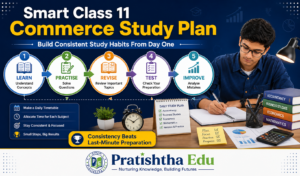
Building a strong Class 11 Commerce Foundation requires consistency rather than studying for long hours only before examinations. Students need a practical routine that gives sufficient attention to each subject while leaving enough time for revision, practice, and rest.
The best study plan is not necessarily the one with the longest study hours. It is the one that a student can follow consistently throughout the academic year.
A balanced approach can help students manage school studies, foundation preparation, self-study, assignments, and examinations without unnecessary pressure.
Start With the Basics
Before moving towards advanced questions, students should make sure that their fundamental concepts are clear.
This is particularly important in Accountancy, Economics, and Mathematics or Applied Mathematics because later topics often depend on earlier concepts.
A useful approach is:
Understand the concept → Study examples → Practise basic questions → Solve application-based questions → Revise
Students should avoid rushing through chapters simply to complete the syllabus. Understanding fewer topics properly is generally more useful than completing many topics without conceptual clarity.
Create a Realistic Daily Study Routine
A daily routine should divide study time between different types of learning.
For example, a student may structure self-study like this:
| Study Activity | Suggested Time |
| Accountancy Practice | 60–75 minutes |
| Economics | 45–60 minutes |
| Business Studies | 45–60 minutes |
| Mathematics/Applied Mathematics | 45–60 minutes |
| Revision | 20–30 minutes |
These timings are only examples. Students should adjust them according to school hours, homework, coaching classes, personal strengths, and other responsibilities.
The important thing is to maintain consistency rather than following an unrealistic timetable for only a few days.
Follow the Daily 3-Step Learning Method
Students can divide their daily preparation into three simple stages.
Step 1: Learn
Understand a new concept from the textbook, classroom notes, teacher explanation, or appropriate study material and learning resources.
Do not move ahead if the basic idea is unclear.
Step 2: Practise
Solve questions related to the concept.
For numerical subjects, students should start with simple questions before attempting more challenging problems.
Step 3: Revise
Spend a short amount of time reviewing what was learned.
This could include formulas, definitions, accounting rules, important points, or mistakes made during practice.
This three-step method keeps learning, practice, and revision connected.
Give Extra Practice to Accountancy
Accountancy requires regular practice because students need to understand the logic behind accounting procedures and apply it correctly.
A useful weekly routine can include:
- Learning new accounting concepts
- Practising journal entries
- Solving ledger questions
- Revising accounting rules
- Attempting mixed questions
- Reviewing incorrect answers
Students should not simply check the correct answer after making a mistake. They should identify why the mistake happened.
For example, was it caused by:
- Incorrect application of a rule?
- Calculation error?
- Wrong account classification?
- Misreading the question?
- Lack of practice?
Understanding the reason behind a mistake can prevent it from being repeated.
Study Economics Through Concepts and Examples
Economics becomes easier when students connect theoretical concepts with real-life situations.
When studying a topic, students can ask:
What does this concept mean?
Why does it happen?
Where can I see an example of it?
How would a change in one factor affect another?
For example, while studying demand, students can think about how changes in price, preferences, income, or other factors may influence consumer behaviour.
Students should also practise statistics and data-based questions regularly rather than leaving them for examination time.
Prepare Business Studies With Smart Notes
Business Studies contains many concepts and terms that students need to remember accurately.
Instead of copying entire chapters into notebooks, students can create concise revision notes.
A useful note-making format is:
Concept → Meaning → Features → Importance → Example
Students can also use headings, subheadings, tables, and real-world examples to make revision easier.
Regular short revisions are generally more manageable than trying to memorise an entire chapter in one sitting.
Practise Mathematics Regularly
Students who choose Mathematics or Applied Mathematics should maintain consistent practice.
Mathematics is a skill-based subject. Reading a solution may help with understanding, but solving questions independently is necessary for improvement.
Students should:
- Maintain a formula notebook
- Practise different question types
- Solve questions without immediately checking answers
- Mark difficult questions
- Reattempt incorrect problems
- Revise formulas regularly
During revision, students should focus particularly on questions where they previously made mistakes.
Use Weekly Revision Sessions
Daily learning becomes more effective when supported by weekly revision.
At the end of each week, students can spend some time reviewing:
- Concepts studied during the week
- Important definitions
- Accounting rules
- Formulas
- Difficult questions
- Common mistakes
- Unfinished topics
A weekly review also helps students identify whether they are falling behind schedule.
If a topic remains unclear, it can be added to the following week’s priority list.
Follow a Monthly Self-Assessment
A monthly self-assessment can provide a broader view of academic progress.
Students can rate each subject based on:
| Area | Rating |
| Concept Understanding | Good / Average / Needs Improvement |
| Question Practice | Good / Average / Needs Improvement |
| Accuracy | Good / Average / Needs Improvement |
| Revision | Good / Average / Needs Improvement |
| Confidence | Good / Average / Needs Improvement |
The purpose is not to judge the student negatively. Instead, it helps identify where additional effort is required.
Manage Time Between School and Foundation Preparation
Students should remember that school studies remain an important part of their Class 11 preparation.
A foundation programme should support school learning rather than create unnecessary duplication.
One effective approach is to revise the same topic after learning it in school.
For example:
School Class → Foundation/Guided Learning → Self-Practice → Revision
This can strengthen understanding while reducing the need to learn the same concept repeatedly from the beginning.
Students can also use structured academic courses and learning programmes to supplement their regular school preparation when additional guidance is required.
Avoid Last-Minute Preparation
One of the most common mistakes among Class 11 students is postponing difficult subjects until examinations are close.
Last-minute preparation can lead to:
- Incomplete syllabus
- Poor revision
- Increased stress
- Lack of practice
- More careless mistakes
Instead, students should divide the syllabus into smaller weekly targets.
For example:
Week 1: Complete one Accountancy concept + one Economics topic.
Week 2: Continue new topics + revise Week 1.
Week 3: Add new topics + practise mixed questions.
Week 4: Monthly revision + self-assessment.
This creates a continuous learning cycle.
Maintain a Mistake Notebook
A simple mistake notebook can become a valuable revision resource.
Students can record:
- Questions answered incorrectly
- Formulas forgotten
- Accounting rules misunderstood
- Definitions confused
- Frequently repeated errors
- Questions that took too much time
Before a test, students can quickly review this notebook instead of going through every chapter again.
This method makes revision more focused.
Practise Answer Writing
Commerce preparation is not only about knowing the correct answer. Students also need to communicate their understanding clearly.
Business Studies and Economics, in particular, require organised answers.
Students should practise:
- Writing appropriate headings
- Using important terminology
- Explaining points clearly
- Giving relevant examples
- Showing steps in numerical questions
- Avoiding unnecessary information
Clear presentation can make answers easier to evaluate and can help students communicate their knowledge effectively.
Take Breaks and Maintain a Healthy Routine
A study plan should also include adequate breaks.
Studying continuously for several hours without rest can reduce concentration and efficiency.
Students can use short breaks between study sessions and maintain a routine that includes:
- Adequate sleep
- Regular meals
- Physical activity
- Short study breaks
- Limited distractions during study time
The objective is to create a sustainable academic routine that can continue throughout the year.
Use a Focused Study Environment
Students have different preferences when it comes to studying.
Some can concentrate effectively at home, while others prefer a quiet library or dedicated study environment.
A focused environment can help students maintain regular study hours and reduce distractions. Students can choose whichever environment allows them to concentrate comfortably and consistently.
A Simple Weekly Class 11 Commerce Study Plan
A basic weekly structure can look like this:
| Day | Main Focus |
| Monday | Accountancy + Economics |
| Tuesday | Business Studies + Mathematics |
| Wednesday | Accountancy + Economics |
| Thursday | Business Studies + Mathematics |
| Friday | Accountancy + Economics |
| Saturday | Mixed Practice + Revision |
| Sunday | Weekly Test + Mistake Analysis |
This is only a sample. Students should modify it according to their school timetable and individual needs.
What If a Student Falls Behind?
Falling behind occasionally does not mean that the entire preparation has failed.
Students should first identify the reason.
Is the problem:
- Too much syllabus?
- Lack of practice?
- Difficulty understanding a topic?
- Poor time management?
- Too many distractions?
Once the reason is identified, students can create a smaller recovery plan.
Instead of trying to complete everything in one day, divide pending work into manageable targets and complete them gradually.
Key Takeaway
An effective 11th Commerce Foundation is built through consistent learning, regular practice, revision, and self-assessment.
Students should focus on understanding concepts, practising Accountancy and Mathematics regularly, connecting Economics with real-life examples, preparing Business Studies through structured notes, and revising all subjects throughout the year.
The most important goal is not to study for the maximum number of hours. It is to develop a routine that can be followed consistently.
With the right study plan and disciplined approach, students can gradually improve their understanding, accuracy, confidence, and examination readiness.
Common Challenges Faced by Class 11 Commerce Students
Moving from Class 10 to Class 11 Commerce can feel like a major academic change. Students are introduced to new subjects, unfamiliar concepts, longer chapters, and different methods of answering questions.
Some students adjust quickly, while others need additional time and guidance. Facing difficulties during the beginning of Class 11 is normal. The important thing is to identify the problem early and work on it with a practical approach.
A well-planned Class 11 Commerce Foundation can help students understand their weak areas, improve their study habits, and gradually become more confident in different subjects.
Difficulty Understanding Accountancy
Accountancy is often one of the first subjects that students find challenging because it introduces terminology and concepts they may not have studied before.
Terms such as assets, liabilities, capital, debit, credit, journal, and ledger may initially seem confusing.
How to Overcome It
Students should avoid trying to memorise accounting rules without understanding their logic.
A better approach is:
- Understand the basic accounting concept.
- Learn the relevant rule.
- Study a few solved examples.
- Practise simple questions.
- Move towards application-based problems.
- Review mistakes regularly.
Students should also practise Accountancy frequently rather than studying it only once or twice a week.
Trying to Memorise Everything
Another common problem is relying too heavily on memorisation.
Commerce subjects contain definitions, principles, classifications, and terminology, but understanding is still essential.
For example, in Business Studies, students may remember the definition of a business concept but struggle to explain its importance or apply it to a practical situation.
How to Overcome It
Use the following method:
Understand → Explain in your own words → Connect with an example → Revise → Practise
If a student can explain a concept without looking at the textbook, it usually indicates a better level of understanding.
Managing Multiple Subjects
Class 11 Commerce students may have several subjects that require different types of preparation.
A student may spend most of the available study time on Accountancy and then have little time left for Economics or Business Studies.
How to Overcome It
Create a balanced weekly timetable.
Instead of studying one subject continuously for several days, distribute subjects across the week.
For example:
- Accountancy: Regular numerical practice
- Economics: Concept learning + statistics
- Business Studies: Reading + notes + answer writing
- Mathematics/Applied Mathematics: Problem solving
- English: Reading + writing practice
This approach reduces the chance of neglecting any subject.
Lack of Regular Practice
Some students understand concepts during class but do not practise them afterwards.
This can create problems because understanding a solved example is different from solving a question independently.
How to Overcome It
Set small daily practice targets.
For example:
Accountancy: 5–10 questions
Mathematics: A selected set of problems
Economics: Concept-based and statistical questions
Business Studies: One answer-writing practice session
The number of questions is less important than consistency.
Poor Time Management
Students sometimes spend too much time on one difficult chapter and then rush through other subjects.
This can create an unbalanced preparation schedule.
How to Overcome It
Use time blocks.
For example:
60 minutes: Accountancy practice
10-minute break
45 minutes: Economics
10-minute break
45 minutes: Business Studies
20 minutes: Revision
Students can adjust these timings according to their own routine.
The goal is to give every subject regular attention.
Studying Only Before Examinations
Last-minute preparation is one of the biggest challenges for students.
When students postpone learning until examinations are close, they may have to deal with a large syllabus, incomplete revision, and limited practice time simultaneously.
How to Overcome It
Start preparing from the beginning of the academic year.
Divide the syllabus into:
- Daily targets
- Weekly targets
- Monthly targets
- Revision targets
This makes the overall syllabus feel more manageable.
Ignoring Weak Topics
Students often spend more time studying subjects they already like and avoid difficult topics.
For example, a student may enjoy Business Studies but avoid Accountancy because it feels difficult.
Avoiding the problem usually makes it bigger.
How to Overcome It
Identify weak topics and give them additional practice.
Students can create a Weak Topic List containing:
- Difficult chapters
- Unclear concepts
- Frequently incorrect questions
- Difficult formulas
- Important topics requiring revision
Review this list every week and gradually reduce the number of pending topics.
Not Asking Questions
Some students hesitate to ask questions because they are worried that their doubt is too basic.
This can create learning gaps.
There is no problem with asking questions about fundamental concepts. In fact, clearing a basic doubt early can make later chapters much easier.
How to Overcome It
Students should maintain a Doubt List.
Whenever something is unclear, write it down instead of ignoring it.
The doubt can then be discussed with:
- School teachers
- Foundation teachers
- Mentors
- Classmates
- Appropriate learning resources
The important thing is to resolve the doubt before it affects future topics.
Using Too Many Study Resources
Having access to multiple books, websites, videos, notes, and question banks can sometimes create more confusion instead of improving preparation.
Students may keep switching between resources without completing any of them properly.
How to Overcome It
Follow a simple resource hierarchy:
Textbook → Class Notes → Practice Questions → Additional Study Material → Mock Tests
Additional study material and learning resources should be used when they genuinely help clarify or practise a topic.
Quality and consistency are more important than collecting a large number of resources.
Difficulty Staying Focused
Mobile phones, social media, entertainment, and notifications can make it difficult to maintain concentration.
Even short interruptions can break the flow of study.
How to Overcome It
During study sessions:
- Keep the phone away when possible
- Turn off unnecessary notifications
- Study at a fixed location
- Keep only required books nearby
- Set a specific study target
- Take planned breaks
Students can also use a quiet library or dedicated study environment if they find it difficult to concentrate at home.
Fear of Numerical Subjects
Some students enter Commerce believing that they need to be exceptionally good at Mathematics to succeed.
This can create unnecessary anxiety.
Commerce includes different subject combinations, and the specific requirements depend on the student’s school, board, and future academic plans.
For students studying Accountancy or Mathematics, improvement generally comes through understanding concepts and practising regularly.
How to Overcome It
Start with easy questions.
Then gradually increase difficulty:
Basic → Intermediate → Application-Based → Mixed Practice
This allows confidence to develop step by step.
Poor Answer Writing
Knowing the concept is important, but students also need to present their answers appropriately.
This is particularly relevant for Business Studies and Economics.
How to Overcome It
Students should practise:
- Using clear headings
- Writing point-wise answers
- Highlighting important terms where appropriate
- Giving relevant examples
- Maintaining logical structure
- Avoiding unnecessary repetition
Regular answer-writing practice can make students more comfortable during examinations.
Not Reviewing Mistakes
Many students check their marks after a test and move on.
However, the real value of a test comes from analysing mistakes.
How to Overcome It
After every test, classify mistakes into:
Concept Error: The topic was not understood.
Calculation Error: The method was correct, but the calculation was wrong.
Careless Error: The student knew the answer but made an avoidable mistake.
Time Error: Too much time was spent on a particular question.
Presentation Error: The answer was not organised clearly.
This analysis can help students improve more effectively.
Comparing Yourself With Other Students
Every student has a different learning speed.
Comparing marks continuously with classmates can create unnecessary pressure and may distract students from their own improvement.
How to Overcome It
Compare current performance with previous performance.
Ask:
- Am I understanding more concepts?
- Are my mistakes decreasing?
- Is my accuracy improving?
- Am I completing questions faster?
- Am I revising more consistently?
Personal improvement should be the primary goal.
Losing Motivation After Low Marks
Low marks in one test do not determine a student’s future performance.
Sometimes a low score simply shows that a particular topic needs more practice.
How to Overcome It
Use low marks as feedback.
Follow this process:
Test → Analyse → Identify Weakness → Practise → Retest
The next assessment can then show whether improvement has taken place.
Creating a Supportive Learning System
Students often perform better when school learning, self-study, revision, and academic guidance work together.
A useful learning system can include:
School Learning + Foundation Support + Self-Study + Regular Practice + Revision
Students who need additional academic guidance can explore suitable educational courses and academic support programmes based on their learning requirements.
What Parents Can Do to Support Commerce Students
Parents can also play an important role in creating a positive study environment.
Instead of focusing only on marks, parents can encourage:
- Regular study habits
- Consistent attendance
- Completion of assignments
- Healthy sleep routines
- Open communication about difficulties
- Balanced use of digital devices
Students generally benefit more from constructive support than from constant examination pressure.
When Should Students Seek Additional Academic Support?
Students may consider additional guidance when they consistently experience problems such as:
- Difficulty understanding basic concepts
- Repeatedly low scores
- Inability to maintain a study routine
- Large amounts of pending syllabus
- Difficulty solving questions independently
- Lack of confidence in important subjects
The purpose of additional academic support should be to help students understand concepts and become more independent, not to make them completely dependent on coaching.
Key Takeaway
The challenges faced by Class 11 Commerce students are often manageable when identified early.
Difficulty in Accountancy, lack of practice, poor time management, weak revision, fear of numerical subjects, and dependence on memorisation can all be addressed through consistent and structured preparation.
A strong 11th Commerce Foundation focuses on gradual improvement rather than instant perfection.
Students should remember that mistakes are part of the learning process. What matters is whether they analyse those mistakes, correct them, and continue practising.
With the right routine, appropriate study material, regular revision, and a focused learning environment, students can gradually build the confidence required to perform better in Class 11 and prepare for the next stage of their academic journey.
Career Options After Class 11 Commerce
Choosing Commerce after Class 10 opens the door to a wide range of academic and professional opportunities. Students are not limited to a single career path. Depending on their interests, subject choices, skills, and long-term goals, they can explore careers in accounting, finance, management, economics, business, law, taxation, banking, entrepreneurship, and many other fields.
This is why developing a strong Class 11 Commerce Foundation is important. The concepts and study habits developed during Class 11 can support students as they move towards higher education and professional courses.
Students do not need to finalise their entire career immediately after choosing Commerce. Class 11 can instead be used to explore different fields, understand personal interests, and gradually identify suitable options.

Chartered Accountancy (CA)
Chartered Accountancy is one of the most popular professional career options for Commerce students.
Students interested in this career can learn more about Chartered Accountancy and its professional pathway through the official Institute of Chartered Accountants of India.
CA professionals work in areas such as accounting, auditing, taxation, financial reporting, and financial management.
Students interested in this field can benefit from developing strong fundamentals in Accountancy, Economics, Mathematics, or related numerical skills, depending on their academic path.
A good foundation during Class 11 can help students become comfortable with accounting concepts and analytical thinking before beginning dedicated professional preparation.
Skills Useful for CA
Students interested in Chartered Accountancy can gradually develop:
- Accounting knowledge
- Numerical ability
- Analytical thinking
- Attention to detail
- Time management
- Problem-solving skills
- Consistent study habits
Students should remember that professional-course preparation requires a separate structured approach after meeting the relevant eligibility requirements.
Company Secretary (CS)
Company Secretary is another professional option that may interest Commerce students.
The field is related to corporate governance, company law, compliance, corporate administration, and related business functions.
Students who enjoy Business Studies, law-related concepts, communication, and organisational topics may find this career path interesting.
A strong Commerce foundation can help students develop familiarity with business terminology and organisational concepts before entering specialised preparation.
Cost and Management Accountancy (CMA)
Students interested in cost management, accounting, financial planning, and business decision-making can explore the Cost and Management Accountancy pathway.
CMA professionals can work in areas related to cost accounting, budgeting, financial analysis, management accounting, and business planning.
Students who enjoy Accountancy and numerical problem-solving may consider exploring this field further as they progress through higher education.
Bachelor of Commerce (B.Com)
B.Com is one of the most common undergraduate choices for Commerce students.
Depending on the college and programme, students may study subjects related to:
- Accounting
- Finance
- Economics
- Business
- Taxation
- Management
- Banking
- Business law
B.Com can also provide a foundation for further education and professional qualifications.
Students may later choose specialised postgraduate programmes or professional certifications depending on their career goals.
Bachelor of Business Administration (BBA)
Students interested in business management, entrepreneurship, marketing, human resources, or organisational leadership may consider BBA.
BBA programmes generally introduce students to different aspects of business and management.
Commerce students can benefit from developing communication, analytical, numerical, and business understanding during Class 11 and Class 12.
Economics
Students who enjoy understanding markets, consumer behaviour, data, and economic decision-making may explore Economics as a higher-education field.
Economics can lead towards areas such as:
- Economic research
- Banking
- Financial services
- Data analysis
- Public policy
- Business research
- Consulting
- Academic research
Students interested in this field should develop strong conceptual and analytical skills during school.
Finance and Banking
Commerce students can also explore careers in finance and banking.
Possible areas include:
- Banking
- Investment services
- Financial analysis
- Corporate finance
- Accounting
- Insurance
- Financial planning
Students interested in finance should gradually develop numerical ability, analytical thinking, financial awareness, and communication skills.
A strong foundation in Accountancy and Economics can provide useful academic preparation for these areas.
Entrepreneurship
Not every Commerce student needs to follow a traditional employment path.
Students interested in starting and managing businesses can explore entrepreneurship.
Commerce subjects can provide useful knowledge about:
- Business operations
- Finance
- Markets
- Customers
- Business planning
- Management
- Decision-making
Students can also develop entrepreneurial skills through small projects, business case studies, and practical learning activities.
Management and Marketing
Students interested in leadership, communication, customer behaviour, sales, and business strategy may explore management and marketing.
These areas are relevant across almost every industry.
Students can begin developing useful skills during Class 11 by participating in:
- Presentations
- Group projects
- Business case discussions
- Communication activities
- Research projects
- School competitions
Academic knowledge combined with practical skills can help students become better prepared for future management programmes.
Law and Corporate Careers
Commerce students may also explore law, particularly areas connected with business and corporate activities.
Students interested in business law, corporate law, taxation, compliance, or legal aspects of business can explore relevant higher-education pathways.
Good communication, reading ability, analytical thinking, and understanding of business concepts can be useful skills in this direction.
CUET and University Admissions
Students planning to pursue undergraduate programmes at participating universities may also explore entrance routes such as the Common University Entrance Test (CUET), depending on the programme and institution.
Preparation requirements can vary by course and university, so students should always check current official eligibility, subject requirements, and admission information before making decisions.
Building a strong academic foundation during Class 11 can help students become better prepared for future entrance-oriented study.
How Class 11 Foundation Supports Future Careers
Students may wonder why career planning is being discussed as early as Class 11.
The answer is that career preparation does not always mean starting intensive competitive examination preparation.
At this stage, preparation mainly means developing transferable academic skills.
These include:
Conceptual Understanding
Students learn how to understand rather than simply memorise information.
Numerical Ability
Accountancy and Mathematics can help students become more comfortable with calculations and problem-solving.
Analytical Thinking
Economics and business-related topics encourage students to analyse information and understand relationships.
Communication
Business Studies, English, presentations, and answer writing help students improve communication skills.
Time Management
Regular study schedules teach students how to manage multiple academic responsibilities.
Consistency
Daily practice builds discipline that can become valuable during higher education and professional-course preparation.
Choosing a Career Based on Interest
Students should not choose a career only because it is popular.
For example, one student may enjoy accounting and numbers, while another may be more interested in management, communication, economics, or entrepreneurship.
Before choosing a career path, students can consider:
- Which subjects do I enjoy?
- Which subjects am I naturally comfortable with?
- Do I enjoy numerical problem-solving?
- Do I prefer theory and communication?
- Do I like business and management?
- Do I enjoy analysing data?
- What type of work interests me?
- What higher-education options are available?
Career decisions can be refined gradually as students learn more about Pratishtha edu themselves.
Don’t Rush Career Decisions in Class 11
Class 11 is an excellent time to explore career options, but students do not need to have every decision finalised immediately.
They can spend this stage building their academic foundation while learning about different courses and professions.
A sensible approach is:
Explore → Understand → Compare → Develop Skills → Decide
This reduces unnecessary pressure and allows students to make more informed decisions later.
Building a Strong Academic Base for Class 12
Whatever career path a student eventually chooses, Class 11 concepts should not be ignored.
Students should aim to complete Class 11 with:
- Strong subject fundamentals
- Good study habits
- Regular revision practice
- Better numerical ability
- Improved answer writing
- Greater confidence
- Clearer understanding of career interests
This makes the transition into Class 12 more comfortable.
Students who want continued academic support can later explore an appropriate 12th Science Foundation or other senior-secondary foundation resources according to their selected stream and academic requirements.
Explore Before You Decide
The Commerce stream offers flexibility, but that flexibility also means students need to understand their options.
Instead of choosing a career based only on what friends or relatives are doing, students should research courses, eligibility requirements, entrance examinations, career responsibilities, and future opportunities.
Speaking with teachers, mentors, parents, and qualified career professionals can also help students understand different pathways.
The goal is not to choose the “best” career for everyone. The goal is to identify an option that matches the student’s interests, abilities, goals, and willingness to develop the required skills.
Key Takeaway
Commerce offers diverse opportunities in accounting, finance, management, economics, business, law, banking, entrepreneurship, and professional education.
A strong 11th Commerce Foundation does not guarantee a particular career, but it can provide students with the academic skills needed to explore these options with greater confidence.
The most important focus during Class 11 should be to understand subjects properly, practise consistently, improve communication and analytical skills, and explore future possibilities without unnecessary pressure.
With a strong foundation, students can enter Class 12 better prepared and make more informed decisions about higher education and professional courses.
How to Choose the Right Class 11 Commerce Foundation Course?
Choosing the right Class 11 Commerce Foundation Course can make the learning journey more organised and comfortable for students. However, students and parents should not select a programme only based on advertisements, discounts, or the number of classes offered.
The focus should be on the quality of teaching, conceptual clarity, practice opportunities, academic support, and whether the programme matches the student’s actual learning needs.
Before choosing a foundation programme, consider the following factors.
Concept-Focused Teaching
The first priority should be conceptual understanding.
Students should be able to understand the logic behind Accountancy, Economics, Business Studies, and other subjects rather than simply memorising answers.
A good foundation programme should explain difficult concepts in a simple and structured manner and provide enough examples for students to understand their practical application.
Experienced and Supportive Faculty
Teachers play an important role in helping students adjust to the Commerce stream.
Students should have opportunities to ask questions, clarify doubts, and receive guidance when they face difficulties.
A supportive learning environment can also help students become more comfortable with subjects that initially seem challenging.
Regular Practice and Assessments
A foundation programme should provide opportunities for regular practice.
Tests and assessments can help students identify:
- Strong and weak topics
- Common mistakes
- Areas requiring additional practice
- Time-management issues
- Overall academic progress
The purpose of assessments should not be limited to giving marks. They should also help students understand how they can improve.
Study Material and Learning Support
Appropriate study material and learning resources can revise and practice easier.
Students should look for resources such as:
- Concept notes
- Practice questions
- Revision material
- Topic-wise exercises
- Test papers
- Important formulas and definitions
- Additional practice resources
However, the quality and usefulness of the material are more important than the quantity.
Doubt Resolution
Students should have a convenient way to clarify academic doubts.
A small doubt in one chapter can sometimes create difficulties in later topics. Therefore, regular doubt support can help students maintain continuity in their learning.
Balanced Academic Approach
The ideal foundation programme should balance:
Concepts + Practice + Revision + Tests + Doubt Support
Focusing only on completing the syllabus may not be enough.
Students should have enough opportunities to understand concepts, practise questions, review mistakes, and improve gradually.
Class 11 Commerce Foundation at Pratishtha Edu
For students looking for structured academic support, Pratishtha Edu focuses on helping learners build a stronger academic foundation through concept-oriented learning and regular preparation.
The objective of a foundation programme is to help students become more confident with their subjects and develop consistent study habits.
Depending on the programme and available academic support, students can benefit from areas such as:
- Concept-based learning
- Subject-wise academic preparation
- Regular practice
- Revision support
- Doubt clarification
- Test and assessment practice
- Academic guidance
- Structured learning resources
Students can combine guided learning with their school studies and independent practice to create a balanced preparation system.
A strong foundation should ultimately help students become more independent learners rather than depending entirely on external guidance.
Building a Strong Commerce Foundation With Consistency
No coaching programme can replace a student’s own effort.
Teachers can explain concepts, provide guidance, and create practice opportunities, but students still need to attend classes regularly, complete practice work, revise topics, and analyse their mistakes.
A simple formula for effective preparation is:
Concept Clarity + Regular Practice + Revision + Consistency = Strong Foundation
Students who follow this approach from the beginning of Class 11 can gradually develop better academic confidence.
Frequently Asked Questions About Class 11 Commerce Foundation
What is Class 11 Commerce Foundation?
Class 11 Commerce Foundation is a structured approach to developing strong conceptual knowledge, subject understanding, problem-solving skills, and study habits after choosing Commerce in Class 11.
It focuses on understanding the fundamentals of subjects such as Accountancy, Business Studies, Economics, and Mathematics or Applied Mathematics, depending on the student’s subject combination.
Is Commerce difficult for Class 11 students?
Commerce may initially feel difficult because several subjects and concepts are new. However, difficulty varies from student to student.
With clear explanations, regular practice, revision, and consistent study habits, students can gradually become comfortable with Commerce subjects.
Which subjects are important in Class 11 Commerce?
Accountancy, Business Studies, and Economics are among the major Commerce subjects. Students may also study Mathematics or Applied Mathematics, English, and other subjects depending on their school and chosen subject combination.
Each subject requires a different preparation strategy.
Why is Accountancy important in Class 11?
Accountancy introduces students to fundamental accounting concepts and develops numerical and analytical skills.
Topics such as accounting principles, journal entries, ledger, trial balance, and financial statements form an important part of the subject’s foundation.
Regular practice is essential for developing accuracy and confidence.
How should I prepare for Class 11 Commerce?
Students should begin with basic concepts and follow a consistent study routine.
A useful approach is:
Understand → Practise → Revise → Test → Analyse Mistakes
Students should give regular attention to all subjects instead of preparing only before examinations.
Is a Commerce Foundation Course useful for CA preparation?
A Commerce foundation can help students develop basic knowledge in subjects such as Accountancy and Economics, along with study discipline and numerical ability.
However, dedicated professional-course preparation has its own syllabus, eligibility requirements, and examination structure. Students should treat Class 11 foundation learning as an academic base rather than as a replacement for professional-course preparation.
When should students start Class 11 Commerce preparation?
Students should ideally begin building their foundation from the beginning of Class 11.
Starting early gives students more time to understand concepts, practise questions, revise topics, and address learning gaps before examinations.
Can students prepare for Class 11 Commerce through self-study?
Yes. Students can study independently using their textbooks, class notes, practice questions, and appropriate learning resources.
However, students who have difficulty understanding concepts, maintaining consistency, or resolving doubts may benefit from additional academic guidance.
How can a foundation course help Commerce students?
A structured foundation course can provide concept explanations, subject-wise preparation, regular practice, revision support, assessments, doubt resolution, and academic guidance.
The effectiveness ultimately depends on the quality of learning and the student’s own consistency.
Final Tips for Class 11 Commerce Students
Before beginning the academic year, students should remember a few simple principles:
Understand before memorising.
Try to understand the logic behind every important concept.
Practise regularly.
Especially for Accountancy, Mathematics, and numerical areas of Economics.
Revise continuously.
Do not wait until examinations to revise previously studied topics.
Ask questions.
Clearing doubts early can prevent bigger learning gaps later.
Track mistakes.
Mistakes are useful when students understand why they happened and work to avoid repeating them.
Stay consistent.
Small amounts of regular preparation are generally more sustainable than irregular long study sessions.
Explore career options gradually.
Students can learn about CA, CS, CMA, B.Com, BBA, Economics, Finance, Management, Banking, Entrepreneurship, and other options without feeling pressured to make an immediate final decision.
Build Your Strong Commerce Foundation From Class 11
Class 11 is an important stage for students entering the Commerce stream. It introduces new subjects and concepts that can influence academic preparation in Class 12 and beyond.
A strong Class 11 Commerce Foundation helps students focus on conceptual understanding, regular practice, effective revision, problem-solving, and consistent study habits.
The journey does not require students to be perfect from the beginning. What matters is the willingness to learn, practise, identify mistakes, and improve step by step.
Whether a student aims for professional courses such as CA, CS, or CMA, plans to pursue B.Com or BBA, or wants to explore Finance, Economics, Management, Banking, or Entrepreneurship, the fundamentals developed during Class 11 can provide a useful academic base.
Students can combine school education, self-study, appropriate study material, regular practice, and academic guidance to create a balanced learning system.
For students seeking structured academic support, Pratishtha Edu can be considered as part of their academic preparation journey.
Start Building Your Class 11 Commerce Foundation
A strong future begins with strong fundamentals.
Understand your concepts. Practise consistently. Revise regularly. Build confidence.
Start your Class 11 Commerce Foundation with a focused and consistent approach, and take the first step towards a stronger academic journey.

Conclusion
A strong 11th Commerce Foundation is not about studying everything at once. It is about developing the right concepts, habits, and skills step by step.
Class 11 allows students to understand Accountancy, Business Studies, Economics, Mathematics or Applied Mathematics, and other subjects in greater depth. With regular practice and proper guidance, students can overcome common challenges and become more confident learners.
The most effective approach combines concept clarity, regular practice, revision, assessment, doubt resolution, and consistency.
Students should also remember that every learner has a different pace. Instead of comparing themselves with others, they should focus on continuous personal improvement.
With the right foundation and a disciplined approach, Class 11 Commerce can become a strong starting point for Class 12, higher education, professional courses, and a wide range of future career opportunities.
Leave a Reply