Introduction
Preparing for the GATE Mechanical Syllabus 2027 requires a clear understanding of the syllabus before starting your preparation. The syllabus covers a wide range of topics from Mechanical Engineering, along with Engineering Mathematics and General Aptitude. Since GATE is one of the most competitive engineering entrance examinations in India, knowing the complete syllabus helps candidates create a realistic study plan, prioritize high-weightage subjects, and prepare more efficiently.
Whether you are preparing for admission into M. Tech or M.E. programs aiming for PSU recruitment or planning to pursue research opportunities, understanding the latest syllabus is the first step toward success. If you are looking for expert classroom guidance along with a structured study plan, you can also explore our GATE Mechanical Coaching in Bangalore, where experienced faculty, comprehensive study materials, regular mock tests, and personalized mentoring help students prepare confidently for the examination.
In this complete guide, you will find the GATE Mechanical Syllabus 2027, subject-wise topics, expected weightage, important concepts, revision strategies, recommended books, and practical preparation tips. By following this roadmap and combining it with consistent practice, you can prepare systematically and improve your chances of achieving an excellent GATE score.
Latest Changes in GATE Mechanical Syllabus 2027
One of the most common questions among GATE aspirants is whether the GATE Mechanical Syllabus 2027 has changed. As of now, no major changes have been officially announced for the Mechanical Engineering (ME) syllabus. Candidates should continue their preparation based on the latest officially available syllabus until the conducting institute releases any new notification.
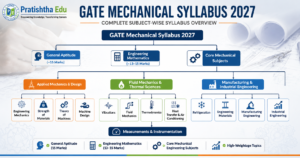
The syllabus continues to focus on three major sections:
- General Aptitude
- Engineering Mathematics
- Core Mechanical Engineering Subjects
The core Mechanical Engineering syllabus is broadly divided into the following areas:
- Applied Mechanics & Design
- Fluid Mechanics & Thermal Sciences
- Materials, Manufacturing & Industrial Engineering
These sections remain the foundation of the GATE Mechanical examination and require equal attention during preparation.
Instead of waiting for possible syllabus updates, candidates should begin preparing as early as possible. Along with understanding the syllabus, it is equally important to follow a structured GATE 2027 Preparation Guide that helps you create an effective study plan, prioritize important subjects, and manage your preparation time efficiently.
Historically, the GATE Mechanical syllabus remains largely unchanged, with only minor revisions or clarifications in some years. Building strong fundamentals, solving previous year question papers, and taking regular mock tests are far more important than waiting for official announcements.
Before beginning your preparation, always download the latest syllabus from the official GATE website and stay updated with any notifications released by the conducting institute.
Complete GATE Mechanical Syllabus 2027 (Subject-wise)
The GATE Mechanical Syllabus 2027 covers a broad range of engineering concepts designed to evaluate both theoretical understanding and practical problem-solving skills. Instead of giving equal importance to every topic, students should understand the scope of each subject and plan their preparation strategically.
Below is the complete subject-wise syllabus along with the important topics that every aspirant should study before the examination.
General Aptitude
The General Aptitude section carries 15 marks and is common to all GATE papers. Since this section is highly scored, candidates should include it in their daily preparation schedule.
Important Topics
Verbal Ability
- English Grammar
- Reading Comprehension
- Vocabulary
- Sentence Completion
Numerical Ability
- Percentages
- Ratio and Proportion
- Averages
- Time and Work
Logical Reasoning
- Analytical Reasoning
- Data Interpretation
- Logical Puzzles
Preparation Tip: Practice aptitude questions for at least 20–30 minutes every day to improve speed and accuracy.
Engineering Mathematics
Engineering Mathematics is one of the most important and highest-scoring sections in the GATE Mechanical Syllabus 2027. Every year, a significant number of questions are asked from this subject, making it a key contributor to your overall GATE score. A strong foundation in Engineering Mathematics not only helps you perform well in this section but also improves your problem-solving skills in several core Mechanical Engineering subjects. To achieve better results, candidates should follow a structured GATE Mechanical Preparation Strategy 2027, revise formulas regularly, and solve previous year questions to strengthen both speed and accuracy.
Important Topics
- Linear Algebra
- Matrix Operations
- Eigenvalues and Eigenvectors
- Calculus
- Differential Calculus
- Integral Calculus
- Differential Equations
- Partial Differential Equations
- Probability and Statistics
- Numerical Methods
- Vector Calculus
- Complex Variables
Preparation Tip: Prepare a separate formula notebook and revise it daily. Practice numerical questions from previous year GATE papers to improve accuracy, speed, and confidence.
Engineering Mechanics
Engineering Mechanics is one of the fundamental subjects in the GATE Mechanical Syllabus 2027 and serves as the foundation for many advanced Mechanical Engineering topics. This subject evaluates your understanding of forces, equilibrium, motion, energy, and rigid body mechanics. Since most questions are concept-based, candidates should focus on building strong fundamentals instead of memorising formulas. Solving GATE Mechanical Previous Year Papers regularly will help you understand the exam pattern, identify frequently asked concepts, and improve your problem-solving ability.
Important Topics
- Force Systems
- Free Body Diagrams (FBD)
- Equilibrium of Rigid Bodies
- Friction
- Centroid and Centre of Gravity
- Moment of Inertia
- Kinematics of Particles
- Kinetics of Particles
- Work, Power, and Energy
- Impulse and Momentum
Preparation Tip: Focus on understanding concepts through numerical practice rather than rote learning. Solve topic-wise questions regularly and analyse previous year papers to improve both speed and accuracy.
Strength of Materials (SOM)
Strength of Materials is one of the most important subjects in the GATE Mechanical syllabus and frequently contributes to numerical questions.
Important Topics
- Stress and Strain
- Elastic Constants
- Principal Stress
- Shear Stress
- Bending Stress
- Shear Force and Bending Moment
- Torsion of Circular Shafts
- Thin and Thick Cylinders
- Columns and Struts
- Deflection of Beams
- Mohr’s Circle
Preparation Tip: Solve a variety of numerical problems to improve calculation speed and concept clarity.
Theory of Machines (TOM)
Theory of Machines is a scoring subject for students with a strong conceptual understanding.
Important Topics
- Mechanisms
- Kinematic Pairs
- Velocity Analysis
- Acceleration Analysis
- Gears and Gear Trains
- Flywheel
- Governors
- Cams
- Balancing of Rotating Masses
Preparation Tip: Practice both diagrams and numerical problems to strengthen your understanding.
Machine Design
Machine Design focuses on the design and analysis of machine elements. Questions often combine theoretical concepts with numerical calculations.
Important Topics
- Design Philosophy
- Static and Dynamic Loading
- Fatigue Failure
- Stress Concentration
- Shafts
- Keys
- Couplings
- Springs
- Bearings
- Riveted Joints
- Welded Joints
- Threaded Fasteners
Preparation Tip: Understand standard design equations and solve application-based problems regularly.
Vibrations
Although Vibrations carries comparatively lower weightage than some other subjects, it should not be ignored because questions are usually straightforward.
Important Topics
- Free Vibrations
- Forced Vibrations
- Damped Vibrations
- Single Degree of Freedom Systems
- Natural Frequency
- Resonance
- Critical Damping
Preparation Tip: Focus on numerical problems involving natural frequency and damping concepts.
Fluid Mechanics
Fluid Mechanics is an essential subject in the GATE Mechanical syllabus and plays an important role in Thermal Engineering.
Important Topics
- Fluid Properties
- Fluid Statics
- Fluid Kinematics
- Fluid Dynamics
- Bernoulli’s Equation
- Control Volume Analysis
- Boundary Layer Theory
- Laminar and Turbulent Flow
- Flow Through Pipes
- Dimensional Analysis
- Similarity Principles
- Pumps
- Hydraulic Turbines
Preparation Tip: Strengthen your concepts by solving numerical problems based on Bernoulli’s equation, pipe flow, and dimensional analysis, as these areas are frequently tested.
The subjects covered above form a major portion of the GATE Mechanical Syllabus 2027. Once you build a strong foundation in these areas, the remaining subjects in Thermal Engineering, Manufacturing Engineering, and Industrial Engineering become much easier to understand and revise.
Complete GATE Mechanical Syllabus 2027 (Continued)
Thermodynamics
Thermodynamics is one of the most important subjects in the GATE Mechanical Syllabus 2027. Every year, several questions are asked on this subject, making it a high-priority area for preparation. A strong understanding of thermodynamic laws and processes helps candidates solve numerical and concept-based questions efficiently.
Important Topics
- Thermodynamic Properties
- Zeroth Law of Thermodynamics
- First Law of Thermodynamics
- Second Law of Thermodynamics
- Third Law of Thermodynamics
- Pure Substances
- Ideal and Real Gases
- Steam Tables
- Availability and Irreversibility
- Thermodynamic Cycles
- Entropy
- Gas Power Cycles
- Vapour Power Cycles
Preparation Tip: Focus on understanding the fundamental laws and practice numerical problems based on thermodynamic cycles, entropy, and steam properties.
Heat Transfer
Heat Transfer is closely related to Thermodynamics and contributes a significant number of questions in the GATE Mechanical examination. Questions are generally numerical and require conceptual clarity.
Important Topics
- Modes of Heat Transfer
- Steady-State Conduction
- Transient Heat Conduction
- Extended Surfaces (Fins)
- Radiation
- Heat Exchangers
- Boiling
- Condensation
Preparation Tip: Practice numerical problems involving conduction, convection, radiation, and heat exchangers, as these topics appear regularly in the examination.
Refrigeration & Air Conditioning
Although Refrigeration and Air Conditioning usually carries comparatively fewer questions, it is a scoring subject when prepared properly. Understanding refrigeration cycles and psychrometric processes is essential.
Important Topics
- Refrigeration Cycles
- Vapour Compression Refrigeration System (VCRS)
- Vapour Absorption Refrigeration System (VARS)
- Psychrometry
- Air Conditioning Processes
- Refrigerants
- Cooling Load Calculation
Preparation Tip: Learn the working principles of refrigeration systems and practice psychrometric chart-based problems.
Engineering Materials
Engineering Materials form the foundation of Manufacturing Engineering and Machine Design. Questions from this subject are mostly theoretical and concept-based.
Important Topics
- Crystal Structure
- Mechanical Properties of Materials
- Heat Treatment
- Phase Diagrams
- Ferrous Materials
- Non-Ferrous Materials
- Composite Materials
- Material Testing
- Corrosion
Preparation Tip: Prepare concise notes on material properties, heat treatment methods, and phase diagrams to make revision easier.
Manufacturing Engineering
Manufacturing Engineering is one of the most important and highest-weightage subjects in the GATE Mechanical Syllabus 2027. Every year, this section contributes a good number of questions, making it essential for candidates aiming for a high GATE score. A clear understanding of manufacturing processes, machining operations, and metrology can significantly improve your performance. Along with conceptual learning, referring to the Best Books for GATE Mechanical 2027 and practising topic-wise questions can strengthen your preparation.
Important Topics
- Casting
- Welding
- Metal Forming
- Machining
- Machine Tools
- Cutting Tool Materials
- Metrology
- Non-Traditional Machining
- CNC Machines
- Additive Manufacturing
Preparation Tip: Give extra attention to machining, welding, metrology, and manufacturing processes. Solve previous year questions regularly to understand the pattern and improve accuracy.
Industrial Engineering
Industrial Engineering focuses on production planning, operations research, quality management, and decision-making techniques. It is considered one of the scoring sections in the GATE Mechanical Syllabus 2027, especially for students who practice numerical problems consistently and understand the underlying concepts.
Important Topics
- Forecasting
- Inventory Control
- Production Planning
- Scheduling
- Quality Control
- Operations Research
- Linear Programming
- Queuing Theory
- Project Management
- Work Study
Preparation Tip: Practice numerical problems related to inventory models, linear programming, project management, and operations research to improve both speed and accuracy.
Measurements & Instrumentation
Measurements and Instrumentation is an important subject in the GATE Mechanical Syllabus 2027 that evaluates your understanding of measuring systems, sensors, transducers, and instrumentation techniques. Questions from this section are generally concept-based, with a few numerical applications. Regular revision and solving GATE Mechanical Mock Test questions can help you gain confidence in this subject.
Important Topics
- Measurement Systems
- Errors in Measurement
- Sensors and Transducers
- Pressure Measurement
- Temperature Measurement
- Flow Measurement
- Strain Measurement
- Signal Conditioning
- Data Acquisition Systems
Preparation Tip: Focus on understanding the working principles of commonly used measuring instruments instead of memorising definitions. Revise important concepts regularly and practise conceptual questions from mock tests..
GATE Mechanical Subject-wise Weightage
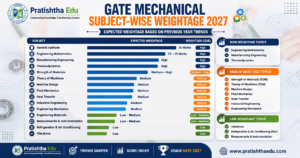
The official GATE authority does not publish a fixed chapter-wise weightage for the Mechanical Engineering paper. However, an analysis of previous years’ question papers indicates that certain subjects consistently contribute more marks than others. Understanding the expected weightage helps candidates prioritise high-scoring topics while ensuring they complete the entire GATE Mechanical Syllabus 2027.
Before planning your preparation, it is also helpful to understand the GATE Mechanical Exam Pattern 2027, as it explains the marking scheme, question types, and distribution of marks across different sections.
| Subject | Expected Weightage | Difficulty Level |
| General Aptitude | 15 Marks | Easy |
| Engineering Mathematics | 13–15 Marks | Moderate |
| Manufacturing Engineering | High | Moderate |
| Thermodynamics | High | Moderate to Difficult |
| Strength of Materials | Medium to High | Moderate |
| Theory of Machines | Medium | Moderate |
| Machine Design | Medium | Moderate |
| Fluid Mechanics | Medium | Moderate |
| Heat Transfer | Medium | Moderate |
| Industrial Engineering | Medium | Easy to Moderate |
| Engineering Mechanics | Medium | Moderate |
| Engineering Materials | Low to Medium | Easy |
| Measurements & Instrumentation | Low to Medium | Easy |
| Refrigeration & Air Conditioning | Low | Moderate |
| Vibrations | Low | Moderate |
Note: The actual distribution of questions may vary from year to year. Candidates should prepare the complete GATE Mechanical Syllabus 2027 instead of relying solely on previous years’ weightage trends. A balanced preparation strategy covering all subjects will improve your chances of scoring well in the examination.
Who Should Prepare Using This Syllabus?
The GATE Mechanical Syllabus 2027 is designed for a wide range of Mechanical Engineering aspirants who wish to pursue higher education, secure PSU jobs, or strengthen their technical knowledge. Understanding who can benefit from this syllabus helps candidates plan their preparation more effectively.
Final-Year B.E./B.Tech Mechanical Engineering Students
Students in their final year should begin preparing early to build strong fundamentals while balancing their college academics. Starting preparation during the final year provides sufficient time for revision, practice, and mock tests.
Mechanical Engineering Graduates
Graduates planning to pursue M.Tech, M.E., or research programs can use this syllabus as a structured roadmap for systematic preparation.
PSU Job Aspirants
Several leading Public Sector Undertakings (PSUs) recruit Mechanical Engineering candidates based on GATE scores. A thorough understanding of the complete syllabus is essential for achieving a competitive score.
Working Professionals
Candidates who are currently employed but planning to pursue higher studies or switch careers can prepare using this syllabus by following a well-planned part-time study schedule.
Self-Study Aspirants
Students preparing without coaching can use the GATE Mechanical Syllabus 2027 to create a realistic study plan, choose the right reference books, prioritise important subjects, and monitor their progress throughout their preparation journey.
Regardless of your current stage, following the latest GATE Mechanical Syllabus 2027 ensures that your preparation remains organised, focused, and aligned with the examination requirements.
High-Weightage Topics You Should Never Skip
While every subject in the GATE Mechanical Syllabus 2027 is important, certain topics consistently contribute a significant number of questions in previous examinations. Giving these subjects extra attention can greatly improve your overall score.
Engineering Mathematics
Engineering Mathematics is one of the highest-scoring sections in the examination. A strong command of formulas and problem-solving techniques not only helps in this subject but also supports solving numerical questions in several core Mechanical Engineering subjects. Daily formula revision and regular practice are highly recommended.
Manufacturing Engineering
Manufacturing Engineering frequently contributes a large number of questions every year. Important topics such as machining, welding, casting, metrology, CNC machines, and non-traditional machining should be prepared thoroughly.
Thermodynamics
Thermodynamics forms the backbone of Thermal Engineering. Candidates should focus on understanding thermodynamic laws, entropy, gas power cycles, vapour power cycles, and steam properties before moving to advanced applications.
Strength of Materials (SOM)
Stress analysis, bending, torsion, beam deflection, and Mohr’s Circle are among the most frequently asked topics. Regular numerical practice helps improve both accuracy and speed.
Theory of Machines
Theory of Machines includes several scoring topics such as gears, governors, cams, flywheels, balancing of rotating masses, and velocity analysis. A clear conceptual understanding is essential for solving these questions quickly.
Fluid Mechanics
Fluid Mechanics remains one of the most important subjects in the GATE Mechanical examination. Bernoulli’s equation, boundary layer theory, dimensional analysis, fluid statics, and flow through pipes are frequently tested.
Instead of studying subjects randomly, begin your preparation with these high-weightage areas and gradually move on to the remaining topics. This strategy helps in completing the syllabus more efficiently while improving your chances of achieving a high GATE score.
GATE Mechanical Preparation Strategy, Revision Plan, Best Books & Common Mistakes
30-Day Revision Plan for GATE Mechanical
The last 30 days before the GATE examination are the most crucial phase of your preparation. Instead of learning new topics, focus on revising the complete GATE Mechanical Syllabus 2027, strengthening concepts, solving GATE Mechanical Previous Year Papers, and attempting regular GATE Mechanical Mock Tests. A structured revision plan helps improve retention, increase accuracy, and build confidence before the examination.
Week 1: Revise Core Mechanical Subjects
Begin your revision with the core Mechanical Engineering subjects that carry significant weightage.
Focus on:
- Engineering Mathematics
- Engineering Mechanics
- Strength of Materials
- Theory of Machines
- Machine Design
During this week:
- Revise important formulas.
- Solve topic-wise numerical problems.
- Go through your short notes.
- Identify concepts that require additional practice.
Avoid spending too much time on a single subject. Maintain a balanced revision schedule so that every important topic receives equal attention.
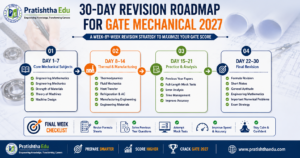
Week 2: Revise Thermal and Manufacturing Subjects
The second week should focus on Thermal Sciences and Manufacturing Engineering.
Subjects to revise include:
- Thermodynamics
- Fluid Mechanics
- Heat Transfer
- Refrigeration & Air Conditioning
- Manufacturing Engineering
- Engineering Materials
Spend time solving numerical problems, revising standard formulas, and strengthening weak concepts. Regular revision during this stage will improve both speed and accuracy.
Week 3: Solve Previous Year Papers and Mock Tests
This week should be dedicated to applying everything you have revised.
Aim to solve:
- 3–4 Full-Length GATE Mechanical Previous Year Papers
- 2–3 Full-Length GATE Mechanical Mock Tests
After every test:
- Analyse incorrect answers.
- Identify weak areas.
- Revise the related concepts immediately.
- Track improvements in speed, accuracy, and time management.
Remember, analysing your mistakes is more valuable than simply attempting more tests.
Week 4: Final Revision and Exam Readiness
The final week should be reserved for quick revision. Avoid learning new topics at this stage.
Instead, focus on:
- Formula Sheets
- Short Notes
- Frequently Asked Concepts
- Important Numerical Problems
- General Aptitude
- Engineering Mathematics
Ensure you get adequate sleep, maintain a healthy routine, and stay confident. A calm mind, proper revision, and consistent practice will help you perform your best on the examination day.
Best Preparation Strategy After Completing the GATE Mechanical Syllabus 2027
Completing the GATE Mechanical Syllabus 2027 is only the first milestone in your preparation journey. The real challenge begins after finishing the syllabus, when you need to revise consistently, solve practice questions, and improve both speed and accuracy. A well-planned preparation strategy helps convert your knowledge into marks and increases your confidence before the examination.
Along with regular revision, candidates should attempt GATE Mechanical Mock Tests to evaluate their preparation level, identify weak areas, and improve time management under actual exam conditions.
Create a Daily Study Routine
A disciplined study schedule is far more effective than studying irregularly for long hours. Instead of focusing only on the number of study hours, aim for productive learning sessions that include concept revision, numerical practice, and regular self-assessment.
A balanced daily routine may look like this:
| Activity | Time |
| Concept Revision | 2 Hours |
| Numerical Practice | 2 Hours |
| Previous Year Questions | 1 Hour |
| Formula Revision | 30 Minutes |
| Mock Test Analysis | 30 Minutes |
Following a consistent daily routine, revising regularly, and analysing your performance after every mock test will help you complete your preparation with greater confidence and improve your chances of securing a high GATE score.
Revise Every Week
Many students complete the syllabus but forget previously studied subjects due to a lack of regular revision.
A simple weekly revision schedule can be:
| Day | Subject |
| Monday | Engineering Mathematics |
| Tuesday | Strength of Materials |
| Wednesday | Thermodynamics |
| Thursday | Manufacturing Engineering |
| Friday | Fluid Mechanics |
| Saturday | Theory of Machines & Machine Design |
| Sunday | Mock Test + Revision |
Weekly revision strengthens long-term memory and improves confidence.
Solve Previous Year Question Papers
Previous Year Question Papers (PYQs) are one of the most valuable resources for GATE preparation.
They help you:
- Understand the exam pattern
- Identify important topics
- Improve problem-solving speed
- Build confidence
- Learn frequently repeated concepts
Try solving papers under actual exam conditions to improve time management.
Attempt Full-Length Mock Tests
Mock tests are essential for evaluating your preparation.
After every mock test:
- Analyse your mistakes.
- Identify weak subjects.
- Revise difficult concepts.
- Improve time management.
- Monitor your progress.
Do not focus only on your score. Focus on improving accuracy and reducing unnecessary mistakes.
Prepare Short Notes
Prepare concise notes throughout your preparation for quick revision.
Your notes should include:
- Important formulas
- Standard equations
- Definitions
- Frequently asked concepts
- Short tricks
- Important exceptions
These notes become extremely useful during the final weeks before the examination.
Manage Your Time Wisely
Many students spend excessive time on their favourite subjects while neglecting weaker areas.
A balanced preparation strategy should include:
- High-weightage subjects first
- Daily numerical practice
- Weekly revision
- Regular mock tests
- Performance analysis
- Continuous improvement
Consistency is the key to success in GATE Mechanical.
Best Books for GATE Mechanical 2027
Choosing the right study material is just as important as following the correct preparation strategy. Instead of referring to multiple books for the same subject, select one reliable textbook and revise it thoroughly. Studying from too many sources often creates confusion and makes revision difficult.
If you are looking for a detailed subject-wise book list with buying tips and recommendations for beginners as well as advanced learners, you can also read our Best Books for GATE Mechanical 2027 guide.
The table below includes some of the most recommended books used by GATE Mechanical aspirants and experts over the years.
| Subject | Recommended Book | Author |
| Engineering Mathematics | Higher Engineering Mathematics | B. S. Grewal |
| Strength of Materials | Strength of Materials | R. K. Rajput |
| Theory of Machines | Theory of Machines | S. S. Rattan |
| Machine Design | Machine Design | V. B. Bhandari |
| Thermodynamics | Engineering Thermodynamics | P. K. Nag |
| Heat Transfer | Heat and Mass Transfer | R. K. Rajput |
| Fluid Mechanics | Fluid Mechanics & Hydraulic Machines | R. K. Rajput |
| Manufacturing Engineering | Manufacturing Science | Amitabha Ghosh & Ashok Kumar Mallik |
| Industrial Engineering | Industrial Engineering & Management | O. P. Khanna |
Additional Preparation Resources
Apart from standard textbooks, candidates should regularly practice:
- Previous Year Question Papers
- Standard Mock Tests
- Topic-wise Practice Questions
- Formula Sheets
- Short Notes
Using limited but high-quality study material is more effective than referring to too many books.
Common Mistakes to Avoid During GATE Mechanical Preparation
Many capable students fail to achieve their target score not because they lack knowledge, but because of avoidable mistakes during preparation. Avoiding these mistakes can significantly improve your performance.
1. Ignoring the Official Syllabus
Always prepare according to the latest GATE Mechanical Syllabus. Studying topics outside the syllabus wastes valuable preparation time.
2. Skipping Engineering Mathematics
Engineering Mathematics contributes a significant number of marks every year. Ignoring this subject can considerably reduce your overall score.
3. Not Solving Previous Year Papers
Previous year papers provide valuable insight into question patterns, important topics, and difficulty levels. Skipping them means missing one of the best preparation resources.
4. Avoiding Mock Tests
Many students postpone mock tests until the final month. Start attempting mock tests early to improve time management, identify weak areas, and build exam confidence.
5. Studying Without a Proper Plan
Random study sessions often result in incomplete preparation. Follow a structured timetable that includes learning, revision, practice, and regular assessment.
6. Referring to Too Many Books
Using multiple books for the same subject often creates confusion. Stick to one trusted source for each subject and revise it multiple times.
7. Neglecting Revision
Completing the syllabus once is not enough. Regular revision is essential for retaining concepts and recalling them during the examination.
8. Ignoring Weak Subjects
Many aspirants focus only on their favourite subjects and avoid difficult topics. Instead, spend additional time strengthening weaker areas to improve your overall score.
9. Poor Time Management During the Exam
Knowing the answers is not enough if you cannot complete the paper on time. Regular mock tests help improve speed and teach effective time management strategies.
10. Losing Consistency
Studying continuously for a few months is far more effective than studying intensely for a few days. Small daily improvements lead to significant results over time.
Avoiding these common mistakes and following a disciplined preparation strategy will improve both your confidence and your chances of securing a high score in GATE Mechanical 2027.
Why Choose Pratishtha Edu for GATE Mechanical Preparation?
Preparing for GATE Mechanical is not just about completing the syllabus. It requires the right guidance, consistent practice, regular revision, and continuous performance evaluation. While self-study plays an important role, expert mentoring and a structured learning environment can make your preparation more focused and effective.
At Pratishtha Edu, we are committed to helping Mechanical Engineering aspirants achieve their GATE goals through quality teaching, comprehensive study materials, and result-oriented preparation strategies. Our coaching program is designed to strengthen conceptual understanding, improve problem-solving skills, and build confidence for the examination.
Experienced Faculty
Learn from highly qualified and experienced faculty members who simplify complex Mechanical Engineering concepts through practical examples and exam-oriented teaching methods. Our mentors focus on building strong fundamentals, enabling students to solve both conceptual and numerical questions with confidence.
Structured Course Plan
Our well-planned curriculum ensures that every topic in the GATE Mechanical Syllabus 2027 is covered systematically. The course includes regular revisions, assignments, and practice sessions to help students stay on track throughout their preparation.
Comprehensive Study Material
Students receive updated study notes, topic-wise assignments, formula sheets, and practice questions based on the latest GATE examination pattern. The study material is designed to simplify learning and support effective revision.
Regular Mock Tests
Regular mock tests help students assess their preparation level, improve time management, and become familiar with the actual examination pattern. Detailed performance analysis after each test helps identify strengths and areas that require improvement.
Doubt-Clearing Sessions
Dedicated doubt-solving sessions ensure that students receive timely clarification on difficult concepts. This helps prevent learning gaps and builds confidence before moving on to advanced topics.
Performance Tracking
Individual performance reports enable students to monitor their progress throughout the course. Personalised feedback helps them focus on weaker areas and continuously improve their performance.
Small Batch Size
We maintain small batch sizes to provide personalised attention to every student. This encourages better interaction with faculty members and creates a more effective learning environment.
Focused Learning Environment
Pratishtha Edu offers a disciplined and motivating atmosphere where students can concentrate on their preparation without distractions. Our structured approach encourages consistency, which is essential for success in GATE Mechanical.
Whether you are a final-year student, graduate, working professional, or a self-study aspirant seeking expert guidance, our GATE Mechanical Coaching in Bangalore provides expert faculty, structured classroom programs, comprehensive study materials, regular mock tests, and continuous mentorship to help you prepare with confidence and achieve your target GATE score.
Frequently Asked Questions (FAQs)
1. What is the GATE Mechanical Syllabus 2027?
The GATE Mechanical Syllabus 2027 includes General Aptitude, Engineering Mathematics, Engineering Mechanics, Strength of Materials, Theory of Machines, Machine Design, Fluid Mechanics, Thermodynamics, Heat Transfer, Manufacturing Engineering, Industrial Engineering, Engineering Materials, Measurements & Instrumentation, Vibrations, and Refrigeration & Air Conditioning.
2. Has the GATE Mechanical Syllabus changed in 2027?
As of now, no major changes have been officially announced. Candidates should continue preparing according to the latest officially available syllabus and regularly check the official GATE website for updates.
3. Which subjects carry the highest weightage in GATE Mechanical?
Engineering Mathematics, Manufacturing Engineering, Thermodynamics, Strength of Materials, Theory of Machines, and Fluid Mechanics generally contribute a significant number of marks based on previous years’ trends.
4. Is Engineering Mathematics compulsory for GATE Mechanical?
Yes. Engineering Mathematics is a compulsory section and contributes around 13–15 marks. Strong mathematical skills also help solve problems in several core Mechanical Engineering subjects.
5. How many months are sufficient for GATE Mechanical preparation?
Most aspirants require approximately 6 to 9 months of consistent preparation. However, the ideal duration depends on your current knowledge level, study schedule, and revision strategy.
6. Which books are best for GATE Mechanical preparation?
Some of the most recommended books include:
- Higher Engineering Mathematics by B. S. Grewal
- Engineering Thermodynamics by P. K. Nag
- Machine Design by V. B. Bhandari
- Theory of Machines by S. S. Rattan
- Strength of Materials by R. K. Rajput
- Industrial Engineering & Management by O. P. Khanna
Along with these books, candidates should regularly solve previous year papers and take mock tests.
7. Can I crack GATE Mechanical without coaching?
Yes. Many students successfully clear GATE through self-study by following a disciplined study plan. However, coaching can provide expert guidance, structured learning, regular assessments, and doubt-clearing support, making preparation more efficient.
8. Are the previous year’s question papers enough for GATE preparation?
Previous year papers are one of the most valuable preparation resources because they help you understand the exam pattern, important topics, and frequently asked concepts. However, they should be supplemented with standard textbooks, revision, and mock tests for comprehensive preparation.
9. Is the GATE Mechanical syllabus useful for PSU recruitment?
Yes. Several Public Sector Undertakings (PSUs) recruit Mechanical Engineering graduates based on GATE scores. Therefore, preparing the complete syllabus not only helps with higher education but also enhances PSU job opportunities.
10. How should beginners start GATE Mechanical preparation?
Beginners should first understand the complete syllabus, prepare a realistic study timetable, build strong fundamentals, solve previous year question papers, revise regularly, and attempt mock tests to monitor their progress.
Conclusion
The GATE Mechanical Syllabus 2027 is much more than a list of subjects—it serves as the foundation of your entire preparation journey. A thorough understanding of the syllabus helps you prioritise important topics, create an effective study plan, and avoid spending valuable time on less relevant areas.
Instead of trying to study everything at once, focus on building strong fundamentals in Engineering Mathematics and the core Mechanical Engineering subjects. Regular revision, consistent practice, solving previous year question papers, and attempting mock tests are essential for improving your accuracy, speed, and confidence. If you are looking for additional preparation tips, don’t miss our detailed guide on How to Crack GATE Mechanical in First Attempt, where you’ll find proven strategies to maximise your score.
Whether your goal is to secure admission to a prestigious M.Tech or M.E. programme, pursue research opportunities, or earn a position in a leading Public Sector Undertaking (PSU), disciplined preparation and smart planning can help you achieve your target score.
If you are looking for expert guidance, experienced faculty, comprehensive study materials, regular mock tests, and personalised mentoring, explore our GATE Mechanical Coaching in Bangalore and take advantage of a structured learning environment designed to help you succeed.
Start your preparation today, stay consistent, believe in your abilities, and take the first step towards achieving success in GATE Mechanical 2027.
Leave a Reply