Preparing for the IIT JAM Physics 2027 examination is one of the most important steps for students who wish to pursue M.Sc. Physics and other postgraduate science programs at India’s premier institutes. Every year, thousands of aspirants appear for the IIT JAM Physics Exam to secure admission to prestigious IITs and other participating institutes known for their academic excellence, research opportunities, and world-class faculty.
The IIT JAM Physics examination is a national-level Physics Entrance Exam that evaluates candidates’ understanding of undergraduate-level physics concepts. A good score in the examination opens the door to higher education, advanced research, and rewarding careers in teaching, research organizations, government, and private industry. Whether your goal is to pursue higher studies, prepare for research, or build a strong career in physics, qualifying IIT JAM can be a significant milestone.
This comprehensive guide covers everything you need to know about the IIT JAM Physics 2027 examination, including eligibility criteria, exam pattern, complete syllabus, important dates, subject-wise weightage, best books, preparation strategy, previous year cut-offs, career opportunities, and frequently asked questions. Whether you are beginning your IIT JAM Physics Preparation or looking to improve your score, this guide will help you understand every important aspect of the examination in a simple and structured manner.
This guide is regularly updated with the latest IIT JAM Physics 2027 notification, syllabus, eligibility criteria, exam pattern, important dates, preparation strategy, previous year papers, cut-off, and admission-related updates to help aspirants stay informed throughout their preparation journey.
Before starting your preparation, it is important to thoroughly understand the IIT JAM Physics Syllabus 2027, as it helps you identify high-weightage topics, plan your study schedule effectively, and focus on the concepts that carry the highest marks in the examination. Similarly, understanding the IIT JAM Physics Exam Pattern, IIT JAM Physics Eligibility Criteria, and IIT JAM Physics Important Dates will help you prepare with a clear strategy and avoid missing any important admission events.
If you are looking for reliable guidance, high-quality Study Material, expert mentorship, and a disciplined study environment, Pratishtha Edu and Pratishtha Library provide the resources you need to prepare effectively for competitive examinations like IIT JAM. You can also explore the IIT-JAM Physics program and learn more about our teaching approach through the About Us page to understand how we support students throughout their preparation journey.
What is IIT JAM Physics?
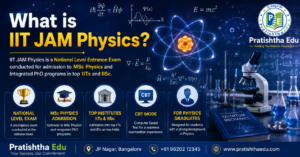
The Indian Institute of Technology Joint Admission Test for Masters (IIT JAM) is one of India’s most prestigious entrance examinations conducted for admission to postgraduate science programs. Among its various papers, IIT JAM Physics is specifically designed for students who wish to pursue M.Sc. Physics Admission and other related postgraduate programs offered by IITs and participating institutes.
The IIT JAM Physics Exam evaluates a candidate’s understanding of undergraduate-level physics concepts, mathematical techniques, analytical thinking, and problem-solving ability. Rather than focusing only on theoretical knowledge, the examination tests conceptual clarity and the practical application of physics principles across multiple subjects.
Every year, thousands of science graduates from universities across India compete in IIT JAM Physics 2027 to secure admission to some of the country’s top institutions. A good score not only increases the chances of getting admission into a reputed IIT but also opens opportunities for higher education, research, and specialized careers in physics and interdisciplinary sciences.
Full Form
IIT JAM stands for Indian Institute of Technology Joint Admission Test for Master’s. It is a national-level entrance examination conducted annually by one of the Indian Institutes of Technology on behalf of the organizing committee.
Purpose of the Exam
The primary objective of the IIT JAM Physics examination is to select deserving candidates for postgraduate science programs based on their conceptual knowledge and analytical skills. The examination provides a common admission platform for candidates seeking admission to leading institutes without the need to appear for multiple entrance examinations.
Participating IITs
Qualified candidates can apply for admission to several prestigious IITs and other participating institutes that accept IIT JAM scores for postgraduate science programs. The list of participating institutes may vary slightly each year based on the official admission notification.
Programs Offered
A valid IIT JAM Physics score can be used for admission to various postgraduate programs, including:
- M.Sc. Physics
- Joint M.Sc.–Ph.D. Programs
- Integrated Ph.D. Programs
- Other interdisciplinary science programs offered by participating institutes
Why Students Choose IIT JAM Physics
There are several reasons why students choose IIT JAM Physics after completing their bachelor’s degree:
- Admission to prestigious IITs and top science institutes.
- Excellent academic environment with experienced faculty.
- Access to advanced laboratories and research facilities.
- Better opportunities for Ph.D. programs in India and abroad.
- Career opportunities in research organizations, government laboratories, teaching, public sector undertakings, and private industries.
- Strong foundation for competitive examinations and scientific research careers.
Choosing IIT JAM Physics 2027 is not only about securing admission into a reputed institute but also about building a strong academic and professional future in the field of physics. With the right IIT JAM Physics Preparation, quality Study Material, regular practice, and proper guidance, candidates can significantly improve their chances of achieving a high rank.
IIT JAM Physics 2027 Highlights
The following table provides a quick overview of the IIT JAM Physics 2027 examination. Candidates should always refer to the official notification for the latest updates and changes.
| Particular | Details |
| Examination Name | IIT JAM Physics 2027 |
| Full Form | Indian Institute of Technology Joint Admission Test for Masters |
| Conducting Body | Conducting IIT (Announced Every Year) |
| Examination Level | National Level |
| Examination Mode | Computer-Based Test (CBT) |
| Duration | 3 Hours (180 Minutes) |
| Medium of Examination | English |
| Total Questions | 60 |
| Total Marks | 100 |
| Question Types | MCQ, MSQ & NAT |
| Negative Marking | Applicable for MCQs only |
| Official Website | Official IIT JAM Portal |
The above highlights provide a quick overview of the IIT JAM Physics 2027 examination. Before beginning your preparation, candidates should carefully understand the IIT JAM Physics Eligibility Criteria, IIT JAM Physics Exam Pattern, IIT JAM Physics Syllabus 2027, and the complete admission process. A well-planned preparation strategy, supported by quality Study Material, regular mock tests, and consistent revision, can significantly improve your performance in the examination.
IIT JAM Physics Eligibility Criteria 2027
Before applying for the IIT JAM Physics 2027 examination, candidates must carefully review the eligibility requirements mentioned in the official admission brochure. Meeting the eligibility criteria is essential for participating in the admission process and securing admission to postgraduate programs offered by participating IITs and other institutes.
The eligibility criteria generally include educational qualification, qualifying degree, nationality, and institute-specific admission requirements. Although the IIT JAM Physics Exam is open to students from various science backgrounds, candidates should ensure that they fulfill all the eligibility conditions before submitting the application form.
Educational Qualification
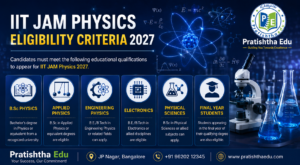
Candidates who have completed or are currently pursuing a bachelor’s degree in science or a related discipline from a recognized university are eligible to appear for the IIT JAM Physics 2027 examination.
Students from the following academic backgrounds generally apply for the Physics paper:
- B.Sc. Physics
- Applied Physics
- Physics Honours
- Engineering Physics
- Electronics
- Mathematics & Physics
- Physical Sciences
- Astronomy & Astrophysics
- Other equivalent science disciplines
Final-year undergraduate students are also eligible to apply, provided they complete their qualifying degree within the timeline specified during the admission process.
Age Limit
There is no upper or lower age limit for appearing in the IIT JAM Physics Exam. Candidates of any eligible age group can apply, provided they satisfy the educational qualification and admission requirements prescribed by the participating institutes.
Nationality
Indian nationals are eligible to apply for the examination. Foreign nationals may also be considered for admission according to the admission policies of the respective participating institutes. Candidates should always refer to the official admission brochure for institute-specific guidelines.
Minimum Marks Requirement
Currently, there is no minimum percentage requirement for appearing in the IIT JAM examination. However, candidates must satisfy the admission requirements specified by the institute where they seek admission after qualifying the examination.
Since admission policies may change from year to year, aspirants should carefully read the latest official notification before applying.
Who Can Apply?
The following candidates are generally eligible to apply for IIT JAM Physics 2027:
- Final-year undergraduate students.
- Graduates with a bachelor’s degree in Physics or related science disciplines.
- Candidates interested in pursuing M.Sc. Physics or interdisciplinary postgraduate programs.
- Students planning careers in research, teaching, higher education, or government scientific organizations.
After confirming your eligibility, the next step is to keep track of the IIT JAM Physics Important Dates 2027 so that you do not miss the notification, application process, admit card release, examination date, result announcement, or counselling schedule.
IIT JAM Physics Important Dates 2027
Candidates planning to appear for IIT JAM Physics 2027 should regularly monitor the important dates related to the examination. Staying updated with the official schedule helps candidates complete every stage of the admission process on time and avoid missing important deadlines.
The official notification generally includes the complete schedule for registration, application correction, admit card release, examination, result declaration, and counselling.
| Event | Expected Schedule* |
| Official Notification | August 2026 |
| Online Application Starts | September 2026 |
| Last Date to Apply | October 2026 |
| Application Correction Window | November 2026 |
| Admit Card Release | January 2027 |
| IIT JAM Physics Exam Date | February 2027 |
| Result Declaration | March 2027 |
| Admission Form Submission | April 2027 |
| Counselling & Admission Process | May–June 2027 |
The above dates are tentative and will be updated after the official IIT JAM 2027 notification is released.
Candidates are advised to regularly visit the Official IIT JAM Website for the latest announcements regarding the application process, admit card, examination schedule, result declaration, and admission counselling. Keeping track of these dates will help you plan your IIT JAM Physics Preparation more effectively and avoid missing any important event.
IIT JAM Physics Exam Pattern 2027
Understanding the IIT JAM Physics Exam Pattern 2027 is one of the most important steps in preparing for the examination. It helps candidates understand the question paper structure, marking scheme, question types, and time allocation, enabling them to develop an effective preparation strategy.
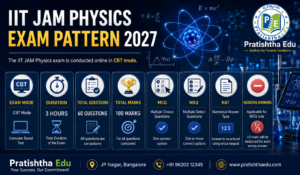
The IIT JAM Physics 2027 examination is conducted in Computer-Based Test (CBT) mode and consists of three different types of questions. The examination is designed to evaluate candidates’ conceptual understanding, analytical thinking, numerical ability, and problem-solving skills across various undergraduate-level physics topics.
IIT JAM Physics Exam Pattern 2027
| Particular | Details |
| Examination Mode | Computer-Based Test (CBT) |
| Duration | 3 Hours (180 Minutes) |
| Medium | English |
| Total Questions | 60 |
| Total Marks | 100 |
| Sections | Section A, Section B & Section C |
| Question Types | MCQ, MSQ & NAT |
| Negative Marking | Applicable only for Section A (MCQs) |
| Exam Level | National Level |
| Conducting Body | Conducting IIT |
Question Types
The IIT JAM Physics Exam consists of three different question formats designed to assess conceptual understanding, analytical thinking, and numerical problem-solving ability.
Section A – Multiple Choice Questions (MCQs)
Section A contains Multiple Choice Questions (MCQs), where each question has four answer options with only one correct answer. Negative marking is applicable in this section. One-third mark is deducted for every incorrect answer in 1-mark questions, while two-thirds mark is deducted for every incorrect answer in 2-mark questions.
Section B – Multiple Select Questions (MSQs)
Section B contains Multiple Select Questions (MSQs), where one or more options may be correct. Candidates must select all the correct options to receive full marks. There is no negative marking for MSQ questions.
Section C – Numerical Answer Type (NAT)
Section C consists of Numerical Answer Type (NAT) questions. Candidates are required to enter the numerical answer using the virtual keyboard available on the computer screen. There is no negative marking for NAT questions.
Marking Scheme
The IIT JAM Physics examination follows a structured marking scheme. While MCQ questions carry negative marking for incorrect responses, MSQ and NAT questions do not have any negative marking. Candidates should therefore answer MCQ questions carefully and avoid unnecessary guesswork.
Time Management
The total duration of the examination is 180 minutes, during which candidates must attempt all three sections. It is advisable to begin with familiar questions before moving to lengthy calculations or conceptually challenging problems. Effective time management, regular mock tests, and consistent revision are essential components of a successful IIT JAM Physics Preparation strategy.
After understanding the exam pattern, candidates should thoroughly study the IIT JAM Physics Syllabus 2027 to prepare every topic systematically and maximize their performance in the examination.
IIT JAM Physics Syllabus 2027
The IIT JAM Physics Syllabus 2027 is one of the most important aspects of the examination. Before starting your IIT JAM Physics Preparation, every aspirant should have a clear understanding of the complete syllabus to identify high-weightage topics and prepare systematically. The syllabus is primarily based on undergraduate-level physics and covers both theoretical concepts and numerical problem-solving.
A well-planned preparation strategy begins with completing the syllabus topic by topic. Instead of studying randomly, candidates should focus on understanding concepts, practicing numerical problems, and revising important formulas regularly. Along with the IIT JAM Physics Exam Pattern, a thorough knowledge of the syllabus helps candidates manage their preparation more effectively.
The syllabus includes several major branches of physics, each carrying significant weightage in the examination. Below is a detailed overview of the important topics included in the IIT JAM Physics Syllabus 2027.
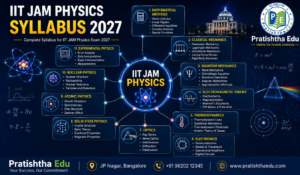
Mathematical Methods
Mathematical Methods form the foundation of almost every topic in physics. A strong understanding of mathematical concepts is essential for solving analytical and numerical problems throughout the examination.
Important topics include:
- Vector Algebra
- Vector Calculus
- Matrices and Determinants
- Eigenvalues and Eigenvectors
- Differential Equations
- Partial Differentiation
- Fourier Series
- Laplace Transform
- Complex Variables
- Probability and Statistics
Candidates should regularly practice numerical problems from this section because mathematical methods are frequently applied in Mechanics, Quantum Mechanics, Electromagnetic Theory, and Statistical Physics.
Classical Mechanics
Classical Mechanics is one of the highest-scoring and most important sections of the IIT JAM Physics Exam. Questions generally focus on conceptual understanding along with mathematical applications.
Major topics include:
- Newton’s Laws of Motion
- Frames of Reference
- Work, Energy and Power
- Conservation Laws
- Rotational Motion
- Moment of Inertia
- Central Force Motion
- Harmonic Oscillations
- Lagrangian Mechanics
- Hamiltonian Mechanics
- Rigid Body Dynamics
- Non-Inertial Frames
Candidates should practice derivations as well as numerical problems to strengthen this section.
Electromagnetic Theory
Electromagnetic Theory plays a significant role in the examination and requires a good understanding of both concepts and mathematical derivations.
Important topics include:
- Electrostatics
- Gauss’s Law
- Electric Potential
- Capacitance
- Dielectrics
- Magnetostatics
- Ampere’s Law
- Faraday’s Law
- Maxwell’s Equations
- Electromagnetic Waves
- Boundary Conditions
- Electromagnetic Energy
This section often includes conceptual as well as application-based questions.
Quantum Mechanics
Quantum Mechanics is considered one of the most important and high-weightage sections in the IIT JAM Physics Syllabus 2027. Most questions require conceptual clarity along with mathematical problem-solving skills.
Major topics include:
- Wave Function
- Schrödinger Equation
- Operators
- Eigenvalues
- Eigenfunctions
- Expectation Values
- Angular Momentum
- Hydrogen Atom
- Harmonic Oscillator
- Tunneling
- Spin
- Approximation Methods
Students should focus on solving previous numerical problems to improve accuracy in this section.
Thermodynamics and Statistical Physics
Thermodynamics and Statistical Physics are essential topics that appear regularly in the examination.
Important topics include:
- Laws of Thermodynamics
- Thermodynamic Processes
- Entropy
- Heat Engines
- Maxwell Relations
- Carnot Cycle
- Kinetic Theory of Gases
- Maxwell-Boltzmann Distribution
- Bose-Einstein Statistics
- Fermi-Dirac Statistics
- Partition Function
- Black Body Radiation
Conceptual understanding combined with numerical practice is the key to scoring well in this section.
Electronics
Electronics is another important section in the IIT JAM Physics Exam. Candidates should understand both analog and digital electronics.
Important topics include:
- Semiconductor Physics
- PN Junction Diode
- Zener Diode
- Bipolar Junction Transistor
- Field Effect Transistor
- Operational Amplifier
- Logic Gates
- Boolean Algebra
- Flip-Flops
- Counters
- Digital Circuits
Regular practice of circuit-based numerical problems is recommended for better performance.
The topics discussed above constitute the first half of the IIT JAM Physics Syllabus 2027. In the next section, we will cover the remaining high-weightage topics, including Oscillations, Waves & Optics, Solid State Physics, Atomic & Molecular Physics, Nuclear & Particle Physics, and Experimental Physics, along with their important subtopics for the examination.
IIT JAM Physics Syllabus 2027 (Continued)
The remaining topics of the IIT JAM Physics Syllabus 2027 are equally important and frequently contribute a significant number of questions in the examination. Candidates should complete these subjects thoroughly while continuing regular revision of previously studied topics. A balanced preparation strategy covering every section of the syllabus can substantially improve overall performance in the IIT JAM Physics Exam.
Oscillations, Waves and Optics
This section evaluates a candidate’s understanding of wave motion, oscillatory systems, and optical phenomena. Questions often involve conceptual understanding along with numerical calculations.
Important topics include:
- Simple Harmonic Motion (SHM)
- Damped and Forced Oscillations
- Resonance
- Superposition of Waves
- Standing Waves
- Doppler Effect
- Wave Equation
- Interference
- Diffraction
- Polarization
- Geometrical Optics
- Physical Optics
- Optical Instruments
Students should practice derivations, graphical interpretations, and numerical problems to strengthen this section.
Solid State Physics
Solid State Physics introduces candidates to the properties of solids and crystalline materials. Although the number of questions may vary, this section is considered scoring for well-prepared candidates.
Important topics include:
- Crystal Structure
- Unit Cells
- Miller Indices
- Reciprocal Lattice
- Crystal Binding
- Lattice Vibrations
- Free Electron Theory
- Band Theory of Solids
- Semiconductors
- Conductors and Insulators
- Magnetic Properties
- Superconductivity
Understanding diagrams and basic theoretical concepts is essential for answering conceptual questions correctly.
Atomic and Molecular Physics
Atomic and Molecular Physics focuses on the structure of atoms and molecules, their spectra, and interaction with radiation.
Important topics include:
- Bohr Model
- Hydrogen Spectrum
- Atomic Energy Levels
- Fine Structure
- Zeeman Effect
- Stark Effect
- Atomic Spectra
- Molecular Bonding
- Rotational Spectra
- Vibrational Spectra
- Electronic Spectra
- Lasers
Candidates should pay special attention to theoretical concepts along with standard numerical applications.
Nuclear and Particle Physics
Nuclear and Particle Physics is an important section that frequently appears in the IIT JAM Physics Exam. Most questions test conceptual understanding and the application of fundamental principles.
Important topics include:
- Nuclear Structure
- Binding Energy
- Nuclear Stability
- Radioactivity
- Alpha Decay
- Beta Decay
- Gamma Decay
- Nuclear Reactions
- Nuclear Fission
- Nuclear Fusion
- Elementary Particles
- Fundamental Interactions
- Conservation Laws
Candidates should understand the physical significance of various nuclear processes and practice numerical problems wherever applicable.
Experimental Physics
Experimental Physics tests practical knowledge gained during undergraduate laboratory courses. This section generally includes direct conceptual questions based on common experiments and measurement techniques.
Important topics include:
- Error Analysis
- Significant Figures
- Measurement Techniques
- Vernier Calipers
- Screw Gauge
- Travelling Microscope
- Spectrometer
- Optical Bench
- Cathode Ray Oscilloscope (CRO)
- Electronic Measuring Instruments
- Data Analysis
- Graph Plotting
Regular revision of laboratory experiments and instrument working principles can help candidates score well in this section.
Important Tips to Complete the IIT JAM Physics Syllabus
Completing the IIT JAM Physics Syllabus 2027 requires proper planning and consistent practice. Instead of studying multiple subjects simultaneously without revision, candidates should divide the syllabus into manageable sections and complete one topic at a time.
Some effective preparation tips include:
- Create a realistic weekly study schedule.
- Complete conceptual learning before solving numerical problems.
- Prepare short notes for important formulas and derivations.
- Revise completed topics every week.
- Practice previous year questions regularly.
- Attempt topic-wise mock tests after completing each subject.
- Identify weak areas and allocate additional study time to improve them.
A systematic approach towards the IIT JAM Physics Syllabus 2027 not only improves conceptual understanding but also increases confidence before the examination. After completing the syllabus, candidates should focus on understanding the IIT JAM Physics Subject-Wise Weightage, selecting the Best Books for IIT JAM Physics Preparation, and solving previous year question papers to maximize their chances of securing a high score.
IIT JAM Physics Subject-Wise Weightage
Understanding the IIT JAM Physics Subject-Wise Weightage helps candidates prioritize high-scoring topics and prepare more efficiently. Although the exact distribution of questions may vary every year, certain subjects consistently carry higher weightage in the IIT JAM Physics Exam. Candidates should focus on these areas while ensuring that every topic in the syllabus is covered.
The table below provides an expected subject-wise weightage based on previous examination trends.
| Topic | Expected Questions | Difficulty Level | Importance |
| Mathematical Methods | 7–9 | Moderate | Very High |
| Quantum Mechanics | 7–9 | Moderate to Difficult | Very High |
| Classical Mechanics | 6–8 | Moderate | Very High |
| Electromagnetic Theory | 5–7 | Moderate | High |
| Thermodynamics & Statistical Physics | 5–7 | Moderate | High |
| Oscillations, Waves & Optics | 4–6 | Easy to Moderate | High |
| Electronics | 3–5 | Easy to Moderate | Moderate |
| Solid State Physics | 2–4 | Easy | Moderate |
| Atomic & Molecular Physics | 2–4 | Moderate | Moderate |
| Nuclear & Particle Physics | 2–4 | Moderate | Moderate |
| Experimental Physics | 2–3 | Easy | Moderate |
Candidates should remember that every topic is important. Even sections carrying fewer questions can make a significant difference in the final score. Instead of focusing only on high-weightage subjects, complete the entire IIT JAM Physics Syllabus 2027 and revise regularly to improve accuracy and confidence.
Best Books for IIT JAM Physics Preparation
Choosing the right books is an important part of IIT JAM Physics Preparation. Standard textbooks help candidates build strong conceptual knowledge, while practice books improve numerical problem-solving skills and examination confidence.
The following books are highly recommended by teachers and successful IIT JAM aspirants.
| Book | Author | Why Recommended |
| Introduction to Electrodynamics | David J. Griffiths | Best book for Electromagnetic Theory and conceptual understanding. |
| Introduction to Quantum Mechanics | David J. Griffiths | Excellent for Quantum Mechanics with theory and numerical problems. |
| Classical Mechanics | Herbert Goldstein | Comprehensive coverage of Classical Mechanics concepts. |
| Fundamentals of Physics | Halliday, Resnick & Walker | Ideal for strengthening undergraduate physics fundamentals. |
| Concepts of Modern Physics | Arthur Beiser | Covers Atomic, nuclear, and Modern Physics simply. |
| Solid State Physics | A. J. Dekker | Useful for understanding crystal structure and semiconductor physics. |
| Electronic Devices and Circuit Theory | Robert Boylestad | Recommended for Electronics and semiconductor devices. |
| Mathematical Physics | B. D. Gupta | Covers Mathematical Methods frequently asked in IIT JAM. |
| Problems in General Physics | I. E. Irodov | Excellent for advanced numerical practice and conceptual clarity. |
| IIT JAM Physics Previous Year Question Papers | Various Publications | Helps understand question trends, difficulty level, and important topics. |
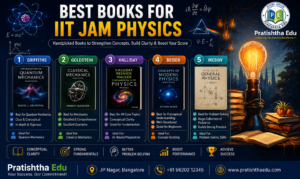
How to Select the Right Books
While preparing for the IIT JAM Physics Exam, avoid using too many books for the same subject. Instead, select one standard textbook for conceptual learning and one practice book for solving numerical questions.
A smart study plan should include:
- Building concepts from standard textbooks.
- Preparing short notes during study.
- Solving chapter-wise numerical problems.
- Practicing previous year question papers regularly.
- Revising formulas and important derivations every week.
- Attempting mock tests after completing each major topic.
Candidates who follow quality Study Material, maintain regular revision, and solve previous year papers consistently are more likely to perform well in the examination.
After completing the syllabus and selecting the right books, the next step is to develop an effective IIT JAM Physics Preparation Strategy. A structured study plan, proper time management, regular mock tests, and continuous revision can significantly improve your chances of securing a high rank in IIT JAM Physics 2027.
IIT JAM Physics Preparation Strategy 2027
A well-planned IIT JAM Physics Preparation Strategy can make a significant difference in your final score. Since the examination covers a wide range of undergraduate-level physics topics, candidates should focus on concept building, numerical problem-solving, revision, and regular mock tests instead of memorizing formulas.
The first step is to understand the IIT JAM Physics Syllabus 2027 thoroughly and divide it into manageable sections. Allocate sufficient time to each subject based on its difficulty level and expected weightage. Candidates should also understand the IIT JAM Physics Exam Pattern before starting their preparation, as it helps in planning an effective study schedule and improving time management skills.
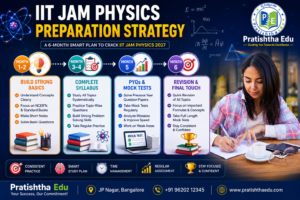
6-Month Preparation Plan
A six-month preparation plan is ideal for candidates who are starting from scratch.
Month 1–2: Build Strong Fundamentals
Focus on strengthening the basics of major subjects, including:
- Mathematical Methods
- Classical Mechanics
- Electromagnetic Theory
- Thermodynamics
During this phase:
- Study concepts from standard textbooks.
- Prepare short notes.
- Solve basic numerical problems.
- Revise every weekend.
Month 3–4: Complete the Remaining Syllabus
Cover the remaining important subjects, including:
- Quantum Mechanics
- Electronics
- Solid State Physics
- Atomic & Molecular Physics
- Nuclear & Particle Physics
- Experimental Physics
- Oscillations, Waves & Optics
At this stage:
- Solve chapter-wise practice questions.
- Revise previously completed subjects.
- Prepare formula sheets.
- Practice numerical problems daily.
Month 5: Previous Year Papers & Mock Tests
This month should focus mainly on practice.
Candidates should:
- Solve Previous Year Question Papers.
- Attempt full-length Mock Tests.
- Analyze mistakes after every test.
- Improve speed and accuracy.
- Strengthen weak subjects.
Regular practice during this phase helps candidates become familiar with the actual IIT JAM Physics Exam pattern.
Month 6: Revision & Final Preparation
The last month should be dedicated entirely to revision.
During this period:
- Revise short notes.
- Practice important formulas.
- Solve important numerical questions.
- Attempt at least 8–10 Full-Length Mock Tests.
- Improve time management.
- Avoid starting completely new topics.
Consistent revision improves confidence and minimizes mistakes in the final examination.
Revision Strategy
Revision is one of the most important parts of IIT JAM Physics Preparation.
Candidates should:
- Revise every completed topic within one week.
- Maintain concise handwritten notes.
- Prepare separate formula sheets.
- Revise important derivations regularly.
- Practice conceptual questions every week.
- Focus more on weak areas.
A well-planned revision schedule ensures long-term retention of concepts.
Mock Test Strategy
Mock tests play a crucial role in improving examination performance.
Candidates should:
- Attempt one mock test every week during the initial months.
- Increase to two or three mock tests per week during the final two months.
- Analyze every incorrect answer carefully.
- Track progress after each test.
- Improve speed without compromising accuracy.
Mock tests help candidates understand their preparation level and build confidence before the actual examination.
Common Mistakes to Avoid
Many aspirants lose valuable marks because of avoidable mistakes. Some common mistakes include:
- Ignoring Mathematical Methods.
- Skipping low-weightage topics.
- Not revising regularly.
- Depending only on theory without numerical practice.
- Solving very few Previous Year Papers.
- Attempting difficult questions first during the examination.
- Studying from too many books simultaneously.
- Poor time management during mock tests.
Avoiding these mistakes can significantly improve your overall score.
IIT JAM Physics Previous Year Cut Off
The IIT JAM Physics Cut Off varies every year depending on factors such as the number of candidates, examination difficulty level, available seats, and overall performance of aspirants. Therefore, candidates should treat previous year cut-offs as a reference rather than a guaranteed qualifying score.
The table below presents the previous year’s qualifying cut-off trends.
| Year | General | OBC-NCL/EWS | SC/ST/PwD |
| 2026* | To be Updated | To be Updated | To be Updated |
| 2025 | As per Official Notification | As per Official Notification | As per Official Notification |
| 2024 | As per Official Notification | As per Official Notification | As per Official Notification |
| 2023 | As per Official Notification | As per Official Notification | As per Official Notification |
*The latest cut-off will be updated after the official IIT JAM 2027 result is announced.
Candidates aiming for admission to top IITs should target a score well above the previous year’s cut-off to improve their chances of securing their preferred institute and specialization.
IIT JAM Physics Previous Year Question Papers
Solving IIT JAM Physics Previous Year Question Papers is one of the most effective ways to improve preparation. Previous year papers help candidates understand the examination pattern, identify frequently asked topics, and improve confidence before the final examination.
Benefits of Solving Previous Year Papers
- Understand the latest examination pattern.
- Identify high-weightage topics.
- Improve conceptual clarity.
- Increase problem-solving speed.
- Learn effective time management.
- Build examination confidence.
- Evaluate preparation level.
How to Solve Previous Year Papers
For maximum benefit, candidates should solve previous year papers under actual examination conditions.
Follow these steps:
- Complete the syllabus before attempting full papers.
- Set a timer for three hours.
- Avoid using books or notes during practice.
- Analyze every incorrect answer.
- Revise weak topics immediately after each paper.
- Maintain an error notebook for revision.
Common Mistakes While Solving Previous Year Papers
Candidates should avoid the following mistakes:
- Solving papers without completing the syllabus.
- Ignoring mistakes after the test.
- Memorizing answers instead of understanding concepts.
- Not maintaining a record of weak topics.
- Skipping numerical questions.
- Attempting too few mock tests before the examination.
Consistent practice of IIT JAM Physics Previous Year Question Papers, combined with a strong preparation strategy, regular revision, quality Study Material, and effective time management, can significantly improve your chances of achieving an excellent score in IIT JAM Physics 2027.
Career Opportunities After IIT JAM Physics
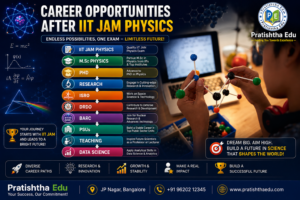
Qualifying IIT JAM Physics 2027 opens the door to a wide range of academic, research, and professional opportunities. A postgraduate degree from a reputed IIT or participating institute not only enhances subject knowledge but also improves career prospects in research organizations, government sectors, higher education, and private industries.
Students who successfully clear the IIT JAM Physics Exam can pursue higher studies in specialized areas of physics and build rewarding careers in scientific research, technology, education, and innovation. Depending on their interests and long-term goals, candidates can choose from several career paths after completing their postgraduate studies.
M.Sc. Physics
The most popular option after qualifying for IIT JAM Physics is pursuing an M.Sc. Physics from an IIT or another participating institute.
During the postgraduate program, students gain in-depth knowledge of subjects such as:
- Quantum Mechanics
- Electromagnetic Theory
- Condensed Matter Physics
- Nuclear Physics
- Particle Physics
- Astrophysics
- Computational Physics
- Materials Science
An M.Sc. degree provides a strong academic foundation for higher studies as well as employment opportunities in various industries.
Ph.D. in Physics
Students interested in advanced scientific research can pursue a Ph.D. in Physics after completing their master’s degree.
A doctoral program allows students to specialize in areas such as:
- Quantum Physics
- Nuclear Physics
- High Energy Physics
- Condensed Matter Physics
- Nanotechnology
- Plasma Physics
- Laser Physics
- Astrophysics
- Computational Physics
A Ph.D. opens opportunities in research laboratories, universities, government organizations, and international research institutions.
Research Scientist
Research is one of the most preferred career options for Physics graduates.
Research Scientists work on developing new technologies, conducting experiments, solving scientific problems, and contributing to innovation across multiple disciplines.
Research opportunities are available in:
- National Laboratories
- Research Institutes
- Universities
- Defence Organizations
- Space Research Centres
- Private Research & Development Companies
ISRO
Physics graduates can prepare for careers in the Indian Space Research Organisation (ISRO) after completing their postgraduate studies.
Career opportunities include:
- Scientist
- Research Engineer
- Technical Officer
- Space Science Research
- Satellite Technology
- Remote Sensing
- Space Applications
Working at ISRO offers opportunities to contribute to India’s space missions and scientific advancements.
DRDO
The Defence Research and Development Organisation (DRDO) recruits Physics graduates for research and technology development related to national defence.
Popular roles include:
- Scientist
- Research Officer
- Technical Scientist
- Defence Technology Research
- Electronics Research
- Materials Research
Candidates with strong analytical and problem-solving skills have excellent career prospects in DRDO.
BARC
The Bhabha Atomic Research Centre (BARC) offers excellent career opportunities for postgraduate Physics students.
Major work areas include:
- Nuclear Science
- Reactor Technology
- Radiation Physics
- Atomic Energy Research
- Materials Science
- Advanced Instrumentation
BARC provides excellent research facilities along with opportunities to work on cutting-edge scientific projects.
Public Sector Undertakings (PSUs)
Many Public Sector Undertakings recruit candidates with postgraduate qualifications in Physics for scientific, technical, and research-oriented roles.
Career opportunities may be available in organizations working in:
- Energy
- Oil & Gas
- Power Generation
- Electronics
- Instrumentation
- Scientific Research
Government organizations often provide attractive salary packages, job security, and career growth.
Teaching & Academics
Candidates interested in education can build successful careers in teaching after completing postgraduate studies.
Career options include:
- School Teacher
- Assistant Professor
- Lecturer
- Academic Researcher
- Coaching Faculty
- Educational Content Developer
Many students also prepare for national-level eligibility examinations to become faculty members in colleges and universities.
Data Science & Analytics
Physics graduates possess strong mathematical, analytical, and programming skills, making them suitable for careers in Data Science and Analytics.
Popular job profiles include:
- Data Analyst
- Data Scientist
- Machine Learning Engineer
- Business Analyst
- AI Research Associate
- Quantitative Analyst
Many multinational companies actively recruit Physics graduates for analytical and technology-based roles.
Why Choose Pratishtha Edu for IIT JAM Physics Coaching?
Preparing for IIT JAM Physics 2027 requires conceptual clarity, consistent practice, expert guidance, and a disciplined study plan. At Pratishtha Edu, we focus on helping students build a strong foundation through structured classroom learning, quality Study Material, and regular assessment.
Our coaching methodology is designed to help aspirants understand difficult concepts, improve problem-solving skills, and perform confidently in the examination.
What We Offer
- Experienced Faculty with subject expertise.
- Comprehensive Classroom Coaching.
- Online and Offline Learning Options.
- Updated Study Material based on the latest syllabus.
- Topic-wise Practice Questions.
- Previous Year Question Paper Discussion.
- Regular Mock Tests.
- Performance Analysis after every test.
- Doubt Clearing Sessions.
- Personal Mentorship and Preparation Guidance.
- Revision Classes before the examination.
- Peaceful learning environment through Pratishtha Library.
Whether you are beginning your preparation or looking to improve your score, Pratishtha Edu provides the guidance and academic support required for effective IIT JAM Physics Preparation.
Final Thoughts
The IIT JAM Physics 2027 examination is an excellent opportunity for students who aspire to pursue postgraduate studies in Physics at some of India’s most prestigious institutes. Success in the examination requires conceptual understanding, regular practice, effective time management, and consistent revision.
A well-planned preparation strategy should begin with understanding the complete IIT JAM Physics Syllabus 2027, followed by studying the IIT JAM Physics Exam Pattern, checking the IIT JAM Physics Eligibility Criteria, solving previous year question papers, and attempting regular mock tests. Consistency and disciplined preparation play a far more important role than studying for long hours without a structured plan.
If you are looking for expert guidance, quality Study Material, experienced faculty, and a dedicated study environment, Pratishtha Edu and Pratishtha Library can support you throughout your preparation journey.
Start your IIT JAM Physics Preparation today, stay focused on your goal, practice consistently, and take one step closer to securing admission to your dream institute.
Ready to begin your IIT JAM Physics journey?
- Join a Demo Class at Pratishtha Edu
- Explore our Study Material
- Visit the IIT-JAM Physics page for course details
- Learn more through our About Us page
- Contact our team for personalized guidance and admission support
Frequently Asked Questions (FAQs)
1. What is IIT JAM Physics?
IIT JAM Physics is a national-level entrance examination conducted for admission to M.Sc., Joint M.Sc.-Ph.D., and other postgraduate science programs offered by IITs and participating institutes. The examination evaluates candidates’ understanding of undergraduate-level Physics concepts and analytical skills.
2. Who is eligible for IIT JAM Physics 2027?
Candidates who have completed or are pursuing a bachelor’s degree in Physics or a related science discipline from a recognized university are generally eligible to apply. Applicants should also satisfy the admission requirements specified by the participating institutes.
3. Is there any age limit for IIT JAM Physics?
No. There is no upper or lower age limit for appearing in the IIT JAM Physics examination.
4. What is the exam mode of IIT JAM Physics?
The IIT JAM Physics examination is conducted in Computer-Based Test (CBT) mode.
5. How many questions are asked in IIT JAM Physics?
The examination consists of 60 questions carrying a total of 100 marks.
6. What is the duration of the IIT JAM Physics Exam?
Candidates are given 3 hours (180 minutes) to complete the examination.
7. Is there negative marking in IIT JAM Physics?
Yes. Negative marking is applicable only for Multiple Choice Questions (MCQs). There is no negative marking for Multiple Select Questions (MSQs) and Numerical Answer Type (NAT) questions.
8. Which subjects are included in the IIT JAM Physics Syllabus?
The syllabus includes Mathematical Methods, Classical Mechanics, Quantum Mechanics, Electromagnetic Theory, Thermodynamics, Electronics, Oscillations and Waves, Optics, Solid State Physics, Atomic Physics, Nuclear Physics, Particle Physics, and Experimental Physics.
9. How much time is required to prepare for IIT JAM Physics?
Most aspirants require 6 to 8 months of dedicated preparation. However, the preparation time depends on the candidate’s conceptual understanding and consistency.
10. Which books are best for IIT JAM Physics Preparation?
Some of the most recommended books include David J. Griffiths for Electrodynamics and Quantum Mechanics, Herbert Goldstein for Classical Mechanics, Halliday, Resnick & Walker for Fundamentals of Physics, Arthur Beiser for Modern Physics, and I. E. Irodov for numerical practice.
11. Can final-year students apply for IIT JAM Physics?
Yes. Final-year undergraduate students are eligible to apply, provided they complete their qualifying degree within the timeline prescribed during the admission process.
12. Is IIT JAM Physics difficult?
The examination is considered moderately difficult. Candidates with strong conceptual understanding, regular practice, and effective time management can perform well.
13. How should I start my IIT JAM Physics Preparation?
Begin by understanding the complete syllabus and exam pattern. Build strong fundamentals, prepare short notes, solve numerical problems regularly, revise consistently, and attempt previous year question papers along with mock tests.
14. Are previous year question papers important?
Yes. Previous year papers help candidates understand the examination pattern, identify frequently asked topics, improve time management, and evaluate their preparation level.
15. What career opportunities are available after IIT JAM Physics?
After qualifying IIT JAM Physics and completing postgraduate studies, candidates can pursue careers in research, higher education, teaching, ISRO, DRDO, BARC, Public Sector Undertakings (PSUs), Data Science, and private research organizations.
16. Can IIT JAM Physics help in pursuing a Ph.D.?
Yes. Qualifying IIT JAM Physics and completing an M.Sc. from a reputed institute provides an excellent foundation for pursuing Ph.D. programs in India and abroad.
17. How many mock tests should I attempt before the examination?
Candidates should ideally attempt 10–15 full-length mock tests before the examination and analyze each test carefully to improve speed and accuracy.
18. Why should I choose Pratishtha Edu for IIT JAM Physics Preparation?
Pratishtha Edu offers experienced faculty, comprehensive Study Material, regular mock tests, previous year paper discussions, doubt-clearing sessions, personal mentorship, and both online and offline coaching. Students can also benefit from the focused learning environment available at Pratishtha Library.
Final Thoughts
The IIT JAM Physics 2027 examination is an excellent opportunity for students aspiring to build successful careers in Physics, research, higher education, and technology. A disciplined preparation strategy, consistent revision, and regular practice of numerical problems are the keys to success.
Before beginning your preparation, make sure you thoroughly understand the IIT JAM Physics Syllabus 2027, IIT JAM Physics Exam Pattern, Eligibility Criteria, and Important Dates. Completing the syllabus on time, solving previous year question papers, and taking mock tests regularly will significantly improve your chances of securing a high rank.
If you are looking for expert guidance, structured Study Material, experienced faculty, and a dedicated study environment, Pratishtha Edu and Pratishtha Library can help you prepare with confidence.
Start your IIT JAM Physics Preparation today and take the first step toward securing admission to your dream IIT.
Leave a Reply