
Introduction
The IIT JAM Mathematics Syllabus 2027 is an important resource for candidates preparing for the Joint Admission Test for Masters (JAM) and aiming to pursue postgraduate studies in Mathematics and related areas through participating institutes. Understanding the syllabus before beginning preparation helps candidates identify the major mathematical concepts they need to study and organize their preparation in a systematic manner.
The IIT JAM Mathematics Exam tests a candidate’s understanding of mathematical concepts, analytical thinking, problem-solving ability, and accuracy. Rather than focusing only on memorizing formulas, candidates need to develop a clear understanding of fundamental concepts and learn how to apply them to different types of problems.
For students beginning their IIT JAM Mathematics Preparation, knowing the complete syllabus is one of the first and most important steps. A well-understood syllabus allows candidates to divide topics into manageable sections, prioritize areas that require more practice, and create a realistic study schedule. It also helps students track their progress and avoid leaving important portions of the syllabus for the final stage of preparation.
The IIT JAM Mathematics Syllabus 2027 covers several important areas of Mathematics, including Calculus, Linear Algebra, Differential Equations, Real Analysis, Algebra, Vector Calculus, Probability and Statistics, and other prescribed mathematical topics. Each area requires a different approach to preparation, making it important to study concepts systematically and practice questions regularly.
Candidates should also understand that completing the syllabus is only one part of effective preparation. After covering the required topics, students should solve previous year questions, take mock tests, revise important concepts, and analyze their mistakes. This approach can help improve both accuracy and speed during the examination.
This guide provides a structured overview of the IIT JAM Mathematics Syllabus 2027, important topics, topic-wise preparation approach, syllabus completion plans, and useful preparation tips. Whether you are starting your preparation from the beginning or revising the syllabus before the examination, this guide can help you organize your study plan more effectively.
Before starting your preparation, candidates should carefully go through the complete syllabus and understand what each topic requires. A clear understanding of the syllabus can help you build a focused preparation strategy instead of studying topics randomly.
IIT JAM Mathematics Eligibility Criteria 2027

Before applying for the IIT JAM Mathematics 2027, candidates should understand the basic eligibility requirements for appearing in the examination and the requirements applicable to admission. The eligibility criteria for appearing in JAM and the admission requirements of a particular postgraduate programme may not always be the same. Therefore, candidates should carefully check the programme-specific requirements before applying.
Educational Qualification
Candidates should have completed an undergraduate degree or be appearing in the final examination of their qualifying undergraduate programme, subject to the applicable JAM and programme-specific requirements.
Students planning to pursue postgraduate studies through JAM should also check the eligibility requirements of the particular programme they wish to join, as admission requirements can vary between programmes and institutes.
Qualifying Degree
The qualifying degree must satisfy the academic requirements specified for the programme for which the candidate is seeking admission. Candidates interested in Mathematics-related postgraduate programmes should carefully review the applicable Eligibility Requirements (ERs) and Minimum Educational Qualifications (MEQs) before applying.
Age Limit
According to the latest official JAM information currently available, there is no age restriction for appearing in the JAM examination. Candidates preparing for IIT JAM Mathematics 2027 should nevertheless verify the final eligibility conditions when the official 2027 information brochure is released.
Nationality
Candidates of different nationalities may be eligible to appear for JAM, subject to the applicable examination and admission rules. International candidates should also check the requirements specified by the respective admitting institute before applying.
Minimum Marks
Candidates should distinguish between the eligibility requirements for appearing in the JAM examination and the eligibility requirements for admission to a particular postgraduate programme. The minimum academic requirements for admission may vary depending on the programme and institute.
Final-Year Students
Candidates who are appearing in the final examination of their qualifying undergraduate degree may be eligible to appear for JAM, subject to the applicable rules. However, they must complete the qualifying degree within the timeline specified for admission and provide the required documents as prescribed by the admitting institute.
Who Can Apply for IIT JAM Mathematics?
Candidates who have completed an eligible undergraduate degree or are appearing in the final examination of their qualifying degree can generally consider applying for IIT JAM Mathematics, subject to the applicable examination and programme-specific requirements.
Candidates should always check the Official IIT JAM Website for the latest examination, eligibility, admission and other official updates before applying.
What Is IIT JAM Mathematics Syllabus 2027?
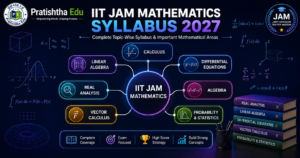
The IIT JAM Mathematics Syllabus 2027 is the prescribed set of mathematical topics and concepts that candidates need to prepare for the Mathematics paper of the Joint Admission Test for Masters.
The syllabus acts as a roadmap for preparation. It tells candidates which areas they need to study and helps them organize their preparation from basic concepts to more advanced problem-solving.
For a competitive examination such as IIT JAM, students should not rely only on individual chapters from textbooks or coaching notes. They should compare their study material with the prescribed syllabus and make sure that all relevant areas are covered.
Why Is the IIT JAM Mathematics Syllabus Important?
Understanding the syllabus at the beginning of preparation provides several advantages.
First, it gives candidates a clear idea of the scope of the examination. Instead of spending too much time on unrelated topics, students can concentrate on the areas relevant to the Mathematics paper.
Second, the syllabus helps candidates divide their preparation into different study phases. For example, a student can initially focus on conceptual learning, followed by topic-wise problem solving, previous year questions, mock tests, and revision.
Third, the syllabus can help students identify their strong and weak areas. A candidate who is comfortable with Calculus but finds Linear Algebra difficult can allocate additional practice time to Linear Algebra.
Finally, knowing the syllabus makes revision easier. Students can use the syllabus as a checklist and mark topics as they complete, practice, and revise them.
How Should Students Use the Syllabus?
Candidates should not treat the syllabus as a document that needs to be read only once.
Instead, it should remain a part of the preparation process throughout the study period.
A useful approach is to divide the syllabus into three categories:
- Completed Topics
Topics that have been studied thoroughly and practiced with questions.
- Topics Under Preparation
Topics that have been studied but still require additional problem-solving or revision.
- Topics Requiring More Attention
Topics in which the candidate has difficulty understanding concepts or solving questions.
Maintaining such a classification can make preparation more organized and help students monitor their progress.
IIT JAM Mathematics Syllabus and Preparation Strategy
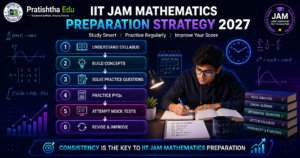
The syllabus should form the foundation of the overall IIT JAM Mathematics Preparation Strategy.
Candidates can begin by understanding the concepts included in each topic. After learning the fundamentals, they should solve basic questions before moving toward more challenging problems.
Once a topic has been completed, students should practice relevant previous year questions to understand how the concepts are tested in the actual examination.
Regular revision is equally important. Mathematics involves interconnected concepts, and forgetting fundamental ideas can make advanced topics more difficult. Short revision sessions throughout the preparation period can therefore be more effective than trying to revise the entire syllabus at the last moment.
Complete the Syllabus Before the Final Revision Phase
Candidates should try to complete the first round of syllabus coverage well before the examination.
This gives them sufficient time for:
- Previous year question practice
- Mock tests
- Topic-wise revision
- Formula revision
- Weak-area improvement
- Full-length practice tests
Students who complete the syllabus very late may have limited time to identify and correct their preparation gaps.
Therefore, the objective should not simply be to “finish” the syllabus. Candidates should aim to understand, practice, revise, and apply the concepts included in the syllabus.
In the upcoming sections, we will discuss the major topics included in the IIT JAM Mathematics Syllabus 2027 and explain how candidates can approach each area during their preparation.
IIT JAM Mathematics Syllabus 2027: Complete Topic-Wise Overview
The IIT JAM Mathematics Syllabus 2027 includes a range of fundamental and advanced mathematical concepts that candidates need to understand for effective preparation. Instead of studying every chapter independently, students should understand how different topics are connected and prepare them in a systematic sequence.
The major areas of preparation include Sequences and Series, Differential Calculus, Integral Calculus, Differential Equations, Vector Calculus, Linear Algebra, Real Analysis, Algebra, and Probability and Statistics, along with other mathematical concepts prescribed for the examination.
A topic-wise understanding of the syllabus helps candidates decide where to begin, how much time to allocate to each area, and which topics require additional practice.
Candidates can also refer to the official IIT JAM Mathematics syllabus to verify the topics prescribed for the examination.
Sequences and Series
Sequences and series form an important foundation for mathematical analysis. Candidates should understand the basic concepts related to sequences, their behavior, convergence, and different types of series.
Preparation should focus on understanding the underlying concepts rather than simply memorizing standard results.
Students should practice problems involving limits, convergence, and series so that they become comfortable identifying the appropriate method for solving a question.
A strong understanding of sequences and series can also support preparation for other areas of Mathematics where concepts related to limits and convergence are required.
Differential Calculus
Differential Calculus is another major area that candidates should prepare carefully.
The topic involves understanding functions, limits, continuity, differentiability, and derivatives. Students should develop the ability to apply differentiation concepts to mathematical problems rather than learning formulas in isolation.
During preparation, candidates should practice different types of functions and understand how derivatives can be used to analyze their behavior.
Regular problem-solving is particularly important because examination questions may require candidates to combine multiple concepts to reach the correct answer.
Integral Calculus
Integral Calculus deals with integration and its applications.
Candidates should develop a clear understanding of fundamental integration concepts and practice different methods of solving integration problems.
Students should pay attention to standard techniques and learn how to recognize which method is appropriate for a particular problem.
Regular practice is essential because integration questions can involve multiple steps and may require accurate calculations.
Differential Equations
Differential Equations is another important mathematical area that candidates should include in their preparation plan.
Students should first understand the basic terminology and concepts associated with differential equations before moving toward problem-solving.
The focus should be on understanding different forms of equations, recognizing the appropriate solution method, and applying the method correctly.
Candidates should solve a variety of problems after learning each concept so that they can improve both accuracy and speed.
Vector Calculus
Vector Calculus combines concepts from vectors and calculus and is useful for understanding mathematical relationships involving multiple variables and vector quantities.
Candidates should develop a strong understanding of vector operations and the mathematical concepts included under this area.
Problem-solving practice is important because questions may require candidates to apply multiple mathematical operations in a systematic manner.
Students should revise important formulas and concepts regularly while continuing to solve practice questions.
Linear Algebra
Linear Algebra is a fundamental area of Mathematics and should receive adequate attention during IIT JAM Mathematics Preparation.
Candidates should build a clear understanding of matrices, determinants, systems of equations, vector spaces, and other relevant concepts prescribed in the syllabus.
Rather than memorizing procedures, students should understand why a particular method works and when it should be applied.
Practice is especially important in Linear Algebra because candidates need to perform calculations accurately while managing examination time.
Students should maintain a separate revision section for important formulas, properties, and problem-solving techniques.
Real Analysis
Real Analysis requires strong conceptual understanding and careful study.
Candidates should focus on fundamental concepts involving real numbers, functions, limits, continuity, differentiability, sequences, and related analytical ideas included in the syllabus.
This section may require more conceptual thinking than direct formula application. Students should therefore avoid rushing through theoretical concepts.
A good preparation approach is to understand the definition first, study important properties, work through examples, and then solve examination-level problems.
Algebra
Algebra covers important mathematical concepts that require logical thinking and problem-solving ability.
Candidates should approach this section systematically and make sure that fundamental concepts are clear before moving to more advanced problems.
Students should maintain notes containing important definitions, properties, formulas, and frequently used methods.
Regular revision is particularly useful because algebraic concepts can involve several definitions and relationships that need to be remembered accurately.
Probability and Statistics
Probability and Statistics introduce concepts related to uncertainty, data, and mathematical analysis.
Candidates should develop conceptual clarity before attempting more complicated numerical problems.
The preparation should include understanding fundamental probability concepts, standard formulas, and the methods used to solve numerical questions.
Students should practice a wide range of problems because different questions may require different approaches.
How to Prioritize the IIT JAM Mathematics Syllabus
Although every prescribed topic should be covered, students do not necessarily have the same level of understanding across all areas.
A practical approach is to classify topics according to preparation level.
High-Confidence Topics
These are topics that the candidate already understands well and can solve questions from with reasonable accuracy.
Such topics should be revised regularly rather than receiving the majority of study time.
Moderate-Confidence Topics
These are topics where the candidate understands the basic concepts but struggles with difficult or multi-step questions.
Students should allocate additional practice time to these areas.
Weak Topics
These are topics where the candidate has difficulty understanding concepts or solving even basic questions.
Weak topics should be studied from the fundamentals, followed by guided examples and regular practice.
This approach helps candidates use their preparation time efficiently.
How to Make an IIT JAM Mathematics Syllabus Checklist
Creating a syllabus checklist can make preparation easier to track.
Candidates can create a simple table containing:
| Topic | Concept Study | Practice | PYQs | Revision |
| Sequences & Series | Yes / No | Yes / No | Yes / No | Yes / No |
| Differential Calculus | Yes / No | Yes / No | Yes / No | Yes / No |
| Integral Calculus | Yes / No | Yes / No | Yes / No | Yes / No |
| Differential Equations | Yes / No | Yes / No | Yes / No | Yes / No |
| Vector Calculus | Yes / No | Yes / No | Yes / No | Yes / No |
| Linear Algebra | Yes / No | Yes / No | Yes / No | Yes / No |
| Real Analysis | Yes / No | Yes / No | Yes / No | Yes / No |
| Algebra | Yes / No | Yes / No | Yes / No | Yes / No |
| Probability & Statistics | Yes / No | Yes / No | Yes / No | Yes / No |
The checklist should not be treated as a simple completion exercise. A topic should ideally be marked complete only after the candidate has understood the concepts, practiced relevant questions, and revised the important points.
Why Topic-Wise Preparation Is Important
Studying the IIT JAM Mathematics Syllabus 2027 topic by topic helps candidates avoid an unstructured preparation routine.
For example, completing Differential Calculus and immediately moving to another unrelated topic without practice may make it difficult to retain the concepts. A better approach is to study the topic, solve questions, review mistakes, and then move forward.
Similarly, candidates should periodically return to previously completed topics. Spaced revision can help maintain familiarity with important concepts throughout the preparation period.
The ultimate goal should be to reach a stage where candidates can identify the concept required for a problem, select an appropriate method, and solve the question accurately within the available time.
In the next section, we will look at the important topics within the IIT JAM Mathematics Syllabus 2027 and discuss how candidates can identify areas that deserve greater preparation attention.
Important Topics in IIT JAM Mathematics Syllabus 2027
Understanding the complete syllabus is important, but candidates should also learn how to identify the topics that require greater attention during preparation. The IIT JAM Mathematics Syllabus 2027 covers multiple areas of Mathematics, and students may find some topics easier than others depending on their academic background.
Instead of assuming that one particular topic will definitely carry a fixed number of questions, candidates should prepare the complete prescribed syllabus and use previous year papers to understand recurring concepts, question styles, and areas that require regular practice.
Calculus
Calculus should be given consistent attention during IIT JAM Mathematics Preparation because it involves several interconnected concepts.
Candidates should build their preparation around a clear understanding of limits, continuity, differentiation, integration, and related concepts included in the prescribed syllabus.
While preparing Calculus, students should:
- Understand concepts before memorizing formulas.
- Practice standard problems after learning each concept.
- Maintain a formula and concept revision sheet.
- Solve mixed problems after completing individual topics.
- Review mistakes regularly.
Students should also practice questions that require more than one step, as this helps improve mathematical reasoning and accuracy.
Linear Algebra
Linear Algebra is another important area that candidates should prepare systematically.
Topics involving matrices, determinants, systems of equations, vector spaces, and related concepts require both conceptual understanding and calculation practice.
A good preparation strategy is to first understand definitions and properties and then practice numerical problems.
Candidates should pay particular attention to calculation accuracy because even a small error in a mathematical operation can change the final answer.
Regular practice can also help candidates become faster at recognizing the appropriate method for solving a problem.
Differential Equations
Differential Equations requires candidates to understand the structure of equations and the methods used to solve them.
Students should begin with basic concepts and gradually move toward different types of problems included in the syllabus.
Rather than memorizing solution procedures without understanding them, candidates should learn why and when a particular method is applicable.
After completing each concept, solving several practice questions can help reinforce the method.
Real Analysis
Real Analysis is generally more concept-oriented than topics that rely heavily on direct calculations.
Candidates should therefore give sufficient time to definitions, properties, and logical relationships between concepts.
A useful study sequence is:
Concept → Definition → Example → Problem Solving → Revision
Students should avoid skipping foundational concepts because later topics may depend on an understanding of earlier ideas.
Maintaining concise notes for definitions and important results can make revision more efficient.
Algebra
Algebra requires logical thinking and a strong understanding of mathematical relationships.
Candidates should study the fundamental concepts first and then gradually move toward more complex problems.
While preparing Algebra, students should maintain a separate list of important definitions and properties. Regular revision is useful because many algebraic problems require candidates to recall the correct property or relationship before beginning the solution.
Vector Calculus
Vector Calculus requires candidates to combine mathematical concepts systematically.
Students should understand the underlying concepts and practice problems that involve multiple operations.
Instead of learning formulas separately, candidates should understand the conditions under which different mathematical expressions and operations are used.
Regular practice can improve familiarity and reduce the time required to solve standard problems.
Probability and Statistics
Probability and Statistics require both conceptual understanding and numerical practice.
Candidates should first understand the basic principles and terminology before moving to more complicated problems.
While preparing this section, students should:
- Understand the meaning of important terms.
- Learn standard formulas.
- Practice numerical problems.
- Analyze incorrect answers.
- Revise formulas periodically.
Students should not rely only on formula memorization. Understanding the reasoning behind a formula can make it easier to apply correctly in unfamiliar questions.
How to Identify High-Priority Topics for IIT JAM Mathematics Preparation
Candidates often search for a fixed list of “most important topics” for the IIT JAM Mathematics Exam. However, students should be careful with such lists because the actual distribution of questions can vary from one examination to another.
A better approach is to identify high-priority areas using three factors:
1. Previous Year Questions
Previous year questions can help candidates identify concepts that have appeared repeatedly or have been tested in different forms.
Students should maintain a record of the topics from which they make mistakes or require more time.
2. Personal Strength and Weakness
A topic that is difficult for one candidate may be relatively easy for another.
Therefore, candidates should evaluate their own preparation rather than following a generic priority list blindly.
For example, if a student is comfortable with Calculus but struggles with Linear Algebra, additional practice should be allocated to Linear Algebra while maintaining regular revision of Calculus.
3. Conceptual Connections
Some mathematical topics are connected with one another. Strong fundamentals in one area can make it easier to understand related concepts.
Candidates should therefore avoid treating every chapter as completely separate.
Topic-Wise Preparation Approach
A structured topic-wise method can make the syllabus easier to complete.
Step 1: Learn the Concept
Begin with the basic theory and understand the meaning of important definitions, formulas, and properties.
Step 2: Solve Basic Problems
After understanding the concept, solve straightforward questions to check whether the fundamentals are clear.
Step 3: Move to Mixed Problems
Once the basics are comfortable, solve questions that require multiple concepts or more detailed reasoning.
Step 4: Practice Previous Year Questions
Use previous year questions to understand how the concept is tested in the actual examination.
Step 5: Record Mistakes
Maintain a mistake notebook or digital record containing questions that were answered incorrectly or took too much time.
Step 6: Revise
Return to completed topics regularly instead of waiting until the end of the preparation period.
IIT JAM Mathematics Syllabus: Conceptual Learning vs Formula Memorization
Mathematics preparation should not depend entirely on memorizing formulas.
Formulas are certainly useful, especially during time-limited examinations, but candidates should understand how and when they are applied.
For example, simply remembering a differentiation or integration formula may not be enough if a question requires candidates to identify the appropriate transformation or method first.
A balanced approach is therefore more effective:
Understand the concept → Learn the relevant formula → Solve examples → Practice questions → Revise
This method helps candidates develop both conceptual clarity and problem-solving ability.
Common Mistakes While Preparing the IIT JAM Mathematics Syllabus
Candidates often make avoidable mistakes while studying for a competitive Mathematics examination.
Studying Without a Syllabus Checklist
Without a checklist, students may spend too much time on familiar topics while leaving other areas incomplete.
Focusing Only on Easy Topics
Easy topics can provide confidence, but candidates should not completely avoid difficult areas.
Weak topics should receive additional attention so that preparation remains balanced.
Memorizing Without Understanding
Formula memorization without conceptual understanding can make unfamiliar questions difficult.
Ignoring Previous Year Questions
Previous year questions provide valuable insight into question style and practical application of concepts.
Delaying Revision
Waiting until the final weeks to revise the complete syllabus can put unnecessary pressure on the candidate.
Solving Questions Without Analyzing Mistakes
Simply counting the number of questions solved is not enough. Candidates should understand why an answer was incorrect and how the same mistake can be avoided in the future.
How to Track Your IIT JAM Mathematics Syllabus Progress
Candidates can use a simple progress system throughout their preparation.
For every topic, track four stages:
Concept Completed → Practice Completed → PYQs Completed → Revision Completed
For example:
| Topic | Concepts | Practice | PYQs | Revision |
| Calculus | ✓ | ✓ | ✓ | Pending |
| Linear Algebra | ✓ | ✓ | Pending | Pending |
| Differential Equations | ✓ | Pending | Pending | Pending |
| Real Analysis | ✓ | ✓ | ✓ | ✓ |
| Algebra | ✓ | Pending | Pending | Pending |
This approach gives students a realistic picture of their preparation rather than simply showing how many chapters they have read.
How to Balance All Topics During Preparation
A common problem among candidates is spending too much time on one subject or chapter.
A better approach is to divide study time between:
- New concept learning
- Problem-solving practice
- Previous year questions
- Revision
- Mock tests
- Weak-topic improvement
For example, during the initial preparation stage, more time can be devoted to concept building. As the examination approaches, the focus can gradually shift toward revision, previous year questions, mock tests, and improving speed and accuracy.
The exact schedule should depend on the candidate’s available preparation time and existing level of understanding.
Key Takeaway
The IIT JAM Mathematics Syllabus 2027 should be treated as a preparation roadmap rather than merely a list of chapters. Candidates should aim to understand every prescribed area, identify their weak points, practice questions regularly, solve previous year papers, and revise completed topics throughout the preparation period.
There is no need to rely on an unofficial fixed weightage or assume that a particular topic will definitely appear with a specific number of questions. Consistent preparation across the complete syllabus, combined with previous year question analysis and mock-test practice, provides a more reliable approach.
In the next section, we will discuss a topic-wise study plan and syllabus completion strategy, including how candidates can divide the IIT JAM Mathematics syllabus into manageable study phases.
IIT JAM Mathematics Syllabus 2027: Topic-Wise Study Plan
Completing the IIT JAM Mathematics Syllabus 2027 requires more than simply reading every topic once. Candidates should follow a structured study plan that combines concept learning, problem-solving, previous year questions, revision, and regular self-assessment.
A well-planned study schedule also helps students avoid spending too much time on one topic while leaving other parts of the syllabus incomplete. The exact schedule can vary according to a candidate’s academic background and available preparation time, but the overall preparation process can be divided into clear stages.
Start With a Syllabus-Based Study Schedule
Before beginning detailed preparation, candidates should create a complete list of the topics they need to cover.
Divide the syllabus into manageable study units and assign realistic time to each unit. Topics that require stronger conceptual understanding can be given more time, while familiar topics can be covered comparatively faster.
A basic study cycle can be:
Concept Learning → Examples → Practice Questions → Previous Year Questions → Revision
Candidates should complete this cycle for each major topic instead of postponing all question practice until the end.
Phase 1: Build Strong Mathematical Fundamentals
The first stage of preparation should focus on developing conceptual clarity.
Candidates should begin with the topics they are familiar with and gradually move toward areas that require more effort. The objective at this stage should be understanding the concepts rather than trying to solve a large number of questions.
During this phase, students should:
- Read the basic theory carefully.
- Understand important definitions and properties.
- Make concise notes.
- Learn important formulas after understanding their application.
- Solve basic examples.
- Identify difficult concepts for additional study.
Students should avoid rushing through chapters simply to mark them as completed.
A topic should be considered properly studied only when the candidate can explain the basic concept and solve standard questions without depending completely on notes.
Phase 2: Topic-Wise Problem Solving
After completing the fundamental theory, candidates should move toward regular problem-solving practice.
Mathematics requires active practice. Reading a solution or watching a lecture does not provide the same benefit as attempting a problem independently.
For every completed topic, students should solve questions of different levels.
Basic Questions
These questions help candidates check whether the fundamental concept is clear.
Application-Based Questions
These require candidates to select and apply the appropriate concept or method.
Mixed Questions
These may involve more than one concept and help candidates develop problem-solving flexibility.
While solving questions, candidates should avoid looking at the solution immediately after getting stuck. They should first try to identify where the difficulty lies and attempt the problem again.
Phase 3: Previous Year Question Practice
Once candidates have completed sufficient topic-wise practice, they should begin solving IIT JAM Mathematics Previous Year Questions regularly.
Previous year questions can help students understand how mathematical concepts are presented in an actual competitive examination.
Candidates should not use previous year papers only as a final revision activity. They can also use them after completing individual topics.
For example, after completing Linear Algebra, students can solve relevant previous year questions and analyze:
- Which concepts were tested?
- How difficult were the questions?
- How much time did they require?
- Which mistakes were made?
- Which concepts need additional revision?
This approach turns previous year questions into a learning tool rather than simply a test.
Phase 4: Revision and Weak-Area Improvement
Revision should continue throughout the preparation period.
Candidates should maintain short revision notes containing:
- Important formulas
- Definitions
- Key properties
- Frequently used methods
- Common mistakes
- Difficult concepts
- Questions that require repeated practice
Students should revise completed topics periodically instead of waiting until the final month.
A useful revision cycle can include:
First Revision → Practice → Second Revision → PYQs → Mock Tests → Final Revision
The exact frequency can be adjusted according to individual requirements.
6-Month IIT JAM Mathematics Preparation Plan
Candidates who have around six months available can divide their preparation into several stages.
Month 1: Foundation and Initial Topics
The first month should focus on understanding the syllabus and building strong fundamentals.
Candidates can begin with topics they are reasonably comfortable with and establish a consistent study routine.
The main objectives should be:
- Understand the complete syllabus.
- Create a realistic timetable.
- Begin concept-based preparation.
- Prepare concise notes.
- Start basic question practice.
Students should also begin maintaining a mistake notebook from the beginning.
Month 2: Continue Concept Building
During the second month, candidates should continue covering new topics while revising the material studied during the first month.
The focus should remain on conceptual clarity and regular problem-solving.
A good daily routine can include:
New Topic + Practice + Short Revision
Candidates should avoid completely abandoning earlier topics while moving forward.
Month 3: Increase Problem-Solving Practice
By the third month, candidates should gradually increase the number of practice questions.
The focus can shift from basic questions toward application-based and mixed problems.
Students should also begin solving topic-wise previous year questions wherever appropriate.
At this stage, candidates should start identifying:
- Strong topics
- Moderate topics
- Weak topics
- Frequently occurring mistakes
- Topics requiring more revision
Month 4: PYQs and Advanced Practice
The fourth month can focus more heavily on previous year questions and examination-oriented practice.
Candidates should solve questions under time constraints and analyze their performance after each practice session.
Instead of only checking the final score, students should examine:
- Accuracy
- Time taken
- Questions left unanswered
- Calculation errors
- Conceptual mistakes
- Questions that consumed excessive time
This analysis can reveal specific areas that require improvement.
Month 5: Mock Tests and Intensive Revision
During the fifth month, candidates should introduce regular full-length mock tests along with topic-wise revision.
Mock tests should be treated as a diagnostic tool.
After every test, students should spend time analyzing the questions they answered incorrectly or could not solve.
A mistake log can be divided into categories such as:
Concept Error | Calculation Error | Time Management Error | Question Selection Error
This makes improvement more targeted.
Month 6: Final Revision
The final month should focus primarily on revision, practice, and examination readiness.
Candidates should avoid starting completely new study resources unless absolutely necessary.
The focus should be on:
- Revising important concepts
- Reviewing formulas
- Solving selected PYQs
- Taking mock tests
- Revising mistakes
- Improving speed and accuracy
- Maintaining a consistent routine
The objective of the final month should be to strengthen already studied material rather than create unnecessary pressure by attempting to learn everything again.
3-Month IIT JAM Mathematics Preparation Plan
Students with only three months available should follow a more focused strategy.
Month 1: Complete Core Concepts
The first month should be dedicated to covering the major syllabus areas and building fundamental understanding.
Candidates should avoid spending excessive time making lengthy notes. Instead, they should create concise revision material while solving questions alongside their studies.
Month 2: PYQs and Intensive Practice
The second month should focus heavily on problem-solving and previous year questions.
Students should identify their weak topics and allocate additional practice time to them.
Regular timed practice can also help candidates gradually improve speed.
Month 3: Revision and Mock Tests
The final month should combine:
- Full syllabus revision
- Previous year questions
- Mock tests
- Mistake analysis
- Formula revision
- Weak-topic practice
Candidates should focus on improving consistency rather than simply increasing the number of tests attempted.
Daily Study Routine for IIT JAM Mathematics Preparation
A daily schedule should be realistic and sustainable.
Instead of studying for an unrealistic number of hours for a few days and then losing consistency, candidates should create a routine they can maintain for several months.
A sample structure can be:
| Study Activity | Suggested Focus |
| Concept Learning | New topic |
| Problem Solving | Topic-wise questions |
| Previous Revision | Earlier topics |
| PYQs | Examination-oriented practice |
| Error Analysis | Mistake review |
Candidates can adjust the duration according to their college schedule, academic commitments, and preparation level.
How to Balance New Topics and Revision
One of the most common preparation problems is focusing entirely on new topics.
When students continuously learn new chapters without revising earlier material, they may forget important concepts.
A better approach is to divide study time between:
New Learning + Current Practice + Previous Revision
For example, after studying a new topic during the first session, candidates can dedicate another session to solving questions and a shorter session to revising previously completed material.
This approach keeps earlier concepts active while allowing preparation to move forward.
How to Use Study Material Effectively
Good study material can make preparation more organized, but candidates should avoid collecting too many resources.
Using multiple books, notes, videos, and question banks for the same topic can create confusion and consume valuable preparation time.
A practical approach is to select:
- One primary source for concepts
- One reliable question-practice source
- Previous year papers
- Mock tests
- Short revision notes
Candidates should focus more on understanding and practicing the selected material than continuously searching for new resources.
How to Revise the IIT JAM Mathematics Syllabus
Revision should not mean reading the same chapter repeatedly without solving questions.
Effective revision should involve active recall and problem-solving.
Candidates can revise a topic by:
- Reviewing important concepts.
- Recalling formulas without immediately looking at notes.
- Solving selected questions.
- Reviewing previous mistakes.
- Attempting relevant PYQs.
- Updating short notes if necessary.
This method makes revision more useful and helps identify areas that still require attention.
How to Know Whether Your Syllabus Is Actually Complete
A candidate should not consider a topic complete merely because they have read the chapter.
A topic can be considered reasonably prepared when the student can:
- Explain its fundamental concepts.
- Recall important definitions and formulas.
- Solve standard problems.
- Attempt relevant previous year questions.
- Identify common mistakes.
- Revise the topic without depending entirely on textbooks.
This distinction between “syllabus completed” and “syllabus prepared” is important.
Completing the syllabus means covering the content.
Preparing the syllabus means understanding it, practicing it, revising it, and being able to apply the concepts in examination-style questions.
Final Preparation Checklist
Before moving into the final revision stage, candidates should check whether they have:
- Covered all prescribed syllabus areas.
- Practiced questions from major topics.
- Solved relevant previous year questions.
- Identified weak areas.
- Revised important concepts.
- Maintained a mistake notebook.
- Attempted mock tests.
- Analyzed mock-test performance.
- Prepared concise revision notes.
- Developed a realistic examination strategy.
Following this checklist can help candidates enter the final stage of IIT JAM Mathematics Preparation with greater clarity and confidence.
The next section will focus on IIT JAM Mathematics syllabus-wise weightage, important topics, and how candidates can use previous year trends without relying on fixed or unofficial predictions.
IIT JAM Mathematics Subject-Wise Weightage 2027
Understanding the relative importance of different topics can help candidates plan their IIT JAM Mathematics Preparation more efficiently. However, candidates should remember that the examination does not guarantee a fixed number of questions from every individual topic in every year.
The distribution of questions can vary between examination papers. Therefore, students should avoid preparing only a selected group of topics based on unofficial predictions.
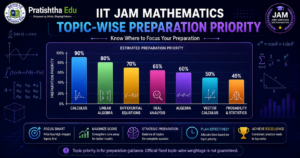
A better strategy is to complete the prescribed IIT JAM Mathematics Syllabus 2027 and then use previous year papers to understand which concepts have been tested and how questions are generally framed.
Is There a Fixed Topic-Wise Weightage?
There is no need to assume that every topic will carry a fixed number of questions.
For example, one examination may contain more questions related to Calculus, while another paper may distribute questions differently across the syllabus.
Therefore, tables showing “expected questions” should be treated only as preparation references, not as guaranteed predictions.
Candidates should use three factors when deciding how much preparation time to allocate to a topic:
- Coverage in the prescribed syllabus
- Previous year question patterns
- Personal strength and weakness
This approach is more reliable than depending entirely on predicted weightage.
Major Areas to Prioritize in IIT JAM Mathematics
Although exact question distribution can change, candidates should give consistent attention to the major mathematical areas included in the syllabus.
| Major Area | Preparation Priority | Recommended Approach |
| Calculus | High | Concept clarity + extensive problem solving |
| Linear Algebra | High | Concepts + calculations + PYQs |
| Differential Equations | High | Methods + application-based practice |
| Real Analysis | High | Definitions + concepts + problem solving |
| Algebra | High | Properties + logical problem solving |
| Vector Calculus | Moderate to High | Concepts + formula application |
| Probability & Statistics | Moderate to High | Concepts + numerical practice |
| Other Prescribed Topics | Essential | Complete syllabus coverage + revision |
The priority column should not be interpreted as official examination weightage. It is a preparation-oriented classification to help candidates organize their study time.
Calculus: Why It Deserves Regular Practice
Calculus includes several interconnected concepts and requires consistent problem-solving practice.
Candidates should not study Calculus only by memorizing formulas. They should understand the conditions under which different methods are applicable.
While preparing this area, students should focus on:
- Conceptual understanding
- Formula application
- Problem-solving speed
- Multi-step questions
- Previous year questions
- Regular revision
Candidates who find Calculus difficult should begin with basic concepts and gradually move toward more challenging questions.
Linear Algebra: Focus on Concepts and Accuracy
Linear Algebra requires candidates to combine conceptual understanding with accurate calculations.
Students should make sure that fundamental definitions, properties, and methods are clear before attempting difficult questions.
Practice should include different types of problems so that candidates become comfortable identifying the appropriate method.
A separate revision sheet containing important properties and formulas can also be useful during the final revision phase.
Differential Equations: Understand the Methods
Preparation for Differential Equations should focus on understanding different forms of equations and the methods used to solve them.
Candidates should practice enough questions to recognize which method is appropriate for a given problem.
Simply memorizing solution steps may not be sufficient when a question is presented in an unfamiliar form.
Therefore, students should combine theoretical learning with regular application-based practice.
Real Analysis: Give Importance to Conceptual Clarity
Real Analysis can require careful attention to definitions and mathematical reasoning.
Candidates should avoid rushing through theoretical portions of this area.
A useful approach is:
Definition → Property → Example → Application → Practice → Revision
Students should maintain concise notes for important definitions and results so that these can be reviewed regularly.
Algebra: Strengthen Logical Thinking
Algebra requires candidates to understand mathematical relationships and apply them logically.
Students should begin with fundamental concepts and gradually increase the difficulty of practice questions.
While studying Algebra, candidates should maintain a list of important definitions, properties, and standard methods.
Regular practice can make it easier to identify the correct approach during the examination.
Vector Calculus: Practice Application
Vector Calculus requires candidates to understand mathematical operations and apply them correctly.
Students should focus on understanding the concepts before attempting lengthy problems.
After learning each major concept, candidates should solve practice questions and then attempt relevant previous year questions.
This helps students understand how theoretical concepts are converted into examination questions.
Probability and Statistics: Combine Theory With Numerical Practice
Probability and Statistics should be prepared through a combination of conceptual learning and numerical practice.
Candidates should understand the meaning of important concepts and formulas before attempting more complicated problems.
Regular practice can help students improve both accuracy and speed.
Students should also maintain a short formula sheet and revise it periodically.
How to Use Previous Year Papers to Understand Weightage
Previous year papers are one of the most useful resources for understanding examination trends.
Instead of relying on a random online list of “most important topics,” candidates can analyze previous papers themselves.
For every question, record:
- Topic
- Sub-topic
- Question type
- Difficulty level
- Time required
- Whether the answer was correct
- Reason for any mistake
After analyzing several papers, students can identify patterns in the concepts that have been tested.
However, previous year trends should be used for preparation guidance rather than treated as a guarantee for the next examination.
Create Your Own IIT JAM Mathematics Priority List
Every candidate’s priority list can be different.
For example, a student who has a strong background in Calculus may need less time for basic Calculus revision and more time for difficult areas such as Algebra or Real Analysis.
A simple priority system can be used:
Priority 1: Weak + Important
Give these topics the highest amount of practice time.
Priority 2: Moderate + Important
Revise concepts and solve additional questions.
Priority 3: Strong + Important
Maintain regular revision and solve selected PYQs.
Priority 4: Strong + Less Challenging
Review periodically so that these topics remain fresh.
This system allows candidates to personalize their IIT JAM Mathematics Preparation Strategy.
How Much Time Should You Give to Each Topic?
There is no single study-time formula that works for every student.
The time required for a topic depends on:
- Existing knowledge
- Topic difficulty
- Number of concepts involved
- Problem-solving ability
- Preparation timeline
- Performance in practice tests
A student preparing full-time may be able to complete a topic faster than a student balancing college classes and examination preparation.
Therefore, candidates should track their actual progress instead of following an unrealistic timetable.
Topic-Wise Weightage vs Complete Syllabus Coverage
Candidates sometimes make the mistake of studying only the topics they believe will have the highest weightage.
This approach can create unnecessary risk.
If the examination changes the distribution of questions, students who have ignored other parts of the syllabus may find themselves underprepared.
A safer strategy is:
Complete the syllabus → Identify recurring concepts → Prioritize weak areas → Practice PYQs → Revise the complete syllabus
This provides both broad coverage and targeted preparation.
How to Use Mock Tests for Topic Analysis
Mock tests can also help candidates understand their personal topic-wise performance.
After every mock test, students should calculate more than just their total score.
They should check:
| Performance Area | What to Analyze |
| Accuracy | Percentage of correct answers |
| Speed | Time taken per question |
| Topic | Which areas caused difficulty |
| Mistakes | Conceptual or calculation errors |
| Unattempted | Questions left due to time or uncertainty |
| Revision Need | Topics requiring additional study |
For example, if a candidate consistently makes mistakes in Linear Algebra, that topic should be added to the weak-area revision list.
This method makes mock tests much more useful for preparation.
Should You Skip Low-Weightage Topics?
Candidates should generally avoid completely skipping prescribed syllabus areas merely because they are considered “low weightage.”
Even if a topic has appeared less frequently in previous papers, it can still be relevant to the examination.
Instead of completely ignoring such topics, candidates can:
- Learn the fundamental concepts.
- Understand important formulas and properties.
- Solve representative questions.
- Revise them periodically.
This approach provides broader syllabus coverage without requiring excessive time on every individual topic.
Final Strategy for Topic-Wise Preparation
The best way to use topic-wise weightage information is to treat it as a planning tool, not as a prediction.
Candidates should first complete the IIT JAM Mathematics Syllabus 2027 and then use previous year papers, mock tests, and personal performance to decide where additional preparation is needed.
A balanced preparation strategy can be summarized as:
Complete → Practice → Analyze → Prioritize → Revise → Test Again
By following this cycle consistently, candidates can gradually improve their conceptual understanding, problem-solving ability, accuracy, and examination confidence.
In the next section, we will discuss the best books and study resources for IIT JAM Mathematics Preparation, including how to select reliable resources without using too many books at the same time.
Best Books for IIT JAM Mathematics Preparation
Choosing the right books and study resources is an important part of effective IIT JAM Mathematics Preparation. However, candidates do not need to collect a large number of books to prepare successfully. Using a limited number of reliable resources consistently is usually more useful than switching between multiple books for the same topic.
The ideal study material should help candidates understand mathematical concepts clearly, provide sufficient practice questions, and support revision and previous year question practice.
Students should also make sure that the resources they use are aligned with the prescribed IIT JAM Mathematics Syllabus 2027.
How to Choose the Best Books for IIT JAM Mathematics
Before selecting a book, candidates should consider the following factors:
Syllabus Coverage
The book should cover the topics relevant to the Mathematics paper. Students should compare the contents of the book with the prescribed syllabus before beginning detailed preparation.
Conceptual Clarity
A good book should explain concepts clearly rather than presenting only formulas and final answers.
Problem-Solving Practice
Mathematics preparation requires regular practice. Therefore, candidates should select resources containing a sufficient variety of questions.
Difficulty Level
The material should ideally contain basic, moderate, and challenging questions so that students can gradually improve their problem-solving ability.
Previous Year Questions
Books or practice resources containing relevant previous year questions can be particularly useful for understanding examination-style problems.
Recommended Books and Resources for IIT JAM Mathematics
Candidates can use standard undergraduate-level Mathematics textbooks along with dedicated competitive-examination resources.
| Resource Type | Useful For | How to Use |
| Standard Calculus Textbooks | Calculus concepts | Concept building + examples |
| Linear Algebra Textbooks | Matrices and related concepts | Theory + problem solving |
| Real Analysis Textbooks | Conceptual understanding | Definitions + proofs + applications |
| Differential Equations Books | Differential equation concepts | Methods + practice |
| Algebra Textbooks | Algebraic concepts | Theory + problem solving |
| Probability & Statistics Books | Probability concepts and numerical practice | Formula understanding + questions |
| IIT JAM Previous Year Papers | Exam-oriented preparation | Timed practice + analysis |
| Mock Tests | Speed and accuracy | Full-length practice |
| Revision Notes | Quick revision | Final preparation |
Students should select books according to their existing academic level. A beginner may require a more explanatory textbook, while a student with strong fundamentals may benefit from a problem-oriented resource.
Standard Textbooks vs Competitive-Exam Books
Candidates often wonder whether they should use standard university-level textbooks or books specifically written for IIT JAM preparation.
Both can be useful, but they serve different purposes.
Standard Textbooks
Standard textbooks are generally useful for developing conceptual understanding.
They can be particularly helpful when a student finds a topic difficult or wants a detailed explanation of the underlying mathematics.
However, some textbooks may contain content beyond what is required for the examination. Students should therefore use the syllabus as a guide and avoid spending excessive time on unrelated material.
Competitive-Exam Books
Dedicated competitive-examination books can be useful for focused practice.
They may provide:
- Topic-wise questions
- Practice exercises
- Previous year questions
- Short explanations
- Examination-oriented problems
These resources can save time when the candidate already understands the basic concepts.
The Best Approach
Candidates do not necessarily need to choose one type of resource exclusively.
A practical approach is:
Standard Textbook for Difficult Concepts + Competitive Resource for Practice + PYQs for Examination Preparation
IIT JAM Mathematics Previous Year Papers as a Study Resource
Previous year papers should be an important part of the preparation strategy.
They help candidates understand:
- The style of questions
- The application of concepts
- The level of calculation required
- Common mistakes
- Time-management requirements
Students should not wait until the final month to begin using previous year papers.
Topic-wise PYQ practice can begin after completing individual syllabus areas.
Later, candidates can solve complete papers under examination-like conditions.
How to Use Previous Year Questions Effectively
A useful three-stage approach is:
Stage 1: Topic-Wise PYQs
After completing a topic, solve relevant questions from previous papers.
The objective is to understand how the concept is tested.
Stage 2: Mixed PYQs
After completing several topics, solve questions without looking at the topic name.
This forces candidates to identify the appropriate concept independently.
Stage 3: Full-Length Papers
During the later stages of preparation, solve complete previous year papers within the prescribed examination conditions.
After completing the paper, analyze every mistake.
Mock Tests for IIT JAM Mathematics Preparation
Mock tests are useful for developing examination readiness.
However, candidates should remember that taking a mock test is only one part of the process. The analysis after the test is equally important.
After every mock test, students should review:
- Correct answers
- Incorrect answers
- Unattempted questions
- Questions that took too much time
- Calculation mistakes
- Conceptual mistakes
- Question-selection decisions
The objective should be to identify why marks were lost and how the same mistake can be prevented in future tests.
How to Use Study Material Without Getting Confused
One of the most common preparation mistakes is collecting too many resources.
A candidate may have multiple textbooks, coaching notes, online lectures, question banks, PDFs, and test series but still struggle to complete the syllabus.
The problem is usually not a lack of material but a lack of consistent execution.
A simple resource system can be:
One Primary Concept Source
Choose one reliable source for learning the concepts.
One Practice Source
Use a dedicated question bank or practice material for solving problems.
Previous Year Papers
Use PYQs to understand actual examination-style questions.
One Mock-Test Series
Regularly attempt mock tests and analyze performance.
Short Revision Notes
Maintain concise notes for formulas, definitions, methods, and mistakes.
This keeps preparation manageable.
Should You Study From Multiple Books?
Using multiple books is not automatically wrong, but candidates should have a clear reason for using each resource.
For example, if one textbook explains Real Analysis clearly but does not provide enough practice questions, a second resource may be useful for additional problems.
However, reading three or four books covering exactly the same material may consume time that could be spent on practice and revision.
Candidates should ask themselves:
“Will this resource improve my understanding or problem-solving ability?”
If the answer is no, it may not be necessary to add another resource.
IIT JAM Mathematics Study Material
Good study material should support every stage of preparation.
A complete preparation resource set can include:
- Concept notes
- Topic-wise practice questions
- Previous year papers
- Mock tests
- Formula sheets
- Mistake notes
- Revision material
Candidates can organize these resources topic-wise so that everything related to a particular subject is available in one place.
For example:
Linear Algebra Folder
- Concept Notes
- Important Formulas
- Practice Questions
- Previous Year Questions
- Mistake Log
- Revision Notes
The same structure can be followed for other major topics.
How to Make Effective Mathematics Notes
Candidates should avoid creating extremely long notes.
The purpose of revision notes is to help students quickly recall important information before tests and revision sessions.
Useful notes can contain:
Important Definitions
Write difficult or frequently forgotten definitions in simple language.
Key Formulas
Record formulas that are repeatedly used during problem solving.
Important Properties
Include properties that help identify the correct method.
Common Mistakes
Write down mistakes made during practice.
Difficult Questions
Keep a record of questions that required multiple attempts or additional understanding.
These notes can become especially valuable during the final revision period.
How to Use Online Study Resources
Online resources can supplement traditional books, particularly when a candidate finds a difficult concept difficult to understand from text alone.
Students can use online lectures or educational resources for:
- Concept clarification
- Difficult topics
- Additional examples
- Problem-solving approaches
- Revision
However, candidates should avoid spending most of their preparation time watching lectures without attempting questions.
A useful rule is:
Learn → Pause → Solve → Check → Revise
Active problem solving should remain a major part of Mathematics preparation.
How Pratishtha Edu Study Material Can Support Preparation
Candidates preparing through coaching can also use structured study resources provided by their institute.
At Pratishtha Edu, study resources can be integrated with classroom learning, practice, revision, and test preparation to provide a more organized learning process.
Students can use structured IIT JAM Mathematics Study Material alongside regular classes and problem-solving practice.
The purpose of study material should not be to replace practice. Instead, it should make the preparation process more systematic by providing concepts, examples, practice questions, and revision support in an organized manner.
Best Resource Combination for IIT JAM Mathematics
Instead of asking which single book is the “best,” candidates should focus on building a balanced resource combination.
A practical structure is:
Concept Resource
↓
Topic-Wise Practice
↓
Previous Year Questions
↓
Mock Tests
↓
Mistake Analysis
↓
Revision
This approach ensures that candidates do not spend their entire preparation period only reading theory.
Common Mistakes While Selecting Books
Choosing Too Many Books
More books do not automatically mean better preparation.
Ignoring the Syllabus
A detailed textbook may contain topics outside the examination syllabus. Candidates should use the syllabus to stay focused.
Avoiding Practice Material
Reading theory without solving enough questions can limit problem-solving improvement.
Changing Resources Frequently
Switching resources whenever a topic feels difficult can slow preparation.
Following Unverified Recommendations
Candidates should evaluate resources based on their syllabus relevance, clarity, practice quality, and usefulness rather than selecting a book only because it is popular online.
Final Advice on Books and Study Resources
The right books can support preparation, but consistent practice remains more important than the number of resources collected.
Candidates should select resources that match their learning level and use them systematically. A small, well-organized collection of study material can be more effective than a large collection that is never completed.
For IIT JAM Mathematics Preparation, the ideal balance is:
Conceptual Understanding + Quality Practice + Previous Year Questions + Mock Tests + Regular Revision
Once the required study resources are selected, candidates should shift their focus toward consistent execution and performance analysis.
In the next section, we will discuss IIT JAM Mathematics Previous Year Cut-Off, previous year question papers, and how candidates can use past performance data to plan their preparation effectively.
IIT JAM Mathematics Previous Year Cut-Off
The IIT JAM Mathematics Cut-Off is an important aspect of the admission process that candidates should understand while planning their preparation. However, students should distinguish between the official qualifying cut-off and the actual admission requirements for a particular institute or programme.
The qualifying cut-off can vary from year to year depending on factors such as the difficulty level of the examination and the overall performance of candidates.
Therefore, candidates should not prepare with the assumption that a particular score will guarantee admission.
What Is IIT JAM Mathematics Cut-Off?
The cut-off generally refers to the minimum qualifying marks or rank-related criteria used in the examination and admission process.
Candidates should understand that qualifying the IIT JAM Mathematics Exam does not automatically guarantee admission to a particular postgraduate programme.
Admission depends on the applicable admission process, programme eligibility, available seats, and the requirements of the participating institute.
Students should always verify the latest official admission information before making decisions based on cut-off data.
IIT JAM Mathematics Previous Year Cut-Off Trends
Candidates can use previous year cut-off information as a reference to understand the competitive nature of the examination.
| Year | General | OBC-NCL/EWS | SC/ST |
| 2026 | Check Official Data | Check Official Data | Check Official Data |
| 2025 | Check Official Data | Check Official Data | Check Official Data |
| 2024 | Check Official Data | Check Official Data | Check Official Data |
| 2023 | Check Official Data | Check Official Data | Check Official Data |
Important: Candidates should verify category-wise qualifying marks from the official IIT JAM admission/examination information for the relevant year before relying on any cut-off table. Cut-offs can change from year to year.
How Should Candidates Use Previous Year Cut-Offs?
Previous year cut-offs should be used as a reference point, not as a fixed target.
Candidates should aim to build enough preparation strength to perform well even if the paper is more difficult or competitive than expected.
Instead of focusing only on the minimum qualifying marks, students should work toward improving:
- Conceptual accuracy
- Problem-solving speed
- Question selection
- Time management
- Mock-test performance
- Previous year paper performance
A stronger preparation level gives candidates more flexibility during the actual examination.
IIT JAM Mathematics Previous Year Question Papers
Previous year question papers are among the most valuable resources for IIT JAM Mathematics Preparation.
They allow candidates to move beyond theoretical preparation and understand how mathematical concepts are tested in an actual examination environment.
Students can use previous year papers to understand:
- Question formats
- Difficulty levels
- Concept application
- Calculation requirements
- Time-management challenges
- Common mistakes
- Personal preparation gaps
Previous year papers should therefore be included throughout the preparation process rather than being reserved only for the final weeks.
Why Solve IIT JAM Mathematics Previous Year Papers?
Solving PYQs provides several benefits.
Understand the Question Style
Candidates become familiar with the way mathematical concepts are converted into examination questions.
Identify Weak Areas
Repeated mistakes can reveal concepts that require additional study.
Improve Speed
Regular timed practice helps candidates become more comfortable solving questions under pressure.
Improve Accuracy
Analyzing incorrect answers helps identify calculation and conceptual mistakes.
Build Examination Confidence
Familiarity with actual examination-style questions can reduce uncertainty during preparation.
How to Solve Previous Year Questions Effectively
Candidates should avoid simply solving a paper, checking the score, and moving on.
A better approach is to divide PYQ practice into three stages.
Stage 1: Topic-Wise PYQs
After completing a topic, solve relevant questions from previous papers.
For example, after completing Linear Algebra, practice questions related to the concepts studied.
This helps candidates understand how the topic has been tested.
Stage 2: Mixed PYQs
Once several topics have been completed, solve questions without identifying the topic beforehand.
This is important because candidates will not receive a chapter name during the actual examination.
Students must recognize the concept required to solve the problem.
Stage 3: Full-Length PYQ Practice
During the later stages of preparation, attempt complete previous year papers under examination-like conditions.
Follow the prescribed time limit and avoid checking solutions while solving.
After finishing the paper, analyze the complete performance.
How to Analyze Your PYQ Performance
A score alone does not provide enough information.
Candidates should maintain a simple analysis table:
| Area | What to Check |
| Correct Questions | Concepts you understand well |
| Incorrect Questions | Mistakes requiring analysis |
| Unattempted Questions | Difficult or time-consuming areas |
| Calculation Errors | Accuracy issues |
| Conceptual Errors | Revision requirements |
| Time Taken | Speed and question selection |
| Repeated Mistakes | Priority areas for improvement |
This analysis can turn previous year papers into a personalized preparation tool.
Common Mistakes While Solving PYQs
Looking at Solutions Too Quickly
Candidates should make a genuine attempt before checking the solution.
Focusing Only on the Final Score
The purpose of PYQ practice is not only to obtain a score but also to identify preparation gaps.
Ignoring Incorrect Questions
Every incorrect question should be analyzed to understand the reason behind the mistake.
Solving Without Time Limits
Timed practice should be introduced gradually so that candidates can develop examination speed.
Repeating the Same Mistake
Students should record recurring errors and revise the related concepts.
Career Opportunities After IIT JAM Mathematics

Qualifying for IIT JAM Mathematics can provide candidates with an opportunity to pursue postgraduate studies in Mathematics and related areas, depending on the programmes and admission requirements available during the relevant admission cycle.
A postgraduate degree can further open pathways in academics, research, teaching, government-related opportunities, and several mathematics-intensive careers.
MSc Mathematics
One of the primary academic pathways after IIT JAM Mathematics is postgraduate study in Mathematics.
An MSc programme can help students develop advanced knowledge in areas such as mathematical analysis, algebra, applied mathematics, statistics, computational mathematics, and other specialized areas depending on the programme.
Students can later pursue research, teaching, or specialized professional opportunities based on their interests and qualifications.
PhD and Research
Students interested in academic research can consider pursuing a PhD after completing the required postgraduate qualifications.
Research opportunities can exist across areas such as:
- Pure Mathematics
- Applied Mathematics
- Mathematical Modelling
- Computational Mathematics
- Statistics
- Theoretical and Interdisciplinary Research
Candidates interested in research should develop strong conceptual foundations and mathematical problem-solving abilities during their postgraduate studies.
Teaching and Academia
Mathematics graduates can also explore teaching and academic careers.
Depending on the institution and position, additional qualifications may be required.
Students interested in academia should focus on developing both subject expertise and strong communication skills.
Government and Scientific Research Opportunities
A strong background in Mathematics can also be useful for certain government, scientific, analytical, and research-oriented career pathways.
Eligibility requirements vary significantly across organizations and job roles.
Candidates should therefore check the official recruitment notification for the specific position rather than assuming that an MSc Mathematics degree alone makes them eligible for every government or scientific position.
Data Science and Analytics
Mathematics provides a strong foundation for analytical fields.
Students with postgraduate Mathematics backgrounds may explore areas related to:
- Data Analysis
- Statistical Modelling
- Quantitative Analysis
- Machine Learning
- Data Science
- Business Analytics
Additional technical skills such as programming, statistics, databases, and machine learning may be required depending on the role.
Quantitative Finance
Mathematical and statistical skills are also relevant to quantitative finance and related analytical careers.
Students interested in this area may need additional knowledge of:
- Probability
- Statistics
- Financial Mathematics
- Programming
- Data Analysis
The career path generally requires more than a Mathematics degree alone, so candidates should build relevant technical and domain skills alongside their academic studies.
Software and Technology Careers
Mathematics graduates can also explore technology-related roles, particularly when they develop programming and computational skills.
Areas such as algorithms, modelling, optimization, data analysis, and machine learning can provide opportunities for students who combine Mathematics with technical skills.
Candidates interested in these careers should consider learning programming languages and relevant software tools during or after their postgraduate studies.
Skills to Develop Alongside IIT JAM Mathematics Preparation
While the immediate goal may be to qualify for the examination, students can also begin developing skills that may support their long-term career plans.
Useful skills can include:
- Mathematical reasoning
- Problem solving
- Logical thinking
- Statistical understanding
- Programming
- Data analysis
- Research skills
- Communication
- Time management
The specific combination should depend on the student’s preferred career direction.
For example, a student interested in research may prioritize mathematical depth and research methodology, while a student interested in data science may combine Mathematics with programming and statistics.
IIT JAM Mathematics: From Entrance Exam to Career
IIT JAM Mathematics should not be viewed only as an entrance examination.
For many students, it can be an important step toward higher education and specialized mathematical study.
A possible academic pathway can look like:
IIT JAM Mathematics → Postgraduate Study → Specialization → Research / Teaching / Industry / Analytical Career
The exact pathway will depend on the programme selected, academic performance, additional qualifications, and the student’s long-term career goals.
Candidates should therefore choose postgraduate programmes after carefully considering the curriculum, eligibility requirements, career relevance, and their own interests.
Final Takeaway
Previous year cut-offs and question papers can provide valuable guidance, but they should not become the only focus of IIT JAM Mathematics Preparation.
Candidates should use cut-off trends to understand competitiveness, use PYQs to understand the examination, and use mock tests to measure their personal performance.
At the same time, students should keep their long-term goals in mind. Whether the goal is MSc Mathematics, research, teaching, data science, analytics, quantitative finance, or another mathematics-related career, a strong conceptual foundation can provide valuable opportunities beyond the entrance examination.
In the next section, we will cover why students may choose Pratishtha Edu for IIT JAM Mathematics Coaching, how structured preparation can help, frequently asked questions, and the final conclusion of this complete guide.
Why Choose Pratishtha Edu for IIT JAM Mathematics Coaching?
Preparing for a competitive examination such as IIT JAM Mathematics requires a combination of conceptual understanding, regular practice, revision, and performance analysis. While self-study can be effective, some students prefer structured guidance to maintain consistency and receive support when they face difficult concepts.
Pratishtha Edu provides a structured learning environment for students preparing for competitive examinations. Candidates preparing for IIT JAM Mathematics can benefit from organized classes, study resources, practice sessions, doubt support, and regular guidance.
Expert Faculty
Experienced and supportive faculty can help students understand mathematical concepts in a structured manner.
Instead of focusing only on formulas, students can work on understanding the concepts behind different mathematical methods and learn how to approach examination-oriented problems.
A strong conceptual foundation is particularly important for Mathematics because many questions require candidates to apply concepts rather than simply recall formulas.
Online and Offline Classes
Students may have different learning preferences and schedules.
Online learning can provide flexibility, while offline classroom learning can offer a more interactive environment.
A suitable learning format allows students to maintain consistency throughout their IIT JAM Mathematics Preparation.
IIT JAM Mathematics Study Material
Well-organized study material can help candidates follow the syllabus systematically.
Students can use structured notes, practice questions, revision material, and other resources alongside their regular preparation.
Candidates should always compare their study material with the prescribed syllabus to ensure that their preparation remains focused on relevant topics.
Test Series and Mock Tests
Regular tests can help candidates evaluate their preparation.
Mock tests are particularly useful for understanding:
- Time management
- Question selection
- Accuracy
- Calculation speed
- Weak topics
- Examination pressure
However, candidates should not focus only on the score. Analyzing mistakes after every test is equally important.
Previous Year Question Practice
Previous year questions can help students understand how concepts are applied in the actual examination.
Regular PYQ practice can also help candidates identify topics that require additional revision.
Students should gradually move from topic-wise PYQs to mixed questions and eventually full-length papers.
Doubt Sessions
Mathematical concepts can sometimes become difficult when a student gets stuck at a particular step.
Doubt-solving support can help students identify the source of confusion and understand the correct approach.
Candidates should make a habit of noting recurring doubts and reviewing them during revision.
Personal Mentorship
A structured preparation plan becomes more effective when students regularly evaluate their progress.
Mentorship can help candidates review:
- Syllabus completion
- Practice performance
- Weak areas
- Mock-test results
- Revision requirements
- Time-management issues
The objective should be to make preparation more organized and consistent.
Frequently Asked Questions About IIT JAM Mathematics
1. What is IIT JAM Mathematics?

IIT JAM Mathematics is the Mathematics test paper conducted as part of the Joint Admission Test for Masters (JAM). JAM is used for admission to eligible postgraduate programmes at participating IITs and other participating institutes, subject to the applicable eligibility and admission requirements.
2. Who is eligible for IIT JAM Mathematics?
Eligibility depends on the requirements specified for the relevant JAM examination and the programme to which a candidate seeks admission.
For example, the official JAM 2026 information stated that candidates who had completed their undergraduate degree or were appearing in the final examination of their qualifying degree could appear, while programme-specific eligibility requirements applied for admission. Candidates should check the official brochure for the relevant examination year.
3. Is there an age limit for IIT JAM Mathematics?
The official JAM 2026 information stated that there was no age restriction for appearing in JAM 2026. Candidates preparing for JAM 2027 should verify the official information brochure once it is released.
4. Can final-year students apply for IIT JAM Mathematics?
Final-year students can be eligible to appear subject to the rules of the relevant examination year. For JAM 2026, candidates appearing in the final examination of their qualifying undergraduate degree were eligible to appear. For admission, the undergraduate programme had to be completed before the applicable admission date and the required proof had to be submitted within the specified timeline.
5. What is the IIT JAM Mathematics exam pattern?
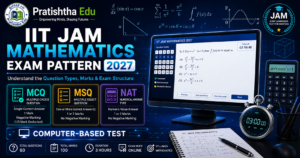
IIT JAM is conducted as a computer-based test. The Mathematics paper is identified as MA. The detailed question structure, marking scheme, duration, and other examination rules should always be checked in the official information brochure for the relevant year.
6. Is there negative marking in IIT JAM Mathematics?
The marking scheme depends on the type of question in the JAM examination. Candidates should carefully check the official examination brochure for the relevant year before finalizing their test-taking strategy.
Students should not assume that every question type follows the same negative-marking rule.
7. How many questions are asked in IIT JAM Mathematics?
The number and structure of questions should be verified from the official JAM 2027 information brochure when released.
Candidates should avoid relying on outdated examination patterns because examination authorities can revise the structure from one cycle to another.
8. What are the most important topics in IIT JAM Mathematics?
Candidates should prepare the complete prescribed syllabus rather than depending on a small list of predicted topics.
Major preparation areas include Calculus, Linear Algebra, Differential Equations, Real Analysis, Algebra, Vector Calculus, Probability and Statistics, and other topics specified in the official syllabus.
Previous year papers can then be used to understand recurring concepts and question styles.
9. Which books are best for IIT JAM Mathematics Preparation?
The best book depends on the candidate’s existing mathematical foundation.
A practical resource combination can include a reliable undergraduate-level textbook for conceptual clarity, a focused practice resource, previous year papers, mock tests, and concise revision notes.
Candidates should avoid collecting too many books and should prioritize completing and practicing from selected resources.
10. How difficult is IIT JAM Mathematics?
The difficulty of IIT JAM Mathematics can vary from one examination cycle to another.
A candidate’s experience of difficulty also depends on their mathematical foundation, conceptual clarity, problem-solving speed, and familiarity with examination-style questions.
Consistent practice and previous year paper analysis can help students become more comfortable with different types of questions.
11. How many months are enough for IIT JAM Mathematics Preparation?
There is no fixed number of months that is sufficient for every candidate.
A student with a strong Mathematics background may require less time for concept building, while another student may need more time to strengthen fundamentals.
Six months can provide a useful structured preparation window for many students, while candidates with less time can follow a focused three-month strategy.
The important factor is consistency rather than simply the number of months available.
12. Are previous year papers important for IIT JAM Mathematics?
Yes. Previous year papers are highly useful for understanding question patterns, applying concepts, practicing time management, and identifying preparation gaps.
Candidates should solve them topic-wise during preparation and full-length under timed conditions during the later stages.
13. How many mock tests should I attempt?
There is no universally correct number of mock tests.
Candidates should focus on quality and analysis rather than attempting a large number of tests without reviewing their mistakes.
After each mock test, students should analyze incorrect, unattempted, and time-consuming questions and use the results to improve their preparation.
14. What is a good score in IIT JAM Mathematics?
There is no single score that can guarantee admission to every programme.
The competitiveness of a score depends on factors such as the examination year, candidate performance, category, programme, institute, eligibility requirements, and available seats.
Candidates should therefore focus on maximizing their own performance rather than preparing only for a fixed score.
15. What is the difference between qualifying and getting admission through IIT JAM?
Qualifying in JAM does not automatically guarantee admission.
The official JAM information states that admission depends on the applicable requirements of the admitting institute, including minimum educational qualifications and other programme-specific conditions.
Therefore, candidates should carefully check the eligibility requirements of the programme they wish to join.
16. What are the career opportunities after MSc Mathematics?
After completing postgraduate Mathematics studies, students can explore different academic and professional pathways.
Depending on their interests and additional qualifications, possible areas include:
- Research
- PhD
- Teaching
- Academia
- Data Science
- Analytics
- Quantitative Finance
- Mathematical Modelling
- Government and scientific organizations
- Technology-related careers
The requirements for specific jobs can vary, so students should check the eligibility criteria of individual organizations.
17. Is coaching necessary for IIT JAM Mathematics?
Coaching is not compulsory.
Students can prepare through self-study if they have the required resources, discipline, and ability to understand concepts independently.
However, structured coaching can be useful for students who want organized classes, guided preparation, doubt support, practice material, and regular tests.
18. Can I prepare for IIT JAM Mathematics without coaching?
Yes. Self-study is possible with a disciplined approach.
Candidates should have a reliable study source, follow the prescribed syllabus, practice regularly, solve previous year papers, take mock tests, and analyze their mistakes.
The most important factor is consistent execution of the preparation plan.
19. How can I improve my IIT JAM Mathematics score?
Candidates can improve their performance by focusing on five areas:
Conceptual Clarity + Problem Solving + PYQs + Mock Tests + Revision
Students should also maintain a mistake log and regularly revisit the concepts responsible for repeated errors.
Improvement generally comes from analyzing weaknesses rather than simply increasing the number of questions attempted.
20. Where can I check official IIT JAM updates?
Candidates should use the official JAM website and official admission portals for examination notifications, eligibility information, admission requirements, important dates, and other official updates.
For example, the official JAM 2026 website provided examination, admission, eligibility, and programme information through its official portal.
For IIT JAM Mathematics 2027, candidates should verify the latest information once the official 2027 website and information brochure are released.
Candidates should also refer to the Official IIT JAM Website for the latest examination, syllabus, eligibility, admission and other official updates.
Final Thoughts on IIT JAM Mathematics 2027
Preparing for IIT JAM Mathematics 2027 is a long-term process that requires consistency, conceptual clarity, regular practice, and proper revision.
Candidates should begin by understanding the complete IIT JAM Mathematics Syllabus 2027 and then create a realistic preparation plan according to their available time and current level of knowledge.
Instead of focusing only on predicted high-weightage topics, students should aim to cover the complete syllabus. After learning the concepts, they should solve topic-wise questions, practice previous year papers, attempt mock tests, analyze mistakes, and revise regularly.
Candidates should also remember that qualifying the examination is only one step. Admission depends on the eligibility requirements, programme, institute, seat availability, and applicable admission process.
A simple preparation cycle can be followed:
Understand → Practice → Solve PYQs → Analyze → Revise → Take Mock Tests → Improve
Students who remain consistent with this cycle can gradually improve their mathematical understanding, speed, accuracy, and examination confidence.
If you are looking for structured guidance, study resources, regular practice, and mentorship for your preparation, you can explore Pratishtha Edu’s IIT JAM Mathematics coaching and learning support.
Start your preparation early, follow the syllabus systematically, practice regularly, and keep evaluating your progress.
Your IIT JAM Mathematics preparation should not be about studying everything at once. It should be about studying the right concepts consistently and improving every day.
Leave a Reply