
Introduction
The UGC NET English Literature 2027 is an important examination for postgraduate students and English Literature aspirants seeking careers in teaching, research, or higher education. The examination requires a strong understanding of English literature, literary history, criticism, theory, language, cultural studies, and research-related concepts.
Preparing for UGC NET English Literature is not simply about reading a large number of books. Candidates need to understand the syllabus, identify key literary periods and authors, revise key concepts, solve previous-year questions, and regularly assess their preparation.
For many students, the biggest challenge is deciding what to study, which topics to prioritise, which books to follow, and how to manage revision. A structured preparation strategy can make the process more organised and help candidates use their preparation time effectively.
Before beginning your preparation, it is important to understand the complete UGC NET English Literature Syllabus and examination structure. Once you have a clear idea of what the examination covers, you can divide the syllabus into manageable sections and create a realistic study plan.
This guide to UGC NET English Literature 2027 covers the major aspects of preparation, including the examination structure, eligibility, syllabus, important topics, preparation strategy, books, previous year questions, mock tests, revision, and career opportunities. Students can also use relevant Study Material and maintain a consistent study routine to strengthen their preparation.
Whether you are starting your preparation from the beginning or revising the syllabus for the upcoming examination, this guide can help you understand the overall preparation process and build a more systematic approach.
What Is UGC NET English Literature?
The University Grants Commission National Eligibility Test (UGC NET) is a national-level examination conducted for determining eligibility for various academic and research opportunities in India.
English is one of the subjects offered under UGC NET. Students with an academic background in English or related areas can prepare for the English subject by studying literature across different periods, genres, movements, authors, theories, criticism, language, cultural studies, and research methodology.
The English paper requires candidates to combine factual knowledge with conceptual understanding. Questions may require familiarity with authors and their works, literary chronology, important movements, critical approaches, literary terminology, and theoretical concepts.
Therefore, effective UGC NET English Preparation should not depend entirely on memorisation. Candidates should understand how different literary periods, writers, works, movements, and critical ideas are connected.
UGC NET English Literature Full Form
UGC NET stands for University Grants Commission National Eligibility Test.
The examination is relevant for candidates interested in academic and research-oriented career paths. For English Literature aspirants, preparation involves studying a wide range of literary texts, authors, historical periods, criticism, theory, and related areas included in the prescribed syllabus.
Candidates should always check the latest official examination information before applying because eligibility requirements, dates, examination procedures, and other details may be updated for different examination cycles.
Who Should Prepare for UGC NET English Literature?
UGC NET English Literature is particularly relevant for students who have a strong interest in English literature, teaching, research, and higher academic studies.
Candidates may consider preparing for the examination if they want to:
- Build a career in higher education
- Pursue academic research
- Work towards a PhD
- Explore teaching opportunities
- Develop expertise in English Literature
- Prepare for research-oriented academic careers
- Strengthen their understanding of literary studies
A postgraduate background in English or a relevant subject can provide a useful foundation, but candidates should carefully check the latest official eligibility requirements before applying.
Why Choose UGC NET English Literature?
English Literature offers a broad academic field covering literature, language, culture, history, philosophy, criticism, and theory. Preparing for UGC NET can therefore help students develop a deeper understanding of literary studies while working towards their academic goals.
Academic Opportunities
Candidates interested in teaching and higher education can consider UGC NET as an important examination in their academic journey. Qualification requirements for particular positions can vary, so candidates should verify the latest official rules and institutional requirements.
Research Opportunities
Students interested in research can use their preparation as a foundation for further academic study. Areas such as literary criticism, cultural studies, postcolonial literature, gender studies, language studies, and comparative literature can provide different research directions.
Stronger Understanding of Literature
UGC NET preparation requires candidates to study literature across multiple periods and traditions. This can help develop a stronger understanding of:
- Literary movements
- Major authors
- Important works
- Literary genres
- Critical theories
- Literary terminology
- Historical context
- Cultural developments
Better Academic Foundation
A systematic preparation process can also help students build a stronger foundation for higher studies and research in English Literature.
Students who want to understand the academic support and learning environment available through Pratishtha Edu can later explore the About Us section for more information.
What Makes UGC NET English Literature Preparation Challenging?
The syllabus of English Literature covers a wide range of topics. Candidates may need to remember authors, texts, literary periods, movements, theories, concepts, and historical relationships.
Some common challenges include:
- Covering a broad syllabus
- Remembering literary chronology
- Connecting authors with their works
- Understanding literary criticism and theory
- Revising a large amount of information
- Solving questions within the examination time
- Identifying weak areas
- Maintaining consistency during preparation
The solution is not to study everything randomly. Instead, divide the syllabus into smaller sections and follow a structured cycle of concept study, practice, revision, PYQs, and mock tests.
UGC NET English Literature 2027 Highlights
Before starting your preparation, it is important to understand the basic structure of the examination. Knowing the examination format helps you plan your study schedule and understand how UGC NET English Literature Preparation should be approached.
| Particular | Details |
| Examination | UGC NET |
| Subject | English |
| Examination Body | National Testing Agency (NTA) |
| Examination Mode | Computer-Based Test (CBT) |
| Papers | Paper 1 and Paper 2 |
| Paper 1 | Teaching & Research Aptitude |
| Paper 2 | English |
| Examination Level | National Level |
| Question Type | Objective-Type Questions |
| Language | English/Hindi as applicable, subject to official instructions |
| Eligibility | Based on prescribed UGC/NTA criteria |
| Official Information | Latest UGC NET/NTA notification |
Note: Examination dates, number of questions, marks, duration, eligibility conditions, subject codes, and other details can be updated by the authorities. Candidates should verify the latest information from the Official UGC NET Website before applying or preparing according to a specific examination cycle.
UGC NET English Literature Eligibility Criteria 2027
Candidates planning to appear for UGC NET English should first check whether they satisfy the prescribed eligibility requirements.
Eligibility generally depends on factors such as educational qualification, percentage requirements, category-based relaxation, and other conditions specified in the official notification.
Educational Qualification
Candidates should generally have a recognised postgraduate degree in the relevant subject or an equivalent qualification from a recognised university or institution.
For English Literature aspirants, a postgraduate qualification in English or a relevant discipline can provide the academic foundation required for preparing for the English paper.
However, students should not rely on old eligibility rules because UGC NET requirements can be revised. Always check the latest official UGC NET notification before submitting the application form.
Minimum Percentage Requirement
Candidates are required to meet the minimum percentage criteria prescribed by the examination authorities.
The required percentage can vary according to the candidate’s category and applicable rules.
Therefore, before applying, candidates should carefully check:
- Minimum marks required
- Category-wise relaxation
- Recognised postgraduate qualifications
- Accepted equivalent degrees
- Any special eligibility provisions
Age Limit
Age requirements can depend on the purpose for which the candidate is appearing and the applicable UGC NET rules.
Candidates interested in Junior Research Fellowship should pay particular attention to the age-related requirements mentioned in the latest official notification.
For Assistant Professor eligibility, the applicable rules may be different.
Because age criteria and relaxation provisions can change, candidates should verify the latest notification rather than relying on information from previous examination cycles.
Relaxation for Reserved Categories
The examination authorities may provide relaxation in certain eligibility requirements for candidates belonging to eligible reserved categories according to the applicable government and UGC rules.
Candidates should check the latest official notification for:
- Percentage relaxation
- Age relaxation
- Category-specific provisions
- Documentation requirements
Who Can Apply for UGC NET English?
Students who satisfy the prescribed educational and other eligibility requirements can apply for the English subject.
Before submitting an application, candidates should verify:
- Their postgraduate qualification
- Required percentage
- Category-related eligibility
- Age requirements, where applicable
- Recognition of their degree
- Subject eligibility
- Latest application instructions
Choosing the correct subject is also important. Candidates should select the subject that matches their academic background and the applicable rules.
UGC NET English Subject Selection
Candidates preparing for UGC NET English Literature should understand that the examination subject is generally referred to as English under UGC NET.
The preparation, however, involves extensive study of English Literature and related areas such as:
- Poetry
- Drama
- Fiction
- Non-fiction
- Literary criticism
- Literary theory
- Language
- Cultural studies
- English in India
- Research methodology
This is why candidates should use the UGC NET English Syllabus as the primary roadmap instead of studying English Literature randomly.
Why Understanding Eligibility Matters Before Preparation
Many students begin preparation without checking whether they satisfy the current eligibility requirements. This can create unnecessary confusion later.
Before investing months in preparation, make sure you understand the latest requirements.
A simple approach is:
Check Eligibility → Confirm Subject → Understand Exam Pattern → Study Syllabus → Start Preparation
This sequence can help you avoid preparing with outdated information.
Important Documents and Information to Check
Before applying for UGC NET English, candidates should keep their academic and application-related information organised.
Depending on the latest application instructions, candidates may need information related to:
- Educational qualifications
- Postgraduate marks
- Category details, where applicable
- Identity information
- Photograph and signature requirements
- Examination centre preferences
- Other application details specified by NTA
Always follow the document and application requirements mentioned in the current official notification.
UGC NET English Literature Preparation Starts With the Syllabus
Once eligibility and examination basics are clear, the next step is understanding the syllabus.
The UGC NET English Literature Syllabus covers a wide range of literary and academic areas. Candidates should not try to prepare all topics simultaneously.
Instead, divide the syllabus into categories such as:
Literary Genres
- Poetry
- Drama
- Fiction
- Short Story
- Non-fictional prose
Literary History
- Major literary periods
- Important movements
- Historical developments
- Major writers and works
Literary Criticism
- Major critics
- Critical concepts
- Important schools of criticism
- Development of literary criticism
Literary Theory
- Major theoretical approaches
- Important theorists
- Key concepts
- Applications of theory
Language and Cultural Studies
- Language-related concepts
- English in India
- Cultural studies
- Postcolonial perspectives
Research
- Research methodology
- Academic concepts
- Research-related terminology
This broad classification can make a large syllabus easier to manage.
How to Use the UGC NET English Syllabus for Preparation
Do not treat the syllabus as something to read only once.
Use it as a preparation checklist throughout your study journey.
For every topic, ask yourself:
- Have I studied the basic concept?
- Have I revised it?
- Do I know the important authors and works?
- Have I solved related questions?
- Have I revised previous year questions?
- Can I answer questions within a limited time?
This method helps transform the syllabus from a simple document into a practical preparation tool.
Building a Strong Foundation for UGC NET English Preparation
A strong foundation is especially important for students who are beginning their preparation from scratch.
Start by understanding literary chronology and major literary periods. Once the timeline becomes clear, it becomes easier to connect writers, works, movements, and critical developments.
For example, instead of memorising individual authors separately, try to understand:
Literary Period → Major Movement → Important Writers → Major Works → Literary Features → Critical Concepts
This approach can make revision more meaningful and reduce disconnected memorisation.
Part 2 Summary
Before moving towards detailed preparation, candidates should have clarity about four basic areas:
- Eligibility
Understand whether you meet the latest requirements. - Examination Structure
Know the difference between Paper 1 and Paper 2. - English Subject
Understand the broad areas covered under the English paper. - Syllabus
Use the prescribed syllabus as your preparation roadmap.
Once these fundamentals are clear, you can move towards the UGC NET English Literature Exam Pattern 2027, including Paper 1, Paper 2, question structure, marking approach, and time-management strategy.
UGC NET English Literature Exam Pattern 2027
Understanding the UGC NET English Literature Exam Pattern is an important part of preparation. The examination consists of two papers, and candidates need to prepare for both according to their respective requirements.
Paper 1 focuses on general teaching and research aptitude, while Paper 2 is subject-specific and focuses on English.
For an English Literature aspirant, Paper 2 requires detailed preparation across literature, criticism, theory, language, cultural studies, and other areas included in the prescribed syllabus.
Before preparing according to a particular year’s examination pattern, candidates should always verify the latest official notification because examination authorities can update the structure or instructions.
UGC NET Paper 1
Paper 1 is common for candidates appearing for different UGC NET subjects.
It broadly tests the candidate’s understanding of teaching and research aptitude along with other general academic abilities.
Major areas include:
- Teaching Aptitude
- Research Aptitude
- Comprehension
- Communication
- Mathematical Reasoning and Aptitude
- Logical Reasoning
- Data Interpretation
- Information and Communication Technology
- People, Development and Environment
- Higher Education System
Why Is Paper 1 Important?
English Literature candidates sometimes focus almost entirely on Paper 2 and underestimate Paper 1.
This can be a mistake.
Paper 1 provides an opportunity to improve the overall performance by developing a strong understanding of general teaching and research concepts.
A balanced preparation strategy should therefore include both papers.
UGC NET Paper 2 English
Paper 2 is the subject-specific component of the examination.
For candidates preparing for UGC NET English Literature, Paper 2 requires extensive knowledge of English literature and related academic areas.
The preparation broadly includes:
- Poetry
- Drama
- Fiction
- Short Stories
- Non-fictional prose
- Literary criticism
- Literary theory
- Language
- English in India
- Cultural studies
- Research methods
Candidates should study the official syllabus carefully and divide these areas into smaller topics.
Difference Between Paper 1 and Paper 2
| Feature | Paper 1 | Paper 2 |
| Nature | General | Subject-specific |
| Focus | Teaching & Research Aptitude | English |
| Preparation | General academic skills | English Literature and related areas |
| Applicable To | All UGC NET subjects | Selected subject |
| Strategy | Concept + Practice | Literature + Theory + Practice + Revision |
A candidate preparing for UGC NET English should not completely ignore either paper.
UGC NET English Literature Question Strategy
Knowing the exam pattern is only the first step. Candidates also need to develop a method for approaching questions.
During preparation, practise identifying:
- Questions you can answer immediately
- Questions requiring calculation or careful reasoning
- Questions requiring detailed recall
- Questions based on literary concepts
- Questions that need elimination or deeper analysis
Regular practice can help improve both speed and accuracy.
UGC NET English Literature Marking Scheme
Candidates should understand the marking system before attempting mock tests and previous year papers.
The marking approach determines how candidates should think about question selection and accuracy.
Instead of attempting questions randomly, develop a habit of reading the question carefully and identifying the correct answer based on your knowledge.
Important: Always verify the latest marking scheme and negative-marking rules from the current official UGC NET notification before the examination, rather than relying on information from an older examination cycle.
How to Manage Time in UGC NET English Literature
Time management is particularly important because candidates need to handle both papers within the prescribed examination duration.
A useful strategy is to divide preparation into three levels:
Level 1: Conceptual Preparation
First understand the topic.
For example:
Romanticism → Major Features → Important Poets → Major Works → Critical Context
This makes information easier to remember.
Level 2: Question Practice
After completing a topic, solve relevant questions.
This helps you understand how theoretical and factual information can be converted into examination questions.
Level 3: Timed Practice
Once you are comfortable with individual topics, begin solving mixed questions within a fixed time.
This gradually develops examination speed.
How to Improve Accuracy in UGC NET English
English Literature contains a large amount of factual information, so careless mistakes can occur even when candidates have studied the topic.
Common mistakes include:
- Confusing authors with their works
- Mixing literary periods
- Forgetting publication chronology
- Confusing literary movements
- Mixing critics and theories
- Misinterpreting a literary term
- Selecting an answer without reading all options
To reduce these mistakes, maintain concise revision notes.
For example:
Author → Major Works → Period → Movement → Important Concepts
This format can make revision much easier.
UGC NET English Literature PYQ Strategy
UGC NET English Literature Previous Year Papers should become an important part of your preparation after you have studied the relevant concepts.
PYQs can help you understand:
- Question patterns
- Frequently tested areas
- Important authors
- Important literary works
- Critical theories
- Difficulty level
- Your weak areas
How to Use PYQs Effectively
Do not simply solve a paper and record your score.
Instead:
Solve → Check Answer → Identify Mistake → Understand Concept → Make Note → Reattempt
This process turns PYQs into a learning resource rather than just a test.
UGC NET English Literature Mock Test Strategy
Mock tests should gradually become a regular part of preparation.
However, taking a large number of tests without analysing them may not produce significant improvement.
After each mock test, check:
Accuracy
How many questions did you answer correctly?
Mistakes
Which questions were incorrect?
Reason
Was the mistake caused by:
- Lack of knowledge?
- Confusion between options?
- Carelessness?
- Poor time management?
Weak Areas
Which topics repeatedly appear in your incorrect answers?
Improvement
What specific action will you take before the next test?
This process can help turn every mock test into an opportunity for improvement.
UGC NET English Literature Preparation: Paper 1 + Paper 2 Balance
A common preparation mistake is spending almost all available study time on English Literature while postponing Paper 1.
A better approach is to create a balanced routine.
For example:
English Literature Concept Study
↓
Paper 1 Practice
↓
English Literature Questions
↓
Revision
The exact amount of time allocated to each paper should depend on your strengths and weaknesses.
If Paper 2 is your strongest area, you can use some additional time to improve Paper 1. If Paper 1 is already strong, focus more attention on the English syllabus.
How to Make an Effective UGC NET English Study Routine
A practical daily routine can include four activities:
1. New Topic
Study a new literary period, author, theory, genre, or concept.
2. Previous Topic Revision
Spend some time revising what you studied earlier.
3. Question Practice
Solve topic-wise questions or UGC NET English PYQs.
4. Short Revision
At the end of the day, quickly review important names, works, concepts, and notes.
This approach creates a continuous cycle of learning and revision.
UGC NET English Literature Exam Preparation Formula
A simple preparation cycle can be:
Syllabus → Concepts → Literary History → Practice → PYQs → Revision → Mock Tests → Analysis
Candidates should repeat this cycle throughout their preparation rather than studying the syllabus once and leaving it untouched.
The next major step is to understand the UGC NET English Literature Syllabus 2027 in detail and divide it into manageable units, literary periods, genres, criticism, theory, and research-related areas.
UGC NET English Literature Syllabus 2027
The UGC NET English Literature Syllabus 2027 covers a wide range of topics related to English literature, literary history, criticism, theory, language, cultural studies, and research. Since the syllabus is extensive, candidates should avoid studying topics randomly. A systematic approach can make it easier to cover the syllabus and revise important concepts.
Before starting preparation, candidates should refer to the latest official syllabus and examination information, as the prescribed syllabus and examination guidelines may be updated by the authorities.
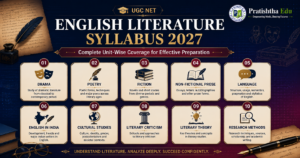
Major Areas Covered in UGC NET English Literature
The syllabus can be approached through several broad areas, including literary genres, literary history, important writers and works, criticism, literary theory, language, English in India, cultural studies, and research methodology.
Drama
Drama is an important area of English Literature preparation. Candidates should develop an understanding of drama across different literary periods and traditions.
Important areas include:
- Classical drama
- Medieval drama
- Renaissance drama
- Restoration drama
- Victorian drama
- Modern drama
- Contemporary drama
- Indian drama
- Major dramatists
- Important dramatic works
- Dramatic forms and conventions
While preparing drama, do not focus only on memorising titles. Try to understand the relationship between the dramatist, work, literary period, genre, and major themes.
A useful revision format is:
Dramatist → Major Work → Period → Genre → Important Features
Poetry
Poetry is another important area for candidates preparing for UGC NET English Literature.
Preparation should include important poets, poetic works, literary periods, poetic forms, movements, and major concepts.
Important areas include:
- Major English poets
- Renaissance poetry
- Metaphysical poetry
- Romantic poetry
- Victorian poetry
- Modern poetry
- Contemporary poetry
- Indian poetry in English
- Major poetic forms
- Poetic devices
- Important themes and movements
Candidates should also develop a chronological understanding of major poets and literary movements.
A useful preparation method is:
Period → Movement → Major Poets → Important Works → Characteristics
Fiction and Short Story
Fiction preparation should cover major developments in the English novel and short story traditions.
Important areas include:
- Development of the English novel
- Major novelists
- Important novels
- Major themes
- Narrative techniques
- Modern fiction
- Postmodern fiction
- Indian fiction in English
- Short story traditions
- Important short-story writers
Candidates should try to understand how fictional forms developed across different literary periods.
Non-Fictional Prose
Non-fictional prose includes several forms of writing that are different from poetry, drama, and fiction.
Preparation may include:
- Essays
- Biography
- Autobiography
- Travel writing
- Letters
- Diaries
- Speeches
- Journals
- Important prose writers and works
Candidates should focus on major writers, important texts, literary forms, and their historical and cultural contexts.
UGC NET English Literature Literary History
Understanding literary history is important because candidates need to connect writers, works, movements, and literary developments with their respective periods.

Instead of studying each period as an isolated topic, create a broad chronological timeline.
Old English Period
Focus on:
- Major characteristics
- Important texts
- Major authors
- Historical context
- Development of English literature
Middle English Period
Important areas include:
- Major literary developments
- Geoffrey Chaucer
- Medieval literary traditions
- Important works
- Religious and social influences
Renaissance Period
Candidates should focus on:
- Renaissance humanism
- Elizabethan literature
- Major poets
- Major dramatists
- William Shakespeare
- Development of prose
Restoration and Eighteenth Century
Important areas include:
- Restoration literature
- Neoclassicism
- Satire
- Comedy of manners
- Major writers and works
- Development of the English novel
Romantic Period
Candidates should study:
- Romanticism
- Nature
- Imagination
- Individualism
- Major Romantic poets
- Major literary works
- Important characteristics of Romantic literature
Victorian Period
Important areas include:
- Victorian society
- Industrialisation
- Major poets
- Victorian novel
- Social criticism
- Major writers and works
Modern Period
Candidates should focus on:
- Modernism
- Literary experimentation
- Modern poetry
- Modern fiction
- Modern drama
- Major modernist writers
- Important modernist concepts
Postmodern and Contemporary Literature
Preparation should include:
- Postmodernism
- Fragmentation
- Intertextuality
- Metafiction
- Contemporary literary developments
- Major writers and works
UGC NET English Literature Important Topics
After understanding the broad syllabus, candidates should identify topics that require regular revision.
Major Writers and Their Works
Create author-wise notes containing:
- Author’s name
- Literary period
- Major works
- Genre
- Important characters
- Major themes
- Literary movement
- Important critical concepts
A simple revision format can be:
Author → Period → Major Works → Genre → Movement → Key Concepts
This approach can make last-minute revision more organised and efficient.
Literary Movements
Candidates should understand the characteristics and major representatives of important literary movements.
Important areas include:
- Renaissance
- Neoclassicism
- Romanticism
- Realism
- Naturalism
- Modernism
- Postmodernism
- Symbolism
- Imagism
- Existentialism
- Postcolonialism
Rather than memorising only definitions, understand when a movement developed, why it emerged, its major characteristics, and its important writers.
Literary Criticism
Literary criticism is an important component of English Literature preparation.
Candidates should study major critics, their ideas, important works, and critical concepts.
Preparation should include:
- Classical criticism
- Renaissance criticism
- Neoclassical criticism
- Romantic criticism
- Victorian criticism
- Modern criticism
- Contemporary criticism
A useful revision format is:
Critic → Major Work → Critical Concept → Literary Approach
This makes it easier to connect important critics with their major ideas and contributions.
Literary Theory
Literary theory can initially seem difficult because it includes abstract concepts and specialised terminology. Candidates should therefore focus on understanding the major theoretical approaches and the thinkers associated with them.
Important areas include:
- Structuralism
- Poststructuralism
- Marxism
- Feminism
- Psychoanalytic criticism
- Postcolonial theory
- New Historicism
- Reader-response theory
- Deconstruction
- Cultural theory
While studying theory, candidates should understand both the theorist and the concept associated with that theorist rather than relying only on one-line definitions.
English Language and English in India
Language-related topics should also be included in the preparation strategy.
Candidates can focus on:
- History and development of English
- Language change
- Varieties of English
- English in India
- Indian English
- Language and society
- Important linguistic concepts
- Relationship between language and culture
These topics should be studied according to the prescribed syllabus and supported by reliable study resources.
Cultural Studies
Cultural studies connects literature with society, identity, history, media, politics, and culture.
Important areas may include:
- Culture and representation
- Popular culture
- Identity
- Gender
- Media and society
- Postcolonial culture
- Cultural theory
Candidates should understand major concepts and their relationship with literary and cultural texts.
Indian Writing in English
Indian Writing in English is an important area for candidates preparing for English Literature.
Preparation should include:
- Indian poetry in English
- Indian fiction in English
- Indian drama
- Indian prose
- Major Indian writers
- Major works
- Postcolonial perspectives
- Important literary developments
Create separate notes for major writers and their important works.
A useful revision format is:
Writer → Genre → Major Works → Themes → Period → Important Concepts
Research Methodology
Research-related topics should also be included in the preparation strategy.
Candidates should understand concepts such as:
- Research methodology
- Research questions
- Literature review
- Primary and secondary sources
- Citation and referencing
- Academic writing
- Research ethics
- Plagiarism
- Bibliography
- Research design
Regular revision of important research terminology can make these topics easier to retain.
How to Divide the UGC NET English Literature Syllabus
A practical way to manage the syllabus is to divide it into five broad preparation groups:
Group 1: Literature
- Poetry
- Drama
- Fiction
- Non-fiction
Group 2: Literary History
- Major literary periods
- Literary movements
- Important authors
- Major works
Group 3: Criticism and Theory
- Major critics
- Literary criticism
- Literary theory
- Critical approaches
Group 4: Language and Culture
- Language
- English in India
- Cultural studies
- Postcolonial studies
Group 5: Research
- Research methodology
- Academic concepts
- Research terminology
This classification can make the syllabus easier to organise and can help candidates create a realistic study schedule.
How to Prioritise UGC NET English Literature Topics
Candidates should not give the same amount of preparation time to every topic. Start with the official syllabus and use previous year questions to understand which areas require more practice and revision.
A practical priority system is:
High Priority → Concept Study + Regular Revision + PYQ Practice
Medium Priority → Concept Study + Periodic Revision
Revision Priority → Short Notes + Regular Recall
This approach does not mean ignoring any part of the official syllabus. Instead, it helps candidates manage their available preparation time more effectively.
UGC NET English Literature Syllabus Revision Method
After completing a topic, follow a simple four-step cycle:
Concept Study → Short Notes → PYQs → Revision
For example, while preparing Romantic Poetry:
Study the major characteristics
↓
Prepare notes on important poets and works
↓
Solve related previous year questions
↓
Revise important chronology and concepts
This method helps candidates test their understanding instead of repeatedly reading the same material without practice.
UGC NET English Literature Important Topics & Preparation Strategy
After understanding the complete UGC NET English Literature Syllabus 2027, the next step is to identify the areas that require focused preparation and regular revision. Since the syllabus covers different literary periods, genres, writers, works, criticism, theory, language, and cultural studies, students should follow a structured approach instead of trying to memorise everything at once.
Important Topics for UGC NET English Literature
Literary Periods
Develop a clear chronological understanding of major literary periods, including:
- Old English
- Middle English
- Renaissance
- Restoration
- Neoclassical Period
- Romantic Period
- Victorian Period
- Modern Period
- Postmodern and Contemporary Literature
For each period, prepare notes covering its major characteristics, important writers, significant works, literary movements, and historical context.
Major Authors and Their Works
Author-work relationships are an important part of literature preparation. Create concise notes for major writers and include:
- Author
- Literary period
- Major works
- Genre
- Important themes
- Literary movement
- Major characters where relevant
- Important literary concepts
A useful revision format is:
Author → Period → Major Works → Genre → Movement → Key Concepts
This format can revise faster and help reduce confusion between writers and their works.
Literary Movements
Candidates should understand the development and characteristics of important literary movements.
Important areas include:
- Renaissance
- Neoclassicism
- Romanticism
- Realism
- Naturalism
- Modernism
- Postmodernism
- Symbolism
- Imagism
- Existentialism
- Postcolonialism
Do not restrict preparation to definitions. Understand the historical background, major characteristics, important writers, and representative works associated with each movement.
Important Areas of Literary Genres
Poetry
For poetry, focus on:
- Major poets
- Important poems
- Poetic forms
- Literary periods
- Poetic movements
- Themes
- Literary devices
- Historical and cultural contexts
Maintain a chronological list of major poets and their works to make revision easier.
Drama
For drama, focus on:
- Major dramatists
- Important plays
- Dramatic forms
- Major themes
- Development of English drama
- Renaissance drama
- Restoration drama
- Modern drama
- Contemporary drama
- Indian drama
Try to connect each dramatist with the appropriate period, genre, major works, and important characteristics.
Fiction
For fiction, prepare:
- Major novelists
- Important novels
- Development of the English novel
- Narrative techniques
- Major themes
- Literary periods
- Modern fiction
- Postmodern fiction
- Indian fiction in English
Non-Fiction
Important areas include:
- Essays
- Biography
- Autobiography
- Travel writing
- Letters
- Diaries
- Speeches
- Journals
- Major prose writers and works
Literary Criticism and Theory
Literary criticism and theory require special attention because questions can test both factual knowledge and conceptual understanding.
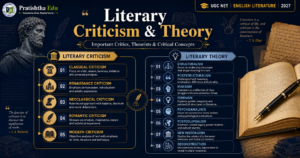
Literary Criticism
Candidates should study criticism chronologically and understand the contribution of major critics.
Important areas include:
- Classical criticism
- Renaissance criticism
- Neoclassical criticism
- Romantic criticism
- Victorian criticism
- Modern criticism
- Contemporary criticism
While preparing critics, use the following format:
Critic → Major Work → Critical Idea → Important Concept
This helps you remember the relationship between a critic and their contribution.
Literary Theory
Literary theory is another important area that should be studied systematically.
Focus on major approaches such as:
- Structuralism
- Poststructuralism
- Marxism
- Feminism
- Psychoanalytic criticism
- Postcolonial theory
- New Historicism
- Reader-response theory
- Deconstruction
- Cultural theory
For every theoretical approach, try to understand:
Theory → Major Theorist → Key Concept → Important Terminology
This approach is more useful than memorising isolated definitions.
Indian Writing in English
Indian Writing in English should receive dedicated preparation because it covers an important area of literary studies.
Focus on:
- Indian poetry in English
- Indian fiction in English
- Indian drama
- Indian prose
- Major Indian writers
- Major literary works
- Themes and literary developments
- Postcolonial perspectives
Prepare separate author-wise notes and connect writers with their genres, major works, themes, and literary contexts.
English in India and Language
Candidates should also prepare important concepts related to the English language and its development.
Important areas include:
- History and development of English
- Language change
- Varieties of English
- English in India
- Indian English
- Language and society
- Language and culture
- Important linguistic concepts
These topics should be prepared according to the prescribed syllabus and supported by reliable study resources.
Cultural Studies
Cultural studies allows candidates to understand literature in relation to society, identity, media, culture, and history.
Important areas include:
- Culture and representation
- Popular culture
- Identity
- Gender
- Media and society
- Postcolonial culture
- Cultural theory
Candidates should understand important concepts and how they can be applied to literary and cultural texts.
Research Methodology
Research methodology should not be left for the final stage of preparation.
Important areas include:
- Research methods
- Research questions
- Literature review
- Primary sources
- Secondary sources
- Citation and referencing
- Academic writing
- Research ethics
- Plagiarism
- Bibliography
- Research design
Prepare short notes for important research terminology and revise them regularly.
How to Identify High-Priority Topics
There is no single list of topics that guarantees questions in every examination. Instead, candidates should identify priority areas using the official syllabus, previous year questions, and their own performance in practice tests.
A useful method is:
Official Syllabus → Previous Year Questions → Topic Analysis → Revision Priority
If a particular area repeatedly creates mistakes during PYQ or mock-test practice, give that area additional revision time.
UGC NET English Literature Preparation Strategy
A successful preparation strategy should combine learning, practice, revision, and testing.
Step 1: Understand the Complete Syllabus
Start by reading the complete syllabus carefully.
Divide it into smaller sections such as:
- Literary history
- Poetry
- Drama
- Fiction
- Non-fiction
- Criticism
- Theory
- Language
- Cultural studies
- Research methodology
This makes a large syllabus easier to manage.
Step 2: Build Your Literary Timeline
Create a chronological timeline of major literary periods.
For each period, record:
- Major characteristics
- Important writers
- Major works
- Literary movements
- Important concepts
A strong timeline can help you connect authors and works with the correct literary period.
Step 3: Prepare Author-Work Notes
Create concise notes rather than copying large paragraphs from reference books.
For each important author, record:
Author → Works → Genre → Period → Movement → Themes → Important Concepts
These notes can become valuable during final revision.
Step 4: Study Literary Criticism and Theory Separately
Do not mix all critics and theories.
Create separate sections for:
- Critics
- Critical works
- Literary theories
- Theorists
- Important concepts
- Key terminology
This makes difficult theoretical topics easier to revise.
Step 5: Solve Previous Year Questions
After completing a topic, practise relevant UGC NET English Literature Previous Year Questions.
PYQs can help you understand:
- Question patterns
- Frequently tested concepts
- Important authors
- Important works
- Areas where you make mistakes
Do not only check your score. Analyse every incorrect answer.
Step 6: Use Mock Tests for Assessment
Once you have covered a reasonable portion of the syllabus, start taking mock tests.
After every test, identify:
- Incorrect answers
- Unattempted questions
- Weak topics
- Repeated mistakes
- Time-management problems
Use this analysis to improve your preparation.
Step 7: Revise Regularly
Revision should continue throughout your preparation.
A simple cycle is:
Study → Revise → Practise → Test → Analyse → Revise Again
Regular revision is particularly important for literary chronology, authors, works, dates, movements, theories, and critical concepts.

UGC NET English Literature Study Plan
A practical study routine can include four major activities every day.
New Topic
Study a new topic from the syllabus and understand its basic concepts.
Previous Topic Revision
Spend some time revising topics studied earlier.
Question Practice
Solve topic-wise questions or previous year questions.
Quick Recall
At the end of the study session, revise important names, works, theories, and concepts without looking at your notes.
This combination helps maintain a balance between learning new material and retaining previously studied topics.
How to Make UGC NET English Literature Preparation More Effective
Avoid collecting too many books and study resources. Having multiple resources does not automatically improve preparation.
Instead, follow a simple resource strategy:
One Main Resource → Short Notes → PYQs → Mock Tests → Regular Revision
Candidates can also use reliable Study Material to supplement their preparation, provided the material follows the prescribed syllabus and is updated appropriately.
The goal should be to develop strong conceptual understanding and accurate recall rather than simply completing a large number of books.
Common Preparation Mistakes to Avoid
Studying Without the Syllabus
Starting preparation without understanding the syllabus can lead to unnecessary study and poor time management.
Ignoring Literary Chronology
Memorising authors individually without understanding their literary periods can create confusion.
Focusing Only on Famous Writers
UGC NET preparation requires broader syllabus coverage. Do not prepare only the most famous authors while completely ignoring other prescribed areas.
Ignoring Literary Theory
Theory and criticism require regular revision. Leaving them until the end can make preparation difficult.
Not Solving PYQs
Reading books without practising examination questions does not provide enough exposure to the actual question style.
Taking Too Many Mock Tests Without Analysis
The number of tests is less important than what you learn from each test.
Using Too Many Resources
Too many books, notes, PDFs, and videos can create information overload. Choose reliable resources and revise them properly.
UGC NET English Literature Preparation Formula
A simple preparation formula to follow is:
Complete Syllabus → Understand Concepts → Build Notes → Solve PYQs → Take Mock Tests → Analyse Mistakes → Revise Regularly
Consistency is more important than trying to complete the entire syllabus in a very short period.
Candidates who maintain a structured routine and regularly evaluate their preparation can gradually improve their knowledge, accuracy, and confidence for the examination.
UGC NET English Literature Books, PYQs, Mock Tests & Study Plan
Choosing the right resources is an important part of UGC NET English Literature Preparation. Candidates do not need to collect a large number of books or study materials. A focused combination of reliable resources, short notes, previous year questions, mock tests, and regular revision is generally more useful than studying from too many sources.
Best Books for UGC NET English Literature Preparation
The right books can help candidates understand literary history, criticism, theory, genres, and important writers. Instead of using multiple books for the same topic, select resources that provide clear explanations and support the prescribed syllabus.
Books for English Literary History
For literary history, focus on resources that explain the development of English literature chronologically.
Your preparation should cover:
- Old English Literature
- Middle English Literature
- Renaissance Literature
- Restoration Literature
- Neoclassical Literature
- Romantic Literature
- Victorian Literature
- Modern Literature
- Contemporary Literature
While studying literary history, make your own concise timeline containing important periods, writers, works, and literary movements.
Books for Literary Criticism and Theory
Literary criticism and theory require conceptual understanding.
Your study resources should help you understand:
- Major critics
- Critical works
- Literary theories
- Major theorists
- Important concepts
- Critical terminology
- Development of literary criticism
Avoid relying only on short definitions. Try to understand the central idea of each theory and its major representatives.
Books for Indian Writing in English
For Indian Writing in English, use resources that cover:
- Indian poets
- Indian novelists
- Indian dramatists
- Major works
- Literary movements
- Major themes
- Postcolonial perspectives
Create separate author-wise notes so that important writers and their works can be revised quickly.
Books for UGC NET English Practice
Practice books can be useful for testing your understanding after completing a topic.
Choose practice material that includes:
- Topic-wise questions
- Previous year questions
- Explanations
- Mixed practice sets
- Mock tests
The goal should not be to solve questions mechanically. Analyse incorrect answers and identify the concepts that need further revision.
How to Choose the Right Study Material
Students often make the mistake of collecting too many PDFs, books, notes, videos, and online resources.
A better approach is to follow:
One Main Resource → Short Notes → PYQs → Mock Tests → Revision
Before using any study material, check whether it:
- Follows the prescribed syllabus
- Covers the required topics
- Is reasonably updated
- Provides accurate information
- Helps with revision and practice
Using reliable Study Material can make preparation more organised, especially when combined with your own notes.
UGC NET English Literature Previous Year Questions
UGC NET English Literature Previous Year Questions are an important part of exam preparation.
PYQs help candidates understand how literary knowledge and concepts are tested in the examination.
Why Are PYQs Important?
Solving previous year questions can help you identify:
- Frequently tested areas
- Important authors
- Major literary works
- Literary periods
- Critical concepts
- Theoretical approaches
- Question patterns
- Personal weak areas
PYQs should not be treated only as question papers. They can also be used as a diagnostic tool to understand your preparation level.
When Should You Start Solving PYQs?
You do not have to wait until the entire syllabus is complete.
Start topic-wise PYQ practice after completing individual sections.
For example:
Romantic Literature → Study Topic → Solve Related PYQs → Analyse Mistakes → Revise
Once a major portion of the syllabus is completed, start solving complete previous year papers under timed conditions.
How to Analyse PYQs
After solving a question paper, divide your mistakes into categories:
Knowledge Gap
You did not know the concept or fact.
Conceptual Confusion
You knew the topic but misunderstood the question.
Recall Problem
You studied the topic but could not remember the information.
Careless Mistake
You knew the answer but selected the wrong option.
Time Management Issue
You could not attempt the question properly within the available time.
This analysis can help you decide what to revise next.
UGC NET English Literature Mock Test Strategy
Mock tests are useful for evaluating your preparation and improving examination performance.
However, simply taking many mock tests is not enough. The most important part is analysing the results.
When Should You Start Mock Tests?
Begin with topic-wise tests while studying the syllabus.
After completing a substantial portion of the syllabus, gradually move towards full-length mock tests.
This allows you to develop both subject knowledge and examination stamina.
How Often Should You Take Mock Tests?
There is no fixed number of tests that guarantees success.
Your mock-test frequency should increase as the examination approaches.
A practical approach is:
Initial Preparation → Topic Tests
Middle Preparation → Sectional Tests
Advanced Preparation → Full-Length Tests
Final Revision → Timed Mock Tests + Mistake Analysis
How to Analyse a Mock Test
After every test, record:
- Total score
- Correct answers
- Incorrect answers
- Unattempted questions
- Topics responsible for mistakes
- Time spent
- Questions where you were unsure
Maintain a mistake notebook containing important errors and concepts that require repeated revision.
UGC NET English Literature Study Plan
A study plan should be realistic and flexible. Instead of creating an extremely long daily timetable that becomes difficult to maintain, divide your preparation into manageable sessions.
Daily Study Routine
A balanced daily routine can include:
Session 1: Literature
Study a new literary period, genre, writer, work, or movement.
Session 2: Criticism and Theory
Revise one critic, theorist, critical concept, or theoretical approach.
Session 3: Paper 1
Practise areas such as teaching aptitude, research aptitude, reasoning, comprehension, ICT, or other prescribed Paper 1 topics.
Session 4: PYQs and Revision
Solve previous year questions and revise topics studied earlier.
The exact duration of each session can be adjusted according to your preparation level and available study time.
3-Month UGC NET English Literature Preparation Plan
Students with limited preparation time can divide their preparation into three stages.
Month 1: Syllabus Coverage
Focus on:
- Literary history
- Poetry
- Drama
- Fiction
- Non-fiction
- Major authors and works
Create concise notes while studying.
Month 2: Criticism, Theory and Practice
Focus on:
- Literary criticism
- Literary theory
- Language
- English in India
- Cultural studies
- Indian Writing in English
- Research methodology
- PYQs
Start identifying weak areas.
Month 3: Revision and Testing
Focus primarily on:
- Complete revision
- Previous year papers
- Mock tests
- Weak topics
- Literary chronology
- Important authors and works
- Critical concepts
- Theoretical terminology
Avoid starting too many new resources during the final stage.
30-Day UGC NET English Literature Revision Strategy
During the final month, focus on revision rather than collecting new study material.
Week 1
Revise:
- Literary history
- Major periods
- Literary movements
- Poetry
- Drama
Week 2
Revise:
- Fiction
- Non-fiction
- Indian Writing in English
- English in India
- Cultural studies
Week 3
Revise:
- Literary criticism
- Literary theory
- Major critics
- Major theorists
- Research methodology
Week 4
Focus on:
- PYQs
- Full-length mock tests
- Mistake notebook
- Weak areas
- Important authors and works
- Final revision
How to Balance Paper 1 and English Literature
Candidates preparing for UGC NET English should not postpone Paper 1 until the final stage.
Include Paper 1 practice regularly along with English Literature.
A simple weekly structure can be:
English Literature Concept Study + Paper 1 Practice + PYQs + Revision + Mock Test
If you are stronger in English Literature but weaker in Paper 1, dedicate additional practice time to Paper 1. Similarly, if Paper 2 is your weaker area, give more time to literature, criticism, and theory.
How to Use Pratishtha Library for UGC NET Preparation
A consistent study environment can make it easier to follow a long-term preparation routine. Students who prefer a dedicated study space can explore Pratishtha Library and choose a study routine that suits their preparation schedule.
A distraction-free environment can be particularly useful during:
- Literary history revision
- PYQ practice
- Mock tests
- Reading sessions
- Final revision
The most important factor, however, is consistency. A good study environment works best when combined with a realistic study plan and regular revision.
UGC NET English Literature Revision Technique
One effective way to revise large amounts of literature is to use active recall.
Instead of repeatedly reading the same notes, close the book and try to recall:
- Important writers
- Major works
- Literary periods
- Movements
- Critical concepts
- Theorists
- Important terminology
You can also create quick revision charts such as:
Writer → Work → Period → Movement
Critic → Work → Critical Idea
Theorist → Theory → Key Concept
Period → Characteristics → Major Writers → Major Works
These formats can make last-minute revision considerably easier.
Final Preparation Formula
A practical preparation cycle for UGC NET English Literature 2027 can be summarised as:
Understand the Syllabus → Study Concepts → Make Short Notes → Solve PYQs → Take Mock Tests → Analyse Mistakes → Revise Regularly
Do not measure preparation only by the number of books completed or mock tests attempted. The quality of revision, accuracy, conceptual clarity, and ability to learn from mistakes are equally important.
A focused preparation strategy using reliable books, relevant Study Material, previous year questions, mock tests, and regular revision can help candidates approach the examination with greater confidence and better organisation.
UGC NET English Literature Career Opportunities, Common Mistakes & Final Preparation Tips
Preparing for UGC NET English Literature 2027 requires more than completing the syllabus. Candidates also need to understand common preparation mistakes, evaluate their progress, and know what opportunities may become available after qualifying the examination.
Common Mistakes in UGC NET English Literature Preparation
Many candidates spend considerable time studying but do not get the expected results because of an unstructured preparation approach. Avoiding common mistakes can make your preparation more efficient.
Studying Without Understanding the Syllabus
Starting preparation without going through the complete syllabus can result in spending too much time on less relevant topics while leaving important areas incomplete.
Use the official syllabus as your primary checklist and mark each topic as you complete it.
Relying Only on Memorisation
English Literature contains a large amount of factual information, but memorising isolated facts is not enough.
Try to understand the relationship between:
Author → Work → Literary Period → Movement → Theme → Critical Context
This approach can make information easier to recall.
Ignoring Literary Criticism and Theory
Some students focus heavily on literary periods and famous writers while giving very little attention to criticism and theory.
This can create gaps in preparation.
Give regular time to:
- Major critics
- Critical works
- Literary theories
- Theorists
- Important concepts
- Critical terminology
Studying Too Many Books
Using too many books and resources can create confusion.
Instead of reading five different books for the same topic, choose a reliable primary resource and supplement it with relevant Study Material, PYQs, and revision notes.
Not Solving Previous Year Questions
Reading theory without solving questions does not show whether you can apply what you have studied.
Make UGC NET English Literature Previous Year Questions a regular part of your preparation.
Taking Mock Tests Without Analysis
A mock-test score alone does not tell you how to improve.
After every test, identify:
- Incorrect answers
- Weak topics
- Repeated mistakes
- Time-management problems
- Questions where you were uncertain
Then revise those areas.
Ignoring Revision
Completing the syllabus once does not mean that preparation is complete.
English Literature involves a large amount of information, so regular revision is essential.
Use short notes, timelines, charts, flashcards, and active recall to retain important information.
How to Improve UGC NET English Literature Preparation
Create a Realistic Study Schedule
Your study plan should match your available time, academic background, and preparation level.
Do not create an unrealistic timetable that requires studying for an excessive number of hours every day.
Instead, set achievable daily and weekly targets.
Maintain Short Revision Notes
Create concise notes while studying.
For literature, use:
Author → Work → Period → Movement → Theme
For criticism:
Critic → Work → Critical Idea
For theory:
Theorist → Theory → Key Concept
These formats can revise faster.
Keep a Mistake Notebook
Maintain a separate record of questions you repeatedly answer incorrectly.
Include:
- Question or concept
- Correct answer
- Reason for your mistake
- Related topic
- Important explanation
Review this notebook regularly, especially before mock tests and final revision.
Follow the Syllabus During Revision
When revising, keep the official syllabus beside you and check whether every major area has been covered.
This reduces the possibility of completely overlooking a topic.
UGC NET English Literature Career Opportunities
Qualifying UGC NET can support different academic and research-oriented career paths. However, qualification does not automatically guarantee a job or appointment. Candidates should understand the specific eligibility requirements for the position or institution they are interested in.

Assistant Professor
UGC NET qualification can be relevant to eligibility for Assistant Professor positions in higher education institutions, subject to applicable rules and institutional requirements.
Candidates interested in teaching should also develop:
- Strong subject knowledge
- Communication skills
- Academic writing ability
- Research awareness
- Classroom skills
Junior Research Fellowship
Candidates who qualify for JRF according to the applicable criteria may pursue research opportunities and work towards advanced academic research.
JRF can provide an opportunity to develop expertise in a specialised area of English Literature.
Possible research areas include:
- Literary criticism
- Literary theory
- Indian Writing in English
- Postcolonial literature
- Cultural studies
- Gender studies
- Comparative literature
- Modern literature
- Contemporary literature
PhD and Research
English Literature graduates interested in academic research can explore PhD opportunities in areas related to literature, language, criticism, theory, and cultural studies.
A strong foundation in research methodology is particularly useful for students planning to pursue advanced research.
Academic and Literary Careers
Apart from traditional teaching and research pathways, English Literature graduates can explore areas such as:
- Academic content development
- Publishing
- Editing
- Literary research
- Content writing
- Academic writing
- Educational content
- Research assistance
The suitability of each career depends on the candidate’s qualifications, skills, experience, and specific career goals.
Skills That Can Help English Literature Aspirants
Preparing for UGC NET can also help candidates develop skills that are useful beyond the examination.
Critical Thinking
Literary criticism and theory encourage students to analyse texts, arguments, and perspectives.
Research Skills
Research methodology can help candidates understand how to identify sources, develop research questions, and organise academic work.
Academic Writing
Regular reading and note-making can improve structured writing and communication.
Reading and Analysis
English Literature preparation requires students to read texts critically and understand their historical and cultural contexts.
Communication
Candidates interested in teaching and academic careers can benefit from developing clear written and verbal communication skills.
How to Know If Your UGC NET English Preparation Is on Track
Instead of judging preparation only by the number of hours studied, evaluate yourself using measurable indicators.
Ask yourself:
- Have I completed the prescribed syllabus?
- Can I recall major literary periods?
- Can I connect authors with their works?
- Do I understand important literary movements?
- Can I explain major critical concepts?
- Have I studied literary theory systematically?
- Have I solved previous year questions?
- Am I improving in mock tests?
- Have I identified my weak areas?
- Am I revising regularly?
If several answers are “no,” adjust your preparation plan instead of simply increasing study hours.
UGC NET English Literature Final Preparation Checklist
Before the examination, make sure you have reviewed:
- Complete UGC NET English Literature syllabus
- Literary periods
- Major literary movements
- Important authors
- Major works
- Poetry
- Drama
- Fiction
- Non-fiction
- Literary criticism
- Literary theory
- Indian Writing in English
- English in India
- Cultural studies
- Research methodology
- Paper 1 topics
- Previous year questions
- Mock tests
- Mistake notes
- Short revision notes
This checklist can help you identify any major area that still needs attention.
Final Preparation Tips for UGC NET English Literature 2027
A strong preparation strategy does not require studying continuously without a break. What matters more is consistency and effective revision.
Keep the following principles in mind:
Follow the Official Syllabus
Use the prescribed syllabus as the foundation of your preparation.
Study Systematically
Move from literary history and genres to criticism, theory, language, cultural studies, and research.
Practise Regularly
Solve PYQs and practice questions throughout your preparation rather than waiting until the end.
Revise Multiple Times
Regular revision is essential for remembering authors, works, theories, movements, and literary chronology.
Analyse Your Mistakes
Every incorrect answer should help you identify something that needs improvement.
Avoid Resource Overload
A small number of reliable resources, supported by useful Study Material, is generally better than collecting numerous books and PDFs.
Stay Consistent
A realistic daily routine maintained for several months can be more effective than an intense study schedule followed for only a few days.
Building a Long-Term Academic Career Through English Literature
UGC NET preparation can be viewed not only as examination preparation but also as an opportunity to build a strong academic foundation.
Candidates who develop knowledge of literature, criticism, theory, research methodology, and academic writing can use these skills for different educational and research-oriented paths.
Whether your goal is teaching, research, JRF, PhD, publishing, or another academic career, focus on developing genuine subject knowledge rather than preparing only for short-term examination recall.
A consistent approach combining UGC NET English Literature Preparation, Study Material, Previous Year Questions, mock tests, revision, and conceptual understanding can help you build a stronger foundation for your academic goals.
Frequently Asked Questions About UGC NET English Literature 2027
What is UGC NET English Literature?
UGC NET English Literature refers to preparation for the English subject under the University Grants Commission National Eligibility Test. The examination covers areas such as poetry, drama, fiction, non-fiction, literary history, criticism, literary theory, language, cultural studies, and research methodology.
Candidates should refer to the latest official syllabus and notification for the current examination cycle.
Is UGC NET English Literature difficult?
UGC NET English Literature can be challenging because the syllabus is broad and requires knowledge of different literary periods, authors, works, movements, criticism, theory, and related areas.
However, a structured UGC NET English Literature Preparation Strategy can make the syllabus more manageable.
Candidates should focus on:
- Understanding the syllabus
- Building literary chronology
- Studying important authors and works
- Understanding criticism and theory
- Solving PYQs
- Taking mock tests
- Revising regularly
How should I start UGC NET English Literature preparation?
Start by understanding the complete syllabus and examination pattern.
Then divide the syllabus into smaller sections such as:
Literary History → Poetry → Drama → Fiction → Criticism → Theory → Language → Cultural Studies → Research
After completing each topic, make short notes and practise relevant questions.
What are the important topics for UGC NET English Literature?
Important preparation areas include:
- Literary periods
- Major authors and works
- Literary movements
- Poetry
- Drama
- Fiction
- Non-fiction
- Literary criticism
- Literary theory
- Indian Writing in English
- English in India
- Cultural studies
- Research methodology
Candidates should not completely ignore any part of the prescribed syllabus. Use previous year questions and mock-test performance to identify areas that require additional revision.
Which books are best for UGC NET English Literature?
There is no single book that is best for every candidate.
Choose resources that provide reliable coverage of:
- English literary history
- Major authors and works
- Literary criticism
- Literary theory
- Indian Writing in English
- UGC NET practice questions
- Previous year questions
Avoid collecting too many books. A focused combination of reliable books, Study Material, PYQs, and revision notes is generally easier to manage.
Are UGC NET English Literature Previous Year Questions important?
Yes. Previous year questions are an important part of preparation because they help candidates understand question patterns and identify areas that require additional practice.
Use PYQs to:
- Test your understanding
- Identify weak topics
- Recognise important concepts
- Improve accuracy
- Practise under time limits
Do not simply solve PYQs and check your score. Analyse the reasons behind incorrect answers.
When should I start solving mock tests?
You can begin with topic-wise tests while preparing individual sections.
Once you have covered a substantial portion of the syllabus, gradually move towards sectional and full-length mock tests.
During the final stage of preparation, focus on timed tests, revision, and detailed analysis of mistakes.
How much time is required to prepare for UGC NET English Literature?
The required preparation time varies from student to student.
It depends on:
- Existing knowledge of English Literature
- Familiarity with literary theory
- Available study time
- Previous preparation
- Reading speed
- Revision requirements
Instead of focusing only on the number of months, create a realistic study plan based on the syllabus and your current preparation level.
Can I prepare for UGC NET English Literature without coaching?
Yes, many candidates prepare independently using books, reliable study resources, previous year questions, mock tests, and self-made notes.
The most important factors are:
- Consistency
- Proper planning
- Reliable resources
- Regular practice
- Revision
- Self-assessment
Candidates who prefer structured guidance can also explore relevant UGC NET preparation resources and academic support options.
How important is literary theory for UGC NET English?
Literary theory is an important part of English Literature preparation. Candidates should understand major theories, theorists, concepts, and terminology.
Instead of memorising definitions alone, try to understand the relationship between:
Theorist → Theory → Key Concept → Application
Regular revision and question practice can make theoretical topics easier to remember.
What are the career opportunities after qualifying UGC NET English?
UGC NET qualification can support academic and research-oriented career paths, depending on the applicable rules and specific requirements.
Potential pathways include:
- Assistant Professor
- Junior Research Fellowship, where applicable
- PhD and academic research
- Teaching and education
- Academic content development
- Publishing and editing
- Literary research
- Academic writing
Qualification does not automatically guarantee employment. Candidates should check the eligibility requirements of individual institutions and positions.
UGC NET English Literature Final Preparation Checklist
Before appearing for the examination, candidates should review the following areas:
- Complete UGC NET English Literature syllabus
- Literary periods and chronology
- Major literary movements
- Important authors and works
- Poetry
- Drama
- Fiction and short stories
- Non-fictional prose
- Literary criticism
- Literary theory
- Indian Writing in English
- English in India
- Cultural studies
- Research methodology
- Paper 1 preparation
- Previous year questions
- Mock tests
- Mistake analysis
- Short revision notes
- Final revision
Final Thoughts
Preparing for UGC NET English Literature 2027 requires a combination of subject knowledge, regular revision, question practice, and effective time management. The syllabus may appear extensive at first, but dividing it into manageable sections can make preparation much more organised.
Begin with the official syllabus and understand the major literary periods, genres, authors, works, criticism, theory, language, cultural studies, and research methodology. Build concise notes while studying and use previous year questions to understand how your knowledge is tested.
Do not depend entirely on memorisation. Try to understand the connections between authors, works, literary periods, movements, critics, theories, and historical contexts.
Regular UGC NET English Literature Preparation, supported by reliable Study Material, PYQs, mock tests, and consistent revision, can help you identify your weak areas and improve your overall preparation.
Most importantly, maintain a realistic study routine and evaluate your progress regularly. Instead of trying to finish everything at once, focus on completing the syllabus systematically, revising repeatedly, and learning from every practice test.
With consistent preparation and a clear strategy, you can approach the UGC NET English Literature examination with greater confidence and a stronger academic foundation.
Leave a Reply