
The UGC NET HRM 2027 examination is an important opportunity for candidates interested in Human Resource Management, Labour Welfare, Personnel Management, Industrial Relations, Labour and Social Welfare, teaching, research, and higher education. The subject covers a wide range of concepts related to employees, organisations, workplace relationships, labour welfare, and human resource practices.
Preparing for UGC NET requires more than simply memorising definitions and theories. Candidates need to understand key concepts, connect different topics, practise previous-year questions, and revise regularly. A clear understanding of the UGC NET HRM Syllabus 2027 can help candidates organise their preparation and identify the areas that require more attention.
This complete guide covers the UGC NET HRM Exam, eligibility requirements, important dates, exam pattern, syllabus, important topics, preparation strategy, previous year questions, study material, and career opportunities. It is designed to help candidates understand the examination before beginning their detailed preparation.
What is UGC NET HRM 2027?
UGC NET HRM refers to the UGC NET subject area covering Human Resource Management and related fields such as Labour Welfare, Personnel Management, Industrial Relations, and Labour and Social Welfare. The subject provides candidates with an opportunity to demonstrate their understanding of important concepts related to people management, employment relationships, workplace practices, and labour-related issues.
Human Resource Management focuses on managing people within an organisation through areas such as recruitment, selection, training, performance management, employee development, compensation and strategic HR planning. However, the UGC NET HRM syllabus has a broader scope and also includes topics connected with labour welfare, industrial relations, personnel management and social security.
For this reason, candidates preparing for the examination should study the complete prescribed syllabus instead of focusing only on conventional HRM concepts.
UGC NET HRM Full Form
UGC NET stands for University Grants Commission National Eligibility Test, while HRM stands for Human Resource Management.
The examination is relevant for candidates who want to pursue academic and research-oriented opportunities after completing their postgraduate studies. Depending on the applicable eligibility conditions and qualification category, UGC NET can support pathways related to teaching, research, and higher education.
UGC NET HRM Subject Code
The HRM-related subject is associated with Subject Code 55 and covers areas including Labour Welfare, Personnel Management, Industrial Relations, Labour and Social Welfare, and Human Resource Management.
Candidates should carefully check the subject name and code while completing the application form and should refer to the latest examination information before applying.
Who Should Appear for UGC NET HRM?
UGC NET HRM can be considered by candidates whose academic background and interests are connected with Human Resource Management, Personnel Management, Labour Welfare, Industrial Relations, Labour Studies and related disciplines.
The subject may be particularly relevant for candidates interested in:
- Human Resource Management
- Personnel Management
- Industrial Relations
- Labour Welfare
- Labour and Social Welfare
- Teaching and higher education
- Research and academics
- PhD and research-oriented careers
Candidates should carefully check the latest eligibility requirements before applying because educational qualifications, minimum marks, age-related conditions, and other requirements are governed by the applicable UGC NET rules.
Why is UGC NET HRM Important?
UGC NET HRM is important for candidates who want to develop an academic or research-oriented career in Human Resource Management and related fields. The examination requires candidates to develop knowledge across several interconnected areas rather than concentrating on a single HR function.
For example, recruitment and selection are connected with workforce planning, training and development influence employee performance, and compensation and reward systems can affect employee motivation. Similarly, industrial relations and labour welfare involve broader issues related to employees, employers, workplace relationships and labour conditions.
Understanding these connections can make UGC NET HRM Preparation more effective. Instead of studying every topic independently, candidates can create a structured study plan that connects related concepts and allows sufficient time for practice and revision.
A well-planned preparation approach should include the complete syllabus, conceptual learning, short notes, previous year questions, mock tests, and regular revision. Candidates should also use reliable UGC NET Study Material and avoid depending on too many unrelated resources.
UGC NET HRM 2027 Highlights
| Particular | Details |
| Examination | UGC NET |
| Subject Area | Human Resource Management and related labour studies |
| Subject Code | 55 |
| Paper 1 | Teaching and Research Aptitude |
| Paper 2 | Subject-Specific Paper |
| Examination Level | National Level |
| Main Areas | HRM, Personnel Management, Labour Welfare, Industrial Relations and Labour & Social Welfare |
| Preparation Focus | Concepts, Syllabus, PYQs, Mock Tests and Revision |
The examination consists of two papers, and candidates preparing for the UGC NET HRM Exam should give appropriate attention to both Paper 1 and Paper 2. Paper 1 focuses on general teaching and research aptitude, while Paper 2 assesses subject-specific knowledge.
Candidates should verify the latest examination pattern, dates, eligibility requirements, and other details from the applicable official examination notification before beginning the application process.
UGC NET HRM Eligibility Criteria 2027
Before starting UGC NET HRM Preparation, candidates should understand the eligibility requirements carefully. Meeting the prescribed eligibility conditions is essential before submitting the application form. The eligibility requirements generally consider educational qualification, minimum marks, age-related conditions, and applicable relaxations.
Candidates should always verify the latest eligibility rules before applying because examination requirements may be updated in a particular UGC NET cycle.
Educational Qualification
Candidates generally need to hold a Master’s degree or an equivalent postgraduate qualification from a recognised university or institution in a relevant subject, as prescribed by the applicable UGC NET rules.
Candidates who are pursuing their postgraduate degree may also be eligible under the conditions specified in the latest examination notification. However, they must fulfil the prescribed requirements within the applicable time period.
Students should therefore check their qualification carefully before applying for the UGC NET HRM Exam.
Minimum Marks Required
Candidates are generally required to secure the prescribed minimum percentage of marks in their postgraduate qualification. The minimum marks requirement can differ according to the candidate’s category and applicable rules.
Instead of relying on information from older examination cycles, candidates should check the latest official eligibility criteria before completing the application form.
Age Limit
The age requirement depends on the category of UGC NET qualification for which a candidate is applying.
For candidates appearing for Junior Research Fellowship (JRF), an upper age limit is applicable according to the prevailing UGC NET rules. Candidates appearing for eligibility for Assistant Professor are generally not subject to the same upper-age condition.
Since age requirements and relaxations can change, candidates should confirm the applicable conditions in the latest UGC NET notification.
Age Relaxation
Age relaxation may be available to eligible candidates belonging to categories covered under the applicable government and UGC rules.
The extent of relaxation can depend on the candidate’s category and other prescribed conditions. Candidates should therefore check the latest notification rather than relying on general assumptions about age relaxation.
Eligibility for JRF
Candidates interested in Junior Research Fellowship should carefully check the additional eligibility conditions applicable to JRF.
JRF qualification can provide an opportunity to pursue research in the relevant subject area, subject to the applicable rules of the fellowship and the institution where the candidate undertakes research.
Candidates planning to pursue research should therefore understand the distinction between qualifying for Assistant Professor eligibility and qualifying for JRF.
Who Can Apply for UGC NET HRM?
Candidates with an appropriate postgraduate academic background and who fulfil the prescribed eligibility conditions can apply for the relevant UGC NET subject.
Before submitting the application, candidates should confirm:
- Their postgraduate qualification
- Required percentage of marks
- Applicable category requirements
- Age-related conditions, where applicable
- Subject eligibility
- Documents required for application
- Current examination instructions
Candidates should select the subject carefully because the syllabus and Paper 2 examination are subject-specific.

UGC NET HRM 2027 Important Dates
The important dates for UGC NET HRM 2027 should be checked from the latest examination notification. Candidates should avoid relying on dates from previous examination cycles, as the schedule may change.
| Event | Date |
| Official Notification | To Be Announced |
| Application Form Begins | To Be Announced |
| Last Date to Apply | To Be Announced |
| Application Correction Window | To Be Announced |
| Admit Card | To Be Announced |
| Examination Date | To Be Announced |
| Provisional Answer Key | To Be Announced |
| Result Declaration | To Be Announced |
Candidates should regularly check the latest examination updates once the UGC NET 2027 notification is released. Important information such as the application deadline, correction period, examination schedule, and admit card availability should be noted carefully.
Missing the application deadline can prevent a candidate from appearing in the examination cycle, so maintaining a personal schedule of important dates is recommended.
UGC NET HRM Exam Pattern 2027
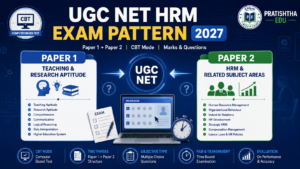
Understanding the UGC NET HRM Exam Pattern 2027 is an important part of preparation. The examination includes two papers designed to evaluate different areas of a candidate’s knowledge and aptitude.
Paper 1 Exam Pattern
Paper 1 evaluates general teaching and research aptitude. It covers areas such as teaching aptitude, research aptitude, reasoning ability, communication, data interpretation, information and communication technology, higher education, and other related topics.
Although Paper 1 is not specific to Human Resource Management, candidates should not ignore it because performance in both papers contributes to the overall examination result.
Paper 2 HRM Exam Pattern
Paper 2 focuses specifically on the selected subject. For candidates preparing for the HRM-related subject, Paper 2 covers the prescribed areas of Human Resource Management, Personnel Management, Industrial Relations, Labour Welfare, Labour and Social Welfare, and related concepts.
Candidates should give significant preparation time to Paper 2 because it requires detailed knowledge of the subject-specific syllabus.
Number of Questions
The number of questions, marks, and other examination details should be confirmed from the latest UGC NET notification applicable to the examination cycle.
Candidates should avoid preparing according to old examination patterns without checking whether the current pattern has changed.
Total Marks
The total marks are distributed across Paper 1 and Paper 2 according to the examination pattern prescribed by the National Testing Agency for the relevant UGC NET cycle.
Understanding the marks distribution can help candidates decide how much preparation time should be allocated to Paper 1 and Paper 2.
Examination Duration
UGC NET is conducted through a computer-based examination format, with candidates appearing for both papers according to the prescribed examination schedule.
Candidates should practise completing questions within the available examination time during their mock-test preparation.
Marking Scheme
Candidates should understand how marks are awarded for correct answers and whether any negative marking applies under the current examination pattern.
The marking rules should always be verified from the latest official examination instructions before the examination.
Negative Marking
Candidates should check the latest notification for the applicable negative-marking rules. Understanding the marking system can help candidates develop an appropriate question-attempt strategy during mock tests and the actual examination.
Paper 1 vs Paper 2
| Feature | Paper 1 | Paper 2 |
| Main Focus | Teaching and Research Aptitude | Subject-Specific Knowledge |
| Content | General aptitude areas | HRM and related subject areas |
| Preparation | Reasoning, teaching, research, and general aptitude | HRM, Labour Welfare, Personnel Management and Industrial Relations |
| Approach | Conceptual practice and aptitude questions | Detailed subject preparation |
| Importance | Essential | Essential |
A balanced preparation strategy should cover both papers. Candidates who focus entirely on Paper 2 while ignoring Paper 1 may miss an opportunity to improve their overall performance.
For effective UGC NET HRM Preparation, candidates should create separate study sessions for Paper 1 and Paper 2, practise questions regularly, and review their performance after every mock test.
UGC NET HRM Syllabus 2027
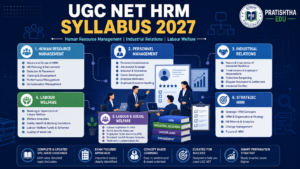
The UGC NET HRM Syllabus 2027 is the most important part of the preparation process because it defines the subject areas that candidates need to study for Paper 2. The syllabus covers Human Resource Management along with related areas such as personnel management, industrial relations, labour welfare, and labour and social welfare.
Candidates should first understand the complete syllabus and then divide it into smaller topics. This makes it easier to prepare a realistic study schedule and track progress during preparation.
Human Resource Management
Human Resource Management focuses on the effective management and development of people within an organisation. Important concepts include the nature and scope of HRM, HR functions, human resource planning, employee development and strategic approaches to managing employees.
Candidates should understand how HR practices contribute to organisational effectiveness and how human resources can be aligned with organisational objectives.
Human Resource Planning
Human resource planning deals with determining an organisation’s future workforce requirements. It includes analysing the existing workforce, forecasting human resource needs and planning for the availability of suitable employees.
Important areas include manpower planning, demand and supply forecasting, workforce analysis, succession planning and human resource information systems.
Recruitment, Selection and Placement
Recruitment and selection are important HR functions concerned with attracting and choosing suitable candidates for available positions.
Preparation should cover sources of recruitment, recruitment methods, selection procedures, employment tests, interviews, placement and induction. Candidates should understand the difference between recruitment and selection and the role each process plays in building an effective workforce.
Training and Development
Training and development focus on improving employee knowledge, skills, abilities and overall performance.
Important concepts include training needs assessment, training methods, management development, career development, executive development and evaluation of training effectiveness.
Candidates should also understand how employee development contributes to organisational growth and long-term performance.
Performance Management
Performance management involves planning, monitoring and evaluating employee performance in relation to organisational objectives.
Important areas include performance appraisal, performance standards, appraisal methods, feedback, employee counselling and performance improvement.
Candidates should understand the difference between traditional performance appraisal and broader performance-management approaches.
Compensation and Reward Management
Compensation management deals with the financial and non-financial rewards provided to employees.
Important topics include wages, salaries, incentives, benefits, reward systems, job evaluation, compensation structures and factors affecting employee remuneration.
Candidates should understand how compensation policies can influence employee motivation, satisfaction and retention.
Industrial Relations
Industrial relations focus on the relationship between employees, employers and their representatives.
Important areas include trade unions, collective bargaining, industrial disputes, grievance handling, disciplinary procedures, worker participation and mechanisms for maintaining healthy workplace relations.
Understanding the causes of industrial conflict and methods of resolving disputes is particularly important for candidates preparing for this part of the syllabus.
Labour Welfare
Labour welfare covers measures designed to improve employees’ working conditions, wellbeing and quality of work life.
Candidates should study concepts related to statutory and non-statutory welfare measures, employee welfare services, occupational health and safety, working conditions and social security.
Labour welfare should be studied not only as a collection of benefits but also as an important component of employee wellbeing and productive workplace relationships.
Labour Laws and Social Security
Labour-related laws and social-security provisions form an important area for candidates studying the broader HRM and labour-welfare syllabus.
Preparation should focus on understanding the objectives, scope and major provisions of relevant labour legislation and social-security frameworks. Candidates should use updated study resources because labour laws and regulatory provisions can change over time.
Strategic Human Resource Management
Strategic Human Resource Management connects HR policies and practices with the long-term objectives of an organisation.
Important concepts include strategic HR planning, competitive advantage, HR strategies, organisational performance, talent management, employee engagement and alignment between business strategy and HR strategy.
Candidates should understand how HR can move beyond administrative functions and contribute to organisational decision-making and long-term growth.
How to Study the UGC NET HRM Syllabus 2027
Candidates should avoid trying to complete the entire syllabus in a single continuous study cycle. A unit-wise approach is more practical and allows sufficient time for revision.
Start by identifying the major areas of the syllabus and divide them according to their difficulty and familiarity. Topics that are already familiar can be revised later, while difficult areas should receive additional study time.
Creating short notes can also help during revision. Instead of copying entire chapters into notebooks, candidates should record important definitions, theories, concepts, models, laws, thinkers, and frequently confused terms.
Previous year questions should be used alongside syllabus preparation. They can help candidates understand how concepts are tested and which areas require greater attention.
A combination of UGC NET HRM Study Material, conceptual learning, previous year questions, mock tests and regular revision can make preparation more organised and effective.
UGC NET HRM Important Topics 2027
After understanding the complete UGC NET HRM Syllabus 2027, the next step is to identify the topics that require focused preparation. The syllabus includes several interconnected areas, so candidates should prioritise concepts that are fundamental to understanding Human Resource Management, labour welfare, personnel management and industrial relations.
Important Human Resource Management Topics
Human Resource Management includes several core concepts that form the foundation of the subject. Candidates should understand the nature, scope, and objectives of HRM along with the major functions performed by HR professionals.
Important areas include:
- Human Resource Planning
- Recruitment and Selection
- Placement and Induction
- Training and Development
- Performance Management
- Compensation Management
- Career Planning
- Employee Engagement
- Talent Management
- Strategic Human Resource Management
- Human Resource Development
- Employee Retention
Candidates should focus on understanding the purpose and application of each HR function rather than memorising definitions alone.
Important Industrial Relations Topics
Industrial relations is another major area that requires conceptual clarity. It deals with relationships between employees, employers, trade unions and other stakeholders in the workplace.
Important topics include:
- Meaning and scope of industrial relations
- Trade unionism
- Trade union structure and functions
- Collective bargaining
- Industrial disputes
- Grievance handling
- Disciplinary procedures
- Worker participation in management
- Industrial conflict
- Industrial dispute settlement
- Employee-employer relations
Candidates should understand the causes of industrial disputes and the different mechanisms used to prevent and resolve workplace conflicts.
Important Labour Welfare Topics
Labour welfare focuses on improving employee wellbeing and working conditions. Candidates should understand both the conceptual and practical aspects of employee welfare.
Important topics include:
- Meaning and objectives of labour welfare
- Statutory welfare measures
- Non-statutory welfare measures
- Employee health and safety
- Working conditions
- Occupational welfare
- Social security
- Employee welfare programmes
- Quality of work life
- Employee wellbeing
Candidates should also understand the relationship between labour welfare, employee satisfaction, productivity and organisational performance.
Important Labour Law Topics
Candidates preparing for the HRM and labour-related subject should develop a clear understanding of major labour legislation and the principles behind employment regulation.
Preparation should include the objectives and important provisions of relevant labour laws, industrial relations legislation, employee welfare provisions and social-security frameworks prescribed in the syllabus.
Candidates should pay attention to:
- Important definitions
- Objectives of major labour laws
- Rights and responsibilities
- Employer and employee obligations
- Labour dispute provisions
- Welfare provisions
- Social-security provisions
- Important authorities and mechanisms
- Key concepts and terminology
Since legal and regulatory provisions can change, candidates should always use updated study material while preparing labour-law topics.
Important Strategic HRM Topics
Strategic Human Resource Management connects human-resource practices with the long-term goals of an organisation.
Important topics include:
- Strategic HR planning
- HR strategy
- Competitive advantage
- Strategic workforce planning
- Talent management
- Employee engagement
- Organisational effectiveness
- Strategic performance management
- HR metrics
- Human capital management
- Alignment of HR strategy with organisational strategy
Candidates should understand how HR decisions can contribute to organisational performance and long-term competitiveness.
Topics Requiring Numerical or Analytical Practice
Although much of the HRM syllabus is conceptual, candidates may encounter questions that require interpretation, comparison or application of concepts.
Candidates should practise questions involving:
- HR-related calculations
- Compensation concepts
- Performance measurement
- Workforce analysis
- Data interpretation
- Research-related concepts
- Logical comparison of HR practices
- Application-based case situations
Regular question practice can improve accuracy and help candidates become comfortable with application-based questions.
How to Prioritise Important Topics for UGC NET HRM
Candidates should not assume that only a small list of topics is important. The complete syllabus should remain the foundation of preparation, while important topics can be used to organise revision and allocate additional study time.
A practical approach is to divide topics into three categories:
High Priority: Fundamental Concepts, frequently revised and closely connected with multiple areas of the syllabus.
Medium Priority: Topics that require conceptual understanding but may need comparatively less revision.
Revision Priority: Topics that have already been studied and should be revisited through short notes, previous year questions, and mock tests.
This approach allows candidates to maintain complete syllabus coverage without spending disproportionate time on only a few chapters.
UGC NET HRM Previous Year Questions for Topic Analysis
Previous year questions are useful for understanding how different HRM concepts are tested. Instead of simply checking the correct answer, candidates should analyse the topic, concept and reasoning behind each question.
While solving UGC NET HRM Previous Year Questions, candidates can maintain a separate record of incorrect answers. Reviewing these mistakes regularly can reveal weak areas and help improve accuracy.
Combining important-topic revision with previous year questions is more effective than memorising a list of supposedly high-weightage topics. The objective should be to develop strong conceptual understanding across the complete syllabus while giving additional revision time to areas that need more practice.
UGC NET HRM Preparation Strategy 2027
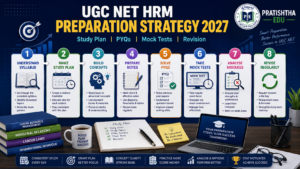
A well-planned UGC NET HRM Preparation Strategy 2027 can help candidates cover the syllabus systematically and use their preparation time effectively. Since the subject includes Human Resource Management, Personnel Management, Industrial Relations, Labour Welfare and related areas, studying without a clear plan can make the syllabus feel difficult to manage.
The most effective approach is to combine conceptual learning, regular practice, previous year questions, mock tests and revision. Candidates should also avoid depending on memorisation alone because many questions require an understanding of concepts and their practical application.
Step 1 – Understand the Complete Syllabus
Before starting detailed preparation, read the complete UGC NET HRM Syllabus 2027 carefully. Identify all major areas and divide them into smaller topics.
Create a checklist of the syllabus and mark topics as you complete them. This prevents candidates from repeatedly studying familiar chapters while leaving difficult areas unfinished.
The syllabus should remain the foundation of the entire preparation plan.
Step 2 – Create a Unit-Wise Study Plan
Divide the syllabus into manageable study targets. Instead of attempting several unrelated topics in one day, focus on connected concepts.
For example, recruitment and selection can be studied together, while training, development and performance management can form another study block.
A practical study plan should include:
- New topic learning
- Revision
- Previous year questions
- Mock-test practice
- Mistake analysis
- Short-note revision
The plan should also leave enough time for completing the entire syllabus before the final revision phase.
Step 3 – Build Strong HRM Concepts
Conceptual clarity is one of the most important parts of UGC NET HRM preparation. Candidates should understand the meaning, purpose, application, and differences between important HR concepts.
For example, recruitment and selection are related but represent different stages of the hiring process. Similarly, training and development have different purposes even though both focus on improving employee capabilities.
Creating comparisons and examples can make such concepts easier to remember.
Step 4 – Prepare Short Notes
Short notes can make revision considerably easier, especially when the syllabus contains numerous theories, models, definitions, concepts and legal provisions.
Instead of copying complete textbook chapters, prepare concise notes containing:
- Important definitions
- HRM concepts
- Theories and models
- Important thinkers and contributors
- Key differences
- Important labour-law concepts
- Important terms
- Frequently confused concepts
Keep the notes simple enough to revise quickly before mock tests and the examination.
Step 5 – Solve Previous Year Questions
Solving UGC NET HRM Previous Year Questions should be an important part of preparation. Previous year questions help candidates understand how concepts are presented and identify areas where they need additional practice.
After solving each question, do not focus only on whether the answer is correct. Understand why the correct option is right and why the other options are incorrect.
Maintain a record of questions answered incorrectly and revise those concepts regularly.
Step 6 – Take Mock Tests
Mock tests help candidates practise the examination environment and improve time management.
Initially, candidates can take topic-wise or smaller practice tests. After completing a significant portion of the syllabus, they should gradually move towards full-length mock tests.
After every mock test, analyse:
- Correct answers
- Incorrect answers
- Unattempted questions
- Time spent
- Repeated mistakes
- Weak topics
A mock test becomes much more useful when candidates analyse their performance instead of simply checking the final score.
Step 7 – Analyse Your Mistakes
Mistake analysis can significantly improve preparation because it identifies the areas that need attention.
Common reasons for incorrect answers include:
- Lack of conceptual understanding
- Confusion between similar terms
- Careless reading
- Incomplete knowledge
- Poor time management
- Incorrect interpretation of the question
Maintain a mistake notebook or digital record and review it during weekly revision sessions.
Step 8 – Revise Regularly
Revision should begin from the early stages of preparation rather than being postponed until the end.
A simple revision cycle can include:
First Revision: Shortly after completing a topic.
Second Revision: After completing a larger section of the syllabus.
Final Revision: During the last phase of preparation using short notes, important concepts and previous year questions.
Regular revision helps candidates retain information for a longer period and reduces the pressure of completing the entire syllabus immediately before the examination.
How to Manage Paper 1 and Paper 2 Together
Candidates should prepare Paper 1 and Paper 2 alongside each other rather than completely ignoring one paper until the end.
Paper 2 requires detailed subject preparation, while Paper 1 requires regular practice of teaching aptitude, research aptitude, reasoning, communication, data interpretation, and other areas.
A balanced daily schedule can include a dedicated study session for HRM and another shorter session for Paper 1 practice.
How to Use UGC NET HRM Study Material Effectively
The quality and organisation of study material are more important than collecting a large number of books and notes.
Candidates should select reliable UGC NET HRM Study Material that follows the prescribed syllabus and provides sufficient explanations, examples, and practice questions.
Avoid switching between multiple resources for the same topic unless additional clarification is required. Too many resources can create unnecessary confusion and make revision difficult.
The ideal preparation cycle is:
Learn → Make Notes → Practise Questions → Analyse Mistakes → Revise
Following this cycle consistently can make UGC NET HRM preparation more organised and manageable.
UGC NET HRM Previous Year Questions and Mock Tests
UGC NET HRM Previous Year Questions are an important part of preparation because they help candidates understand the nature of questions and apply the concepts they have studied. Reading the syllabus and completing study material is not enough; regular question practice is necessary to improve accuracy and confidence.
Previous year questions can also help candidates identify topics that they find difficult. Instead of solving questions only for marks, candidates should use them as a tool for understanding concepts and improving their preparation strategy.
Why PYQs Are Important
Previous year questions provide practical exposure to the examination. They help candidates understand how theoretical concepts are converted into questions and how closely related options can be presented.
By practising PYQs, candidates can improve their ability to:
- Recognise important concepts
- Understand question patterns
- Identify confusing options
- Apply theoretical knowledge
- Improve accuracy
- Manage examination time
- Identify weak areas
Candidates should maintain a separate record of difficult questions and revisit them during revision.
How to Analyse Previous Year Questions
Simply checking the correct answer after solving a question is not enough. Candidates should analyse every important question carefully.
For an incorrect answer, identify the reason behind the mistake. It could be a lack of conceptual knowledge, confusion between two similar concepts, incorrect interpretation of the question or careless reading.
A useful approach is to divide questions into three categories:
Correct and Confident: The concept is understood, and the answer was selected confidently.
Correct but Uncertain: The answer was correct, but the concept needs further revision.
Incorrect: The topic requires additional study and practice.
This method helps candidates identify where their preparation needs improvement.
How Many Mock Tests Should You Attempt?
There is no fixed number of mock tests that guarantees success. The focus should be on the quality of practice and the analysis performed after each test.
Candidates who are beginning their preparation can start with topic-wise tests. After completing a substantial portion of the syllabus, they can gradually move towards full-length tests.
During the final preparation phase, regular full-length mock tests can help candidates improve time management and develop a suitable question-attempt strategy.
How to Improve Accuracy and Time Management
Time management is particularly important when candidates have to deal with a large number of questions within a limited examination period.
Candidates can improve their speed and accuracy by:
- Reading questions carefully
- Avoiding unnecessary time on one question
- Practising timed tests
- Reviewing incorrect answers
- Identifying frequently confusing concepts
- Developing a systematic question-attempt strategy
The objective should not be to answer questions as quickly as possible. It should be to maintain a good balance between speed and accuracy.
Best Books and Study Material for UGC NET HRM
Choosing appropriate study resources can make preparation more organised. Candidates should select resources that cover the prescribed syllabus and explain important concepts clearly.
Instead of collecting a large number of books, candidates should focus on a limited number of reliable resources and revise them thoroughly.
How to Choose UGC NET HRM Study Material
Good study material should:
- Follow the prescribed syllabus
- Cover major HRM concepts
- Explain important theories clearly
- Include relevant labour and industrial-relations topics
- Provide practice questions
- Support revision
- Use updated information where required
Candidates should compare their study resources with the syllabus regularly to ensure that important topics have not been missed.
Using Previous Year Papers
Previous year papers should be used alongside study material rather than only during the final days of preparation.
After completing a topic, candidates can solve questions related to that topic and check whether they can apply the concepts independently.
This approach helps connect theoretical learning with examination practice.
Making Effective Revision Notes
Revision notes should be concise and easy to understand. Candidates can prepare separate notes for HRM theories, important definitions, industrial relations concepts, labour welfare, compensation, performance management and other major areas.
For labour-law topics, notes should focus on important concepts, provisions and terminology included in the prescribed syllabus. Since legal provisions can change, candidates should use updated sources while revising such topics.
Avoiding Too Many Study Resources
Using too many resources can make preparation less efficient. Candidates may repeatedly switch between books without completing any one resource properly.
A better approach is to select reliable material, complete the syllabus, solve questions and revise the same resources multiple times.
UGC NET HRM Career Opportunities
Qualifying for UGC NET can support candidates who want to pursue careers in teaching, research and higher education, subject to the applicable qualification category and institutional requirements.
Assistant Professor
Candidates who qualify for the applicable Assistant Professor eligibility can explore teaching opportunities in colleges and universities, subject to the recruitment rules and eligibility requirements of the respective institution.
Junior Research Fellowship
JRF provides a research-oriented pathway for eligible candidates who qualify under the applicable JRF criteria. It can support candidates interested in pursuing research and higher academic qualifications.
PhD and Research
UGC NET qualification can also be relevant for candidates planning to pursue doctoral research. Candidates can explore research areas connected with Human Resource Management, labour welfare, industrial relations, personnel management, and related disciplines.
HR and Academic Career Opportunities
The knowledge gained while preparing for UGC NET HRM can also be useful for candidates interested in HR-related academic and professional areas. A strong understanding of recruitment, employee development, performance management, compensation, industrial relations, and labour welfare can provide a foundation for further academic or professional development.

Career Growth After UGC NET
UGC NET should not be viewed only as an examination. For many candidates, it can become part of a longer academic and research journey involving teaching, higher education, research publications, doctoral studies, and professional development.
Candidates should select their career path according to their qualifications, interests, and long-term goals while keeping the applicable recruitment and eligibility requirements in mind.
Frequently Asked Questions About UGC NET HRM 2027
What is UGC NET HRM?
UGC NET HRM is the subject area covering Human Resource Management, Personnel Management, Industrial Relations, Labour Welfare and Labour and Social Welfare. Candidates preparing for this subject need to study the prescribed syllabus for Paper 2 along with Paper 1.
What is the subject code for UGC NET HRM?
The HRM-related subject is associated with Subject Code 55. Candidates should verify the subject code and subject name in the latest UGC NET notification before submitting their application.
What is the eligibility for UGC NET HRM?
Candidates generally need to meet the prescribed postgraduate educational qualification and minimum marks requirements. Eligibility can vary according to the candidate’s category and applicable UGC NET rules. Candidates should check the latest official notification for the current requirements.
Is UGC NET HRM difficult?
The difficulty of UGC NET HRM depends on a candidate’s subject knowledge, preparation strategy and familiarity with the syllabus. The subject covers several areas, including HRM, personnel management, industrial relations and labour welfare. A structured study plan, regular revision and consistent question practice can make preparation more manageable.
How should I prepare for UGC NET HRM?
Start by understanding the complete syllabus and dividing it into manageable topics. Build conceptual understanding, prepare concise notes, practise previous year questions, take mock tests and regularly analyse mistakes. Both Paper 1 and Paper 2 should be included in the preparation schedule.
Is Paper 1 compulsory?
Candidates preparing for UGC NET should prepare for both Paper 1 and Paper 2 according to the applicable examination pattern. Paper 1 focuses on teaching and research aptitude, while Paper 2 assesses knowledge of the selected subject.
Are previous year questions important for UGC NET HRM?
Yes. Previous year questions can help candidates understand the type of questions asked, identify areas requiring additional revision, and improve their ability to apply concepts. PYQs should be practised throughout preparation rather than being left only for the final revision stage.
What career opportunities are available after UGC NET HRM?
Depending on the qualification category and applicable requirements, UGC NET can support pathways related to Assistant Professor eligibility, Junior Research Fellowship, PhD, and academic research. Candidates can also develop their knowledge for academic and professional opportunities related to Human Resource Management, labour welfare, and industrial relations.
Final Thoughts on UGC NET HRM 2027
Preparing for the UGC NET HRM 2027 examination requires consistency, conceptual clarity, and a systematic approach. The syllabus covers multiple areas of Human Resource Management along with Personnel Management, Industrial Relations, Labour Welfare, and Labour and Social Welfare, making proper planning essential.
Candidates should begin by understanding the complete syllabus and then create a realistic study schedule. Instead of focusing only on memorisation, they should try to understand the concepts, theories, and practical applications of different HRM and labour-related topics.
Regular practice of UGC NET HRM Previous Year Questions can help candidates understand question patterns and identify weak areas. Mock tests can further improve accuracy, time management, and examination confidence. Regular revision using concise notes can also make it easier to retain important concepts.
Candidates should use reliable and updated UGC NET HRM Study Material, particularly when preparing topics involving labour laws and other areas where information may change over time.
Most importantly, preparation should be consistent. Completing the syllabus once is only the beginning; repeated revision, question practice, and mistake analysis are essential for effective preparation.
With a structured study plan, focused revision, and consistent practice, candidates can approach the UGC NET HRM examination with greater confidence and work towards their academic and career goals.
Leave a Reply