
If you are planning to appear for the UGC NET Computer Science 2027 examination, understanding the complete exam structure before starting your preparation is essential. UGC NET Computer Science and Applications is a competitive exam for candidates seeking to build an academic, teaching, research, or higher-education career in computer science. A clear understanding of the syllabus, eligibility requirements, examination pattern, and preparation approach can help you organise your studies more effectively.
The examination requires preparation across a wide range of computer science concepts, including programming, data structures, algorithms, operating systems, database management, computer networks, software engineering, computer architecture, theory of computation, artificial intelligence, and other related areas. Along with subject knowledge, candidates also need to prepare for UGC NET Paper 1, which evaluates teaching and research aptitude.
This UGC NET Computer Science 2027 guide is designed to give candidates a clear overview of the examination before they begin detailed preparation. It covers the key areas students generally need to understand, including eligibility, exam pattern, syllabus, important topics, preparation strategy, previous-year questions, mock tests, study resources, and career opportunities.
Candidates should also keep the latest official UGC NET notification as an important reference because examination dates, eligibility conditions, application requirements, and other details may be updated by the conducting authority.
Students looking for structured academic and competitive exam guidance can also explore Pratishtha Edu, where they can find information about different preparation programs and learning support.
What is UGC NET Computer Science 2027?
UGC NET Computer Science 2027 refers to the Computer Science and Applications subject offered under the University Grants Commission National Eligibility Test. The examination is conducted nationally and provides eligible candidates with an opportunity to qualify for academic and research-related pathways according to the applicable UGC NET rules.
Computer Science and Applications is suitable for candidates with an academic background in computer science, computer applications, information technology, or closely related areas, subject to the eligibility conditions specified in the applicable official notification.
The subject requires both conceptual understanding and problem-solving ability. Unlike preparation that depends only on memorising definitions, UGC NET Computer Science preparation requires candidates to understand how different concepts work and how they are applied in practical or theoretical problems.
For example, candidates may need to understand data structures and algorithms, database concepts, operating-system principles, computer networks, programming concepts, software engineering methods, and theoretical foundations of computation. Strong fundamentals can therefore make preparation more manageable and help candidates approach objective-type questions with greater confidence.
UGC NET Computer Science and Applications Full Form
The subject is officially referred to as Computer Science and Applications under UGC NET. Candidates should use the official subject name while checking the syllabus, application information, examination notices, and other official documents.
Understanding the exact subject name is useful when searching for the official syllabus or examination-related information because UGC NET contains numerous subjects from different academic disciplines.
UGC NET Computer Science Subject Code
The UGC NET Computer Science and Applications subject code is 087. Candidates should verify the subject code against the latest official UGC NET subject list before submitting their application.
The subject code is important because candidates need to select the appropriate subject while completing the UGC NET application form. Choosing the wrong subject or relying on outdated information can create unnecessary problems during the application process.
Who Should Appear for UGC NET Computer Science?
UGC NET Computer Science is particularly relevant for candidates who have an academic interest or qualification related to computer science and want to explore opportunities in teaching, research, higher education, or academic development.
Students and graduates who enjoy programming, algorithms, databases, computer networks, operating systems, artificial intelligence, software development, or theoretical computer science may find the subject particularly relevant to their academic goals.
However, candidates should not decide their eligibility based only on their interest or graduation subject. They should carefully review the official UGC NET eligibility criteria and the latest notification before applying.
Candidates preparing for different UGC NET subjects can also explore related academic disciplines such as UGC NET Commerce, UGC Management, UGC English Literature, UGC NET Psychology, and UGC NET in HRM and Law according to their educational background and career interests.
Why Choose UGC NET Computer Science?
Choosing UGC NET Computer Science can be beneficial for candidates who want to develop a career connected with higher education, teaching, research, or advanced academic study. Qualifying UGC NET can open pathways associated with academic and research opportunities, subject to the applicable rules and eligibility requirements.
Another important advantage is that preparation for the examination strengthens a candidate’s understanding of fundamental computer science concepts. Topics such as algorithms, operating systems, database management, computer networks, software engineering, and artificial intelligence are valuable areas of knowledge for students pursuing long-term careers in technology and academia.
At the same time, candidates should understand that qualifying for UGC NET is an examination achievement and does not automatically guarantee a particular job or position. Career opportunities depend on factors such as eligibility, vacancies, institutional requirements, further qualifications, and the applicable recruitment rules.
UGC NET Computer Science 2027 Highlights
Before beginning detailed preparation, candidates should understand the basic structure of the examination. The following overview provides the key areas that candidates should keep in mind while preparing for UGC NET Computer Science 2027.
| Particular | Details |
| Examination | UGC NET |
| Subject | Computer Science and Applications |
| Subject Code | 087 |
| Conducting Agency | National Testing Agency (NTA) |
| Mode | Computer-Based Test |
| Papers | Paper 1 and Paper 2 |
| Paper 1 | Teaching and Research Aptitude |
| Paper 2 | Computer Science and Applications |
| Level | National Level |
Candidates should treat this table as a quick overview rather than a replacement for the latest official examination notice. Before filling out the application form or planning the final examination schedule, always verify the latest information released by the National Testing Agency.
A strong preparation plan begins with knowing what to study, how the examination is structured, and which topics require consistent practice. Once these fundamentals are clear, candidates can move towards understanding the eligibility criteria and important dates before starting detailed syllabus preparation.
UGC NET Computer Science Eligibility Criteria 2027
Before beginning UGC NET Computer Science Preparation 2027, candidates should first understand the eligibility requirements. Checking eligibility in advance helps candidates avoid confusion during the application process and ensures that they are preparing for the correct examination category.
UGC NET eligibility is based on conditions such as educational qualification, minimum marks, category-related provisions, and, where applicable, age requirements for Junior Research Fellowship (JRF). The exact conditions for the 2027 examination should be verified from the latest official notification released by the National Testing Agency (NTA). The official UGC-NET portal states that NTA conducts UGC-NET and that eligibility for Assistant Professor and JRF-related categories is determined according to the applicable rules.

Educational Qualification
Candidates applying for UGC NET Computer Science 2027 should have the prescribed postgraduate qualification or an equivalent qualification recognised under the applicable UGC NET rules.
Candidates from relevant academic backgrounds such as Computer Science, Computer Applications, Information Technology and related disciplines should carefully check whether their specific qualification meets the requirements mentioned in the official notification.
Having a computer-related degree alone should not be considered sufficient without checking the applicable eligibility rules. Candidates should verify their qualification, subject relevance, and other conditions before submitting the application form.
Minimum Marks Required
Candidates are required to meet the minimum marks criteria in their qualifying postgraduate examination as specified under the applicable UGC NET rules.
The minimum percentage requirement can differ according to the candidate’s category. Therefore, candidates should check the latest eligibility requirements instead of relying on information from an older examination cycle.
Candidates who are appearing in or awaiting the result of their qualifying postgraduate examination may also be eligible under specific conditions. Such candidates must satisfy the prescribed requirements within the permitted period.
Age Limit
The age requirement depends on the category for which a candidate is applying.
For Assistant Professor eligibility, there is generally no upper age limit. However, candidates should verify the latest official notification for the rules applicable to their particular examination cycle.
For JRF, an upper age limit applies according to the rules specified for the relevant UGC NET examination. Applicable relaxation may be available to eligible categories according to government regulations.
Candidates should therefore check the latest official notification before applying, particularly if they are close to the applicable JRF age limit.
Age Relaxation
Eligible categories may receive age relaxation for JRF according to the applicable government rules.
Candidates claiming age relaxation should make sure that they satisfy the relevant conditions and have the required supporting documents wherever applicable.
Since age-related provisions can change, candidates should always confirm the current requirements from the official UGC NET notification before completing their application.
Eligibility for JRF
Candidates interested in Junior Research Fellowship through UGC NET Computer Science need to fulfil the academic and age-related conditions applicable to JRF.
JRF can be particularly relevant for candidates interested in research, doctoral studies, and an academic career. However, qualifying for JRF does not by itself guarantee admission to a particular PhD programme. Admission and research opportunities remain subject to the rules and requirements of the concerned institution.
The official UGC-NET information confirms that candidates qualifying for JRF and Assistant Professor are considered based on their aggregate performance in Paper 1 and Paper 2.
Who Can Apply for UGC NET Computer Science?
Candidates who fulfil the prescribed educational and other eligibility requirements can apply for the Computer Science and Applications subject.
Before submitting the application, candidates should check:
- Whether their postgraduate qualification meets the prescribed requirements
- Whether they satisfy the applicable minimum marks criteria
- Whether they meet the age requirement for JRF, if applicable
- Whether they qualify for any applicable relaxation
- Whether their selected UGC NET subject matches their academic background
- Whether all required application documents are available
Candidates should also verify the correct UGC NET Computer Science subject code in the latest official subject list before completing the application form.
UGC NET Computer Science 2027 Important Dates
Important dates are an essential part of planning for UGC NET Computer Science 2027. Candidates need to keep track of the notification, application process, correction window, examination, answer key, and result.
The exact 2027 dates should not be guessed or copied from previous examination cycles. Candidates should rely on the official NTA announcement when the examination schedule is released. The NTA regularly publishes examination schedules and advises candidates to visit its official website for the latest updates.
| Event | Date |
| Official Notification | To be announced |
| Application Begins | To be announced |
| Last Date to Apply | To be announced |
| Application Correction Window | To be announced |
| Admit Card | To be announced |
| Examination Date | To be announced |
| Provisional Answer Key | To be announced |
| Result | To be announced |
When Will the UGC NET Computer Science 2027 Notification Be Released?
The exact release date of the UGC NET Computer Science 2027 notification should be confirmed through the official NTA UGC-NET portal.
Candidates should avoid depending only on unofficial social media posts, coaching websites or old examination calendars for important dates. Once the notification is released, candidates should carefully review the application schedule, eligibility conditions, subject details, examination information, and instructions.
Why Should Candidates Track UGC NET Important Dates?
Keeping track of important dates helps candidates manage both their preparation and application responsibilities.
Candidates should particularly note:
- Notification release
- Application start date
- Application deadline
- Correction window
- Admit card release
- Examination date
- Answer key release
- Result announcement
A simple calendar can help candidates avoid missing deadlines while continuing their UGC NET Computer Science Preparation.
Candidates should also keep their academic information and other required documents ready before the application process begins. This can reduce last-minute errors and allow more time for preparation.
Once the eligibility requirements and examination schedule are understood, the next step is to understand how the UGC NET Computer Science examination is structured, how Paper 1 and Paper 2 are organised, and how marks and questions are distributed.
UGC NET Computer Science Exam Pattern 2027
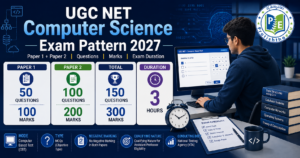
Understanding the UGC NET Computer Science Exam Pattern 2027 is an important step before starting intensive preparation. Once candidates know how the papers are organised, they can divide their study time between subject-specific concepts and Paper 1 more effectively.
UGC NET is conducted by the National Testing Agency (NTA) in Computer-Based Test (CBT) mode. The examination consists of Paper 1 and Paper 2, and performance in both papers contributes to the overall result for eligibility categories.
For Computer Science candidates, Paper 2 focuses on Computer Science and Applications, while Paper 1 assesses teaching and research aptitude.
UGC NET Computer Science Paper 1
Paper 1 is common to candidates across UGC NET subjects. It is designed to assess abilities related to teaching aptitude, research aptitude, reasoning, comprehension, communication, data interpretation, information and communication technology, and other general areas.
Although Paper 1 is not specific to Computer Science, candidates should not ignore it during preparation. A strong performance in Paper 1 can contribute significantly to the overall score.
Important Areas Covered in Paper 1
Candidates generally need to prepare areas such as:
- Teaching Aptitude
- Research Aptitude
- Comprehension
- Communication
- Mathematical Reasoning and Aptitude
- Logical Reasoning
- Data Interpretation
- Information and Communication Technology
- People, Development and Environment
- Higher Education System
Candidates should study these areas systematically instead of trying to complete them immediately before the examination.
UGC NET Computer Science Paper 2
Paper 2 is the subject-specific paper for candidates appearing in Computer Science and Applications. It tests the candidate’s knowledge of computer science concepts and related theoretical and practical areas.
The official NTA material identifies Computer Science and Applications as Subject Code 087.
Paper 2 is therefore the most important subject-focused component of UGC NET Computer Science Preparation 2027. Candidates should devote substantial preparation time to understanding the syllabus, practising questions, and revising important concepts.
The subject covers multiple areas of Computer Science, so candidates should avoid preparing only the topics they find comfortable. A balanced approach across the complete syllabus is more useful.
UGC NET Computer Science Exam Pattern: Paper 1 vs Paper 2
| Particular | Paper 1 | Paper 2 |
| Nature | General | Subject-specific |
| Subject | Teaching & Research Aptitude | Computer Science and Applications |
| Questions | 50 | 100 |
| Marks | 100 | 200 |
| Focus | General aptitude | Computer Science concepts |
| Subject Code | Common Paper | 087 for Computer Science and Applications |
Candidates should verify the latest official examination information before the 2027 examination because NTA may update examination-related details through its official notifications.
Number of Questions and Total Marks
The UGC NET examination pattern includes 50 questions in Paper 1 and 100 questions in Paper 2, giving candidates a total of 150 questions across both papers.
Paper 1 carries 100 marks, while Paper 2 carries 200 marks. Therefore, the combined examination carries 300 marks.
This distribution shows why candidates should give substantial attention to Paper 2 while maintaining consistent preparation for Paper 1.
Examination Duration
UGC NET is conducted as a three-hour examination, with Paper 1 and Paper 2 completed within the same examination session rather than as separate three-hour tests.
Candidates should therefore practise managing their time across both papers. Spending too much time on a difficult Computer Science question can reduce the time available for easier questions later.
A good strategy is to develop the habit of identifying questions that can be answered quickly and returning to difficult questions after completing the more manageable ones.
Marking Scheme
The marking scheme is an important part of UGC NET Computer Science Exam Preparation because candidates need to understand how correct and incorrect responses affect their performance.
Candidates receive marks for correct responses according to the prescribed marking scheme. They should read the instructions provided for their examination carefully and follow the latest official rules.
Is There Negative Marking in UGC NET Computer Science?
Candidates should pay particular attention to the latest official examination instructions regarding marking. The marking scheme applicable to the examination should be verified from the official NTA notification for the relevant examination cycle.
Rather than making assumptions based on older exams or other competitive examinations, candidates should check the latest official examination information before the test.
How to Prepare According to the Exam Pattern
Knowing the examination pattern is useful only when it is converted into a practical study plan. Candidates preparing for UGC NET Computer Science 2027 can divide their preparation into three major areas: Paper 1, Computer Science concepts, and question practice.
Give Consistent Time to Paper 1
Paper 1 should not be left entirely for the final weeks. Candidates can study one or two Paper 1 topics regularly alongside their Computer Science preparation.
This approach can help reduce the pressure of completing the entire general aptitude syllabus at the end.
Focus Strongly on Paper 2
Since Paper 2 contains 100 subject-specific questions, candidates should devote substantial time to Computer Science concepts.
The preparation should include conceptual study, problem-solving, previous year questions, and revision.
Practise Questions Regularly
Reading theory alone is not enough for an objective examination. Candidates should regularly solve practice questions to understand how concepts are tested.
Question practice can also reveal which topics need additional revision.
Improve Time Management
Candidates should practise solving questions within a limited time. During mock tests, they should monitor how much time they spend on individual questions.
If a question requires excessive calculation or lengthy reasoning, candidates can consider moving ahead and returning to it later, depending on the examination interface and instructions.
Why Understanding the Exam Pattern Matters
A clear understanding of the UGC NET Computer Science Exam Pattern 2027 helps candidates create a realistic preparation schedule.
Instead of treating the entire examination as one large syllabus, candidates can divide their preparation into:
Paper 1 → General aptitude preparation
Paper 2 → Computer Science subject preparation
PYQs → Question-pattern analysis
Mock Tests → Speed and accuracy improvement
Revision → Long-term retention
This structured approach can make preparation more organised and help candidates identify weaknesses before the actual examination.
The next major step is to understand the complete UGC NET Computer Science Syllabus 2027 and study each unit systematically. Knowing the syllabus in detail will help candidates identify important concepts, plan their study schedule, and decide which topics require more practice.
UGC NET Computer Science Syllabus 2027
The UGC NET Computer Science Syllabus 2027 is the most important part of the preparation process because Paper 2 covers the subject-specific knowledge required for Computer Science and Applications. Before selecting books or creating a daily timetable, candidates should go through the complete syllabus and understand the major concepts included in each unit.
The official NTA material identifies Computer Science and Applications as Subject Code 087. Candidates should always compare the syllabus used for preparation with the latest official syllabus or examination notification available from NTA before the examination.
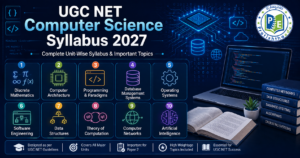
UGC NET Computer Science Syllabus: Unit-Wise Overview
The Computer Science and Applications syllabus covers a broad combination of theoretical concepts, programming, mathematical foundations, computer systems, databases, networking, software development, and emerging areas. A unit-wise approach can make this large syllabus easier to organise and revise.
Unit 1 – Discrete Structures and Optimization
This area focuses on the mathematical and logical foundations required in Computer Science. Candidates should develop a clear understanding of concepts related to discrete mathematics, logic, sets, relations, functions, graphs, trees and combinatorial methods.
Important areas may include:
- Mathematical logic
- Sets, relations and functions
- Graph theory
- Trees
- Boolean algebra
- Combinatorics
- Recurrence relations
- Algebraic structures
- Probability and statistics
- Optimization concepts
These topics are useful not only for direct questions but also for understanding several other areas of Computer Science.
Unit 2 – Computer System Architecture
Computer System Architecture deals with how computer systems are organised and how different hardware components work together.
Candidates should understand topics such as:
- Digital logic
- Data representation
- Computer arithmetic
- Register transfer and micro-operations
- CPU organisation
- Instruction sets
- Memory organisation
- Input-output organisation
- Pipelining
- Parallel processing
- Cache memory
- Multiprocessor systems
A strong understanding of architecture can also help candidates connect concepts from operating systems and computer organisation.
Unit 3 – Programming Languages and Computer Graphics
Programming-related concepts form another important part of the Computer Science syllabus. Candidates should understand programming language principles as well as the fundamentals of computer graphics.
Preparation may include:
- Programming language concepts
- Language paradigms
- Syntax and semantics
- Data types
- Control structures
- Functions and procedures
- Object-oriented programming concepts
- Exception handling
- Graphics primitives
- 2D and 3D transformations
- Viewing and clipping
- Curves and surfaces
- Computer graphics algorithms
Rather than memorising programming terminology, candidates should focus on understanding how different programming concepts work.
Unit 4 – Database Management Systems
Database Management Systems is an important area for candidates preparing for UGC NET Computer Science. It covers the principles used to organise, store, retrieve, and manage data efficiently.
Important topics include:
- Database concepts and architecture
- Data models
- Relational databases
- Entity-relationship models
- Relational algebra
- SQL
- Functional dependencies
- Normalisation
- Transaction management
- Concurrency control
- Database recovery
- Distributed databases
Candidates should combine theoretical study with practical SQL and database problem-solving wherever possible.
Unit 5 – System Software and Operating System
This unit focuses on system-level software and the principles behind operating systems.
Candidates should study concepts such as:
- Assemblers
- Loaders and linkers
- Macro processors
- Compilers
- Operating-system structure
- Processes and threads
- CPU scheduling
- Process synchronisation
- Deadlocks
- Memory management
- Virtual memory
- File systems
- Input-output systems
- Security and protection
Operating System questions can require conceptual clarity, so candidates should practise problems involving scheduling, memory management and related concepts instead of relying only on theoretical notes.
Unit 6 – Software Engineering
Software Engineering focuses on systematic approaches to software development, maintenance and quality management.
Major areas include:
- Software development life cycle
- Software process models
- Requirements engineering
- Software design
- Software testing
- Software maintenance
- Project management
- Software metrics
- Quality assurance
- Risk management
- Configuration management
- Agile development concepts
Candidates should understand the differences between major development models and know how software engineering practices are applied throughout the development life cycle.
Unit 7 – Data Structures and Algorithms
Data Structures and Algorithms is a fundamental area of Computer Science and requires both conceptual understanding and regular problem-solving practice.
Important topics include:
- Arrays
- Linked lists
- Stacks
- Queues
- Trees
- Binary search trees
- Heaps
- Graphs
- Hashing
- Searching
- Sorting
- Algorithm analysis
- Complexity analysis
- Divide and conquer
- Greedy algorithms
- Dynamic programming
- Backtracking
Candidates should practise algorithms regularly and understand their time and space complexity. Solving questions repeatedly can help improve speed and accuracy.
Unit 8 – Theory of Computation and Compilers
This unit covers the theoretical foundations of computation and the basic principles involved in translating programming languages.
Candidates should focus on:
- Formal languages
- Finite automata
- Regular expressions
- Regular languages
- Context-free grammars
- Pushdown automata
- Turing machines
- Computability
- Decidability
- Compiler phases
- Lexical analysis
- Syntax analysis
- Semantic analysis
- Intermediate code generation
- Code optimisation
This section can initially seem theoretical, but regular practice with automata, grammars and related problems can make the concepts easier to understand.
Unit 9 – Computer Networks
Computer Networks deals with communication between computer systems and the protocols used to exchange information.
Important areas include:
- Network architecture
- OSI and TCP/IP models
- Transmission media
- Data-link layer
- Error detection and correction
- Multiple access protocols
- Ethernet
- Routing
- IP addressing
- Transport protocols
- TCP and UDP
- Network security
- Application-layer protocols
- Wireless networks
Candidates should understand how protocols operate and how different networking layers interact rather than memorising isolated definitions.
Unit 10 – Artificial Intelligence
Artificial Intelligence covers concepts related to intelligent systems, problem-solving, knowledge representation and learning.
Important areas include:
- Introduction to Artificial Intelligence
- Problem-solving techniques
- State-space representation
- Knowledge representation
- Reasoning
- Expert systems
- Machine learning concepts
- Neural networks
- Natural language processing
- Pattern recognition
- Intelligent agents
Candidates should also keep an eye on developments in AI while preparing, but the examination preparation should remain focused on the concepts included in the applicable official syllabus.
How to Study the UGC NET Computer Science Syllabus 2027
Completing the syllabus should not simply mean reading every topic once. Candidates should divide each unit into smaller topics and maintain a systematic revision cycle.
A practical approach is to first identify the topics they already understand well and the areas that require additional study. After completing a topic, candidates can solve relevant questions and record mistakes in a separate revision notebook.
The syllabus can also be divided into three preparation categories:
Concept-based topics:
Focus on understanding definitions, principles and theoretical relationships.
Problem-solving topics:
Practise algorithms, mathematical problems, databases, automata and other question-based areas regularly.
Revision-heavy topics:
Create concise notes for terminology, classifications, models, protocols and important theoretical concepts.
This approach can make UGC NET Computer Science Preparation 2027 more organised and reduce the pressure of revising the entire syllabus at the last moment.
Candidates should also avoid assuming that one or two familiar units are enough to perform well. Since Paper 2 covers the subject broadly, preparation should eventually include all major syllabus areas.
The next step after understanding the syllabus is to identify the UGC NET Computer Science Important Topics 2027 and determine which concepts deserve greater attention during preparation and revision.
UGC NET Computer Science Important Topics 2027
After understanding the complete syllabus, the next step is to identify the UGC NET Computer Science Important Topics 2027 that require regular practice and revision. Candidates should not depend only on a short list of “most important” topics because the examination can test concepts from different parts of the syllabus.
A better approach is to understand every unit and then give additional practice time to topics that require more conceptual understanding, numerical problem-solving, algorithms, or repeated revision.
Important Topics for UGC NET Computer Science 2027
Discrete Structures and Optimization
Discrete Structures provides the mathematical foundation for several Computer Science concepts. Candidates should develop strong fundamentals in logic, sets, relations, functions, graphs and combinatorial concepts.
Important areas to focus on include:
- Mathematical logic
- Propositional and predicate logic
- Sets and relations
- Functions
- Graph theory
- Trees
- Boolean algebra
- Combinatorics
- Recurrence relations
- Probability
- Optimization techniques
Candidates should practise numerical and logical problems regularly because understanding the concept alone may not be enough to solve objective questions quickly.
Computer System Architecture
Computer architecture requires candidates to understand how different components of a computer system operate and communicate with each other.
Important topics include:
- Number systems and data representation
- Boolean logic
- Digital circuits
- CPU organisation
- Instruction formats
- Addressing modes
- Memory hierarchy
- Cache memory
- Virtual memory
- Input-output organisation
- Pipelining
- Parallel processing
Questions from architecture can involve both conceptual knowledge and problem-solving. Candidates should therefore practise calculations and diagrams alongside theoretical study.
Programming Languages and Computer Graphics
Programming language concepts require an understanding of how programming languages are designed and how their components behave.
Candidates should focus on:
- Programming paradigms
- Syntax and semantics
- Data types
- Control structures
- Functions
- Parameter passing
- Object-oriented programming
- Exception handling
- Language translation concepts
For Computer Graphics, important areas include:
- Graphics primitives
- Line and circle algorithms
- 2D transformations
- 3D transformations
- Viewing
- Clipping
- Curves
- Surfaces
- Rendering concepts
Candidates should solve programming and graphics-based questions regularly instead of limiting their preparation to theoretical definitions.
Database Management Systems
Database Management Systems is an important area of UGC NET Computer Science Preparation because it combines theoretical concepts with practical problem-solving.
Candidates should give particular attention to:
- Relational data models
- Entity-relationship models
- Relational algebra
- SQL
- Functional dependencies
- Normalisation
- Transaction management
- Concurrency control
- Serialisability
- Database recovery
- Distributed databases
SQL practice can be particularly useful because candidates need to understand how database operations work rather than simply memorising SQL commands.
Operating Systems
Operating Systems requires strong conceptual clarity and regular problem practice.
Important topics include:
- Processes and threads
- Process scheduling
- Inter-process communication
- Process synchronisation
- Semaphores
- Deadlocks
- Memory management
- Paging
- Segmentation
- Virtual memory
- File systems
- Disk scheduling
- Protection and security
Candidates should practise scheduling and memory-management problems repeatedly. Maintaining a small collection of solved examples can make revision easier before the examination.
Software Engineering
Software Engineering focuses on systematic software development and quality management.
Important topics include:
- Software development life cycle
- Software process models
- Waterfall model
- Incremental development
- Agile methodologies
- Requirements engineering
- Software design
- Software testing
- Software maintenance
- Software metrics
- Software quality
- Risk management
- Project management
Candidates should understand the differences between development models and know when different testing and development approaches are used.
Data Structures and Algorithms
Data Structures and Algorithms is one of the most practice-oriented areas of Computer Science.
Candidates should focus on:
- Arrays
- Linked lists
- Stacks
- Queues
- Trees
- Binary search trees
- Heaps
- Graphs
- Hashing
- Searching algorithms
- Sorting algorithms
- Recursion
- Algorithm complexity
- Divide and conquer
- Greedy algorithms
- Dynamic programming
- Backtracking
Time and space complexity deserve particular attention. Candidates should practise identifying the complexity of algorithms and comparing different approaches to solving a problem.
Theory of Computation and Compilers
Theory of Computation can become easier when candidates understand the relationship between different computational models.
Important topics include:
- Finite automata
- Regular expressions
- Regular languages
- Context-free grammars
- Pushdown automata
- Turing machines
- Computability
- Decidability
- Compiler phases
- Lexical analysis
- Syntax analysis
- Semantic analysis
- Intermediate code generation
- Code optimisation
Candidates should solve automata and grammar-based problems regularly because these concepts often require application rather than simple recall.
Computer Networks
Computer Networks is another major area where conceptual understanding and protocol-based knowledge are both important.
Candidates should focus on:
- OSI model
- TCP/IP model
- Network topologies
- Transmission media
- Data-link layer
- Error detection
- Error correction
- Multiple access protocols
- Ethernet
- Routing algorithms
- IP addressing
- IPv4 and IPv6
- TCP and UDP
- Network security
- Application-layer protocols
Candidates should understand how different layers work together and how protocols perform specific functions.
Artificial Intelligence
Artificial Intelligence is an important modern area of Computer Science and should be prepared systematically.
Important topics include:
- Intelligent agents
- Problem-solving
- State-space representation
- Search techniques
- Knowledge representation
- Reasoning
- Expert systems
- Machine learning fundamentals
- Neural networks
- Natural language processing
- Pattern recognition
Candidates should focus on the fundamental concepts included in the syllabus rather than trying to cover every new development in artificial intelligence.
How to Prioritise Important Topics
Candidates should avoid creating a preparation strategy based entirely on assumptions about which topics will have the highest number of questions. Instead, use a combination of the official syllabus, previous year questions, personal strengths and regular mock-test performance.
A useful priority system can be:
Priority 1 – Weak and Concept-Heavy Topics
Start with topics that you find difficult and that require significant practice. Studying these earlier gives you more time for revision.
Priority 2 – Frequently Practised Topics
Topics that repeatedly appear in your previous year question practice should receive regular revision.
Priority 3 – Strong Topics
Do not completely ignore topics you already understand. Instead, use periodic revision and practice questions to maintain accuracy.
How Previous Year Questions Help Identify Important Topics
Previous year questions can help candidates understand how theoretical concepts are converted into objective questions. While past questions should never be treated as a guarantee of what will appear in the next examination, they are useful for identifying areas that deserve additional practice.
After solving a set of questions, candidates can maintain a simple record:
| Topic | Questions Attempted | Correct | Needs Revision |
| Data Structures | 20 | 16 | Yes |
| Operating Systems | 20 | 13 | Yes |
| DBMS | 20 | 18 | No |
| Computer Networks | 20 | 15 | Yes |
| Theory of Computation | 20 | 11 | Yes |
This type of analysis can make UGC NET Computer Science Preparation 2027 more personalised. Instead of spending equal time on every topic, candidates can identify where additional effort is actually required.
Common Mistakes While Selecting Important Topics
One common mistake is studying only the topics that appear easy. Another is relying completely on an unofficial list of “100% expected questions” or “guaranteed important topics.”
Candidates should also avoid skipping an entire unit simply because it seems difficult. A difficult topic can become manageable when divided into smaller concepts and practised consistently.
The best strategy is to use important topics as a priority tool, not as a replacement for the complete syllabus.
Once the important areas are identified, candidates can move towards creating a practical UGC NET Computer Science Preparation Strategy 2027 that combines syllabus coverage, concept building, question practice, mock tests, and revision.
UGC NET Computer Science Preparation Strategy 2027
A well-planned UGC NET Computer Science Preparation Strategy 2027 can help candidates cover the syllabus systematically while giving enough time to practice, revise and analyse their performance. Computer Science is a broad subject, so trying to complete everything at once can make preparation stressful. A better approach is to divide the syllabus into manageable units and follow a consistent study routine.
Preparation should focus on three major areas: conceptual understanding, question practice and revision. Candidates should also prepare Paper 1 alongside Paper 2 instead of leaving it entirely for the final stage.

Step 1 – Understand the Complete Syllabus
Before creating a timetable, go through the complete UGC NET Computer Science Syllabus 2027.
Make a list of all the units and divide them into smaller topics. Mark each topic according to your current understanding:
- Strong
- Average
- Needs improvement
This simple classification can help you decide where to spend more study time.
Candidates should also compare their preparation resources with the latest official syllabus so that they do not spend excessive time studying topics outside the examination requirements.
Step 2 – Create a Unit-Wise Study Plan
Once the syllabus is divided into units, create a realistic study schedule.
Instead of deciding to complete an entire subject in a few days, divide the work into smaller daily targets. For example, one day can focus on a specific concept from Operating Systems, followed by question practice and short revision.
A practical study routine can include:
| Activity | Purpose |
| Concept Study | Build understanding |
| Practice Questions | Test application |
| PYQs | Understand question patterns |
| Revision | Improve retention |
| Mock Tests | Improve speed and accuracy |
The exact number of study hours should depend on your existing knowledge, available preparation time and examination schedule.
Step 3 – Build Strong Computer Science Concepts
Conceptual clarity is especially important for UGC NET Computer Science because many questions require candidates to apply principles rather than simply recall definitions.
Focus on understanding:
- Why a particular algorithm works
- How a database operation is performed
- How an operating-system mechanism functions
- How network protocols communicate
- How different data structures behave
- How programming concepts are implemented
- How theoretical models represent computation
If a concept is difficult, break it into smaller parts and study each part separately.
Candidates should avoid moving to advanced topics without understanding the underlying fundamentals. Strong basics can make later topics much easier to approach.
Step 4 – Practise Programming and Numerical Problems
Computer Science preparation should not be limited to reading notes.
Candidates should regularly solve questions involving:
- Algorithms
- Data structures
- Complexity analysis
- Operating-system calculations
- Database queries
- Computer architecture
- Discrete mathematics
- Automata and grammars
- Computer networks
For programming-related topics, practise tracing code and understanding the output or behaviour of different programs.
Regular practice can improve both accuracy and speed, especially for topics where a candidate initially takes considerable time to reach the correct answer.
Step 5 – Solve UGC NET Computer Science Previous Year Questions
UGC NET Computer Science Previous Year Questions are useful for understanding how concepts are tested in the examination.
While solving PYQs, do not focus only on the final answer. Try to understand:
- Which concept was tested?
- Why is the correct option correct?
- Why are the other options incorrect?
- Was the question conceptual or application-based?
- Did you take too much time to solve it?
Maintain a separate record of questions that you answer incorrectly. Revisiting these mistakes during revision can be more useful than repeatedly solving only questions you already know.
Step 6 – Use Mock Tests Regularly
Mock tests are an important part of UGC NET Computer Science Preparation 2027 because they provide an opportunity to practise under examination-like conditions.
Candidates can begin with topic-wise tests and gradually move towards unit-wise and full-length tests.
A useful progression is:
Topic Test → Unit Test → Mixed Test → Full-Length Mock Test
After every mock test, spend time analysing the result.
Check:
- Accuracy
- Number of unanswered questions
- Time spent
- Weak topics
- Repeated mistakes
- Questions that required excessive time
Simply taking a large number of mock tests without analysing mistakes may not provide the same benefit as focused practice.
Step 7 – Analyse Your Mistakes
Mistake analysis should become a regular part of preparation.
Create a simple mistake notebook or digital document containing:
- Incorrect questions
- Correct answers
- Relevant concepts
- Reason for the mistake
- Short explanation
- Date of revision
For example, if you repeatedly make mistakes in CPU scheduling, do not simply memorise the correct answers. Revisit the scheduling concepts and solve several similar problems.
This approach helps convert mistakes into learning opportunities.
Step 8 – Revise Regularly
Revision is essential because the UGC NET Computer Science syllabus contains a large number of concepts.
Instead of waiting until the end, use multiple revision cycles.
First Revision
Revise the topic shortly after completing it.
Second Revision
Review the topic after completing the relevant unit.
Final Revision
Focus on short notes, formulas, concepts, important distinctions, and previously incorrect questions.
Candidates should keep their revision material concise. Creating extremely long notes can make final revision difficult.
How to Prepare Paper 1 Alongside Computer Science
Candidates should not completely ignore UGC NET Paper 1 while preparing for Paper 2.
A practical approach is to dedicate regular time to Paper 1 topics such as:
- Teaching Aptitude
- Research Aptitude
- Logical Reasoning
- Mathematical Reasoning
- Data Interpretation
- Communication
- ICT
- Comprehension
- People and Environment
- Higher Education System
Even a consistent short study session can help candidates maintain continuity with Paper 1 preparation.
How to Manage Your Daily Study Routine
A balanced daily routine can include four basic activities:
Concept Learning → Question Practice → Paper 1 → Revision
For example, a candidate with several hours available for preparation could divide the day between a major Computer Science topic, practice questions, Paper 1 and revision.
The exact schedule should be personalised rather than copied from another student’s timetable.
Candidates preparing alongside college, work or other responsibilities should create smaller but achievable daily targets instead of following an unrealistic schedule.
How to Use Study Resources Effectively
Using too many books, notes and online resources can create confusion. Candidates should select a limited number of reliable resources and complete them systematically.
A useful resource strategy includes:
- One primary source for concepts
- One reliable question source
- Previous year papers
- Mock tests
- Short revision notes
- Official examination information
Candidates can also explore relevant Study Material resources for additional preparation support, but they should ensure that the material matches the applicable syllabus.
Final Preparation Approach
As the examination approaches, candidates should shift gradually from learning new concepts to revision and practice.
During the final stage, focus on:
- Complete syllabus revision
- Previous year questions
- Mock-test analysis
- Weak-topic revision
- Important formulas and concepts
- Short notes
- Time-management practice
Avoid continuously changing study resources during the final phase. A consistent revision strategy is generally more useful than repeatedly starting new books or courses.
UGC NET Computer Science Previous Year Questions, Mock Tests, Books & Study Material
After completing the basic concepts and following a structured UGC NET Computer Science Preparation Strategy 2027, candidates should focus on practice. Previous year questions, mock tests and carefully selected study material can help candidates understand how different Computer Science concepts are tested in the examination.
Preparation becomes more effective when candidates combine conceptual learning with regular question-solving. Instead of simply reading the syllabus repeatedly, use practice sessions to identify weak areas and then return to those concepts for revision.
UGC NET Computer Science Previous Year Questions
Solving UGC NET Computer Science Previous Year Questions can help candidates understand the style and level of questions asked in the examination. PYQs can also show how a familiar concept may be presented in different ways.
Candidates should solve previous year questions after completing the relevant topics rather than waiting until the end of preparation.
For example, after completing Data Structures, candidates can solve questions related to:
- Trees
- Graphs
- Searching
- Sorting
- Hashing
- Complexity analysis
- Stacks and queues
Similarly, after studying Operating Systems, candidates can practise questions related to process scheduling, deadlocks, memory management and file systems.
Why Are Previous Year Questions Important?
PYQs can help candidates:
- Understand question patterns
- Identify frequently tested concepts
- Improve problem-solving speed
- Find weak areas
- Practise applying theoretical concepts
- Become familiar with objective-type questions
However, previous year questions should not be treated as a prediction of the exact questions that will appear in the next examination. Their main purpose is to improve understanding and practice.
How to Analyse Previous Year Questions
Do not simply check whether your answer is correct.
After every practice session, ask:
- Which topic was tested?
- Did I understand the concept?
- Why was my answer wrong?
- Was the mistake due to a knowledge gap or calculation error?
- Did I spend too much time on the question?
- Should this topic be added to my revision list?
This method turns PYQ practice into a learning activity rather than just an assessment.
UGC NET Computer Science Mock Tests
Mock tests are useful for improving speed, accuracy and examination readiness. Candidates should gradually move from smaller topic-based tests to complete examination-style tests.
A practical progression can be:
Topic-wise Test → Unit-wise Test → Mixed Test → Full-Length Mock Test
Initially, candidates can use shorter tests to check their understanding. After completing most of the syllabus, full-length tests can be included more regularly.
How Many Mock Tests Should You Attempt?
There is no fixed number of mock tests that every candidate must complete. Quality and analysis are more important than simply increasing the number.
After every mock test, analyse:
- Total score
- Correct answers
- Incorrect answers
- Unattempted questions
- Time taken
- Weak units
- Repeated mistakes
If a candidate completes many mock tests but does not analyse mistakes, the benefit of additional tests may be limited.
How to Improve Accuracy Through Mock Tests
Accuracy improves when candidates understand why they make mistakes.
If you repeatedly answer questions incorrectly from a particular area, return to that topic before taking another test.
For example, if several mock tests show difficulty with Theory of Computation, revisit finite automata, regular expressions, grammars or Turing machines and then practise targeted questions.
This creates a continuous cycle:
Test → Analyse → Identify Weakness → Revise → Practise Again
Best Books and Resources for UGC NET Computer Science
Candidates do not necessarily need a large collection of books to prepare for UGC NET Computer Science 2027. Too many resources can make preparation confusing and increase the amount of unfinished material.
A better approach is to select resources according to their purpose.
Concept-Based Resources
Use a reliable source for understanding Computer Science concepts in depth. The resource should cover the applicable syllabus and explain difficult concepts clearly.
Previous Year Question Resources
Use a dedicated PYQ resource to practise questions from earlier examinations and analyse the concepts behind them.
Mock Test Resources
Choose mock tests that provide explanations and performance analysis rather than focusing only on the final score.
Revision Notes
Create short notes while studying. These can include:
- Important definitions
- Algorithms
- Formulas
- Comparisons
- Short explanations
- Common mistakes
- Frequently revised concepts
These notes can become particularly useful during the final revision period.
How to Choose UGC NET Computer Science Study Material
Good UGC NET Computer Science Study Material should be aligned with the syllabus and should help candidates understand concepts rather than simply provide large amounts of information.
Before using any study resource, check whether:
- It follows the relevant syllabus
- Concepts are explained clearly
- Practice questions are included
- Previous year questions are available
- Answers have proper explanations
- The material is regularly updated
- The content does not unnecessarily go beyond the examination requirements
Candidates should also compare their study material with the latest official syllabus to ensure that important topics are not missed.
Along with digital study resources, students can also maintain a consistent study routine in a dedicated learning environment. Pratishtha Library can be considered by students who prefer a focused space for regular study, revision and mock-test practice.
How to Make Effective Revision Notes
Revision notes should be short enough to review quickly.
For theoretical subjects, candidates can create comparison tables. For technical topics, flowcharts and diagrams can make revision easier.
For example, while studying operating systems, notes can include comparisons between different scheduling algorithms. While studying Computer Networks, candidates can create a compact summary of important protocols and their functions.
For Data Structures and Algorithms, notes can include:
- Algorithm name
- Main purpose
- Time complexity
- Space complexity
- Advantages
- Limitations
The goal is not to rewrite the textbook. The goal is to create a quick revision resource.
Avoid Using Too Many Study Resources
One of the common mistakes during competitive examination preparation is continuously switching between books, videos, notes and online courses.
Candidates may start one resource, move to another after finding a difficult topic and then begin a third resource without completing either of the first two.
A better approach is to select a small number of dependable resources and complete them properly.
If a particular concept is difficult, use an additional explanation only for that concept rather than replacing your entire preparation system.
Create a Personal Weak-Topic List
Every candidate has different strengths and weaknesses. Therefore, your preparation should be based partly on your own performance.
Create a list such as:
| Area | Current Level | Action |
| Data Structures | Strong | Regular revision |
| DBMS | Good | Practise PYQs |
| Operating Systems | Average | More problem practice |
| Theory of Computation | Weak | Relearn concepts |
| Computer Networks | Average | Solve more questions |
Update this list after mock tests and practice sessions.
This helps candidates spend more time where it is actually required rather than following the same study schedule throughout the preparation period.
Combining PYQs, Mock Tests and Revision
The strongest practice strategy is not to use these resources separately.
Instead, combine them:
Study a Topic → Solve PYQs → Take a Topic Test → Analyse Mistakes → Revise → Repeat
After completing several units:
Take a Mixed Mock → Analyse Performance → Identify Weak Units → Revise Weak Areas
This process can make UGC NET Computer Science Preparation 2027 more systematic and measurable.
Candidates can also maintain a simple progress tracker showing completed units, PYQs solved, mock-test scores and topics requiring revision.
UGC NET Computer Science Career Opportunities
Qualifying UGC NET Computer Science 2027 can open opportunities in teaching, research and higher education. However, the career path depends on the category in which a candidate qualifies, academic qualifications, institutional requirements and the rules applicable at the time of recruitment or admission.
UGC NET should therefore be viewed not only as an examination but also as an opportunity to build a long-term academic and research career.

Assistant Professor and Teaching Opportunities
One of the major opportunities associated with UGC NET is eligibility for Assistant Professor positions, subject to the recruitment rules of the concerned university, college or institution.
Candidates interested in teaching Computer Science can develop careers in areas such as:
- Computer Science
- Computer Applications
- Information Technology
- Programming
- Data Structures and Algorithms
- Database Management
- Computer Networks
- Artificial Intelligence
- Software-related subjects
Qualifying UGC NET does not automatically guarantee a teaching position. Candidates must apply for relevant vacancies and satisfy the recruitment criteria specified by the concerned institution.
Junior Research Fellowship
Candidates who qualify for Junior Research Fellowship (JRF) can pursue research-oriented academic opportunities subject to the applicable rules.
JRF can be particularly useful for candidates interested in:
- Computer Science research
- Artificial Intelligence
- Machine Learning
- Data Science
- Computer Networks
- Cybersecurity
- Database systems
- Software Engineering
- Theoretical Computer Science
- Human-computer interaction
Research interests can gradually become more specialised as candidates progress towards doctoral-level study.
PhD and Research Opportunities
Candidates interested in higher education and research may consider pursuing a PhD after qualifying through the applicable UGC NET category.
A research career requires more than examination preparation. Candidates should develop:
- Research skills
- Academic writing skills
- Problem-solving ability
- Programming skills
- Analytical thinking
- Knowledge of research methodology
- Ability to study research papers
- Interest in a specific Computer Science domain
Candidates should check the admission and eligibility requirements of individual universities because PhD admission procedures can vary between institutions.
Career Growth After UGC NET Computer Science
UGC NET can serve as an important academic qualification, but long-term career growth also depends on continuous learning.
Computer Science is a rapidly developing field, so candidates can strengthen their professional profile by developing knowledge in areas such as:
- Artificial Intelligence
- Machine Learning
- Cloud Computing
- Cybersecurity
- Data Science
- Big Data
- Internet of Things
- Blockchain
- Software Development
The right area depends on the candidate’s academic background and career goals.
Frequently Asked Questions About UGC NET Computer Science 2027
What is UGC NET Computer Science?
UGC NET Computer Science and Applications is a subject-specific UGC NET examination paper for candidates seeking eligibility under the applicable UGC NET categories. The subject is identified by its prescribed subject code in the official NTA subject list.
What is the UGC NET Computer Science subject code?
The subject code for Computer Science and Applications is 087 in the official UGC NET subject list. Candidates should verify the current subject list before submitting their application.
Is UGC NET Computer Science difficult?
The difficulty level depends on a candidate’s academic foundation, preparation strategy and familiarity with the syllabus.
Computer Science includes several technical and theoretical areas, so candidates may find some units more challenging than others. Consistent concept study, PYQ practice, mock tests and revision can make preparation more manageable.
How should I prepare for UGC NET Computer Science?
Start by understanding the complete syllabus and examination pattern. Then create a unit-wise study plan, build strong concepts, solve previous year questions, take mock tests and revise regularly.
Candidates should also analyse their mistakes instead of focusing only on their test scores.
Is Paper 1 important for UGC NET Computer Science?
Yes. Paper 1 is a common component of the UGC NET examination and tests areas related to teaching and research aptitude and other general abilities.
Candidates should prepare Paper 1 consistently alongside Computer Science rather than leaving it entirely for the final stage.
Are previous year questions important?
Yes. UGC NET Computer Science Previous Year Questions can help candidates understand how concepts are tested and identify areas where additional practice may be required.
However, candidates should not assume that the same questions will be repeated.
What study material should I use for UGC NET Computer Science?
Candidates should use study material that follows the applicable syllabus and provides clear explanations, practice questions and revision support.
It is better to complete a limited number of reliable resources properly than to collect a large number of incomplete resources.
What career opportunities are available after UGC NET Computer Science?
Depending on the qualification category and applicable institutional requirements, candidates may explore opportunities related to teaching, research, JRF and higher academic studies. Candidates can also strengthen their career profile by developing specialised Computer Science skills.
Final Thoughts on UGC NET Computer Science 2027
Preparing for UGC NET Computer Science 2027 requires a combination of conceptual understanding, systematic syllabus coverage, regular practice and consistent revision.
Candidates should begin by understanding the eligibility criteria and examination pattern before moving to the complete syllabus. After that, a unit-wise preparation strategy can help organise the study process.
Regularly solving UGC NET Computer Science Previous Year Questions, attempting mock tests and analysing mistakes can improve both accuracy and confidence. At the same time, candidates should avoid depending entirely on predictions about important questions and should aim to cover the complete syllabus.
For additional academic support, candidates can explore suitable UGC NET Study Material and maintain a structured revision routine. A focused preparation approach, combined with consistent practice, can help candidates move towards their UGC NET goals with greater clarity.
Most importantly, candidates should keep checking official NTA updates for the latest examination information, syllabus, eligibility conditions and application instructions.
Leave a Reply