
Choosing Science after Class 10 is an important academic decision. Class 11 is not simply the next step after school; it is the stage where students begin studying concepts in greater depth and develop the academic foundation required for higher studies and competitive examinations. Subjects such as Physics, Chemistry, Mathematics and Biology require students to understand concepts clearly rather than depend only on memorisation.
For many students, the transition from Class 10 to Class 11 Science can initially feel challenging. The syllabus becomes more detailed, questions become more analytical, and students need to manage multiple subjects along with regular revision and practice. This is where an 11th Science Foundation can help students build strong fundamentals from the beginning.
A well-planned 11th Science Foundation Course focuses on conceptual understanding, regular practice, revision, and problem-solving skills. It can also help students prepare for future academic goals, such as board examinations, JEE, NEET, and other entrance examinations.
Students looking for structured 11th Science Preparation should first understand what foundation learning actually means, why Class 11 is important, and how a systematic approach can make Science subjects easier to manage.
What Is 11th Science Foundation?
An 11th Science Foundation is a structured learning approach designed to help students build a strong conceptual base in Class 11 Science subjects. Instead of focusing only on completing the school syllabus, foundation learning aims to make students comfortable with the fundamental concepts that they will use in Class 11, Class 12, and, depending on their goals, future competitive examinations.
The foundation approach generally combines classroom or online learning, concept explanation, practice questions, revision and assessment. The exact structure can vary from one 11th Science Foundation Course to another, so students should understand what a course actually provides before making a decision.
Class 11 introduces students to several concepts that become important in later academic stages. For example, Physics requires students to understand mathematical relationships and apply concepts to numerical problems. Chemistry introduces students to physical, organic and inorganic concepts in greater depth, while Mathematics requires consistent practice and logical thinking. Biology involves understanding detailed concepts, terminology and processes.
A strong foundation helps students approach these subjects systematically instead of trying to study everything immediately before examinations.
What Does Class 11 Science Foundation Include?
A good Class 11 Science Foundation approach generally focuses on four important areas:
- Conceptual Understanding
Students first need to understand the meaning and application of a concept. Learning formulas or definitions without understanding their use can make advanced questions difficult. Foundation learning therefore places emphasis on explaining concepts in a simple and structured manner.
- Regular Practice
Science subjects require continuous practice. Physics and Mathematics involve numerical problem-solving, while Chemistry and Biology also require students to practise different types of questions. Regular practice helps students identify their weak areas and improve gradually.
- Revision and Retention
Students often understand a chapter when it is taught but struggle to remember it after several weeks. Regular revision helps strengthen learning and makes it easier to recall concepts during tests and examinations.
- Assessment and Improvement
Tests and practice exercises help students understand their progress. Instead of waiting until the final examination, students can identify difficult topics early and work on them with a proper study plan.
Why Is Class 11 Science So Important?
Class 11 is a major transition point for students who choose Science. The academic level is generally more detailed than Class 10, and students are expected to understand concepts and apply them to different types of questions.
This is why starting 11th Science Preparation with a clear strategy can be beneficial. Students who develop consistent study habits in Class 11 can find it easier to manage the Class 12 syllabus later.
Another important reason is that many concepts introduced in Class 11 are connected with higher-level topics. A weak understanding of fundamental concepts can make subsequent chapters more difficult, while strong basics can provide a better starting point for advanced learning.
Students who are planning to appear for competitive examinations should also pay attention to their Class 11 concepts. For example, students preparing for engineering or medical entrance examinations need to develop a strong understanding of Physics, Chemistry, Mathematics or Biology according to their chosen pathway.
Therefore, 11th Science Foundation Coaching can be considered by students who want additional academic structure, regular practice and guided preparation alongside their school studies.
Who Should Consider an 11th Science Foundation Course?
An 11th Science Foundation Course may be useful for students who want structured preparation from the beginning of Class 11.
It can be particularly relevant for:
- Students who have recently completed Class 10 and are entering Class 11 Science.
- Students who want to strengthen their basic concepts in Physics, Chemistry, Mathematics or Biology.
- Students who find the transition from Class 10 to Class 11 challenging.
- Students who want a regular study schedule instead of depending only on self-study.
- Students who want additional practice and assessment.
- Students who are planning long-term preparation for JEE, NEET or other competitive examinations.
- Students who want to improve their academic performance through consistent revision and problem-solving.
However, joining a foundation course is not a substitute for regular school learning. Students should continue attending school, studying their prescribed syllabus and using reliable resources for their preparation.
Students can also use 11th Science Study Material along with their classroom learning to revise concepts, practise questions and strengthen difficult topics.
11th Science Foundation for Long-Term Academic Preparation
One of the biggest advantages of starting foundation preparation in Class 11 is that students get more time to understand concepts instead of rushing through them before examinations.
A student who studies consistently can divide preparation into smaller goals. For example, instead of trying to complete an entire subject in a short period, students can study individual chapters, practise questions, revise important concepts and take periodic tests.
This approach can be useful for both board-level academics and future competitive preparation. The exact requirements, syllabus and examination pattern for competitive examinations can change, so students should always check the latest information on the relevant official examination websites.
For students interested in engineering or medical entrance examinations, official information from the National Testing Agency (NTA) can be used to understand current examination-related requirements.
At the same time, students should not ignore their school curriculum. A balanced preparation strategy should combine classroom learning, textbook study, conceptual practice, revision and additional preparation according to the student’s academic goals.
What Makes a Strong 11th Science Foundation?
A strong foundation is not about studying for extremely long hours. It is about learning consistently and understanding concepts properly.
Students should focus on:
- Understanding concepts before memorising them.
- Maintaining regular study hours.
- Practising questions after completing each topic.
- Revising previously studied chapters.
- Keeping track of difficult concepts.
- Asking questions whenever a concept is unclear.
- Taking regular tests to measure progress.
- Maintaining a balance between school studies and additional preparation.
Students can also explore academic and competitive exam preparation resources to find useful study materials and guidance according to their individual requirements.
The goal of foundation preparation should be to make students more confident and independent learners. When the basics are clear, students can gradually move towards more advanced questions and higher-level preparation.
In the next part, we will look at the importance of 11th Science Foundation in detail, including how it can support board preparation, concept building, problem-solving skills and the foundation required for future competitive examinations.
Why Is 11th Science Foundation Important?
Class 11 is one of the most important stages in a student’s academic journey, especially for students who choose the Science stream. The concepts introduced during this year are more detailed and require a different approach compared with Class 10. Students need to understand theories, apply formulas, solve problems, and revise topics regularly.
This is why a structured 11th Science Foundation can be helpful for students who want to develop strong academic fundamentals from the beginning.
Foundation preparation is not only about completing chapters. It is about developing the ability to understand concepts, connect different topics and apply knowledge to questions. When students develop these skills early, they can approach Class 12 studies and future entrance examinations with greater confidence.
Building Strong Concepts from Class 11
One of the biggest benefits of foundation preparation is that it gives students an opportunity to focus on concepts instead of studying only for marks.
For example, in Physics, students may encounter concepts involving motion, force, work, energy and mathematical relationships. Understanding these concepts properly is important because later topics may require students to apply the same fundamentals in different situations.
Similarly, Chemistry requires students to understand basic principles, reactions, calculations and chemical properties. Mathematics requires regular practice and logical thinking, while Biology requires students to understand processes, terminology and relationships between different concepts.
A strong conceptual base can make these subjects easier to approach.
Students following a systematic 11th Science Preparation plan should therefore ask themselves whether they understand a topic rather than simply whether they have completed it.
Preparing for Board Examinations
Class 11 marks are important for academic development, but students should also use this year to develop habits that will help them in Class 12 board examinations.
Regular preparation can help students:
- Understand chapters before examination pressure increases.
- Complete the syllabus in a planned manner.
- Revise important concepts multiple times.
- Practise different question formats.
- Improve writing and problem-solving speed.
- Identify weak areas before final examinations.
Students should give appropriate importance to their prescribed textbooks and curriculum. For CBSE students, the latest information and curriculum should always be checked through the official CBSE website rather than relying on outdated information from third-party sources.
A good foundation approach complements school education instead of replacing it.
Developing Problem-Solving Skills
Science is not limited to reading and memorising information. Students often need to apply what they have learned to unfamiliar questions.
Physics and Mathematics especially require regular numerical practice. Chemistry also includes calculations and application-based questions, while Biology can require students to understand processes and interpret information carefully.
A structured 11th Science Foundation Course can provide students with opportunities to practise questions after learning a concept.
The process should generally follow:
Learn → Understand → Practise → Analyse Mistakes → Revise → Test Again
Repeating this cycle helps students gradually improve their problem-solving ability.
Creating a Consistent Study Routine
Many students face difficulty in Class 11 because they do not have a consistent study routine. They may study intensively for a few days and then leave their preparation for several days.
Consistency is more useful than occasional long study sessions.
A student can divide daily preparation into manageable sessions. For example, one session can be used for learning a new concept, another for solving questions and a shorter session for revision.
The exact timetable should depend on the student’s school schedule, learning speed and academic goals.
The purpose of an 11th Science Foundation Coaching program should be to provide additional structure and guidance, while students should continue developing independent study habits.
Benefits of Joining an 11th Science Foundation Course
Not every student needs the same type of support. Some students are comfortable with self-study, while others perform better with structured classes, regular tests, and guided preparation.
For students who prefer additional academic support, an 11th Science Foundation Course can provide several potential benefits.
1. Structured Learning
A structured course can help students study topics in a planned sequence instead of choosing chapters randomly.
This can be particularly useful when students are managing multiple Science subjects simultaneously.
2. Regular Practice
Students often understand a concept but do not practise enough questions. Regular practice can help convert theoretical understanding into practical problem-solving skills.
3. Doubt Resolution
Students may sometimes continue studying a chapter even when a basic concept is unclear. If doubts are addressed early, students can move forward with better understanding.
4. Periodic Assessment
Regular tests can help students measure their preparation. Marks are not the only purpose of a test; analysing incorrect answers is equally important.
Students should identify:
- Which questions were incorrect?
- Was the mistake conceptual or calculation-based?
- Did the student misunderstand the question?
- Was the answer affected by poor time management?
- Does the topic need additional revision?
This type of analysis can make testing more useful.
5. Better Revision Management
With multiple subjects and chapters, students can easily forget previously studied topics. A planned revision system can help maintain continuity.
Revision can include short notes, formula revision, important definitions, diagrams, practice questions and chapter-wise tests depending on the subject.
11th Science Foundation for JEE Preparation
Students who are planning to prepare for engineering entrance examinations should understand the importance of Class 11 concepts.
JEE preparation involves Physics, Chemistry, and Mathematics, and students need strong fundamentals before moving towards more advanced problem-solving.
A foundation approach can help students gradually develop:
- Conceptual understanding
- Numerical-solving ability
- Mathematical application
- Time management
- Accuracy
- Regular testing habits
However, students should not treat Class 11 foundation preparation as a guarantee of success in JEE. Competitive examinations require consistent preparation over time, proper understanding of the current syllabus and regular practice.
Students should always check the latest examination information from the JEE Main official website and follow the current requirements rather than depending on old preparation material.
The ideal approach is to strengthen Class 11 concepts first and gradually increase the difficulty level of questions.
11th Science Foundation for NEET Preparation
For students interested in medical education, Class 11 Biology and Chemistry concepts form an important part of their academic preparation. Physics also requires regular numerical practice.
A foundation approach can help NEET-oriented students build consistent study habits while continuing their school education.
Students should focus on:
- Understanding Biology concepts carefully.
- Revising important terminology and processes.
- Building Chemistry fundamentals.
- Practising Physics numericals regularly.
- Revising chapters at planned intervals.
- Taking periodic tests.
- Analysing mistakes after every test.
Students preparing for NEET should verify the latest examination information, syllabus and requirements from the official sources before planning their preparation.
A foundation course should therefore be viewed as a way to develop academic skills and strengthen fundamentals, not as a shortcut to examination success.
School Studies vs Foundation Coaching
A common question among Class 11 students is whether school studies and foundation coaching are different.
They serve different but complementary purposes.
School education generally follows the prescribed curriculum and provides the core academic instruction required for the student’s class.
Foundation coaching may provide additional explanation, structured practice, revision, tests, and academic guidance depending on the course.
Students do not necessarily have to choose one over the other. A balanced approach can involve attending school regularly, studying prescribed textbooks, completing school assignments and using foundation support for additional practice and conceptual strengthening.
This balance is especially important because students should avoid taking on an unnecessarily heavy study schedule.
How Parents Can Support Class 11, Science Students
Parents can also play an important role in helping students adjust to the Science stream.
Instead of focusing only on marks, parents can encourage students to develop consistent study habits and ask about areas where they need help.
Useful support can include:
- Providing a quiet study environment.
- Encouraging a realistic daily routine.
- Helping students maintain a balance between studies and rest.
- Discussing academic difficulties without unnecessary pressure.
- Encouraging regular revision.
- Supporting students in finding appropriate 11th Science Study Material.
- Monitoring progress without comparing the student constantly with others.
Every student has a different learning speed. A preparation strategy that works for one student may not work equally well for another.
What Should Students Focus on During the First Few Months of Class 11?
The beginning of Class 11 is an ideal time to establish good academic habits.
Students should focus on understanding the syllabus, organising their study material and creating a realistic routine.
During the initial months, students can prioritise:
Concept clarity: Understand every new chapter properly.
Regular practice: Solve questions soon after learning a topic.
Revision: Revisit older chapters instead of continuously moving forward.
Doubt solving: Do not allow unresolved doubts to accumulate.
Testing: Take small tests regularly instead of waiting for school examinations.
Time management: Learn how to divide time between different subjects.
Self-analysis: Identify subjects and topics that require additional attention.
Students who develop these habits early can gradually become more confident and independent learners.
Building a Strong Academic Foundation with the Right Resources
Good preparation requires more than attending classes. Students also need reliable learning resources that match their syllabus and preparation level.
Textbooks, class notes, practice questions, revision notes, and appropriate 11th Science Study Material can all contribute to effective preparation.
Students can also explore academic and competitive exam preparation resources to understand different learning options and plan their studies according to their goals.
The most important thing is to avoid collecting too many resources without actually studying them. One reliable textbook and a well-organised set of practice material can often be more useful than multiple resources that remain incomplete.
A strong Class 11 Science Foundation is ultimately built through consistency. Students who understand concepts, practise regularly, revise systematically and learn from their mistakes can develop a much stronger base for the academic years ahead.
In the next part, we will explore the major Class 11 Science subjects—Physics, Chemistry, Mathematics and Biology, what students generally study in each subject, and how they can approach each one effectively from the beginning.
11th Science Subjects: What Students Need to Study
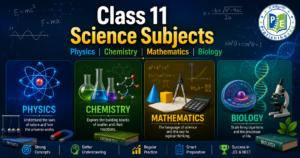
Choosing Science in Class 11 means moving from basic concepts towards more detailed and application-based learning. Students generally study subjects such as Physics, Chemistry, Mathematics and Biology depending on their chosen combination and academic goals.
Each subject requires a different preparation approach. Physics and Mathematics involve considerable numerical and logical practice, Chemistry requires a combination of conceptual understanding, calculations and memorisation, while Biology requires detailed understanding and regular revision.
A successful 11th Science Foundation approach should therefore not treat every subject in exactly the same way. Students should understand the nature of each subject and develop a study method accordingly.
Physics in Class 11
Physics is one of the subjects where students need to move beyond simply remembering formulas. The subject involves understanding physical concepts and applying them to numerical and real-world situations.
Topics introduced in Class 11 can help students develop an understanding of motion, forces, energy, matter and other fundamental physical principles. The exact syllabus and chapter structure can vary according to the board and curriculum, so students should always refer to their prescribed syllabus and textbook.
How to Study Physics in Class 11
Students beginning their 11th Science Preparation should focus on understanding the concept before attempting difficult questions.
A useful approach is:
Understand the concept → Learn the relevant formula → Understand the units → Solve basic questions → Practise application-based problems → Analyse mistakes
Students should avoid learning formulas without knowing when and how they should be applied.
For numerical problems, students can maintain a separate formula and concept notebook. However, simply collecting formulas is not enough. Each formula should be understood in terms of the quantities involved and the conditions under which it can be used.
Regular practice is especially important because Physics problems may appear different even when they are based on the same underlying concept.
Common Physics Mistakes
Students often make mistakes such as:
- Memorising formulas without understanding them.
- Skipping basic numerical questions.
- Ignoring units and dimensions.
- Moving to advanced questions before mastering fundamentals.
- Not analysing incorrect answers.
- Leaving difficult chapters for the end.
A consistent practice routine can help prevent these problems.
Students who are also planning for engineering entrance examinations can gradually increase the difficulty of their Physics questions after building their Class 11 fundamentals.
Chemistry in Class 11
Chemistry is a subject that combines conceptual learning, calculations and the understanding of chemical processes. Students may initially find it difficult because different areas of Chemistry require different learning techniques.
A good 11th Science Foundation Course should help students understand the basic principles before moving towards more complicated concepts.
How to Study Chemistry in Class 11
Students should first understand the basic terminology and principles used in each chapter.
For calculation-based topics, regular numerical practice is important. For conceptual topics, students should focus on understanding relationships between different concepts rather than memorising isolated statements.
Students can divide their Chemistry preparation into three broad learning approaches:
Concept-based learning: Understand principles and relationships.
Numerical practice: Solve calculations regularly and check each step.
Revision-based learning: Revise important reactions, properties, definitions and concepts at planned intervals.
The exact approach should depend on the chapter and the student’s learning requirements.
How to Make Chemistry Easier
Students can make Chemistry more manageable by:
- Reading the prescribed textbook carefully.
- Making short and organised notes.
- Practising numerical questions regularly.
- Revising important concepts after each chapter.
- Creating a separate section for difficult reactions or formulas where applicable.
- Solving chapter-wise questions.
- Reviewing mistakes after tests.
Students should avoid trying to memorise the entire subject in one sitting. Regular revision is much more effective for long-term retention.
Mathematics in Class 11
Mathematics is a subject where regular practice plays a major role. Understanding the method is important, but students also need to solve enough questions to become comfortable with different problem types.
Class 11 Mathematics introduces students to concepts that can require logical reasoning, algebraic manipulation, graphical understanding, and systematic problem-solving.
For students planning engineering entrance preparation, strong mathematical fundamentals can be particularly useful.
How to Study Mathematics in Class 11
The best way to approach Mathematics is through consistent practice.
A student can follow this pattern:
Understand the concept → Study solved examples → Solve basic questions → Attempt application-based questions → Review mistakes → Practise again
Students should not spend too much time simply reading Mathematics. The subject needs active problem-solving.
If a student is unable to solve a question, they should first identify where the difficulty occurred. Was the formula forgotten? Was the concept unclear? Was there a calculation mistake? Or was the question misunderstood?
Finding the reason behind a mistake is an important part of learning Mathematics.
Building Strong Mathematical Fundamentals
Students should focus on understanding rather than rushing through chapters.
Useful habits include:
- Solving questions regularly.
- Maintaining a record of difficult problems.
- Revising important formulas.
- Practising different question types.
- Avoiding unnecessary dependence on solutions.
- Reattempting questions that were previously incorrect.
- Taking timed practice tests.
Students preparing for competitive examinations can gradually introduce more challenging questions after becoming comfortable with the fundamental concepts.
Biology in Class 11
Biology is an important subject for students who choose a medical or life-science-oriented academic pathway. Unlike Mathematics, Biology generally requires students to understand a large amount of detailed information and retain it accurately.
However, Biology should not be treated as a subject based entirely on memorisation. Understanding processes, relationships and scientific concepts can make revision easier.
How to Study Biology in Class 11
Students should begin with their prescribed textbook and focus carefully on the concepts, terminology, diagrams and explanations provided.
A useful Biology study routine includes:
- Reading the chapter carefully.
- Understanding the concept before memorising details.
- Making short revision notes.
- Revising important terminology.
- Practising objective and conceptual questions.
- Reviewing diagrams and processes.
- Revising chapters at regular intervals.
Students should avoid reading a chapter only once and assuming that they will remember everything until the examination.
Importance of Revision in Biology
Regular revision is especially important because students may have to remember many terms, processes and scientific details.
Instead of revising an entire book repeatedly, students can divide chapters into smaller sections.
For example:
First revision: Review the main concepts.
Second revision: Focus on important terminology and details.
Third revision: Solve questions and identify weak areas.
Final revision: Quickly review important points and previously made mistakes.
This approach can make large portions of the syllabus easier to manage.
Physics, Chemistry, Mathematics and Biology: Different Study Approaches
Although all Science subjects require consistency, students should not use exactly the same method for each subject.
| Subject | Main Preparation Focus |
| Physics | Concept understanding + numerical practice |
| Chemistry | Concepts + calculations + regular revision |
| Mathematics | Logical understanding + extensive practice |
| Biology | Concept clarity + detailed reading + revision |
The purpose of a good Class 11 Science Foundation program should be to help students develop appropriate learning habits for each subject rather than simply increase the number of study hours.
How Many Hours Should a Class 11 Science Student Study?
There is no single number of study hours that is ideal for every student.
Study time depends on factors such as school timings, travel, learning speed, homework, extracurricular activities, and individual academic goals.
Instead of focusing only on the number of hours, students should focus on the quality and consistency of their preparation.
For example, a student may divide independent study time into:
- Concept learning
- Problem-solving
- Revision
- Homework or assignments
- Test practice
Students should also include adequate sleep, breaks, and physical activity in their routine. Studying continuously for long periods without rest does not automatically lead to better learning.
A realistic and sustainable routine is generally more useful than an extremely demanding schedule that cannot be followed consistently.
How Foundation Preparation Connects Different Science Subjects
Another advantage of starting an 11th Science Foundation Course is that students can gradually understand how different subjects connect.
Physics and Mathematics are closely connected because mathematical concepts are often used to represent physical relationships.
Chemistry also involves mathematical calculations in certain topics, while Biology and Chemistry may overlap in areas involving cells, biomolecules, and biological processes.
Understanding these connections can help students develop a broader scientific perspective.
Students should therefore avoid studying every subject as a completely separate area. While each subject requires its own preparation strategy, the ability to connect concepts can improve overall understanding.
Choosing the Right Study Resources for Class 11 Science
Students have access to many books, online resources, videos, notes, and practice materials. However, having more resources does not always mean having better preparation.
The first priority should be the prescribed textbook and curriculum. After that, students can use suitable additional resources according to their learning requirements.
Students can also explore 11th Science Study Material for revision and practice, provided the material is aligned with their syllabus and academic goals.
A good study resource should be:
- Relevant to the current syllabus.
- Easy to understand.
- Well organised.
- Suitable for the student’s level.
- Useful for practice and revision.
- Free from outdated or misleading information.
Students should avoid constantly switching between resources. Completing and revising one reliable resource is often more productive than collecting several incomplete ones.
Role of Guidance in 11th Science Preparation
Some students can create and follow their own study plan successfully, while others may benefit from additional guidance.
11th Science Foundation Coaching can provide structured learning and academic support depending on the course. This may include classroom teaching, practice sessions, tests, revision, and doubt-solving support.
However, the student’s own effort remains essential.
No course or study material can replace regular practice and revision. Students need to actively participate in the learning process and take responsibility for their preparation.
Those looking for structured academic support can explore 11th Science Foundation Course in Bangalore options and compare factors such as teaching approach, course structure, study material, tests, and student support before making a decision.
Preparing for the Next Academic Stage
The purpose of Class 11 preparation is not only to perform well in one examination. It is also an opportunity to develop habits that can support Class 12 and future academic goals.
Students who develop strong fundamentals, regular revision habits and problem-solving skills during Class 11 can enter the next stage with a more organised approach.
Whether the goal is board examinations, engineering, medicine, pure sciences or another academic pathway, the basic principles remain similar:
Understand the concepts → Practise regularly → Revise consistently → Test yourself → Learn from mistakes
Students can also use reliable academic and competitive exam preparation resources to supplement their learning when required.
In the next part, we will discuss what an 11th Science Foundation Course generally covers, including concept-based teaching, study plans, tests, doubt solving, revision, study material and the features students should look for before joining a course.
What Does an 11th Science Foundation Course Cover?
An 11th Science Foundation Course is generally designed to provide students with a structured approach to learning Class 11 Science subjects. While the exact course structure can differ between institutes, a well-planned foundation program should focus on conceptual understanding, regular practice, revision and assessment.
The purpose should not simply be to finish chapters quickly. Students should have enough time to understand important concepts, ask questions, practise different types of problems and revise what they have learned.
For students transitioning from Class 10 to Class 11, this structure can make the change in academic level easier to manage.
A good foundation program may include classroom teaching, practice sessions, study material, regular tests, doubt-solving support and revision sessions depending on the course.
Concept-Based Teaching
Concept clarity should be at the centre of any 11th Science Foundation program.
In Class 11, students encounter topics that can be significantly more detailed than what they studied in earlier classes. Simply memorising definitions and formulas may not be enough to solve application-based questions.
Concept-based teaching focuses on explaining:
- What the concept means.
- Why the concept works.
- How it can be applied.
- How it connects with other topics.
- What types of questions can be asked from it.
For example, when learning a Physics topic, students should understand the physical principle before memorising the associated formula. Similarly, in Chemistry, students should understand the relationship between different concepts rather than memorising isolated facts.
In Mathematics, students should understand the logic behind a method, while Biology students should understand processes and relationships before attempting to memorise detailed information.
This approach helps students develop a stronger academic foundation.
Syllabus-Oriented Learning
A foundation course should follow a clearly defined syllabus and learning sequence.
Students should know:
- Which chapters will be covered.
- In what order they will be taught.
- How much time is allocated to each topic.
- When practice sessions will be conducted.
- When revision will take place.
- When tests will be conducted.
A planned sequence prevents students from randomly moving between chapters.
Students should also compare the course structure with their school syllabus so that their classroom learning and additional preparation remain manageable.
The latest curriculum and syllabus should always be verified from the relevant official education board or examination authority because academic requirements can change over time.
Regular Practice and Problem Solving
Learning a concept is only the first stage of preparation. Students also need to apply what they have learned.
Regular practice is particularly important for Physics and Mathematics, where students need to solve numerical and application-based problems. Chemistry may also require regular calculation-based practice, while Biology requires students to practise questions that test conceptual understanding and detailed knowledge.
A good 11th Science Foundation Coaching approach should therefore provide opportunities for students to practise after learning each important topic.
Students can follow a simple cycle:
Learn → Practise → Check → Correct → Revise
When students make mistakes, they should not simply look at the correct answer and move on. They should understand why the original answer was incorrect.
This process turns mistakes into learning opportunities.
Study Material for Class 11 Science
Appropriate study material can make preparation more organised.
Students generally use their prescribed textbooks along with class notes, practice questions, revision material and other resources according to their requirements.
Good 11th Science Study Material should be:
- Aligned with the relevant syllabus.
- Clearly organised.
- Easy to revise.
- Appropriate for the student’s academic level.
- Supported by examples and practice questions where required.
- Regularly updated when syllabus or examination requirements change.
Students should avoid using too many resources at the same time. A small number of reliable resources that are studied thoroughly can be more useful than a large collection of incomplete books and notes.
For additional learning support, students can explore Study Material resources that are relevant to their subjects and preparation level.
Regular Tests and Assessments
Tests are an important part of a structured foundation program.
Students may understand a chapter during classroom learning but discover gaps when they attempt questions independently. Regular assessments can identify these gaps early.
A useful testing system can include:
Chapter-Wise Tests
These tests focus on individual chapters after completion. They help students determine whether they have understood the topic properly.
Subject-Wise Tests
These tests combine multiple chapters from one subject. They can help students practise switching between different concepts.
Mixed Tests
Mixed tests can include questions from several topics and may help students develop the ability to identify which concept is required to solve a question.
Revision Tests
Revision tests can be conducted after students have completed and revised a group of chapters.
The objective of testing should not be limited to obtaining marks. Students should analyse their performance and identify the reason behind each mistake.
Importance of Test Analysis
Taking a test without analysing the result reduces its usefulness.
After every important assessment, students should review:
Conceptual mistakes: Did I misunderstand the topic?
Calculation mistakes: Did I make an arithmetic or calculation error?
Application mistakes: Did I know the concept but fail to apply it?
Reading mistakes: Did I misunderstand what the question was asking?
Time-management mistakes: Did I spend too much time on certain questions?
This analysis helps students identify patterns in their mistakes.
For example, if a student repeatedly makes errors in numerical problems despite knowing the formulas, the issue may be application or calculation rather than memorisation.
A structured 11th Science Foundation Course can use such assessments to help students understand where they need additional practice.
Doubt-Solving Support
Doubts are a normal part of learning Science.
Students may understand most of a chapter but remain confused about one particular concept. If that doubt is ignored, it can sometimes create difficulty when the student reaches a related topic later.
Doubt-solving support can help students clarify such concepts.
A useful doubt-solving system should allow students to:
- Ask questions about difficult concepts.
- Discuss problems they could not solve.
- Understand mistakes in tests.
- Clarify confusing formulas or definitions.
- Get guidance on difficult chapters.
However, students should also develop the habit of attempting a problem themselves before immediately asking for the solution. This encourages independent problem-solving.
Revision and Reinforcement
Completing a chapter does not mean preparation is finished.
Students need to revisit previously studied concepts to retain them over the long term.
A foundation course can include planned revision through:
- Short revision sessions.
- Formula revision.
- Concept summaries.
- Practice questions.
- Chapter tests.
- Previous mistakes.
- Quick revision notes.
Students can also maintain their own revision notebook containing formulas, difficult concepts, frequently made mistakes and important points.
Regular revision becomes especially useful when students are studying multiple Science subjects simultaneously.
Online and Offline Learning Options
Students today may have access to both online and offline learning formats.
Offline Learning
Offline classes allow students to attend physical classrooms and interact directly with teachers and classmates. Some students prefer this format because it provides a fixed study environment and regular classroom routine.
Online Learning
Online classes can provide flexibility and allow students to access lessons from their preferred location. They may be useful for students who have scheduling or travel limitations.
Neither format is automatically better for every student. The right choice depends on the student’s learning style, schedule, available support and ability to remain consistent.
Students considering 11th Science Coaching in Bangalore should compare the actual teaching structure, faculty support, class schedule, practice system and student requirements rather than choosing a course only because it is online or offline.
Importance of a Structured Study Plan
A study plan can help students divide a large syllabus into manageable targets.
Instead of thinking about completing the entire Class 11 syllabus at once, students can create smaller weekly and monthly goals.
A basic study plan can include:
Daily: Learn concepts, complete homework, and solve practice questions.
Weekly: Revise topics covered during the week and take short tests.
Monthly: Review completed chapters and identify weak areas.
Before examinations: Complete systematic revision and practise examination-style questions.
The exact schedule should be customised according to school timings, syllabus and individual learning speed.
The goal is consistency rather than an unrealistic timetable.
How a Foundation Course Can Support Different Academic Goals
Students may join an 11th Science Foundation Course in Bangalore for different reasons.
Some students may primarily want to improve their school performance. Others may want to build a foundation for JEE, NEET or future Science-related studies.
A good foundation approach can support these goals by strengthening:
- Fundamental concepts.
- Problem-solving ability.
- Study discipline.
- Revision habits.
- Test-taking skills.
- Time management.
- Academic confidence.
However, students should choose additional preparation according to their individual goals. A student preparing for engineering entrance examinations may require more emphasis on Physics, Chemistry and Mathematics, while a medical aspirant may need a different balance involving Biology.
What Should Students Check Before Joining a Foundation Course?
Before selecting an 11th Science Foundation Coaching program, students and parents should look beyond advertisements and compare the actual academic structure.
Important factors include:
Faculty and Teaching Approach
Students should understand who will teach the subjects and whether the teaching approach focuses on conceptual learning.
Course Structure
Check whether the course has a clear syllabus, schedule and progression plan.
Practice and Tests
Find out how frequently students receive practice questions and assessments.
Doubt Support
Understand how students can ask questions and get their doubts resolved.
Study Material
Check whether the provided material is relevant, organised, and suitable for the student’s level.
Batch Size and Student Support
Students may also consider whether the learning environment provides sufficient academic interaction and support.
Flexibility
If choosing an online or hybrid program, students should check whether the schedule fits their school routine.
Overall Learning Environment
The learning environment should encourage consistency, questions, practice and improvement rather than focusing only on examination pressure.
Foundation Coaching Is a Support System, Not a Shortcut
Students need to understand that joining a foundation course does not automatically guarantee high marks or success in a competitive examination.
The course can provide structure, guidance and resources, but students still need to attend classes regularly, complete practice work, revise concepts and analyse their mistakes.
A successful preparation system depends on three major factors:
Good Guidance + Consistent Practice + Regular Self-Study
When these three elements work together, students can gradually build stronger academic fundamentals.
Students can also make use of academic and competitive exam preparation resources to supplement their preparation, but they should avoid depending on too many sources at once.
The ultimate objective of an 11th Science Foundation should be to help students become confident learners who can understand concepts, solve problems and manage their academic workload effectively.
In the next part, we will focus on a practical 11th Science Preparation Strategy, including daily study planning, weekly revision, subject prioritisation, note-making, question practice, test analysis, and how students can manage school studies along with foundation preparation.
11th Science Preparation Strategy: How to Study Effectively
A strong 11th Science Foundation is built through consistent preparation rather than last-minute studying. Class 11 students have to manage several subjects, school assignments, practical work, tests, and personal responsibilities at the same time. Without a realistic plan, it can become difficult to maintain consistency.
A good 11th Science Preparation strategy should therefore focus on understanding concepts, regular practice, revision, and self-assessment.
Students do not need to study every subject for the same amount of time every day. Instead, they should divide their available study time according to their school schedule, subject difficulty, and individual learning needs.
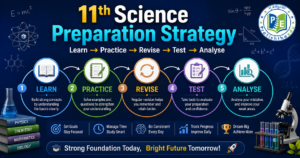
Step 1: Understand the Syllabus Before Starting
Before beginning serious preparation, students should understand what they are expected to study.
Go through the relevant Class 11 syllabus and identify:
- Subjects and chapters.
- Topics included in each chapter.
- Chapters that require more practice.
- Conceptually difficult topics.
- Approximate time required for each subject.
- School examination requirements.
Students should use the latest syllabus and curriculum information from reliable official sources. For CBSE students, the official CBSE website should be used to verify the current curriculum instead of depending on outdated information.
Once the syllabus is understood, students can divide it into smaller targets.
Instead of thinking, “I have to complete the entire Physics syllabus,” a student can set a target such as completing one topic, practising related questions, and revising it within a specific period.
This makes preparation more manageable.
Step 2: Create a Realistic Daily Study Routine
A daily routine does not have to be extremely long or complicated.
The main purpose of a timetable is to make sure that important subjects receive regular attention.
A student can divide independent study into different activities:
Concept Learning: Understand new topics taught at school or in foundation classes.
Practice: Solve questions related to the concepts studied.
Revision: Review previously completed topics.
Homework: Complete school or course assignments.
Self-Assessment: Attempt short quizzes or questions to check understanding.
The exact duration of each activity should depend on the student’s schedule.
A realistic routine that can be followed consistently is better than a timetable that looks impressive but becomes impossible to maintain after a few days.
Step 3: Follow the Learn–Practice–Revise Cycle
One of the simplest methods for Class 11 Science students is to follow a repeated learning cycle.
Learn
Start by understanding the concept through classroom teaching, textbooks, notes or other reliable resources.
Practice
After understanding the topic, solve relevant questions. This helps students determine whether they can actually apply what they have learned.
Revise
Revisit the topic after a suitable interval. Revision helps strengthen memory and makes future learning easier.
This cycle should continue throughout the academic year.
Students should not wait until examinations to revise a chapter for the first time.
Step 4: Give Priority to Concept Clarity
Students often make the mistake of trying to complete chapters as quickly as possible.
Completing a chapter does not necessarily mean understanding it.
For every important topic, students should ask:
- Can I explain this concept in my own words?
- Do I understand the basic principle?
- Can I solve a simple question based on it?
- Can I apply it to a slightly different question?
- Do I know where I made mistakes previously?
If the answer is no, the topic needs more attention.
This approach is particularly important in Physics, Mathematics and Chemistry, where later topics may depend on earlier concepts.
Step 5: Practise Questions Every Day
Regular question practice should be a part of 11th Science Foundation Coaching as well as self-study.
Students should not restrict question practice to weekends or examination periods.
Even a smaller number of questions solved consistently can help students improve their understanding and accuracy.
For numerical subjects, students should focus on understanding the steps rather than simply checking the final answer.
When a question is incorrect, students should identify whether the problem was caused by:
- Lack of conceptual understanding.
- Incorrect formula.
- Calculation error.
- Incorrect substitution.
- Misreading the question.
- Poor time management.
Maintaining a small “mistake record” can be useful. Students can write down recurring mistakes and review them during revision.
Step 6: Make Short and Useful Notes
Good notes can help students revise faster.
However, students should avoid rewriting entire textbooks in their notebooks.
Instead, notes can include:
- Important concepts.
- Formulas.
- Definitions.
- Key relationships.
- Difficult points.
- Important diagrams where applicable.
- Common mistakes.
- Questions that require additional practice.
The format can differ by subject.
For Physics and Mathematics, formula sheets and problem-solving steps can be useful.
For Chemistry, students may maintain organised notes for concepts, calculations and important reactions or properties according to the chapter.
For Biology, concise notes containing important terminology, processes and diagrams can support revision.
Students can combine their school notes with relevant 11th Science Study Material, provided the material is accurate and aligned with the syllabus.
Step 7: Use Spaced Revision
Studying a topic once and never revisiting it can lead to forgetting.
Students should revise topics at planned intervals.
A simple revision pattern can be:
First Revision: Soon after completing the topic.
Second Revision: After several days.
Third Revision: After a few weeks.
Final Revision: Before the relevant examination or major test.
The exact intervals do not have to be identical for every student.
The important point is to revisit concepts regularly instead of waiting until the last moment.
Step 8: Give More Attention to Weak Topics
Students should not spend all their study time on subjects they already enjoy.
For example, a student who is comfortable with Biology but struggles with Physics may need to allocate additional practice time to Physics.
A useful way to identify weak areas is to maintain a simple subject tracker.
| Area | Current Level | Action Required |
| Strong Topics | Good understanding | Regular revision |
| Average Topics | Some mistakes | More practice |
| Weak Topics | Conceptual difficulty | Relearn + practise |
| Very Weak Topics | Unable to solve questions | Seek guidance + intensive revision |
This allows students to use their study time more efficiently.
Step 9: Take Regular Tests
Tests should be treated as part of learning rather than something that happens only before examinations.
Students can use different types of tests throughout the academic year.
Topic Tests
Useful immediately after completing a small topic.
Chapter Tests
Useful after completing an entire chapter.
Subject Tests
Useful after completing multiple chapters.
Mixed Tests
Useful for checking whether students can identify the correct concept when questions from different chapters are combined.
Mock Tests
Useful for practising time management and examination conditions.
Students should always analyse their test results rather than focusing only on the score.
Step 10: Analyse Every Important Test
Test analysis is one of the most overlooked parts of preparation.
After a test, students should separate their mistakes into different categories.
Conceptual Error: The concept was not understood.
Calculation Error: The method was correct, but the calculation was wrong.
Application Error: The concept was understood but could not be applied correctly.
Careless Error: The student knew the answer but made an avoidable mistake.
Time Error: Too much time was spent on certain questions.
This analysis can help students understand exactly what needs improvement.
For example, if most mistakes are conceptual, the student should revise the relevant chapters. If most mistakes are due to calculation, more practice may be needed.
Step 11: Balance School and Foundation Preparation
Students joining an 11th Science Foundation Course should not ignore their regular school studies.
School and foundation preparation should support each other.
A practical approach can be:
Before school: Quick revision of previously studied concepts.
During school: Focus on classroom explanations and note important doubts.
After school: Complete homework and revise the day’s lessons.
Foundation classes: Attend regularly and participate actively.
Evening/self-study: Practise questions and revise difficult topics.
Weekend: Review the week’s work and take a short test.
The exact schedule will differ from student to student.
Students should also avoid overloading themselves with too many classes, books and online resources. Preparation should remain sustainable throughout the academic year.
Step 12: Manage Time Between Different Science Subjects
One common challenge in Class 11 is giving too much attention to one subject while ignoring another.
Students can use a rotating schedule to ensure that all subjects receive regular attention.
For example:
Monday: Physics + Mathematics + Biology revision
Tuesday: Chemistry + Mathematics + Physics practice
Wednesday: Biology + Chemistry + Mathematics
Thursday: Physics + Chemistry + Biology
Friday: Mathematics + Physics + revision
Weekend: Weekly revision + test + mistake analysis
This is only an example. Students should customise their routine according to their subjects, school timetable and academic requirements.
Step 13: Keep a Weekly Progress Check
At the end of each week, students can spend a few minutes reviewing their progress.
Ask:
- Which chapters did I complete?
- Which concepts are still unclear?
- How many questions did I practise?
- Which mistakes did I make repeatedly?
- Did I revise older topics?
- Did I complete my school assignments?
- What should I improve next week?
This simple review can prevent small gaps from becoming larger problems.
Students can maintain a weekly progress sheet in a notebook or digital document.
Step 14: Avoid Last-Minute Preparation
Last-minute preparation may help students remember some information temporarily, but it is not an effective long-term strategy for Science subjects.
Trying to complete several chapters immediately before an examination can result in:
- Incomplete understanding.
- Increased stress.
- Less practice.
- Poor revision.
- Difficulty remembering concepts.
- Lack of time for test analysis.
A better strategy is to divide preparation throughout the academic year.
The earlier students begin consistent 11th Science Preparation, the more time they have to understand difficult concepts and revise them.
Step 15: Use Reliable Learning Resources
Students have many options today, including textbooks, coaching notes, videos, online courses, question banks and practice material.
However, students should not continuously switch resources.
A practical order can be:
Prescribed Textbook → Class Notes → Practice Questions → Additional Study Material → Test & Revision
Students can explore relevant academic and competitive exam preparation resources when additional support is needed.
For students who prefer a dedicated study environment, a facility such as Pratishtha Library can also provide a structured place for focused self-study, depending on the student’s requirements and available facilities.
The most important factor is not the number of resources but how effectively students use them.
Step 16: Take Care of Sleep and Study Breaks
Academic preparation should be sustainable.
Students should maintain a healthy daily routine that includes adequate sleep, regular meals and appropriate breaks.
Studying continuously without rest can reduce concentration and make it harder to retain information.
Short breaks between study sessions can help students return to their work with better concentration.
Students should also avoid comparing their daily study hours with classmates. Individual learning requirements can be different.
A Practical Formula for 11th Science Preparation
Students can remember the following simple formula:
Concept Clarity + Daily Practice + Regular Revision + Testing + Mistake Analysis = Strong Foundation
This approach works because it covers the complete learning cycle.
Concept clarity helps students understand the topic.
Practice develops application skills.
Revision improves retention.
Testing measures preparation.
Mistake analysis identifies areas that need improvement.
Together, these habits can help students develop a stronger Class 11 Science Foundation.
How Parents and Teachers Can Help Students Follow the Strategy
Students may sometimes understand what they need to do but struggle to maintain consistency.
Parents and teachers can support them by encouraging realistic goals and regular progress rather than creating unnecessary pressure.
Teachers can help students identify difficult concepts and suggest appropriate practice.
Parents can help create a suitable study environment and encourage a balanced routine.
Students themselves should remain responsible for their preparation and gradually develop independent study habits.
Final Strategy for Students Starting Class 11 Science
Students beginning Class 11 should remember that they do not need to master everything immediately.
The goal during the initial months should be to establish a strong and consistent routine.
Start with the syllabus, understand the fundamentals, practise questions, revise regularly, and take tests.
If a topic is difficult, seek guidance rather than leaving it unresolved.
If a test result is low, analyse the reason instead of becoming discouraged.
If a chapter is easy, continue revising it so that the concept remains strong.
With this approach, an 11th Science Foundation Course can become a useful part of a student’s overall academic preparation.
Students who need additional guidance can compare suitable 11th Science Foundation Coaching options based on faculty, course structure, study material, tests, doubt support, and learning environment.
In the next part, we will look at 11th Science Foundation for JEE and NEET preparation, how Class 11 concepts connect with competitive examinations, common preparation mistakes, and how students can gradually build the skills required for future entrance examinations.
11th Science Foundation for Competitive Exam Preparation
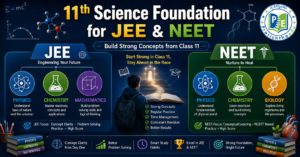
For many students, choosing Science in Class 11 is connected with long-term academic goals such as engineering, medicine, research, technology, or other Science-related careers. Students who plan to appear for competitive examinations should understand that preparation is not something that needs to begin only a few months before the examination.
Class 11 provides an opportunity to build the basic concepts, problem-solving skills and study habits that can support future preparation.
A structured 11th Science Foundation can help students approach this stage systematically. However, foundation preparation should not be treated as a shortcut or a guarantee of success. Competitive examinations require continuous effort, regular practice, revision, and adaptation to the current syllabus and examination pattern.
Why Is Class 11 Important for JEE and NEET Preparation?
Class 11 introduces students to several fundamental concepts that can become important for higher-level preparation.
For engineering-oriented preparation, students generally need strong foundations in Physics, Chemistry and Mathematics. For medical-oriented preparation, Physics, Chemistry and Biology require consistent attention.
The main advantage of starting early is time.
Students have more opportunity to:
- Understand concepts properly.
- Practise different types of questions.
- Identify weak areas.
- Improve accuracy.
- Develop time-management skills.
- Revise topics multiple times.
- Become comfortable with examination-style questions.
Instead of trying to learn advanced concepts immediately, students should first make sure that their Class 11 fundamentals are strong.
11th Science Foundation for JEE
Students planning to prepare for JEE should pay particular attention to Physics, Chemistry and Mathematics.
JEE preparation involves more than remembering formulas or solving questions from a single textbook. Students need to understand concepts and apply them to different types of problems.
Physics for JEE Foundation
Physics preparation should begin with strong conceptual understanding.
Students should learn how to:
- Understand physical principles.
- Interpret the information given in a question.
- Select appropriate formulas.
- Apply mathematical relationships.
- Check units and calculations.
- Analyse why an answer is correct or incorrect.
Students should first become comfortable with fundamental Class 11 topics before attempting increasingly difficult problems.
Chemistry for JEE Foundation
Chemistry requires students to use different learning approaches depending on the topic.
Students may need to combine:
- Conceptual understanding.
- Numerical practice.
- Regular revision.
- Understanding of chemical principles.
- Careful reading of prescribed material.
A strong foundation can help students gradually handle more application-based questions.
Mathematics for JEE Foundation
Mathematics requires regular problem-solving practice.
Students should focus on:
- Understanding concepts.
- Learning appropriate methods.
- Solving problems independently.
- Improving calculation accuracy.
- Working on different question types.
- Reviewing difficult problems.
Students should not become dependent on looking at solutions immediately. Attempting a problem independently, identifying the point of difficulty, and then reviewing the solution can provide better learning.
Students planning for JEE should always verify the latest information through the JEE Main official website and relevant official examination authorities.
11th Science Foundation for NEET
Students planning to pursue medical education often begin building their academic foundation in Class 11.
NEET-oriented preparation generally requires attention to Physics, Chemistry and Biology.
Biology for NEET Foundation
Biology requires a detailed understanding and regular revision.
Students should focus on:
- Reading the prescribed textbook carefully.
- Understanding biological processes.
- Learning important terminology.
- Reviewing diagrams and relationships.
- Practising questions.
- Revising chapters repeatedly.
Students should avoid treating Biology as a subject that can be completed through one-time reading.
Chemistry for NEET Foundation
Chemistry preparation should combine conceptual learning, calculations, and revision.
Students should identify which areas require numerical practice and which require repeated conceptual revision.
Regular chapter-wise practice can help students improve accuracy.
Physics for NEET Foundation
Physics requires students to develop numerical-solving skills.
Students should understand the concept first and then practise questions of gradually increasing difficulty.
The objective should be to improve both understanding and accuracy.
Students planning for NEET should verify the latest syllabus, examination pattern and eligibility requirements from official sources before planning their preparation.
Foundation Preparation vs Competitive Exam Preparation
It is important to understand that foundation preparation and dedicated competitive exam preparation are related but not identical.
Foundation preparation focuses primarily on strengthening fundamental concepts and developing study habits.
Competitive exam preparation generally requires more specialised practice, examination-specific question patterns, time management and regular mock tests.
A student may begin with a strong foundation and gradually increase the level of preparation as they become more comfortable with the Class 11 syllabus.
This gradual progression can be more sustainable than immediately attempting the most difficult questions without understanding the basics.
How to Gradually Increase the Difficulty Level
Students should not compare themselves with students who are already solving advanced questions.
A better approach is to progress through levels.
Level 1: Basic Understanding
Understand the concept and solve straightforward questions.
Level 2: Application
Solve questions that require the concept to be applied in a slightly different way.
Level 3: Mixed Problems
Combine concepts from different parts of a chapter or subject.
Level 4: Advanced Practice
Attempt more challenging questions after the fundamentals are strong.
Level 5: Timed Practice
Solve questions within a fixed time to improve speed and accuracy.
This gradual approach can help students build confidence while avoiding unnecessary frustration.
Common Mistakes Students Make During Class 11 Preparation
Even motivated students can make mistakes during their preparation. Identifying these mistakes early can help students avoid them.
Mistake 1: Studying Only for School Tests
Preparing only when an examination is near can lead to gaps in understanding.
Students should maintain regular preparation throughout the academic year.
Mistake 2: Ignoring Basic Concepts
Students sometimes try to move quickly towards difficult questions without understanding fundamental concepts.
This can create problems later because advanced questions often depend on basic principles.
Mistake 3: Collecting Too Many Books
Having many books does not automatically improve preparation.
Students should select appropriate resources and complete them properly.
Mistake 4: Watching Videos Without Practising
Educational videos can explain concepts, but passive watching is not the same as learning.
Students should solve questions after learning a concept.
Mistake 5: Memorising Without Understanding
Memorisation has a role in Science, but it should not replace conceptual understanding.
Students should first understand the principle and then remember important information where necessary.
Mistake 6: Avoiding Difficult Subjects
It is natural for students to prefer certain subjects.
However, consistently avoiding a difficult subject can make the gap larger.
Students should identify the reason for the difficulty and seek appropriate support.
Mistake 7: Not Revising
Students often move from one chapter to another without revisiting previous topics.
Regular revision is necessary to retain concepts.
Mistake 8: Ignoring Mistakes in Tests
A test score alone does not show everything about preparation.
Students should analyse incorrect answers and understand why the mistakes happened.
Mistake 9: Comparing Study Hours
Students sometimes compare their daily study hours with friends or classmates.
The quality and consistency of preparation are more important than simply counting hours.
Mistake 10: Starting Competitive Preparation Without a Plan
Students may collect advanced books and test series without first building their fundamentals.
A structured progression is generally more effective.
How to Build a Long-Term Preparation Plan
Students who have long-term competitive examination goals should think beyond a single week or month.
A broad preparation plan can include:
Class 11: Build fundamentals, understand concepts and develop consistent study habits.
End of Class 11: Revise important topics and identify weak areas.
Class 12: Continue syllabus preparation while strengthening previously studied concepts.
Revision Phase: Combine revision, question practice and examination-specific preparation.
The exact timeline will vary according to the examination, students’ academic level and current syllabus.
The most important point is to avoid postponing all preparation until the final stage.
Role of Mock Tests in Competitive Preparation
As students progress towards competitive examinations, tests become increasingly important.
Mock tests can help students practise:
- Time management.
- Question selection.
- Speed.
- Accuracy.
- Concentration.
- Examination strategy.
However, students should not take mock tests simply to collect scores.
After each test, they should analyse:
Attempted questions: How many were attempted?
Correct questions: How many were correct?
Incorrect questions: What caused the errors?
Unattempted questions: Why were they left?
Time usage: Where was most time spent?
This analysis can help students improve their examination strategy.
How Parents Can Support Competitive Preparation
Parents can support students by creating an environment where consistent learning is encouraged.
Useful support can include:
- Encouraging a routine.
- Providing appropriate study resources.
- Helping students maintain a balanced schedule.
- Discussing academic difficulties calmly.
- Avoiding constant comparison with other students.
- Encouraging students to analyse mistakes rather than fear low marks.
Competitive preparation can be demanding, so students benefit from realistic expectations and consistent encouragement.
Choosing 11th Science Foundation Coaching for Competitive Goals
Students considering 11th Science Foundation Coaching should first identify their academic goal.
A student primarily interested in board examinations may need a different level of support from a student planning for JEE or NEET.
Before choosing a course, students and parents can consider:
- Subject coverage.
- Teaching methodology.
- Faculty experience.
- Course duration.
- Study material.
- Practice questions.
- Test frequency.
- Doubt-solving support.
- Batch structure.
- Online/offline options.
- Compatibility with school timings.
Students searching for 11th Science Foundation Course in Bangalore should compare these factors rather than selecting a course only on the basis of advertisements or price.
The right course should complement the student’s school education and provide a practical learning structure.
Using Study Material Effectively
Students can find a large amount of 11th Science Study Material online and offline. The challenge is choosing and using it effectively.
A simple system is:
Primary textbook: Build the basic understanding.
Class notes: Review explanations provided by the teacher.
Practice material: Solve additional questions.
Revision notes: Quickly review important concepts.
Test papers: Measure preparation.
Students should not move to additional material before understanding the basics.
For students who need a focused environment for self-study, Pratishtha Library can be considered as a dedicated study option depending on individual requirements.
Similarly, students can explore academic and competitive exam preparation resources to supplement their learning when necessary.
Developing the Right Mindset for Class 11
Academic preparation is not always linear.
Some chapters may be easy, while others may take more time. Test scores may improve gradually rather than immediately.
Students should focus on progress rather than expecting perfection from the beginning.
A useful mindset is:
Do not fear difficult chapters. Understand them step by step.
Do not fear mistakes. Analyse them and learn from them.
Do not compare your preparation with others. Track your own progress.
Do not depend only on motivation. Build consistent habits.
This mindset can help students continue their preparation even when they face academic challenges.
A Balanced Approach to Foundation and Competitive Preparation
The strongest approach is usually a balanced one.
Students should first understand their school syllabus and build strong fundamentals. Once the basics are comfortable, they can gradually introduce more competitive-style questions and timed practice.
This prevents students from becoming overwhelmed by advanced material too early.
A well-planned Class 11 Science Foundation should therefore focus on the following progression:
School Concepts → Strong Fundamentals → Regular Practice → Revision → Application Questions → Tests → Competitive-Level Preparation
This progression allows students to develop their skills step by step.
What Students Should Remember
There is no single preparation method that works for every Class 11 student.
Some students learn quickly through self-study, while others benefit from classroom guidance. Some students require more practice in Mathematics and Physics, while others may need additional revision in Chemistry or Biology.
The key is to identify individual needs and create a realistic plan.
An 11th Science Foundation Course can provide structure and guidance, but the student’s regular effort remains the most important part of preparation.
Students should focus on understanding concepts, practising questions, revising regularly and learning from mistakes.
With consistent preparation, Class 11 can become a strong starting point for board examinations as well as future academic and competitive goals.
In the next part, we will discuss how to choose the right 11th Science Foundation course, what students should check before admission, common questions about foundation coaching, and how Pratishtha Edu can support students looking for structured Class 11 Science preparation.
How to Choose the Right 11th Science Foundation Course?
Choosing the right 11th Science Foundation Course is an important decision because students may spend a significant part of their academic year following the course. The right program should complement school education, provide structured learning and help students develop strong fundamentals.
Students and parents should not select a course only because of advertisements, discounts or claims about results. Instead, they should understand what the course actually provides and whether it matches the student’s academic goals.
A good foundation program should focus on learning quality, consistency, practice and student support.
Check the Course Structure
Before joining an 11th Science Foundation Coaching program, students should understand how the course is organised.
Important questions include:
- Which subjects are covered?
- What is the duration of the course?
- How many classes are conducted each week?
- Is the syllabus divided into manageable sections?
- Is there a planned revision schedule?
- Are regular tests included?
- Is doubt-solving support available?
A clearly organised course can make it easier for students to follow their preparation throughout the academic year.
Check the Faculty and Teaching Method
The quality of teaching is one of the most important factors when choosing a foundation course.
Students should look for a teaching approach that focuses on understanding concepts rather than simply completing chapters.
A good teaching environment should encourage students to:
- Ask questions.
- Understand concepts step by step.
- Practise problems.
- Discuss mistakes.
- Revise difficult topics.
- Develop independent learning habits.
Students can also consider whether the teaching pace is suitable for their current academic level.
A course that moves too quickly may leave students with unanswered doubts, while a course that moves too slowly may make it difficult to complete the syllabus on time.
Look at Study Material and Practice Support
Study material is another important factor.
Students should check whether the course provides organised 11th Science Study Material and whether it is aligned with the relevant syllabus.
Useful material may include:
- Chapter notes.
- Concept explanations.
- Practice questions.
- Revision material.
- Formula sheets where relevant.
- Topic-wise exercises.
- Test papers.
However, students should remember that study material is only useful when it is actually studied and practised.
Having a large amount of material without a proper study plan can create unnecessary confusion.
Check the Testing System
Regular tests are important because they help students measure their progress.
Before joining a course, students can ask about:
- Chapter-wise tests.
- Subject-wise tests.
- Revision tests.
- Mock tests.
- Test frequency.
- Performance analysis.
A good assessment system should help students understand their mistakes rather than simply provide a score.
Students should ideally receive opportunities to review incorrect questions and identify topics requiring additional preparation.
Check Doubt-Solving Support
Students should not hesitate to ask about doubt-solving facilities before joining a course.
In Class 11 Science, students may encounter difficult concepts in Physics, Chemistry, Mathematics or Biology. If doubts remain unresolved for a long time, they may affect understanding of related topics.
A suitable course should provide students with a clear way to ask questions and receive academic guidance.
The exact format may differ between courses, but students should understand how doubt support works before admission.
Consider Online, Offline or Hybrid Learning
Students can choose between online, offline, and hybrid learning depending on their needs.
Offline 11th Science Coaching
Offline learning may be suitable for students who prefer a fixed classroom environment, direct interaction with teachers and a regular academic routine.
Online 11th Science Coaching
Online learning may be suitable for students who need flexibility or prefer studying from home.
Hybrid Learning
Hybrid programs combine elements of online and offline learning and may provide additional flexibility.
There is no universally best format. Students should consider their learning style, school schedule, travel requirements, concentration level, and available academic support.
Students searching for 11th Science Coaching in Bangalore can compare these formats before making a decision.
Consider the Learning Environment
A positive learning environment can influence a student’s consistency.
Students should look for an environment where:
- Questions are encouraged.
- Teachers are approachable.
- Students receive academic guidance.
- Regular practice is encouraged.
- Progress is monitored.
- Unnecessary pressure is avoided.
The goal of foundation coaching should be to help students become more confident learners rather than make them dependent on coaching for every academic decision.
Balance Between School and Foundation Coaching
Students should make sure that an additional foundation course fits comfortably with their school schedule.
An overly packed timetable may leave insufficient time for:
- School homework.
- Self-study.
- Revision.
- Practice.
- Sleep and rest.
The purpose of an 11th Science Foundation Course should be to make preparation more structured, not unnecessarily complicated.
Students should therefore consider class timings, travel time, homework load and independent study requirements before choosing a course.
Choosing 11th Science Foundation Coaching in Bangalore
Students and parents looking for 11th Science Foundation Course in Bangalore have multiple options. Instead of choosing a coaching centre only because it appears in advertisements or search results, it is better to compare the actual academic support provided.
Some useful comparison factors include:
| Factor | What to Check |
| Faculty | Teaching experience and approach |
| Subjects | Physics, Chemistry, Mathematics, Biology as applicable |
| Course Structure | Syllabus, schedule and progression |
| Study Material | Quality and relevance |
| Tests | Frequency and performance analysis |
| Doubt Support | Availability and process |
| Learning Mode | Online, offline or hybrid |
| Batch Structure | Learning environment and interaction |
| Revision | Planned revision support |
| Student Support | Academic guidance and communication |
This comparison can help students make a more informed decision.
Why Strong Foundation Matters More Than Shortcuts
Students sometimes look for shortcuts to complete the syllabus quickly. However, Science subjects generally require understanding and practice.
A student who spends more time building fundamentals may initially feel slower than someone who is simply memorising answers. Over time, however, conceptual understanding can make it easier to handle unfamiliar questions.
The purpose of an 11th Science Foundation is therefore not simply to make students finish chapters quickly.
It should help students develop the ability to:
- Understand concepts.
- Apply knowledge.
- Solve problems.
- Revise effectively.
- Identify mistakes.
- Study independently.
These skills can remain useful beyond Class 11.
11th Science Foundation at Pratishtha Edu
Students looking for structured academic support can explore Pratishtha Edu and understand the available learning options for Class 11 Science students.
The aim of a foundation-focused approach should be to help students strengthen their fundamentals while maintaining consistency in their school studies.
Depending on the course structure, students may look for support in areas such as:
- Concept-based learning.
- Subject-wise preparation.
- Regular practice.
- Revision.
- Doubt solving.
- Assessment and testing.
- Study guidance.
Students should review the current course details, subjects, batch timings and available learning options before making an admission decision.
Students who want to understand the broader academic and competitive preparation options available through the institute can also explore relevant academic and competitive exam preparation resources.
For students who prefer a dedicated environment for self-study, Pratishtha Library can also be considered as an option for focused academic preparation, subject to the facilities and current availability.
How Pratishtha Edu Can Fit Into a Student’s Preparation
A student’s preparation generally involves more than classroom learning.
A balanced system can include:
Classroom Learning: Understand concepts and ask questions.
Self-Study: Review and practise independently.
Study Material: Use organised resources for additional practice.
Revision: Revisit previously completed topics.
Tests: Measure understanding and accuracy.
Doubt Solving: Clarify concepts that remain difficult.
Students can combine these elements according to their individual requirements.
The goal should be to develop a consistent learning routine rather than depend entirely on coaching classes.
Frequently Asked Questions About 11th Science Foundation
What is an 11th Science Foundation Course?
An 11th Science Foundation Course is a structured academic program designed to help Class 11 Science students strengthen their fundamental concepts, practise questions, revise important topics, and prepare systematically for their academic goals.
The exact subjects, teaching methods, tests, and support provided can differ between institutes.
Is 11th Science Foundation useful for students preparing for JEE?
Yes, a strong Class 11 foundation can be useful for students planning long-term JEE preparation because Physics, Chemistry and Mathematics require strong fundamentals and regular problem-solving practice.
However, foundation preparation alone does not guarantee success. Students need consistent preparation and examination-specific practice as they progress.
Is 11th Science Foundation useful for NEET preparation?
A strong foundation can help students planning for NEET by strengthening concepts in Physics, Chemistry and Biology.
Students should combine foundation learning with regular textbook study, question practice, revision and appropriate examination-specific preparation.
When should students start 11th Science preparation?
Students should ideally begin preparing from the start of Class 11 rather than waiting until examinations are close.
Starting early provides more time for concept building, practice and revision.
Is coaching necessary for Class 11 Science?
Coaching is not compulsory for every student. Some students can prepare effectively through self-study and school support, while others may benefit from structured classes, additional practice and doubt-solving guidance.
The right choice depends on the student’s learning style, academic requirements and goals.
Which subjects are important in 11th Science?
The subjects depend on the student’s chosen stream and curriculum. Common Science subjects include Physics, Chemistry, Mathematics and Biology.
Students should identify their academic pathway and give appropriate attention to each subject.
How can I improve my Class 11 Science preparation?
Students can improve preparation by following a consistent study routine, understanding concepts, practising questions regularly, revising completed topics, taking tests and analysing mistakes.
Using suitable 11th Science Study Material can also support revision and practice.
What should I check before joining 11th Science Foundation Coaching?
Students should check faculty, course structure, subject coverage, study material, test frequency, doubt-solving support, batch structure, class timings and the overall learning environment.
Students should also ensure that the course fits comfortably alongside their school schedule.
Is online or offline 11th Science coaching better?
Both formats can work depending on the student. Offline learning may provide a fixed classroom environment and direct interaction, while online learning can offer flexibility.
Students should choose the format that matches their learning style and schedule.
Can Class 11 foundation preparation help with Class 12?
Yes. Strong fundamentals and consistent study habits developed in Class 11 can make it easier for students to approach more advanced concepts in Class 12.
However, students should continue studying the Class 12 syllabus systematically rather than relying only on their Class 11 preparation.
In the final part, we will bring everything together with a complete Class 11 Science preparation checklist, final guidance for students and parents, more FAQs and practical tips for building a strong foundation throughout the academic year.
Practical Checklist for 11th Science Students
Starting Class 11 Science with a proper plan can make the academic journey more organised and manageable. Students do not need to follow a complicated strategy from the first day. Instead, they should develop a few consistent habits and improve them gradually.
The following checklist can help students stay on track throughout the academic year.
Understand Your Syllabus
Before beginning preparation, go through the latest syllabus and understand the chapters and topics that need to be covered.
Keep a record of completed, ongoing, and pending topics. This makes it easier to identify whether preparation is progressing according to plan.
Study Every Day
Regular study is more effective than depending on occasional long study sessions.
Students should try to maintain a daily routine that includes concept learning, question practice and revision according to their available time.
Revise Regularly
Do not wait until the examination to revise a chapter for the first time.
Use short revision sessions throughout the academic year to retain previously studied concepts.
Practise Questions
Science preparation becomes stronger when students regularly apply what they have learned.
Solve questions after completing concepts and gradually increase the difficulty level.
Analyse Mistakes
Maintain a record of important mistakes made in tests and practice sessions.
Review this record during revision so that the same mistakes are not repeated.
Clear Doubts Early
Do not allow difficult concepts to remain unresolved for a long time.
Ask teachers, mentors, or appropriate academic support resources whenever necessary.
Take Regular Tests
Tests help students understand their actual level of preparation.
Do not focus only on marks. Analyse incorrect and unattempted questions to understand what needs improvement.
Maintain Balance
Along with studies, students should maintain adequate sleep, breaks, and other healthy daily habits.
A sustainable routine is more useful than an extremely demanding schedule that cannot be followed consistently.
A Simple Weekly Plan for Class 11 Science
Students can use a weekly structure to maintain consistency.
Monday to Friday
Focus on:
- School lessons.
- Homework and assignments.
- Revision of recently completed topics.
- Practice questions.
- One difficult topic that requires additional attention.
Saturday
Use Saturday for:
- Revising the week’s lessons.
- Completing pending work.
- Practising important questions.
- Revisiting difficult concepts.
Sunday
Use Sunday for:
- Weekly revision.
- A short test or practice session.
- Analysing mistakes.
- Planning the following week.
This is only a sample structure. Students should modify it according to their school schedule and individual requirements.
How Parents Can Help During Class 11
Parents can play an important supporting role in a student’s 11th Science Preparation.
The transition from Class 10 to Class 11 can sometimes be academically demanding. Students may need time to adjust to the increased level of detail and the number of concepts they have to manage.
Parents can help by providing:
- A comfortable study environment.
- Reasonable academic support.
- Encouragement to follow a routine.
- Appropriate learning resources.
- Time for rest and recreation.
- Support when students face difficulties.
Parents should also avoid comparing their child continuously with other students. Every student has a different learning pace and different academic strengths.
Instead of asking only about marks, parents can ask questions such as:
“Which topic did you understand today?”
“Which chapter are you finding difficult?”
“Do you need help with anything?”
This can encourage students to communicate about their actual learning difficulties.
How Students Can Stay Motivated
Motivation can change from day to day. Students may feel highly motivated at the beginning of the academic year but experience periods when studying feels difficult.
Instead of depending entirely on motivation, students should build routines.
Small and consistent targets can be more effective than setting unrealistic goals.
For example, instead of deciding to complete five chapters in one week, a student can set targets such as:
- Complete one topic.
- Solve a fixed set of practice questions.
- Revise one previously completed chapter.
- Take one short test.
- Review mistakes.
Achieving smaller targets regularly can help students maintain confidence and consistency.
Importance of Self-Study in Foundation Preparation
Even if students join 11th Science Foundation Coaching, self-study remains essential.
Classroom teaching can explain concepts, but students need independent practice to determine whether they can apply those concepts themselves.
A simple self-study cycle can be:
Class → Review → Practise → Revise → Test → Analyse
Students should therefore reserve sufficient time for independent study.
They can use textbooks, class notes and appropriate 11th Science Study Material for additional practice and revision.
How to Use the Right Study Environment
A focused environment can make self-study more productive.
Students should try to reduce distractions while studying and keep the required books, notes, and stationery organised.
Those who prefer studying in a dedicated environment can consider Pratishtha Library for focused self-study, depending on their requirements and the current facilities available.
The purpose of a study environment is to help students maintain concentration and develop a consistent routine.
What Should Students Do If They Fall Behind?
Falling behind on a few chapters does not mean that preparation has failed.
The important thing is to identify the reason and create a recovery plan.
Students can:
- List all pending topics.
- Separate important and less urgent tasks.
- Complete foundational concepts first.
- Allocate additional time to weak subjects.
- Continue current topics while gradually clearing the backlog.
- Take a short test after completing pending topics.
- Return to the regular schedule once the backlog is manageable.
Students should avoid trying to complete everything in one or two days. This can create additional stress and may result in incomplete understanding.
How to Track 11th Science Preparation Progress
Students can maintain a simple progress tracker.
| Area | Weekly Check |
| New Concepts | Completed / Pending |
| Question Practice | Completed / Needs Improvement |
| Revision | Completed / Pending |
| Tests | Taken / Not Taken |
| Mistake Analysis | Done / Pending |
| Doubts | Cleared / Pending |
| Weak Topics | Improving / Need More Practice |
A progress tracker makes preparation more visible and can help students identify problems early.
Frequently Asked Questions About 11th Science Foundation
What is the main purpose of an 11th Science Foundation?
The main purpose is to help students develop strong fundamentals in Class 11 Science subjects through conceptual learning, regular practice, revision and assessment.
It can also help students develop study habits that may support future academic and competitive examination preparation.
Can I prepare for JEE or NEET along with school studies?
Yes. Many students combine school education with additional preparation.
The key is to maintain a realistic schedule and avoid creating an unnecessarily heavy workload. Students should first understand their school syllabus and then gradually add examination-specific preparation according to their goals.
Should I join foundation coaching from the beginning of Class 11?
Starting from the beginning can give students more time to understand concepts and develop consistent habits. However, coaching is not compulsory for every student.
Students should consider their learning requirements, academic goals and preferred learning method before making a decision.
How much time should I spend studying every day?
There is no fixed number of hours that works for every student.
Study time depends on school timings, homework, learning speed, subjects, preparation goals and individual requirements.
Students should focus on consistent and productive study rather than simply counting hours.
Which subject should I study first?
There is no universal order.
Students can prioritise subjects based on their school timetable, upcoming tests and personal strengths and weaknesses.
However, difficult subjects should not be continuously postponed.
Is NCERT important for Class 11 Science?
For students following a curriculum where NCERT textbooks are prescribed or relevant, they can be an important foundation resource.
Students should follow the textbooks and curriculum prescribed for their particular board and verify the latest requirements from official sources.
Can foundation coaching improve school performance?
Structured learning, regular practice and revision may help students strengthen their understanding and improve preparation. However, actual academic performance depends on several factors, including the student’s effort, school learning, practice and consistency.
Is foundation coaching only for JEE and NEET aspirants?
No. A foundation approach can also be useful for students who simply want stronger conceptual understanding and better preparation for their Class 11 and Class 12 academics.
Students should choose the level and type of preparation according to their individual goals.
What study material should a Class 11 student use?
Students should begin with their prescribed textbook and school material. Additional 11th Science Study Material can then be used for practice and revision according to individual requirements.
Using fewer reliable resources consistently is generally better than collecting too many resources.
How can I find 11th Science Foundation Coaching in Bangalore?
Students can compare available 11th Science Coaching in Bangalore options based on faculty, subjects, course structure, study material, tests, doubt-solving support, learning mode, batch structure, and compatibility with school timings.
The course should match the student’s academic needs rather than being selected only because of promotional claims.
Why a Strong Foundation Matters Beyond Class 11
The value of a strong foundation is not limited to one academic year.
Students who learn how to understand concepts, solve problems, revise effectively and analyse their mistakes are developing skills that can remain useful throughout their academic journey.
Class 11 can therefore be viewed as a stage where students begin developing the habits required for more advanced learning.
Whether a student eventually chooses engineering, medicine, pure sciences, technology, research or another field, the ability to learn systematically can remain valuable.
Students should focus on building knowledge step by step instead of worrying about completing everything immediately.
Building Your Academic Journey with the Right Support
Every student’s academic journey is different. Some students are comfortable with independent learning, while others benefit from structured classes and regular academic guidance.
A well-designed 11th Science Foundation Course can provide additional structure through concept-based teaching, practice, tests, revision, and doubt support.
At the same time, students should continue taking responsibility for their own preparation through self-study and regular revision.
Students and parents looking for structured academic guidance can explore Pratishtha Edu to understand the available learning options and current course details.
For students who want to explore broader academic and competitive preparation options, academic and competitive exam preparation resources can also be useful for understanding different pathways and study opportunities.
Final Thoughts
Class 11 Science is an important stage in a student’s academic journey. The subjects become more detailed, questions require deeper understanding and students need to develop a more organised approach to learning.
A strong 11th Science Foundation can help students build the fundamentals required to understand Physics, Chemistry, Mathematics and Biology more effectively. It can also help students develop important habits such as regular practice, revision, test analysis and time management.
Students should remember that there is no shortcut to strong academic preparation.
The most effective approach is simple:
Understand concepts.
Practise regularly.
Revise consistently.
Take tests.
Analyse mistakes.
Improve gradually.
Students preparing for JEE, NEET or other competitive examinations can use Class 11 as an opportunity to build their fundamentals before moving towards more advanced preparation.
At the same time, students focused primarily on school academics can use the same principles to improve their conceptual understanding and examination readiness.
Choosing the right 11th Science Foundation Course in Bangalore can provide additional structure and guidance, but the student’s own consistency remains the most important part of the journey.
With the right study plan, reliable resources, regular practice and a positive learning environment, Class 11 can become a strong foundation for the academic years ahead.
Students and parents can explore Pratishtha Edu, relevant 11th Science Foundation Coaching, 11th Science Study Material, and suitable academic and competitive exam preparation resources to plan the next stage of their academic journey.
The goal is not simply to complete Class 11. The goal is to understand it well enough that the knowledge and skills developed during this year continue to support future studies and career goals.
Leave a Reply