
Class 12 is an important academic year for Commerce students. With subjects such as Accountancy, Business Studies, Economics, and Mathematics or Applied Mathematics, students need to manage different types of learning together. Some topics require numerical practice, while others need conceptual understanding, revision, and answer-writing practice.
This is why having a practical 12th Commerce Study Plan can make preparation more organised. A proper study schedule helps students decide what to study, how much time to give each subject, and when to revise completed topics.
However, a good timetable is not simply a list of subjects with fixed hours. It should match the student’s current preparation level, school schedule, coaching classes, and self-study time. The goal should be to create a routine you can follow consistently.
A well-planned Class 12 Commerce Study Plan can help students stay consistent, reduce last-minute pressure, and identify weak areas before examinations. It can also make it easier to balance concept learning, question practice, revision, and tests.
Students who are still working on their basic concepts can first understand the importance of a 12th Commerce Foundation before following a detailed study schedule.
What Is a 12th Commerce Study Plan?
A 12th Commerce Study Plan is a structured schedule that divides available study time among different subjects and academic activities. It can include daily learning, question practice, revision, doubt solving, test preparation, and performance analysis.
Instead of deciding every day what to study at the last moment, students can use a planned routine to stay focused on their priorities.
A useful study plan should answer simple questions such as:
- Which subject should I study today?
- Which topic needs more attention?
- When should I practise questions?
- When should I revise completed chapters?
- When should I take tests?
- How much progress have I made this week?
The answers will be different for every student, which is why there is no single timetable that works perfectly for everyone.
Students should use the latest CBSE curriculum and prescribed NCERT textbooks while planning their Class 12 Commerce preparation.
Why Is a Study Plan Important for Class 12 Commerce?
1. It Creates a Clear Direction
Without a proper plan, students may spend too much time on one subject while giving very little attention to another. A timetable creates a clear direction and helps distribute study time more effectively.
2. It Helps Maintain Consistency
Studying for long hours on one day and doing very little for the next few days can make preparation irregular. A realistic timetable encourages students to study consistently.
3. It Makes Revision Easier
Revision becomes difficult when students postpone it until the final weeks. A study plan can include weekly and monthly revision from the beginning.
4. It Gives More Time to Difficult Topics
Not every topic needs the same amount of time. Students can identify difficult chapters and give them additional practice sessions without ignoring the rest of the syllabus.
5. It Reduces Last-Minute Pressure
A structured 12th Commerce Preparation strategy allows students to spread the syllabus across the available months instead of trying to complete everything at the end.
What Should a Good 12th Commerce Study Plan Include?
A balanced study schedule should include more than reading textbooks. Students should divide their time among different learning activities.
| Activity | Main Purpose |
| Concept Learning | Understand new topics |
| Question Practice | Apply concepts |
| Revision | Retain previously studied topics |
| Doubt Solving | Clear confusing concepts |
| Test Practice | Check preparation |
| Mistake Analysis | Identify areas for improvement |
This approach creates a complete learning cycle:
Learn → Practise → Revise → Test → Analyse → Improve
For example, after completing a chapter in Accountancy, students should not simply move to another chapter. They can solve questions, review mistakes and return to the chapter during a planned revision session.
How to Make a Practical Class 12 Commerce Study Plan
The first step is to understand the amount of time actually available each day.
Students should consider:
School Time + Coaching Time + Self-Study Time + Revision Time + Breaks + Sleep
A timetable becomes difficult to follow when it ignores school hours, travel, homework or rest.
Instead of creating an unrealistic schedule with too many study hours, start with the time that can genuinely be maintained every day.
Start With Weekly Goals
Before preparing a daily timetable, set weekly targets.
For example:
Accountancy: Complete one chapter and solve practice questions
Business Studies: Complete one chapter and practise answer writing
Economics: Cover selected topics and revise important concepts
Mathematics/Applied Mathematics: Complete planned exercises and practice questions
Weekly goals make daily planning easier and allow students to measure actual progress.
Daily Study Plan vs Weekly Study Plan
Both daily and weekly schedules have different purposes.
A daily study plan tells students what they should focus on today.
A weekly study plan gives a broader view of the syllabus, revision, and testing targets.
Using both together can make preparation more flexible. If one day’s target is missed because of school work or another commitment, it can be adjusted within the weekly plan instead of disrupting the entire schedule.
The Right Study Plan Is Different for Every Student
A student who has strong concepts may need more qu
estion practice and tests. Another student may need additional time for concept building and revision.
Similarly, students preparing for board examinations along with entrance or competitive examinations may need a different schedule.
Therefore, the best 12th Commerce Study Plan is not necessarily the timetable with the maximum number of study hours. It is the timetable that supports consistent learning, regular practice, and gradual improvement.
Daily Timetable for Class 12 Commerce Students
A daily timetable can help Class 12 Commerce students use their available study time more effectively. Instead of studying every subject for the same amount of time, students should divide their day according to the difficulty of each subject, their current preparation level, and the type of work required.
For example, Accountancy may need regular numerical practice, while Business Studies may need concept revision and answer-writing practice. Economics can require both conceptual understanding and question practice, and Mathematics or Applied Mathematics may require consistent problem-solving.
The purpose of a daily Class 12 Commerce Timetable is not to keep students busy throughout the day. It is to make study sessions focused and manageable.
Sample Daily Study Timetable
The following timetable is an example. Students can adjust it according to their school and coaching schedule.
| Time | Study Activity |
| 6:00 AM – 6:30 AM | Quick Revision |
| 6:30 AM – 7:30 AM | Accountancy / Mathematics Practice |
| School Hours | School Learning & Classwork |
| 4:00 PM – 5:00 PM | Rest, Snacks & Refreshment |
| 5:00 PM – 6:30 PM | Main Subject Study |
| 6:30 PM – 7:00 PM | Short Break |
| 7:00 PM – 8:00 PM | Question Practice / Homework |
| 8:00 PM – 9:00 PM | Dinner & Break |
| 9:00 PM – 10:00 PM | Revision / Business Studies / Economics |
| 10:00 PM – 10:20 PM | Review of the Day & Next-Day Planning |

This is only a sample routine. Students should change the timings according to their individual needs rather than trying to follow the exact schedule.
How to Divide Study Time Between Commerce Subjects
One of the most common mistakes students make is giving equal study time to every subject regardless of their strengths and weaknesses.
A better approach is to divide study time based on the type of preparation required.
Accountancy
Accountancy should receive regular practice because numerical accuracy improves through solving questions.
A study session can include:
Concept Review → Solved Example → Practice Questions → Mistake Analysis
Students should avoid studying Accountancy only by reading notes. Writing and solving questions is an important part of effective preparation.
Business Studies
Business Studies requires conceptual understanding, revision and answer-writing practice.
A productive session can include:
Read the Concept → Understand Key Points → Connect With Examples → Write Answers → Revise
Short revision sessions can be useful for retaining definitions, features, advantages, functions, and other important concepts.
Economics
Economics preparation should combine concepts, application, and revision.
Students can divide the session into:
Concept Learning → Graphs or Numerical Practice Where Applicable → Questions → Revision
Instead of memorising every line, students should try to understand the relationship between important economic concepts.
Mathematics or Applied Mathematics
Students who have Mathematics or Applied Mathematics should maintain regular problem-solving practice.
A useful session can follow:
Formula Review → Worked Example → Exercise Questions → Timed Practice → Error Review
Students should maintain a record of formulas and repeated mistakes for quick revision.
Morning Study vs Evening Study
Some students can concentrate better in the morning, while others perform better in the evening.
Students who feel more focused in the morning can use that time for:
- Accountancy numericals
- Mathematics practice
- Difficult topics
- Quick revision
Evening sessions can then be used for:
- Business Studies
- Economics
- Homework
- Answer writing
- Revision
There is no universal rule that a particular subject must always be studied at a particular time. The important factor is concentration and consistency.
Use Focused Study Sessions
Studying continuously for several hours without a break may reduce concentration. Instead, divide long study periods into focused sessions.
For example:
50 Minutes Study → 10 Minutes Break
During the study period, avoid unnecessary phone usage, social media and unrelated activities.
The break should be used to relax briefly rather than turning into a long digital distraction.
Give Priority to Weak Subjects
Students should not spend most of their time studying subjects they already find easy.
A simple priority system can help:
| Topic Level | Study Priority |
| Weak | High Practice + Extra Revision |
| Average | Regular Practice |
| Strong | Revision + Periodic Testing |
For example, if a student is comfortable with Business Studies but struggles with Accountancy numericals, more practice time should be allocated to Accountancy.
This does not mean ignoring strong subjects. It simply ensures that weak areas receive enough attention.
Keep Daily Revision Short but Consistent
Daily revision does not have to take hours.
Even 15–30 minutes of focused revision can help students revisit formulas, definitions, key concepts, and previously studied topics.
A useful routine can be:
Morning → Previous-Day Revision
Afternoon/Evening → New Topic
Night → Quick Review
This creates repeated exposure to important concepts without making revision overwhelming.
Include Question Practice Every Day
One of the most important parts of a 12th Commerce Study Plan is regular question practice.
Reading a chapter can create the feeling that a topic has been understood, but solving questions shows whether the student can actually apply that knowledge.
Depending on the subject, daily practice may include:
Accountancy: Numerical problems
Business Studies: Short and long answers
Economics: Conceptual, numerical or application-based questions
Mathematics: Exercise and timed questions
Even a small number of questions completed consistently can make a significant difference over time.
Keep Time for Doubt Solving
Students should not allow doubts to accumulate for weeks.
If a concept is unclear, mark it and try to resolve it as soon as possible through teachers, class notes, reliable study resources or appropriate academic support.
Clearing doubts early makes later revision much easier.
Plan Tomorrow Before Going to Bed
A simple habit can make the next day more organised.
Before finishing the day, write down:
- Subject to revise
2. Topic to learn
3. Questions to practise
4. Pending homework
5. One topic for quick revision
This takes only a few minutes but gives the next study session a clear starting point.
Avoid Creating an Impossible Timetable
A common mistake is preparing a timetable that looks impressive on paper but cannot be followed in real life.
For example, planning ten or twelve hours of self-study every day may not be practical for a student who already has school, homework, coaching, and travel.
A better strategy is to create a realistic schedule and follow it consistently.
Realistic Plan + Daily Execution > Perfect Timetable + No Consistency
Adjust the Timetable During Tests and Examinations
The daily schedule should not remain the same throughout the academic year.
During the early stage of preparation, more time can be given to concept building.
As examinations approach, the focus can gradually shift towards:
Revision → Question Practice → Sample Papers → Timed Tests → Mistake Analysis
This makes the study plan adaptable instead of rigid.
A Simple Daily Formula for Class 12 Commerce
Students can remember this simple structure:
Learn → Practise → Revise → Test → Analyse
For example:
Morning: Quick revision
Afternoon: New concepts
Evening: Question practice
Night: Revision and planning
The exact timings can change, but the learning cycle should remain consistent.
Complete Weekly 12th Commerce Study Plan
A daily timetable helps students manage individual study sessions, but a weekly study plan gives them a bigger picture of their preparation. It helps students decide which subjects to study during the week, when to revise completed topics and when to test their understanding.
A good 12th Commerce Study Plan should balance all major subjects instead of focusing on only one subject for several consecutive days.
The weekly plan can be divided into four major activities:
Concept Learning + Question Practice + Revision + Testing
Students can then adjust the amount of time given to each activity according to their preparation level.
Sample Weekly Study Plan for Class 12 Commerce
The following is a practical example that students can modify according to their school, coaching and personal routine.
| Day | Main Subject | Secondary Activity | Practice / Revision |
| Monday | Accountancy | Economics | Accountancy Questions |
| Tuesday | Business Studies | Mathematics / Applied Mathematics | Answer Writing |
| Wednesday | Economics | Accountancy | Concept Revision |
| Thursday | Accountancy | Business Studies | Numerical Practice |
| Friday | Mathematics / Applied Mathematics | Economics | Formula & Concept Revision |
| Saturday | Business Studies | Accountancy | Chapter Practice |
| Sunday | Weekly Revision | Weak Topics | Test + Mistake Analysis |
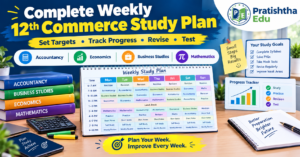
This schedule is only an example. Students should change the subjects and timings according to their individual requirements.
Monday – Start the Week With Accountancy
Monday can be used to focus on Accountancy because it is a subject where regular numerical practice is important.
Students can divide the session into:
Concept Revision → Examples → Practice Questions → Error Checking
A shorter Economics revision session can also be included to maintain continuity.
The objective is not to complete a large number of questions in one day but to practise consistently.
Tuesday – Focus on Business Studies
Tuesday can be used for Business Studies concepts and answer-writing practice.
Students can:
- Study a new topic
- Identify important concepts
- Understand key points
- Connect concepts with examples
- Practise writing answers
A short Mathematics or Applied Mathematics session can also be included if it is part of the student’s subject combination.
Wednesday – Economics and Accountancy
By the middle of the week, students can use Wednesday to strengthen Economics concepts and revise Accountancy.
Economics preparation may include:
Concept Learning → Application → Question Practice → Quick Revision
The Accountancy session can be shorter and focused on questions from topics already studied.
This combination allows students to keep previously completed material active while continuing with new learning.
Thursday – Strong Accountancy Practice
Thursday can again be dedicated to Accountancy because regular exposure to numerical questions can help improve accuracy.
Students can focus on:
Difficult Questions + Mixed Practice + Mistake Analysis
Business Studies can be included as a secondary subject through short revision or answer-writing practice.
Friday – Mathematics or Applied Mathematics
Students who have Mathematics or Applied Mathematics can use Friday for focused problem-solving practice.
The session can include:
Formula Revision → Solved Examples → Exercise Questions → Timed Practice
Economics can be used as the secondary subject through concept revision or short practice questions.
Students should maintain a list of formulas or question types that they frequently find difficult.
Saturday – Business Studies and Accountancy
Saturday can be used for strengthening topics studied during the week.
Business Studies can focus on chapter revision and answer writing, while Accountancy can be used for additional numerical practice.
Saturday can also be a good day to complete pending schoolwork or revise topics that were not completed during the week.
Sunday – Revision, Testing and Weekly Review
Sunday should not be treated only as a day off from academic work. It can be used as a weekly review day.
Students can:
Revise → Take a Test → Analyse Mistakes → Review Weak Topics → Plan Next Week
A short test can be based on chapters covered during the previous six days.
This gives students a realistic picture of their preparation.
How to Divide Weekly Study Time
The exact percentage will vary from student to student, but a balanced weekly routine may include:
| Activity | Suggested Focus |
| Concept Learning | 30–35% |
| Question Practice | 25–30% |
| Revision | 20–25% |
| Tests & Analysis | 10–15% |
These are flexible guidelines rather than fixed rules. Students who are still building basic concepts may need more concept-learning time, while students closer to examinations may need more revision and testing.
Keep One Day for Weak Areas
One useful strategy is to reserve part of the weekly schedule for weak topics.
For example:
If Accountancy is difficult → give extra numerical practice.
If Business Studies answers are weak → increase answer-writing practice.
If Economics concepts are unclear → spend additional time on conceptual revision.
If Mathematics accuracy is low → solve timed questions and analyse mistakes.
This makes the weekly schedule responsive to actual performance instead of following the same routine regardless of progress.
Use a Weekly Target Sheet
Students can create a simple weekly checklist.
Weekly Target Example
Accountancy
- Complete planned topic
- Solve practice questions
- Review mistakes
Business Studies
- Complete selected chapter
- Prepare key points
- Practise answers
Economics
- Study planned concepts
- Revise important terms
- Solve questions
Mathematics / Applied Mathematics
- Revise formulas
- Complete exercises
- Attempt timed questions
At the end of the week, mark each target as:
Completed ✓ | Partially Completed → | Pending ✗
This makes progress easier to track.
Weekly Revision Strategy
Revision should not happen only at the end of the month.
A simple system can be:
Daily Revision: Review what was studied that day.
Weekly Revision: Review the important topics covered during the week.
Monthly Revision: Revisit larger portions of the syllabus and identify weak chapters.
This repeated revision cycle can help students retain concepts for longer periods.
Include a Weekly Test
A weekly test does not need to be a full three-hour examination.
Depending on the preparation level, students can take:
- A short topic test
- A chapter test
- A mixed-subject test
- A numerical practice test
- An answer-writing test
The goal is to check understanding and identify mistakes.
Analyse the Weekly Test
After completing the test, students should spend some time analysing the result.
Ask:
Did I understand the concept?
Did I make a calculation mistake?
Did I misunderstand the question?
Did I run out of time?
Was my answer properly presented?
The analysis is often more valuable than simply looking at the final score.
Do Not Overload Every Day
A weekly plan should have some flexibility.
Unexpected school assignments, practical work, family commitments, health issues or other responsibilities can affect the schedule.
Instead of abandoning the entire timetable after missing one target, students can move the unfinished task to another available session during the week.
This is one of the major advantages of having a weekly plan.
Weekly Planning Formula
Students can remember this simple formula:
5 Days Learning + 1 Day Strengthening + 1 Day Revision & Testing
This does not mean every student must follow exactly seven identical days. The idea is to maintain continuous learning while keeping sufficient time for revision and assessment.
Track Your Progress Every Sunday
At the end of each week, spend a few minutes answering:
What did I complete?
Which topics are still weak?
Which subject needs more time next week?
What mistakes did I repeat?
What should I change in my timetable?
These questions can help students improve their schedule gradually.
A study plan should not remain fixed throughout the academic year. It should change as the student’s preparation improves.
Subject-Wise Study Strategy for Class 12 Commerce
A good Class 12 Commerce Study Plan should not give the same amount of time to every subject. Different Commerce subjects require different methods of learning, practice, and revision.
Accountancy and Mathematics generally require regular problem-solving, while Business Studies needs conceptual understanding, revision, and answer-writing practice. Economics requires a combination of concepts, application, revision, and question practice.
Understanding these differences can help students create a more effective 12th Commerce Preparation routine.

Accountancy Study Strategy
Accountancy is a subject where consistent practice can make a major difference. Simply reading solved examples is not enough. Students should regularly solve questions themselves and analyse their mistakes.
Focus on Concept Clarity First
Before solving questions, understand the underlying accounting concept. When the logic is clear, students can handle different question formats more confidently.
Practise Questions Regularly
Include Accountancy practice in the weekly timetable instead of leaving it for one long session.
A useful study cycle is:
Concept → Solved Example → Independent Practice → Error Checking → Revision
Maintain a Mistake Record
Whenever a mistake is made, note the reason behind it.
For example:
Wrong Formula | Calculation Error | Incorrect Treatment | Misread Question | Careless Mistake
Reviewing these mistakes regularly can help prevent them from being repeated.
Use Timed Practice
As preparation progresses, include timed numerical practice. This can help students improve both speed and accuracy.
Business Studies Study Strategy
Business Studies involves concepts, terminology, explanations and answer writing. Students should focus on understanding the meaning of each topic rather than trying to memorise entire chapters without context.
Understand Before Memorising
Read the concept carefully and identify the main idea first. Once the meaning is clear, important points become easier to remember.
Create Short Revision Notes
Instead of rewriting entire chapters, prepare concise notes containing:
Definitions | Key Features | Functions | Advantages | Limitations | Important Keywords
These notes can be useful during revision.
Practise Answer Writing
Students should regularly write answers rather than only reading them.
Focus on:
- Understanding what the question is asking
- Using relevant keywords
- Organising answers clearly
- Giving appropriate points or explanations
- Managing the available time
Use Real-Life Examples
Connecting Business Studies concepts with familiar business situations can make abstract ideas easier to understand and remember.
Economics Study Strategy
Economics requires both conceptual understanding and regular revision. Students should try to understand how different economic ideas are connected.
Learn the Concept First
Before memorising definitions, understand what the concept means and how it works.
Ask simple questions such as:
What does this concept mean?
Why does it happen?
What factors affect it?
What is its practical application?
Revise Important Terms
Important definitions, concepts, and terminology should be revised regularly.
Short revision sessions can prevent students from forgetting topics that were studied earlier.
Practise Graphs and Numerical Questions
Where applicable, students should practise graphs, calculations and application-based questions regularly.
Neat presentation and correct labelling are also important when working with graphical questions.
Connect Different Topics
Instead of studying every topic as a completely separate unit, try to understand the relationship between related concepts.
This can improve overall understanding and make revision more meaningful.
Mathematics or Applied Mathematics Study Strategy
Students who have Mathematics or Applied Mathematics should include regular practice in their timetable.
Keep Formula Revision Regular
Create a compact formula sheet and review it periodically. Do not wait until the examination period to start revising formulas.
Solve Questions Step by Step
Focus on understanding the method rather than immediately looking at the final answer.
A useful approach is:
Understand the Question → Choose the Method → Solve Step by Step → Check the Answer
Practise Different Difficulty Levels
Begin with basic questions to strengthen the concept, then move to moderate and more challenging problems.
This gradual approach can improve confidence without making practice overwhelming.
Include Timed Questions
Timed practice can help students improve speed while also identifying questions that take longer than expected.
English and Other Supporting Subjects
Commerce students should not completely ignore English or other subjects while preparing for their major Commerce subjects.
A small amount of regular study can be enough to maintain continuity.
Students can use dedicated sessions for:
Reading → Writing Practice → Grammar → Revision
The exact requirement will depend on the student’s subject combination and board.
How Much Time Should You Give Each Subject?
There is no universal number of hours that every student should follow. Instead, time allocation should depend on:
Difficulty Level + Current Preparation + Syllabus Remaining + Examination Schedule
A sample weekly priority can look like this:
| Subject | Main Focus | Practice Frequency |
| Accountancy | Concepts + Numericals | 4–5 sessions/week |
| Business Studies | Concepts + Answer Writing | 3–4 sessions/week |
| Economics | Concepts + Questions + Revision | 3–4 sessions/week |
| Mathematics/Applied Mathematics | Problem Solving | 3–5 sessions/week |
| English/Other Subjects | Revision + Practice | 2–3 sessions/week |
These are flexible guidelines, not fixed rules. Students should adjust the schedule according to their individual needs.
Give More Time to Weak Areas
Suppose a student performs well in Business Studies but struggles with Accountancy.
In that situation, increasing Accountancy practice can be more beneficial than spending extra hours repeatedly revising already strong topics.
A simple system can help:
Strong Topic → Maintain With Revision
Average Topic → Regular Practice
Weak Topic → Extra Practice + Doubt Solving + More Revision
This approach makes the 12th Commerce Study Plan more personalised.
Combine New Learning With Revision
Students should avoid spending the entire week only completing new chapters.
A better weekly pattern is:
New Topic + Previous Topic Revision + Question Practice
For example, after learning a new Economics chapter, spend a short session revising an older chapter as well.
This keeps previously learned concepts active while new topics are being added.
Subject Rotation Can Prevent Boredom
Studying one subject for many hours repeatedly can become tiring.
Subject rotation can make the routine more balanced.
For example:
Morning → Accountancy
Afternoon/Evening → Business Studies
Night → Economics Revision
The next day, the order can change.
This does not mean switching subjects every few minutes. Each session should still have enough time for focused study.
Keep Practice Proportional to the Subject
Different subjects need different types of effort.
Accountancy → More Numerical Practice
Mathematics → More Problem Solving
Business Studies → More Revision + Answer Writing
Economics → Concepts + Application + Revision
This is why a subject-wise strategy is more useful than simply dividing total study hours equally.
When Should Students Change Their Study Strategy?
The study strategy should evolve during the academic year.
Early Preparation
Focus mainly on:
Concept Building + Syllabus Coverage
Middle Preparation
Increase:
Question Practice + Revision + Chapter Tests
Final Preparation
Give more importance to:
Revision + Sample Papers + Timed Tests + Mistake Analysis
This gradual change helps students move from learning concepts to examination readiness.
A Simple Subject-Wise Formula
Students can remember:
Accountancy: Learn → Solve → Check → Repeat
Business Studies: Understand → Note → Write → Revise
Economics: Understand → Connect → Practise → Revise
Mathematics: Learn Method → Practise → Time Yourself → Analyse
Following a subject-specific approach can make daily preparation more organised and purposeful.
The most important thing is not to create a complicated routine. Students should choose a manageable schedule, follow it consistently and adjust it whenever their preparation level changes.
How to Balance School, Coaching and Self-Study
Class 12 Commerce students often have to manage school classes, homework, coaching sessions and self-study at the same time. Without proper planning, students may feel that there is not enough time to complete everything.
The solution is not always to increase study hours. A better approach is to organise available time properly and give every activity a clear purpose.
A practical 12th Commerce Study Plan should create a balance between classroom learning, guided learning, independent practice and revision.
Understand the Purpose of Each Study Mode
School, coaching and self-study perform different roles in academic preparation.
| Study Mode | Main Purpose |
| School | Learn concepts, attend classes, and complete academic work |
| Coaching | Additional explanation, structured practice and guidance |
| Self-Study | Practice, revision, homework and independent learning |
| Testing | Measure preparation and identify weak areas |
Students should avoid assuming that attending school and coaching means self-study is no longer necessary.
Self-study is where students actually practise concepts, solve questions and revise what they have learned.
How to Manage School Time Effectively
School hours already provide a large part of the learning process. Students should try to make the most of that time.
Pay Attention During Classes
Listening carefully in class can reduce the amount of time needed to understand the same topic later.
When teachers explain an important concept, students should note down key points or questions that need clarification.
Complete Important School Work on Time
Pending homework can quickly consume self-study hours. Try to complete important assignments within the planned schedule instead of allowing them to accumulate.
Mark Difficult Topics
If a topic is not clear during school, make a quick note about it.
For example:
Accountancy → Doubt in a particular adjustment
Economics → Concept needs revision
Business Studies → Answer-writing confusion
These notes can then be addressed during coaching or self-study.
How to Use Coaching Time Properly
Coaching should complement school learning rather than simply repeat everything without purpose.
Students can use coaching sessions for:
Concept Clarification → Guided Practice → Doubt Solving → Test Preparation
Before attending a class, spending a few minutes reviewing the relevant topic can make the session more productive.
After the class, students should revisit the concepts and practise questions independently.
Self-Study Is the Most Important Part of the Routine
A timetable is incomplete without self-study.
During self-study, students should work independently rather than simply reading notes.
A productive session can include:
Read → Understand → Solve → Check → Correct → Revise
For example, after an Accountancy class, students should solve some questions without looking at the solution.
Similarly, after a Business Studies lesson, students can practise writing answers from memory.
How Much Self-Study Time Is Enough?
There is no fixed number of hours that works for every Class 12 student.
The required self-study time depends on:
School Schedule + Coaching Hours + Homework + Preparation Level + Subjects + Examination Timeline
Instead of deciding that every student must study a certain number of hours, focus on completing meaningful tasks consistently.
For one student, a focused two-hour session may be more productive than five hours of distracted study.
Create a Time Budget
One practical method is to create a daily time budget.
For example:
School → Fixed Time
Travel → Fixed Time
Coaching → Fixed Time
Homework → Planned Time
Self-Study → Planned Time
Revision → Short Daily Session
Sleep → Protected Time
Once fixed responsibilities are identified, the remaining time can be divided between study activities.
This makes the Class 12 Commerce Timetable more realistic.
Keep Revision Separate From New Learning
Students sometimes spend all their available time learning new chapters and forget to revise older topics.
A better approach is to divide study time into:
New Learning
and
Revision
For example, a two-hour evening session could be:
75 minutes → New Topic
30 minutes → Previous Topic Revision
15 minutes → Quick Self-Test
This keeps old concepts active while allowing the syllabus to move forward.
Use Small Revision Sessions
Revision does not always require a long study block.
Short sessions can be used for:
- Formulas
- Definitions
- Important terms
- Key concepts
- Previous mistakes
- Short questions
These sessions can be completed in 15–30 minutes depending on the topic.
Small but frequent revision can make the overall routine easier to manage.
Avoid Switching Between Too Many Tasks
Multitasking can make study sessions less effective.
For example, students should avoid:
Accountancy + Mobile Notifications + Social Media + Business Studies + Messages
at the same time.
Instead, choose one clear target for every session.
For example:
“Complete 15 Accountancy questions.”
or
“Revise one Business Studies topic and write two answers.”
Specific goals make study sessions easier to track.
Common Study Planning Mistakes to Avoid
1. Creating an Unrealistic Timetable
Planning too many study hours can make the schedule impossible to maintain.
A realistic timetable is more useful than an impressive-looking timetable that is abandoned after a few days.
2. Studying Only Favourite Subjects
Students sometimes spend more time on subjects they enjoy and avoid difficult ones.
Weak subjects should receive additional attention rather than being ignored.
3. Ignoring Revision
Completing a chapter does not mean it will automatically be remembered.
Revision should be included from the beginning.
4. Practising Only Before Tests
Question practice should be a regular part of preparation.
Waiting until a test is announced can create unnecessary pressure.
5. Spending Too Much Time Making Timetables
Planning is useful, but excessive planning can become a form of procrastination.
Spend a reasonable amount of time creating the schedule and focus most of your energy on following it.
6. Changing the Timetable Every Day
Small adjustments are normal, but constantly changing the routine can make consistency difficult.
Give a reasonable amount of time to a schedule before deciding whether it needs improvement.
7. Ignoring Sleep and Breaks
Students sometimes remove sleep or breaks from their timetable to create more study hours.
This can make the routine difficult to sustain. A balanced schedule should include sufficient rest and short breaks.
How Parents Can Support the Study Plan
Parents can support students by helping create a calm and organised study environment.
Instead of focusing only on the number of hours studied, they can ask:
What did you complete today?
Which topic was difficult?
What do you plan to study tomorrow?
This encourages students to focus on progress rather than simply counting study hours.
How to Combine Coaching With Self-Study
Students attending 12th Commerce Coaching can follow a simple cycle:
Before Class → Preview the Topic
During Class → Understand and Ask Questions
After Class → Revise and Practise
Later → Test Yourself
This approach helps students convert classroom learning into independent understanding.
Use a Weekly Review to Make Adjustments
At the end of every week, check whether the timetable is actually working.
Ask:
Did I complete my weekly targets?
Which subject received less attention?
Which topics remain weak?
Did I get enough revision time?
Which part of the timetable should be changed next week?
A weekly review helps students improve the schedule based on real performance.
Build a Flexible Timetable
A good timetable should provide structure without becoming too rigid.
For example, if a school assignment takes more time than expected, students can adjust another session rather than feeling that the entire schedule has failed.
This is why weekly planning is often more flexible than following an identical daily routine.
A Simple Balance Formula
Students can remember this structure:
School = Learn
Coaching = Understand & Practise With Guidance
Self-Study = Apply & Revise
Testing = Measure
Analysis = Improve
When these five elements work together, the overall 12th Commerce Preparation process becomes more organised.
Final Rule: Consistency Over Long Study Hours
A student does not need to study for extremely long hours every day to make progress.
A better goal is to study with concentration, complete planned tasks, revise regularly and practise questions consistently.
Focused Study + Consistent Practice + Regular Revision = Better Preparation
The perfect timetable is not the one with the highest number of study hours. It is the one that a student can realistically follow for weeks and months.
Monthly Revision and Progress Tracking for Class 12 Commerce
A daily timetable and weekly study plan can help students stay consistent, but monthly planning is equally important. A monthly review gives students enough time to look at the bigger picture and understand whether their preparation is moving in the right direction.
A practical 12th Commerce Study Plan should therefore work at three levels:
Daily Planning → Weekly Planning → Monthly Review
This structure helps students manage regular study while also keeping track of syllabus coverage, revision and test performance.
Why Monthly Planning Matters
Daily targets tell you what to do today, while weekly targets show what needs to be completed during the week. Monthly planning helps students understand whether they are making enough progress towards their academic goals.
A monthly review can help answer questions such as:
- How much of the syllabus has been completed?
- Which chapters have been revised?
- Which subjects are still weak?
- How are test scores improving?
- Which topics require additional practice?
- Is the current timetable working?
This makes the study plan more flexible and realistic.
Create Monthly Academic Targets
At the beginning of every month, divide the syllabus into manageable targets.
For example:
| Subject | Monthly Target |
| Accountancy | Complete planned chapters + numerical practice |
| Business Studies | Complete selected chapters + answer writing |
| Economics | Cover planned concepts + revision |
| Mathematics/Applied Mathematics | Complete exercises + timed practice |
| English/Other Subjects | Regular revision + written practice |
The exact targets should depend on the student’s school schedule, current preparation and examination timeline.
Divide the Month Into Four Weeks
Instead of trying to complete everything in the final week, divide monthly targets across the four weeks.
Week 1 – Concept Building
Focus on understanding new chapters and clearing basic doubts.
Learn → Understand → Make Short Notes
Week 2 – Practice
Start solving questions from the topics studied during Week 1.
Practise → Check → Correct
Week 3 – Revision and Mixed Practice
Revise earlier topics while continuing with the remaining syllabus.
Revise → Practise → Test
Week 4 – Assessment and Review
Use the final week to check progress through tests and identify weak areas.
Test → Analyse → Improve → Plan Next Month
This cycle prevents students from leaving revision until the last moment.
Build a Monthly Revision Cycle
A useful revision system can be based on repeated review.
For example:
First Review: Shortly after completing a topic
Second Review: During the weekly revision session
Third Review: During monthly revision
Final Review: Before the examination
The timing does not have to be identical for every subject. The main idea is to revisit important topics multiple times rather than depending on one final revision.
Maintain a Chapter Tracking Sheet
Students can create a simple chapter tracker.
| Chapter | Learned | Practised | Revised | Tested |
| Chapter 1 | ✓ | ✓ | ✓ | ✓ |
| Chapter 2 | ✓ | ✓ | → | ✗ |
| Chapter 3 | ✓ | → | ✗ | ✗ |
This simple system makes preparation visible.
A chapter should ideally move through the complete cycle:
Learned → Practised → Revised → Tested
Completing the chapter once is not the same as being fully prepared.
How to Use Tests as a Progress Tool
Tests should not be viewed only as a way to obtain marks. They should also be used as diagnostic tools.
A test can reveal:
Concept Gaps
Calculation Errors
Poor Answer Presentation
Weak Time Management
Frequently Repeated Mistakes
For this reason, students should spend time analysing their tests after completion.
Keep a Test Performance Record
Students can maintain a simple table to track progress.
| Test | Subject | Score | Main Problem | Action |
| Test 1 | Accountancy | 62% | Calculation Errors | More Numerical Practice |
| Test 2 | Economics | 70% | Concept Gaps | Revise Weak Topics |
| Test 3 | Business Studies | 78% | Answer Presentation | Practise Writing |
The exact score is less important than identifying the reason behind the result.
Do Not Judge Progress Only by Marks
Marks are useful, but they are not the only measure of improvement.
Students should also look at:
Accuracy
Speed
Concept Clarity
Question-Solving Ability
Answer Presentation
Confidence
For example, a student may score the same marks in two tests but make significantly fewer mistakes in the second test. That is still meaningful progress.
How to Modify the Study Plan Based on Performance
A study plan should change according to actual results.
Suppose Accountancy test scores remain low while Business Studies scores are consistently strong.
Instead of spending equal extra time on both subjects, students can increase Accountancy practice while maintaining Business Studies through shorter revision sessions.
This creates a more personalised Class 12 Commerce Study Plan.
A useful rule is:
Low Performance → Increase Practice
Average Performance → Maintain Regular Practice
Strong Performance → Focus on Revision and Testing
Three Stages of the Academic Year
Students can gradually modify their study strategy as examinations come closer.
Stage 1 – Concept Building
At the beginning, focus on:
Understanding Topics + Completing Syllabus + Clearing Doubts
The priority is to build a strong academic base.
Stage 2 – Practice and Strengthening
Once a significant portion of the syllabus has been covered, increase:
Question Practice + Revision + Chapter Tests
Students should start identifying repeated mistakes and weak areas.
Stage 3 – Examination Preparation
As examinations approach, the focus should gradually shift towards:
Revision + Sample Papers + Timed Tests + Mistake Analysis
At this stage, students should spend less time simply reading and more time demonstrating what they can solve independently.
When Should Full-Length Tests Begin?
Full-length tests are most useful once students have covered enough of the syllabus to attempt a meaningful paper.
Starting with smaller tests is usually more manageable:
Topic Test → Chapter Test → Unit Test → Full-Length Test
This progression allows students to build confidence and improve examination technique gradually.
Practise Under Examination Conditions
As the examination gets closer, students should occasionally practise in conditions similar to the real test.
That means:
Fixed Time
No Unnecessary Breaks
Complete Paper
Proper Answer Writing
Time Management
After completing the paper, analyse which questions took too long and which sections caused difficulties.
Use Previous Questions and Sample Papers
Practice material such as previous questions and appropriate sample papers can help students become familiar with question patterns and time management.
However, students should use resources that are relevant to their current syllabus and board requirements.
The goal should be to understand how questions are asked and how answers need to be presented—not simply to memorise previous answers.
One-Month-Left Study Strategy
When approximately one month remains before the examination, the timetable should become more revision-focused.
A sample structure could be:
Morning → Formula / Definition Revision
Main Session → Difficult Chapters
Afternoon → Question Practice
Evening → Sample Paper or Chapter Test
Night → Mistake Review and Quick Revision
Students should avoid starting unnecessary new resources at this stage.
One-Week-Left Study Strategy
During the final week, the focus should be on revision and confidence rather than trying to learn the entire syllabus from scratch.
Prioritise:
Important Concepts
Weak Topics
Formulas and Definitions
Frequently Made Mistakes
Answer-Writing Practice
Time Management
Avoid creating a completely new timetable during the final week. Follow a familiar routine and keep revision organised.
Track Your Weekly and Monthly Progress Together
At the end of every month, compare the results from each week.
Ask:
Did I complete my planned syllabus?
Which subject improved the most?
Which subject needs more attention?
Did my test scores improve?
Which mistakes are still repeating?
What should I change next month?
This process turns the study plan into a continuous improvement system.
Avoid Comparing Your Study Plan With Others
Every student has different strengths, weaknesses and available study time.
One student may need more Accountancy practice, while another may need more Economics revision. Some students may attend coaching, while others may rely mainly on school and self-study.
Therefore, students should compare their current performance with their own previous performance rather than copying another student’s timetable exactly.
Create a Buffer in the Monthly Plan
A useful timetable should have some extra space for unexpected work.
School assignments, practical activities, tests or personal commitments may affect the planned schedule.
Keeping a few flexible study sessions every month gives students room to adjust without disturbing the entire routine.
A Simple Monthly Planning Formula
Students can remember:
Week 1 → Learn
Week 2 → Practise
Week 3 → Revise
Week 4 → Test & Analyse
This cycle can be repeated throughout the academic year and adjusted as examinations approach.
Final Rule for Long-Term Preparation
The strongest study plan is not the one that looks perfect on paper. It is the one that students can follow consistently and improve over time.
A practical 12th Commerce Study Plan should remain flexible enough to adapt to school schedules, changing preparation levels and examination requirements.
By combining:
Daily Study + Weekly Targets + Monthly Review + Regular Tests + Mistake Analysis
students can create a more organised approach to Class 12 Commerce preparation.
Exam-Oriented Revision Strategy for Class 12 Commerce
As the Class 12 examinations get closer, the purpose of a 12th Commerce Study Plan gradually changes. During the early months, students mainly focus on understanding concepts and completing the syllabus. Later, the priority should move towards revision, question practice, testing and improving examination performance.
The final stage of preparation should not be about studying everything again from the beginning. It should be about revising strategically and using available time effectively.
A useful exam-focused cycle is:
Revise → Practise → Test → Analyse → Improve
Start Revision Before the Final Weeks
One common mistake is waiting until the last few weeks to begin revision.
Students should start revising chapters soon after completing them. This makes the final revision period much easier because the concepts have already been reviewed multiple times.
A simple system is:
Daily → Short Revision
Weekly → Chapter or Topic Revision
Monthly → Larger Revision
Before Exams → Complete Revision + Tests
Create a Priority List
Not every chapter needs exactly the same amount of revision time.
Divide topics into three categories:
| Category | Meaning | Action |
| Strong | Concepts are clear and questions are comfortable | Revise & Test |
| Average | Some mistakes or confusion remain | Practise More |
| Weak | Concepts or questions are difficult | Extra Revision + Doubt Solving |
This allows students to spend more time where it can make the greatest difference.
Focus on High-Value Revision
During the final stage, students should avoid spending hours reading entire chapters repeatedly.
Instead, focus on:
Important Concepts
Formulas
Definitions
Key Terms
Important Examples
Frequently Made Mistakes
Previously Difficult Questions
This approach can make revision more focused and manageable.
Subject-Wise Final Revision
Accountancy
For Accountancy, revision should include concepts as well as numerical practice.
Focus on:
Important Formats → Concepts → Common Adjustments → Numerical Questions → Mistake Review
Students should solve selected questions independently rather than only reading solutions.
Business Studies
For Business Studies, focus on:
Key Concepts → Important Points → Keywords → Answer Writing → Quick Revision
Students should practise structuring answers clearly and using relevant terminology.
Economics
Economics revision can include:
Definitions → Concepts → Graphs → Numerical Questions Where Applicable → Application-Based Questions
Students should also revise topics that they found difficult during earlier tests.
Mathematics or Applied Mathematics
For Mathematics or Applied Mathematics, focus on:
Formulas → Methods → Important Question Types → Timed Practice → Error Analysis
Regular problem-solving should continue even during the final revision stage.
Use Sample Papers Strategically
Sample papers can help students practise complete examination-style questions.
Instead of solving papers without analysing the result, follow this process:
Attempt Paper → Check Answers → Identify Mistakes → Record Weak Areas → Revise → Attempt Again Later
This makes sample papers a learning tool rather than simply a score-producing exercise.
Practise Time Management
Students may know the answers but still struggle to complete the examination within the available time.
Timed practice can help improve this.
During practice papers, monitor:
Time Taken
Questions Left Unattempted
Time Spent on Difficult Questions
Writing Speed
Time Available for Final Review
The objective is to develop a practical strategy for completing the paper without unnecessary panic.
Learn When to Move On From a Difficult Question
During an examination, spending too much time on one difficult question can affect the rest of the paper.
Students should learn to recognise when a question is taking too long.
A practical approach is:
Attempt → Assess → Move Forward if Necessary → Return Later
This can help protect time for questions that can be answered more confidently.
Improve Answer Presentation
Good preparation is not only about knowing the answer. The answer also needs to be presented clearly.
Students should focus on:
Readable Handwriting
Proper Structure
Relevant Points
Correct Steps in Numerical Questions
Appropriate Headings Where Useful
Neat Presentation
Practice writing answers under time limits so that presentation remains clear even when the student is working quickly.
Revise From Your Own Mistake Notebook
A mistake notebook can become especially useful during the final weeks.
Instead of revising every topic equally, review:
Repeated Calculation Errors
Forgotten Definitions
Confusing Concepts
Frequently Incorrect Questions
Time-Management Problems
Answer-Writing Issues
This allows students to focus on their personal weak areas.
One Week Before the Examination
The final week should be calm and organised.
A simple structure can be:
Morning → Formulas / Definitions / Short Revision
Main Study Session → Weak Topics
Afternoon → Important Questions
Evening → Practice Test or Sample Paper
Night → Mistake Review + Quick Revision
Students should avoid starting completely new and unrelated study resources during this stage.
One Day Before the Examination
The day before an examination should be used for light and focused revision.
Prioritise:
Important Formulas
Definitions
Key Concepts
Short Notes
Common Mistakes
Important Question Types
Avoid trying to study the entire syllabus overnight. Adequate rest is also important.
What Not to Do During Final Preparation
Do Not Start Too Many New Books
Using multiple new resources at the last minute can create confusion.
Do Not Ignore Weak Subjects
Avoid spending all your time revising subjects that already feel comfortable.
Do Not Study Continuously Without Breaks
Short breaks can help maintain concentration.
Do Not Compare Your Preparation With Others
Another student’s study hours or revision speed does not determine your own preparation level.
Do Not Panic After One Difficult Test
A low test score should be treated as feedback. Analyse the reason and improve the weak areas.
How to Stay Consistent During the Final Stage
Consistency becomes especially important when examinations are close.
Students can use a simple daily checklist:
☐ Revision completed
☐ Questions practised
☐ Weak topic reviewed
☐ Mistakes analysed
☐ Tomorrow’s target prepared
Checking these tasks every day can keep preparation organised.
Balance Revision and Testing
Some students spend all their time revising and take very few tests. Others keep taking tests without properly revising their mistakes.
A better approach is to balance both.
For example:
Revision → Practice → Test → Analysis → Revision
This creates a continuous improvement cycle.
Keep Your Study Resources Organised
Keep important materials in one place:
Textbooks
Class Notes
Revision Notes
Practice Questions
Sample Papers
Mistake Notebook
Organised Study Material can save time during revision because students do not have to search for different resources repeatedly.
Protect Your Sleep and Health
Long study hours are not useful if the routine cannot be maintained.
During the final preparation period, students should try to maintain:
Regular Sleep
Short Breaks
Healthy Meals
Adequate Water
Limited Digital Distractions
A calm routine can make it easier to concentrate and revise effectively.
A Final 12th Commerce Revision Formula
Students can remember this simple sequence:
Learn the Concept
↓
Practise Questions
↓
Revise Regularly
↓
Take Tests
↓
Analyse Mistakes
↓
Improve Weak Areas
↓
Repeat
This process can help students convert preparation into examination readiness.
Final Reminder for Class 12 Commerce Students
A study plan should guide your preparation, not create additional pressure.
Some days will be highly productive, while on other days school work, fatigue or unexpected responsibilities may affect the schedule. The important thing is to return to the routine rather than giving up completely.
A successful 12th Commerce Study Plan is built through realistic goals, regular practice, continuous revision and honest performance analysis.
Final Checklist for Class 12 Commerce Preparation
A good study plan becomes useful only when students consistently follow it. By the time examinations are approaching, students should have a clear idea of what has been completed, what needs revision and which areas still require improvement.
The following checklist can help students review their preparation before the examination.
Syllabus Completion
Make sure that the prescribed syllabus has been covered systematically.
✓ All major chapters completed
✓ Important topics identified
✓ Difficult topics marked for revision
✓ Pending doubts cleared
Completing the syllabus early creates more time for revision and examination practice.
Practice Completion
Students should make sure that they have practised enough questions from every major subject.
✓ Accountancy numerical practice
✓ Business Studies answer writing
✓ Economics question practice
✓ Mathematics/Applied Mathematics problem solving
✓ Previous questions or suitable sample papers
Practice should be spread across the preparation period instead of being concentrated only at the end.
Revision Completion
Before the final examination, students should have revised:
✓ Important concepts
✓ Formulas
✓ Definitions and key terms
✓ Important question types
✓ Previous mistakes
✓ Difficult chapters
Revision should focus more heavily on areas where confidence or accuracy is low.
Always cross-check your preparation with the latest official CBSE curriculum and examination information.
Common Last-Minute Mistakes to Avoid
Trying to Complete Everything in One Night
Last-minute studying may increase stress and reduce the quality of learning. A better approach is to follow the revision schedule already created.
Starting Completely New Study Material
New books, videos or notes can create unnecessary confusion during the final days.
Use the resources you have already studied and understood.
Ignoring Mistakes From Previous Tests
Test papers contain useful information about weak areas. Review mistakes instead of simply checking the final score.
Spending Too Much Time on One Topic
During final revision, time should be distributed according to priority. Avoid spending several hours on one small topic while leaving other important areas untouched.
Sacrificing Sleep for Extra Study Hours
Reducing sleep to study continuously can make the routine harder to maintain. Students should aim for a balanced final revision schedule.
How to Stay Calm Before the Examination
Exam preparation can sometimes create unnecessary pressure, especially when students compare themselves with classmates or worry about unfinished topics.
A better approach is to focus on controllable actions:
Study Today’s Topics
Revise Weak Areas
Practise Questions
Analyse Mistakes
Prepare for Tomorrow
Instead of repeatedly thinking about the final result, concentrate on completing the next meaningful task.
Frequently Asked Questions About a 12th Commerce Study Plan
What is the best study plan for Class 12 Commerce?
The best 12th Commerce Study Plan is one that fits the student’s school schedule, preparation level and academic goals. It should include concept learning, question practice, revision, tests and mistake analysis.
There is no single timetable that works perfectly for every student.
How many hours should a Class 12 Commerce student study?
Study hours depend on school timings, coaching, homework, subjects and individual learning speed. Rather than focusing only on the number of hours, students should focus on productive study sessions and consistent completion of planned tasks.
How many hours should I study Accountancy?
Accountancy benefits from regular numerical practice. Instead of studying it for very long hours only once or twice a week, include shorter and consistent practice sessions throughout the week.
How often should I revise Commerce subjects?
A useful revision cycle is:
Daily → Quick Revision
Weekly → Topic/Chapter Revision
Monthly → Larger Revision
Before Exams → Complete Revision
Students can increase revision frequency for difficult topics.
When should I start solving sample papers?
Students can begin with topic and chapter tests while learning. As a larger portion of the syllabus is completed, they can gradually move towards unit tests and full-length sample papers.
Should I follow the same timetable throughout the year?
Not necessarily.
The study plan should change as preparation progresses.
Early Stage → Concept Building
Middle Stage → Practice + Revision
Final Stage → Revision + Tests + Examination Practice
What should I do if I miss a study target?
Do not abandon the entire timetable because of one missed target. Move the unfinished task into another available session during the week.
This is why flexible weekly planning is useful.
Is self-study necessary if I attend coaching?
Yes, self-study remains important. Coaching can provide guidance and structured learning, but students still need independent practice, revision, and testing to strengthen their preparation.
A Complete 12th Commerce Study Plan Formula
Students can remember the entire preparation process with one simple framework:
- Plan
Set realistic daily, weekly, and monthly targets. - Learn
Understand new concepts carefully. - Practise
Solve questions independently. - Revise
Review completed topics regularly. - Test
Use topic tests, chapter tests and full-length papers. - Analyse
Identify mistakes and weak areas. - Improve
Modify the study schedule according to performance. - Repeat
Continue the cycle consistently.
This turns a simple timetable into a complete academic preparation system.
Your Final Week Checklist
During the final week, keep your routine focused and simple.
Revise important concepts
Review formulas and definitions
Practise important question types
Review your mistake notebook
Complete selected timed practice
Organise study resources
Follow the examination schedule
Get adequate rest
Avoid unnecessary distractions and focus on the topics that matter most to your preparation.
Your Final Day Checklist
The day before an examination should be used for light, focused revision.
Keep your important materials ready and review only the topics that require attention.
Revise → Stay Calm → Prepare Your Essentials → Sleep on Time
Avoid trying to learn large amounts of new content at the last moment.
Building a Stronger Commerce Preparation With Consistency
A 12th Commerce Study Plan is not about following a perfect timetable every single day. It is about creating a realistic system that helps students learn, practise, revise and improve consistently.
Whether a student studies through school, coaching, self-study or a combination of all three, the basic principles remain similar:
Clear Concepts + Regular Practice + Smart Revision + Testing + Consistency
Students should also use their Study Material carefully, keep their notes organised, and regularly review their progress.
A well-structured routine can reduce last-minute pressure and help students approach their Class 12 examinations with greater confidence.

Conclusion
Class 12 Commerce preparation becomes more manageable when students know what they need to study and when they need to study it.
A practical 12th Commerce Study Plan should include:
Daily Study
Weekly Targets
Monthly Revision
Subject-Wise Practice
Regular Tests
Mistake Analysis
Final Examination Revision
The objective is not to create the longest possible timetable. The objective is to create a routine that can be followed consistently.
Start with realistic targets, give additional attention to weak subjects, revise completed chapters regularly, and use tests to measure your progress. Most importantly, do not compare your preparation journey with someone else’s.
A strong academic routine is built gradually. With consistent effort, organised 12th Commerce Preparation, and the right learning resources, students can move towards their board examinations with better clarity and confidence.
Prepare With Purpose. Practise With Consistency. Improve Every Week.
For students looking for structured academic guidance, Pratishtha Edu can be explored as an option for Class 12 Commerce preparation. Before choosing any programme, students and parents should consider the teaching approach, course structure, study support, practice system, and overall learning environment.
Your timetable is only the plan. Your consistency is what turns that plan into progress.
Leave a Reply