
Understand the GATE 2027 Exam Before You Start
Preparing for GATE 2027 requires a clear understanding of the examination, the syllabus of your chosen paper, and the time you have available for preparation. Before starting with technical subjects, it is important to understand how the exam works and what you want to achieve.
The Graduate Aptitude Test in Engineering (GATE) is a national-level examination that assesses candidates’ understanding of subjects across engineering, technology, science, architecture, humanities, and related disciplines, depending on the paper selected.
GATE scores are used for postgraduate admissions at participating institutions. Certain public sector organisations may also consider GATE scores for recruitment, depending on their individual eligibility criteria and selection procedures.
If you are beginning your GATE 2027 preparation, understanding the exam structure will help you make better decisions about subject selection, practice sessions, revision, and mock tests.
Check the GATE 2027 Exam Pattern
Before creating your study timetable, review the official GATE 2027 examination pattern. Knowing the duration, question formats, and marking scheme can help you plan your preparation more effectively.
The examination structure includes the following key features:
Exam duration: Three hours.
Total marks: 100.
Question types: Multiple Choice Questions (MCQs), Multiple Select Questions (MSQs), and Numerical Answer Type (NAT) questions.
General Aptitude: An important component of the examination.
Subject-specific questions: Based on the syllabus of your selected GATE paper.
The distribution of questions and marks can vary by paper. Negative marking applies to incorrect answers in MCQs according to the applicable marking scheme, while MSQ and NAT questions follow different rules.
Always check the latest official information instead of relying entirely on previous years’ exam patterns.
You can refer to the official GATE 2027 examination pattern for the latest details.
Why Understanding the Exam Pattern Matters
Understanding the exam pattern helps you divide your study time between conceptual learning, numerical problem-solving, General Aptitude, and mock-test practice.
It also helps you develop an effective time-management strategy. For example, practising different question formats can help you recognize which questions you can solve confidently and which ones require more time.
Students exploring GATE coaching in Bangalore can also use this information to compare course structures, subject coverage, and test-practice opportunities before selecting a preparation programme.
Before moving to the next stage, identify your target GATE paper and review its official syllabus. Make a list of subjects you already understand, topics that need revision, and concepts you have not studied yet.
This simple exercise will give you a clearer starting point for building a realistic and subject-wise GATE 2027 preparation plan.
Check the GATE 2027 Syllabus for Your Selected Paper
Before creating a detailed study timetable, make reviewing the official GATE 2027 syllabus your next priority. The syllabus helps you understand which subjects and topics you need to cover and prevents you from spending too much time on material that may not be relevant to your chosen paper.
The GATE 2027 syllabus varies according to the examination paper. Students preparing for Computer Science, Mechanical Engineering, Civil Engineering, Electrical Engineering, Electronics and Communication Engineering, or another discipline should follow the syllabus published for their specific paper.
Rather than relying entirely on old notes or general lists of important topics, use the latest official syllabus as the foundation of your preparation.
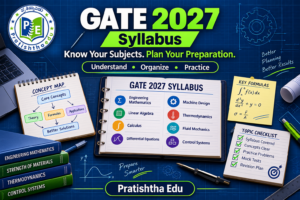
How to Analyse the GATE 2027 Syllabus
A syllabus becomes easier to manage when you divide it into smaller sections. Start by downloading the official syllabus for your selected paper and listing its major subjects and individual topics.
Next, assess your current understanding of each topic. You can use the following three categories to organize your preparation:
- Strong topics: Concepts you understand well and can apply while solving questions.
- Topics requiring revision: Subjects you have studied before but need to practise again.
- Topics requiring detailed study: Concepts that are unfamiliar or need additional explanation and practice.
This simple classification will help you identify where to begin and how to allocate your study time.
For example, if you are preparing for GATE Computer Science and already understand basic programming concepts, you may focus first on strengthening your weaker areas while continuing regular practice of familiar topics. Students preparing for Mechanical or Civil Engineering should use the same approach with subjects relevant to their respective papers.
Understand Your Branch-Wise Syllabus
Every GATE paper has its own subject requirements. Before choosing books, video lectures, or practice material, confirm that the resources match your selected examination paper.
Your syllabus review should include the following:
- Major subjects and their listed topics.
- Fundamental concepts required to understand advanced subjects.
- Mathematical or analytical concepts relevant to your paper.
- General Aptitude and any other applicable components.
- Topics that require additional revision or problem-solving practice.
Do not assume that the same subject priorities apply to every engineering branch. Previous-year question papers can help you understand the style of questions, but they should not replace the official syllabus.
Where to Find the Official GATE 2027 Syllabus
Visit the official GATE 2027 website and open the syllabus section for your selected paper. Download the relevant document and keep it accessible throughout your preparation.
The official website should be your primary reference for checking syllabus updates and examination-related information.
How to Use the Syllabus to Build Your Preparation Plan
Once you have reviewed the syllabus, turn it into a practical study checklist. Break larger subjects into smaller topics and set realistic deadlines for completing them.
After studying each topic, solve relevant questions to test your understanding. Mark difficult concepts for revision and revisit them during your weekly review.
If you are considering GATE coaching in Bangalore, compare the course syllabus with the official examination syllabus before enrolling. Check whether the programme covers the subjects relevant to your paper and provides enough time for practice, doubt clarification, and revision.
A well-organized syllabus checklist gives you a clear view of your progress and helps you move towards the next stage of preparation with greater confidence.
Create a Subject-Wise GATE 2027 Preparation Strategy
After reviewing the official syllabus, the next step is to turn it into a practical subject-wise preparation strategy. Instead of studying topics randomly, organize your learning around clear goals, regular practice, and revision.
A well-planned GATE 2027 preparation plan should consider your existing subject knowledge, the topics included in your chosen paper, and the time available before the examination. This approach helps you focus on understanding concepts rather than simply completing chapters.
Step 1: Start with Fundamental Concepts
Begin with the basic concepts required to understand more advanced topics in your selected discipline. A strong foundation makes it easier to solve numerical problems, understand technical principles and apply formulas correctly.
For example, students preparing for GATE Computer Science may need to revise mathematical and programming fundamentals before progressing to more advanced topics. Candidates in Mechanical, Civil, Electrical or Electronics and Communication Engineering should identify the prerequisite concepts relevant to their own syllabus.
Avoid rushing through difficult chapters just to mark them as completed. Make sure you can explain the main concept and apply it to practice questions.
Step 2: Divide Each Subject into Smaller Topics
Large subjects can feel difficult when you approach them as a single unit. Divide each subject into manageable topics and set realistic targets for completing them.
For every topic, follow a simple process:
- Understand the underlying concept.
- Review relevant formulas, definitions or methods.
- Solve basic questions to check your understanding.
- Attempt more challenging problems.
- Record mistakes and revise the topic later.
This method helps you monitor your progress and identify areas where you need additional support.
Step 3: Prioritize Topics Using the Right Criteria
Not every topic will require the same amount of preparation time. Prioritize your study sessions by considering your current understanding, the topic’s relevance to the official syllabus and your performance in practice questions.
Previous-year GATE papers can help you understand the types of questions asked and how concepts have been tested in earlier examinations. However, previous trends cannot guarantee which topics will appear in GATE 2027.
A useful approach is to work on difficult foundational topics early while continuing to revise the subjects you already understand.
Step 4: Practise Questions After Every Topic
Reading notes and watching lectures can help you learn, but solving questions is necessary to check whether you can apply that knowledge independently.
After completing a topic, practise relevant questions before moving to the next one. Start with basic problems and gradually progress to questions that require multiple concepts or several calculation steps.
When you get an answer wrong, identify the reason. You may have misunderstood a concept, applied an incorrect formula, made a calculation error, or misread the question.
Maintain a short error notebook so that you can revisit these mistakes during revision.
Step 5: Include General Aptitude in Your Routine
General Aptitude is an important part of GATE preparation. Make time for regular practice instead of leaving it entirely until the end of your syllabus.
Work on the areas included in the official examination syllabus, such as verbal ability, quantitative aptitude, and reasoning. Practise questions consistently and review the methods you find difficult.
Short, focused sessions can help you maintain familiarity with different question types while continuing your technical preparation.
Step 6: Review Your Progress Every Week
At the end of each week, review the topics you completed, the questions you solved, and the mistakes you made.
Ask yourself three questions:
- Which topics can I solve confidently?
- Which concepts still require revision?
- What should be my main priority next week?
Use your answers to adjust your timetable. If a topic requires additional practice, allocate more time to it rather than moving forward with unresolved conceptual gaps.
Students looking for structured guidance may also explore GATE coaching in Bangalore and compare available programmes based on subject coverage, faculty support, practice tests and doubt-clearing opportunities.
A consistent subject-wise approach will make your preparation more organized and help you build a stronger foundation for revision and mock-test practice.
Create a Practical GATE 2027 Study Plan
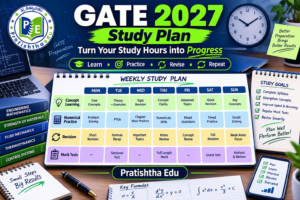
A realistic timetable can make GATE preparation easier to manage, especially when you need to balance technical subjects, General Aptitude, revision, and practice questions. Once you understand the syllabus and identify your weaker areas, create a study plan that fits your daily routine.
Your GATE 2027 preparation plan should not focus only on completing chapters. It should also include enough time for problem-solving, revision, and evaluating your performance through practice tests.
Step 1: Divide Your Preparation into Three Stages
A useful way to organize your preparation is to divide it into three stages: concept building, syllabus practice, and revision.
Stage 1: Concept Building
Begin by studying the fundamental concepts in your selected GATE paper. Follow the official syllabus, prepare concise notes, and solve basic questions after each topic.
Stage 2: Syllabus Coverage and Problem-Solving
Continue studying the remaining subjects while practising topic-wise questions and previous-year papers. Identify recurring mistakes and revisit difficult concepts before moving to more advanced problems.
Stage 3: Revision and Mock Tests
As your syllabus coverage improves, dedicate more time to revision, mixed-topic practice, and timed mock tests. Use your results to identify the areas that need further attention.
The time required for each stage depends on your existing knowledge, available study hours, and the examination date. Adjust the schedule according to your circumstances rather than following a fixed timetable blindly.
Step 2: Follow a 12-Week GATE Preparation Timetable
The following timetable is a flexible framework for candidates who have already covered some fundamentals. If you are starting from zero, you may need a longer preparation period.
Weeks 1–2: Assess Your Preparation and Strengthen Fundamentals
- Download and review the official GATE 2027 syllabus.
- Take a short diagnostic test to assess your current level.
- Identify strong subjects and topics that require additional work.
- Start revising foundational concepts and making short notes.
Weeks 3–4: Build Conceptual Understanding
- Continue studying important topics from your selected paper.
- Solve practice questions after each topic.
- Review formulas, definitions, and problem-solving methods.
- Include regular General Aptitude practice in your schedule.
Weeks 5–6: Continue Syllabus Coverage
- Progress through the remaining subjects according to your plan.
- Practise previous-year questions related to completed topics.
- Revise earlier subjects to prevent knowledge gaps.
- Maintain a list of difficult questions and recurring mistakes.
Weeks 7–8: Improve Problem-Solving Skills
- Attempt mixed-topic practice sets.
- Focus on applying concepts to unfamiliar questions.
- Revisit subjects where your practice performance is weak.
- Begin timed sectional tests when appropriate.
Weeks 9–10: Revise and Evaluate Your Progress
- Revise completed subjects using short notes.
- Attempt timed tests and analyse your performance.
- Review calculation errors and conceptual misunderstandings.
- Adjust your remaining study time according to your weaknesses.
Weeks 11–12: Focus on Mock Tests and Final Revision
- Attempt full-length mock tests under examination-like conditions.
- Analyse incorrect and unanswered questions.
- Revise important concepts and formulas.
- Practise time management and avoid unnecessary last-minute changes to your study resources.
This schedule is a suggested framework, not an official GATE timetable. Check the announced examination date and adapt the weeks to your actual preparation window.
Step 3: Create a Daily Study Routine
Your daily timetable should include different types of learning rather than spending the entire day reading theory.
For example, a student who can study for approximately six hours a day might follow this routine:
- 2 hours: Technical concepts and theory.
- 2 hours: Subject-wise numerical problems and practice questions.
- 1 hour: Previous-year questions or revision of difficult topics.
- 30 minutes: General Aptitude practice.
- 30 minutes: Formula revision and planning for the next day.
You can rearrange these sessions depending on your college schedule, work commitments, and personal learning pace. Take short breaks between sessions to maintain concentration.
Step 4: Track Your Weekly Progress
At the end of each week, review what you have completed and identify the topics that still need attention.
Maintain a simple tracker with the following details:
- Topics completed.
- Practice questions attempted.
- Accuracy and recurring mistakes.
- Subjects requiring revision.
- Targets for the following week.
Do not measure progress only by the number of chapters completed. Your ability to understand concepts and solve questions independently is equally important.
If you are considering GATE coaching in Bangalore, compare available programmes with your preparation schedule. Check whether the classes, practice sessions, and revision support fit your needs and leave enough time for independent study.
A well-organized timetable will help you approach preparation systematically, recognize weak areas early, and use your remaining study time more effectively.
Use Previous-Year Questions and Mock Tests Effectively
Completing the syllabus is an important milestone, but it does not automatically mean you are ready for the GATE examination. You also need to understand how to apply concepts, solve questions accurately, and manage your time under examination conditions.
Previous-year question papers and mock tests can help you evaluate your preparation and identify areas that need improvement. When used alongside the official GATE 2027 syllabus, they provide a practical way to measure your progress and refine your study strategy.
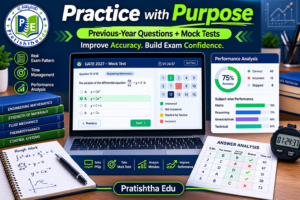
Why Previous-Year GATE Questions Are Important
Previous-year questions help you understand how concepts from your selected paper are tested in an examination setting. They also allow you to practise different question formats and become familiar with the level of reasoning required.
Instead of attempting every question randomly, organize your practice around the subjects and topics you have already studied.
Follow these steps to get more value from previous-year papers:
Practise topic-wise questions: Solve questions related to a topic immediately after completing it.
Review the solution carefully: Understand the reasoning behind the correct answer instead of memorizing the final result.
Identify recurring mistakes: Record conceptual errors, calculation mistakes, and incorrect assumptions.
Attempt mixed-topic sets: Once you have covered several subjects, combine questions from different areas to improve flexibility.
Revisit difficult questions: Return to questions you previously answered incorrectly and try solving them independently.
Previous-year papers can help you understand past examination trends, but they cannot predict the exact questions or topics that will appear in GATE 2027.
How to Use Mock Tests During GATE Preparation
Mock tests allow you to practise answering questions within a fixed time limit. They can help you understand your current performance, improve time management, and identify topics that require additional revision.
Start with topic-wise or sectional tests while you are learning the syllabus. As your preparation develops, gradually introduce mixed-subject tests and full-length mock examinations.
For the best results, attempt mock tests under conditions similar to the actual examination. Avoid checking notes or solutions while taking a timed test, and review your answers only after completing the attempt.
Analyse Every Mock Test, Not Just Your Score
Your score provides useful information, but the analysis after a test is equally important. A low score may indicate a conceptual gap, poor question selection, calculation errors, or difficulty managing time.
After each mock test, review the following areas:
- Conceptual mistakes
Identify questions where you did not understand the underlying concept. Revisit the relevant topic and solve additional questions before attempting similar problems again.
- Calculation errors
Check whether you used the correct formula, followed the calculation steps properly, and verified your final answer where possible.
- Time-management problems
Notice which questions took longer than expected. Practise recognizing when to continue solving a question and when to move on to another one.
- Unattempted questions
Review questions you skipped. Determine whether you lacked the necessary knowledge, could not identify the correct approach or simply ran out of time.
- Repeated mistakes
Maintain an error notebook containing the questions or concepts you repeatedly get wrong. Review it during your weekly revision sessions.
Improve Accuracy and Time Management
Effective time management starts with understanding the question and selecting an appropriate solving method. During practice, learn to distinguish between questions you can solve confidently and those that require more time.
You can improve your approach by following these habits:
Read each question carefully before beginning calculations.
Practise mental calculations and formula application where appropriate.
Avoid spending too much time on a single difficult question during timed practice.
Review the official marking scheme for your selected paper.
Practise MCQ, MSQ, and NAT questions according to their different answer formats and marking rules.
Remember that negative marking applies to certain incorrect answers in MCQs, according to the applicable examination rules. Check the official GATE 2027 question paper pattern before finalizing your examination strategy.
Create a Simple Mock-Test Performance Tracker
Keep a record of each mock test so you can identify patterns in your performance over time.
Your tracker can include:
Test date and paper or subject covered.
Score obtained.
Questions answered incorrectly.
Topics requiring revision.
Time-management issues.
Action points for the next test.
Use this information to plan your next study sessions. For example, if you repeatedly struggle with a particular subject, revisit its fundamental concepts and practise targeted questions before taking another test.
Students preparing through self-study or exploring GATE coaching in Bangalore can benefit from this approach. When comparing coaching programmes, check whether they include relevant practice tests, performance analysis, and opportunities to clarify doubts.
The goal is not simply to attempt more tests. It is to learn from every test, reduce repeated mistakes, and develop a more reliable approach to solving examination questions.
Common GATE Preparation Mistakes to Avoid
Preparing for GATE 2027 requires more than completing chapters and solving practice questions. Your study habits, revision schedule, and approach to difficult topics can also influence how effectively you prepare.
Many students spend considerable time studying but struggle to assess their progress or use their preparation time efficiently. Identifying common mistakes early can help you make better decisions and build a more consistent study routine.
Mistake 1: Studying Without Following the Official Syllabus
One common mistake is studying from random resources without checking whether the topics are included in the selected GATE paper.
This can lead to unnecessary work while important syllabus areas receive less attention.
How to avoid it: Download the official GATE 2027 syllabus for your chosen paper. Use it as a checklist and mark topics as you complete them. Check the official website for any updates before relying on older study material.
Mistake 2: Focusing Only on Theory and Ignoring Practice
Reading textbooks, watching lectures, and making notes can help you understand concepts, but these activities alone may not prepare you to solve examination questions independently.
You need to apply what you learn through regular problem-solving.
How to avoid it: After studying a topic, solve related questions and review the methods used in their solutions. Gradually increase the difficulty of the questions as your understanding improves.
Mistake 3: Collecting Too Many Study Materials
Switching constantly between books, online lectures, notes, and multiple question banks can make preparation confusing. You may spend more time searching for resources than actually studying.
How to avoid it: Select a manageable set of reliable resources that covers your official syllabus. Use additional material when it addresses a specific learning gap rather than changing resources without a clear reason.
Mistake 4: Ignoring Revision Until the End
Students sometimes focus entirely on completing new chapters and postpone revision. As a result, concepts studied earlier may become difficult to recall when they are needed.
How to avoid it: Schedule weekly revision sessions from the beginning of your preparation. Maintain concise notes containing important formulas, concepts, and mistakes so that you can review them efficiently.
Mistake 5: Avoiding Difficult Subjects
Spending all your study time on familiar topics may feel productive, but it can leave important conceptual gaps unresolved.
How to avoid it: Identify the reason a topic feels difficult. Revisit its fundamentals, divide it into smaller sections, and practise questions gradually. Seek clarification when a concept remains unclear after repeated attempts.
Mistake 6: Taking Mock Tests Without Analysing Results
Attempting numerous mock tests without reviewing mistakes may not lead to meaningful improvement. Your score alone does not explain why you lost marks or which concepts require additional practice.
How to avoid it: After every test, analyse incorrect answers, unanswered questions, calculation mistakes, and time-management problems. Use these findings to decide what to revise before your next test.
Mistake 7: Following an Unrealistic Study Timetable
A timetable with too many daily targets can become difficult to maintain, particularly for students balancing college examinations, projects or other commitments.
Missing targets repeatedly can also make it harder to track progress accurately.
How to avoid it: Set achievable daily goals and divide large subjects into smaller tasks. Leave time for revision, practice, and unexpected academic commitments. Review your schedule each week and adjust it when necessary.
Mistake 8: Comparing Your Progress Constantly With Others
Every candidate begins with a different level of subject knowledge, study experience, and available preparation time. Comparing your progress with someone else’s can distract you from your own learning needs.
How to avoid it: Track your personal progress through completed topics, practice performance, and recurring mistakes. Use other students’ experiences as a source of ideas rather than as a measure of your own potential.
Mistake 9: Neglecting General Aptitude and Time Management
Focusing exclusively on technical subjects can leave insufficient time for General Aptitude practice and examination-specific preparation.
How to avoid it: Include General Aptitude in your regular schedule and practise timed questions. Learn the question formats and marking rules applicable to your selected GATE paper.
Mistake 10: Choosing Coaching Without Checking Course Details
Students considering GATE coaching in Bangalore may compare institutes based only on advertisements, fees, or general claims about results. However, the right programme should also match their selected paper and learning requirements.
How to avoid it: Before enrolling, check the course syllabus, faculty support, batch schedule, practice-test arrangements, doubt-clearing facilities, and total fees. Confirm which branches and subjects are currently offered.
Build Better Study Habits for GATE 2027
Avoiding these mistakes can help you use your preparation time more effectively. Focus on understanding concepts, practising questions, revising consistently, and learning from your errors.
You do not need a perfect timetable from the first day. What matters is having a realistic plan, reviewing your progress, and making improvements when your current approach is not working.
With consistent effort and a clear understanding of the official syllabus, you can develop a more organized approach to GATE 2027 preparation.
Self-Study vs GATE Coaching in Bangalore: How to Choose the Right Approach
Can You Prepare for GATE 2027 Through Self-Study?
Yes, self-study can be a practical option for students who understand their core engineering subjects, can identify the right study materials, and follow a disciplined timetable.
With self-study, you can organise your preparation around your strengths and weaknesses. You can spend more time on difficult subjects, revise at your own pace and choose when to practise previous-year questions and mock tests.
However, self-study also requires you to evaluate your own progress honestly. If you repeatedly postpone difficult topics, struggle to understand concepts, or cannot identify why your mock-test scores are low, you may need additional guidance.
Self-study may suit you if you:
- Have a good understanding of your engineering fundamentals.
- Can follow a realistic daily and weekly timetable.
- Know how to find reliable study resources.
- Practise questions regularly and analyse your mistakes.
- Can maintain consistency without external supervision.
What Are the Benefits of Joining GATE Coaching in Bangalore?
A structured coaching programme can help students follow a planned preparation schedule. It may be particularly useful for those who need concept clarification, regular practice, or guidance in completing the syllabus.
When comparing GATE coaching in Bangalore, look beyond advertisements and fee offers. Check whether the course matches your GATE paper, current syllabus, and preparation level.
A suitable coaching programme may provide:
- Structured syllabus coverage: Topics are organised into a planned learning sequence.
- Faculty guidance: Teachers can help explain challenging engineering concepts and problem-solving methods.
- Regular practice: Topic-wise assignments and tests help you apply what you learn.
- Performance feedback: Test analysis can highlight weak subjects and recurring mistakes.
- Revision support: Planned revision sessions can help you revisit important concepts.
- Study discipline: A timetable and regular classes can make it easier to maintain consistency.
Coaching does not guarantee a GATE qualification or a particular score. Your results still depend on conceptual understanding, consistent practice, revision, and performance on exam day.
Self-Study vs Coaching: Which Is Better for You?
The following comparison can help you make a practical decision.
| Factor | Self-Study | GATE Coaching |
| Study schedule | You create your own timetable | Classes may follow a structured schedule |
| Learning support | You solve doubts independently or seek outside help | Faculty support may be available |
| Study resources | You select and organise your materials | Course materials may be provided |
| Practice and tests | You arrange your own practice and mock tests | Regular tests may be included |
| Flexibility | Usually offers greater flexibility | Depends on batch timings and course format |
| Cost | Often lower, depending on resources used | Fees vary by institute and course |
| Accountability | Requires strong self-discipline | Scheduled classes can provide structure |
Neither method is automatically better for every student. Choose the approach that addresses your actual preparation needs.
How to Choose the Right GATE Coaching Institute in Bangalore
If you decide to join a coaching institute, compare a few options carefully before paying the fees. The most suitable institute is one that supports your learning requirements rather than simply making attractive promises.
- Check the course for your engineering branch
Confirm that the programme covers your selected GATE paper and follows the applicable official syllabus. Course availability and subject coverage can vary by institute.
- Understand the teaching approach
Ask whether classes focus on concept building, numerical problem-solving, previous-year questions and doubt clarification. If possible, attend a demo class before making a decision.
- Review the test and revision schedule
A good preparation routine should include topic-wise practice, revision and mock-test analysis—not just lectures. Ask how often tests are conducted and whether feedback is provided.
- Compare fees and course inclusions
Check what the quoted fee covers, such as classroom sessions, online access, study materials, test series, and revision classes. Confirm any additional charges before enrolling.
- Check batch timings and learning support
Choose a schedule you can maintain alongside college, work, or other responsibilities. If you need additional help with difficult topics, ask how doubts are handled.
- Verify claims before enrolling
Do not rely only on promotional statements or guaranteed-result claims. Review the course details, faculty information, and available student feedback before deciding.
Can You Combine Self-Study With GATE Coaching?
Yes. A blended approach can work well for students who want expert guidance while retaining control over their daily preparation.
For example, you could attend classes for difficult subjects, revise the concepts independently, solve previous-year questions, and use mock tests to measure your progress. For topics you already understand, focused self-study may be sufficient.
A simple weekly routine could include:
- Concept learning: Attend classes or study the topic independently.
- Question practice: Solve topic-wise numerical problems and previous-year questions.
- Doubt clearing: Revisit questions you could not solve and seek help where necessary.
- Revision: Review formulas, key concepts, and mistakes from earlier tests.
- Performance review: Identify weak areas and adjust the next week’s timetable.
This approach allows you to use coaching where it adds value without becoming completely dependent on classroom sessions.
How Pratishtha Edu Can Fit Into Your GATE Preparation
Students looking for academic guidance can explore the GATE preparation options available at Pratishtha Edu and compare them with their individual requirements.
Before enrolling, enquire about your specific engineering branch, syllabus coverage, class schedule, faculty support, practice tests, and fees. This will help you determine whether the available programme matches your preparation plan.
You can also read our guide on GATE 2027 preparation strategy for practical study-planning advice and our article on choosing the right GATE coaching institute in Bangalore for more factors to consider.
Add internal links to these published articles and the relevant GATE course page on the Pratishtha Edu website.
Final Thoughts: Choose a Preparation Method You Can Follow Consistently
The choice between self-study and coaching should be based on your current knowledge and available time
GATE 2027 Revision Strategy and Last-Minute Preparation Tips
Completing the GATE syllabus is an important milestone, but effective revision is equally important. Students often spend several months learning new concepts and solving problems, yet struggle to recall formulas, apply concepts quickly, or manage time during the examination.
A well-planned revision strategy helps you strengthen what you have already studied, identify remaining weak areas, and become more comfortable with exam-style questions. Instead of trying to study everything again from the beginning, focus on revising strategically and practising consistently.
Why Is Revision Important for GATE 2027?
GATE tests conceptual understanding and the ability to apply knowledge to different types of questions. Simply reading notes multiple times may not be enough to prepare for the examination.
Regular revision helps you remember important concepts, recognise common problem-solving methods, and reduce repeated mistakes. It also allows you to identify topics that need more attention before the exam.
Revise a part of your preparation from the beginning rather than waiting until the entire syllabus is complete.
Create Short Notes for Every Subject
Short notes can make your final revision more manageable. Instead of reading lengthy textbooks or complete lecture notes every time, prepare concise summaries while studying each subject.
Your revision notes can include:
Important formulas and equations.
Key concepts and definitions.
Frequently used problem-solving methods.
Important conditions, assumptions, and exceptions.
Mistakes made while solving previous-year questions.
Topics that require additional practice.
Keep the notes organised subject-wise and update them whenever you discover an important concept or repeated error.
Avoid copying entire chapters into your revision notebook. The purpose is to create a quick reference that helps you recall essential information efficiently.
Follow a Subject-Wise Revision Plan
Do not divide your revision time equally between every subject without considering your preparation level. Some subjects may require more practice, while others may need only a quick review.
Classify each subject into three categories:
Strong subjects: Revise important concepts and solve mixed questions to maintain accuracy.
Moderate subjects: Review concepts, practise standard problems, and identify areas where you hesitate.
Weak subjects: Revisit the fundamentals, solve basic questions first, and gradually move towards more challenging problems.
Give extra attention to subjects that you find difficult, but do not completely ignore the subjects you have already mastered. Regular practice helps maintain confidence across the syllabus.
Use Previous-Year Questions During Revision
Previous-year GATE questions are useful for checking whether you can apply a concept rather than simply remember it.
After revising a topic, solve relevant questions without immediately looking at the solutions. If you cannot solve a question, identify the reason before moving on.
Ask yourself:
Did I forget a formula or concept?
Did I misunderstand what the question was asking?
Was my calculation incorrect?
Did I choose an inefficient solving method?
Did I spend too much time on the problem?
Record recurring mistakes in a separate error notebook. Review that notebook during subsequent revision sessions so you can track whether the same errors are continuing.
Take Mock Tests and Analyse Your Performance
Mock tests help you practise working under time constraints and understand how well you apply your preparation across different subjects.
However, taking more tests does not automatically improve performance. The most valuable step is reviewing your answers after each test.
After completing a mock test, examine:
Questions you answered incorrectly.
Questions you left unanswered despite knowing the concept.
Questions that took longer than expected.
Topics where you made repeated calculation errors.
Sections where you spent too much time.
Questions you answered correctly but found difficult.
Use this analysis to decide what to revise next. If your mistakes mainly come from conceptual gaps, return to the relevant topic. If you understand the concepts but struggle with speed, practise more questions of a similar type.
Improve Time Management Before the Examination
Time management is an important part of GATE preparation because students must balance accuracy with the time available.
Practise solving questions within reasonable time limits, but avoid rushing through problems just to finish quickly. An incorrect answer caused by careless reading can be as frustrating as a question you could not solve.
During mock tests, practise identifying questions you can solve confidently and those that may require more time. If a question is taking too long, consider moving forward and returning to it later when appropriate.
Your strategy should follow the official examination instructions and the rules applicable to your question paper. Remember that negative marking applies to specified MCQ questions, while MSQ and NAT questions have different marking rules. Review the current official pattern rather than relying on outdated exam information.
Follow a Practical Seven-Day Revision Schedule
If you have seven days available for a focused revision cycle, use the following flexible plan. It can be adapted to your branch, syllabus coverage, and current preparation level.
| Day | Main task |
| Day 1 | Revise key concepts and formulas from a difficult subject |
| Day 2 | Practise topic-wise questions and review mistakes |
| Day 3 | Revise another important subject and solve previous-year questions |
| Day 4 | Review General Aptitude and Engineering Mathematics, where applicable |
| Day 5 | Attempt a full-length mock test under exam-like conditions |
| Day 6 | Analyse the mock test and revise weak topics |
| Day 7 | Review short notes, formulas, and your error notebook |
This is an example, not a fixed timetable for every student. If your syllabus is still incomplete, adjust the schedule to cover essential remaining topics while preserving time for practice and revision.
What Should You Avoid During the Final Preparation Phase?
The final phase of preparation should focus on strengthening your knowledge rather than creating unnecessary pressure.
Avoid these common mistakes:
Starting several new books or courses without a clear reason.
Spending too much time on a single difficult topic.
Ignoring subjects you have already studied.
Taking mock tests without reviewing your answers.
Comparing your test scores constantly with other students.
Making major changes to your preparation strategy at the last moment.
Sacrificing adequate sleep to study for excessively long hours.
Prioritise your weak areas, maintain a manageable routine, and use your available time carefully. A consistent approach is generally more useful than making sudden, unrealistic changes.
How Coaching and Self-Study Can Support Revision
Students preparing independently can use short notes, previous-year questions, mock tests and weekly reviews to organise their revision.
Students enrolled in coaching can use faculty guidance, revision sessions, and practice tests where these are available. If you are considering GATE coaching in Bangalore, check whether the programme includes structured revision, doubt-clearing support and test analysis relevant to your selected paper.
At Pratishtha Edu, prospective students should enquire about the available GATE course, branch coverage, class schedule, revision support and test facilities before deciding whether the programme suits their needs.
You can also read our earlier guides on GATE 2027 preparation strategy and choosing the right GATE coaching institute in Bangalore for additional planning advice.
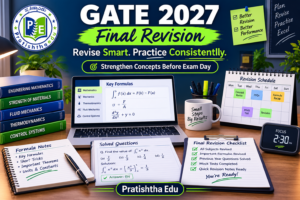
Final Checklist for GATE 2027 Revision
Before the examination, review your preparation using this checklist:
I have checked the official syllabus for my selected GATE paper.
I have revised the major concepts covered in my preparation.
I have organised my important formulas and short notes.
I have practised previous-year questions.
I have reviewed mistakes from mock tests.
I have identified and revised my weaker topics.
I understand the current exam pattern and marking rules.
I have practised managing my time during tests.
I have planned a manageable final revision routine.
Final Thoughts
A good GATE 2027 revision strategy is built around regular practice, focused review, and honest evaluation of your progress. You do not need to restart your preparation every time you discover a weak area. Instead, identify the gap, revise the relevant concept, practise questions, and check whether your understanding has improved.
Keep your revision plan realistic, follow the official GATE 2027 updates, and concentrate on improving your own performance. Consistent preparation can help you approach the examination with greater clarity and confidence.
Leave a Reply