
Introduction to Civil Engineering Training in Bangalore
Civil Engineering Training Bangalore is important for students pursuing Diploma, BE and B.Tech courses who want to strengthen their understanding of core engineering subjects. From Structural Analysis and RCC Design to Surveying, Geotechnical Engineering and Fluid Mechanics, students need a clear understanding of theoretical concepts and their practical applications. Subject-wise academic guidance can help students improve their knowledge and prepare effectively for examinations.
However, many students find certain engineering subjects challenging because they involve mathematical calculations, technical drawings, structural concepts, and numerical problem-solving. Subjects such as Engineering Mathematics, Strength of Materials, Structural Analysis, RCC Design, Geotechnical Engineering and Fluid Mechanics require regular practice and a clear understanding of fundamental concepts.
This is why students often look for Civil Engineering Training Institutes in Bangalore that can provide academic guidance, subject-wise tuition, and additional learning support during their engineering studies.
Whether you are studying in the first year or preparing for advanced Civil Engineering subjects, the right academic support can help you understand difficult topics, improve problem-solving skills, and prepare more confidently for university examinations.
Students pursuing BE Civil Engineering should understand their university syllabus before planning their subject-wise preparation. They can refer to the official VTU BE Civil Engineering syllabus to review the prescribed subjects, course structure and academic requirements.

Why Do Civil Engineering Students Need Subject-Wise Tuition?
Civil Engineering is a broad academic discipline with several interconnected subjects. Understanding basic concepts is important because many advanced topics depend on the knowledge gained in earlier semesters.
For example, Engineering Mechanics and Strength of Materials help students understand forces, stress, strain, and structural behaviour. These concepts become useful when studying Structural Analysis, RCC Design and Steel Structure Design.
Similarly, Engineering Mathematics supports numerical calculations across subjects such as Fluid Mechanics, Hydrology, and Structural Engineering.
Students searching for Civil Engineering Subject Tuition in Bangalore may need academic assistance for different reasons, including:
- Understanding complex engineering concepts and numerical problems.
- Preparing for internal assessments and semester examinations.
- Revising difficult subjects and important syllabus topics.
- Improving technical drawing and analytical skills.
- Getting additional explanations for topics covered in college.
- Practising subject-related problems and previous examination questions.
Subject-wise learning support can help students focus on the topics where they need additional guidance instead of repeating subjects they already understand.
Who Can Benefit from Civil Engineering Academic Support?
Civil Engineering subject tuition may be useful for different categories of students:
- Diploma Civil Engineering Students: Students who need help understanding fundamental engineering concepts and diploma-level subjects.
- BE and B.Tech Students: Undergraduate students looking for support with semester-wise subjects, numerical problems, and university examinations.
- Students Preparing for Backlogs: Students who want to revise specific subjects and strengthen their understanding before supplementary examinations.
- Students Who Need Conceptual Clarity: Learners who want additional explanations and guided practice beyond regular college lectures.
- M.Tech Students: Postgraduate students who may require support in selected advanced topics, depending on their specialisation.
Students planning postgraduate studies in Civil Engineering should also review the subjects and academic structure prescribed for their programme. The VTU PG scheme and syllabus can help students understand the postgraduate curriculum.
Need Help with Your Civil Engineering Subjects?
Complete List of Civil Engineering Subjects and Their Important Topics
Civil Engineering includes several technical subjects that help students understand how infrastructure projects are planned, designed, constructed, and maintained. Each subject develops a different set of engineering skills, from mathematical calculations and structural design to soil testing, transportation planning, and environmental protection.
Students pursuing a Diploma, BE or B. Tech in Civil Engineering study a combination of basic engineering subjects, core technical papers, laboratory subjects, and advanced topics. Understanding these subjects is important for academic performance as well as developing the technical knowledge required in the construction and infrastructure industries.
Below is a detailed overview of the major Civil Engineering subjects and the topics students commonly study.
The subjects and topics covered in Civil Engineering may differ depending on the university and academic scheme. Students studying under Visvesvaraya Technological University can check the official VTU syllabus to understand their prescribed subjects and curriculum.
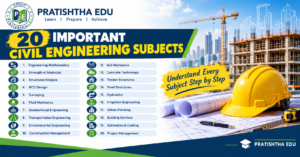
1. Engineering Mathematics
Engineering Mathematics is a foundational subject used in several areas of Civil Engineering. Students apply mathematical concepts to solve engineering problems, perform calculations, and analyse technical data.
Important topics include:
- Differential and Integral Calculus
- Differential Equations
- Matrices and Linear Algebra
- Vector Calculus
- Probability and Statistics
- Numerical Methods
- Complex Variables
Students looking for Engineering Mathematics tuition often need additional practice in solving numerical problems and understanding mathematical methods used in engineering applications.
2. Engineering Mechanics
Engineering Mechanics introduces students to the behaviour of forces and their effects on physical bodies. It provides the foundation for understanding structural systems and load distribution.
Important topics include:
- Force Systems and Resultants
- Equilibrium of Forces
- Moments and Couples
- Friction
- Centroid and Centre of Gravity
- Moment of Inertia
- Analysis of Simple Structures
A clear understanding of Engineering Mechanics helps students progress to Strength of Materials and Structural Analysis.
3. Strength of Materials
Strength of Materials, also known as Mechanics of Solids, explains how different materials behave when subjected to external forces and loads.
Important topics include:
- Stress and Strain
- Elasticity and Hooke’s Law
- Shear Force and Bending Moment
- Bending and Shear Stresses
- Torsion of Shafts
- Deflection of Beams
- Principal Stresses and Mohr’s Circle
- Columns and Buckling
This subject involves several numerical problems, diagrams and engineering calculations. Regular practice is important for developing confidence in solving these problems.
4. Building Materials and Construction Technology
This subject introduces students to the materials used in building construction and the methods followed during construction activities.
Important topics include:
- Properties of Building Materials
- Cement and Concrete
- Bricks and Blocks
- Timber and Steel
- Mortar and Aggregates
- Foundations and Masonry
- Doors, Windows and Flooring
- Construction Methods and Techniques
- Building Components and Finishes
Students learn how construction materials are selected and used according to structural requirements, durability and project conditions.
5. Surveying
Surveying is an essential Civil Engineering subject used to measure land, determine elevations and prepare maps and plans for construction projects.
Important topics include:
- Chain Surveying
- Compass Surveying
- Plane Table Surveying
- Levelling and Contouring
- Theodolite Surveying
- Traversing
- Total Station Surveying
- GPS and Modern Surveying Techniques
- Area and Volume Calculations
Surveying knowledge is useful in road construction, land development, building layout, and infrastructure projects.
6. Fluid Mechanics and Hydraulics
Fluid Mechanics deals with the behaviour of liquids and gases at rest and in motion. It is an important subject for understanding water-related engineering systems.
Important topics include:
- Properties of Fluids
- Fluid Pressure and Measurement
- Hydrostatic Forces
- Buoyancy and Flotation
- Bernoulli’s Theorem
- Flow Through Pipes
- Flow Measurement
- Open Channel Flow
- Hydraulic Machines
- Pumps and Turbines
Students should understand the underlying concepts and practise numerical problems involving fluid properties, pressure and flow.
7. Structural Analysis
Structural Analysis explains how beams, columns, trusses and frames respond to different loads. It helps students understand how forces are transferred through structural systems.
Important topics include:
- Determinate and Indeterminate Structures
- Analysis of Trusses
- Analysis of Beams and Frames
- Influence Lines
- Slope Deflection Method
- Moment Distribution Method
- Energy Methods
- Matrix Methods of Structural Analysis
Structural Analysis is one of the important subjects for students interested in structural design and construction engineering. Students searching for Structural Analysis Tuition may particularly need guidance with numerical methods and structural problem-solving.
8. Design of Reinforced Cement Concrete Structures (RCC Design)
RCC Design focuses on designing concrete structural elements reinforced with steel to safely resist different types of loads.
Important topics include:
- Working Stress Method
- Limit State Design
- Singly and Doubly Reinforced Beams
- One-Way and Two-Way Slabs
- Design of Columns
- Design of Footings
- Staircase Design
- Development Length and Reinforcement Detailing
Students looking for RCC Design Classes generally need to understand design procedures, calculations, reinforcement requirements and relevant design provisions.
9. Steel Structure Design
Steel Structure Design teaches students how to design structural elements made from steel for buildings, industrial structures, and other engineering applications.
Important topics include:
- Properties of Structural Steel
- Design of Tension Members
- Design of Compression Members
- Steel Beams and Columns
- Bolted Connections
- Welded Connections
- Plate Girders
- Roof Trusses
- Structural Connections
This subject develops an understanding of steel design calculations, structural safety and connection details.
10. Geotechnical Engineering and Soil Mechanics
Geotechnical Engineering studies the engineering properties of soil and its behaviour under different loading and environmental conditions. It is essential for foundation design and construction planning.
Important topics include:
- Soil Formation and Classification
- Index Properties of Soil
- Soil Compaction
- Permeability of Soil
- Seepage Analysis
- Consolidation
- Shear Strength of Soil
- Earth Pressure
- Slope Stability
- Bearing Capacity of Soil
Foundation Engineering is closely related to this subject and covers shallow foundations, deep foundations, piles and other foundation systems.
Students searching for Geotechnical Engineering Tuition may require additional help with soil mechanics concepts, laboratory test calculations and numerical problem-solving.
11. Transportation Engineering
Transportation Engineering deals with the planning, design, construction and maintenance of transportation infrastructure.
Important topics include:
- Highway Planning and Alignment
- Geometric Design of Roads
- Highway Materials
- Pavement Design
- Traffic Engineering
- Road Safety
- Railway Engineering
- Airport Engineering
- Traffic Surveys and Transportation Planning
The subject helps students understand how safe and efficient transportation systems are developed.
12. Environmental Engineering
Environmental Engineering focuses on protecting public health and the environment through proper water supply, wastewater treatment and pollution control systems.
Important topics include:
- Water Supply Engineering
- Water Quality and Treatment
- Wastewater Collection Systems
- Sewage Treatment
- Water Distribution Networks
- Solid Waste Management
- Air Pollution Control
- Noise Pollution
- Environmental Impact Assessment
These concepts are important for developing sustainable infrastructure and managing environmental challenges.
13. Hydrology and Water Resources Engineering
Hydrology deals with the movement, distribution, and management of water in the natural environment. Water Resources Engineering applies these concepts to the planning and design of water-related infrastructure.
Important topics include:
- Hydrological Cycle
- Rainfall and Runoff
- Infiltration and Evaporation
- Hydrographs
- Groundwater
- Reservoir Planning
- Irrigation Engineering
- Dams and Spillways
- Canal Systems
- Flood Management
Students learn how water resources are assessed, stored, distributed, and managed.
14. Estimation, Costing and Quantity Surveying
This subject teaches students how to calculate construction quantities, estimate project costs, and prepare essential project documents.
Important topics include:
- Estimation of Building Quantities
- Measurement of Earthwork
- Quantity Calculation for Concrete and Masonry
- Rate Analysis
- Bill of Quantities (BOQ)
- Material Estimation
- Labour and Equipment Costing
- Valuation of Buildings
- Tendering and Contract Documents
These skills are useful in construction planning, project execution, and quantity surveying roles.
15. Construction Planning and Management
Construction Planning and Management focuses on organising construction projects within defined budgets, schedules, and quality requirements.
Important topics include:
- Construction Project Planning
- Project Scheduling
- CPM and PERT
- Resource Management
- Labour and Equipment Planning
- Construction Cost Control
- Quality Management
- Construction Safety
- Contract Management
- Site Supervision
Students learn how construction activities are coordinated and monitored throughout a project.
16. Engineering Drawing and Computer-Aided Design
Engineering Drawing develops students’ ability to read, understand, and prepare technical drawings. Computer-Aided Design introduces digital tools used for creating engineering drawings and design plans.
Important topics include:
- Engineering Drawing Fundamentals
- Orthographic Projections
- Isometric Views
- Building Plans and Elevations
- Sections and Detailed Drawings
- AutoCAD Basics
- Dimensioning and Drafting
- Reading Structural Drawings
These skills help students understand technical drawings used in building design and construction projects.
17. Engineering Geology
Engineering Geology explains the geological conditions that influence construction and infrastructure development.
Important topics include:
- Types of Rocks and Minerals
- Geological Structures
- Weathering and Erosion
- Geological Maps
- Groundwater Conditions
- Landslides
- Site Investigation
- Geological Factors in Foundation Construction
Understanding geological conditions helps engineers assess construction sites and identify possible ground-related challenges.
18. Earthquake Engineering
Earthquake Engineering studies how buildings and structures respond to seismic forces and how structural systems can be designed to improve earthquake resistance.
Important topics include:
- Earthquake Fundamentals
- Seismic Waves
- Seismic Zones
- Earthquake Forces on Structures
- Structural Response
- Ductile Detailing
- Seismic Design Principles
- Earthquake-Resistant Construction
This subject is particularly important for understanding structural safety in earthquake-prone areas.
19. Concrete Technology
Concrete Technology deals with the properties, production, testing, and performance of concrete used in construction.
Important topics include:
- Cement Properties
- Aggregates and Their Properties
- Water-Cement Ratio
- Concrete Mix Design
- Fresh and Hardened Concrete
- Workability Tests
- Compressive Strength Tests
- Concrete Durability
- Special Types of Concrete
Students learn how concrete quality is assessed and how suitable concrete mixes are selected for different applications.
20. Advanced and Elective Civil Engineering Subjects
Depending on the university, academic scheme, and specialisation, Civil Engineering students may also study advanced and elective subjects such as:
- Advanced Structural Engineering
- Bridge Engineering
- Prestressed Concrete
- Finite Element Methods
- Ground Improvement Techniques
- Advanced Foundation Engineering
- Urban Planning
- Green Building Technology
- Remote Sensing and GIS
- Sustainable Construction
- Infrastructure Management
The availability and names of elective subjects can differ across universities and academic schemes.
Semester-Wise Civil Engineering Subjects: What Do Students Learn?
The Civil Engineering curriculum is generally divided into different semesters, with each stage introducing students to new engineering concepts and technical applications. During the initial semesters, students develop a foundation in mathematics, physics, engineering mechanics, and basic engineering principles. As they progress, they study specialised subjects related to structural design, soil mechanics, transportation, environmental engineering and construction management.
The exact subjects and semester arrangements may differ between universities, academic regulations, and course schemes. The following is a general learning progression to help students understand how Civil Engineering topics are introduced throughout an undergraduate programme.
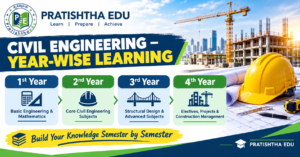
First Year: Basic Engineering and Foundation Subjects
During the first year, students generally study foundational subjects that support their understanding of engineering.
Common subjects include:
- Engineering Mathematics
- Engineering Physics and Chemistry
- Basic Electrical and Mechanical Engineering
- Engineering Mechanics
- Engineering Drawing
- Programming or Basic Computing
- Environmental Studies
Topics that may require additional practice: Engineering Mathematics, Engineering Mechanics, and Engineering Drawing.
Students need to develop strong fundamentals because these subjects support several advanced Civil Engineering papers.
Second Year: Core Civil Engineering Subjects
The second year usually introduces students to the main technical concepts of Civil Engineering.
Common subjects include:
- Strength of Materials
- Building Materials and Construction
- Surveying
- Fluid Mechanics
- Engineering Geology
- Concrete Technology
- Basic Structural Analysis
Topics that may require additional practice: Stress and strain calculations, shear force and bending moment diagrams, surveying calculations, fluid pressure and flow problems.
At this stage, students begin connecting theoretical concepts with construction and infrastructure applications.
Third Year: Advanced Civil Engineering and Design Subjects
During the third year, students generally study more specialised subjects that involve engineering calculations, design procedures and technical analysis.
Common subjects include:
- Structural Analysis
- Reinforced Cement Concrete Design
- Geotechnical Engineering
- Foundation Engineering
- Transportation Engineering
- Environmental Engineering
- Hydrology and Water Resources Engineering
Topics that may require additional practice: RCC beam and slab design, structural analysis methods, soil mechanics numerical problems, foundation calculations, and pavement design.
These subjects often require students to understand multiple concepts together and apply suitable engineering methods to solve problems.
Fourth Year: Advanced Topics, Electives and Project Work
The final year generally focuses on advanced subjects, specialised electives and practical project work.
Depending on the university and chosen electives, students may study:
- Steel Structure Design
- Construction Planning and Management
- Estimation and Costing
- Quantity Surveying
- Earthquake Engineering
- Bridge Engineering
- Advanced Structural Engineering
- Remote Sensing and GIS
- Project Work and Technical Seminars
Topics that may require additional practice: Structural design calculations, project planning, estimation, quantity calculations, and advanced elective subjects.
Students also get opportunities to apply their academic knowledge through project work, technical reports, and practical assignments.
Which Civil Engineering Subjects Do Students Commonly Find Difficult?
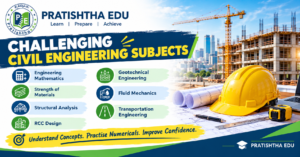
The level of difficulty depends on a student’s academic background, understanding of basic concepts, and regular practice. However, several Civil Engineering subjects involve extensive numerical calculations, design procedures, and analytical thinking.
Some subjects that students may need additional guidance in include:
- Engineering Mathematics: Requires practice in calculus, differential equations, and numerical methods.
- Strength of Materials: Involves stress, strain, bending moments and structural behaviour.
- Structural Analysis: Requires understanding of beams, trusses, frames, and different analysis methods.
- RCC Design: Involves structural design calculations and reinforcement detailing.
- Geotechnical Engineering: Includes soil properties, consolidation, shear strength and bearing capacity.
- Fluid Mechanics: Requires understanding of fluid behaviour, pressure and flow calculations.
- Transportation Engineering: Includes road design, traffic studies and pavement-related calculations.
Students who find these topics challenging can benefit from systematic revision, guided problem-solving and additional subject-wise academic support.
How Can Subject-Wise Tuition Help During Different Semesters?
Civil Engineering subject tuition can provide additional learning support according to a student’s semester, syllabus, and academic requirements.
For example, first-year students may need help with mathematics and mechanics, while second- and third-year students may require additional practice in Strength of Materials, Structural Analysis, RCC Design or Geotechnical Engineering.
Final-year students may need academic guidance with selected advanced subjects, numerical problems, and project-related concepts.
Students looking for BE Civil Engineering Tuition in Bangalore can enquire with Pratishtha Edu about available subjects, teaching modes, and academic support options according to their requirements.
Civil Engineering Software and Practical Skills Every Student Should Learn
Civil Engineering is not limited to textbooks, mathematical calculations, and university examinations. Students also need to understand how engineering concepts are applied in real construction and infrastructure projects. Technical drawing, structural modelling, surveying, quantity estimation, and project planning are important skills that connect classroom learning with professional engineering work.
Along with academic subjects, learning relevant Civil Engineering software can help students understand design procedures, prepare technical drawings, and explore different engineering applications. The software required depends on a student’s academic level, specialisation, and career interests.

1. AutoCAD for Civil Engineering
AutoCAD is widely used for preparing and modifying technical drawings in engineering and construction-related work. Civil Engineering students can use it to understand building plans, elevations, sections, and structural drawings.
Important learning areas include:
- Basic Drawing Commands
- 2D Drafting and Editing
- Layers and Dimensioning
- Building Plans and Elevations
- Sections and Detailed Drawings
- Layouts and Plotting
- Reading and Modifying Engineering Drawings
AutoCAD knowledge is useful for students interested in technical drafting, design documentation and building drawing interpretation.
2. STAAD.Pro for Structural Analysis
STAAD.Pro is a structural analysis and design software used by engineering professionals for analysing different structural systems.
Students interested in structural engineering can explore topics such as:
- Creating Structural Models
- Defining Materials and Properties
- Applying Loads and Load Combinations
- Analysing Beams, Frames and Trusses
- Understanding Analysis Results
- Reviewing Structural Design Outputs
Learning structural analysis concepts before using the software is important. Software results should always be interpreted and verified by qualified professionals.
3. ETABS for Building Analysis and Design
ETABS is commonly used for modelling and analysing building structures. It helps engineers study how building systems respond to different loading conditions.
Important learning areas include:
- Building Model Creation
- Defining Structural Elements
- Assigning Loads and Load Combinations
- Analysis of Multi-Storey Buildings
- Understanding Structural Behaviour
- Reviewing Analysis and Design Results
ETABS is particularly relevant for students interested in building structures and structural engineering applications.
4. Revit for Building Information Modelling (BIM)
Revit is a Building Information Modelling software used to create and manage digital building models.
Students can explore:
- 3D Building Modelling
- Architectural and Structural Elements
- Model Coordination
- Building Components
- Construction Documentation
- Basic BIM Concepts
Understanding BIM helps students become familiar with digital design and coordination processes used in modern construction projects.
5. Civil 3D for Infrastructure Design
Autodesk Civil 3D supports civil infrastructure design and documentation, particularly in areas such as roads, land development and surveying.
Important topics include:
- Survey Data Management
- Surface Modelling
- Alignment Creation
- Road Profiles
- Corridor Modelling
- Earthwork Calculations
- Civil Infrastructure Documentation
It can be useful for students interested in transportation engineering, site development, and infrastructure design.
6. Primavera P6 and MS Project for Construction Planning
Construction projects require proper scheduling, resource management, and progress monitoring. Primavera P6 and Microsoft Project are tools used for project planning and management.
Students can learn:
- Project Scheduling
- Work Breakdown Structure
- Activity Planning
- Resource Allocation
- Project Timelines
- Progress Monitoring
- Basic Project Reporting
These tools are relevant to students interested in construction management and project coordination.
Practical Skills Civil Engineering Students Should Develop

Apart from software knowledge, students should understand the practical activities associated with Civil Engineering subjects.
Important practical learning areas include:
Surveying Practice: Understanding levelling, distance measurement, theodolite operation, and total station concepts.
Material Testing: Learning about cement tests, aggregate tests, concrete workability, and compressive strength testing.
Soil Testing: Understanding soil classification, moisture content, compaction, and basic laboratory testing procedures.
Concrete Technology: Learning about concrete mix proportions, workability, curing and concrete quality assessment.
Structural Drawing Interpretation: Understanding reinforcement details, structural drawings, sections, and construction specifications.
Quantity Estimation: Practising measurements, material calculations, rate analysis, and preparation of basic Bills of Quantities (BOQ).
Why Are Software and Practical Skills Important?
Civil Engineering software and practical knowledge help students connect academic concepts with engineering applications. For example, Structural Analysis introduces the theoretical behaviour of beams and frames, while structural analysis software helps students explore these systems through digital models.
Similarly, Surveying explains land measurement principles, while modern surveying instruments demonstrate how measurements are carried out in the field.
Students should first develop a strong understanding of engineering fundamentals and then gradually learn software tools relevant to their interests and career goals.
Students searching for Civil Engineering Software Training in Bangalore can enquire about relevant learning options and available academic support from Pratishtha Edu.
Benefits of Joining Civil Engineering Subject Tuition
Civil Engineering students study a wide range of technical subjects that involve mathematical calculations, engineering drawings, structural concepts, and practical applications. While regular college lectures provide the academic foundation, some students may need additional guidance to understand particular topics or prepare for examinations.
Civil Engineering subject tuition can provide focused academic support based on a student’s syllabus, learning requirements, and areas of difficulty.
Here are some important benefits of subject-wise academic tuition.
1. Better Understanding of Difficult Engineering Concepts
Subjects such as Strength of Materials, Structural Analysis, RCC Design, and Geotechnical Engineering involve technical concepts that require proper explanation and regular practice.
Additional academic guidance can help students understand these concepts step by step and identify the methods used to solve different engineering problems.
2. Focused Support for Individual Subjects
Not every student needs help with all Civil Engineering subjects. Some may find Engineering Mathematics difficult, while others may need additional practice in Fluid Mechanics, Surveying or Structural Design.
Subject-wise tuition allows students to concentrate on the particular papers or topics where they require more academic support.
3. Practice with Numerical Problems
Many Civil Engineering subjects involve numerical calculations and design-based problems. Regular practice helps students understand the steps involved in solving questions.
Additional guidance may be useful for topics such as:
- Shear Force and Bending Moment Diagrams
- Stress and Strain Calculations
- Fluid Mechanics Numericals
- Soil Mechanics Problems
- RCC Design Calculations
- Structural Analysis Methods
- Estimation and Quantity Calculations
4. Support for Semester Examinations and Backlogs
Students preparing for internal assessments, university examinations, or supplementary examinations may need a structured revision approach.
Academic tuition can help them revise important concepts, practise syllabus-related questions, and identify topics that need more attention.
5. Flexible Learning Based on Academic Requirements
Students may have different academic schedules and learning preferences. Depending on the availability of a tuition provider, they can enquire about online or offline classes, individual subject support, and suitable class timings.
6. Improved Confidence in Technical Subjects
Understanding engineering concepts and solving problems independently can help students become more confident in their academic work.
Consistent practice, topic-wise revision, and feedback can support better learning habits throughout the Civil Engineering programme.
Get Academic Support for Your Civil Engineering Preparation
How to Choose the Best Civil Engineering Training Institute in Bangalore
Selecting an appropriate academic institute is an important decision for students who need additional support during their engineering studies.
Before joining Civil Engineering tuition in Bangalore, consider the following factors.
1. Check Subject Coverage
Find out whether the institute provides academic support for the specific subjects you want to study, such as Engineering Mathematics, Strength of Materials, Structural Analysis, RCC Design, or Geotechnical Engineering.
Do not assume that every institute teaches all Civil Engineering subjects.
2. Understand the Teaching Method
Ask how difficult concepts, numerical problems, and syllabus topics are explained. A clear teaching approach should help students understand the subject rather than simply memorise answers.
3. Check Faculty and Subject Expertise
Enquire about the academic qualifications and subject-specific teaching experience of the faculty members. Understanding the teacher’s expertise is particularly important for advanced subjects such as Structural Analysis and RCC Design.
4. Ask About Class Mode and Timings
Check whether online or offline classes are available and whether the schedule is suitable for your college timings, examinations, and other academic commitments.
5. Understand Fees and Course Duration
Before enrolling, ask for complete details about subject-wise fees, class duration, number of sessions, study materials, and any additional charges.
Compare the course details rather than selecting an institute based only on the lowest fee.
6. Look for Practice and Doubt-Solving Support
Ask whether the classes include numerical problem-solving, revision sessions, assignments, and opportunities to clarify doubts.
These activities can make additional tuition more useful for students studying technical engineering subjects.
7. Review the Learning Support Available
Before joining, understand how the institute monitors student progress and whether students receive guidance according to their academic requirements.
Choosing an institute that matches your subject needs, learning preferences, and schedule can make your additional academic preparation more effective.
Civil Engineering Subject Tuition at Pratishtha Edu, Bangalore
Choosing the right academic support can make a difference in how students understand technical subjects and prepare for their engineering examinations. Students looking for Civil Engineering Training Institutes in Bangalore should consider their subject requirements, learning preferences, and the academic support available before enrolling.
Pratishtha Edu is an educational institute based in JP Nagar, Bangalore, offering coaching and academic learning support across different educational and competitive examination programmes.
Students interested in Civil Engineering subject tuition can contact Pratishtha Edu to enquire about the availability of specific subjects, faculty guidance, class schedules, and suitable learning options.
Whether you need additional help with Engineering Mathematics, Strength of Materials, Structural Analysis, RCC Design, Geotechnical Engineering, or other Civil Engineering subjects, discuss your academic requirements with the team before choosing a course.
How to Enquire About Civil Engineering Tuition
Before contacting an institute, students can prepare a few details to help identify their academic requirements:
- Current course: Diploma, BE, B.Tech, or M.Tech.
- Semester or year of study.
- Subjects for which additional guidance is required.
- Topics or numerical problems that are difficult to understand.
- Preferred online or offline learning mode.
- Examination schedule and available class timings.
Sharing these details can help the academic team understand what kind of subject-wise support you are looking for.
Students can contact Pratishtha Edu to discuss available Civil Engineering tuition options and get further information.
Frequently Asked Questions About Civil Engineering Tuition in Bangalore
1. Which subjects are included in Civil Engineering?
Civil Engineering includes Engineering Mathematics, Engineering Mechanics, Strength of Materials, Surveying, Fluid Mechanics, Structural Analysis, RCC Design, Steel Structure Design, Geotechnical Engineering, Transportation Engineering, Environmental Engineering, Hydrology, and Construction Management. Subject combinations vary according to the university syllabus.
2. Where can I find Civil Engineering subject tuition in Bangalore?
Students can explore Civil Engineering coaching institutes and academic tuition providers in Bangalore. Before enrolling, check subject availability, faculty expertise, teaching methods, class schedules, and fees.
3. Is subject-wise tuition available for BE Civil Engineering students?
Subject-wise tuition can help BE Civil Engineering students focus on individual papers that require additional academic support. Contact the tuition provider to confirm which subjects are currently available.
4. Which Civil Engineering subjects are considered difficult?
Students commonly need additional practice in Engineering Mathematics, Strength of Materials, Structural Analysis, RCC Design, Fluid Mechanics, and Geotechnical Engineering. Difficulty depends on individual understanding and preparation.
5. Can I get tuition for Civil Engineering backlog subjects?
Students preparing for supplementary or backlog examinations can enquire about tuition for their specific subjects. Availability depends on the subjects offered by the institute.
6. Are online Civil Engineering classes useful?
Online classes can be useful when they include clear explanations, numerical problem-solving, doubt clarification, and syllabus-related guidance. Students should check the teaching format before enrolling.
7. How can I enquire about Civil Engineering tuition at Pratishtha Edu?
You can contact Pratishtha Edu at 7676047382 or visit https://pratishthaedu.com/ to enquire about available Civil Engineering subjects, class schedules and tuition options.
Start Your Civil Engineering Learning Journey with the Right Academic Support

Understanding Civil Engineering requires consistent learning, conceptual clarity, and regular practice. From Engineering Mathematics and Strength of Materials to Structural Analysis, RCC Design, Surveying and Geotechnical Engineering, every subject contributes to a student’s technical foundation.
If you are searching for Civil Engineering Training Institutes in Bangalore or additional support for individual engineering subjects, contact Pratishtha Edu to discuss your academic requirements.
Pratishtha Edu – Bangalore
Website: https://pratishthaedu.com/
Phone: 7676047382
Enquire about available Civil Engineering subject tuition and academic support options.
Enquire About Civil Engineering Tuition at Pratishtha Edu
Speak with our team to discuss your subject-wise academic requirements.
Leave a Reply