Introduction
Choosing the right engineering course begins with understanding the engineering subjects list, available specialisations, and academic requirements. Students planning to pursue Bachelor of Engineering (BE) or Bachelor of Technology (BTech) often have questions about the subjects included in different engineering branches, the courses required for admission, and the technical knowledge they will develop throughout their degree.
Engineering is a broad field that combines mathematics, science, technology, design, and practical problem-solving. Depending on the selected specialisation, students study different engineering course subjects related to computer programming, mechanical systems, construction, electronics, electrical circuits, chemical processes, and other technical areas.
Understanding the engineering courses list before choosing a degree can help students identify their interests and make better academic decisions. Some subjects are common across multiple engineering branches, while others are specifically designed for individual specialisations. For example, Computer Science students study programming and data structures, whereas Mechanical Engineering students learn thermodynamics, manufacturing processes, and machine design.
Students also need to understand the difference between subjects required before admission and the subjects taught during an engineering degree. Mathematics, Physics, and Chemistry provide an important academic foundation for many engineering programmes, while the actual degree curriculum varies according to the branch, university, and semester.
This guide explains the different engineering courses, important subjects in major branches, first-year engineering topics, admission-related subject requirements, and ways to understand the curriculum before selecting a specialisation. It also provides useful information for students searching for engineering tuition and subject-wise academic support in Bangalore.
What Is an Engineering Course?
An engineering course is an undergraduate or postgraduate academic programme that teaches students how to apply scientific principles, mathematical concepts, and technical knowledge to solve real-world problems.
Engineering education focuses on understanding how different systems, structures, machines, electrical devices, software applications, and industrial processes are designed, developed, tested, and improved.
In India, students commonly pursue engineering through Bachelor of Engineering (BE) and Bachelor of Technology (BTech) programmes. These undergraduate degrees generally cover four years of academic study, although the exact programme structure and requirements depend on the institution and applicable regulations.
During an engineering degree, students learn through different academic activities, including:
- Theoretical learning: Understanding engineering concepts, mathematical principles, and scientific fundamentals.
- Practical laboratory sessions: Performing experiments and testing technical concepts.
- Programming and technical applications: Learning software tools, coding languages, and engineering applications where relevant.
- Design and project work: Developing solutions to practical engineering problems.
- Industrial exposure: Understanding how engineering knowledge is applied in professional environments.
- Internships and technical training: Gaining experience related to their chosen specialisation.
The engineering subjects list differs from one branch to another. However, most programmes combine foundational subjects, core engineering topics, practical work, electives, and project-based learning.
Why Is Understanding the Engineering Subjects List Important?
Selecting an engineering branch is an important academic decision. Students should understand the subjects included in their chosen programme instead of selecting a course only because it is popular or has good career opportunities.
Knowing the engineering course subjects can help students in several ways.
1. Helps Students Select the Right Engineering Branch
Every engineering specialisation focuses on different technical areas. Students interested in computers and software may explore Computer Science Engineering, while those interested in machines and manufacturing may consider Mechanical Engineering.
Understanding the subjects helps students compare different branches based on their interests and strengths.
2. Builds a Strong Academic Foundation
Engineering programmes involve mathematics, scientific concepts, technical calculations, and practical applications. Knowing the subjects in advance helps students understand the academic foundation required for their selected programme.
3. Makes Semester Planning Easier
Engineering degrees are divided into semesters, with different subjects introduced throughout the programme. Understanding the curriculum helps students prepare for theoretical examinations, laboratory assessments, assignments, and projects.
4. Helps Identify Difficult Engineering Subjects
Some subjects require strong mathematical understanding, while others involve programming, technical drawing, circuit analysis, or practical applications.
Knowing these subjects can help students identify topics that may require additional preparation.
5. Supports Better Academic and Career Decisions
Different engineering branches develop different technical skills. Understanding the subjects can help students connect their academic interests with possible career areas, higher education opportunities, and professional goals.
What Are the Different Types of Engineering Specialisations?
Engineering includes several specialisations, each focusing on a particular area of science, technology, and industrial development.
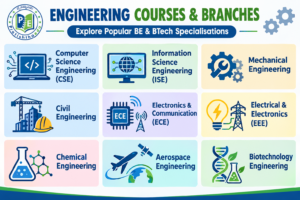
Some of the commonly available engineering branches in Indian colleges include:
- Computer Science and Engineering (CSE)
- Information Science and Engineering (ISE)
- Mechanical Engineering
- Civil Engineering
- Electronics and Communication Engineering (ECE)
- Electrical and Electronics Engineering (EEE)
- Chemical Engineering
- Aerospace Engineering
- Biotechnology Engineering
Each specialisation has its own combination of foundational and advanced subjects. The detailed engineering subjects list for these branches will be explained separately in the upcoming sections of this guide.
What Is the Difference Between BE and BTech Engineering Courses?
BE and BTech are two commonly offered undergraduate engineering degrees in India. Both provide technical education and prepare students for engineering-related professional opportunities.
| Particulars | BE | BTech |
| Full form | Bachelor of Engineering | Bachelor of Technology |
| Main focus | Engineering principles and applications | Technology and engineering applications |
| Duration | Generally 4 years | Generally 4 years |
| Academic structure | Theory, practicals and projects | Theory, practicals and projects |
| Specialisations | Multiple engineering branches | Multiple engineering branches |
The actual curriculum, teaching approach, and academic structure depend on the university and institution. Neither degree should automatically be considered superior to the other.
Students should compare the university syllabus, accreditation, faculty, laboratory facilities, practical exposure, and available specialisations before selecting an engineering programme.
Complete Engineering Courses List: Major Branches and Specialisations
Complete Engineering Courses List in India
Engineering offers several specialisations that allow students to develop knowledge and technical skills in specific areas of science, technology, infrastructure, manufacturing, computing, and industrial development.
When exploring an engineering courses list, students should understand that every branch has a different academic focus, subject combination, practical requirements, and career opportunities. Some engineering programmes focus on software and digital technologies, while others concentrate on machines, construction, electronics, energy systems, and industrial processes.
The following are some of the major engineering courses available in Indian colleges and universities.
1. Computer Science and Engineering (CSE)
Computer Science and Engineering focuses on computer systems, software development, programming, algorithms, and modern computing technologies.
Students interested in software, applications, artificial intelligence, and digital technologies can explore this specialisation.
Some important areas covered in Computer Science Engineering include:
- Programming Languages
- Data Structures and Algorithms
- Database Management Systems
- Operating Systems
- Computer Networks
- Software Engineering
- Artificial Intelligence
- Machine Learning
- Cybersecurity
- Cloud Computing
CSE students develop programming, logical reasoning, computational thinking, and software development skills.
2. Information Science and Engineering (ISE)
Information Science and Engineering focuses on information systems, software applications, databases, computer networks, and data management.
This branch combines computing fundamentals with information technology applications.
Important areas include:
- Data Structures
- Database Management Systems
- Web Technologies
- Computer Networks
- Software Engineering
- Information Security
- Data Analytics
- Operating Systems
- Cloud Technologies
Students interested in software systems, information management, and IT-related applications may consider this specialisation.
3. Mechanical Engineering
Mechanical Engineering deals with the design, development, manufacturing, operation, and maintenance of machines and mechanical systems.
It combines mathematics, physics, material science, and engineering design principles.
Some important areas of Mechanical Engineering include:
- Engineering Mechanics
- Thermodynamics
- Fluid Mechanics
- Strength of Materials
- Manufacturing Technology
- Machine Design
- Heat Transfer
- Theory of Machines
- Industrial Engineering
- CAD and CAM
This specialisation is relevant to students interested in automobiles, manufacturing, industrial machinery, robotics, and mechanical product development.
4. Civil Engineering
Civil Engineering focuses on the planning, design, construction, and maintenance of infrastructure and built environments.
It involves the study of buildings, roads, bridges, dams, transportation systems, and water resources.
Important Civil Engineering areas include:
- Building Materials and Construction
- Surveying
- Structural Analysis
- Strength of Materials
- Geotechnical Engineering
- Fluid Mechanics
- Transportation Engineering
- Environmental Engineering
- Concrete Technology
- Design of Reinforced Concrete Structures
Students interested in construction, infrastructure development, structural design, and project management may explore this branch.
5. Electronics and Communication Engineering (ECE)
Electronics and Communication Engineering focuses on electronic devices, communication systems, signal processing, and embedded technologies.
Students learn how electronic circuits and communication systems are designed and used in modern devices.
Important areas include:
- Electronic Devices and Circuits
- Digital Electronics
- Analog Electronics
- Signals and Systems
- Communication Systems
- Microprocessors
- Microcontrollers
- Digital Signal Processing
- VLSI Design
- Embedded Systems
This branch is suitable for students interested in electronics, telecommunications, semiconductor technologies, and embedded applications.
6. Electrical and Electronics Engineering (EEE)
Electrical and Electronics Engineering deals with electrical power generation, transmission, distribution, electrical machines, and electronic control systems.
The programme combines electrical engineering fundamentals with electronics and automation concepts.
Some major areas include:
- Electrical Circuit Theory
- Electrical Machines
- Power Systems
- Power Electronics
- Control Systems
- Electrical Measurements
- Signals and Systems
- Electrical Drives
- Renewable Energy Systems
- Power System Protection
Students interested in electrical equipment, energy systems, industrial automation, and power technologies can consider this specialisation.
7. Chemical Engineering
Chemical Engineering focuses on converting raw materials into useful products through chemical, physical, and biological processes.
It combines chemistry, mathematics, physics, and engineering principles to understand industrial production systems.
Important areas include:
- Chemical Process Calculations
- Fluid Mechanics
- Heat Transfer
- Mass Transfer
- Chemical Reaction Engineering
- Process Control
- Thermodynamics
- Separation Processes
- Plant Design
- Process Equipment Design
This branch is relevant to industries such as pharmaceuticals, petrochemicals, food processing, fertilizers, and materials manufacturing.
8. Aerospace Engineering
Aerospace Engineering focuses on the design, development, testing, and maintenance of aircraft, spacecraft, and related systems.
It combines aerodynamics, mechanics, materials science, propulsion, and advanced engineering mathematics.
Important areas include:
- Aerodynamics
- Flight Mechanics
- Aircraft Structures
- Propulsion Systems
- Aerospace Materials
- Aircraft Design
- Gas Dynamics
- Orbital Mechanics
- Avionics
- Computational Fluid Dynamics
Students interested in aviation, aircraft technology, space exploration, and aerospace research may consider this field.
9. Biotechnology Engineering
Biotechnology Engineering combines biology, chemistry, and engineering to develop technologies and processes used in healthcare, agriculture, pharmaceuticals, and industrial biotechnology.
It focuses on applying biological knowledge to practical and technological challenges.
Some important areas include:
- Cell Biology
- Biochemistry
- Microbiology
- Molecular Biology
- Genetic Engineering
- Bioprocess Engineering
- Bioinformatics
- Enzyme Technology
- Immunology
- Biochemical Engineering
This specialisation is suitable for students interested in biological sciences, research, healthcare technologies, and biotechnology applications.
10. Other Emerging Engineering Specialisations
Apart from traditional branches, several institutions offer specialised engineering programmes in emerging technology areas.
Some examples include:
| Engineering specialisation | Main academic focus |
| Artificial Intelligence and Machine Learning | Intelligent systems and predictive models |
| Data Science Engineering | Data analysis and computational methods |
| Robotics and Automation | Automated machines and robotic systems |
| Mechatronics Engineering | Integration of mechanical and electronic systems |
| Biomedical Engineering | Engineering applications in healthcare |
| Environmental Engineering | Pollution control and environmental protection |
| Mining Engineering | Mineral extraction and mining technologies |
| Agricultural Engineering | Agricultural machinery and resource management |
| Automobile Engineering | Vehicle design and automotive systems |
| Marine Engineering | Marine machinery and ship systems |
The availability of these courses varies across institutions. Students should check the current programme names, curriculum, admission requirements, and recognition before applying.
How to Compare Different Engineering Courses Before Choosing a Branch
Selecting an engineering specialisation requires more than checking the course name. Students should understand the subjects, practical components, and academic expectations associated with each programme.
Consider the following factors before making a decision:
- Interest in subjects: Identify whether you enjoy mathematics, programming, physics, electronics, construction, or biological sciences.
- Course curriculum: Review the syllabus and engineering course subjects offered by the university.
- Practical learning: Check laboratory facilities, technical projects, workshops, and internship opportunities.
- Specialisation requirements: Understand the technical knowledge and academic preparation required for the chosen branch.
- Future learning opportunities: Explore higher education, professional certifications, and areas of specialisation.
Choosing a branch based on personal interest and understanding of its subjects can help students approach their engineering education with greater clarity.
First-Year Engineering Subjects List: Common Subjects in BE and BTech
First-Year Engineering Subjects List for BE and BTech Students
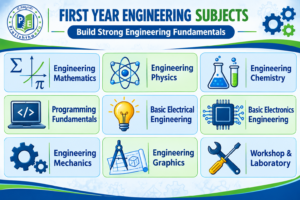
The first year of an engineering degree introduces students to the scientific, mathematical, and technical concepts required for advanced engineering studies. Although the exact syllabus differs between universities and engineering branches, many BE and BTech programmes include a combination of fundamental subjects, laboratory sessions, practical activities, and introductory technical courses.
Understanding the first-year engineering subjects list helps students prepare for the transition from school-level education to university-level technical learning.
During this stage, students develop their understanding of mathematics, physics, chemistry, programming, engineering principles, and basic technical applications. These subjects provide a foundation for studying advanced topics in specialisations such as Computer Science, Mechanical, Civil, Electrical, and Electronics Engineering.
The following are some commonly included subjects in first-year engineering programmes.
1. Engineering Mathematics
Engineering Mathematics is one of the important foundational subjects in many engineering programmes. It helps students develop the mathematical knowledge required to understand technical problems, perform calculations, and analyse engineering systems.
Common topics include:
- Differential Calculus
- Integral Calculus
- Differential Equations
- Linear Algebra
- Matrices and Determinants
- Vector Calculus
- Probability and Statistics
- Numerical Methods
Why is it important?
Mathematics is used in almost every engineering specialisation. Computer Science students apply mathematical concepts in algorithms and computational methods, while Mechanical and Civil Engineering students use mathematical calculations in design, mechanics, and structural analysis.
2. Engineering Physics
Engineering Physics introduces students to the scientific principles behind various engineering technologies and applications.
It helps students understand how physical laws are applied in electronic devices, mechanical systems, materials, and modern technological developments.
Some common topics include:
- Wave Optics
- Quantum Physics
- Semiconductor Physics
- Laser Technology
- Fibre Optics
- Electrical and Magnetic Properties
- Material Science
- Modern Physics
Why is it important?
Physics provides the scientific foundation for understanding how engineering systems operate. Concepts from this subject are useful in electronics, electrical systems, telecommunications, mechanical applications, and material-related technologies.
3. Engineering Chemistry
Engineering Chemistry explains the chemical principles and material-related concepts used in engineering applications.
It introduces students to the properties of materials, chemical reactions, corrosion, energy sources, and environmental considerations.
Common topics include:
- Electrochemistry
- Corrosion and Its Prevention
- Water Treatment
- Engineering Materials
- Polymers
- Fuels and Combustion
- Batteries and Energy Storage
- Environmental Chemistry
Why is it important?
Chemical knowledge helps engineers understand material behaviour, corrosion prevention, water quality, industrial processes, and energy-related applications.
This subject is particularly relevant to students exploring Chemical, Civil, Mechanical, and Materials Engineering.
4. Programming for Problem Solving
Programming for Problem Solving introduces students to computer programming and logical thinking.
Students learn how to convert a problem into a sequence of instructions that can be executed by a computer. Depending on the university curriculum, programming may be taught using languages such as C, Python, or other suitable programming tools.
Important topics include:
- Introduction to Programming
- Algorithms and Flowcharts
- Variables and Data Types
- Operators and Expressions
- Conditional Statements
- Loops and Iterations
- Functions
- Arrays and Strings
- Basic Problem-Solving Techniques
Why is it important?
Programming helps engineering students develop logical reasoning and computational skills. It is particularly important for Computer Science and Information Science students, but programming knowledge is also useful in automation, simulation, data analysis, and other engineering applications.
5. Basic Electrical Engineering
Basic Electrical Engineering introduces students to the fundamentals of electrical circuits, electrical quantities, and electrical systems.
It helps students understand how electricity is generated, transmitted, measured, and used in different applications.
Common topics include:
- Voltage and Current
- Ohm’s Law
- Electrical Power and Energy
- DC Circuits
- AC Circuits
- Kirchhoff’s Laws
- Transformers
- Electrical Machines
- Basic Circuit Analysis
Why is it important?
Electrical fundamentals are useful across several engineering disciplines. Even students studying Computer Science, Mechanical, and Civil Engineering may need basic knowledge of electrical systems for interdisciplinary applications.
6. Basic Electronics Engineering
Basic Electronics Engineering introduces students to electronic components, circuits, and fundamental electronic devices.
It helps students understand the working principles behind electronic systems used in communication devices, computers, automation, and modern equipment.
Some common topics include:
- Semiconductor Fundamentals
- Diodes
- Transistors
- Rectifiers
- Amplifiers
- Logic Gates
- Digital Electronics Basics
- Electronic Circuit Applications
Why is it important?
Electronic concepts provide a foundation for understanding digital devices, communication systems, control circuits, and embedded technologies.
These fundamentals are especially relevant to students interested in ECE, EEE, and related engineering specialisations.
7. Engineering Mechanics
Engineering Mechanics focuses on the behaviour of forces and their effects on physical bodies and mechanical systems.
It introduces students to the principles required to analyse structures, machines, and objects under different loading conditions.
Important topics include:
- Force Systems
- Equilibrium of Forces
- Moments and Couples
- Friction
- Centroid and Centre of Gravity
- Simple Machines
- Kinematics
- Kinetics
- Work and Energy
Why is it important?
Engineering Mechanics develops the analytical skills needed to understand how forces influence physical systems.
It provides a foundation for advanced subjects such as Strength of Materials, Structural Mechanics, Machine Design, and Dynamics.
8. Engineering Graphics and Technical Drawing
Engineering Graphics teaches students how to represent engineering components, objects, and structures through technical drawings.
It develops spatial understanding and helps students communicate technical designs accurately.
Common topics include:
- Engineering Drawing Fundamentals
- Orthographic Projections
- Isometric Projections
- Projection of Solids
- Sectional Views
- Dimensioning
- Development of Surfaces
- Computer-Aided Drafting Basics
Why is it important?
Technical drawing is an important communication tool in engineering. Civil engineers use drawings to represent buildings and infrastructure, while Mechanical engineers use them to communicate component designs and manufacturing details.
9. Workshop Practice and Laboratory Sessions
Workshop practice and laboratory sessions provide practical experience that supports theoretical engineering education.
Students learn how to use tools, instruments, machines, and laboratory equipment while following appropriate technical procedures and safety practices.
Depending on the curriculum, practical activities may include:
- Basic Manufacturing Processes
- Fitting and Carpentry
- Welding Fundamentals
- Electrical Wiring Practice
- Basic Electronics Experiments
- Material Testing
- Measurement Techniques
- Computer Laboratory Practice
Why is it important?
Practical learning helps students connect classroom concepts with real engineering applications. It also develops technical confidence, observation skills, teamwork, and familiarity with engineering equipment.
Are First-Year Engineering Subjects the Same for All Branches?
No. First-year engineering subjects are not necessarily identical across all branches or universities.
Many institutions introduce common foundational subjects during the initial semesters. However, the combination of subjects, credits, practical sessions, and technical electives may differ according to the selected specialisation and university curriculum.
For example:
| Engineering branch | Areas students may encounter |
| Computer Science Engineering | Programming, Mathematics, Computing Fundamentals |
| Mechanical Engineering | Mechanics, Engineering Graphics, Materials |
| Civil Engineering | Engineering Mechanics, Materials, Surveying Fundamentals |
| Electronics Engineering | Basic Electronics, Circuits, Physics |
| Electrical Engineering | Electrical Circuits, Mathematics, Electrical Fundamentals |
| Chemical Engineering | Chemistry, Mathematics, Process Fundamentals |
Students should always refer to their university’s current syllabus to understand the exact subjects prescribed for each semester.
How Can Students Prepare for First-Year Engineering Subjects?
The transition from school-level studies to engineering education can require a different approach to learning. Students need to understand concepts, practise numerical problems, complete practical work, and develop consistent study habits.
Here are some useful preparation strategies:
- Strengthen mathematical fundamentals: Revise algebra, calculus basics, trigonometry, and problem-solving techniques.
- Understand scientific concepts: Focus on the fundamentals of Physics and Chemistry rather than memorising definitions.
- Practise programming regularly: Start with basic logic, algorithms, and simple coding exercises.
- Maintain practical records: Complete laboratory work and technical assignments according to university guidelines.
- Follow the semester syllabus: Understand the topics prescribed for each subject and plan preparation accordingly.
- Revise difficult topics: Regular revision helps students improve their understanding of technical concepts and numerical methods.
A consistent study routine can help students build confidence and prepare for the more advanced subjects introduced in later semesters.
Branch-Wise Engineering Subjects List: Complete Guide to All Major Engineering Branches
Branch-Wise Engineering Subjects List for BE and BTech Students
Engineering students study different subjects depending on their selected specialisation. Although some foundational subjects may be common across multiple branches, advanced engineering course subjects are designed according to the technical requirements of each discipline.
Understanding the branch-wise engineering subjects list helps students identify what they will study during their degree programme and what kind of technical knowledge they need to develop.
Below is an overview of the important subjects covered in some of the major engineering branches.
1. Computer Science Engineering Subjects List
Computer Science and Engineering focuses on programming, software development, algorithms, computer systems, and modern computing technologies.
Students learn how computer applications are developed, how data is processed, and how software systems operate.
Important Computer Science Engineering subjects:
| Subject | What students learn |
| Data Structures | Organising and managing data efficiently |
| Design and Analysis of Algorithms | Developing efficient computational solutions |
| Database Management Systems | Storing, retrieving and managing information |
| Operating Systems | Understanding computer resource management |
| Computer Networks | Communication between connected computer systems |
| Software Engineering | Designing and maintaining software applications |
| Theory of Computation | Mathematical foundations of computation |
| Computer Architecture | Structure and functioning of computer systems |
| Artificial Intelligence | Developing systems that perform intelligent tasks |
| Machine Learning | Building models that learn from data |
Why are these subjects important?
These subjects develop programming knowledge, logical reasoning, problem-solving abilities, and an understanding of computer systems. They provide a foundation for areas such as software development, artificial intelligence, cybersecurity, and data science.
2. Information Science and Engineering Subjects List
Information Science and Engineering focuses on computing technologies, information systems, databases, software applications, and data management.
Although it shares several subjects with Computer Science Engineering, the specific curriculum and subject combinations may differ between universities.
Important Information Science Engineering subjects:
| Subject | What students learn |
| Data Structures | Techniques for organising and processing data |
| Database Management Systems | Database design and information storage |
| Web Technologies | Developing websites and web applications |
| Software Engineering | Software design and development methods |
| Computer Networks | Network communication and protocols |
| Operating Systems | Managing computer hardware and software resources |
| Data Analytics | Analysing information to identify patterns |
| Information Security | Protecting digital information |
| Cloud Computing | Understanding internet-based computing services |
| Object-Oriented Programming | Developing applications using programming objects |
Why are these subjects important?
These subjects help students understand how information is collected, processed, stored, secured, and used in digital systems. They are useful for students interested in software development, information technology, databases, and data-related applications.
3. Mechanical Engineering Subjects List
Mechanical Engineering deals with the design, analysis, manufacturing, and operation of machines and mechanical systems.
Students learn how mechanical components work, how materials behave under different conditions, and how machines are designed and manufactured.
Important Mechanical Engineering subjects:
| Subject | What students learn |
| Engineering Mechanics | Forces and their effects on physical bodies |
| Strength of Materials | Behaviour of materials under different loads |
| Thermodynamics | Heat, energy and work relationships |
| Fluid Mechanics | Behaviour of liquids and gases |
| Heat Transfer | Movement of heat through different materials |
| Theory of Machines | Motion and operation of mechanical systems |
| Machine Design | Designing mechanical components |
| Manufacturing Technology | Different manufacturing processes |
| Engineering Materials | Properties and applications of materials |
| CAD and CAM | Computer-aided design and manufacturing |
Why are these subjects important?
Mechanical Engineering subjects develop knowledge of machine design, thermal systems, material behaviour, manufacturing, and mechanical analysis. They are useful for understanding industrial equipment, automobiles, production systems, and mechanical product development.
4. Civil Engineering Subjects List
Civil Engineering focuses on the planning, design, construction, and maintenance of infrastructure such as buildings, bridges, roads, dams, and transportation systems.
Students study how structures are designed, how construction materials behave, and how engineering principles are applied to infrastructure projects.
Important Civil Engineering subjects:
| Subject | What students learn |
| Surveying | Measuring land and preparing site information |
| Building Materials | Properties and uses of construction materials |
| Strength of Materials | Mechanical behaviour of structural materials |
| Structural Analysis | Analysing forces and structural behaviour |
| Geotechnical Engineering | Soil properties and foundation engineering |
| Fluid Mechanics | Behaviour of fluids in engineering applications |
| Concrete Technology | Properties and applications of concrete |
| Transportation Engineering | Planning roads and transportation systems |
| Environmental Engineering | Water, wastewater and pollution management |
| Design of RCC Structures | Design principles for reinforced concrete structures |
Why are these subjects important?
Civil Engineering subjects help students understand structural safety, construction techniques, soil behaviour, transportation planning, and infrastructure development.
5. Electronics and Communication Engineering (ECE) Subjects List
Electronics and Communication Engineering focuses on electronic circuits, semiconductor devices, communication technologies, signal processing, and embedded systems.
Students learn how electronic devices function and how information is transmitted through different communication systems.
Important ECE subjects:
| Subject | What students learn |
| Electronic Devices | Working principles of electronic components |
| Analog Electronics | Design and analysis of analog circuits |
| Digital Electronics | Digital circuits and logic systems |
| Signals and Systems | Representation and analysis of signals |
| Network Theory | Electrical network analysis |
| Analog Communication | Fundamentals of analog communication |
| Digital Communication | Digital information transmission |
| Microprocessors | Processor architecture and applications |
| Digital Signal Processing | Processing digital signals |
| VLSI Design | Design of integrated electronic circuits |
Why are these subjects important?
These subjects provide knowledge of electronic systems, communication technologies, digital devices, and integrated circuits. They are relevant to telecommunications, embedded systems, electronics design, and semiconductor-related applications.
6. Electrical and Electronics Engineering (EEE) Subjects List
Electrical and Electronics Engineering focuses on electrical circuits, power generation, electrical machines, control systems, and energy technologies.
Students learn how electrical energy is generated, transmitted, distributed, and used in different industrial and domestic applications.
Important EEE subjects:
| Subject | What students learn |
| Electrical Circuit Theory | Analysis of electrical circuits |
| Electrical Machines | Working principles of motors and generators |
| Power Systems | Generation and distribution of electrical power |
| Power Electronics | Electronic control of electrical power |
| Control Systems | Analysis and control of dynamic systems |
| Electrical Measurements | Measurement of electrical quantities |
| Electrical Drives | Motor control and industrial drive systems |
| Power System Protection | Protection of electrical networks |
| Renewable Energy Systems | Solar, wind and other energy technologies |
| High Voltage Engineering | Electrical insulation and high-voltage systems |
Why are these subjects important?
EEE subjects help students understand electrical equipment, power networks, automation systems, energy conversion, and industrial electrical applications.
7. Chemical Engineering Subjects List
Chemical Engineering deals with industrial processes that convert raw materials into useful products through chemical, physical, and biological operations.
Students study how industrial processes are designed, controlled, and optimised.
Important Chemical Engineering subjects:
| Subject | What students learn |
| Chemical Process Calculations | Material and energy balance calculations |
| Chemical Engineering Thermodynamics | Energy and equilibrium principles |
| Fluid Mechanics | Fluid flow in industrial systems |
| Heat Transfer | Industrial heat exchange processes |
| Mass Transfer | Separation and transfer of components |
| Chemical Reaction Engineering | Design and analysis of chemical reactions |
| Process Control | Monitoring and controlling industrial processes |
| Separation Processes | Distillation, absorption, and related methods |
| Process Equipment Design | Design of industrial process equipment |
| Plant Design | Planning and designing chemical plants |
Why are these subjects important?
These subjects help students understand industrial production, chemical processing, equipment design, and process optimisation in sectors such as pharmaceuticals, petrochemicals, food processing, and manufacturing.
8. Aerospace Engineering Subjects List
Aerospace Engineering focuses on aircraft, spacecraft, flight systems, propulsion technologies, and aerospace structures.
Students learn how flying vehicles are designed, how aerodynamic forces affect their movement, and how propulsion systems operate.
Important Aerospace Engineering subjects:
| Subject | What students learn |
| Aerodynamics | Forces acting on aircraft and flying bodies |
| Flight Mechanics | Motion and stability of aircraft |
| Aircraft Structures | Structural design and analysis |
| Propulsion Systems | Aircraft and spacecraft propulsion |
| Gas Dynamics | Flow behaviour at high speeds |
| Aerospace Materials | Materials used in aircraft and spacecraft |
| Aircraft Design | Design principles of aircraft |
| Orbital Mechanics | Motion of objects in space |
| Avionics | Electronic systems used in aircraft |
| Computational Fluid Dynamics | Numerical analysis of fluid flow |
Why are these subjects important?
These subjects provide a foundation for understanding aircraft design, flight performance, propulsion, aerospace structures, and space-related technologies.
9. Biotechnology Engineering Subjects List
Biotechnology Engineering combines engineering principles with biological sciences to develop products, technologies, and processes for healthcare, agriculture, pharmaceuticals, and industrial applications.
Students study biological systems and learn how they can be used in technological and industrial processes.
Important Biotechnology Engineering subjects:
| Subject | What students learn |
| Cell Biology | Structure and functions of cells |
| Biochemistry | Chemical processes in living organisms |
| Microbiology | Study of microorganisms |
| Molecular Biology | Biological processes at the molecular level |
| Genetics | Genes and heredity |
| Genetic Engineering | Techniques for modifying genetic material |
| Bioprocess Engineering | Engineering of biological production processes |
| Enzyme Technology | Applications of enzymes |
| Immunology | Study of immune systems |
| Bioinformatics | Computational analysis of biological information |
Why are these subjects important?
These subjects help students understand biological processes, laboratory techniques, biotechnology applications, and the development of products used in healthcare, pharmaceuticals, and agriculture.
10. How Do Engineering Subjects Differ from One Branch to Another?
Although engineering branches share some fundamental concepts, their advanced subjects are designed according to their respective technical requirements.
For example, a Computer Science student may spend more time learning programming, algorithms, and database systems, whereas a Civil Engineering student focuses on structural analysis, construction materials, and geotechnical engineering.
The following comparison provides a quick overview:
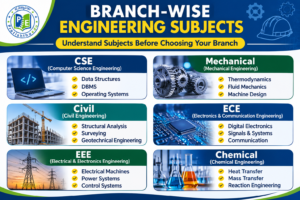
| Engineering branch | Main subject areas |
| CSE | Programming, algorithms, databases |
| ISE | Information systems, software, data |
| Mechanical | Thermodynamics, machine design, manufacturing |
| Civil | Structural analysis, surveying, construction |
| ECE | Electronics, communication, signal processing |
| EEE | Electrical machines, power systems, control |
| Chemical | Process engineering, thermodynamics, mass transfer |
| Aerospace | Aerodynamics, flight mechanics, propulsion |
| Biotechnology | Microbiology, genetics, bioprocess engineering |
Students should remember that the subjects and their sequence can vary according to the university, academic scheme, and chosen specialisation. The tables above provide representative subject areas rather than a fixed semester syllabus.
11. How Can Students Understand and Manage Different Engineering Subjects?
Engineering students may find certain subjects challenging because each branch involves different mathematical concepts, technical applications, and practical requirements.
A systematic approach to learning can make the academic process easier.
- Understand the syllabus: Review the prescribed subjects and units for every semester.
- Build conceptual clarity: Focus on understanding fundamental principles before attempting advanced problems.
- Practise numerical problems: Subjects such as Mathematics, Thermodynamics, Electrical Circuits, and Structural Analysis require regular practice.
- Improve technical skills: Develop programming, drawing, laboratory, and analytical skills according to your branch.
- Prepare for practical examinations: Understand laboratory procedures and the purpose of each experiment.
- Follow a revision schedule: Revise important concepts regularly instead of waiting until semester examinations.
Students who understand their engineering subjects early can develop better academic confidence and prepare more effectively for advanced technical topics.
Engineering Required Courses and Subjects: What Should Students Study Before Admission?
Engineering Required Courses and Subjects for Students After Class 10 and 12
Students planning to pursue engineering often have questions about the subjects they should study before entering a BE or BTech programme. Understanding the engineering required courses and academic qualifications can help students prepare for admission and choose a suitable engineering specialisation.
In India, students generally enter undergraduate engineering programmes after completing Class 12 or an equivalent qualification. Mathematics and Physics are important foundational subjects for many engineering pathways, while the specific qualifying subject combinations depend on the applicable admission regulations and institution.
Students should also understand that the subjects studied before engineering admission are different from the technical subjects included in the actual engineering degree. For example, a student may study Physics, Mathematics, and Chemistry in Classes 11 and 12, but later study subjects such as Data Structures, Thermodynamics, Structural Analysis, or Electrical Machines depending on the selected branch.
The following sections explain the common academic pathways, important school subjects, admission requirements, and alternative routes available to students interested in engineering.
1. What Subjects Are Needed for Engineering After Class 10?
Students who want to pursue engineering after Class 10 generally choose the Science stream for their higher secondary education.
The choice of subjects in Classes 11 and 12 can influence the engineering programmes and entrance examinations they can apply for.
Some important subjects include:
Mathematics
Mathematics is one of the most important foundational subjects for engineering education.
Students develop numerical, analytical, and problem-solving skills that are useful in almost every engineering branch.
Important topics include:
- Algebra
- Trigonometry
- Coordinate Geometry
- Calculus
- Probability
- Vectors
- Differential Equations
These mathematical concepts are later applied in engineering subjects such as Engineering Mathematics, Mechanics, Circuit Analysis, Structural Analysis, and Computer Science.
Physics
Physics helps students understand the scientific principles behind machines, electrical systems, electronics, energy, materials, and other engineering applications.
Important topics include:
- Mechanics
- Laws of Motion
- Work, Energy and Power
- Thermodynamics
- Waves and Oscillations
- Electricity and Magnetism
- Optics
- Modern Physics
A good understanding of Physics helps students develop the scientific foundation required for technical education.
Chemistry
Chemistry introduces students to the properties of materials, chemical reactions, energy-related concepts, and the behaviour of different substances.
Important topics include:
- Atomic Structure
- Chemical Bonding
- Thermodynamics
- Chemical Equilibrium
- Electrochemistry
- Organic Chemistry
- Chemical Kinetics
- Materials and Their Properties
Chemistry can be particularly useful in understanding Chemical Engineering, Biotechnology, Materials Engineering, and several foundational engineering topics.
Computer Science or Other Optional Subjects
Depending on the school board and available subject combinations, students may also study Computer Science, Information Practices, Electronics, Biology, Biotechnology, or other subjects.
Computer Science can help students develop early programming knowledge and logical reasoning, particularly if they are interested in computing-related fields.
However, students should not assume that Computer Science is compulsory for every engineering programme. Admission requirements depend on the applicable rules.
2. Is PCM Compulsory for Engineering?
PCM stands for Physics, Chemistry, and Mathematics.
It is a commonly chosen subject combination among students preparing for engineering entrance examinations and undergraduate engineering programmes in India.
- Physics: Builds an understanding of scientific principles and physical systems.
- Chemistry: Develops knowledge of materials, reactions, and chemical processes.
- Mathematics: Strengthens analytical thinking and quantitative problem-solving.
PCM provides a strong academic foundation for many traditional engineering disciplines, including Mechanical, Civil, Electrical, Electronics, and Computer Science Engineering.
However, it is important to understand that admission subject requirements are not identical across all universities and programmes.
Some applicable admission frameworks permit specified alternative qualifying subjects in addition to Physics and Mathematics. Students must check the current eligibility conditions of the relevant university, entrance examination, and state admission authority before selecting their Class 11 and 12 subjects.
aicte.gov.in+1
3. Courses Needed for Engineering After Class 12
After completing Class 12, students can explore different undergraduate engineering programmes based on their interests, academic qualifications, and admission eligibility.
Some commonly available engineering degree programmes include:
| Engineering course | Main area of study |
| BE Computer Science | Computing and software development |
| BTech Computer Science | Computer systems and technology |
| BE Mechanical Engineering | Machines and manufacturing |
| BTech Civil Engineering | Infrastructure and construction |
| BE Electronics Engineering | Electronic devices and circuits |
| BTech Electrical Engineering | Electrical systems and power technologies |
| BE Chemical Engineering | Industrial chemical processes |
| BTech Aerospace Engineering | Aircraft and aerospace technologies |
| BTech Biotechnology | Biological and engineering applications |
| BTech Information Science | Information systems and computing |
Students should compare the programme curriculum, eligibility conditions, university recognition, and available specialisations before choosing a course.
4. Engineering Entrance Examinations After Class 12
Many engineering colleges use entrance examinations or merit-based admission processes to select students for undergraduate programmes.
Students should understand the admission process followed by their preferred college or university before preparing for an examination.
Some commonly known engineering entrance examinations in India include:
| Entrance examination | Purpose |
| JEE Main | Admission pathway for NITs, IIITs and other participating institutions |
| JEE Advanced | Admission to IIT undergraduate programmes, subject to eligibility |
| KCET | Karnataka undergraduate professional course admissions |
| COMEDK UGET | Admission to participating engineering colleges in Karnataka |
| State-level CET examinations | Engineering admissions through respective state authorities |
| University-level entrance tests | Admission to selected university programmes |
Students planning to study engineering in Bangalore can explore relevant admission pathways such as KCET, COMEDK UGET, JEE Main, and applicable institutional admission processes.
Important: Qualifying for an entrance examination and meeting the admission eligibility criteria are two different requirements. Students should check the current information bulletin, qualifying subjects, examination rules, counselling process, and seat-allocation conditions before applying.
5. What Are the Academic Eligibility Requirements for BE and BTech?
Academic eligibility for undergraduate engineering admission depends on the programme, institution, affiliating university, and applicable state or national admission regulations.
Students generally need to complete Class 12 or an equivalent qualifying examination. The accepted subject combinations and minimum qualifying marks must be checked for the specific programme.
Some important points to understand include:
- Completion of a recognised 10+2 or equivalent qualification.
- Meeting the required subject combination specified by the admission authority.
- Satisfying the minimum qualifying marks, where applicable.
- Meeting entrance examination requirements, if applicable.
- Following the counselling and admission procedures of the institution or state authority.
AICTE’s Approval Process Handbook 2024–27 FAQ specifically directs institutions to the applicable eligibility provisions and clarifies that concerned state authorities and universities determine admission eligibility for engineering courses. Therefore, students should not assume that one subject combination or percentage applies to every college.
aicte.gov.in
6. Can Students Pursue Engineering After a Diploma?
Yes. Students who have completed a recognised engineering or technology diploma may have an opportunity to enter a BE or BTech programme through a route called Lateral Entry.
Lateral entry generally allows eligible diploma holders to seek admission directly into the second year of an undergraduate engineering programme, subject to applicable rules and available seats.
Some important points include:
- Students generally need a recognised diploma in Engineering or Technology.
- The diploma must meet the relevant eligibility conditions.
- Minimum marks and accepted diploma branches depend on the admission authority.
- Students may need to qualify for a separate lateral-entry entrance examination.
- Universities may prescribe bridge courses to help students cover academic gaps.
For example, AICTE’s 2024–27 FAQ recognises diploma-qualified students for undergraduate engineering admission under specified conditions. The Haryana State Technical Education Society also publishes a lateral-entry pathway for eligible diploma and BSc candidates.
aicte.gov.in+1
What Is the Difference Between Regular Entry and Lateral Entry?
| Particulars | Regular Engineering Admission | Lateral Entry |
| Entry qualification | Generally Class 12 or equivalent | Eligible diploma or other accepted qualification |
| Entry level | First year | Generally second year |
| Course duration | Generally 4 years | Generally 3 years after second-year entry |
| Admission process | Applicable entrance or merit process | Separate lateral-entry rules may apply |
The actual eligibility, entry year, and duration should always be verified with the respective university and admission authority.
7. Can BSc Students Apply for BE or BTech Through Lateral Entry?
In certain admission systems, students who have completed a recognised BSc degree may also be eligible to apply for engineering lateral entry.
For example, applicable AICTE provisions and state admission rules recognise certain BSc graduates who have studied Mathematics at the Class 12 level, subject to minimum marks and other conditions.
Students should check the following before applying:
- Whether their BSc qualification is recognised.
- Whether Mathematics at the required level is compulsory.
- Whether the selected engineering branch accepts their qualification.
- Whether a lateral-entry entrance examination is required.
- Whether bridge courses or additional academic requirements apply.
Not every university offers the same pathway, so students should confirm the current admission brochure before making an application.
aicte.gov.in+1
8. How Should Students Choose the Right Engineering Subjects Before Admission?
Selecting the right subjects during higher secondary education can help students prepare for engineering studies.
Students should consider their academic strengths, interests, and future specialisation before finalising their subject combination.
Here are some useful suggestions:
- Understand your interests: Identify whether you enjoy mathematics, physics, chemistry, computers, electronics, or biological sciences.
- Check admission requirements: Review the subject combinations accepted by the universities and entrance examinations you are considering.
- Develop mathematical skills: Build a strong foundation in calculations, algebra, trigonometry, and problem-solving.
- Improve scientific understanding: Focus on understanding scientific concepts and their practical applications.
- Explore engineering branches: Learn about the different specialisations and the subjects included in their degree programmes.
- Plan your entrance examination preparation: Understand the syllabus, examination pattern, and admission timeline.
Making informed academic decisions before admission can help students prepare for their chosen engineering programme with greater confidence.
Important Difference Between Admission Subjects and Engineering Degree Subjects
Students should not confuse the subjects required for admission with the subjects included in an engineering degree.
| Before engineering admission | During engineering degree |
| Mathematics | Engineering Mathematics |
| Physics | Engineering Physics |
| Chemistry | Engineering Chemistry |
| Computer Science (where studied) | Programming and Computing |
| Other accepted qualifying subjects | Branch-specific technical subjects |
The subjects required for admission are determined by the applicable eligibility rules, whereas degree subjects are determined by the university curriculum.
Understanding this difference helps students prepare for admission and plan their academic journey more effectively.
How to Choose the Right Engineering Course and Subjects: A Complete Student Guide
Purpose of this part: Help students understand how to select an engineering branch, evaluate its subjects, and make an informed academic decision. This section keeps the blog’s main focus on the informational keyword engineering subjects list, without repeating the tuition-focused content of your first two blogs.
1. How to Choose the Right Engineering Course
Choosing an engineering course is an important academic decision. Students should not select a branch only because it is popular or because their friends have chosen it. Every engineering specialisation has different subjects, learning methods, practical requirements, and career opportunities.
Before selecting a branch, consider these factors:
- Personal interest: Identify the subjects and topics you genuinely enjoy learning.
- Academic strengths: Consider whether you are more comfortable with mathematics, programming, physics, design, electronics, or chemistry.
- Practical learning: Some branches involve more laboratory work, machines, construction, circuits, or programming.
- Course syllabus: Review the semester-wise subjects before choosing a specialisation.
- Future opportunities: Understand the different industries and career paths related to the branch.
- College curriculum: Compare the subjects, electives, laboratories, and project opportunities offered by different institutions.
A good engineering branch should match your interests, learning abilities, and long-term goals.
2. Select Engineering Subjects Based on Your Interest
Understanding your interests can make it easier to choose an engineering specialisation. Each branch focuses on a different area of technology and problem-solving.
| Student interest | Engineering branch to explore | Common subjects |
| Coding and software development | Computer Science Engineering | Programming, Data Structures, DBMS, Operating Systems |
| Website and application development | Information Science Engineering | Web Technologies, Software Engineering, Computer Networks |
| Machines and product design | Mechanical Engineering | Thermodynamics, Fluid Mechanics, Machine Design |
| Buildings and infrastructure | Civil Engineering | Structural Analysis, Surveying, Geotechnical Engineering |
| Circuits and communication | Electronics and Communication | Digital Electronics, Signals and Systems, VLSI |
| Power and electrical systems | Electrical Engineering | Electrical Machines, Power Systems, Control Systems |
| Chemical processes and materials | Chemical Engineering | Process Calculations, Heat Transfer, Mass Transfer |
| Biology and technology | Biotechnology | Genetics, Biochemistry, Microbiology, Bioprocess Engineering |
These are examples of common subjects. The actual syllabus may differ between universities and academic schemes.
3. Understand the Difference Between Theoretical and Practical Engineering Subjects
Engineering education combines theoretical knowledge with practical application. Students need both to understand how engineering concepts work in real situations.
Theoretical subjects
Theoretical subjects help students understand formulas, scientific principles, calculations, and technical concepts.
Examples include:
- Engineering Mathematics
- Applied Physics
- Thermodynamics
- Engineering Mechanics
- Network Theory
- Structural Analysis
- Control Systems
Practical subjects
Practical subjects help students apply classroom concepts through experiments, laboratory sessions, software tools, workshops, and projects.
Examples include:
- Programming Laboratory
- Electrical Machines Laboratory
- Engineering Graphics
- Material Testing Laboratory
- Computer-Aided Design (CAD)
- Electronics Laboratory
- Workshop Practice
Why are both important?
Theoretical knowledge helps students understand why a system works, while practical learning helps them understand how to apply that knowledge. Both contribute to a strong engineering foundation.
4. Check the University Engineering Syllabus Before Choosing a Branch
An engineering course may have a similar branch name across different colleges, but its semester-wise subjects, electives, laboratory requirements, and teaching structure may vary.
Before admission, students should review:
- First-year foundational subjects.
- Core subjects from the second year onwards.
- Laboratory and practical requirements.
- Elective subjects and specialisation options.
- Internship and project requirements.
- Assessment and examination structure.
Students studying under VTU-affiliated colleges can refer to the official Visvesvaraya Technological University (VTU) website for applicable curriculum and academic information.
Always check the latest syllabus applicable to your college, admission year, and academic scheme.
5. Identify Difficult Engineering Subjects Early
Some engineering subjects may require additional practice because they involve complex calculations, technical concepts, programming, or multiple problem-solving steps.
Examples of subjects students may find challenging include:
| Engineering branch | Subjects that may require extra practice |
| Computer Science | Data Structures, Algorithms, Operating Systems |
| Mechanical | Thermodynamics, Fluid Mechanics, Machine Design |
| Civil | Structural Analysis, Strength of Materials, Geotechnical Engineering |
| ECE | Signals and Systems, Digital Electronics, Electromagnetic Theory |
| EEE | Electrical Machines, Power Systems, Network Analysis |
| Chemical | Heat Transfer, Mass Transfer, Chemical Reaction Engineering |
Difficulty depends on a student’s preparation, fundamentals, teaching method, and interest. A subject that seems difficult initially can become manageable with regular revision and problem-solving practice.
6. Understand Engineering Electives and Specialisations
Many engineering programmes offer elective subjects in later semesters. These subjects allow students to explore a particular area beyond the compulsory core curriculum.
Examples include:
- Computer Science: Artificial Intelligence, Machine Learning, Cybersecurity, Cloud Computing and Data Science.
- Mechanical: Robotics, Advanced Manufacturing, Automotive Engineering and Product Design.
- Civil: Environmental Engineering, Transportation Engineering, Sustainable Construction and Advanced Structural Design.
- ECE: Internet of Things, VLSI Design, Embedded Systems and Wireless Communication.
- EEE: Smart Grid Technology, Renewable Energy Systems, Electric Vehicles and Power Electronics.
Elective availability depends on the university and college. Students should check the official syllabus before assuming that a particular elective is offered.
7. How Engineering Subjects Are Connected to Career Opportunities
Engineering subjects provide the technical foundation students use in different industries. Understanding this connection can help students select electives, projects, and additional skills.
| Engineering branch | Related career areas |
| Computer Science Engineering | Software development, data analytics, cybersecurity, AI and cloud computing |
| Information Science Engineering | Software engineering, web development, database management and IT services |
| Mechanical Engineering | Manufacturing, automotive, design, quality control and industrial operations |
| Civil Engineering | Construction, structural design, infrastructure, transportation and project management |
| Electronics and Communication | Embedded systems, telecommunications, semiconductor design and electronics |
| Electrical Engineering | Power generation, electrical design, automation and renewable energy |
| Chemical Engineering | Process industries, pharmaceuticals, petrochemicals and materials |
| Biotechnology | Biotech research, pharmaceuticals, laboratory operations and bioprocessing |
Career opportunities also depend on practical skills, internships, projects, communication, higher education, and industry requirements. Studying a particular subject does not automatically guarantee a specific job.
8. Practical Tips for Making Better Academic Decisions
Students can follow these steps to make their engineering journey more organised:
- Explore the complete engineering subjects list: Understand the subjects taught in different branches before making a choice.
- Review the semester-wise syllabus: Identify common subjects, core subjects, electives, and practical sessions.
- Strengthen basic concepts: Revise mathematics, physics, chemistry, and other relevant fundamentals.
- Practise regularly: Solve numerical problems, programming exercises, and technical questions.
- Give importance to laboratory work: Practical knowledge is an essential part of engineering education.
- Prepare for examinations throughout the semester: Avoid depending only on last-minute study.
- Ask for academic guidance: Discuss difficult topics with faculty members and seek support when necessary.
- Connect theory with projects: Apply classroom concepts through assignments, mini-projects, and practical activities.
9. Final Checklist Before Selecting an Engineering Branch
Before finalising your course, make sure you have considered the following:
- Have I checked the subjects included in this engineering branch?
- Do I understand the difference between its core and elective subjects?
- Does the course match my interests and academic strengths?
- Have I reviewed the college’s current syllabus?
- Do I understand the practical and laboratory requirements?
- Have I explored the career areas connected to this specialisation?
- Have I checked the current admission eligibility and entrance examination requirements?
Taking time to answer these questions can help students make a more confident and informed decision.
Engineering Tuition in Bangalore: Subject-Wise Academic Support for BE and BTech Students
Engineering is a challenging academic journey that requires students to understand technical concepts, solve numerical problems, complete practical assignments, and prepare for semester examinations. While classroom learning provides the foundation, some students may need additional academic guidance to understand particular subjects.
Students studying Computer Science, Mechanical, Civil, Electronics, Electrical, Chemical, and other engineering branches may face different academic challenges depending on their university syllabus.
Finding suitable engineering tuition in Bangalore can help students receive additional guidance, strengthen their fundamentals, and improve their understanding of difficult engineering subjects.
1. Why Do Engineering Students Need Subject-Wise Academic Support?
Engineering courses include a combination of mathematics, technical theory, laboratory work, programming, and practical assignments. As students progress through different semesters, subjects become more specialised and require a deeper understanding of concepts.
Some students may understand classroom explanations but need additional practice with numerical problems. Others may require support with programming, technical diagrams, derivations, or subject-specific concepts.
Subject-wise academic support can help students:
- Strengthen fundamental engineering concepts.
- Understand difficult topics through step-by-step explanations.
- Practise numerical problems and technical questions.
- Prepare systematically for internal assessments and semester examinations.
- Improve confidence in challenging subjects.
- Revise important topics and work towards clearing academic backlogs.
The objective of subject-wise learning is not simply to complete the syllabus. It is to help students understand concepts and apply them correctly.
2. Engineering Subjects That May Require Additional Learning Support
Students from different engineering branches may need additional support in different subjects depending on their university syllabus and academic requirements.
| Engineering branch | Examples of engineering subjects |
| Computer Science Engineering | Engineering Mathematics, Data Structures, Algorithms, DBMS, Operating Systems, Computer Networks |
| Information Science Engineering | Programming, Software Engineering, Database Management Systems, Web Technologies |
| Mechanical Engineering | Engineering Mechanics, Thermodynamics, Fluid Mechanics, Strength of Materials, Machine Design |
| Civil Engineering | Surveying, Structural Analysis, Building Materials, Geotechnical Engineering, Fluid Mechanics |
| Electronics and Communication | Electronic Circuits, Digital Electronics, Signals and Systems, Microprocessors |
| Electrical Engineering | Network Theory, Electrical Machines, Power Systems, Control Systems |
| Chemical Engineering | Process Calculations, Heat Transfer, Mass Transfer, Chemical Reaction Engineering |
| Biotechnology | Biochemistry, Genetics, Microbiology, Molecular Biology, Bioprocess Engineering |
These are examples of commonly taught subjects. Actual subject names, semester placement, and syllabus coverage may vary according to the university, college, and academic scheme.
3. Subject-Wise Engineering Tuition for Different Branches
Subject-wise learning allows students to focus on the topics where they need additional explanation and practice. Instead of studying every subject with the same approach, students can identify their academic requirements and work on specific areas.
Some examples of engineering subjects for which students may seek additional academic support include:
Computer Science and Information Science Engineering
- Programming Fundamentals and Problem Solving
- Data Structures and Algorithms
- Database Management Systems
- Operating Systems
- Computer Networks
- Software Engineering
Mechanical Engineering
- Engineering Mechanics
- Strength of Materials
- Thermodynamics
- Fluid Mechanics
- Theory of Machines
- Machine Design
Civil Engineering
- Engineering Mechanics
- Building Materials and Construction
- Surveying
- Structural Analysis
- Geotechnical Engineering
- Transportation Engineering
Electronics and Communication Engineering
- Electronic Devices and Circuits
- Digital Electronics
- Signals and Systems
- Analog Communication
- Microprocessors
- VLSI Fundamentals
Electrical and Electronics Engineering
- Electrical Circuit Analysis
- Electrical Machines
- Power Systems
- Control Systems
- Power Electronics
- Electrical Measurements
Chemical Engineering
- Process Calculations
- Heat Transfer
- Mass Transfer
- Chemical Reaction Engineering
- Process Control
- Chemical Process Technology
Biotechnology Engineering
- Biochemistry
- Genetics
- Microbiology
- Molecular Biology
- Bioprocess Engineering
- Cell Biology
Students should confirm the subjects they need help with and share their university syllabus before enrolling. This makes it easier to identify relevant topics and understand the available academic support.
4. Support for Semester Exams, Assignments and Backlog Subjects
Semester examinations require consistent preparation throughout the academic term. Students sometimes struggle to balance regular college classes, assignments, laboratory work, internal assessments, and examination revision.
A structured learning plan can help students manage these responsibilities more effectively.
Academic support may focus on:
Semester Examination Preparation
Students can revise important concepts, practise syllabus-based questions, and improve their understanding of topics covered during the semester.
Difficult Engineering Subjects
Additional explanation and regular practice can help students understand technical subjects that require more time and attention.
Numerical Problem-Solving
Subjects involving mathematics, engineering calculations, and technical formulas require consistent problem-solving practice.
Backlog Subject Preparation
Students who have pending subjects may need to revisit fundamental concepts, understand the syllabus, and prepare systematically for their backlog examinations.
Concept Revision
Revision of important definitions, formulas, diagrams, derivations, and technical principles can help students organise their examination preparation.
Doubt-Solving
Discussing difficult questions and concepts with a teacher can help students identify mistakes and improve their understanding.
The preparation plan should be based on the student’s university syllabus, examination pattern, and academic requirements.
5. Online and Offline Engineering Learning Support in Bangalore
Students may have different learning preferences depending on their college schedule, location, and academic needs.
Online learning can be convenient for students who prefer studying from home or need to manage their learning around college timings. Offline classroom learning can provide direct interaction and opportunities to discuss questions with the teacher.
Before choosing a learning mode, students should consider:
- Their college and examination timetable.
- The engineering subjects they need help with.
- Their preferred learning environment.
- Faculty availability for the required subjects.
- The time required for regular practice and revision.
- The availability of suitable learning resources.
At Pratishtha Edu, students can enquire about available online and offline learning options and discuss the subjects they need academic support with.
6. Why Consider Pratishtha Edu for Academic Guidance?
Pratishtha Edu is an educational coaching institute located in JP Nagar, Bangalore. Students looking for additional academic support can contact the institute to discuss their engineering-related learning requirements.
The focus of academic learning should be on developing conceptual understanding, practising important topics, and building confidence in technical subjects.
Students can enquire about the following learning features:
- Faculty Guidance: Learn concepts with guidance from educators.
- Concept-Based Learning: Focus on understanding the fundamentals of a subject.
- Interactive Classes: Ask questions and clarify doubts during learning sessions.
- Study Materials: Use structured learning resources where applicable.
- Flexible Learning Options: Enquire about online and offline availability.
- Academic Guidance: Discuss semester preparation and subject-specific learning needs.
The appropriate class format, faculty availability, subject coverage, and schedule should be confirmed with the institute before admission.

7. Engineering Tuition in JP Nagar, Bangalore – How to Get Started
If you are searching for engineering tuition in Bangalore, start by identifying the exact subjects and topics where you need academic support.
Pratishtha Edu is located in JP Nagar, Bengaluru. Students can contact the institute to discuss their engineering subject requirements, preferred learning mode, and available academic options.
Before enquiring, keep the following details ready:
- Engineering branch, such as CSE, ISE, Mechanical, Civil, ECE, or EEE.
- University or college name.
- Current engineering semester.
- Subject or subjects requiring additional support.
- University syllabus or list of topics.
- Preferred learning mode: online or offline.
Sharing these details can help the team understand your requirements and guide you about the available options.
8. Explore More Engineering Tuition Guides
Students looking for more information about engineering academic support can also explore these related guides.
- Tuition for Engineering Students in Bangalore: Complete Guide to Semester Exams, Backlogs and Subject-Wise Learning
Read our detailed guide to understand semester preparation, subject-wise learning, backlog support, and academic guidance.
Read the Complete Guide to Tuition for Engineering Students
- Engineering Tuition Near Me in Bangalore – Complete Guide to All Engineering Branches
Explore different engineering branches, subject requirements, and academic tuition options in Bangalore.
Explore Engineering Tuition Near Me in Bangalore
These related articles provide additional information for students exploring engineering academic support and subject-wise learning options.
9. Contact Pratishtha Edu for Engineering Academic Guidance
Need help understanding difficult engineering subjects or planning your semester preparation?
Contact Pratishtha Edu to discuss your academic requirements, preferred learning mode, and available coaching options.
PRATISHTHA EDU – Engineering Academic Guidance
- Phone: 7676047382 / 8660208963
- Email: info@pratishthaedu.com
- Address: #945 Laxminarayan Complex, 2nd Floor, JP Nagar 2nd Phase, Bengaluru, Karnataka 560078.
- Website: https://pratishthaedu.com/
Students can contact the institute to enquire about available subject-wise academic support, learning schedules, and admission details.
Frequently Asked Questions About Engineering Subjects List
Students planning to pursue BE or BTech often have questions about engineering branches, first-year subjects, admission requirements, semester-wise syllabus, and subject-wise academic preparation.
The following frequently asked questions will help students understand different engineering courses and their academic requirements.
1. What Is an Engineering Subjects List?
An engineering subjects list is a collection of academic subjects taught in different engineering branches, such as Computer Science, Mechanical, Civil, Electrical, Electronics, Chemical, and Biotechnology Engineering.
It generally includes foundational subjects, branch-specific technical subjects, laboratory sessions, electives, and project work.
2. What Are the Main Subjects in Engineering?
The main engineering subjects depend on the selected branch and university syllabus. However, many engineering programmes include foundational subjects such as:
- Engineering Mathematics
- Engineering Physics
- Engineering Chemistry
- Engineering Mechanics
- Programming for Problem Solving
- Basic Electrical Engineering
- Basic Electronics Engineering
- Engineering Graphics
Specialised subjects are introduced as students progress through their engineering semesters.
3. What Are the First-Year Engineering Subjects for BE and BTech Students?
First-year engineering subjects generally focus on building a strong foundation in mathematics, science, programming, and basic technical concepts.
Common examples include Engineering Mathematics, Engineering Physics, Engineering Chemistry, Programming, Engineering Mechanics, Basic Electrical Engineering, and Engineering Graphics.
The exact subjects depend on the university, branch, and academic scheme.
4. Are BE and BTech Subjects the Same?
BE and BTech programmes generally cover similar engineering fundamentals and technical specialisations. However, their curriculum structure, subject names, practical requirements, and elective options may differ depending on the university and institution.
Students should review the official syllabus of the college they plan to join.
5. Which Engineering Branch Has the Most Programming Subjects?
Computer Science Engineering and Information Science Engineering generally include a larger number of programming-related subjects.
These may include:
- Programming Fundamentals
- Data Structures
- Design and Analysis of Algorithms
- Object-Oriented Programming
- Database Management Systems
- Operating Systems
- Software Engineering
- Computer Networks
Other branches may also include programming, simulation, and software-based technical subjects.
6. Which Engineering Branch Includes Mathematics?
Mathematics is an important foundation in many engineering specialisations. Students may study Engineering Mathematics, Applied Mathematics, Numerical Methods, Probability, Statistics, and branch-specific mathematical applications.
The number and type of mathematics subjects vary according to the engineering branch and university curriculum.
7. What Subjects Are Required to Study Engineering After Class 12?
Mathematics and science subjects are important for many engineering admission pathways. However, exact eligibility requirements can differ by programme, institution, entrance examination, and state admission authority.
Students should check the latest admission brochure and eligibility conditions before applying for BE or BTech courses.
8. Can Students Choose Engineering Subjects According to Their Interests?
Yes. Students can consider their interests and academic strengths while selecting an engineering branch. Many universities also provide elective subjects in later semesters.
For example, students interested in software may explore Computer Science, while students interested in machines may consider Mechanical Engineering.
The final choice should also consider the university curriculum, admission eligibility, and available specialisations.
9. Which Engineering Subjects Are Difficult for Students?
Difficulty depends on an individual’s understanding, preparation, and interest. Some students may find subjects such as Data Structures, Thermodynamics, Structural Analysis, Signals and Systems, Electrical Machines, or Heat Transfer challenging.
Regular practice, concept revision, and timely doubt-solving can make these subjects easier to understand.
10. How Can Engineering Students Prepare for Semester Examinations?
Students can prepare for semester examinations by following a structured study routine.
Useful preparation methods include:
- Understand the complete semester syllabus.
- Study technical concepts regularly.
- Practise numerical problems and programming questions.
- Revise important formulas and definitions.
- Complete assignments and practical work on time.
- Solve previous examination questions where available.
- Identify difficult topics early and seek academic guidance.
Consistent preparation throughout the semester is generally more effective than last-minute studying.
11. Can Engineering Students Get Subject-Wise Tuition in Bangalore?
Students in Bangalore can enquire with coaching institutes and academic tutors about subject-wise engineering learning support.
The availability of tuition depends on the branch, subject, faculty, learning mode, and academic requirements.
Students should share their university syllabus and subject details before selecting a suitable academic support option.
12. Where Can Students Find Engineering Tuition in JP Nagar, Bangalore?
Students looking for engineering academic support in JP Nagar can contact Pratishtha Edu to enquire about available subjects, online and offline learning options, and academic guidance.
Contact Pratishtha Edu:
- Phone: 7676047382 / 8660208963
- Email: info@pratishthaedu.com
- Address: #945 Laxminarayan Complex, 2nd Floor, JP Nagar 2nd Phase, Bengaluru, Karnataka 560078.
- Website: https://pratishthaedu.com/
Conclusion: Understand Engineering Subjects Before Choosing Your Course
Choosing an engineering course is an important step in a student’s academic journey. Before selecting a specialisation, students should understand the subjects included in different branches, the first-year engineering curriculum, admission requirements, and the technical knowledge required throughout the programme.
This engineering subjects list provides an overview of popular engineering courses, foundational subjects, branch-wise technical subjects, electives, and academic preparation.
Whether a student is interested in Computer Science, Mechanical, Civil, Electronics, Electrical, Chemical, or Biotechnology Engineering, understanding the course structure can help in making a more informed academic decision.
Students should also review their university syllabus, build strong fundamentals, practise technical concepts, and seek academic guidance when needed.
For students seeking engineering academic guidance and subject-wise learning support in Bangalore, Pratishtha Edu offers an opportunity to enquire about available coaching options.
Explore Pratishtha Edu and take the next step towards stronger engineering concepts and better academic preparation.
Website: https://pratishthaedu.com/
Leave a Reply