Introduction
The Karnataka Post Graduate Common Entrance Test (Karnataka PGCET) is a state-level entrance examination conducted by the Karnataka Examinations Authority (KEA) for admission to postgraduate courses, including Master of Business Administration (MBA), in participating institutions across Karnataka. Students aspiring to pursue an MBA through Karnataka PGCET need to understand the examination syllabus, question format, and preparation requirements before beginning their preparation.
The Karnataka PGCET MBA syllabus 2027 covers aptitude, reasoning, language skills, computer knowledge, and general awareness. Preparing for all the sections requires a clear understanding of the topics, regular practice and a structured study plan. Rather than focusing on only a few areas, candidates should build a balanced preparation strategy that helps them improve accuracy, speed, and conceptual understanding.
In this guide, we will explore the complete Karnataka PGCET MBA syllabus 2027, including all five subjects, topic-wise coverage, important areas to prioritise, preparation strategies and a practical study plan to help candidates prepare systematically for the examination.
Understanding the Karnataka PGCET MBA Examination
Karnataka PGCET MBA is designed to assess candidates’ aptitude and readiness for postgraduate management education. The examination evaluates a combination of numerical ability, analytical thinking, language proficiency, computer knowledge and general awareness.
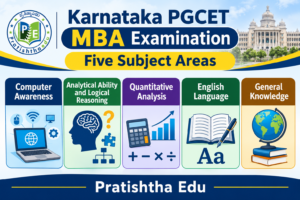
The syllabus is divided into five broad areas that candidates should cover during their preparation:
- Computer Awareness
- Analytical Ability and Logical Reasoning
- Quantitative Analysis
- English Language
- General Knowledge
Understanding these areas before starting preparation helps students identify their strengths and weaknesses, allocate study time effectively and avoid missing important topics during revision.
The syllabus serves as a preparation roadmap for candidates. It helps them organise their study material, plan topic-wise practice, improve problem-solving skills and become more familiar with the type of knowledge and aptitude required for the examination.
Students who want to understand the complete examination process, eligibility requirements, exam pattern, and overall preparation approach can also read our PG-CET MBA Coaching in Bangalore: Complete 2027 Preparation Guide
Candidates preparing for Karnataka PGCET MBA 2027 should also keep an eye on official announcements from the Karnataka Examinations Authority, as the latest notification will provide the official examination details, schedule and instructions for the upcoming examination.
For reference, candidates can also review the Karnataka PGCET MBA 2025 Official Syllabus PDF issued by the Karnataka Examinations Authority. Candidates should refer to the latest notification for the confirmed 2027 syllabus.
- Computer Awareness Syllabus for Karnataka PGCET MBA 2027
Computer Awareness is an important section of the Karnataka PGCET MBA examination that tests a candidate’s basic understanding of computers, their components, operating systems, data representation and fundamental computing concepts. Students preparing for this section should develop a clear understanding of how computers work, how information is processed and how different computer-related technologies are used.
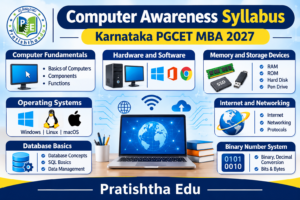
The Computer Awareness section generally covers computer fundamentals, memory, input and output devices, programming languages, operating systems, internet applications, database applications, number systems and binary arithmetic. Candidates should focus on understanding the concepts rather than memorising definitions, as basic conceptual knowledge helps them answer different types of objective questions.
The syllabus provides a broad range of topics that candidates can organise into smaller study units. Preparing each topic systematically, practising multiple-choice questions and revising fundamental concepts regularly can help students approach this section with greater confidence.
Computer Awareness: Topic-Wise Syllabus
A. Computer Fundamentals
Computer fundamentals form the foundation of Computer Awareness preparation. Candidates should understand the basic structure of a computer, how data is processed and the role of different components in performing computing operations.
Topics to prepare include:
- Basic concepts and characteristics of computers
- Organisation of a computer system
- Central Processing Unit (CPU)
- Arithmetic Logic Unit (ALU)
- Control Unit
- Input devices
- Output devices
- Computer memory
- Primary and secondary storage
- Programming languages
- Basic computer applications
Students should understand the functions of important computer components, the differences between hardware and software and how input, processing, output and storage work together in a computer system.
B. Computer Memory and Storage
Computer memory is used to store data, instructions and information required for processing. Candidates should understand different memory types, their functions and the basic differences between memory and storage devices.
Topics include:
- Primary memory
- Secondary memory
- RAM (Random Access Memory)
- ROM (Read Only Memory)
- Cache memory
- Memory units
- Storage devices
- Basic memory organisation
Understanding the differences between RAM, ROM, cache memory and secondary storage can help candidates answer conceptual questions related to computer architecture and memory management.
C. Operating Systems
An operating system manages the resources of a computer and provides an environment in which applications and programs can operate. This topic covers the basic functions, development and types of operating systems.
Topics include:
- Introduction to operating systems
- Evolution of operating systems
- Types of operating systems
- Functions of operating systems
- Modern operating systems
- Basic system management concepts
Candidates should familiarise themselves with the role of operating systems in managing memory, processes, files, hardware devices and user interactions.
D. Internet, Web and Database Applications
Computer Awareness also includes basic knowledge of internet technology, web applications, databases and information systems. These concepts help students understand how computers and digital systems are used for communication, information storage and data management.
Topics include:
- Internet fundamentals
- Web applications
- Basic internet terminology
- Database applications
- Information systems
- Basic concepts of data storage and retrieval
Candidates should understand the purpose of internet applications, the role of databases in storing information and the basic functions of information systems.
E. Data Representation
Data representation explains how computers store and process different types of information using numerical and binary formats. This topic is particularly useful for candidates preparing for questions related to computer fundamentals and number systems.
Topics include:
- Representation of characters
- Representation of integers
- Representation of fractions
- Binary representation
- ASCII representation
- Hexadecimal representation
Candidates should learn how numerical values and characters are represented within a computer system and practise converting values between different number systems.
F. Binary Arithmetic
Binary arithmetic is a practical area of Computer Awareness that requires regular problem-solving practice. Candidates should understand the basic operations performed using binary numbers and how different arithmetic concepts are applied in computer systems.
Topics include:
- Binary addition
- Binary subtraction
- Binary multiplication
- Binary division
- Two’s complement arithmetic
- Floating-point representation
- Normalised floating-point representation
Students should practise binary calculations step by step and understand the logic behind each operation instead of relying only on memorised rules.
How to Prepare for Computer Awareness in Karnataka PGCET MBA
Candidates can prepare for Computer Awareness by dividing the syllabus into conceptual topics and numerical topics. Computer fundamentals, memory, operating systems and internet applications can be prepared through structured notes and concept-based MCQs, while data representation and binary arithmetic require regular practice.
A practical preparation approach includes:
- Begin with computer fundamentals and basic terminology.
- Understand the functions of CPU, memory and input-output devices.
- Study operating systems and their basic functions.
- Learn the concepts of internet, databases and information systems.
- Practise number system conversions.
- Solve binary arithmetic questions regularly.
- Revise important definitions, concepts and terminology.
- Attempt topic-wise MCQs and analyse mistakes.
Candidates should not restrict their preparation to only a few frequently discussed topics. The complete syllabus should be covered, followed by revision and practice.
2. Analytical Ability and Logical Reasoning Syllabus for Karnataka PGCET MBA 2027
Analytical Ability and Logical Reasoning is an important section of the Karnataka PGCET MBA examination that evaluates a candidate’s ability to analyse information, identify patterns, interpret relationships and arrive at logical conclusions. This section tests how effectively students can approach unfamiliar problems, organise information and use reasoning skills to solve questions within a limited time.
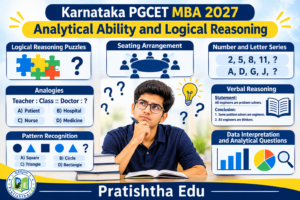
The Karnataka PGCET MBA Analytical Ability and Logical Reasoning syllabus includes topics such as puzzles, analogies, analytical reasoning, logical reasoning, verbal reasoning and diagrams. Candidates may encounter questions that require identifying relationships between objects, arranging information, interpreting logical statements or solving problems using structured reasoning.
Preparing for this section requires more than memorising techniques. Students should develop the habit of analysing questions carefully, identifying the relevant information and applying suitable reasoning methods. Regular practice of different question types can help improve accuracy, speed and confidence during the examination.
Analytical Ability and Logical Reasoning: Topic-Wise Syllabus
A. Analytical Reasoning
Analytical reasoning questions require candidates to examine a set of conditions, organise information and determine the possible outcomes based on the given statements. These questions often involve structured problem-solving, where students must carefully understand the conditions before arriving at an answer.
Topics to prepare include:
- Seating Arrangements
- Linear Arrangements
- Circular Arrangements
- Grouping and Team Formation
- Selection-Based Problems
- Ranking and Ordering
- Scheduling Problems
- Conditional Arrangements
- Analytical Puzzles
- Data-Based Logical Problems
Students should practise arranging information using tables, diagrams and simple representations. These methods help reduce confusion when questions involve multiple conditions and possible arrangements.
B. Logical Reasoning
Logical reasoning focuses on identifying relationships between statements, understanding logical patterns and evaluating conclusions. Candidates should learn to distinguish relevant information from unnecessary details and apply logical rules while solving questions.
Topics to prepare include:
- Syllogisms
- Statement and Conclusion
- Statement and Assumption
- Statement and Argument
- Logical Deductions
- Cause and Effect
- Inference-Based Questions
- Logical Sequences
- Conditional Reasoning
- Decision-Based Reasoning
Practising logical reasoning questions helps students improve their ability to interpret statements, evaluate arguments and identify conclusions supported by the given information.
C. Puzzles
Puzzles are problem-solving questions in which candidates must use a set of clues or conditions to determine the correct arrangement, relationship or outcome. These questions require careful reading, logical organisation and systematic elimination of possibilities.
Topics to prepare include:
- Arrangement Puzzles
- Floor-Based Puzzles
- Scheduling Puzzles
- Grouping Puzzles
- Comparison-Based Puzzles
- Multiple-Condition Puzzles
- Order and Position Puzzles
Candidates should avoid making assumptions while solving puzzles. Instead, they should use the given clues, create structured representations and eliminate possibilities that do not satisfy the conditions.
D. Analogies
Analogy questions evaluate a candidate’s ability to recognise relationships between words, objects, numbers or concepts. Students must identify the relationship in one pair and apply the same logic to another pair.
Topics to prepare include:
- Word Analogies
- Number Analogies
- Letter Analogies
- Relationship-Based Analogies
- Conceptual Analogies
- Pattern-Based Analogies
Candidates should focus on identifying the exact relationship rather than selecting answers based on superficial similarities. Regular practice can improve pattern recognition and logical interpretation.
E. Verbal Reasoning
Verbal reasoning involves interpreting written statements, evaluating information and identifying logical relationships between ideas. It requires candidates to understand the meaning of statements and determine whether a conclusion, assumption or inference follows logically.
Topics to prepare include:
- Statement and Conclusion
- Statement and Assumption
- Statement and Argument
- Inference
- Logical Deduction
- Assertion and Reason
- Cause and Effect
- Critical Reasoning
Students should carefully read each statement and avoid using outside assumptions unless the question specifically requires them. The objective is to evaluate the information presented and arrive at the conclusion supported by the given facts.
F. Diagrams and Visual Reasoning
Diagram-based reasoning questions involve interpreting visual information and identifying relationships using diagrams, shapes, arrangements or graphical representations. These questions require candidates to understand how information is presented visually and apply logical reasoning to determine the correct answer.
Topics to prepare include:
- Venn Diagrams
- Relationship Diagrams
- Arrangement Diagrams
- Pattern-Based Diagrams
- Logical Representation of Statements
- Diagram-Based Problem Solving
Candidates should practise converting verbal conditions into diagrams whenever possible. Visual representation can make complicated reasoning problems easier to understand and solve.
How to Prepare for Analytical Ability and Logical Reasoning in Karnataka PGCET MBA
Candidates can improve their performance in Analytical Ability and Logical Reasoning by practising different question types consistently and developing a systematic approach to problem-solving. This section is best prepared through regular practice rather than memorising answers or shortcuts without understanding the underlying logic.
A structured preparation approach includes:
- Start with basic reasoning concepts and simple logical questions.
- Practise analogy, sequence and relationship-based questions.
- Learn to solve seating arrangement and grouping puzzles systematically.
- Use tables and diagrams to organise puzzle information.
- Practise syllogisms, conclusions and assumption-based questions.
- Develop the habit of reading questions carefully before solving.
- Solve timed practice sets to improve speed and accuracy.
- Analyse incorrect answers and identify the reasoning behind mistakes.
- Revise different question types regularly to maintain consistency.
Students should gradually increase the difficulty of practice questions as their understanding improves. Beginning with simpler questions helps develop confidence, while advanced puzzles and timed exercises help improve problem-solving efficiency.
Candidates preparing for Karnataka PGCET MBA 2027 should cover the complete reasoning syllabus and not depend exclusively on a few puzzle types. The topics listed above represent syllabus areas and useful preparation categories based on recent syllabus coverage; the official 2027 notification should be checked for the final syllabus.
3. Quantitative Analysis Syllabus for Karnataka PGCET MBA 2027
Quantitative Analysis is an important section of the Karnataka PGCET MBA examination that evaluates a candidate’s mathematical ability, numerical understanding and problem-solving skills. This section tests how effectively students can apply mathematical concepts, interpret numerical information and solve quantitative problems within a limited time.
The Karnataka PGCET MBA Quantitative Analysis syllabus includes topics from arithmetic, statistics, probability, mathematical calculations and data interpretation. Candidates need to develop a clear understanding of basic mathematical concepts, learn how to apply formulas correctly and practise different types of numerical questions to improve their accuracy and speed.
Students preparing for this section should avoid relying only on shortcuts or memorised formulas. Understanding the fundamentals of each topic and practising questions at different difficulty levels can help build a strong foundation for the examination. A systematic approach to Quantitative Analysis preparation also allows students to identify difficult topics early and allocate sufficient time for revision and practice.
Quantitative Analysis: Topic-Wise Syllabus
A. Arithmetic
Arithmetic is a fundamental area of Quantitative Analysis that involves numerical calculations and practical mathematical applications. Candidates should strengthen their understanding of arithmetic concepts because these topics help develop the calculation skills required for aptitude-based examinations.
Topics to prepare include:
- Number System
- Percentages
- Ratio and Proportion
- Averages
- Profit and Loss
- Simple Interest
- Compound Interest
- Time and Work
- Pipes and Cisterns
- Time, Speed and Distance
- Problems on Ages
- Mixtures and Alligation
- Unitary Method
Students should practise arithmetic questions regularly, understand the different approaches to solving numerical problems and develop calculation accuracy. Learning how to interpret the question correctly before applying formulas is equally important.
B. Algebra and Mathematical Concepts
Algebra involves the use of mathematical expressions, equations and relationships to solve numerical problems. Candidates should understand basic algebraic concepts and practise applying them to different types of aptitude questions.
Topics to prepare include:
- Algebraic Expressions
- Linear Equations
- Basic Quadratic Equations
- Algebraic Identities
- Mathematical Simplification
- Sequence and Series
- Basic Mathematical Applications
Students should focus on developing a clear understanding of mathematical operations, equations and the methods used to simplify numerical expressions. These fundamentals can also help while solving other quantitative questions.
C. Statistics
Statistics is an important area of quantitative preparation that involves analysing numerical data, understanding measures of central tendency and interpreting statistical information. Candidates should understand the meaning of different statistical measures and practise calculations related to them.
Topics to prepare include:
- Mean
- Arithmetic Mean
- Median
- Mode
- Variance
- Standard Deviation
- Basic Statistical Concepts
- Data Analysis
Students should understand the formulas used to calculate statistical measures and practise questions involving numerical data. Learning how to interpret the results of statistical calculations is also useful while preparing for quantitative aptitude.
D. Probability
Probability measures the likelihood of an event occurring and is an important mathematical concept used in quantitative problem-solving. Candidates should learn the basic principles of probability and practise questions involving different events and possible outcomes.
Topics to prepare include:
- Basic Probability
- Probability of Events
- Independent Events
- Dependent Events
- Conditional Probability (conceptual practice)
- Probability-Based Problems
Candidates should understand the relationship between possible outcomes and favourable outcomes, practise basic probability calculations and gradually work on more complex problems.
E. Permutation and Combination
Permutation and Combination deal with counting methods used to determine the number of possible arrangements or selections under different conditions. These concepts are useful for solving mathematical problems that involve arrangements, selections and counting possibilities.
Topics to prepare include:
- Fundamental Counting Principle
- Permutations
- Combinations
- Arrangements
- Selection-Based Problems
- Basic Counting Techniques
Students should understand the difference between arrangements and selections and practise identifying whether a question requires permutation, combination or a basic counting method.
F. Data Interpretation
Data Interpretation involves analysing information presented in tables, charts, graphs and numerical formats. Candidates need to interpret the given data, perform calculations and draw conclusions based on the information provided.
Topics to prepare include:
- Data Tables
- Bar Graphs
- Pie Charts
- Line Graphs
- Data Comparison
- Numerical Data Analysis
- Percentage-Based Data Interpretation
- Statistical Data Interpretation
Candidates should practise interpreting graphs and tables, calculating percentages, comparing values and identifying trends within numerical data. Improving calculation speed and accuracy can help students handle data interpretation questions more efficiently.
G. Basic Geometry and Other Mathematical Topics
Candidates can also strengthen their preparation by reviewing fundamental geometry and other basic mathematical concepts that may be useful in aptitude-based questions.
Topics to revise include:
- Basic Geometry
- Area and Perimeter
- Basic Mensuration
- Mathematical Relationships
- Numerical Problem-Solving
Candidates should prioritise the officially prescribed syllabus and use these additional mathematical concepts for broader aptitude practice where relevant.
How to Prepare for Quantitative Analysis in Karnataka PGCET MBA
Preparing for Quantitative Analysis requires consistent practice, a clear understanding of mathematical fundamentals and the ability to solve numerical problems accurately. Candidates should divide the syllabus into manageable topics and gradually develop their calculation speed through regular exercises.
A structured preparation approach includes:
- Start with basic arithmetic concepts and numerical calculations.
- Learn formulas and understand how they are applied.
- Practise percentages, ratios, averages and profit-and-loss questions.
- Develop a strong understanding of statistics and probability.
- Solve permutation and combination questions regularly.
- Practise data interpretation using tables, graphs and charts.
- Maintain a formula notebook for quick revision.
- Solve topic-wise MCQs after completing each concept.
- Attempt timed quantitative practice sets.
- Analyse mistakes and revise difficult topics regularly.
Students should focus on accuracy before attempting to increase their solving speed. As their understanding improves, they can gradually practise more questions within a fixed time limit. Regular revision of formulas, numerical concepts and previous practice questions can help improve confidence during the examination.
Candidates preparing for Karnataka PGCET MBA 2027 should give appropriate attention to Statistics, Probability and Data Interpretation along with arithmetic fundamentals. Recent 2026 exam analysis reported substantial coverage of statistics and probability within the Quantitative Analysis section, but topic distribution can change from year to year. Candidates should prepare the complete prescribed syllabus rather than depend on predicted question distribution.
4. English Language Syllabus for Karnataka PGCET MBA 2027
English Language is an important section of the Karnataka PGCET MBA examination that assesses a candidate’s proficiency in English, vocabulary, grammar and sentence comprehension. The section evaluates how effectively students understand language-based questions, identify grammatical errors, interpret sentences and recognise relationships between words.
The Karnataka PGCET MBA English Language syllabus generally covers grammar, vocabulary, sentence correction, synonyms, antonyms, idioms and phrases, sentence completion and other verbal ability topics. Candidates may encounter questions that test their understanding of English usage, sentence structure, word meanings and language-based reasoning.
Preparing for this section requires consistent practice and a strong understanding of basic English grammar. Students who regularly read English articles, revise vocabulary, practise grammar exercises and solve objective questions can gradually improve their language skills and accuracy.
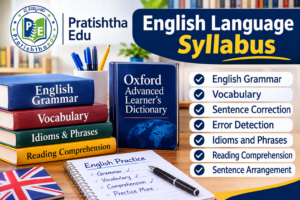
English Language: Topic-Wise Syllabus
A. English Grammar
English grammar is the foundation of verbal ability preparation. Candidates should understand the rules governing sentence formation, word usage and grammatical structure to answer questions accurately.
Topics to prepare include:
- Parts of Speech
- Nouns
- Pronouns
- Verbs
- Adjectives
- Adverbs
- Prepositions
- Conjunctions
- Articles
- Tenses
- Subject-Verb Agreement
- Active and Passive Voice
- Direct and Indirect Speech
- Sentence Structure
- Basic Grammar Rules
Students should focus on understanding how grammar rules are applied in sentences rather than memorising them in isolation. Regular practice of sentence-based grammar questions can help improve accuracy.
B. Vocabulary
Vocabulary questions evaluate a candidate’s understanding of word meanings, usage and relationships between words. A strong vocabulary helps students interpret sentences correctly and answer verbal ability questions more effectively.
Topics to prepare include:
- Synonyms
- Antonyms
- Word Meanings
- One Word Substitution
- Word Usage
- Commonly Confused Words
- Vocabulary-Based Questions
Candidates should develop a habit of learning new words, understanding their meanings and practising their usage in different contexts. Maintaining a vocabulary notebook can be helpful for revision.
C. Sentence Correction and Error Detection
Sentence correction and error detection questions assess a candidate’s ability to identify grammatical mistakes, incorrect word usage and sentence structure problems.
Topics to prepare include:
- Error Detection
- Sentence Correction
- Grammatical Errors
- Incorrect Word Usage
- Subject-Verb Agreement Errors
- Tense Errors
- Sentence Improvement
- Sentence Completion
Students should learn to identify errors systematically by checking grammar, sentence structure, word usage and logical consistency. Practising different sentence-based questions can help develop a better understanding of English language rules.
D. Idioms, Phrases and Expressions
Idioms and phrases are expressions whose meanings may differ from the literal meanings of individual words. Candidates should familiarise themselves with commonly used idioms and phrases that appear in English language aptitude questions.
Topics to prepare include:
- Idioms and Phrases
- Common English Expressions
- Phrasal Verbs
- Phrase Meaning
- Usage of Expressions
- Context-Based Vocabulary
Students should focus on understanding the meaning and usage of common expressions rather than memorising long lists without context.
E. Fill in the Blanks and Sentence Completion
These questions assess a candidate’s ability to select suitable words or expressions to complete sentences correctly. They may involve vocabulary, grammar, context and sentence meaning.
Topics to prepare include:
- Single-Blank Questions
- Multiple-Blank Questions
- Vocabulary-Based Fillers
- Grammar-Based Fillers
- Sentence Completion
- Contextual Word Usage
Candidates should read the complete sentence carefully before selecting an answer. Understanding the context, grammatical structure and intended meaning can help identify the most appropriate word or phrase.
F. Sentence Arrangement and Verbal Ability
Sentence arrangement questions require candidates to organise words, phrases or sentences into a meaningful sequence. These questions assess the ability to understand relationships between ideas and identify the logical flow of written information.
Topics to prepare include:
- Sentence Rearrangement
- Para Jumbles
- Sentence Sequence
- Logical Sentence Formation
- Paragraph Structure
- Verbal Reasoning
Students should identify introductory sentences, connecting phrases, pronoun references and logical relationships while arranging sentences. Regular practice can help improve the ability to recognise the correct sequence.
G. Reading and Comprehension-Based Practice
Reading-based preparation helps candidates develop the ability to understand written information, identify key ideas and interpret the meaning of passages. Although the exact question format may vary, reading comprehension is a useful area of verbal ability preparation.
Preparation areas include:
- Reading and Understanding Passages
- Identifying Main Ideas
- Understanding Context
- Interpretation of Statements
- Vocabulary in Context
- Drawing Conclusions from Written Information
Candidates should develop a regular reading habit and practise understanding the main idea, supporting details and meaning of words within a passage.
How to Prepare for English Language in Karnataka PGCET MBA
English Language preparation should focus on improving grammar, vocabulary, reading ability and sentence comprehension. Candidates do not need to depend on memorisation alone; consistent practice and reading can help develop a better understanding of English usage.
A structured preparation approach includes:
- Revise basic English grammar rules.
- Practise synonyms, antonyms and vocabulary-based questions.
- Learn common idioms, phrases and phrasal verbs.
- Solve sentence correction and error detection exercises.
- Practise fill-in-the-blank questions.
- Work on sentence rearrangement and verbal reasoning.
- Read English newspapers, articles and editorials regularly.
- Practise reading passages and identify their main ideas.
- Maintain a vocabulary notebook for revision.
- Attempt timed English practice sets.
Candidates should focus on improving their accuracy before attempting questions at a faster pace. Regular revision of grammar rules, vocabulary and sentence-based exercises can help strengthen their preparation.
Students preparing for Karnataka PGCET MBA 2027 should cover the complete English Language syllabus and practise a variety of question formats. Reading regularly and solving topic-wise MCQs can help develop the verbal skills required for the examination.
5. General Knowledge Syllabus for Karnataka PGCET MBA 2027
The General Knowledge section of the Karnataka PGCET MBA examination evaluates a candidate’s awareness of important national and international events, economic developments, business trends, government policies, history, geography, science and other relevant topics. This section helps assess how well candidates understand the world around them and their ability to stay informed about important developments.
The Karnataka PGCET MBA General Knowledge syllabus broadly includes static General Knowledge, current affairs, business and economic awareness, Indian polity, history, geography, science and technology, and other important national and international topics. Candidates should develop a habit of regular reading and revision to improve their performance in this section.
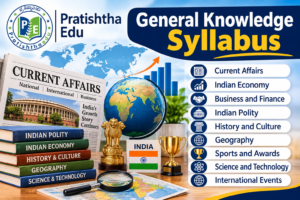
A. Current Affairs
Current affairs play an important role in General Knowledge preparation. Candidates should regularly follow major national and international developments, government initiatives, important events and recent achievements.
Topics to cover include:
- National and international current affairs
- Important government schemes and initiatives
- Major national and international events
- Important appointments and resignations
- Awards, honours and recognitions
- Summits, conferences and international meetings
- Important legal, policy and administrative developments
- Recent developments in education, economy and technology
B. Indian Economy and Business Environment
Understanding basic economic and business developments can help candidates prepare for questions related to India’s economic environment, financial systems and business activities.
Topics to cover include:
- Basic concepts of the Indian economy
- Economic growth and development
- Inflation and economic indicators
- Union Budget and major economic announcements
- Banking and financial awareness
- RBI and important financial institutions
- Business organisations and industries
- Entrepreneurship and business developments
- International trade and economic relations
- Important economic policies and reforms
C. Indian Polity and Governance
Indian polity covers the basic structure of the Indian political system, constitutional provisions, government institutions and important aspects of governance.
Topics to cover include:
- Indian Constitution and its basic features
- Fundamental Rights and Fundamental Duties
- Directive Principles of State Policy
- Parliament and its functions
- President, Prime Minister and Council of Ministers
- Supreme Court and High Courts
- State government structure
- Elections and electoral system
- Important constitutional bodies
- Government policies and administration
D. Indian History and Culture
History and culture help candidates develop awareness of India’s historical background, cultural heritage and major developments across different periods.
Topics to cover include:
- Ancient Indian history
- Medieval Indian history
- Modern Indian history
- Indian freedom movement
- Important historical personalities
- Major historical events
- Indian art, culture and heritage
- Important monuments and historical sites
- Cultural traditions and heritage of India
E. Geography
Geography-related General Knowledge includes basic geographical understanding of India and the world, along with important physical, environmental and resource-related topics.
Topics to cover include:
- Indian geography
- World geography
- Physical geography
- Mountains, rivers, lakes and seas
- Climate and weather patterns
- Natural resources
- Agriculture and major industries
- Countries, capitals and important geographical locations
- Environmental issues and conservation
F. Sports, Awards, Books and Important Personalities
Candidates should also prepare commonly asked static GK and recent information related to sports, awards, notable personalities and important achievements.
Topics to cover include:
- National and international sports events
- Major sports tournaments and championships
- Important sports personalities
- National and international awards
- Books and authors
- Important personalities in politics, science and business
- Notable achievements and recognitions
- Important national and international days
G. Science, Technology and International Awareness
Basic awareness of science, technology and international developments can also help candidates prepare for the General Knowledge section.
Topics to cover include:
- Recent scientific developments
- Space research and missions
- Information technology and digital developments
- Artificial intelligence and emerging technologies
- Major scientific discoveries and innovations
- Important international organisations
- United Nations and its associated organisations
- International relations and global developments
- Environmental and sustainability initiatives
How to Prepare for General Knowledge in Karnataka PGCET MBA
General Knowledge preparation requires consistency rather than last-minute memorisation. Candidates should combine current affairs with static GK and revise important facts regularly. Since the syllabus covers a wide range of topics, a structured approach can make preparation more manageable.
The following steps can help candidates prepare effectively:
- Read current affairs regularly: Follow reliable newspapers or news sources to stay updated with important national, international, economic and business developments.
- Prepare monthly current affairs notes: Organise important events, government schemes, appointments, awards, economic updates and international developments into short notes.
- Cover static GK topics: Study Indian polity, history, geography, sports, awards, important personalities and basic science topics alongside current affairs.
- Focus on business and economic awareness: Revise basic banking concepts, economic terminology, important financial institutions, business developments and major economic announcements.
- Practise GK quizzes and MCQs: Regularly solve objective questions to improve recall, identify weak areas and familiarise yourself with the question format.
- Revise frequently: Review your notes weekly and revisit important topics instead of relying only on new information.
- Avoid random memorisation: Understand the context behind important events, policies, economic developments and international issues wherever possible.
6. Important Topics to Prioritise for Karnataka PGCET MBA 2027
The Karnataka PGCET MBA syllabus covers multiple subjects, and preparing every topic with the same level of attention may not be the most efficient approach. Candidates should first strengthen fundamental concepts, identify topics that require more practice and regularly solve questions from different areas of the syllabus.
Although the Karnataka PGCET MBA examination does not guarantee a fixed topic-wise question distribution, candidates can use the syllabus to identify areas that deserve consistent preparation and revision.
Important Topics in Computer Awareness
Computer Awareness requires a combination of conceptual understanding and numerical practice. Candidates should focus on the fundamentals of computer systems, data representation and basic calculations.
Topics to prioritise:
- Binary arithmetic and number system conversions
- Two’s complement
- Data representation
- Computer fundamentals and organisation
- CPU, ALU and control unit
- Memory and storage
- Operating systems
- Internet and computer applications
- Programming languages and database fundamentals
Candidates should practise binary calculations regularly and revise important computer-related terminology, definitions and concepts.
Important Topics in Analytical Ability and Logical Reasoning
Logical Reasoning requires candidates to analyse conditions, identify patterns and reach conclusions. Regular practice can help improve accuracy and problem-solving speed.
Topics to prioritise:
- Seating arrangements
- Puzzles and grouping
- Number and letter series
- Analogies
- Syllogisms
- Statement and conclusion
- Statement and assumption
- Cause and effect
- Direction sense
- Blood relations
- Venn diagrams
- Coding and decoding
- Ranking and ordering
Candidates should gradually move from basic reasoning questions to complex puzzle-based sets and timed practice.
Important Topics in Quantitative Analysis
Quantitative Analysis requires conceptual clarity, formula knowledge and calculation accuracy. Candidates should focus on mathematical fundamentals and practise different question types.
Topics to prioritise:
- Percentages
- Ratio and proportion
- Averages
- Profit and loss
- Simple and compound interest
- Time and work
- Speed, distance and time
- Statistics
- Probability
- Permutation and combination
- Data interpretation
- Number systems
Candidates should maintain a formula notebook and regularly practise numerical questions without relying on calculators.
Important Topics in English Language
The English Language section can be prepared through grammar revision, vocabulary development and reading practice.
Topics to prioritise:
- Synonyms and antonyms
- Vocabulary
- Idioms and phrases
- Sentence correction
- Error detection
- Fill in the blanks
- Grammar and tenses
- Subject-verb agreement
- Para jumbles
- Sentence arrangement
- Reading comprehension
Candidates should practise objective English questions and read English articles regularly to improve comprehension and vocabulary.
Important Topics in General Knowledge
General Knowledge preparation should include both static GK and current affairs. Candidates should focus on important developments rather than attempting to memorise every news item.
Topics to prioritise:
- Current affairs
- Indian economy
- Business and banking awareness
- Government schemes
- Indian polity
- Important awards and honours
- Sports and tournaments
- Books and authors
- Important personalities
- International organisations
- Science and technology
- Major national and international events
Candidates should revise current affairs regularly and practise GK quizzes to improve recall.
7. Subject-Wise Preparation Strategy for Karnataka PGCET MBA
A structured preparation strategy helps candidates manage all five subjects without neglecting any section. Instead of studying randomly, candidates should divide their preparation into concept learning, question practice, revision and mock tests.
Step 1: Build Strong Fundamentals
Begin with the basic concepts of each subject. Candidates who understand fundamental concepts can solve questions more efficiently and avoid unnecessary mistakes during practice.
- Revise basic mathematical concepts for Quantitative Analysis.
- Understand reasoning patterns and logical relationships.
- Learn computer fundamentals and terminology.
- Strengthen grammar and vocabulary.
- Start building static GK and current affairs knowledge.
Step 2: Prepare a Subject-Wise Study Schedule
Allocate study time to all five subjects according to your strengths and weaknesses. Candidates who are comfortable with mathematics may spend more time on reasoning or computer awareness, while those struggling with numerical questions should practise Quantitative Analysis regularly.
A balanced preparation schedule should include:
- Concept learning
- Topic-wise MCQ practice
- Revision of previously studied topics
- Current affairs reading
- Timed practice sessions
Step 3: Practise Topic-Wise MCQs
After completing a topic, solve multiple-choice questions related to that topic. This helps you understand the question format, improve accuracy and identify concepts that require additional revision.
For additional practice, candidates can refer to Karnataka PGCET MBA Previous Year Question Papers to practise questions from different examination years and understand the question format.
Candidates can also practise using the Karnataka PGCET MBA 2025 Question Paper to understand the question format and improve their problem-solving approach.
Candidates should avoid moving to advanced topics without developing a basic understanding of the concepts.
Step 4: Attempt Mock Tests Regularly
Mock tests help candidates practise under exam-like conditions. They also help in understanding time management, identifying weak subjects and developing an effective question-solving approach.
After each mock test, analyse:
- Questions answered incorrectly
- Questions that took too much time
- Topics that require revision
- Questions left unanswered
- Accuracy across different subjects
Step 5: Maintain a Revision Notebook
Create a notebook or digital document containing important formulas, computer concepts, grammar rules, GK facts, reasoning shortcuts and frequently encountered mistakes.
Regular revision of these notes can help candidates retain information and improve their performance during practice tests.
Step 6: Improve Time Management
Candidates should practise solving questions within a reasonable time limit. During mock tests, learn to identify questions that can be solved quickly and those that require more time.
Avoid spending too much time on a single difficult question when other questions may be easier to attempt.
Step 7: Evaluate Progress and Adjust Preparation
Review your preparation every week. Identify subjects where your performance is improving and areas where you need additional practice.
Adjust your study schedule according to your test results and preparation progress rather than following the same routine without evaluation.
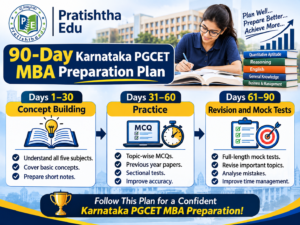
8. 90-Day Preparation Plan for Karnataka PGCET MBA 2027
A 90-day preparation plan can help candidates organise their Karnataka PGCET MBA preparation by dividing the syllabus into manageable stages. Candidates should use the first phase to understand concepts, the second phase to strengthen topic-wise practice and the final phase for revision and mock tests.
The following study plan can be adjusted according to the candidate’s current preparation level, available study time and subject-wise strengths.
Phase 1: Days 1–30 – Build Conceptual Foundations
Goal: Complete the basic concepts of all five subjects.
During the first month, candidates should focus on understanding the syllabus and learning fundamental concepts rather than rushing through questions.
- Computer Awareness: Study computer fundamentals, memory, operating systems, data representation and basic computer concepts.
- Analytical Ability and Logical Reasoning: Practise number series, analogies, coding-decoding, syllogisms, basic puzzles and logical relationships.
- Quantitative Analysis: Cover percentages, ratios, averages, number systems, profit and loss, basic algebra and mathematical fundamentals.
- English Language: Revise grammar, vocabulary, sentence correction, synonyms, antonyms and basic reading comprehension.
- General Knowledge: Start reading current affairs and cover basic static GK, Indian polity, geography and economic awareness.
At the end of this phase, candidates should revise the topics studied and attempt small topic-based tests.
Phase 2: Days 31–60 – Practice and Strengthen Weak Areas
Goal: Improve problem-solving skills and topic-wise accuracy.
The second phase should focus on applying concepts through MCQs, practice sets and timed exercises.
- Computer Awareness: Practise binary arithmetic, number conversions, memory-related questions and computer application MCQs.
- Analytical Ability and Logical Reasoning: Solve seating arrangements, puzzles, statement-based reasoning, Venn diagrams and other analytical questions.
- Quantitative Analysis: Practise statistics, probability, permutation and combination, data interpretation, arithmetic and other numerical topics.
- English Language: Solve sentence correction, fill-in-the-blanks, comprehension, para jumbles and vocabulary-based questions.
- General Knowledge: Revise monthly current affairs, business developments, important awards, sports, government schemes and static GK.
Candidates should begin attempting timed sectional tests during this phase and analyse their performance after every test.
Phase 3: Days 61–90 – Revision and Mock Test Practice
Goal: Improve speed, accuracy, revision and exam readiness.
The final phase should focus on revising the entire syllabus, attempting mock tests and correcting mistakes identified during previous practice sessions.
- Revise formulas, shortcuts and important quantitative concepts.
- Practise reasoning questions with time limits.
- Revise computer fundamentals and binary calculations.
- Review grammar rules, vocabulary and comprehension strategies.
- Revise static GK and current affairs notes.
- Attempt full-length mock tests under exam-like conditions.
- Analyse mock test results and revise weak topics.
- Practise time management and question selection.
Candidates should avoid learning too many new topics at the last moment. Instead, focus on improving the accuracy of topics they have already studied and maintaining consistency in revision.
9. Common Mistakes to Avoid While Preparing for Karnataka PGCET MBA 2027
Candidates preparing for Karnataka PGCET MBA often make mistakes that can affect their preparation and performance. Avoiding these mistakes can help them follow a more organised approach.
1. Preparing Without Understanding the Syllabus
Starting preparation without understanding the syllabus may lead to unnecessary study and incomplete topic coverage. Candidates should first understand the five subjects and their major topics before creating a study plan.
2. Ignoring Any One Subject
Focusing only on Quantitative Analysis or Logical Reasoning while ignoring Computer Awareness, English or General Knowledge can create gaps in preparation. Candidates should allocate time to all five sections.
3. Studying Without Regular Practice
Reading concepts without solving questions may not be sufficient for an entrance examination. Regular MCQ practice helps candidates understand question formats, improve accuracy and identify weak areas.
4. Avoiding Mock Tests
Mock tests provide an opportunity to practise time management and evaluate preparation. Candidates who avoid mock tests may find it difficult to manage time effectively during the examination.
5. Neglecting Revision
Completing topics without revisiting them can make it difficult to retain formulas, vocabulary, computer concepts and GK facts. Revision should be included in the weekly study schedule.
6. Memorising Current Affairs Without Organisation
Randomly reading news articles without taking notes or revising important developments can make GK preparation less effective. Candidates should maintain organised current affairs notes and revise them regularly.
7. Spending Too Much Time on Difficult Questions
A difficult question should not consume too much preparation time or examination time. Candidates should practise identifying questions that can be solved efficiently and return to challenging questions when appropriate.
10. Frequently Asked Questions About Karnataka PGCET MBA Syllabus 2027
Q1. What are the five subjects in the Karnataka PGCET MBA syllabus 2027?
The Karnataka PGCET MBA syllabus broadly covers five subjects: Computer Awareness, Analytical Ability and Logical Reasoning, Quantitative Analysis, English Language and General Knowledge.
Q2. Is Mathematics included in the Karnataka PGCET MBA syllabus?
Yes, Quantitative Analysis includes mathematical topics such as arithmetic, percentages, ratios, averages, algebra, statistics, probability, permutation and combination, and data interpretation.
Q3. Which topics are important in Karnataka PGCET MBA Quantitative Analysis?
Candidates should focus on arithmetic, percentages, ratios, averages, profit and loss, time and work, speed and distance, statistics, probability, permutation and combination, and data interpretation. However, candidates should prepare the complete syllabus instead of relying on a fixed topic-wise question distribution.
Q4. Does Karnataka PGCET MBA include Computer Awareness?
Yes, Computer Awareness is one of the major sections of the Karnataka PGCET MBA examination. It includes computer fundamentals, memory, operating systems, data representation, binary arithmetic, internet-related concepts and other computer topics.
Q5. How should I prepare for Karnataka PGCET MBA General Knowledge?
Candidates should prepare static GK and current affairs together. Regular reading, monthly current affairs notes, economic and business awareness, Indian polity, geography, sports, awards and national and international developments can help build GK knowledge.
Q6. Can I prepare for Karnataka PGCET MBA in 3 months?
Yes, candidates can follow a structured three-month preparation plan by dividing their preparation into concept learning, topic-wise practice, revision and mock tests. The results will depend on their starting level, consistency, available study time and practice.
Q7. How many hours should I study daily for Karnataka PGCET MBA?
The number of study hours depends on the candidate’s preparation level and schedule. Candidates should focus on consistent and effective study sessions covering concept learning, practice questions, revision and current affairs rather than simply counting study hours.
Q8. Where can I get coaching for Karnataka PGCET MBA in Bangalore?
Students looking for structured preparation, subject-wise guidance, practice sessions and test-based learning can explore the GATE and PG-CET coaching programmes at Pratishtha Edu in Bangalore. Candidates should contact the institute to confirm the current availability of Karnataka PGCET MBA coaching, batch timings and course details.
Conclusion
Preparing for the Karnataka PGCET MBA 2027 examination requires a clear understanding of the syllabus, regular practice and a structured preparation strategy. Candidates should focus on all five subjects, strengthen fundamental concepts, solve topic-wise MCQs, revise regularly and attempt mock tests to evaluate their progress.
Understanding the Karnataka PGCET MBA syllabus 2027 is the first step towards building an effective preparation plan. With consistent effort, proper time management and focused revision, candidates can improve their preparation and work towards their MBA admission goals.
For students looking for structured guidance, subject-wise preparation, practice sessions and regular assessment, joining a suitable Karnataka PGCET MBA coaching programme can help bring discipline and direction to their preparation.
Start Your Karnataka PGCET MBA Preparation
Get guidance on course details, batch timings and preparation support.
Leave a Reply