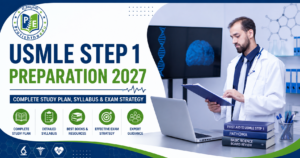
Introduction
Preparing for the United States Medical Licensing Examination (USMLE) Step 1 is an important stage for medical students who plan to pursue medical education, residency, or a medical career in the United States. However, preparing for this examination is not simply about reading more textbooks or memorising large amounts of medical information. A successful USMLE Step 1 Preparation 2027 journey requires a clear understanding of the examination, strong foundational knowledge, reliable study resources, consistent question practice, and a realistic revision strategy.
For many medical students, the biggest challenge is deciding where to begin. The syllabus is broad, the subjects are interconnected, and questions often require students to apply basic science concepts to clinical situations. A student may understand individual topics but still find it difficult to solve integrated questions under time pressure. This is why a structured approach to USMLE Step 1 preparation is important.
The examination requires students to connect different areas of medical knowledge and apply them to clinical situations. Therefore, preparation should focus not only on memorisation but also on understanding mechanisms, recognising patterns, interpreting clinical information, and applying knowledge to patient-based questions. Students need to gradually develop the ability to connect subjects such as physiology, pathology, pharmacology, microbiology, anatomy, biochemistry, and other foundational sciences.
This guide provides a comprehensive roadmap for students planning their preparation in 2027. It covers the USMLE Step 1 syllabus, exam format, study resources, a six-month preparation plan, a shorter three-month strategy, question-bank practice, revision methods, mock-test analysis, common mistakes, and preparation tips for Indian medical students. Students who want a broader overview of the complete USMLE journey can also explore our USMLE Preparation Guide 2027.
The goal is not to follow a fixed routine blindly. Every student begins with a different level of subject knowledge, available preparation time, learning speed, and academic background. A practical USMLE Step 1 study plan should therefore be structured but flexible enough to adapt to individual needs.
What Is USMLE Step 1?
The USMLE Step 1 is the first examination in the United States Medical Licensing Examination sequence. It assesses whether an examinee understands and can apply important concepts of the sciences basic to the practice of medicine. The examination focuses on the principles and mechanisms underlying health, disease, and modes of therapy.
Unlike a traditional university examination that may focus mainly on recalling individual facts, Step 1 requires integrated thinking. A question may combine physiology, pathology, pharmacology, microbiology, anatomy, and other disciplines within a single clinical scenario. Students therefore need to understand how different subjects connect rather than studying every subject as a completely separate topic.
Purpose of the USMLE Step 1 Examination
The main purpose of Step 1 is to assess foundational medical science knowledge and the ability to apply that knowledge in clinically relevant situations. The examination is designed to evaluate how well students understand the scientific principles that form the basis of medical practice.
For students, this means that a strong preparation strategy should include:
- Understanding the normal function of the human body
- Learning how diseases develop and affect different systems
- Connecting pathological changes with clinical findings
- Understanding the mechanisms of drugs and therapies
- Applying basic science principles to patient-based questions
- Developing the ability to interpret clinical information
The examination requires students to move beyond simple memorisation. A student may remember the name of a disease or drug but still find a question difficult if they do not understand the underlying mechanism. For this reason, students should focus on understanding the relationship between normal physiology, disease processes, clinical findings, and treatment principles.
What Does USMLE Step 1 Assess?
The examination assesses much more than the ability to remember isolated facts. Many questions require students to interpret information, identify important clues, understand disease mechanisms, and select the best answer from multiple options.
A question may present:
- A patient’s age and medical history
- Symptoms and physical findings
- Laboratory results
- Imaging or pathological information
- A drug or treatment history
- A question asking about the underlying mechanism
To solve such a question, a student may need to combine knowledge from several areas. Understanding the disease alone may not be sufficient if the student does not understand the related physiology, pathology, pharmacology, or biochemical mechanism.
This is one of the main reasons why USMLE Step 1 preparation should gradually move from basic concept learning to integrated question-solving. Students should not wait until the end of their preparation to begin practising clinical-style questions. Regular practice helps them understand how information is presented and how basic science concepts are tested in clinical contexts.
Students should also develop the habit of analysing their mistakes. Simply completing a large number of questions does not guarantee effective preparation. The explanation behind an incorrect answer can often reveal a gap in understanding or a concept that requires further revision.
Why Is Step 1 Preparation Important for Medical Students?
Step 1 preparation is important because it requires students to bring together knowledge developed across multiple subjects. A student may have studied anatomy, physiology, pathology, pharmacology, microbiology, and biochemistry during medical school, but the examination requires these subjects to be applied in an integrated way.
For this reason, the preparation process should be treated as a gradual transition from learning to application.
A well-planned preparation strategy can help students:
- Identify important topics before beginning intensive revision
- Build a strong foundation in basic medical sciences
- Organise large amounts of information in a manageable way
- Practise solving questions regularly
- Identify weak areas through performance analysis
- Improve accuracy and time management
- Revise high-yield concepts systematically
- Develop confidence before the examination
However, there is no single preparation method that works equally well for every student. Some students may be comfortable with independent study, while others may benefit from structured academic guidance, regular progress monitoring, and a planned learning environment. Students considering USMLE Coaching in Bangalore should evaluate whether structured guidance matches their preparation needs and learning style.
USMLE Step 1 Preparation in 2027: What Should Students Focus On?
Students planning to take Step 1 in 2027 should begin their preparation by understanding the current examination requirements and creating a realistic study strategy. Instead of relying entirely on older study plans, students should regularly review the latest examination information and organise their preparation around reliable resources.
The first step should be to understand the examination framework. The next step is to assess personal preparation needs. A student with a strong foundation in basic sciences may be able to move more quickly into question-bank practice, while a student who needs to rebuild core concepts may require additional time for foundational learning.
A practical approach can include the following stages:
- Assess your current knowledge level and identify strong and weak subjects.
- Review the complete syllabus to understand the broad areas that need to be covered.
- Select a limited number of reliable study resources instead of collecting too many materials.
- Create a realistic preparation timeline based on your examination date and available study hours.
- Combine concept learning with question practice throughout the preparation period.
- Review mistakes carefully rather than focusing only on the number of questions completed.
- Use practice assessments and mock tests to evaluate progress.
- Reserve sufficient time for final revision before the examination.
Students preparing in India may also need to balance medical college responsibilities, clinical rotations, university examinations, and other academic commitments. Therefore, a realistic USMLE preparation for Indian students strategy should focus on consistency rather than attempting to study for an unrealistic number of hours every day.
For students who prefer planned academic support, USMLE preparation in Bangalore may provide access to structured guidance, study planning, and regular academic evaluation. The right approach ultimately depends on the student’s individual background, preparation timeline, and learning requirements.
How to Use This USMLE Step 1 Preparation Guide
This guide is designed to be used as a practical roadmap rather than something to read once and forget. Students can begin with the examination overview, review the syllabus, select appropriate resources, and then build a preparation schedule around their available time.
The following sections will explain the examination format, major subject areas, recommended preparation resources, six-month and three-month study plans, question-bank strategy, revision methods, mock-test analysis, common mistakes, and practical preparation tips.
The most important principle is to maintain balance. Effective preparation does not mean using every available resource or studying without breaks. It means understanding the syllabus, choosing appropriate materials, practising regularly, analysing performance, and making improvements over time.
With a structured approach, consistent effort, and regular evaluation, students can make their preparation more organised and purposeful. The next step is to understand the USMLE Step 1 exam pattern and question format, because knowing how questions are presented is essential for developing an effective preparation strategy.
USMLE Step 1 Exam Pattern and Question Format
Understanding the examination format is an important part of building an effective USMLE Step 1 study plan. Students should know not only what subjects they need to study but also how medical knowledge may be tested during the examination. The USMLE Step 1 is designed to assess the application of foundational science concepts in clinically relevant situations. As a result, preparation should gradually move from learning individual concepts to solving integrated questions.
The USMLE Step 1 is a computer-based examination that uses multiple-choice questions to assess a student’s understanding and application of foundational medical science concepts. Many questions are presented through clinical scenarios in which students need to identify relevant information, understand the underlying disease process or mechanism, and choose the most appropriate answer.
Because the examination focuses on the application of knowledge, students should not limit their preparation to memorising isolated facts. They should also practise interpreting clinical information and connecting concepts from different medical subjects. Regular practice with clinical-style questions can help students become more comfortable with the format and develop a more systematic approach to solving problems.
Computer-Based Examination Format
The computer-based nature of the examination means that students should become comfortable with reading clinical questions on a screen, identifying relevant information quickly, and managing time during different question blocks.
During preparation, students can gradually develop the ability to:
- Read lengthy clinical vignettes efficiently
- Identify the most important information in a question
- Understand what the question is actually asking
- Manage time across different question blocks
- Review difficult questions when appropriate
- Maintain concentration during a long examination session
Students should also practise solving questions under timed conditions as their preparation progresses. However, timed practice does not need to be the focus from the very beginning. During the initial learning phase, students may benefit from spending more time understanding concepts and reviewing explanations. As their knowledge improves, timed question practice can help develop speed and confidence.
Multiple-Choice Questions
Understanding the USMLE Step 1 exam format can help students become more comfortable with multiple-choice questions and clinical scenarios. The challenge is often not simply knowing a fact but applying that fact to the specific situation described in the question.
A question may test:
- A physiological mechanism
- A pathological process
- A pharmacological effect
- A microbiological characteristic
- A biochemical pathway
- An anatomical relationship
- A genetic abnormality
- An epidemiological principle
Students should avoid focusing only on the answer choices. The question stem often contains important clues that help determine what the question is actually testing. During preparation, students should develop the habit of identifying the main problem before looking closely at the options.
For example, a student may read a clinical vignette and ask:
- What is the most important finding?
- What is the question actually asking?
- Which system or mechanism is involved?
- Which concepts are required to solve the problem?
This approach can make question practice more meaningful and help students improve their clinical reasoning.
Integrated Clinical Vignettes
A major part of medical examination preparation is learning how to connect different subjects. A clinical vignette may require knowledge from multiple disciplines at the same time.
For example, a question involving an infectious disease may require an understanding of:
- The causative organism
- The immune response
- The affected organ system
- The pathological changes
- The mechanism of treatment
- The relevant pharmacological effects
This is why students should avoid studying subjects in complete isolation. While subject-wise learning is useful during the initial phase, integrated revision becomes increasingly important as the examination approaches.
A strong USMLE Step 1 preparation strategy should therefore include both concept-based learning and regular question practice. Students should gradually learn to connect basic science knowledge with clinical presentations.
Time Management During the Examination
Time management is an important part of examination preparation. Even students with strong subject knowledge may face difficulty if they spend too much time on individual questions.
During preparation, students should practise:
- Reading the question stem efficiently
- Identifying the key information
- Avoiding unnecessary overthinking
- Making a reasoned choice when uncertain
- Moving forward when a question is taking too long
- Maintaining concentration across multiple blocks
Timed question practice can help students understand their natural pace. However, students should not begin all preparation in timed mode. In the early stages, learning-focused practice can help students understand concepts and review explanations properly. Timed practice can become more important as their knowledge and question-solving ability improve.
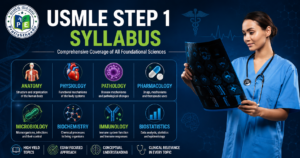
Complete USMLE Step 1 Syllabus and Subject Areas
The USMLE Step 1 syllabus covers a broad range of foundational medical sciences. However, students should understand that these subjects are not always tested as completely separate categories. Questions may combine concepts from multiple disciplines and organ systems.
A practical understanding of the major subject areas can help students organise their preparation and create a more effective study schedule. Instead of treating the syllabus as one large list of topics, students can divide it into manageable sections and gradually connect related concepts.
| Subject Area | Important Preparation Focus | Common Learning Approach |
| Anatomy | Structure, relationships, and clinical anatomy | Concept review and visual learning |
| Behavioral Science and Psychiatry | Behaviour, mental health, and communication | Conceptual study and clinical application |
| Biochemistry and Nutrition | Metabolism, molecular processes, and nutrition | Pathway understanding and clinical correlation |
| Microbiology | Organisms, infections, and disease mechanisms | Pattern recognition and clinical associations |
| Immunology | Immune mechanisms and related disorders | Mechanism-based learning |
| Pathology | Disease mechanisms and tissue changes | Understanding rather than memorisation |
| Pharmacology | Drug mechanisms, effects, and adverse reactions | Mechanism and clinical application |
| Physiology | Normal body function and regulation | Conceptual understanding |
| Genetics and Molecular Biology | Inheritance, mutations, and molecular mechanisms | Pattern-based and conceptual study |
| Biostatistics and Epidemiology | Study design, data interpretation, and research principles | Formula practice and application |
Anatomy
Anatomy preparation should focus on understanding structures and their clinical relationships. Students should pay attention to important anatomical pathways, nerve and vascular relationships, embryological concepts, and clinically relevant structural abnormalities.
Rather than attempting to memorise every detail, students should focus on understanding how anatomical knowledge can explain clinical signs and symptoms. Visual learning, diagrams, labelled images, and repeated revision can be particularly useful.
A strong understanding of anatomy can also support learning in other subjects. For example, knowledge of anatomical structures can make it easier to understand neurological findings, surgical conditions, vascular disorders, and clinical examination findings.
Behavioral Science and Psychiatry
Behavioral science and psychiatry include concepts related to human behaviour, psychological conditions, communication, and aspects of patient care. Students should understand important psychiatric conditions, behavioural patterns, ethical considerations, and communication-related concepts.
Preparation should focus on recognising patterns in clinical scenarios and understanding the principles behind the most appropriate response or diagnosis. Students should also connect theoretical concepts with clinical situations instead of relying only on isolated definitions.
Biochemistry and Nutrition
Biochemistry involves molecular processes, metabolism, enzymes, nutrition, and genetic mechanisms. Students often find this subject difficult when they attempt to memorise isolated pathways without understanding their purpose.
A better approach is to connect biochemical pathways with:
- Clinical diseases
- Enzyme deficiencies
- Nutritional abnormalities
- Genetic disorders
- Laboratory findings
Understanding the clinical significance of a pathway can make revision more effective. Students should focus on the relationship between biochemical abnormalities and the clinical findings they produce.
Microbiology
Microbiology requires students to understand infectious organisms, their characteristics, transmission, associated diseases, and relevant diagnostic or treatment principles.
Students should develop the ability to connect:
Organism → Transmission → Disease → Clinical Presentation → Diagnosis → Treatment
Regular revision and question practice can help reinforce these associations. Instead of memorising large lists of organisms, students should try to understand the important characteristics that help differentiate one infection from another.
Immunology
Immunology focuses on the body’s immune response and the mechanisms involved in immune-related diseases. Students should understand both normal immune mechanisms and the consequences of abnormal immune responses.
Important areas may include:
- Innate and adaptive immunity
- Immune cells and mediators
- Hypersensitivity reactions
- Immunodeficiency disorders
- Autoimmune disease mechanisms
- Transplantation-related concepts
A mechanism-based approach is generally more useful than memorising disconnected lists. Students should understand how an abnormal immune response produces a particular disease or clinical presentation.
Pathology
Pathology is central to understanding how disease affects the body. Students should focus on the mechanisms through which diseases develop, progress, and produce clinical findings.
Effective pathology preparation involves connecting:
Normal Function → Disease Mechanism → Tissue Changes → Clinical Findings
This approach can help students understand why particular symptoms, laboratory abnormalities, and complications occur.
Pathology should also be connected with other subjects. For example, understanding the pathology of a disease becomes more useful when it is linked to the relevant physiology, clinical presentation, microbiology, and treatment.
Pharmacology
Pharmacology requires an understanding of drug mechanisms, therapeutic effects, adverse effects, contraindications, and important interactions.
Instead of memorising long drug lists without context, students should organise drugs according to:
- Mechanism of action
- Therapeutic use
- Important adverse effects
- Contraindications
- Toxicity
- Relevant clinical associations
This makes revision more structured and improves the ability to apply pharmacological knowledge to clinical questions. Students should also revise drug classes together so that similarities and differences between related medications become easier to remember.
Physiology
Physiology provides the foundation for understanding normal body function. A strong understanding of physiology can make pathology and pharmacology easier because students can recognise how disease or treatment changes normal processes.
Important preparation areas include:
- Cardiovascular physiology
- Respiratory physiology
- Renal physiology
- Endocrine regulation
- Gastrointestinal function
- Neurological processes
- Acid-base balance
Students should focus on understanding mechanisms and relationships rather than memorising individual facts. When a student understands how a normal system functions, it becomes easier to identify what changes when disease develops.
Genetics and Molecular Biology
Genetics and molecular biology include inheritance patterns, mutations, gene expression, molecular mechanisms, and genetic disease processes.
Students should practise identifying patterns and connecting genetic changes with clinical presentations. Understanding the underlying mechanism can make many apparently difficult questions easier to approach.
Important preparation areas may include:
- Patterns of inheritance
- Gene mutations
- Chromosomal abnormalities
- DNA and RNA processes
- Gene expression
- Molecular mechanisms of disease
Students should focus on understanding how genetic changes affect cellular function and ultimately produce clinical findings.
Biostatistics and Epidemiology
Biostatistics and epidemiology are important areas that students should not leave entirely for the final days of preparation. The focus should include understanding study design, interpreting data, evaluating diagnostic tests, and applying relevant statistical principles.
Students should practise questions involving:
- Sensitivity and specificity
- Predictive values
- Risk calculations
- Study designs
- Bias
- Screening principles
- Interpretation of research findings
Regular practice is especially useful because many students find it difficult to apply formulas and concepts under examination conditions. Students should understand what a particular calculation means and when it should be used instead of simply memorising formulas.
How to Approach the USMLE Step 1 Syllabus
The syllabus may appear overwhelming when viewed as one large list of subjects. A more practical approach is to divide it into manageable sections and connect related concepts.
For example, while studying cardiovascular medicine, a student may revise:
- Cardiovascular anatomy
- Cardiovascular physiology
- Cardiovascular pathology
- Cardiovascular pharmacology
- Relevant microbiology
- Associated biochemical and genetic conditions
This integrated approach can help students understand how different disciplines contribute to the diagnosis and management of disease.
The most effective preparation strategy is usually a combination of foundational learning, active recall, question practice, error analysis, and repeated revision. Students should avoid spending the entire preparation period reading passively. Regularly testing understanding is essential for identifying gaps in knowledge.
After understanding the examination pattern and major subject areas, the next step is to create a realistic preparation schedule. A structured timeline can help students divide the syllabus, allocate time to question practice, and reserve sufficient time for revision. The next section will focus on how to start USMLE Step 1 preparation in 2027 and how to build a practical six-month study plan.
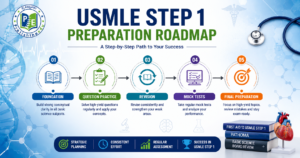
How to Start USMLE Step 1 Preparation in 2027
Starting preparation for a major medical licensing examination can feel overwhelming, especially when students look at the complete syllabus for the first time. Many students make the mistake of beginning with random topics, collecting too many study resources, or creating a study schedule that is difficult to follow. A better approach to USMLE Step 1 Preparation 2027 is to begin with a clear understanding of your current preparation level and then build a realistic plan around your available time.
A successful USMLE Step 1 preparation strategy does not need to be complicated. It should help you understand what to study, when to study it, how to practise questions, and how to measure your progress. The most important thing is to create a system that you can follow consistently over several months.
Understand Your Current Knowledge Level
Before creating a detailed study schedule, evaluate your current understanding of the major basic medical sciences. Your preparation plan should depend partly on your academic background and the time available before the examination.
Some students may have a strong foundation in subjects such as physiology, pathology, and pharmacology. Others may need to revise basic concepts before beginning intensive question-bank practice. Understanding this difference can help prevent unrealistic planning.
Start by asking yourself:
- Which subjects are my strongest?
- Which subjects do I find difficult?
- How much time can I study each day?
- How many months are available before the examination?
- Have I already used any major study resources?
- Have I practised clinical-style questions before?
- How comfortable am I with integrated medical concepts?
A simple self-assessment can help you divide your preparation into three categories:
Strong areas: Topics that require regular revision and question practice.
Moderate areas: Topics that require additional study and application.
Weak areas: Topics that need dedicated concept building and repeated revision.
This assessment does not need to be perfect. Its purpose is to provide a starting point for your preparation.
Review the Complete Syllabus
Once you understand your current knowledge level, review the major content areas included in the examination. Avoid trying to memorise the entire syllabus in a single sitting. Instead, divide it into manageable sections.
For example, you may organise your preparation according to:
- Basic medical sciences
- Organ systems
- Disease mechanisms
- Pharmacology and treatment principles
- Microbiology and infectious diseases
- Genetics and molecular concepts
- Behavioural science
- Biostatistics and epidemiology
An integrated approach can make the syllabus easier to manage. Instead of studying every subject completely separately, you can connect related concepts while revising a particular organ system.
For example, while studying the cardiovascular system, you may revise:
- Cardiovascular anatomy
- Cardiovascular physiology
- Cardiovascular pathology
- Cardiovascular pharmacology
- Relevant microbiology
- Related genetic and biochemical concepts
This approach helps students understand how different subjects work together in clinical situations.
Choose Reliable Study Resources
The number of medical study resources available today can make preparation confusing. Students often spend too much time searching for new books, videos, notes, question banks, and online courses instead of studying the resources they have already selected.
A better strategy is to choose a limited number of reliable resources and use them consistently.
Your study resources may include:
- A primary review resource
- A question bank
- A pathology resource
- A pharmacology or microbiology resource when required
- Practice assessments
- Personal notes and an error log
The goal should not be to complete every available resource. The goal should be to understand important concepts and apply them through regular question practice.
Before adding a new resource, ask yourself:
Will this resource help me understand a difficult concept, revise an important topic, or improve my question-solving ability?
If the answer is no, it may not be necessary to add it to your preparation schedule.
Create a Realistic Study Schedule
A study schedule should match your actual routine. Many students create plans that require ten or twelve hours of highly focused study every day, even when their academic responsibilities make that impossible.
A realistic schedule is more useful than an ambitious schedule that is abandoned after a few days.
When creating your timetable, consider:
- College or clinical responsibilities
- Travel time
- Sleep and rest
- Personal commitments
- Daily study hours
- Weekly revision time
- Question practice requirements
Students may divide their study day into different activities, such as:
Concept Learning: Understanding new topics and reviewing difficult concepts.
Question Practice: Applying knowledge through clinical-style questions.
Review: Analysing explanations and understanding mistakes.
Revision: Revisiting previously studied topics.
The proportion of time given to each activity can change during the preparation period. Early preparation may involve more concept learning, while later preparation may require greater emphasis on questions, revision, and practice assessments.
Set Weekly and Monthly Goals
Long-term goals can sometimes feel distant. Breaking the preparation journey into smaller goals can make progress easier to monitor.
A monthly goal may include completing specific subject areas or completing a particular phase of preparation. Weekly goals can then divide those larger objectives into manageable tasks.
For example:
Monthly Goal: Complete core cardiovascular and respiratory concepts.
Weekly Goals:
- Revise cardiovascular physiology
- Study important cardiovascular pathology
- Review related pharmacology
- Complete relevant practice questions
- Analyse incorrect answers
At the end of each week, evaluate your progress honestly. If a particular topic took longer than expected, adjust the following week’s plan instead of trying to follow the original schedule at any cost.
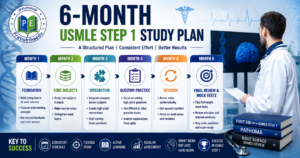
6-Month USMLE Step 1 Study Plan
A six-month USMLE Step 1 Preparation 2027 plan can provide a useful structure for students who have sufficient time to study consistently. However, the exact duration required may vary depending on previous knowledge, academic background, available study hours, and individual learning speed.
The following six-month plan provides a general framework that can be adapted to individual requirements.
| Month | Main Focus | Study Goal | Practice |
| Month 1 | Foundation Building | Strengthen core concepts | Basic question practice |
| Month 2 | Core Subjects | Complete major subject areas | Regular practice |
| Month 3 | Integrated Learning | Connect different disciplines | Question-bank practice |
| Month 4 | Intensive Practice | Improve application and accuracy | Timed question blocks |
| Month 5 | Revision | Improve weak areas | Practice assessments |
| Month 6 | Final Review | Strengthen exam readiness | Mock tests and high-yield revision |
Month 1: Foundation Building
The first month should focus on building a strong foundation. Students should review essential concepts in the major basic medical sciences and identify areas that require additional attention.
Important areas may include:
- Physiology
- Pathology
- Pharmacology
- Biochemistry
- Microbiology
- Immunology
- Anatomy
The goal is not necessarily to complete every topic in great detail during the first month. Instead, students should focus on understanding the basic concepts that will support more advanced learning later.
During this phase, students can begin practising questions regularly. The main purpose of early question practice is learning. Students should focus on understanding why an answer is correct and why the other options are incorrect.
A useful routine may include:
- Concept review during the first study session
- A limited number of practice questions
- Detailed review of explanations
- Recording important mistakes
- Short revision before ending the study day
Students should avoid becoming overly concerned about their initial question-bank performance. Early scores may not accurately reflect future performance because the student is still developing their knowledge and question-solving skills.
Month 2: Core Subject Preparation
During the second month, students can focus on completing important core subject areas and strengthening their understanding of high-yield concepts.
The main objective should be to connect basic science knowledge with disease mechanisms and clinical findings.
For example:
- Physiology should be connected with pathology.
- Pathology should be connected with clinical presentation.
- Pharmacology should be connected with disease treatment.
- Microbiology should be connected with infectious disease patterns.
- Biochemistry should be connected with metabolic disorders.
Students should continue question practice throughout this phase. Questions should not be treated as a separate activity that begins only after completing the syllabus.
A balanced study day may include:
- Learning a new topic
- Reviewing related concepts
- Solving relevant questions
- Analysing explanations
- Revising previously studied material
By the end of the second month, students should have a clearer understanding of their strengths and weaknesses.
Month 3: Integrated Learning and Question Practice
The third month can focus more strongly on integrated learning. By this stage, students should begin connecting different subjects and organ systems more frequently.
For example, while studying renal disease, students may need to connect:
- Renal anatomy
- Renal physiology
- Acid-base balance
- Pathological changes
- Pharmacological treatment
- Relevant genetic and biochemical conditions
This integrated approach can improve the ability to solve questions that combine information from different disciplines.
Question-bank practice should become a regular part of the daily routine. Students should not focus only on completing a particular number of questions. The quality of review is equally important.
After completing a question, students should consider:
- Why was the correct answer correct?
- Why were the other options incorrect?
- Did I misunderstand the concept?
- Did I miss an important clue?
- Was the mistake caused by a knowledge gap or careless reading?
Maintaining an error log can help students identify repeated mistakes and revise them more efficiently.
Month 4: Intensive Question Bank Practice
The fourth month should place greater emphasis on applying knowledge through question-bank practice. Students should gradually become more comfortable solving questions under timed conditions.
The focus should include:
- Regular timed question blocks
- Careful review of incorrect answers
- Identification of recurring weak topics
- Revision of difficult concepts
- Improvement of speed and accuracy
Students should avoid treating question-bank practice as a competition. Completing questions quickly without understanding the explanations may not provide meaningful improvement.
A better approach is to use each question as a learning opportunity. Even when an answer is correct, students should review the explanation if they were uncertain or guessed the answer.
During this stage, students should also begin evaluating their overall preparation more regularly.
Month 5: Revision and Weak Area Improvement
The fifth month should focus on revision and targeted improvement. By this stage, students should have enough experience to identify the subjects and topics that continue to create difficulty.
Instead of revising the entire syllabus with equal intensity, students can prioritise:
- Frequently missed concepts
- Repeated errors
- Difficult subject areas
- Important high-yield topics
- Topics that have not been revised recently
A useful method is to divide weak areas into categories:
Knowledge Gap: The concept has not been studied properly.
Memory Gap: The concept was studied but is not being recalled accurately.
Application Gap: The concept is understood but difficult to apply to a clinical question.
Each type of problem may require a different solution. A knowledge gap may require a concept review, while an application gap may require additional practice with questions.
Students should also begin using practice assessments to evaluate their progress. The purpose of a practice test is not only to obtain a score but also to identify areas that require further attention.
Month 6: Final Revision and Mock Tests
The final month should focus on exam readiness, revision, and performance evaluation. Students should avoid attempting to learn large amounts of completely new material at the last moment unless it represents a significant gap.
The focus should gradually shift towards:
- High-yield revision
- Important weak areas
- Review of previous mistakes
- Question-bank revision
- Practice assessments
- Time management
Mock tests can help students become familiar with the demands of sustained concentration and timed problem-solving. After each assessment, students should analyse their performance carefully.
Important questions to consider include:
- Which subjects caused the most difficulty?
- Were mistakes related to knowledge or interpretation?
- Did time management affect performance?
- Were there repeated mistakes?
- Which topics require final revision?
The final weeks should be organised carefully. Students should avoid making major changes to their entire study strategy at the last minute. A calm and structured approach can help maintain consistency and confidence.
Making the Six-Month Study Plan Work
A study plan is only useful when it can be followed consistently. Students should therefore review their schedule regularly and make adjustments when necessary.
Some weeks may be more productive than others. Academic responsibilities, personal commitments, or unexpected circumstances may affect progress. Missing one study session does not mean the entire plan has failed.
Instead of trying to compensate by creating an unrealistic schedule, students can adjust their upcoming goals and continue with the most important topics.
The most important elements of a successful preparation plan include:
- Consistent daily effort
- Regular question practice
- Careful review of mistakes
- Repeated revision
- Honest performance evaluation
- Flexibility when necessary
Students who require structured academic guidance may also consider a planned USMLE preparation in Bangalore approach that provides support with study planning and progress evaluation. However, regardless of whether a student follows self-study or receives guidance through USMLE Coaching in Bangalore, individual consistency remains an essential part of preparation.
A six-month plan provides a framework, but the actual success of the plan depends on how effectively the student uses study time. Understanding concepts, practising questions, reviewing mistakes, and revising regularly should remain the central priorities throughout the preparation journey.
The next stage of preparation is particularly useful for students with limited time. A focused three-month strategy can help students prioritise high-yield concepts, question practice, revision, and preparation for the final assessment.
3-Month Intensive USMLE Step 1 Preparation Plan
Not every student has six months or more available for preparation. Some students may need to prepare within a shorter period because of academic schedules, examination timelines, or other personal commitments. A three-month preparation plan can be challenging, but a focused and organised approach can help students use their available time more effectively.
The main difference between a three-month and a six-month study plan is the amount of time available for detailed learning. Students following a shorter timeline need to prioritise important concepts, use reliable study resources, practise questions consistently, and avoid spending too much time on low-priority material.
A short preparation schedule should not mean ignoring foundational concepts. Instead, students should combine concept revision with question practice from the beginning.
Month 1: High-Yield Concepts and Foundation Review
The first month should focus on reviewing the most important foundational concepts and identifying areas that require immediate attention.
Students can organise their preparation around major subjects and organ systems. The objective should be to build a strong understanding of the concepts that are most relevant to solving clinical questions.
During this phase, students should focus on:
- Reviewing important basic science concepts
- Strengthening weak subjects
- Understanding disease mechanisms
- Connecting physiology with pathology
- Reviewing important pharmacological principles
- Beginning regular question-bank practice
Students should avoid spending several weeks reading a single subject in isolation. A more integrated approach can help cover a wider range of topics while improving the ability to connect different concepts.
Question practice should begin early. The purpose during the first month is not only to measure performance but also to identify knowledge gaps. Every incorrect answer should be reviewed carefully.
A practical daily routine may include:
- Reviewing a core concept
- Studying related high-yield information
- Solving practice questions
- Reviewing incorrect answers
- Revising previously studied topics
Students should maintain a record of difficult concepts and recurring mistakes. This information can be useful during the final revision phase.
Month 2: Question Bank Practice and Revision
The second month should place greater emphasis on question-bank practice and active revision. By this stage, students should have reviewed a significant portion of the core material and should begin focusing more on applying their knowledge.
The main goals of this phase include:
- Increasing question-solving practice
- Improving accuracy
- Identifying repeated mistakes
- Revising weak topics
- Improving the ability to interpret clinical vignettes
- Developing better time management
Students should gradually increase the number of questions they solve, while still giving sufficient attention to explanations.
The review process is often more important than simply completing a large number of questions. After answering a question, students should understand the reasoning behind the correct answer and review the important concepts associated with the question.
Students can classify their mistakes into different categories:
Knowledge-Based Mistakes: The concept was not understood or remembered.
Interpretation Mistakes: The student misunderstood the question or missed an important clue.
Application Mistakes: The student knew the concept but could not apply it to the clinical situation.
Careless Mistakes: The student knew the answer but selected an incorrect option due to rushed reading or lack of attention.
This type of analysis can help students develop a more targeted revision strategy.
During the second month, students should also begin taking practice assessments when appropriate. The purpose of these assessments is to evaluate progress and identify areas that need additional revision.
Month 3: Mock Tests and Final Review
The third month should focus on final revision, practice assessments, and exam readiness. Students should avoid attempting to study every available resource during this phase.
Instead, they should concentrate on:
- High-yield concepts
- Previously incorrect questions
- Frequently tested principles
- Weak subject areas
- Important clinical associations
- Practice assessments
Mock tests can help students evaluate their preparation and become more comfortable with solving questions under time constraints. However, the value of a practice test depends largely on how carefully the results are analysed.
After completing a practice assessment, students should review:
- Questions answered incorrectly
- Questions answered correctly through guessing
- Topics that caused uncertainty
- Repeated areas of weakness
- Time-management problems
The final weeks should be used for targeted revision rather than completely changing the preparation strategy. Students should focus on reinforcing what they already know and improving the areas that continue to create difficulty.
A three-month plan requires discipline and prioritisation. Students should avoid constantly changing resources or comparing their progress with other candidates. Different students have different academic backgrounds, study speeds, and preparation needs.
The most important goal is to make consistent progress every day.
Best Books and Study Resources for USMLE Step 1
Choosing the right study resources is an important part of effective USMLE Step 1 preparation. The number of books, video lectures, question banks, notes, and online resources available can make the selection process confusing.
Students should remember that using more resources does not automatically lead to better preparation. In many cases, using a limited number of reliable resources consistently can be more effective than repeatedly changing study materials.
A practical resource strategy usually includes:
- One primary review resource
- A reliable question bank
- Targeted resources for difficult subjects
- Practice assessments
- Personal notes and an error log
The best resources may vary depending on the student’s academic background and learning style. However, students should focus on understanding how each resource fits into their overall preparation plan.
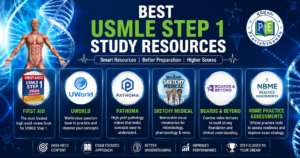
First Aid for the USMLE Step 1
First Aid for the USMLE Step 1 is widely used as a review resource by medical students preparing for the examination. It is commonly used to organise and revise important information across multiple subjects.
Students may find it useful for:
- Reviewing high-yield concepts
- Consolidating information
- Revising important associations
- Making personal annotations
- Preparing for final revision
However, students should avoid treating a review book as a replacement for understanding concepts. If a topic is difficult, additional explanation may be required before the information can be effectively revised.
A practical approach is to use a primary review resource alongside question practice. Students can add important information from their question-bank explanations to their notes or review materials.
The goal should be to gradually build a personalised revision resource rather than repeatedly collecting new books.
UWorld Question Bank
Question-bank practice is an important part of the preparation process. A high-quality question bank can help students practise applying medical knowledge to clinical scenarios and identify areas that require further study.
Students can use question-bank practice to:
- Test their understanding
- Improve clinical reasoning
- Identify weak concepts
- Practise time management
- Review explanations
- Develop familiarity with clinical question formats
The most important part of using a question bank is the review process. Students should not focus only on how many questions they completed in a day.
A question answered incorrectly can provide valuable information about a knowledge gap. Similarly, a question answered correctly through guessing should also be reviewed carefully.
Students can create an error log containing:
- The topic of the question
- The reason for the mistake
- The correct concept
- Important points to remember
- Any related topics requiring revision
This error log can become particularly useful during the final stages of preparation.
Pathoma
Pathology is an important part of medical education and plays a major role in understanding disease mechanisms. A focused pathology resource can help students understand how diseases develop and how pathological changes produce clinical findings.
Students should focus on understanding the connection between:
Disease Mechanism → Pathological Change → Clinical Presentation
Rather than attempting to memorise isolated facts, students should understand the underlying processes.
Pathology revision becomes more effective when it is connected with physiology, pharmacology, microbiology, and clinical findings. This integrated approach can help students understand why particular diseases produce specific symptoms and laboratory abnormalities.
Sketchy Medical
Visual learning resources can be useful for students who find certain subjects difficult to remember through text alone. Visual associations may help with the revision of topics such as microbiology and pharmacology.
Students should use visual resources strategically rather than attempting to watch every available video without a clear plan.
A practical approach may involve:
- Using visual learning for difficult topics
- Reviewing the topic through a primary resource
- Practising related questions
- Revisiting the visual association during revision
The purpose of using an additional resource should be to improve understanding or recall.
Boards and Beyond
Video-based learning resources can be useful for students who prefer detailed explanations of foundational medical concepts. Such resources may help students understand difficult topics before moving to intensive question practice.
Students should avoid passively watching long hours of videos without actively reviewing the material. Active learning can include:
- Taking concise notes
- Pausing to recall concepts
- Connecting the explanation with other subjects
- Solving related questions after studying
The objective should be to use videos to improve understanding rather than simply completing a certain number of lectures.
NBME Practice Assessments
Practice assessments can help students evaluate their preparation and identify areas that require further revision. They are particularly useful during the later stages of preparation when students need to assess their readiness.
Students should not view a practice assessment only as a score-producing activity. The analysis after the assessment is equally important.
After completing a practice test, students should review:
- Incorrect answers
- Uncertain answers
- Topics with repeated errors
- Time-management difficulties
- Concepts that require additional revision
Practice assessments can also help students become more comfortable with the pressure of solving questions within a limited time.
How to Select the Right Study Resources
The best resource combination depends on individual learning needs. A student with a strong academic foundation may require fewer explanatory resources and more question practice. Another student may need additional support with foundational concepts before beginning intensive practice.
Before selecting a new resource, consider:
- Does it explain a difficult topic clearly?
- Does it fit into my current study schedule?
- Will I have enough time to complete and revise it?
- Does it complement my primary resources?
- Will it improve my understanding or question-solving ability?
Students should avoid changing their entire resource strategy every time they see another student’s study routine online. Different preparation methods may work for different learners.
A reliable approach is to select resources early, understand how each one will be used, and remain consistent with the plan.
Combining Books, Videos, and Question Banks
Different study resources serve different purposes.
Books and review materials can help organise and revise information.
Video resources can help explain difficult concepts.
Question banks can help students apply knowledge and identify gaps.
Practice assessments can help evaluate preparation and exam readiness.
These resources should work together rather than being used as completely separate parts of preparation.
For example, a student may:
- Learn a concept through a primary resource.
- Use a video explanation if the topic remains difficult.
- Review the concept again.
- Solve related clinical questions.
- Analyse mistakes.
- Add important points to personal notes.
- Revise the topic later.
This approach can make preparation more active and structured.
Students should remember that completing a book, video course, or question bank is not the final goal. The goal is to understand concepts, apply knowledge, identify weaknesses, and improve performance over time.
The next stage of preparation focuses on one of the most important components of the examination journey: learning how to use question banks effectively and how to analyse performance through practice assessments.
How to Use UWorld Effectively for USMLE Step 1
Question-bank practice is one of the most important parts of a well-planned USMLE Step 1 study plan. However, simply completing a large number of questions does not guarantee effective preparation. The real value of a question bank comes from understanding the questions, reviewing explanations, identifying mistakes, and using that information to improve future performance.
Students should therefore think of question-bank practice as an active learning process rather than simply a test of knowledge.
When Should You Start UWorld?
The right time to begin question-bank practice depends on the student’s preparation level. Some students may begin with a small number of questions while building their foundation, while others may prefer to review important concepts first and then begin more intensive practice.
In general, students should avoid delaying question practice until the final weeks before the examination. Clinical questions require a different style of thinking from traditional textbook study, and students may need time to become comfortable with the format.
Early question practice can help students understand:
- How clinical information is presented
- How different subjects are integrated
- How questions are structured
- Which topics require further study
- How much time is required to solve a question
During the initial stages, students may focus more on learning and understanding explanations. As preparation progresses, question practice can gradually become more focused on timed performance and exam-style conditions.
Tutor Mode vs Timed Mode
Different question-bank modes can serve different purposes during preparation.
Tutor Mode can be useful during the learning phase. Students can focus on one question at a time and review the explanation immediately. This approach may help students understand concepts while they are still building their foundation.
Tutor-style practice can be useful when:
- Learning a new subject
- Reviewing a difficult topic
- Understanding question explanations
- Identifying knowledge gaps
- Building familiarity with clinical vignettes
Timed Mode can become more useful as the examination approaches. It allows students to practise answering questions under time pressure and can help them understand their natural pace.
Timed practice can help students:
- Improve speed
- Develop concentration
- Practise decision-making under pressure
- Identify time-management problems
- Become more comfortable with examination conditions
Students do not necessarily need to choose only one mode throughout their preparation. A combination of learning-focused and timed practice can be useful at different stages.
How to Review Incorrect Answers
Reviewing incorrect answers is one of the most valuable parts of question-bank practice. Students should avoid simply checking the correct answer and moving on to the next question.
After getting a question wrong, ask:
- Did I not know the concept?
- Did I misunderstand the question?
- Did I miss an important clue?
- Did I confuse two similar conditions?
- Did I make a careless mistake?
- Did I know the information but fail to apply it?
Understanding the reason for the mistake is important because different problems require different solutions.
For example, if a student does not understand the mechanism of a disease, additional concept review may be necessary. If the student understands the concept but repeatedly misses important clues in the question, more clinical practice may be required.
Students should also review questions that they answered correctly through guessing. A correct answer does not always mean that the concept is fully understood.
How to Create a USMLE Step 1 Error Log
An error log can help students identify patterns in their mistakes. It does not need to become a large collection of copied explanations. Instead, it should contain concise and useful information.
A practical error log may include:
| Topic | Reason for Mistake | Important Concept | Revision Plan |
| Physiology | Concept not understood | Key mechanism | Review topic |
| Pharmacology | Drug effects confused | Mechanism and adverse effect | Revise drug class |
| Microbiology | Organism not identified | Important association | Practice-related questions |
| Pathology | Clinical finding misunderstood | Disease mechanism | Review pathology |
Students should review the error log periodically rather than waiting until the final week. Repeated mistakes often indicate topics that require additional attention.
An error log can also help reduce unnecessary revision. Instead of rereading every topic with equal intensity, students can focus on concepts that have repeatedly caused difficulty.
Building an Effective Question-Bank Strategy
Question-bank practice should gradually change as preparation progresses.
Early Preparation
During the early phase, the focus should be on learning. Students can solve questions related to the topics they are currently studying and spend sufficient time reviewing explanations.
The main objective is to understand concepts and recognise knowledge gaps.
Middle Phase
During the middle phase, students can increase their question practice and begin working with more integrated topics.
The focus should include:
- Improving knowledge application
- Identifying recurring mistakes
- Increasing question-solving speed
- Revising difficult concepts
- Connecting different subjects
Final Preparation
During the final phase, students should focus more on exam-style practice, timed question blocks, high-yield revision, and performance analysis.
The aim should be to improve consistency and confidence rather than constantly searching for new study resources.
Role of NBME Practice Tests in USMLE Step 1 Preparation
Practice assessments can provide valuable information about a student’s preparation progress. They can help students understand how well they are applying their knowledge and which areas may require additional revision.
However, a practice test should not be treated as a final judgement of a student’s ability. Performance can change as preparation continues, and a single assessment may not reflect the complete level of knowledge.
The most important part of taking a practice assessment is analysing the result.
When to Take Your First NBME Assessment
The timing of the first practice assessment depends on the student’s preparation timeline and academic background. Some students may take an assessment after completing a significant portion of their foundational study, while others may use an earlier assessment to understand their starting point.
Students should avoid waiting until the very end of preparation to evaluate their progress for the first time. Early performance information can help identify areas that need attention.
A practice assessment may help answer questions such as:
- Which subjects are currently strong?
- Which areas require more revision?
- Am I making knowledge-based mistakes?
- Am I struggling with question interpretation?
- Is time management affecting my performance?
The purpose of an early assessment should be to collect useful information and adjust the study plan accordingly.
How to Analyse Your Performance
After completing a practice assessment, students should spend sufficient time reviewing their performance.
The analysis should include:
- Incorrect answers
- Questions answered through guessing
- Questions that took too much time
- Topics that caused uncertainty
- Repeated areas of weakness
Students should classify their mistakes where possible.
Knowledge Gap: The student did not know or understand the concept.
Application Gap: The student knew the concept but could not apply it to the question.
Reading Error: The student missed an important detail in the question.
Time-Management Issue: The student spent too much time on one question or section.
This type of analysis can make the next phase of preparation more targeted.
How to Use Practice Test Results
A practice assessment should lead to action. Students should use the results to adjust their preparation strategy.
For example:
- A weak physiology performance may require additional concept review.
- Repeated pharmacology mistakes may require revision of drug mechanisms.
- Difficulty with long clinical vignettes may indicate a need for more question practice.
- Time-related problems may require more timed blocks.
Students should avoid changing their entire study plan after every single result. Instead, they should look for consistent patterns across practice sessions.
The goal is to use assessments as a feedback system.
Daily Study Schedule for USMLE Step 1 Preparation
A daily study schedule can help students organise their time and maintain consistency. However, there is no universal number of hours that every student must study.
The ideal schedule depends on:
- Academic responsibilities
- Preparation timeline
- Previous knowledge
- Learning speed
- Personal routine
- Available study hours
A student should create a schedule that is challenging but realistic.
Example of a Daily Study Routine
| Time | Activity |
| Morning | Concept learning and revision |
| Midday | Question-bank practice |
| Afternoon | Review of incorrect answers |
| Evening | High-yield topic revision |
| Night | Active recall and short revision |
This schedule can be adjusted according to individual requirements.
Morning: Concept Learning
Many students prefer to study difficult or new concepts during the first part of the day. This session can focus on:
- New topics
- Difficult subjects
- Core concepts
- Mechanisms of disease
- Important physiology and pathology
Students should try to study actively instead of simply reading for several hours.
Active learning may include:
- Writing short summaries
- Drawing mechanisms
- Explaining concepts aloud
- Testing recall without looking at notes
- Connecting related topics
Midday: Question-Bank Practice
Question practice can be scheduled after the concept-learning session. Students can solve questions related to the topics they have studied or work through integrated question blocks.
The number of questions should be realistic. Completing fewer questions with careful review may be more useful than completing a large number without understanding the explanations.
Students should pay attention to:
- Accuracy
- Time taken
- Question interpretation
- Repeated mistakes
Afternoon: Review of Incorrect Answers
The review session is an important part of the study day. Students should carefully analyse questions that were answered incorrectly or with uncertainty.
The review should focus on understanding the concept rather than copying large amounts of information.
Students can ask:
What did I know?
What did I miss?
Why was the correct answer correct?
What should I remember for a similar question in the future?
This approach can help convert mistakes into learning opportunities.
Evening: High-Yield Revision
The evening session can be used for reviewing previously studied topics. Short, repeated revision sessions can help reinforce information over time.
Students may revise:
- Important disease mechanisms
- Drug classes
- Microbiology associations
- Difficult pathways
- Previous mistakes
- High-yield clinical concepts
The focus should be on active recall rather than simply rereading the same material.
Night: Flashcards and Recall
A short final revision session can be used for active recall. Students can test themselves on important facts and concepts without immediately looking at the answer.
For example:
- What is the mechanism of this disease?
- Which drug class is associated with this adverse effect?
- What is the most important feature of this condition?
- Which physiological change explains this finding?
Active recall can help identify information that appears familiar during reading but is difficult to remember independently.
How to Maintain Consistency During Preparation
A daily schedule is useful only when it can be followed consistently. Students should avoid creating a timetable that leaves no time for rest, unexpected responsibilities, or adjustment.
Some days may be more productive than others. A temporary decrease in productivity does not mean that preparation has failed.
Students can maintain consistency by:
- Setting realistic daily goals
- Dividing large tasks into smaller activities
- Tracking progress weekly
- Taking appropriate breaks
- Reviewing their schedule regularly
- Avoiding unnecessary comparison with other students
The most effective study routine is one that can be sustained over time.
Question-bank practice, practice assessments, and daily revision should work together as part of the broader preparation strategy. Students should use their performance data to identify weaknesses and then adjust their study plan accordingly.
The next stage will focus on how to revise effectively for USMLE Step 1, how to organise multiple revision cycles, and the common mistakes students should avoid during their preparation.
How to Revise for USMLE Step 1
Revision is one of the most important parts of a successful USMLE Step 1 preparation strategy for 2027. Medical students study a large amount of information during their preparation, but remembering everything after a single reading is not realistic. Regular revision helps strengthen understanding, improve recall, and identify concepts that require additional attention.
However, revision should not simply mean reading the same book repeatedly from beginning to end. A more effective revision strategy combines active recall, question practice, error analysis, and targeted review.
Students should gradually move from detailed learning to faster and more focused revision as the examination approaches.
First Revision: Build a Strong Understanding
The first revision should take place after the initial learning phase of a subject or topic. The purpose is to review the main concepts and confirm that the information has been understood.
During the first revision, students should focus on:
- Reviewing important concepts
- Understanding difficult mechanisms
- Connecting related subjects
- Revisiting important diagrams and pathways
- Solving related practice questions
- Identifying areas that require additional study
The first revision may take more time because students are still building their understanding.
For example, while revising a topic in cardiovascular medicine, a student may review the relevant physiology, pathology, pharmacology, and clinical presentation together. This integrated approach can make the information easier to apply to clinical questions.
Students should avoid spending excessive time rewriting complete textbooks during revision. Short notes, diagrams, tables, and personal annotations can make the process more efficient.
Second Revision: Improve Recall and Application
The second revision should be more focused than the first. By this stage, students should already have a basic understanding of the major topics.
The focus can shift towards:
- Active recall
- High-yield concepts
- Previous mistakes
- Important clinical associations
- Difficult topics
- Question-bank explanations
Students should try to recall information before looking at their notes. This can help identify the difference between information that feels familiar and information that can actually be remembered independently.
For example, instead of rereading the mechanism of a disease, a student can ask:
What causes this disease?
What is the underlying mechanism?
What clinical findings should I expect?
Which treatment principles are important?
After attempting to recall the information, the student can review the notes and identify any gaps.
Final High-Yield Revision
The final revision should focus on important concepts, personal weaknesses, previous mistakes, and information that requires quick recall.
Students should avoid trying to learn every available detail during the final days of preparation. The final revision period should be organised and focused.
Important areas may include:
- Frequently tested concepts
- Repeatedly missed questions
- Important disease mechanisms
- Drug mechanisms and adverse effects
- Microbiology associations
- Difficult physiology concepts
- Biostatistics principles
- High-yield clinical relationships
The final revision should also include reviewing personal notes and error logs. These materials are often more relevant to the individual student’s preparation than starting an entirely new resource.
Active Recall and Spaced Revision
Active recall can make revision more effective because it requires students to retrieve information from memory rather than simply recognising it while reading.
Students can practise active recall by:
- Asking themselves questions
- Explaining concepts without looking at notes
- Creating short self-tests
- Drawing pathways from memory
- Using flashcards
- Reviewing previously incorrect questions
Spaced revision involves revisiting information at different intervals. Instead of studying a topic once and leaving it for several months, students can review it periodically.
For example:
First Review: Shortly after learning the topic
Second Review: After completing related subjects
Third Review: During integrated revision
Final Review: During the last preparation phase
This approach can help reinforce information over time.
Common Mistakes Students Make During USMLE Step 1 Preparation
Many students work hard but still face difficulties because of ineffective preparation habits. Recognising common mistakes early can help students make better decisions throughout their preparation.
Using Too Many Study Resources
One of the most common mistakes is collecting too many books, video courses, notes, question banks, and online resources.
Students may believe that using more resources will automatically provide better preparation. However, constantly changing resources can create confusion and reduce the time available for actual learning and revision.
A better approach is to:
- Select reliable resources
- Understand the purpose of each resource
- Use them consistently
- Avoid unnecessary resource switching
Before adding a new resource, students should ask whether it will genuinely improve their understanding or question-solving ability.
Delaying Question-Bank Practice
Some students spend several months studying textbooks and notes before beginning question practice. This can create difficulties later because clinical-style questions require a different approach from passive reading.
Question practice should be introduced at an appropriate stage of preparation. Even when students are still building their foundation, solving questions can help them understand how concepts are applied.
Questions can reveal:
- Knowledge gaps
- Misunderstood concepts
- Difficulty interpreting clinical information
- Problems with time management
Students should not wait until the final weeks to discover these issues.
Ignoring Weak Subjects
Students often prefer studying subjects they already enjoy or understand well. While maintaining strengths is important, ignoring weak areas can create problems later.
A weak subject may not become strong after one revision session. It may require:
- Additional concept learning
- Repeated revision
- More question practice
- Visual explanations
- Targeted review
Students should identify weak subjects early and gradually improve them rather than avoiding them completely.
Memorising Without Understanding
Memorisation has an important role in medical education, but memorising isolated information without understanding the underlying concept can make application difficult.
Students should try to understand:
- Why a disease develops
- How a drug produces its effect
- Why a clinical finding occurs
- How a physiological system functions
- How a pathological change affects the body
Understanding mechanisms can help students approach unfamiliar questions more effectively.
Not Analysing Practice Tests
Taking practice tests without reviewing the results is another common mistake. A score alone does not explain why mistakes were made.
Students should analyse:
- Incorrect answers
- Guessed answers
- Repeated mistakes
- Difficult topics
- Time-management problems
The purpose of a practice assessment is to provide feedback. Students should use that feedback to make targeted improvements.
Following an Unrealistic Study Schedule
An unrealistic study schedule can lead to exhaustion and inconsistency. Students may create plans that require extremely long study hours every day but are unable to maintain them.
A better schedule should consider:
- Academic commitments
- Available study time
- Personal responsibilities
- Rest and sleep
- Preparation timeline
Consistency is generally more useful than following an intense schedule for a short period and then losing momentum.
Constantly Comparing Preparation with Other Students
Every student has a different academic background, learning speed, preparation timeline, and study routine.
Comparing the number of hours studied or questions completed by different students can create unnecessary stress.
Students should focus on:
- Their own progress
- Their own weaknesses
- Their own preparation goals
- Improvement in performance over time
The purpose of a study plan is to support individual progress.
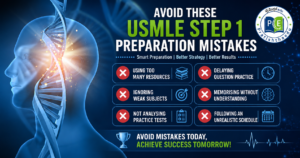
USMLE Step 1 Preparation Tips for Indian Medical Students
Medical students from India may have different academic schedules and preparation challenges. Many students need to balance medical college examinations, clinical responsibilities, internships, and their USMLE Step 1 Preparation 2027.
A practical approach should therefore focus on consistency, planning, and understanding the examination style.
Understand the USMLE Learning Style
The examination may require a different approach from traditional university examinations. Students should become comfortable with applying knowledge to clinical scenarios rather than relying only on memorisation.
Preparation should include:
- Conceptual learning
- Clinical application
- Integrated revision
- Regular question practice
- Analysis of mistakes
Students should gradually develop the habit of asking how a basic science concept relates to a clinical presentation.
Focus on Concept-Based Learning
A strong foundation can make later question practice more effective. Students should understand the mechanisms behind diseases, physiological processes, and pharmacological effects.
Instead of memorising every detail, students should first understand the main concept and then revise important supporting information.
For example, understanding the mechanism of a disease can make it easier to remember:
- Clinical symptoms
- Laboratory findings
- Complications
- Treatment principles
Practise Clinical Vignettes
Students who are more familiar with traditional textbook-style questions may initially find long clinical vignettes challenging.
Regular practice can help students improve their ability to:
- Identify key information
- Recognise important clinical clues
- Ignore irrelevant details
- Connect symptoms with mechanisms
- Select the best answer
Students should gradually practise different types of clinical scenarios and review the reasoning behind each answer.
Maintain Consistency
Students balancing medical college and USMLE preparation for Indian students may not always be able to follow the same schedule every day.
Some days may allow several hours of study, while other days may be more demanding. The important thing is to maintain regular progress over time.
A consistent routine may include:
- Daily concept review
- Regular question practice
- Weekly revision
- Periodic performance evaluation
Even shorter study sessions can be useful when they are part of a consistent long-term plan.
Use Structured Guidance When Needed
Self-study can be effective for students who are comfortable creating their own schedule, selecting resources, and monitoring progress. However, some students may benefit from structured guidance.
Structured academic support may help with:
- Study planning
- Subject-wise preparation
- Regular progress monitoring
- Question-solving strategies
- Identification of weak areas
- Preparation timeline management
Students considering USMLE Coaching in Bangalore should evaluate whether structured guidance matches their preparation needs and learning style.
The most suitable approach may differ from one student to another. Some students may prefer complete self-study, while others may benefit from combining independent learning with academic guidance.
Managing Medical College and USMLE Preparation Together
Many Indian medical students begin thinking about the USMLE during medical school. Managing university studies and licensing examination preparation requires planning.
Students can consider:
- Reviewing basic science concepts during medical school
- Building familiarity with important subjects early
- Gradually becoming comfortable with clinical questions
- Avoiding unnecessary delays in preparation
- Planning intensive preparation around academic commitments
Medical college learning can provide a valuable foundation for USMLE preparation. However, students should understand that examination preparation may require additional question practice and integrated learning.
A student does not necessarily need to prepare for every part of the examination journey at the same time. Instead, preparation can be divided into manageable stages.
Building a Sustainable Preparation Routine
A sustainable preparation routine should support long-term progress without causing unnecessary exhaustion.
Students can improve consistency by:
- Setting realistic daily goals
- Planning the next day’s tasks in advance
- Reviewing progress at the end of each week
- Keeping study resources organised
- Taking appropriate breaks
- Maintaining regular sleep
- Adjusting the plan when circumstances change
The aim should be to create a routine that can be maintained over several months.
Whether a student chooses independent preparation or seeks USMLE Coaching in Bangalore, the most important factors remain understanding the concepts, practising questions, reviewing mistakes, and maintaining consistency.
The next stage of this guide will compare self-study and structured coaching approaches and explain how students can evaluate which preparation method may be suitable for their individual needs.
Self-Study vs USMLE Step 1 Coaching
Students preparing for the USMLE Step 1 may choose different preparation methods depending on their academic background, learning style, preparation timeline, and individual requirements. Some students prefer complete self-study, while others may benefit from structured academic guidance.
There is no single preparation method that is suitable for every student. The most important factor is whether the chosen approach helps the student understand concepts, maintain consistency, practise questions, revise effectively, and evaluate progress regularly.
Benefits of Self-Study
Self-study gives students flexibility and allows them to design their preparation around their personal schedule.
Some potential benefits include:
- Flexible study hours
- Freedom to choose study resources
- Ability to study at an individual pace
- Personalised revision
- Control over the preparation schedule
Students who are comfortable planning their own timetable may find self-study suitable. They can decide which topics to study, how much time to spend on each subject, and when to take practice assessments.
However, successful self-study requires discipline. Students need to monitor their own progress and identify when their preparation strategy needs improvement.
Common challenges may include:
- Difficulty creating a realistic study plan
- Uncertainty about resource selection
- Lack of regular academic evaluation
- Difficulty identifying weak areas
- Delaying question practice
- Inconsistent preparation
Students who choose self-study should regularly evaluate their performance and make changes when necessary.
When Coaching Can Be Helpful
Structured coaching may be useful for students who prefer academic guidance and a planned learning environment.
A structured preparation approach may help students with:
- Understanding the syllabus
- Organising subjects
- Creating a preparation timeline
- Learning difficult concepts
- Practising clinical questions
- Reviewing performance
- Maintaining regular progress
Students who are preparing alongside medical college or other academic responsibilities may find structured guidance helpful for organising their available study time.
However, coaching should not be considered a replacement for individual effort. Students still need to revise independently, practise questions, analyse mistakes, and maintain consistency outside guided learning sessions.
How Structured Guidance Can Support Preparation
A structured learning environment can provide direction during different stages of preparation.
For example, students may receive support with:
Study Planning: Creating a preparation schedule based on the student’s timeline and academic background.
Subject-Wise Learning: Organising difficult topics and identifying areas that require additional attention.
Question Practice: Developing familiarity with clinical-style questions and improving application of knowledge.
Performance Evaluation: Reviewing progress and identifying recurring weaknesses.
Revision Planning: Organising multiple revision cycles before the examination.
Students considering USMLE Coaching in Bangalore should evaluate whether the available academic support matches their preparation needs. Important factors may include the teaching approach, academic guidance, study planning, practice opportunities, and the level of individual support available.
The best preparation method is the one that helps a student remain consistent and make measurable progress.
Why Choose Pratishtha Edu for USMLE Preparation in Bangalore?
Preparing for a major medical licensing examination requires more than simply collecting study materials. Students need a systematic approach that helps them understand important concepts, organise their preparation, practise regularly, and evaluate their progress.
Pratishtha Edu provides a structured learning environment for students seeking academic support during their USMLE Step 1 preparation.
The preparation approach can support students through:
Structured Preparation Approach
A planned preparation approach can help students understand what they need to study and how to organise their preparation over time.
Instead of approaching the syllabus randomly, students can follow a more systematic process that includes concept learning, question practice, revision, and performance evaluation.
Academic Guidance
Students may benefit from guidance when dealing with difficult concepts or deciding how to organise different subjects during preparation.
Academic support can help students develop a clearer understanding of the topics they need to prioritise.
Subject-Wise Learning Support
The USMLE Step 1 syllabus includes multiple foundational medical science subjects. A subject-wise approach can help students identify important concepts and gradually connect them through integrated learning.
Study Planning
A realistic study plan can help students divide their preparation into manageable stages. The schedule may include foundation building, question practice, revision, and practice assessments.
Practice and Performance Evaluation
Regular practice and performance analysis can help students identify areas that require improvement.
Students can use their performance to understand:
- Which subjects require more revision
- Which concepts are frequently misunderstood
- Whether question-solving speed needs improvement
- Which topics should receive priority during revision
Support for Step 1 Preparation
Students looking for USMLE Preparation in Bangalore may consider a structured academic environment that supports consistent learning and preparation planning.
The objective of academic guidance should be to help students become more organised, improve their understanding, and develop a preparation strategy that matches their individual needs.
Frequently Asked Questions About USMLE Step 1 Preparation
How long does it take to prepare for USMLE Step 1?
The preparation time varies from student to student. Some students may require several months of dedicated preparation, while others may need a longer period depending on their academic foundation, study schedule, and previous exposure to the relevant subjects.
A six-month preparation plan can provide sufficient time for foundation building, question practice, revision, and practice assessments for many students. Students with a strong foundation may prefer a shorter and more intensive schedule, while those who need to rebuild basic concepts may require additional time.
The most important factor is not the number of months alone. Students should ensure that they have sufficient time to understand concepts, practise questions, review mistakes, and revise important topics.
Is USMLE Step 1 difficult?
The difficulty of the examination can vary depending on a student’s preparation level and academic background. The broad syllabus and integrated nature of the questions can make preparation challenging.
Students may find the examination difficult when they:
- Rely only on memorisation
- Delay question practice
- Use too many study resources
- Do not revise regularly
- Fail to analyse mistakes
A structured preparation strategy can make the process more manageable. Students should focus on understanding concepts, applying knowledge, and gradually improving their performance through regular practice.
How should I start preparing for USMLE Step 1?
Students should begin by understanding their current knowledge level and identifying strong and weak subjects.
A practical starting approach may include:
- Reviewing the major subject areas
- Selecting reliable study resources
- Creating a realistic preparation timeline
- Beginning concept-based learning
- Introducing question practice
- Tracking mistakes and weak topics
- Revising regularly
Students should avoid trying to complete every available study resource at the beginning. A focused and consistent approach is generally more useful.
What are the best books for USMLE Step 1?
The most suitable study resources depend on the student’s individual learning needs. Many students use a primary review resource along with a question bank and targeted resources for difficult subjects.
Resources commonly used during preparation may include:
- First Aid for the USMLE Step 1
- UWorld Question Bank
- Pathoma
- Sketchy Medical
- Boards and Beyond
- Practice assessments
Students should not try to use every resource at the same time. The goal should be to select appropriate resources and use them consistently.
Is UWorld important for USMLE Step 1 preparation?
Question-bank practice is an important part of preparation because it helps students apply knowledge to clinical-style questions.
A question bank can help students:
- Practise clinical reasoning
- Identify knowledge gaps
- Improve question interpretation
- Develop time-management skills
- Review explanations
- Track recurring mistakes
However, simply completing questions is not enough. Students should spend sufficient time reviewing incorrect and uncertain answers.
Can I prepare for USMLE Step 1 through self-study?
Yes, some students may successfully prepare through self-study. Self-study allows students to create their own schedule and select resources according to their individual needs.
However, self-study requires discipline and regular self-evaluation. Students need to plan their preparation, monitor their progress, identify weaknesses, and make changes when necessary.
Students who find it difficult to create a study plan or maintain consistency may benefit from structured academic guidance.
What is the best USMLE Step 1 study plan?
The best study plan depends on the student’s available time, academic foundation, and preparation requirements.
A general plan may include:
Foundation Phase: Build understanding of important basic medical science concepts.
Question Practice Phase: Apply knowledge through clinical-style questions.
Revision Phase: Review important concepts and previously identified weaknesses.
Assessment Phase: Use practice tests to evaluate progress.
Final Review Phase: Focus on high-yield concepts, mistakes, and exam readiness.
Students should adapt the plan according to their progress rather than following a fixed schedule without evaluation.
How many hours should I study daily for USMLE Step 1?
There is no universal number of hours that every student must study. The ideal study time depends on the preparation timeline, academic responsibilities, and individual learning speed.
A realistic daily schedule is usually more useful than an extremely long timetable that cannot be followed consistently.
Students should focus on the quality of study time and ensure that their daily routine includes appropriate time for:
- Concept learning
- Question practice
- Review of explanations
- Revision
Regular progress over several months is more important than studying for an unrealistic number of hours for a short period.
When should I start taking practice tests?
The timing of practice assessments depends on the student’s preparation stage and individual timeline.
Students should avoid waiting until the very end of preparation to evaluate their progress for the first time. An assessment can provide useful information about strengths, weaknesses, question-solving ability, and time management.
The most important part is analysing the results and using them to improve preparation.
Is USMLE coaching helpful for Indian medical students?
Structured guidance may be helpful for students who prefer a planned learning environment or require support with study planning and academic progress.
Students considering USMLE Coaching in Bangalore should evaluate whether the programme matches their learning needs and preparation goals.
Coaching can provide academic direction, but students still need to study independently, practise questions, revise regularly, and analyse their performance.
How can Indian medical students prepare for USMLE Step 1?
Indian medical students can begin by developing a strong understanding of foundational medical sciences and gradually becoming comfortable with integrated clinical questions.
A practical approach may include:
- Building a strong conceptual foundation
- Using reliable study resources
- Practising clinical-style questions
- Reviewing incorrect answers
- Maintaining a regular study schedule
- Balancing medical college responsibilities with examination preparation
Students should create a preparation timeline that reflects their academic schedule and individual requirements.
What is the role of mock tests in USMLE Step 1 preparation?
Mock tests and practice assessments can help students evaluate their preparation and become more comfortable with timed question-solving.
They can help identify:
- Knowledge gaps
- Weak subjects
- Time-management issues
- Question interpretation problems
- Repeated mistakes
Students should analyse the results carefully rather than focusing only on the score.
How can I improve my USMLE Step 1 preparation?
Students can improve their preparation by regularly reviewing their performance and identifying areas that need attention.
Important strategies include:
- Using a structured study plan
- Understanding concepts instead of relying only on memorisation
- Practising questions regularly
- Reviewing incorrect answers
- Revising weak topics
- Taking practice assessments
- Avoiding unnecessary resource switching
- Maintaining consistency
Small improvements made consistently can contribute significantly to overall preparation progress.
Conclusion
Preparing for the USMLE Step 1 requires a systematic and consistent approach. The broad syllabus, integrated subject areas, and clinical-style questions mean that students need to develop more than simple memorisation skills. They need to understand medical concepts, connect different subjects, apply knowledge to clinical situations, and regularly evaluate their performance.
A successful preparation strategy may include a strong foundation in basic medical sciences, reliable study resources, regular question-bank practice, detailed review of mistakes, repeated revision, and practice assessments. Students should also create a realistic study schedule that matches their academic responsibilities and available preparation time.
Whether a student chooses self-study or seeks structured guidance through USMLE Coaching in Bangalore, individual consistency remains essential. Students should avoid using too many resources, delaying question practice, ignoring weak subjects, or following an unrealistic study routine.
The most effective USMLE Step 1 Preparation 2027 strategy is one that can be followed consistently and adjusted according to individual progress. With organised planning, focused study, regular practice, and continuous performance evaluation, students can approach their preparation with greater clarity and confidence.
Leave a Reply