Preparing for the IIT JAM Physics 2027 examination begins with understanding the complete syllabus. A clear knowledge of the IIT JAM Physics Syllabus 2027 helps candidates identify important topics, understand the scope of the examination, and create an effective study plan. Instead of studying randomly, aspirants should follow the official syllabus and focus on concept-based learning to improve their chances of securing a high score.
The IIT JAM Physics Exam is conducted for admission to M.Sc., Joint M.Sc.-Ph.D., and other postgraduate science programs offered by IITs and participating institutes. Since the examination is highly competitive, candidates should prepare every topic thoroughly while giving extra attention to high-weightage subjects.
This comprehensive guide covers the IIT JAM Physics Syllabus 2027, including topic-wise syllabus, high-weightage subjects, important chapters, subject-wise preparation strategy, recommended books, frequently asked questions, and expert preparation tips. Whether you are starting your IIT JAM Physics Preparation or revising before the examination, this guide will help you understand every important aspect of the syllabus in a simple and structured manner.
This guide is regularly updated with the latest IIT JAM Physics Syllabus 2027, important topics, preparation strategy, best books, previous year question trends, and examination updates to help aspirants prepare effectively.
If you are looking for expert guidance, quality Study Material, and a dedicated learning environment, Pratishtha Edu and Pratishtha Library provide valuable resources to support your preparation for competitive examinations like IIT JAM.
Candidates are advised to always verify the latest syllabus, examination schedule, and official announcements by visiting the Official IIT JAM Website.
What is the IIT JAM Physics Syllabus?
The IIT JAM Physics Syllabus is the official list of topics prescribed for the Physics paper in the Joint Admission Test for Masters (JAM). It defines the subjects, concepts, and chapters from which questions are asked in the examination.
The syllabus is primarily based on undergraduate-level Physics and is designed to assess a candidate’s conceptual understanding, analytical ability, mathematical skills, and problem-solving approach. It includes both theoretical concepts and numerical applications across various branches of Physics.
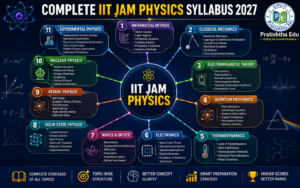
The syllabus covers several important areas, including:
- Mathematical Methods
- Classical Mechanics
- Electromagnetic Theory
- Quantum Mechanics
- Thermodynamics and Statistical Physics
- Electronics
- Oscillations, Waves and Optics
- Solid State Physics
- Atomic and Molecular Physics
- Nuclear and Particle Physics
- Experimental Physics
Every aspirant should carefully study each section because questions can be asked from any topic included in the official syllabus. Before starting topic-wise preparation, it is also recommended to understand the complete IIT JAM Physics examination, including its eligibility, exam pattern, and admission process.
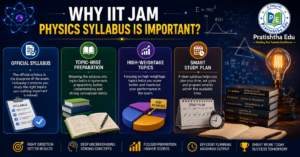
Why is the IIT JAM Physics Syllabus Important?
A thorough understanding of the IIT JAM Physics Syllabus 2027 is the foundation of effective preparation. Many candidates spend months studying unnecessary topics simply because they do not follow the official syllabus.
Knowing the syllabus helps candidates:
- Understand what to study and what to skip.
- Identify high-weightage topics.
- Create a realistic study schedule.
- Allocate sufficient time to difficult subjects.
- Select the right books and study material.
- Prepare for conceptual as well as numerical questions.
- Improve revision and time management.
Candidates who complete the syllabus systematically are generally more confident during the examination and perform better than those who study without a structured plan.
Before starting topic-wise preparation, it is also important to understand the complete IIT JAM Physics examination, including the exam pattern, eligibility criteria, preparation strategy, and admission process. This helps candidates prepare in a more structured manner.
IIT JAM Physics Syllabus 2027 (Topic-Wise)
The IIT JAM Physics Syllabus 2027 is divided into several core subjects that assess a candidate’s understanding of undergraduate-level Physics. Each topic plays an important role in the examination, and aspirants should prepare every section systematically. Some topics carry higher weightage than others, but candidates should avoid leaving any section completely, as questions can be asked from any part of the syllabus.
Below is the detailed topic-wise syllabus for IIT JAM Physics 2027.
Mathematical Methods
Mathematical Methods form the backbone of Physics and are used extensively in almost every subject included in the IIT JAM Physics Syllabus 2027. A strong command of mathematical concepts makes solving numerical and analytical questions much easier.
Important Topics
- Vector Algebra
- Vector Calculus
- Matrices and Determinants
- Eigenvalues and Eigenvectors
- Differential Equations
- Partial Differentiation
- Fourier Series
- Laplace Transform
- Complex Variables
- Probability and Statistics
Candidates should regularly practice numerical problems from this section because Mathematical Methods are frequently used in Quantum Mechanics, Electromagnetic Theory, Thermodynamics, and Classical Mechanics.
Classical Mechanics
Classical Mechanics is one of the highest-weightage sections in the IIT JAM Physics Exam. This subject requires conceptual understanding as well as numerical problem-solving skills.
Important Topics
- Newton’s Laws of Motion
- Frames of Reference
- Work, Energy and Power
- Conservation of Momentum
- Conservation of Energy
- Rotational Motion
- Moment of Inertia
- Central Force Motion
- Simple Harmonic Motion
- Lagrangian Mechanics
- Hamiltonian Mechanics
- Rigid Body Dynamics
- Non-Inertial Frames
Students should focus on understanding derivations, solving conceptual problems, and practicing numerical questions regularly to strengthen this section.
Electromagnetic Theory
Electromagnetic Theory is another important section that regularly contributes questions in the examination. Candidates should understand both mathematical derivations and physical concepts.
Important Topics
- Electrostatics
- Coulomb’s Law
- Electric Field and Potential
- Gauss’s Law
- Capacitance
- Dielectrics
- Magnetostatics
- Ampere’s Circuital Law
- Faraday’s Law of Electromagnetic Induction
- Maxwell’s Equations
- Electromagnetic Waves
- Boundary Conditions
- Energy Stored in Electric and Magnetic Fields
Questions from this section often test conceptual clarity, mathematical application, and problem-solving ability. Regular numerical practice and revision of formulas are essential for scoring well.
After completing these topics, candidates should continue with Quantum Mechanics, Thermodynamics & Statistical Physics, and Electronics, which are also among the most important sections of the IIT JAM Physics Syllabus 2027 and frequently contribute a significant number of questions in the examination.
IIT JAM Physics Syllabus 2027 (Continued)
The remaining subjects of the IIT JAM Physics Syllabus 2027 are equally important for scoring well in the examination. These topics frequently appear in the IIT JAM Physics Exam and require a combination of conceptual understanding, mathematical knowledge, and regular numerical practice. Candidates should complete every topic systematically and revise them regularly to improve accuracy and confidence.
Quantum Mechanics
Quantum Mechanics is one of the highest-scoring as well as conceptually challenging sections of the IIT JAM Physics Syllabus 2027. A strong understanding of mathematical concepts is essential for solving questions from this section.
Important Topics
- Wave Function
- Schrödinger Equation
- Operators
- Eigenvalues and Eigenfunctions
- Expectation Values
- Angular Momentum
- Hydrogen Atom
- Harmonic Oscillator
- Particle in a Box
- Quantum Tunneling
- Spin
- Approximation Methods
Candidates should focus on understanding derivations, mathematical formulations, and solving numerical problems regularly.
Thermodynamics and Statistical Physics
This section combines theoretical concepts with numerical applications and contributes a good number of questions in the examination every year.
Important Topics
- Laws of Thermodynamics
- Thermodynamic Processes
- Entropy
- Heat Engines
- Carnot Cycle
- Maxwell Relations
- Kinetic Theory of Gases
- Maxwell-Boltzmann Distribution
- Bose-Einstein Statistics
- Fermi-Dirac Statistics
- Partition Function
- Black Body Radiation
- Specific Heat
- Thermodynamic Potentials
Students should thoroughly understand the physical significance of each concept and practice numerical problems to improve speed and accuracy.
Electronics
Electronics is considered a scoring section in the IIT JAM Physics Exam. Candidates with a good understanding of semiconductor devices and digital electronics can secure valuable marks from this subject.
Important Topics
- Semiconductor Physics
- PN Junction Diode
- Zener Diode
- Bipolar Junction Transistor (BJT)
- Field Effect Transistor (FET)
- Operational Amplifier (Op-Amp)
- Logic Gates
- Boolean Algebra
- Flip-Flops
- Counters
- Digital Circuits
- Rectifiers
- Electronic Measuring Instruments
Regular circuit analysis and numerical practice help candidates improve their performance in this section.
Preparation Tips for These Subjects
While studying these topics, candidates should follow a structured preparation strategy:
- Build strong conceptual fundamentals before solving numerical problems.
- Prepare short notes for formulas, derivations, and important concepts.
- Practice topic-wise numerical questions regularly.
- Revise completed chapters every week.
- Solve previous year questions after completing each subject.
- Attempt topic-wise mock tests to evaluate your understanding.
- Identify weak areas and spend additional time improving them.
A consistent approach towards these subjects will help candidates strengthen their overall IIT JAM Physics Preparation and improve their performance in the final examination.
In the next section, we will cover the remaining topics of the IIT JAM Physics Syllabus 2027, including Oscillations, Waves & Optics, Solid State Physics, Atomic & Molecular Physics, Nuclear & Particle Physics, and Experimental Physics, along with their important subtopics and preparation tips.
IIT JAM Physics Syllabus 2027 (Continued)
The final section of the IIT JAM Physics Syllabus 2027 covers several important topics that are regularly asked in the examination. Although some of these subjects may carry comparatively fewer questions than Quantum Mechanics or Classical Mechanics, they should not be ignored. A balanced preparation covering every topic of the syllabus significantly improves the chances of securing a high score in the IIT JAM Physics Exam.
Oscillations, Waves and Optics
This section evaluates a candidate’s understanding of wave motion, oscillatory systems, and optical phenomena. Both conceptual and numerical questions are frequently asked from this section.
Important Topics
- Simple Harmonic Motion (SHM)
- Damped Oscillations
- Forced Oscillations
- Resonance
- Superposition of Waves
- Standing Waves
- Doppler Effect
- Wave Equation
- Interference
- Diffraction
- Polarization
- Geometrical Optics
- Physical Optics
- Optical Instruments
Candidates should focus on understanding wave behavior, derivations, and numerical applications while preparing this section.
Solid State Physics
Solid State Physics introduces candidates to the properties of solids, crystal structures, and semiconductor materials. This section is generally considered scoring when concepts are clear.
Important Topics
- Crystal Structure
- Unit Cells
- Miller Indices
- Reciprocal Lattice
- Crystal Binding
- Lattice Vibrations
- Free Electron Theory
- Band Theory
- Semiconductors
- Conductors and Insulators
- Magnetic Properties
- Superconductivity
Revision of diagrams and theoretical concepts can help candidates solve conceptual questions more effectively.
Atomic and Molecular Physics
Atomic and Molecular Physics focuses on the structure of atoms and molecules along with their interaction with electromagnetic radiation.
Important Topics
- Bohr Model
- Hydrogen Atom
- Atomic Energy Levels
- Fine Structure
- Zeeman Effect
- Stark Effect
- Atomic Spectra
- Molecular Bonding
- Rotational Spectra
- Vibrational Spectra
- Electronic Spectra
- Lasers
Students should understand both theoretical concepts and numerical applications while preparing this section.
Nuclear and Particle Physics
This is one of the important units of the IIT JAM Physics Syllabus 2027 and often contains conceptual as well as numerical questions.
Important Topics
- Nuclear Structure
- Binding Energy
- Nuclear Stability
- Radioactivity
- Alpha Decay
- Beta Decay
- Gamma Decay
- Nuclear Reactions
- Nuclear Fission
- Nuclear Fusion
- Elementary Particles
- Fundamental Interactions
- Conservation Laws
Candidates should practice numerical problems related to radioactive decay and nuclear reactions to improve problem-solving speed.
Experimental Physics
Experimental Physics evaluates the practical knowledge acquired during undergraduate laboratory courses. Questions are generally straightforward and scoring.
Important Topics
- Error Analysis
- Significant Figures
- Measurement Techniques
- Vernier Calipers
- Screw Gauge
- Travelling Microscope
- Spectrometer
- Optical Bench
- Cathode Ray Oscilloscope (CRO)
- Electronic Measuring Instruments
- Data Analysis
- Graph Plotting
Candidates should revise commonly performed laboratory experiments and understand the working principles of scientific instruments.
Important Preparation Tips for the Complete Syllabus
Completing the IIT JAM Physics Syllabus 2027 requires consistency, discipline, and regular revision. Instead of studying random topics, candidates should follow a structured plan and complete one subject at a time.
Some useful preparation tips include:
- Divide the syllabus into weekly study targets.
- Build strong conceptual understanding before attempting numerical problems.
- Prepare concise notes for formulas and important derivations.
- Revise completed chapters every week.
- Solve previous year question papers regularly.
- Attempt topic-wise mock tests after finishing each subject.
- Spend additional time improving weak topics instead of repeatedly studying only favorite subjects.
- Maintain consistency throughout your preparation.
Candidates who complete the entire syllabus with proper revision generally perform much better than those who leave important topics for the last moment.
After completing the syllabus, candidates should solve previous year question papers and revise every topic regularly to strengthen their overall IIT JAM Physics Preparation.
After completing the IIT JAM Physics Syllabus 2027, the next step is to understand the IIT JAM Physics Subject-Wise Weightage, identify high-weightage topics, choose the Best Books for IIT JAM Physics Preparation, and create an effective study plan to maximize their score in the examination.
IIT JAM Physics Subject-Wise Weightage 2027
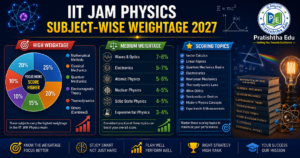
Understanding the IIT JAM Physics Subject-Wise Weightage 2027 helps candidates prioritize important topics and prepare more effectively. Although the exact number of questions may vary every year, previous examination trends indicate that certain subjects consistently carry higher weightage in the IIT JAM Physics Exam.
Candidates should focus more on high-weightage topics while ensuring that every section of the syllabus is covered. Ignoring low-weightage subjects is not recommended, as even a few additional marks can significantly improve the final rank.
The following table provides the expected subject-wise weightage based on previous year examination trends.
| Topic | Expected Questions | Difficulty Level | Importance |
| Mathematical Methods | 7–9 | Moderate | Very High |
| Quantum Mechanics | 7–9 | Moderate to Difficult | Very High |
| Classical Mechanics | 6–8 | Moderate | Very High |
| Electromagnetic Theory | 5–7 | Moderate | High |
| Thermodynamics & Statistical Physics | 5–7 | Moderate | High |
| Oscillations, Waves & Optics | 4–6 | Easy to Moderate | High |
| Electronics | 3–5 | Easy to Moderate | Moderate |
| Solid State Physics | 2–4 | Easy | Moderate |
| Atomic & Molecular Physics | 2–4 | Moderate | Moderate |
| Nuclear & Particle Physics | 2–4 | Moderate | Moderate |
| Experimental Physics | 2–3 | Easy | Moderate |
High-Weightage Topics You Should Never Skip
While preparing for IIT JAM Physics 2027, candidates should give extra attention to the following subjects because they consistently contribute a significant number of questions in the examination:
- Mathematical Methods
- Quantum Mechanics
- Classical Mechanics
- Electromagnetic Theory
- Thermodynamics & Statistical Physics
Completing these subjects thoroughly can substantially improve overall performance. However, candidates should remember that the examination covers the complete syllabus, and questions can be asked from any topic.
How to Prioritize Your Preparation
An effective preparation strategy is not about studying only difficult subjects but about maintaining the right balance between concept building, numerical practice, and revision.
A recommended order of preparation is:
- Mathematical Methods
- Classical Mechanics
- Electromagnetic Theory
- Quantum Mechanics
- Thermodynamics & Statistical Physics
- Electronics
- Oscillations, Waves & Optics
- Solid State Physics
- Atomic & Molecular Physics
- Nuclear & Particle Physics
- Experimental Physics
Following this sequence helps candidates gradually build strong fundamentals before moving to advanced topics.
Candidates should also compare these topics with the complete IIT JAM Physics examination pattern to understand how each subject contributes to the overall paper.
Best Books for IIT JAM Physics Preparation
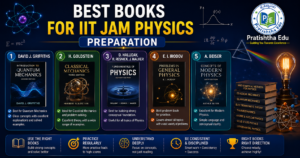
Selecting the right books is one of the most important steps in IIT JAM Physics Preparation. Instead of studying from multiple resources, candidates should choose a few standard textbooks and revise them thoroughly.
The books listed below are widely recommended by experienced teachers and successful IIT JAM aspirants.
| Book | Author | Why Recommended |
| Introduction to Electrodynamics | David J. Griffiths | Best for Electromagnetic Theory and conceptual understanding. |
| Introduction to Quantum Mechanics | David J. Griffiths | Excellent for Quantum Mechanics and numerical problem-solving. |
| Classical Mechanics | Herbert Goldstein | Comprehensive coverage of Mechanics. |
| Fundamentals of Physics | Halliday, Resnick & Walker | Builds strong undergraduate-level concepts. |
| Concepts of Modern Physics | Arthur Beiser | Covers Atomic, Nuclear, and Modern Physics. |
| Solid State Physics | A. J. Dekker | Recommended for crystal structure and semiconductor topics. |
| Electronic Devices and Circuit Theory | Robert Boylestad | Useful for Electronics and semiconductor devices. |
| Mathematical Physics | B. D. Gupta | Covers Mathematical Methods required for IIT JAM. |
| Problems in General Physics | I. E. Irodov | Excellent for advanced numerical practice. |
| IIT JAM Physics Previous Year Papers | Various Publications | Helps understand question trends and improve examination confidence. |
Tips for Choosing the Right Books
Candidates should keep the following points in mind while selecting study material:
- Use one standard textbook for each subject.
- Avoid collecting too many books for the same topic.
- Focus on conceptual understanding before advanced problems.
- Prepare handwritten notes while studying.
- Revise formulas and derivations regularly.
- Solve previous year question papers after completing every major topic.
- Attempt mock tests to evaluate your preparation level.
Choosing quality books along with reliable Study Material can significantly improve conceptual understanding and revision.
In the next section, we will discuss a complete IIT JAM Physics Preparation Strategy, including a 6-month study plan, revision schedule, mock test strategy, common mistakes to avoid, and expert tips for scoring well in IIT JAM Physics 2027.
IIT JAM Physics Preparation Strategy 2027
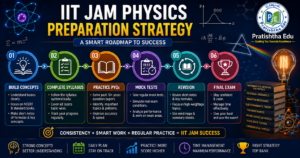
A well-planned IIT JAM Physics Preparation Strategy is just as important as completing the syllabus. Many aspirants study hard but fail to secure a good rank because they do not follow a structured study plan. Consistent preparation, regular revision, and solving previous year question papers are the key factors that help candidates perform well in the IIT JAM Physics Exam.
A disciplined preparation strategy combined with quality Study Material, regular mock tests, and continuous revision can significantly improve your chances of securing a high rank in IIT JAM Physics 2027.
6-Month Preparation Plan
If you have six months for preparation, you can comfortably complete the entire IIT JAM Physics Syllabus 2027 while leaving sufficient time for revision and mock tests.
Month 1–2
Focus on building strong fundamentals by studying:
- Mathematical Methods
- Classical Mechanics
- Electromagnetic Theory
During this phase:
- Study concepts thoroughly.
- Prepare handwritten notes.
- Solve topic-wise numerical problems.
- Revise every weekend.
Month 3–4
Complete the remaining major subjects:
- Quantum Mechanics
- Thermodynamics & Statistical Physics
- Electronics
- Oscillations, Waves & Optics
At this stage:
- Practice previous year questions after each topic.
- Improve numerical solving speed.
- Revise formulas regularly.
Month 5
Complete the remaining topics:
- Solid State Physics
- Atomic & Molecular Physics
- Nuclear & Particle Physics
- Experimental Physics
Also begin:
- Full-length mock tests
- Time management practice
- Error analysis after every mock test
Month 6
The final month should be dedicated entirely to revision.
Focus on:
- Formula revision
- Important derivations
- High-weightage topics
- Previous year question papers
- Full-length mock tests
Avoid starting any completely new topic during the final weeks unless it is necessary.
3-Month Preparation Plan
Candidates with limited preparation time should adopt a smart strategy instead of trying to study everything equally.
First Month
Complete:
- Mathematical Methods
- Classical Mechanics
- Quantum Mechanics
Second Month
Study:
- Electromagnetic Theory
- Thermodynamics
- Electronics
- Waves & Optics
Third Month
Focus entirely on:
- Revision
- Mock Tests
- Previous Year Papers
- Formula Practice
- Weak Areas
Quality revision is much more effective than repeatedly reading the same theory.
Last Month Strategy
The last month before the examination is crucial for improving accuracy and confidence.
During this period:
- Revise every important formula daily.
- Solve one previous year paper regularly.
- Attempt full-length mock tests under actual exam conditions.
- Analyze mistakes after every test.
- Revise weak topics instead of repeatedly studying already strong subjects.
Avoid unnecessary stress and do not keep changing study resources.
Revision Plan
Revision plays a vital role in long-term retention.
A practical revision schedule is:
- Daily revision: 30–45 minutes
- Weekly revision: Every Sunday
- Monthly revision: Complete all previously studied topics
- Final revision: Entire syllabus before the examination
Prepare concise notes containing:
- Important formulas
- Short tricks
- Frequently used derivations
- Difficult concepts
- Common mistakes
These notes become extremely useful during the last few days before the examination.
Mock Test Strategy
Mock tests help candidates understand their preparation level and improve time management.
For effective practice:
- Start topic-wise tests after completing each subject.
- Attempt sectional tests regularly.
- Solve at least 10–15 full-length mock tests before the examination.
- Analyze every incorrect answer carefully.
- Identify weak subjects and revise them immediately.
- Gradually improve both speed and accuracy.
Mock tests should be treated as learning opportunities rather than simply score-checking exercises.
Common Mistakes to Avoid
Many aspirants lose valuable marks because of avoidable mistakes.
Some common mistakes include:
- Ignoring Mathematical Methods.
- Skipping low-weightage topics completely.
- Studying from too many books.
- Not revising regularly.
- Avoiding previous year question papers.
- Taking mock tests without analyzing mistakes.
- Memorizing formulas without understanding concepts.
- Leaving revision for the final week.
Avoiding these mistakes can greatly improve overall performance in the examination.
Expert Tips to Score Well in IIT JAM Physics 2027
To maximize your chances of success:
- Complete the syllabus as early as possible.
- Strengthen conceptual understanding before attempting advanced numerical problems.
- Revise formulas and derivations regularly.
- Practice numerical questions every day.
- Solve previous year question papers consistently.
- Attempt mock tests under timed conditions.
- Analyze your performance after each test.
- Stay consistent with your preparation and avoid long study gaps.
A disciplined preparation strategy combined with regular practice, revision, and proper time management will significantly improve your chances of securing an excellent rank in IIT JAM Physics 2027.
In the next section, we will cover IIT JAM Physics Previous Year Cut Off, Previous Year Question Papers, Career Opportunities After IIT JAM Physics, Frequently Asked Questions, and the final conclusion to complete this comprehensive guide.
IIT JAM Physics Previous Year Cut Off
The IIT JAM Physics Previous Year Cut Off helps aspirants understand the competition level and estimate the score required for admission to IITs and other participating institutes. Although the official cut-off changes every year depending on factors such as the difficulty level of the examination, the number of candidates, available seats, and overall performance, analyzing previous year trends can help candidates set realistic preparation goals.
Candidates should always compare the expected cut-off with the complete IIT JAM Physics examination details before setting their preparation goals.
IIT JAM Physics Previous Year Cut Off (Expected Trend)
| Year | General | OBC-NCL/EWS | SC | ST |
| 2026* | To Be Updated | To Be Updated | To Be Updated | To Be Updated |
| 2025 | As per Official Result | As per Official Result | As per Official Result | As per Official Result |
| 2024 | As per Official Result | As per Official Result | As per Official Result | As per Official Result |
| 2023 | As per Official Result | As per Official Result | As per Official Result | As per Official Result |
Note: Candidates should always check the Official IIT JAM Admission Portal for the latest qualifying marks, admission cut-off, and counselling updates.
IIT JAM Physics Previous Year Question Papers
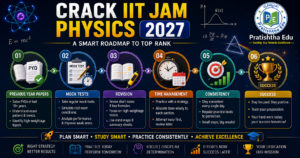
Solving IIT JAM Physics Previous Year Question Papers is one of the most effective ways to prepare for the examination. These papers help candidates understand the latest exam pattern, frequently asked topics, difficulty level, and the types of numerical and conceptual questions asked over the years.
Regular practice also improves speed, accuracy, confidence, and time management.
Benefits of Solving Previous Year Papers
- Understand the latest examination pattern.
- Identify high-weightage topics.
- Improve conceptual understanding.
- Increase problem-solving speed.
- Build confidence before the examination.
- Learn effective time management.
- Analyze frequently repeated concepts.
- Reduce examination stress through regular practice.
How to Solve Previous Year Papers Effectively
To get maximum benefit from previous year papers, candidates should follow a systematic approach.
- Complete the syllabus before attempting full papers.
- Solve papers in a timed environment.
- Avoid checking answers while solving.
- Analyze every mistake after completing the paper.
- Revise weak topics immediately.
- Maintain an error notebook for repeated mistakes.
- Reattempt difficult questions after revision.
Along with previous year papers, candidates should revise the complete IIT JAM Physics Syllabus 2027 multiple times before the examination.
Common Mistakes to Avoid
Many aspirants fail to utilize previous year papers effectively due to the following mistakes:
- Solving papers without completing the syllabus.
- Memorizing answers instead of understanding concepts.
- Ignoring incorrect questions after the test.
- Not managing time properly.
- Skipping numerical practice.
- Solving only one or two previous year papers.
- Avoiding mock tests after practicing PYQs.
Candidates should treat every previous year paper as a real examination and carefully evaluate their performance.
Career Opportunities After IIT JAM Physics
Qualifying the IIT JAM Physics Exam opens the door to several higher education and career opportunities. After completing an M.Sc. in Physics from IITs or other reputed institutes, students can pursue careers in research, academia, government organizations, public sector companies, and emerging technology industries.
M.Sc. Physics
The most common choice after qualifying IIT JAM is pursuing an M.Sc. in Physics from IITs, IISc, NITs, and other participating institutes. This provides advanced subject knowledge and creates opportunities for research and higher studies.
Ph.D. and Research
Students interested in scientific research can pursue a Ph.D. after completing their master’s degree. Research opportunities are available in areas such as:
- Quantum Physics
- Astrophysics
- Condensed Matter Physics
- Nuclear Physics
- Particle Physics
- Material Science
- Computational Physics
Research Scientist
Physics graduates can work as research scientists in universities, government laboratories, and private research organizations. These roles involve innovation, experimentation, and scientific development.
ISRO
The Indian Space Research Organisation (ISRO) recruits Physics graduates for various technical and research positions. Candidates with strong analytical and problem-solving skills can build rewarding careers in India’s space program.
DRDO
The Defence Research and Development Organisation (DRDO) offers excellent career opportunities in defence research, electronics, missile systems, and advanced scientific technologies.
BARC
The Bhabha Atomic Research Centre (BARC) recruits Physics postgraduates for research and development in nuclear science, reactor technology, radiation safety, and related fields.
Public Sector Undertakings (PSUs)
Many PSUs recruit candidates with strong Physics backgrounds for technical and research-oriented positions, especially after higher studies or through competitive recruitment processes.
Teaching and Academia
Candidates interested in education can become:
- School Teachers
- College Lecturers
- Assistant Professors
- Academic Researchers
- Coaching Faculty
Teaching remains one of the most respected and stable career options for Physics graduates
Data Science and Analytics
With additional skills in programming, statistics, and machine learning, Physics graduates can transition into rapidly growing fields such as:
- Data Science
- Artificial Intelligence
- Machine Learning
- Business Analytics
- Quantitative Research
- Financial Modeling
Students planning higher studies can begin their preparation early with proper guidance from Pratishtha Edu.
Why Choose Pratishtha Edu for IIT JAM Physics Coaching?
Preparing for IIT JAM Physics requires expert guidance, structured study material, regular practice, and continuous mentorship. Pratishtha Edu provides a student-focused learning environment designed to help aspirants build strong concepts and prepare confidently for competitive examinations.
Our IIT JAM Physics coaching program is designed to support students at every stage of their preparation through concept-based teaching and exam-oriented learning.
What We Offer
- Experienced and qualified faculty members
- Comprehensive study material based on the latest syllabus
- Online and offline classroom programs
- Regular topic-wise and full-length mock tests
- Previous year question paper practice sessions
- Daily doubt-clearing support
- Personalized mentorship and performance tracking
- Revision classes before the examination
- Individual attention for every student
Students also benefit from the peaceful learning environment of Pratishtha Library, making it easier to maintain consistency throughout their preparation.
Whether you are starting your preparation from scratch or aiming to improve your rank, Pratishtha Edu provides the guidance, resources, and support needed to achieve your academic goals in IIT JAM Physics 2027.
Frequently Asked Questions (FAQs)
1. What is IIT JAM Physics?
IIT JAM Physics is one of the papers of the Joint Admission Test for Masters (JAM), a national-level entrance examination conducted for admission to M.Sc., Joint M.Sc.-Ph.D., and other postgraduate science programs offered by IITs and participating institutes.
2. Who is eligible for IIT JAM Physics 2027?
Candidates who have completed or are pursuing a bachelor’s degree in Physics or a related science discipline from a recognized university are generally eligible to apply. Applicants should also satisfy the admission requirements of their preferred institute and program.
3. Is there any age limit for IIT JAM Physics?
No. There is no upper or lower age limit for appearing in the IIT JAM Physics examination.
4. Can final-year undergraduate students apply?
Yes. Final-year students can apply, provided they complete their qualifying degree within the timeline specified during the admission process.
5. What is the mode of the IIT JAM Physics Exam?
The examination is conducted in Computer-Based Test (CBT) mode.
6. How many questions are asked in IIT JAM Physics?
The paper generally consists of 60 questions carrying a total of 100 marks, including MCQs, MSQs, and NAT questions.
7. Is there negative marking in IIT JAM Physics?
Yes. Negative marking applies to certain MCQ questions, while MSQ and NAT questions generally do not carry negative marking. Candidates should carefully read the instructions during the examination.
8. What is the duration of the IIT JAM Physics examination?
The total duration of the examination is 3 hours (180 minutes).
9. Which topics are most important in the IIT JAM Physics Syllabus 2027?
Some of the highest-weightage topics include:
- Mathematical Methods
- Quantum Mechanics
- Classical Mechanics
- Electromagnetic Theory
- Thermodynamics & Statistical Physics
Candidates should also prepare the remaining topics thoroughly, as questions can be asked from any part of the syllabus.
10. Which books are best for IIT JAM Physics Preparation?
Some of the most recommended books include:
- Introduction to Quantum Mechanics – David J. Griffiths
- Introduction to Electrodynamics – David J. Griffiths
- Classical Mechanics – Herbert Goldstein
- Fundamentals of Physics – Halliday, Resnick & Walker
- Problems in General Physics – I. E. Irodov
11. How much time is required to prepare for IIT JAM Physics?
The preparation time depends on a candidate’s background and understanding of Physics. Most aspirants begin preparing 6–8 months before the examination with a structured study plan.
12. Are previous year question papers important?
Yes. Previous year papers help candidates understand the examination pattern, important topics, question difficulty, and improve both speed and accuracy.
13. How many mock tests should I attempt?
It is recommended to attempt at least 10–15 full-length mock tests before the examination, along with topic-wise practice tests.
14. Is IIT JAM Physics difficult?
The examination is considered moderately difficult to difficult because it tests conceptual understanding, analytical ability, and numerical problem-solving skills. Consistent preparation and regular practice significantly improve performance.
15. What are the career opportunities after qualifying IIT JAM Physics?
After qualifying IIT JAM Physics and completing an M.Sc., candidates can pursue careers in:
- Ph.D. and Research
- ISRO
- DRDO
- BARC
- Public Sector Undertakings (PSUs)
- Teaching and Academia
- Data Science and Analytics
- Scientific Research Organizations
16. What is the difference between IIT JAM Physics and GATE Physics?
IIT JAM Physics is primarily conducted for admission to postgraduate science programs such as M.Sc. and Joint M.Sc.-Ph.D., whereas GATE Physics is mainly used for admission to M.Tech., Ph.D., research programs, and recruitment in Public Sector Undertakings (PSUs).
17. Is coaching necessary for IIT JAM Physics?
Coaching is not compulsory. However, expert guidance, structured study material, regular mock tests, and mentorship can help candidates prepare more efficiently and stay consistent throughout their preparation.
18. How can I improve my score in IIT JAM Physics?
To improve your score:
- Complete the entire syllabus.
- Focus on conceptual understanding.
- Revise regularly.
- Solve previous year papers.
- Attempt mock tests.
- Analyze mistakes after every test.
- Practice numerical problems daily.
Final Thoughts
The IIT JAM Physics 2027 examination is an excellent opportunity for students who wish to pursue higher education in Physics from prestigious institutes such as the IITs and other participating institutions. Success in this examination depends on a clear understanding of the syllabus, consistent preparation, regular revision, and continuous practice of numerical and conceptual questions.
Begin your preparation by completing the IIT JAM Physics Syllabus 2027, understanding the exam pattern, solving previous year question papers, attempting mock tests regularly, and following a disciplined study schedule. With the right strategy and dedication, achieving a good rank in IIT JAM Physics is completely possible.
If you are looking for expert guidance, comprehensive Study Material, regular mock tests, personalized mentorship, and a focused learning environment, Pratishtha Edu is here to support your preparation journey. You can also make use of Pratishtha Library for a peaceful and productive study atmosphere.
Start your IIT JAM Physics 2027 preparation today and take the first step toward securing admission to your dream institute.
Contact Pratishtha Edu
Call Us: +91-7676047382
Website: https://pratishthaedu.com
Visit: Pratishtha Edu, Bangalore
Book your free demo class today and begin your IIT JAM Physics preparation with expert guidance.
Leave a Reply