
Chemistry is a subject where understanding one concept often helps you understand several others. A reaction may depend on electronic effects, a coordination compound may require knowledge of bonding and periodic trends, while a Physical Chemistry problem may combine multiple equations and concepts. This interconnected nature of Chemistry is one of the main reasons why preparing for a competitive examination like CSIR NET Chemical Sciences requires more than simply reading textbooks and memorising formulas.
The CSIR NET examination is an important opportunity for students and Chemistry graduates who want to move toward research, higher education, teaching, or other academic career paths. But qualifying for the examination requires a preparation strategy that is systematic, consistent, and focused on understanding how Chemistry concepts are applied in questions.
Many aspirants start their preparation with enthusiasm. They collect books, download study material, watch lectures, and begin solving questions. However, after a few weeks, they may find themselves struggling to decide what to study next, which topics deserve more attention, or how much time should be spent on Organic, Inorganic, and Physical Chemistry.
This is where having the right CSIR NET Chemical Sciences preparation strategy becomes important.
Understanding What CSIR NET Chemical Sciences Actually Demands
One of the first things an aspirant should understand is that CSIR NET preparation is not about completing as many chapters as possible.
The real challenge is developing the ability to understand a concept and then apply it when the question is presented in an unfamiliar form.
A student may know a particular reaction but still find it difficult to predict the product when the reaction conditions are changed. Similarly, a student may remember a Physical Chemistry formula but struggle to identify which equation should be used in a numerical problem.
This difference between knowing a concept and applying a concept becomes extremely important during competitive examinations.
For this reason, effective preparation should gradually develop four major abilities:
- Strong conceptual understanding
- Application of Chemistry concepts
- Accurate and consistent problem solving
- Better speed and time management
These abilities cannot usually be developed overnight. They improve through regular study, practice, revision, and analysis of mistakes.
Why a Structured Preparation Plan Makes a Difference
The syllabus for Chemical Sciences covers a wide range of topics. Trying to study everything randomly can make preparation stressful and inefficient.
A structured plan gives students a clear direction.
Instead of moving from one chapter to another without a strategy, an aspirant can divide preparation into stages:
Understand the syllabus → Build concepts → Practise questions → Solve previous year questions → Analyse mistakes → Revise → Attempt mock tests
This cycle can then be repeated for different topics.
For example, after completing a topic in Organic Chemistry, students can first revise the important concepts, solve basic questions, move toward application-based problems, and finally attempt relevant previous year questions.
The same approach can be adapted for Inorganic and Physical Chemistry, although the method of learning may be different for each subject.
Building a Strong Foundation in Organic Chemistry
Organic Chemistry can appear difficult when students try to memorise reactions individually.
A better approach is to understand the logic behind reactions.
Concepts such as electronic effects, acidity and basicity, reaction intermediates, stereochemistry, nucleophilic and electrophilic reactions, and reaction mechanisms form the foundation for understanding many advanced Organic Chemistry topics.
Once these fundamentals are clear, students can begin connecting individual reactions to broader reaction patterns.
For example, rather than remembering a reaction only because it appears in a particular chapter, students can ask:
Why does the reaction take place?
What controls the reactivity?
How does the mechanism affect the product?
What happens when the reaction conditions change?
This type of thinking is much more useful for solving application-oriented questions.
Developing Conceptual Clarity in Inorganic Chemistry
Inorganic Chemistry requires a different preparation style.
There are many facts, properties, reactions, structures, and trends that students need to remember. However, memorisation becomes much easier when it is supported by conceptual understanding.
Topics such as chemical bonding, periodic trends, coordination chemistry, transition elements, main group chemistry, organometallic chemistry, and bioinorganic chemistry should be studied with an effort to understand relationships between concepts.
For instance, understanding why a particular trend occurs can be more useful than simply memorising the trend.
Regular revision is equally important because factual information can become difficult to recall if it is not revisited.
Short notes, comparison tables, reaction summaries, and periodic revision can therefore become valuable parts of an Inorganic Chemistry preparation strategy.
Making Physical Chemistry More Manageable
Physical Chemistry is often the section where students realise that understanding theory alone is not enough.
A student may understand a chapter during a lecture but still make mistakes while solving numerical questions.
The solution is regular problem-solving.
Topics involving thermodynamics, quantum chemistry, chemical kinetics, electrochemistry, spectroscopy, statistical mechanics, and related areas require students to become comfortable with equations, calculations, units, graphs, and interpretation.
A good approach is to follow the sequence:
Concept → Formula → Basic Example → Practice Questions → Advanced Problems → Previous Year Questions
Students should also maintain a record of recurring calculation mistakes. Sometimes the problem is not a lack of conceptual knowledge but an error in units, signs, approximation, or calculation.
Identifying these patterns can significantly improve accuracy over time.
The Importance of Previous Year Questions
One of the most useful resources during CSIR NET Chemical Sciences preparation is previous year question practice.
Previous year questions help students understand how theoretical concepts are converted into examination questions. They can also reveal which areas require more attention and whether a student is able to apply concepts under examination conditions.
However, simply checking the answer after solving a question is not enough.
A better method is to analyse every serious mistake.
Suppose a student gets a question wrong. Instead of immediately moving to the next question, they should determine whether the mistake happened because of:
- Lack of conceptual understanding
- Incorrect interpretation of the question
- Formula confusion
- Calculation error
- Memory-related confusion
- Time pressure
This process turns question practice into a learning exercise rather than just a test of knowledge.
Why Mock Tests Should Be Part of Preparation
Mock tests become increasingly useful once students have covered a reasonable portion of the syllabus.
A mock test provides an opportunity to practise under conditions that are closer to the actual examination environment. It helps students understand how they manage time, how quickly they can switch between different topics, and how accurately they can solve questions when working under pressure.
But the score itself should not be the only focus.
The more important part comes after the test.
Students should analyse:
Which questions were wrong?
Which questions took too much time?
Which topics caused repeated mistakes?
Which questions were left despite knowing the concept?
This analysis can help improve the next study cycle.
Creating a Sustainable Study Routine
A strong preparation plan does not necessarily mean studying for extremely long hours every day.
Consistency is more important.
A realistic daily routine may include concept learning, question practice, revision, and previous years’ questions. The exact number of hours can vary depending on whether a student is studying full-time, attending college, working, or preparing alongside other responsibilities.
The important thing is to maintain continuity.
Even a productive study session of a few focused hours can be more valuable than spending an entire day studying without a clear objective.
Students should also keep realistic weekly targets instead of setting unrealistic daily goals.
For example, instead of deciding to “finish everything this week,” a student can target specific topics, a defined number of practice questions, and one revision session.
This makes progress easier to track and reduces unnecessary pressure.
Turning Weak Areas into Strengths
Every CSIR NET aspirant has certain topics that feel easier and others that require more effort.
It is natural to spend more time on comfortable topics because they provide a feeling of progress. However, a strong preparation strategy should also identify weaker areas and gradually improve them.
A simple topic-tracking system can divide chapters into three categories:
Strong: Concepts are clear, and questions can be solved confidently.
Moderate: Basic questions are manageable, but advanced or unfamiliar questions cause difficulty.
Weak: Concepts require revision and regular practice.
This classification can be updated throughout the preparation period.
The objective is not to become perfect in every topic immediately. The objective is to continuously move topics from weak to moderate and from moderate to strong.
Why the Right Learning Environment Also Matters
Preparation becomes easier when students have a disciplined environment where they can focus without frequent distractions.
For students preparing for competitive examinations in Bangalore, access to a structured learning environment, academic guidance, regular practice, and a dedicated study space can make the preparation process more organised.
Coaching can provide direction and subject guidance, while self-study allows students to revise concepts and practise questions according to their individual needs.
The most effective approach is often a combination of both:
Guidance + Self-Study + Practice + Revision + Analysis
Students looking for CSIR NET Chemical Sciences Coaching in Bangalore should therefore consider more than just classroom teaching. Faculty support, study material, doubt solving, question practice, mock tests, revision support, and the overall learning environment can all contribute to a better preparation experience.
Start With the Right Strategy, Not Just More Study Material
The number of books, videos, PDFs, and online resources available today can easily overwhelm an aspirant.
More study material does not automatically mean better preparation.
Instead of continuously collecting new resources, students should select reliable material and use it properly. One good source that is thoroughly understood and revised can be more useful than several resources that are only partially completed.
The same principle applies to question practice.
Solving questions without analysing mistakes may provide a temporary sense of progress. Understanding why an answer is correct, why another option is wrong, and which concept is being tested provides much greater value.
What to Expect From This Complete Guide
A successful CSIR NET Chemical Sciences preparation journey needs a clear roadmap.
In the upcoming sections of this guide, we will look at the examination structure, syllabus, subject-wise preparation strategy, important areas, previous year questions, books, mock tests, revision methods, cut-off considerations, JRF opportunities, and career options after qualifying.
The aim is to make the preparation process easier to understand and more organised for both beginners and students who have already started preparing.
The most important thing to remember is simple:
CSIR NET preparation is not about studying everything at once. It is about understanding the right concepts, practising consistently, learning from mistakes, and improving step by step.
With a focused plan and regular effort, aspirants can build the conceptual foundation and problem-solving confidence needed to approach CSIR NET Chemical Sciences more effectively.
Understanding the CSIR NET Chemical Sciences Examination
The first step toward effective CSIR NET Chemical Sciences preparation is understanding the examination itself. Before creating a study timetable, selecting books, or starting intensive question practice, aspirants should know what the examination is designed to test and how questions are structured.
CSIR NET is not a conventional university examination where remembering definitions and writing descriptive answers is enough. The questions are designed to assess how well candidates understand scientific concepts and how effectively they can apply those concepts to different situations.
For Chemical Sciences aspirants, this means preparation should gradually move from basic understanding to conceptual application, analytical thinking, and problem-solving.
What Is CSIR NET Chemical Sciences?
The CSIR UGC NET examination is conducted for candidates who want to pursue academic and research-oriented opportunities in science. Chemical Sciences is one of the major subject areas covered under the examination.
Candidates should also verify the exact marking scheme and current examination rules from the latest official information bulletin because examination details can change between cycles.
The subject brings together different branches of Chemistry, including Organic Chemistry, Inorganic Chemistry, Physical Chemistry, and several interdisciplinary areas.
A candidate preparing for Chemical Sciences therefore needs to develop a broad understanding of Chemistry while also building sufficient depth in important topics.
This is one of the reasons why starting preparation with a clear understanding of the syllabus and examination structure is so important.
How the Examination Tests Your Chemistry Knowledge
One of the biggest differences between regular academic examinations and competitive examinations is the way knowledge is tested.
In a university examination, a student may be asked to explain a reaction, derive an equation, describe a mechanism, or write a detailed theoretical answer.
In a competitive examination, the same concept may appear in a completely different form.
A question may provide a reaction sequence and ask for the most likely product. A Physical Chemistry problem may require several steps of calculation. A coordination chemistry question may test the relationship between structure, bonding, geometry, and properties.
Therefore, simply reading a chapter repeatedly does not guarantee that a student will be able to solve examination questions.
The preparation process should help students move through three stages:
Understanding → Application → Problem Solving
The stronger these three stages become, the more confidently a student can approach unfamiliar questions.
Understanding the Three-Part Question Structure
The CSIR NET examination uses a three-part structure in which questions are broadly designed to progress from fundamental understanding toward analytical and advanced application.
For Chemical Sciences, students should become familiar with the nature of Part A, Part B, and Part C.
Part A generally focuses on areas such as logical reasoning, quantitative aptitude, graphical analysis, and general analytical ability. Although it is not directly based on advanced Chemistry, it can influence the overall performance of an aspirant.
Part B focuses more directly on subject knowledge. Questions generally test fundamental concepts and understanding of Chemical Sciences.
Part C is designed to test higher-level scientific reasoning and application. Questions may require candidates to analyse information, connect multiple concepts, perform calculations, or apply Chemistry principles to unfamiliar situations.
This progression makes it important for students to prepare differently for different types of questions.
Why Part A Should Not Be Ignored
Students preparing primarily for Chemical Sciences sometimes focus almost entirely on subject-specific topics and give very little attention to Part A.
This can become a weakness.
Reasoning and quantitative aptitude skills can improve with regular practice. Students do not necessarily need to spend several hours every day on these areas, but including them in the weekly study routine can help.
Short practice sessions can cover areas such as:
- Logical reasoning
- Numerical ability
- Data interpretation
- Graph-based questions
- Basic quantitative analysis
- Analytical reasoning
The objective is to become comfortable with the question format and avoid losing valuable marks because of a lack of practice.
Building Strong Subject Knowledge for Part B
Part B is where a strong foundation in Chemistry becomes particularly important.
Aspirants should work systematically across the major areas of Chemical Sciences rather than concentrating only on their favourite branch.
Organic Chemistry requires attention to mechanisms, stereochemistry, reactivity, transformations, and related concepts.
Inorganic Chemistry requires understanding of chemical bonding, coordination chemistry, periodic trends, transition elements, main group chemistry, organometallic chemistry, and other important areas.
Physical Chemistry requires both conceptual clarity and numerical practice across topics such as thermodynamics, quantum chemistry, kinetics, electrochemistry, spectroscopy, and related areas.
The goal should be to develop enough familiarity with different topics that the student can recognise the underlying concept when it appears in an unfamiliar question.
Why Part C Requires a Different Mindset
Part C is where many students realise that memorisation alone is not enough.
Questions at this level can require multiple concepts to be connected before arriving at the correct answer.
For example, an Organic Chemistry question may require knowledge of reaction mechanism along with stereochemical reasoning. A Physical Chemistry problem may combine a theoretical concept with mathematical calculation. An Inorganic Chemistry question may require the candidate to connect bonding, structure, electronic configuration, and chemical behaviour.
This is why CSIR NET Chemical Sciences coaching and preparation should focus heavily on application-based practice.
A useful habit is to ask yourself after studying every topic:
“If the examiner changes the way this concept is presented, will I still be able to solve the question?”
If the answer is yes, the concept is probably becoming strong.
Understanding the Importance of Negative Marking
Another reason why examination strategy matters is negative marking.
A candidate may know many concepts but still lose marks by attempting questions without properly evaluating their confidence.
During preparation, students should therefore develop the habit of distinguishing between:
Questions I know → Questions I can solve with calculation → Questions I can eliminate options for → Questions I should leave
This decision-making ability improves through mock tests and timed practice.
The objective should not be to attempt every question blindly. The objective is to maximise the number of correct answers while avoiding unnecessary negative marks.
Candidates should always verify the exact marking scheme and current examination rules from the latest official information bulletin because examination details can change between cycles.
Who Should Prepare for CSIR NET Chemical Sciences?
CSIR NET Chemical Sciences can be relevant to students and graduates who want to build careers around research, higher education, teaching, and academic development in Chemistry and related fields.
Candidates may come from different academic backgrounds and have different long-term goals.
Some may be interested in pursuing a PhD or research career. Others may be working toward eligibility for academic opportunities. Some may simply want to strengthen their profile for higher studies and research-oriented careers.
Whatever the goal, preparation should begin with a clear understanding of why the examination is being attempted.
Having a specific goal can make it easier to maintain consistency during the months of preparation.
Why Understanding the Syllabus Should Come Before the Timetable
A common mistake is creating a timetable first and looking at the syllabus later.
The process should ideally be reversed.
First, understand the syllabus.
Then divide the syllabus into manageable units.
After that, classify topics according to your current level:
Strong Topics: Concepts are clear, and questions are generally manageable.
Developing Topics: Basic understanding is present, but more practice is required.
Weak Topics: Concepts need to be studied again from the fundamentals.
This simple classification can help students allocate time more effectively.
A weak topic should not be ignored simply because it feels difficult. At the same time, students should not spend an excessive amount of time on one chapter while leaving several other important areas untouched.
The Importance of Time Management
Knowing Chemistry is only one part of preparation. Being able to use the available examination time effectively is another.
Students often lose valuable time because they spend too long trying to solve one difficult question.
Timed practice can gradually improve this.
During practice sessions, students can record:
- Time taken to solve a question
- Number of correct answers
- Number of incorrect answers
- Questions left unanswered
- Topics responsible for mistakes
- Questions that consumed excessive time
After several practice sessions, patterns become easier to identify.
For example, a student may discover that Physical Chemistry calculations take too long, or that Organic Chemistry questions are being attempted too quickly without reading all the information.
These observations can then be converted into specific preparation goals.
How Previous Year Questions Fit Into the Preparation
Previous year questions should not be treated as something to solve only after completing the entire syllabus.
They can be introduced gradually.
Once a topic has been studied, students can solve relevant questions from that topic. This helps them understand how the concept is actually tested.
Later, mixed-topic question sets can be used to simulate the uncertainty of the actual examination.
This creates a natural progression:
Topic-wise Questions → Previous Year Questions → Mixed Practice → Full-Length Mock Tests
Each stage develops a different skill.
Preparing for the Examination With the Right Approach
A successful preparation strategy should combine conceptual study with continuous assessment.
A student can spend several days studying a topic, but without testing that knowledge, it is difficult to know whether the preparation is actually effective.
A balanced cycle can look like this:
Learn → Practise → Test → Analyse → Revise
This cycle should continue throughout the preparation period.
If a test shows that a particular topic is weak, the student should return to that topic, identify the exact problem, revise it, and practise again.
This approach makes preparation dynamic instead of following a fixed timetable regardless of performance.
Choosing the Right Resources for CSIR NET Chemical Sciences
There is no shortage of study material available to aspirants today. Books, online lectures, question banks, PDFs, test series, and coaching material can all be useful.
However, using too many resources can create confusion.
Students should focus on reliable resources that match the syllabus and provide sufficient conceptual explanation and practice.
A good preparation resource should help answer three questions:
What do I need to learn?
How deeply do I need to understand it?
Can I apply it to examination-level questions?
If a resource helps answer all three, it can become a valuable part of the preparation process.
Building Confidence Through Consistent Practice
Confidence for a competitive examination does not come simply from studying for a certain number of hours.
It develops when students repeatedly experience improvement.
The first mock test may have several mistakes. The next one may show improvement in one subject but weakness in another. With continued practice, accuracy can gradually increase, and common mistakes can reduce.
This is why students should not judge their preparation based on one test score.
Instead, they should track their progress over time.
A preparation journey becomes much more productive when every test provides useful information about what needs to be improved.
A Clear Direction for Chemical Sciences Aspirants
Understanding the examination structure gives students a foundation for building a realistic preparation plan.
The next major step is understanding what actually needs to be studied.
Chemical Sciences covers a wide range of topics, and not every topic should be approached in the same way. Some areas require repeated numerical practice, some require conceptual application, while others benefit from systematic revision and retention techniques.
Aspirants who understand this difference can create a more efficient preparation strategy instead of following a one-size-fits-all study routine.
Combining conceptual clarity, syllabus awareness, previous-year question practice, mock tests, revision, and consistent self-analysis can make the overall preparation process more focused and manageable.
CSIR NET Chemical Sciences Syllabus: What You Need to Study
Once you understand the structure of the CSIR NET examination, the next important step is to become familiar with the CSIR NET Chemical Sciences syllabus. A clear understanding of the syllabus helps you decide what to study, how much time to spend on each area, and which topics need more revision and question practice.
Chemical Sciences is a broad subject. It brings together Organic Chemistry, Inorganic Chemistry, Physical Chemistry, and several areas where concepts overlap. Because of this, preparing chapter by chapter without understanding the overall syllabus can make the process confusing.
A better approach is to first understand the major areas of the subject and then break them into smaller topics.
Major Areas Covered in Chemical Sciences
The Chemical Sciences syllabus includes a wide range of concepts from different branches of Chemistry. Although students may have different strengths, preparation should cover the syllabus systematically rather than focusing only on one preferred subject.
The major areas can broadly be understood through the following categories:
Physical Chemistry
Physical Chemistry forms an important part of the subject and requires both conceptual understanding and numerical practice.
Important areas include:
- Thermodynamics and thermochemistry
- Quantum chemistry
- Chemical kinetics
- Electrochemistry
- Statistical mechanics
- Molecular spectroscopy
- Solid state chemistry
- Surface chemistry
- Solutions and related concepts
- Basic mathematical methods used in Chemistry
These topics often require students to understand equations, relationships between variables, graphs, units, and numerical applications.
For many aspirants, Physical Chemistry becomes easier when theory is immediately followed by problem-solving. Reading a formula is only the beginning; knowing when and how to apply it is what matters in an examination.
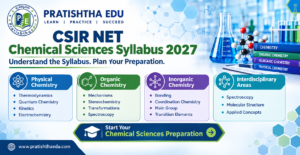
Organic Chemistry
Organic Chemistry is another major area where conceptual clarity can make a significant difference.
Important topics include:
- General Organic Chemistry
- Structure and bonding
- Acidity and basicity
- Stereochemistry
- Reaction mechanisms
- Reaction intermediates
- Organic transformations
- Named reactions
- Pericyclic reactions
- Heterocyclic chemistry
- Carbonyl chemistry
- Aromatic and antiaromatic systems
- Spectroscopic methods
- Selected advanced topics in Organic Chemistry
Organic Chemistry should ideally be studied as a connected system rather than as a collection of unrelated reactions.
For example, understanding electronic effects can help explain reactivity, while reaction mechanisms can make it easier to predict products instead of simply memorising them.
Stereochemistry also needs regular practice because even students who understand the basic theory may make mistakes when questions become structurally complex.
Inorganic Chemistry
Inorganic Chemistry covers concepts ranging from fundamental principles to advanced coordination and organometallic chemistry.
Important areas include:
- Periodic properties
- Chemical bonding
- Coordination chemistry
- Main group chemistry
- Transition elements
- Organometallic chemistry
- Bioinorganic chemistry
- Acids and bases
- Inorganic reaction mechanisms
- Molecular structure and properties
- Selected descriptive chemistry topics
One of the challenges in Inorganic Chemistry is balancing conceptual learning with retention.
Students may need to remember trends, structures, properties, reactions, oxidation states, and related information. However, understanding the reasons behind these patterns can reduce the amount of isolated memorisation required.
Regular revision is particularly important here because even well-understood information can become difficult to recall after a long gap.
Spectroscopy and Interdisciplinary Concepts
Some areas of Chemical Sciences connect different branches of Chemistry.
Spectroscopy is a good example.
Aspirants may encounter concepts related to techniques such as NMR, IR, UV-Visible spectroscopy, and mass spectrometry. These topics can require both theoretical understanding and interpretation of data.
Students should not study such topics only as isolated definitions. They should practise identifying what a spectrum or set of data is indicating and connect the observations with molecular structure.
Interdisciplinary preparation can be especially valuable because a single question may require knowledge from more than one area.
Why You Should Divide the Syllabus Into Smaller Units
Looking at the complete syllabus at once can make it feel overwhelming.
Instead, divide it into smaller study units.
For example, Physical Chemistry can be divided into thermodynamics, quantum chemistry, kinetics, electrochemistry, spectroscopy, and other related areas.
Organic Chemistry can be divided into basic principles, stereochemistry, mechanisms, transformations, spectroscopy, and advanced topics.
Inorganic Chemistry can similarly be divided into bonding, coordination chemistry, periodic properties, main group chemistry, transition elements, organometallic chemistry, and bioinorganic concepts.
Once the syllabus is divided, each unit becomes easier to plan, study, revise, and test.
How to Identify High-Priority Topics
Not every topic will require the same amount of preparation time.
Some topics are broad and interconnected, while others are more specialised. Some students may also have strong academic backgrounds in certain areas and weaker foundations in others.
A practical way to prioritise topics is to consider three factors:
Conceptual Importance: Does this topic form the foundation for other topics?
Question Practice: Can the topic be tested through numerical, analytical, or application-based questions?
Personal Strength: How confident are you when solving questions from this area?
For example, a topic that is both conceptually important and personally weak should receive more attention than a topic that is already well understood.
This approach allows students to create a more personalised CSIR NET Chemical Sciences preparation strategy.
Start With the Foundation Topics
A common mistake is jumping directly into advanced topics without strengthening basic concepts.
The foundation topics act like building blocks.
In Organic Chemistry, basic reaction mechanisms, electronic effects, stereochemistry, and acidity-basicity concepts support more advanced reactions.
In Inorganic Chemistry, chemical bonding and periodic properties help students understand coordination chemistry and the chemistry of elements.
In Physical Chemistry, mathematical basics and fundamental principles can make advanced numerical problems much easier to approach.
Students should therefore avoid treating foundational chapters as “easy topics” that can be skipped.
A strong foundation can save time later because advanced concepts become easier to understand.
How to Study Physical Chemistry From the Syllabus
Physical Chemistry should generally follow a cycle of theory and practice.
Start by understanding the concept and important equations. Then solve basic examples before progressing to examination-level questions.
For numerical topics, maintain a formula and concept notebook, but do not rely on formula memorisation alone.
For every important equation, understand:
- What each term represents
- What units are involved
- Under what conditions the equation applies
- How changing a variable affects the result
- What type of question can be solved using it
This type of preparation helps prevent formula confusion during timed practice.
How to Study Organic Chemistry From the Syllabus
Organic Chemistry becomes more manageable when topics are connected.
Instead of preparing every reaction independently, organise your preparation around mechanisms and reaction families.
While studying a reaction, look at:
Reactants → Conditions → Mechanism → Intermediate → Product
Then compare it with similar transformations.
Reaction maps can be useful for revision, especially when several reactions involve the same functional group or mechanistic principle.
Students should also give consistent attention to stereochemistry and spectroscopy instead of postponing them until the end.
How to Study Inorganic Chemistry From the Syllabus
Inorganic Chemistry requires a combination of understanding and repeated revision.
Start with the fundamental concepts and gradually move toward coordination, transition-metal, organometallic, and descriptive areas.
Tables can be useful for comparing:
- Oxidation states
- Electronic configurations
- Structures
- Magnetic behaviour
- Stability
- Reactivity
- Important compounds
Creating your own notes can revise considerably faster because you can focus on the information that you repeatedly forget.
Making a Topic-Wise Study Tracker
A simple study tracker can help you monitor your syllabus progress.
For each topic, maintain four stages:
Not Started → Learning → Practising → Revised
For example, a student may complete the theory of Thermodynamics but still need extensive numerical practice. In that case, the topic should not be marked as finished.
Similarly, completing a chapter does not necessarily mean that it has been mastered.
A topic should ideally move through all four stages before it is considered preparation-ready.
Why Syllabus Coverage Alone Is Not Enough
One of the biggest mistakes aspirants make is measuring progress by the number of chapters completed.
Suppose a student has completed twenty chapters but cannot confidently solve questions from half of them. On the other hand, another student may have completed fewer chapters but has strong conceptual clarity, good question-solving ability, and regular revision.
The second student may be in a better position.
This is why the quality of preparation matters more than simply counting completed chapters.
Every topic should move through a cycle of:
Learning → Practice → Testing → Revision
Only then can syllabus completion become meaningful.
Connecting Syllabus Preparation With Previous Year Questions
Previous year questions should be connected to your syllabus from the beginning.
After completing an important topic, solve relevant questions and identify how the examination tests that concept.
This can help answer practical questions such as:
- What level of difficulty should I expect?
- Are calculations involved?
- Does the topic require conceptual application?
- Which subtopics repeatedly create mistakes?
- How much time does this type of question require?
As you progress, mixed-topic practice can help you move beyond chapter-specific preparation.
This is important because the actual examination does not tell you which chapter a question belongs to before you solve it.
Revising the Syllabus Without Starting From Zero
Revision should begin before the complete syllabus is finished.
A useful approach is to introduce short revision sessions while continuing with new topics.
For example, after studying a new chapter during the week, reserve time to revise earlier chapters. This prevents older concepts from becoming distant.
A three-layer revision approach can work well:
First Revision: Soon after completing the topic
Second Revision: After a longer interval with question practice
Final Revision: Closer to the examination using concise notes, formulas, reactions, and mistakes
This makes revision progressive rather than stressful.
Keep the Official Syllabus as Your Reference Point
Study material, coaching notes, books, online resources, and question banks can all be useful, but the official syllabus should remain your primary reference.
Whenever you start a new topic, check whether it actually falls within the current examination requirements. This prevents excessive time being spent on material that is outside the scope of your preparation.
Aspirants should also verify the latest examination information and syllabus from the official CSIR NET authorities because examination information can be updated for different cycles.
Creating a Practical Syllabus Strategy
Once the syllabus has been divided, create a preparation plan based on your current level.
A beginner may first focus on foundational concepts before moving into advanced problem-solving.
A student with a strong academic background may spend more time on previous years’ questions, advanced application, mock tests, and weak areas.
Someone preparing while attending college or working may need a longer timeline with smaller daily targets.
There is no single timetable that works perfectly for every aspirant.
The right plan is the one that provides:
Clear targets + Regular practice + Revision + Performance tracking
Turn the Syllabus Into a Roadmap
The CSIR NET Chemical Sciences syllabus should not be viewed as a long list of chapters that needs to be completed as quickly as possible.
It should be treated as a roadmap.
Each topic should have a purpose in your preparation. Some topics build the foundation. Some strengthen numerical ability. Some develop reaction-based thinking. Others improve analytical and application skills.
When the syllabus is organised in this way, preparation becomes much more manageable.
How to Prepare for CSIR NET Chemical Sciences Effectively
Once the syllabus is clearly understood, the next challenge is turning that syllabus into an effective preparation plan. Many students know what they need to study but still struggle with questions such as how to begin, which subject to study first, how much time to give each topic, and when to start solving previous year questions.
A good CSIR NET Chemical Sciences preparation strategy should answer these questions without making the study routine unnecessarily complicated. The objective is to create a system where concepts are learned properly, questions are practised regularly, mistakes are identified, and previously studied topics continue to be revised.
Preparation becomes much more productive when every study session has a clear purpose.
Start by Assessing Your Current Level
Before creating a timetable, understand where you currently stand.
Some students begin CSIR NET preparation immediately after completing their degree, while others return to the subject after a gap. Some may be strong in Organic Chemistry but uncomfortable with Physical Chemistry. Others may find Inorganic Chemistry easier but struggle with numerical problems.
There is no need to compare your starting point with someone else’s.
Begin by identifying your own strengths and weaknesses.
One practical method is to take a basic diagnostic test covering different areas of Chemical Sciences. The objective is not to get a high score. It is to understand which concepts you already know and where your preparation needs attention.
After the assessment, divide topics into three groups:
Strong: You understand the concepts and can solve most questions confidently.
Moderate: You understand the basics but need more practice.
Weak: You need to revisit the fundamentals before attempting advanced questions.
This simple exercise can make your preparation much more focused.
Build Your Preparation Around Concepts
Once you know your current level, begin strengthening the fundamentals.
For every topic, try to understand the concept before moving toward difficult questions. Reading a chapter quickly and immediately attempting advanced questions may lead to frustration if the underlying ideas are not clear.
A better learning cycle is:
Learn the concept → Understand the logic → Study examples → Solve basic questions → Solve application-based questions → Attempt previous year questions
This sequence gradually increases difficulty.
For example, in Organic Chemistry, students should first understand the basic mechanism before trying to solve complicated reaction sequences. In Physical Chemistry, they should understand the principle behind an equation before attempting lengthy numerical problems. In Inorganic Chemistry, they should understand the underlying trend before trying to memorise related facts.
Give Organic, Inorganic and Physical Chemistry Different Treatment
A major part of effective preparation is recognising that the three major branches of Chemistry should not be studied in exactly the same way.
Organic Chemistry: Focus on Mechanisms and Connections
Organic Chemistry becomes much easier when students stop treating every reaction as an isolated fact.
Build your preparation around concepts such as:
- Electronic effects
- Reaction mechanisms
- Stereochemistry
- Acidity and basicity
- Reaction intermediates
- Functional group transformations
- Named reactions
- Pericyclic reactions
- Spectroscopy
While studying a reaction, focus on the reason behind it.
Ask yourself what controls the reaction, how the mechanism proceeds, and why one product is favoured over another.
Reaction maps and mechanism-based notes can make revision much more efficient.
Inorganic Chemistry: Understand Before You Memorise
Inorganic Chemistry contains a considerable amount of information, but memorising everything without understanding relationships can make revision difficult.
Start with the fundamentals and build connections.
For example, chemical bonding and periodic trends can support the understanding of coordination chemistry and transition elements.
Use concise notes, comparison charts, reaction summaries, and regular revision for information that requires stronger retention.
Inorganic Chemistry benefits greatly from repetition. A topic that seems easy during the first reading can become difficult to recall after several weeks unless it is revisited.
Physical Chemistry: Practice Is Essential
Physical Chemistry requires a combination of theory and problem-solving.
For each chapter, first understand the concept, then learn the important equations and immediately begin applying them.
Do not wait until the entire syllabus is completed before starting numerical practice.
For every important equation, understand:
What does the equation represent?
What do the variables mean?
What units are required?
Under what conditions can it be applied?
What happens when the variables change?
This type of understanding helps reduce formula-based mistakes.
Create a Realistic Study Schedule
A preparation timetable should be ambitious enough to create progress but realistic enough to maintain for months.
One of the common mistakes students make is designing a schedule that looks impressive on paper but is difficult to follow in real life.
Instead of planning every minute of the day, create clear study blocks.
For example:
Concept Study → Question Practice → Revision → PYQs
The exact duration of each block can depend on the student’s available time.
A full-time aspirant may be able to dedicate several focused sessions each day, while a student attending college may need a shorter but consistent schedule.
Consistency is more valuable than an unrealistic timetable that is followed for only a few days.
Use Daily, Weekly and Monthly Targets
Breaking a long preparation journey into smaller targets can make the syllabus easier to manage.
A daily target may include completing a specific concept and solving a fixed number of questions.
A weekly target can focus on completing a defined group of topics and revising older material.
A monthly target can include syllabus progress, topic-wise PYQs, and mock-test performance.
This approach creates measurable progress.
Instead of saying:
“I have to complete the whole CSIR NET syllabus.”
you can work toward:
“This week I will complete these topics, solve their previous year questions, and revise the concepts at the end of the week.”
Smaller targets are easier to track and adjust.
Follow the 60–30–10 Principle for Study Time
Students can also divide their study effort according to their current preparation stage.
A practical approach is to dedicate the largest portion of study time to concept learning and question practice, followed by revision and performance analysis.
For example, during the early stage, more time can be given to:
Concept Learning + Practice
As the preparation progresses, the balance can gradually shift toward:
PYQs + Mock Tests + Revision + Weak Areas
The exact ratio does not need to remain fixed throughout the preparation period.
Your study pattern should change as your preparation develops.
Start Previous Year Question Practice Early
Previous year questions should not be saved exclusively for the final months.
Once a topic has been properly studied, solve relevant questions from that topic.
This allows you to understand whether you have actually learned the concept or only recognised it while reading.
For example, after completing a topic in Chemical Kinetics, solve relevant PYQs before moving too far ahead. If you find repeated difficulty, return to the concept, revise it, and practise again.
This creates an immediate feedback loop.
Study → Test → Identify Weakness → Improve → Test Again
That cycle is one of the most effective ways to make preparation more efficient.
Maintain a Mistake Notebook
A mistake notebook can become one of the most valuable resources during long-term preparation.
Do not copy every question into it.
Instead, record things such as:
- Concepts you repeatedly forget
- Common calculation mistakes
- Reactions you frequently confuse
- Important exceptions
- Formulas that are easy to mix up
- Questions that reveal a deeper conceptual weakness
Review this notebook regularly.
Near the examination, such personalised notes can save considerable revision time because they focus on your actual weaknesses rather than repeating everything from the beginning.
Use Active Revision Instead of Re-Reading
Reading the same chapter repeatedly can create the impression that you remember everything.
But recognition is not the same as recall.
Active revision requires you to retrieve information without looking at the source.
For Organic Chemistry, try recalling reaction mechanisms or important transformations from memory.
For Inorganic Chemistry, practise recalling trends, structures, properties, and important reactions.
For Physical Chemistry, solve formulas and numerical problems without referring to the solution immediately.
Other useful techniques include short notes, flashcards, self-questioning, reaction maps, and formula sheets.
The goal of revision is not simply to look at information again. It is to make the information easier to retrieve when you need it.
Learn to Handle Difficult Topics
Every aspirant will encounter topics that seem unusually difficult.
The wrong approach is to keep postponing them indefinitely.
At the same time, spending an entire week on one difficult chapter can disrupt the rest of the syllabus.
A better approach is to divide a difficult topic into smaller sections.
For example:
Basic Concept → Simple Examples → Standard Questions → PYQs → Advanced Application
Work through these stages gradually.
If a concept still remains unclear, identify exactly what is causing the difficulty. Sometimes one missing prerequisite concept is responsible for the entire problem.
Once that foundation is repaired, the advanced topic may become significantly easier.
Improve Speed Without Sacrificing Accuracy
Speed should come after understanding.
Trying to solve questions as quickly as possible before developing accuracy can create careless mistakes.
Start by solving questions correctly, even if it takes longer.
Once the concepts become stronger, use timed practice to gradually improve speed.
During timed sessions, track which types of questions consume the most time.
For example, you may discover that:
- Numerical calculations take too long
- Some Organic Chemistry problems require repeated re-reading
- Inorganic questions are being answered too quickly
- Certain topics repeatedly lead to incorrect guesses
These observations should become part of your preparation strategy.
Use Mock Tests as a Learning Tool
Mock tests are not only for measuring performance.
They are also tools for improving performance.
When you complete a mock test, do not stop at the score.
Analyse every serious mistake and identify patterns.
A low score in one test does not automatically mean that preparation is going badly. It may simply show that certain topics need more attention.
A strong post-test analysis should answer:
What did I get wrong?
Why did I get it wrong?
What should I revise?
Could I have solved it faster?
Should I have attempted it at all?
This process gradually develops examination judgement.
Avoid Collecting Too Many Resources
One of the most common problems in competitive exam preparation is resource overload.
Students may switch continuously between books, online lectures, notes, PDFs, test series, and social-media recommendations.
This often creates incomplete preparation.
Choose a dependable set of resources and use them thoroughly.
Your preparation should be measured by how well you understand and apply the material, not by how many PDFs or books you have collected.
The same principle applies to coaching material. Good material becomes useful when it is studied, revised, and connected with regular question practice.
Balance Coaching With Self-Study
For students taking CSIR NET Chemical Sciences Coaching in Bangalore, classroom or online coaching can provide structure and guidance, but independent study remains essential.
Use classes to understand concepts, clarify difficult areas, and follow a planned sequence.
Use self-study to revise, solve questions, work through PYQs, and strengthen weak areas.
The most effective combination is often:
Learn With Guidance → Study Independently → Practise Questions → Analyse Performance → Revise
Students should also maintain a personal study plan even when they follow a coaching schedule. Your individual strengths and weaknesses may require additional revision beyond the regular class plan.
Build a Preparation Routine You Can Sustain
The most effective preparation strategy is one that can be maintained consistently.
Do not design your entire schedule around your most productive day. Design it around an average day that you can realistically follow.
There may be days when progress is slower because of college, work, personal responsibilities, or fatigue.
That does not mean the preparation has failed.
The important thing is to return to the routine instead of abandoning it.
A long-term examination like CSIR NET rewards consistency. Small improvements repeated over many weeks can make a significant difference.
The Right Strategy Changes as the Exam Gets Closer
Your preparation strategy should not remain the same throughout the year.
During the initial stage, focus more heavily on:
Concept Building + Syllabus Coverage
During the middle stage, increase:
Question Practice + PYQs + Revision
During the later stage, focus more on:
Mock Tests + Weak Areas + Revision + Time Management
This gradual transition helps you move from learning mode to examination mode.
The final phase should not be the time to discover your entire syllabus for the first time. It should primarily be used to consolidate what you have already studied and improve your performance.
Make Every Study Session Purposeful
Before starting a study session, decide exactly what you want to achieve.
Instead of writing:
“Study Organic Chemistry.”
set a specific objective such as:
“Complete stereochemical concepts, revise important terms, solve practice questions, and analyse five PYQs.”
A clear objective makes it easier to maintain focus and measure progress.
At the end of the session, briefly record what was completed and what needs to be continued.
Over time, these small records can provide a clear picture of your preparation journey.
A Preparation Strategy That Focuses on Progress
There is no single perfect timetable for every CSIR NET Chemical Sciences aspirant.
What matters is having a preparation system that combines conceptual clarity, regular practice, targeted revision, and continuous self-analysis.
The strongest approach is not to study everything at the same intensity. It is to understand your priorities, allocate time according to your needs, and keep improving the areas that are holding back your performance.
A well-planned preparation journey can therefore be built around a simple principle:
Study with understanding, practise with purpose, analyse every mistake, and revise consistently.
That approach can help transform a large Chemistry syllabus into a manageable preparation roadmap and make the journey toward CSIR NET Chemical Sciences more organised and focused.
CSIR NET Chemical Sciences Previous Year Questions, Books & Mock Tests
Once the basic concepts are in place and a systematic study routine has been created, the next important step is to strengthen preparation through the right combination of previous year questions, study resources, practice sets, and mock tests.
Many aspirants spend a large amount of time collecting books and study materials but give comparatively less attention to question practice. This can become a problem because knowing a Chemistry concept and being able to apply it in an examination are two different things.
For CSIR NET Chemical Sciences, regular problem solving should therefore become an essential part of preparation. The right resources should help you understand concepts, practise their application, identify mistakes, and gradually improve speed and accuracy.
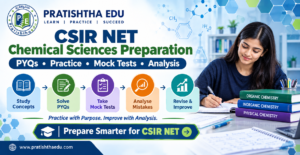
Why Previous Year Questions Are So Important
Previous year questions provide a practical understanding of how Chemical Sciences concepts are tested in the examination.
A textbook may explain a topic in considerable detail, but a question paper shows how that knowledge can be converted into an actual problem. A familiar concept may appear in a different format, involve multiple steps, or require the student to compare several possibilities before selecting the correct answer.
This makes CSIR NET Chemical Sciences Previous Year Questions extremely useful during preparation.
Rather than treating PYQs as something to solve only during the final revision stage, students should introduce them gradually throughout their preparation.
After completing a topic, solve relevant previous year questions and observe how the concept has been tested.
This helps you understand whether you have truly learned the topic or simply recognised it from your study material.
How to Use PYQs Correctly
There is a major difference between simply solving PYQs and actually learning from them.
Suppose you answer a question incorrectly. Checking the correct option and moving on may not solve the underlying problem.
Instead, ask yourself:
What concept was tested?
Why was my answer incorrect?
Did I misunderstand the concept?
Was the calculation wrong?
Did I miss an important condition or exception?
Could I solve a similar question now?
This analysis turns a wrong answer into a learning opportunity.
Students can also maintain a separate PYQ notebook where they record important concepts, repeated mistakes, difficult questions, and useful shortcuts.
Over time, this notebook can become a valuable revision tool.
Topic-Wise PYQ Practice
You do not have to wait until the entire syllabus is complete before beginning PYQ practice.
A better approach is to combine PYQs with topic completion.
For example, after studying Chemical Kinetics, solve relevant questions from that topic.
After completing Coordination Chemistry, practise questions specifically related to coordination compounds.
After finishing a section of Organic Chemistry, solve questions based on the corresponding mechanisms and transformations.
This approach allows students to immediately test what they have learned.
It also helps identify weak areas before they become bigger problems later in the preparation.
Move From Topic-Wise Questions to Mixed Questions
Topic-wise practice is useful during the learning stage, but actual examination preparation eventually needs mixed practice.
Why?
Because an examination does not tell you which concept a question belongs to before you start solving it.
One question may involve Organic Chemistry, the next may involve Physical Chemistry, and another may test Inorganic Chemistry.
Therefore, after building sufficient topic-wise confidence, gradually introduce mixed question sets.
A practical progression is:
Topic Practice → Topic-Wise PYQs → Mixed PYQs → Timed Practice → Full-Length Mock Tests
Each stage prepares you for a different aspect of the examination.
Choosing the Right Books for CSIR NET Chemical Sciences
Books can play an important role in preparation, but choosing too many can create unnecessary confusion.
Students do not need a separate book for every small topic. What matters is having reliable resources that explain concepts clearly and provide enough problems for practice.
When selecting a book or study resource, consider:
Syllabus Coverage: Does it cover the topics relevant to the examination?
Conceptual Depth: Does it explain why a concept works rather than only providing facts?
Question Quality: Are there sufficient problems for practice?
Difficulty Level: Does the material gradually move from basic questions to advanced applications?
Revision Value: Can the material be revisited efficiently before the examination?
The best resource is not necessarily the largest book. It is the resource that you can understand, practise from, revise, and use consistently.
Separate Learning Material From Practice Material
Another useful approach is to distinguish between resources used for learning and resources used for testing.
For example, a textbook or detailed coaching material may be used to learn concepts.
A question bank, PYQ collection, or test series can then be used to practise those concepts.
Trying to learn everything from a question bank can leave conceptual gaps, while reading textbooks continuously without solving questions may provide insufficient examination practice.
A balanced preparation system therefore looks like:
Concept Resource → Notes → Practice Questions → PYQs → Mock Tests
Each resource has a specific purpose.
The Importance of Personal Notes
Making personal notes can make revision much easier, especially for a large syllabus.
However, notes should not become another textbook.
Avoid copying entire chapters.
Instead, write down information that helps you revise quickly, such as:
- Important concepts
- Difficult formulas
- Reaction mechanisms
- Important exceptions
- Frequently confused points
- Short methods
- Common mistakes
- Important PYQ concepts
For Organic Chemistry, reaction maps and mechanism summaries can be particularly useful.
For Inorganic Chemistry, comparison tables and concise factual summaries can help.
For Physical Chemistry, formula sheets combined with conditions and applications can make revision faster.
Mock Tests: From Preparation to Examination Practice
Mock tests become increasingly important as your preparation progresses.
A mock test allows you to practise not just Chemistry, but also time management, question selection, accuracy, and examination temperament.
Students often make the mistake of looking only at their final score.
A score tells you what happened.
Analysis helps explain why it happened.
After every mock test, review the paper carefully.
Look at questions that were:
Correct and confident
Correct but took too much time
Incorrect due to a conceptual mistake
Incorrect due to a careless error
Left despite knowing the concept
Attempted without sufficient confidence
This classification can reveal weaknesses that are not obvious from the score alone.
Mock Test Analysis Is More Important Than Taking More Tests
Taking ten mock tests without analysing them can be less useful than taking fewer tests and studying the mistakes carefully.
After each test, identify patterns.
For example, if Physical Chemistry numerical problems repeatedly consume too much time, the solution may involve additional calculation practice.
If Organic Chemistry mistakes repeatedly come from stereochemistry, that topic may need targeted revision.
If Inorganic Chemistry questions are being answered based on guesses, the problem may be insufficient conceptual or factual revision.
The purpose of a mock test is therefore not simply to produce a number.
Its real purpose is to provide feedback.
When Should You Start Mock Tests?
There is no need to take full-length mock tests immediately after starting preparation.
During the early stage, topic-wise tests can be more useful because they help reinforce recently learned concepts.
As syllabus coverage improves, introduce mixed-subject tests.
Later, move toward full-length timed mock tests.
A practical progression can be:
Early Stage: Topic Tests
Middle Stage: Subject-Wise and Mixed Tests
Advanced Stage: Full-Length Mock Tests
This progression allows students to build confidence before entering complete examination simulation.
Create a Mock Test Analysis Record
Maintaining a simple record after every mock can make progress easier to track.
Record:
Total Score
Attempted Questions
Correct Answers
Incorrect Answers
Questions Left
Average Time Management
Weak Topics
Repeated Mistakes
The purpose is not to become obsessed with numbers.
The purpose is to identify trends.
For example, if your score remains similar but the number of careless mistakes decreases, that is still useful progress.
Likewise, if your score suddenly decreases in one test, examine the reasons before changing your entire preparation plan.
Do Not Ignore Easy Questions
During difficult practice sessions, students often focus heavily on advanced questions.
However, examination performance also depends on solving easier questions accurately.
Basic conceptual questions can become scoring opportunities when the student has prepared well.
This is another reason why a strong foundation remains important throughout preparation.
Do not assume that simple-looking questions are unimportant.
A question based on a fundamental concept may still require careful reading and correct application.
Learn From Every Incorrect Option
Multiple-choice questions contain more information than just the correct answer.
When analysing a question, examine why the other options are incorrect.
This can reveal common misconceptions and help improve conceptual clarity.
For example, in an Organic Chemistry question, understanding why an alternative product is not formed can improve your understanding of the mechanism.
In Inorganic Chemistry, comparing different possible structures or electronic configurations can strengthen conceptual relationships.
In Physical Chemistry, checking the assumptions behind alternative answers can help prevent similar mistakes.
This makes every question more educational.
Avoid Blind Guessing During Practice
Practice sessions should also help develop good examination judgement.
When you solve a question, try to identify your confidence level.
You can mentally classify questions as:
High Confidence: The concept is clear, and the solution is straightforward.
Moderate Confidence: The concept is known but requires careful calculation or reasoning.
Low Confidence: The question appears unfamiliar or involves significant uncertainty.
This habit can later help with question selection during timed tests.
The exact attempt strategy should always be based on the current examination rules and marking scheme.
Use Mock Tests to Improve Time Management
Time management should be practised before the actual examination.
During mock tests, students should notice where time is being spent.
If one difficult question consumes several minutes while several easier questions remain unanswered, the problem may be question selection rather than subject knowledge.
Over time, you should learn to recognise when a question is worth continuing and when it is better to move ahead.
This skill develops through repeated timed practice.
The Role of Coaching Material and Test Series
For students taking CSIR NET Chemical Sciences Coaching in Bangalore, coaching material and structured test series can provide an organised practice framework.
Good study material can reduce the need to search for information from multiple sources, while regular tests can create accountability and provide measurable feedback.
However, students should still maintain their own notes, PYQ analysis, and weak-topic tracker.
External guidance works best when it is combined with active individual preparation.
Build Your Own Resource System
By the middle of your preparation, you should know which resources work best for you.
A practical personal resource system can include:
One Primary Concept Resource
One Reliable PYQ Collection
Personal Short Notes
Mistake Notebook
Mock Test Series
This keeps preparation organised.
There is no advantage in repeatedly switching resources because another student recommends a different book or coaching material.
Consistency allows you to understand the resource deeply and spend more time on actual learning.
Keep Revision Material Short and Useful
As the examination approaches, you should not need to read every detailed chapter from the beginning again.
This is why concise revision material should be developed during preparation itself.
Your final revision resources can include:
- Formula sheets
- Organic reaction maps
- Inorganic comparison tables
- Important concepts
- Frequently repeated PYQ ideas
- Common mistakes
- Difficult topics
- Short tricks or methods
These should be personal and practical.
The objective is to revise faster without sacrificing understanding.
A Smart Practice Cycle for CSIR NET Chemical Sciences
A productive practice cycle can be built around five stages:
Study: Understand the concept properly.
Practise: Solve questions without immediately looking at solutions.
Analyse: Identify why mistakes occurred.
Revise: Return to the relevant concept.
Retest: Solve similar questions again.
This cycle ensures that mistakes do not simply repeat.
It also helps transform question practice into measurable improvement.
The Goal Is Better Performance, Not Just More Questions
Students sometimes judge preparation by the number of questions completed.
But solving 500 questions without understanding mistakes is not necessarily better than solving fewer questions with detailed analysis.
Quality matters.
A useful question after every practice session is:
“What did I learn from these questions that I did not know before?”
The answer may be a concept, a shortcut, a common trap, a calculation method, or a better way of approaching a difficult problem.
That is real progress.
Bringing Everything Together
Previous year questions, books, personal notes, and mock tests each serve a different purpose.
Books help build knowledge.
Notes help organise knowledge.
PYQs show how knowledge is tested.
Mock tests help apply that knowledge under time pressure.
Analysis turns mistakes into improvement.
When these elements work together, preparation becomes much more organised.
For a serious CSIR NET Chemical Sciences aspirant, the ideal goal is not to collect more study material but to create a reliable system that continuously moves preparation from learning toward examination readiness.
The strongest preparation usually develops through a simple cycle:
Learn the concept → Practise the concept → Solve PYQs → Analyse mistakes → Revise → Take a mock test → Improve
This cycle can be repeated throughout the preparation journey, gradually increasing both confidence and accuracy.
Subject-Wise CSIR NET Chemical Sciences Preparation Strategy
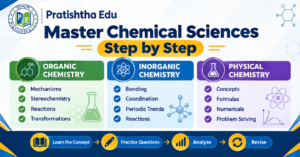
Preparing for CSIR NET Chemical Sciences becomes much more effective when each branch of Chemistry is approached according to its own requirements. Organic Chemistry, Inorganic Chemistry, and Physical Chemistry involve different types of concepts, different learning methods, and different approaches to question solving.
Trying to study all three in the same way can make preparation unnecessarily difficult. A better strategy is to understand what each subject demands and then build a study method around it.
For many aspirants, the biggest improvement comes when they stop asking, “How many chapters have I completed?” and start asking, “How well can I apply the concepts I have studied?”
Preparing Organic Chemistry for CSIR NET
Organic Chemistry is often considered difficult because of the number of reactions and mechanisms involved. However, preparation becomes much more manageable when reactions are studied as part of a connected system rather than as isolated facts.
The first priority should be to build a strong foundation in General Organic Chemistry.
Concepts such as inductive effect, resonance, hyperconjugation, acidity and basicity, aromaticity, reaction intermediates, nucleophiles, electrophiles, and stereochemical principles support many advanced topics.
Without a strong foundation in these areas, students may find advanced reaction mechanisms confusing.
Focus on Reaction Mechanisms
Instead of memorising a reaction only by its name, understand how it happens.
While studying an Organic Chemistry reaction, try to identify:
Reactant → Reaction Conditions → Mechanism → Intermediate → Product
Then ask why the particular pathway is favoured.
Understanding mechanisms helps when a familiar reaction appears in an unfamiliar form. It also makes it easier to predict products and eliminate incorrect options.
Give Special Attention to Stereochemistry
Stereochemistry can become a scoring area when the underlying concepts are clear, but it can also lead to avoidable mistakes when students rely only on memorisation.
Regularly practise concepts involving:
- Chirality
- Enantiomers
- Diastereomers
- R/S configuration
- E/Z notation
- Conformations
- Optical activity
- Stereochemical outcomes of reactions
Do not limit yourself to reading examples. Draw structures and practise identifying relationships between molecules.
The more frequently you work with structures, the more natural stereochemical reasoning becomes.
Study Organic Reactions Through Reaction Maps
A reaction map can be more useful than pages of disconnected notes.
For example, organise transformations around functional groups and identify how one functional group can be converted into another.
This allows you to recognise patterns rather than memorising hundreds of individual reactions.
During revision, reaction maps can also make it easier to quickly revisit important transformations.
Make Mechanism-Based Short Notes
Your Organic Chemistry notes should focus on information that helps you solve problems.
Include:
Important mechanisms
Reaction conditions
Reactive intermediates
Important exceptions
Commonly confused reactions
Stereochemical outcomes
Frequently repeated concepts from PYQs
These notes will become particularly useful during revision.
Preparing Inorganic Chemistry for CSIR NET
Inorganic Chemistry has a reputation for requiring extensive memorisation, but strong conceptual understanding can significantly reduce that burden.
The best place to begin is with foundational concepts.
Chemical bonding and periodic properties provide a framework for understanding many later topics.
Once those basics are clear, students can move toward coordination chemistry, transition elements, main group chemistry, organometallic chemistry, and other important areas.
Understand Trends Instead of Memorising Isolated Facts
Whenever you encounter a trend, try to understand its reason.
Ask:
Why does the trend occur?
What changes across the period or down the group?
How does electronic configuration influence the property?
Are there important exceptions?
This approach makes information easier to remember and apply.
Give Special Attention to Coordination Chemistry
Coordination Chemistry is an important area for serious preparation.
Students should become comfortable with concepts such as:
- Coordination numbers
- Ligands
- Isomerism
- Nomenclature
- Crystal field concepts
- Magnetic properties
- Electronic configurations
- Stability
- Bonding theories
- Spectrochemical concepts
Do not study these topics independently. Try to understand how structure, electronic configuration, bonding, and properties are connected.
For example, when studying a complex, think about its geometry, ligand environment, electronic arrangement, magnetic behaviour, and possible isomerism together.
This integrated approach can make difficult questions easier to interpret.
Use Tables for Inorganic Revision
Inorganic Chemistry often contains information that benefits from comparison.
Create concise tables for:
Oxidation states
Electronic configurations
Geometry
Magnetic behaviour
Important compounds
Reactions
Periodic trends
Comparison-based notes can make last-stage revision much quicker.
Instead of rereading long chapters, you can revise the specific information that is most likely to be forgotten.
Revise Inorganic Chemistry Frequently
Inorganic Chemistry should not be left for one large revision session at the end.
Short and repeated revision is usually more practical.
A topic studied today can be revised after a few days, then again after a longer interval.
This helps maintain familiarity with facts and trends throughout the preparation period.
Preparing Physical Chemistry for CSIR NET
Physical Chemistry requires a different balance.
Students need strong theoretical understanding, but that understanding must be converted into numerical and analytical problem-solving ability.
Reading a chapter and understanding every derivation does not automatically mean that you will be able to solve examination-level questions.
Regular practice is essential.
Understand the Meaning Behind Equations
Do not treat formulas as information that must simply be memorised.
For every important equation, understand:
What does each symbol represent?
What are the units?
What assumptions are involved?
When can the equation be applied?
How does changing a variable affect the result?
This approach helps avoid formula confusion.
It also improves your ability to recognise which equation or principle is relevant when the question is presented differently.
Practise Numericals in Increasing Difficulty
A useful sequence for Physical Chemistry is:
Basic Example → Standard Question → Application-Based Problem → PYQ → Timed Question
Begin with straightforward questions to understand the method.
Then gradually increase the difficulty.
Do not become discouraged if advanced numerical problems initially take a long time. The objective is to develop a systematic problem-solving process.
With practice, you should gradually improve both speed and accuracy.
Maintain a Formula and Concept Sheet
A formula sheet is useful, but it should contain more than formulas.
For each important equation, add a brief note about:
- Meaning
- Units
- Conditions
- Common applications
- Typical mistakes
This prevents the formula sheet from becoming a collection of symbols that are difficult to remember.
Spectroscopy Needs Integrated Preparation
Spectroscopy is an area where students often need knowledge from more than one branch of Chemistry.
Concepts from Organic Chemistry, Physical Chemistry, and molecular structure can come together in spectroscopy-based questions.
Preparation should therefore include both theory and interpretation.
Students should practise identifying what information a technique provides and how that information relates to molecular structure.
Instead of simply memorising definitions, focus on questions such as:
What does the signal indicate?
Why does it appear at a particular region?
How does molecular structure influence the observation?
How can two possible structures be distinguished?
This approach makes spectroscopy more application-oriented.
Preparing for Higher-Level Questions
Strong preparation should eventually move beyond individual topics.
Higher-level questions may require you to connect concepts from different areas.
For example, a question may combine structure and bonding with spectroscopy, or reaction mechanism with stereochemical reasoning.
To prepare for such questions, start solving mixed-topic problems once your individual concepts are sufficiently strong.
Do not become dependent on chapter labels.
Instead of thinking:
“This is an Organic Chemistry question.”
try to identify:
“Which concept is actually being tested?”
This shift in thinking can improve your ability to tackle unfamiliar questions.
How to Approach Part B and Part C Questions
Different levels of questions require different thinking.
For questions that primarily test subject knowledge, focus on recognising the correct concept and applying it accurately.
For more advanced questions, spend additional time understanding the information provided before selecting an answer.
Do not rush simply because the question appears familiar.
At the same time, avoid spending excessive time on one problem while easier opportunities remain.
This balance develops through regular timed practice.
Build a Daily Subject Rotation
Studying one subject continuously for several weeks may create boredom and may also result in weaker retention of the other branches.
A balanced routine can rotate subjects.
For example:
Session 1: Organic Chemistry
Session 2: Physical Chemistry
Session 3: Inorganic Chemistry
The order does not have to remain fixed.
Students can give additional sessions to their weaker subject while still maintaining regular contact with their stronger subjects.
The objective is to prevent any major branch from being completely neglected.
Use Your Strong Subject Strategically
Every aspirant usually has a subject that feels more comfortable.
Do not ignore that strength.
A strong subject can become a reliable source of marks, but it should not become an excuse to avoid weaker areas.
Use your strong subject to build confidence while gradually improving the weaker ones.
For example, if Organic Chemistry is your strongest area but Physical Chemistry is weak, continue revising Organic Chemistry while deliberately allocating additional problem-solving time to Physical Chemistry.
This creates a better balance.
Turn Weak Topics Into Targeted Study Sessions
Instead of writing “Improve Physical Chemistry” in your timetable, identify the exact problem.
For example:
Thermodynamics concepts are clear, but numerical practice is weak.
That is a much more useful target.
Now your study session can focus specifically on solving thermodynamics numericals and analysing errors.
Similarly:
Coordination Chemistry theory is understood, but application-based questions are difficult.
The solution is not to reread the entire chapter. It is to practise more application-based questions and identify the missing concept.
Specific problems require specific solutions.
Use Previous Year Questions Subject-Wise
PYQs become even more useful when organised according to subject.
Maintain separate practice sections for:
Organic Chemistry PYQs
Inorganic Chemistry PYQs
Physical Chemistry PYQs
This helps you identify patterns within each branch.
Later, combine them into mixed practice to simulate the uncertainty of the actual examination.
You may discover that certain concepts are repeatedly causing mistakes. Those concepts should then be added to your revision list.
Make Revision Different for Each Subject
The revision method should also reflect the nature of the subject.
For Organic Chemistry, revise mechanisms, reaction maps, stereochemical concepts, and transformations.
For Inorganic Chemistry, revise trends, structures, properties, reactions, and comparison tables.
For Physical Chemistry, revise equations, concepts, conditions, and numerical problems.
This is much more effective than using the same revision method for every chapter.
Track Subject-Wise Progress
A simple progress tracker can help you understand where your preparation stands.
For every topic, mark:
Concepts Completed
Questions Practised
PYQs Solved
Revision Completed
Mock-Test Performance
A topic should not be considered completely prepared simply because the theory has been read once.
True preparation involves understanding plus application.
Avoid Spending All Your Time on One Subject
It is natural to enjoy studying the subject you like most.
However, competitive examinations require broader preparation.
If a student spends almost all available study time on Organic Chemistry and postpones Physical Chemistry and Inorganic Chemistry, the overall preparation can become unbalanced.
Use a planned distribution of time.
Your weaker subjects may need additional attention, but the stronger subjects should continue to receive regular revision so that their performance does not decline.
Connect Chemistry Concepts Whenever Possible
One of the most powerful preparation habits is learning to connect concepts across subjects.
For example, bonding concepts can help with Inorganic Chemistry, Physical Chemistry, and spectroscopy.
Thermodynamic principles can appear in different contexts.
Organic reaction behaviour may depend on concepts involving acidity, basicity, electronic effects, and molecular structure.
When concepts are connected rather than stored as isolated facts, your understanding becomes more flexible.
This flexibility is especially valuable for application-based questions.
A Balanced Strategy for Long-Term Preparation
A strong CSIR NET Chemical Sciences preparation strategy should gradually move through four phases:
Foundation: Build conceptual clarity.
Development: Increase topic-wise question practice.
Application: Solve PYQs and mixed questions.
Examination Practice: Take timed mock tests and analyse performance.
The exact duration of each phase will depend on your starting level and available preparation time.
The important point is to avoid jumping into advanced mock tests before your basic concepts are strong enough to support them.
The Goal Is to Think Like the Question Setter
As preparation improves, try to understand how a concept can be tested from different angles.
When studying a topic, ask yourself:
What is the basic principle?
What are the common exceptions?
What happens if one condition changes?
What calculation could be based on this concept?
Which misconception could lead to a wrong answer?
This habit encourages deeper learning.
Instead of remembering only one answer, you begin understanding the logic behind possible questions.
That is the kind of preparation that can help you approach unfamiliar problems with greater confidence.
Bringing the Subject-Wise Strategy Together
Organic Chemistry, Inorganic Chemistry, and Physical Chemistry each require a different learning approach, but they should ultimately work together as part of one preparation system.
Organic Chemistry: Understand mechanisms, reaction patterns, and stereochemistry.
Inorganic Chemistry: Build conceptual relationships and revise factual information systematically.
Physical Chemistry: Strengthen theory through continuous numerical practice.
Spectroscopy and Interdisciplinary Areas: Focus on interpretation and connections between concepts.
Alongside these subject-specific methods, continue solving previous year questions, maintaining short notes, revising weak areas, and taking mock tests.
The objective is not to become equally strong in every topic from the beginning. It is to steadily improve your overall command of Chemical Sciences.
Aspirants who combine conceptual learning, subject-wise practice, PYQs, targeted revision, and regular self-analysis can build a much stronger foundation for the examination.
CSIR NET Chemical Sciences Cut-Off, JRF & Career Opportunities
After completing the syllabus, strengthening subject-wise concepts, solving previous year questions, and taking regular mock tests, the next important part of preparation is understanding what happens after the examination. For many aspirants, CSIR NET Chemical Sciences is not just another competitive examination. It can be an important step toward research, higher education, teaching, and long-term academic or scientific careers.
At the same time, students often have questions about cut-offs, Junior Research Fellowship (JRF), eligibility, and what opportunities may become available after qualifying. Understanding these aspects can help aspirants set realistic goals and prepare with a clearer sense of direction.
Understanding the CSIR NET Chemical Sciences Cut-Off
The cut-off is one of the most discussed aspects of any competitive examination.
However, students should avoid treating the cut-off as a fixed number that remains the same for every examination cycle. The qualifying level can vary depending on factors such as examination difficulty, candidate performance, category, and the overall selection process.
This is why preparing only to “cross the expected cut-off” can be risky.
A better strategy is to focus on maximizing your preparation and performance rather than predicting a particular score months before the examination.
Instead of asking:
“What will be the cut-off this year?”
a more useful question is:
“How can I improve my accuracy and attempt quality?”
This shift in focus can reduce unnecessary uncertainty and keep preparation centred on things that students can actually control.
Why Cut-Off Should Not Be the Only Target
Suppose an aspirant prepares only until they believe they have enough marks to clear an expected cut-off.
If the paper turns out to be easier or the overall performance of candidates changes, that estimate may no longer be useful.
On the other hand, a student who prepares with the goal of improving conceptual understanding, question-solving ability, and overall performance is better positioned to handle different levels of difficulty.
This is particularly important for Chemical Sciences because the examination can include questions ranging from straightforward conceptual problems to complex application-based questions.
Therefore, preparation should be based on performance improvement rather than cut-off prediction.
What Is Junior Research Fellowship?
For many Chemical Sciences aspirants, one of the major goals associated with CSIR NET is the Junior Research Fellowship (JRF).
JRF can support candidates who want to pursue research and higher academic qualifications.
A research-oriented career can involve moving into areas such as:
- Chemical research
- Materials science
- Pharmaceutical research
- Environmental chemistry
- Nanoscience
- Analytical chemistry
- Organic synthesis
- Inorganic chemistry
- Physical chemistry
- Interdisciplinary scientific research
The exact opportunities available to a candidate can depend on academic qualifications, institutional requirements, research interests, and applicable eligibility rules.
For students interested in pursuing a PhD, the JRF pathway can therefore be an important part of their academic planning.
CSIR NET and the Research Pathway
Aspirants who are interested in research should understand that qualifying the examination is only one part of the journey.
Research itself requires curiosity, patience, analytical thinking, experimental or computational skills, and the ability to work consistently on a specific scientific problem.
Students who plan to move toward research should begin developing these qualities during their academic years.
Strong fundamentals in Chemistry can be extremely useful because research problems often require students to connect concepts from different areas rather than work within a single textbook chapter.
A strong CSIR NET Chemical Sciences preparation strategy can therefore provide benefits beyond the examination itself.
The habit of understanding concepts deeply, analysing problems, reading scientific material, and questioning assumptions can also support future academic work.
Career Opportunities After CSIR NET Chemical Sciences
Qualifying CSIR NET can support different academic and research-oriented career pathways.
Depending on qualifications, eligibility, institutional requirements, and experience, candidates may explore opportunities related to:
Research: Working toward a PhD and participating in scientific research projects.
Higher Education: Pursuing advanced academic qualifications in Chemistry and related fields.
Teaching and Academia: Exploring eligible teaching and academic opportunities where the applicable qualification requirements are met.
Research Institutes and Laboratories: Building careers in scientific organisations, laboratories, and research environments.
Industry: Using a strong Chemistry background for roles in pharmaceutical, chemical, materials, analytical, environmental, and related industries.
Specialised Research Areas: Developing expertise in areas such as spectroscopy, catalysis, medicinal chemistry, computational chemistry, materials chemistry, or nanoscience.
The path after the examination depends on the candidate’s interests and qualifications.
Choosing the Right Career Direction
Not every CSIR NET aspirant needs to follow the same career path.
Some students are deeply interested in laboratory research.
Others may prefer teaching, higher education, scientific writing, industrial research, or specialised technical roles.
The important thing is to identify what type of work interests you.
Ask yourself:
Do I enjoy solving scientific problems?
Am I interested in laboratory or computational research?
Do I enjoy teaching and explaining concepts?
Would I prefer an industry-focused career?
Do I want to pursue a PhD?
Answers to these questions can help you make better decisions after qualifying.
Why JRF Can Be an Important Goal for Research Aspirants
For students planning a research career, qualifying for JRF can provide a stronger academic pathway toward advanced study and research.
However, students should not choose JRF simply because it is considered prestigious.
Research requires long-term commitment.
A PhD and research career can involve extensive reading, experiments, data analysis, academic writing, presentations, and working through problems that may not have immediate answers.
Students who genuinely enjoy scientific investigation are more likely to find this journey rewarding.
Therefore, understanding your own academic interests is just as important as preparing for the examination.
What Happens After Qualifying?
The next steps depend on the qualification obtained and the candidate’s career objective.
A research-focused candidate may explore PhD opportunities and identify institutions, departments, or research groups working in areas of interest.
Before applying, candidates should carefully review the eligibility conditions and admission requirements of the relevant institution.
It can also be helpful to identify your preferred area of specialisation early.
For example, a student interested in Organic Chemistry may want to explore research in synthesis, medicinal chemistry, catalysis, or related areas.
Similarly, students interested in Physical Chemistry may explore spectroscopy, computational chemistry, electrochemistry, materials, or theoretical areas.
This early exploration can help make post-examination decisions more purposeful.
Building a Strong Academic Profile

CSIR NET preparation can be an important part of an academic profile, but candidates should also work on broader skills.
Students interested in research can gradually develop:
- Scientific reading habits
- Problem-solving ability
- Data interpretation skills
- Academic writing
- Presentation skills
- Research awareness
- Subject-specific software or computational skills where relevant
These skills can complement strong Chemistry fundamentals.
Students should also pay attention to their academic record and continue learning beyond the examination syllabus.
The Importance of Research Interest
A common misconception is that qualifying CSIR NET automatically guarantees a successful research career.
In reality, long-term growth depends on much more than an examination result.
Research careers reward curiosity, persistence, critical thinking, and the willingness to learn continuously.
A student who understands why a concept works and is genuinely interested in exploring scientific questions may have an advantage over someone who has studied only for examination marks.
This is another reason why conceptual preparation is so important.
How Mock Test Performance Can Help Your Final Preparation
Your performance in mock tests can also help you understand whether you are moving closer to your target.
Instead of looking only at total marks, track your performance in:
Organic Chemistry
Inorganic Chemistry
Physical Chemistry
Part A
Application-Based Questions
This subject-wise analysis can show exactly where improvement is needed.
For example, a student may have strong performance in Organic Chemistry but repeatedly lose marks in Physical Chemistry numericals.
The solution is not to restart the entire syllabus.
It is to identify the relevant weak areas and increase targeted practice.
What to Do When Mock Scores Stay Low
Low mock-test scores can be discouraging, especially when preparation has already required significant effort.
However, one low score should not automatically lead to a major change in strategy.
First, analyse the reason.
Perhaps the syllabus coverage is incomplete.
Perhaps too many questions were attempted without sufficient confidence.
Perhaps calculation mistakes reduced the score.
Perhaps time management was poor.
Or perhaps the test included several unfamiliar concepts.
Each situation requires a different response.
A mock test is useful precisely because it shows where the preparation still needs improvement.
Use the Cut-Off as a Reference, Not a Study Strategy
Candidates can review previous qualifying trends to understand the competitive nature of the examination, but they should avoid building their entire preparation around estimated numbers.
Official results, notices, and examination information should always take priority over unofficial predictions.
The purpose of checking previous cut-offs should be to understand the level of competition—not to decide that a particular score is “safe.”
A stronger approach is to continue improving until your performance becomes consistently reliable.
Prepare for Different Levels of Difficulty
A strong candidate should be prepared for both familiar and unfamiliar questions.
If the paper is relatively straightforward, accuracy and question selection can become important.
If the paper is difficult, conceptual clarity and patience may become even more important.
This is why practising only easy questions can create a false sense of confidence.
Similarly, solving only very difficult questions can make preparation unnecessarily stressful.
A balanced mix of basic, moderate, and advanced questions is more useful.
The Long-Term Value of Chemical Sciences Knowledge
One of the biggest benefits of serious CSIR NET preparation is that it can strengthen your overall understanding of Chemistry.
Even when a particular formula or reaction is not directly used after the examination, the analytical habits developed during preparation can remain valuable.
Learning to interpret information, solve unfamiliar problems, identify patterns, and connect concepts are skills that can support higher studies and professional work.
This makes the preparation journey useful beyond a single examination.
Keep Checking Official Examination Information
Students should always verify important examination-related information through the official CSIR NET authorities, especially when it concerns eligibility, examination dates, syllabus updates, marking rules, results, qualifying criteria, or fellowship-related requirements.
Information available through coaching websites, social media, discussion forums, or old preparation material may not always reflect the latest examination cycle.
Using current official information along with your study resources can help avoid preventable confusion.
Build a Career Goal Alongside Your Exam Goal
Aspirants often have a clear examination target but no clear idea about what they want to do afterward.
It can be useful to think beyond the examination while preparing.
Your goal could be:
Qualify → Pursue Research → Build Specialisation → Develop Academic or Scientific Career
or
Qualify → Continue Higher Studies → Explore Teaching or Industry Opportunities
The exact route will depend on your interests, qualifications, and opportunities available at the time.
Having a long-term direction can also provide additional motivation during difficult stages of preparation.
CSIR NET Chemical Sciences Is a Beginning, Not the Final Destination
Preparing for CSIR NET Chemical Sciences can require months of focused effort, but the examination itself can be viewed as one stage in a much larger academic journey.
The real value of preparation comes from developing a stronger command of Chemistry, better analytical thinking, improved problem-solving ability, and a clearer understanding of your academic interests.
For students aiming for JRF, research, higher education, teaching, or scientific careers, these skills can provide a strong foundation for the next stage.
The focus should therefore remain on building genuine subject knowledge and becoming capable of applying it under examination conditions.
CSIR NET Chemical Sciences Coaching in Bangalore with Pratishtha Edu
Preparing for CSIR NET Chemical Sciences requires more than completing a syllabus. It requires a clear direction, regular practice, proper revision, and the ability to identify and improve weak areas. For many aspirants, the biggest challenge is maintaining consistency while managing a large number of concepts, questions, and revision tasks.
A structured learning environment can make this process more organised.
At Pratishtha Edu, the focus is on helping students build a strong foundation in Chemical Sciences while developing the problem-solving and examination skills required for competitive preparation. The learning process can be supported through conceptual teaching, regular practice, doubt-solving, revision, and exam-oriented preparation.
Why Choose Structured CSIR NET Chemical Sciences Preparation?
Every student begins preparation from a different level.
Some students have strong academic fundamentals but need more practice with competitive questions. Others understand the basics but require greater confidence in advanced problem-solving. Some may need a more structured routine to remain consistent.
This is why effective preparation should be adaptable.
A structured approach can help students:
Understand difficult concepts clearly
Follow the syllabus systematically
Practise questions regularly
Work through previous year questions
Identify weak topics
Revise important concepts
Improve accuracy and time management
The purpose is not simply to study for more hours. It is to make each stage of preparation more meaningful.
Building Strong Foundations in Chemical Sciences
A strong foundation remains important whether you are starting preparation from the beginning or returning to Chemistry after a study gap.
Organic Chemistry requires students to understand reaction mechanisms, electronic effects, stereochemistry, and transformations.
Inorganic Chemistry demands conceptual clarity along with systematic revision of trends, bonding, coordination chemistry, and related topics.
Physical Chemistry requires both understanding and numerical problem-solving ability.
When these areas are studied in a connected and organised manner, students can gradually develop the confidence needed to approach different types of questions.
The Importance of Regular Practice
Understanding a concept during class or while reading a book is only the first step.
The real test is whether you can apply that concept independently.
Regular practice helps students discover gaps that may not be visible during theory study.
A good preparation cycle is:
Learn → Practise → Analyse → Revise → Retest
The more consistently this cycle is followed, the easier it becomes to identify specific weaknesses.
Creating a Focused Learning Routine
Students preparing for CSIR NET often have to balance multiple responsibilities. Some may be completing their degree, while others may be preparing full-time.
A practical routine should therefore be realistic.
Rather than setting extremely long study targets that are difficult to maintain, focus on consistent daily progress.
A focused routine can include:
Concept Learning
Question Practice
Previous Year Questions
Revision
Mock Tests
Mistake Analysis
The exact time allocation can vary according to the student’s preparation level and personal schedule.
Making Previous Year Questions Part of Preparation
Previous year questions are one of the most useful ways to understand how Chemical Sciences concepts are tested.
At Pratishtha Edu, aspirants can approach PYQ practice as more than an exercise in finding correct answers.
The goal should be to understand:
What concept was tested?
Why is the correct answer correct?
Why are the other options incorrect?
What mistake did I make?
Can I solve a similar question now?
This type of analysis develops deeper examination awareness.
Improving Through Mock Tests
Mock tests can help students move from preparation mode toward examination readiness.
A mock test can reveal weaknesses in knowledge, accuracy, question selection, calculation speed, and time management.
However, taking a test is only part of the process.
The analysis that follows is equally important.
A strong mock-test routine involves:
Attempt → Check → Analyse → Revise → Practise Again
Over time, this can help students become more comfortable with timed problem-solving and reduce repeated mistakes.
A Supportive Learning Environment in Bangalore
For students looking for CSIR NET Chemical Sciences Coaching in Bangalore, the learning environment can also influence preparation.
Having a dedicated academic setting can make it easier to maintain routine, discuss difficult concepts, ask questions, and stay focused on preparation.
Pratishtha Edu provides an academic environment designed around structured learning and competitive exam preparation, helping students work toward their goals with greater clarity and consistency.
Students who prefer additional focused study time can also explore the Pratishtha Library, where a dedicated study environment can support regular self-study and revision.
Frequently Asked Questions About CSIR NET Chemical Sciences
Is CSIR NET Chemical Sciences difficult?
The level of difficulty can vary from one examination cycle to another. The broad syllabus and application-based nature of the examination can make preparation challenging, but systematic study, regular practice, PYQs, and mock-test analysis can make preparation more manageable.
How should I start preparing for CSIR NET Chemical Sciences?
Start by understanding the current syllabus and examination structure. Then assess your strengths and weaknesses, build your fundamentals, choose reliable study resources, and begin topic-wise question practice.
Should I study Organic, Inorganic and Physical Chemistry every day?
Not necessarily. You can rotate subjects based on your strengths, weaknesses, and preparation stage. The important thing is to maintain regular contact with all major areas and give additional time to topics that need improvement.
When should I start solving previous year questions?
You can begin topic-wise PYQ practice after learning the relevant concepts. There is no need to wait until the entire syllabus is completed. Later, move toward mixed PYQs and timed practice.
How important are mock tests for CSIR NET Chemical Sciences?
Mock tests are useful for improving time management, accuracy, question selection, and examination confidence. Their value increases considerably when each test is followed by detailed analysis.
How many hours should I study every day?
There is no fixed number of hours that guarantees success. The right study duration depends on your starting level, academic commitments, preparation timeline, and ability to maintain concentration. Consistent focused study is more useful than following an unrealistic schedule.
Is coaching necessary for CSIR NET Chemical Sciences?
Coaching is not the only route to success. Some students prefer self-study, while others benefit from structured guidance, faculty support, organised study material, regular tests, and doubt-solving support. The best approach depends on the student’s learning needs.
How can I improve my performance in Chemical Sciences?
Focus on conceptual clarity, regular practice, PYQs, mock tests, revision, and mistake analysis. Pay particular attention to topics where you repeatedly lose marks rather than repeatedly revising only your strongest subjects.
Can CSIR NET Chemical Sciences help with a research career?
Qualifying CSIR NET can support research-oriented academic pathways, including opportunities related to higher studies and fellowship-based research, subject to the applicable eligibility requirements and institutional rules.
How should I prepare for the final stage of the examination?
The final stage should focus heavily on revision, PYQs, mock tests, weak areas, and time management. Avoid trying to learn large amounts of completely new material at the last moment unless necessary.
Your Preparation Journey Starts With the Right Direction
Preparing for CSIR NET Chemical Sciences is a long-term process, but it becomes easier to manage when the preparation is divided into clear stages.
Start with the syllabus.
Build the fundamentals.
Strengthen Organic, Inorganic, and Physical Chemistry.
Practise questions consistently.
Solve previous years’ questions.
Analyse mistakes.
Revise regularly.
Take mock tests.
Improve your strategy based on performance.
This approach helps transform a large and demanding syllabus into a step-by-step preparation journey.
For aspirants looking for CSIR NET Chemical Sciences Coaching in Bangalore, Pratishtha Edu aims to provide structured academic support and a focused learning environment for serious preparation.
The goal is not simply to prepare students for one examination. It is to help them develop stronger Chemistry fundamentals, better analytical thinking, improved problem-solving skills, and greater confidence in approaching competitive questions.
CSIR NET Chemical Sciences Coaching in Bangalore
Concept-Based Learning | Regular Practice | Structured Preparation
Website: www.pratishthaedu.com
Phone: 7676047382
#945 Laxminarayan Complex, 2nd Floor, 24th Main Road, JP Nagar 2nd Phase, Bengaluru, Karnataka 56007
Aspirants who consistently combine conceptual clarity, previous year question practice, mock-test analysis, revision, and targeted improvement can approach the examination with greater confidence and a more realistic understanding of their strengths and weaknesses.
Leave a Reply