Introduction

The UGC NET examination is an important national-level eligibility test for candidates who want to build careers in teaching, research, and higher education. For students and postgraduate candidates from a Computer Science background, UGC Computer Science Coaching in Bangalore can provide structured guidance for understanding the syllabus, planning preparation, and practising important concepts.
UGC NET Computer Science and Applications covers a wide range of technical subjects, including programming, data structures, algorithms, computer networks, operating systems, databases, computer architecture, software engineering, theory of computation, and other core areas. Along with Paper 2, candidates also need to prepare for Paper 1, which tests teaching and research aptitude, reasoning, communication, and other general abilities.
Preparing for the examination requires more than simply completing the syllabus. Candidates need a systematic study plan, regular revision, previous-year question practice, and mock tests. A structured UGC NET Computer Science preparation approach can help students divide the large syllabus into manageable topics and maintain consistency throughout their preparation.
This guide explains the UGC NET Computer Science examination, important preparation areas, eligibility, syllabus, study strategy, and factors to consider when choosing UGC NET Computer Science coaching in Bangalore.
What Is UGC NET Computer Science and Applications?
UGC NET Computer Science and Applications is the subject area for candidates who want to qualify for eligibility in the relevant academic and research fields through the UGC NET examination. The subject is officially listed as Computer Science and Applications, with subject code 087.
The examination consists of two papers. Paper 1 focuses on general teaching and research aptitude, while Paper 2 is subject-specific and focuses on Computer Science and Applications.
Candidates preparing for the examination should therefore avoid treating Paper 1 and Paper 2 as completely separate goals. A balanced preparation strategy can help students cover the technical syllabus while also developing the general aptitude required for Paper 1.
For the latest examination notifications, syllabus information, and official updates, candidates should refer to the official UGC NET website.
Why Choose Structured UGC NET Computer Science Preparation?
Computer Science and Applications has a broad syllabus containing both theoretical concepts and technical topics. Students may find it difficult to decide which subjects to study first, how much time to spend on each unit and how frequently to revise completed topics.
A structured preparation programme can help candidates organise their studies around four important areas:
- Understanding the complete syllabus
- Building strong concepts in core Computer Science subjects
- Practising previous-year questions and objective questions
- Revising regularly through tests and mock examinations
Candidates can also combine classroom guidance with self-study, revision notes and regular practice. This approach is particularly useful when preparing for both UGC NET Computer Science Paper 2 and Paper 1.
UGC NET Computer Science Exam Overview
Before beginning preparation, candidates should understand the basic structure of the examination.
Paper 1
Paper 1 evaluates general teaching and research aptitude. Its areas include topics related to teaching aptitude, research aptitude, comprehension, communication, reasoning, data interpretation, information and communication technology, people and environment, and higher education.
Although Paper 1 is common across subjects, it should not be ignored during Computer Science preparation. Regular practice can help candidates become familiar with the question format and improve accuracy.
Paper 2
Paper 2 is the subject-specific paper for Computer Science and Applications. It covers the core technical concepts that candidates need to study for the subject.
Important areas include:
- Discrete Structures and Optimization
- Computer System Architecture
- Programming Languages and Computer Graphics
- Database Management Systems
- System Software and Operating Systems
- Software Engineering
- Data Structures and Algorithms
- Theory of Computation and Compiler Design
- Computer Networks
- Artificial Intelligence and related areas
A detailed UGC NET Computer Science syllabus should be used to create a unit-wise study plan instead of preparing topics randomly.
How to Start UGC NET Computer Science Preparation
The first step is to understand the complete syllabus and examination requirements. After that, candidates can divide their preparation into smaller study targets.
A practical preparation process can include:
- Analyse the syllabus – Identify every unit and divide large topics into smaller concepts.
- Create a study schedule – Allocate fixed study hours for Paper 1 and Paper 2.
- Build core concepts – Focus on understanding concepts instead of memorising answers.
- Practise questions – Solve previous-year questions after completing individual topics.
- Revise regularly – Maintain short revision notes for formulas, definitions, and difficult concepts.
- Attempt mock tests – Use timed tests to evaluate preparation and identify weaker areas.
- Track progress – Review completed units and revisit topics where accuracy remains low.
This approach can make the preparation process more organised and help candidates maintain consistency over a longer study period.
What Makes Computer Science Preparation Different?
Unlike a preparation plan based only on memorisation, Computer Science requires candidates to understand relationships between concepts. For example, students may need to connect data structures with algorithms, databases with transaction concepts, operating systems with process management, and computer networks with communication protocols.
For this reason, UGC NET Computer Science classes in Bangalore can be useful for candidates who prefer guided learning, topic-wise explanations, and a fixed preparation schedule.
However, classroom learning should be supported by individual practice. Candidates should regularly revise class topics, solve questions, and analyse their performance through tests.
UGC NET Computer Science Eligibility and Career Opportunities
UGC NET Computer Science Eligibility
Before starting UGC NET Computer Science preparation, candidates should understand the eligibility requirements for the examination. Eligibility is generally based on educational qualification, category, and other conditions specified by the National Testing Agency in the relevant examination notification.
Candidates interested in Computer Science and Applications should carefully check the latest official notification before applying because eligibility requirements, important dates and other examination conditions can vary between examination cycles.
Students who have completed a relevant postgraduate qualification and meet the required percentage criteria can explore the eligibility rules for the Computer Science and Applications subject.
For the latest eligibility requirements, candidates should always verify the current information through the official UGC NET notification and information bulletin.
Educational Qualification for UGC NET Computer Science
A postgraduate degree is an important requirement for candidates appearing for UGC NET. The applicable minimum percentage and category-wise requirements are specified in the official examination notification.
Candidates should check whether their postgraduate qualification is relevant to the subject they intend to select. For Computer Science and Applications, students with an appropriate academic background can review the subject-specific requirements before completing the application form.
Minimum Marks and Category Requirements
The required percentage can differ according to the candidate’s category. Therefore, candidates should not rely on information from old examination cycles or unofficial websites.
The latest NTA information bulletin should be treated as the primary source for:
- Minimum educational qualification
- Required percentage
- Category-wise relaxation
- Accepted postgraduate qualifications
- Subject selection
- Application requirements
This is particularly important for candidates planning their preparation well in advance.
UGC NET Computer Science for JRF and Assistant Professor
One of the major reasons candidates prepare for UGC NET is to become eligible for opportunities related to teaching and research.
Depending on the candidate’s result and applicable eligibility conditions, UGC NET qualification can be relevant to pathways such as:
- Junior Research Fellowship (JRF)
- Assistant Professor eligibility
- PhD and research-related opportunities
- Academic teaching careers
- Research positions in higher education
Candidates should understand that qualifying UGC NET does not automatically mean appointment as an Assistant Professor or selection for a particular research position. Recruitment and admission processes can have additional requirements determined by the concerned university, institution or organisation.
What Is UGC NET JRF in Computer Science?
Junior Research Fellowship, commonly known as JRF, is an important research-oriented opportunity associated with UGC NET.
Candidates aiming for JRF should prepare with a strong focus on conceptual understanding, accuracy, and consistent practice. Computer Science has several technical units, so preparation should cover both fundamental concepts and advanced problem-solving areas.
A focused UGC NET JRF Computer Science preparation strategy can include:
Strong Conceptual Foundation
Start with the fundamentals of each unit before moving to complex topics. Concepts from programming, algorithms, databases, operating systems and networking should be studied systematically.
Previous-Year Question Practice
Previous-year questions can help candidates understand the types of concepts repeatedly tested in the examination. After completing each major unit, candidates should practise relevant questions and analyse incorrect answers.
Regular Revision
Computer Science contains a large number of definitions, algorithms, properties and theoretical concepts. Regular revision can help candidates retain important information for longer periods.
Mock Test Practice
Timed mock tests can help candidates evaluate their preparation under examination-like conditions. Performance analysis after every test is equally important because it identifies topics that require additional revision.
Career Opportunities After UGC NET Computer Science
UGC NET qualification can open different academic and research pathways depending on the candidate’s eligibility, result category, and recruitment requirements.
Assistant Professor
Candidates who meet the applicable requirements can pursue teaching opportunities in colleges and universities. Institutions may conduct their own recruitment process, so candidates should check the eligibility and selection criteria for individual positions.
Research and PhD Opportunities
Candidates interested in research can explore PhD programmes and research opportunities in areas such as:
- Artificial Intelligence
- Machine Learning
- Data Science
- Computer Networks
- Cyber Security
- Database Systems
- Software Engineering
- Distributed Computing
- Computer Architecture
- Theoretical Computer Science
Academic and Teaching Careers
Computer Science graduates and postgraduates can explore teaching and academic roles across higher education institutions, subject to the eligibility requirements of individual positions.
A strong foundation in Computer Science can also be useful for candidates who want to continue into specialised research areas.
Why Eligibility Should Be Checked Before Joining a Course
Candidates should verify their eligibility before enrolling in any UGC NET Computer Science course. This helps ensure that their academic qualification and chosen subject are aligned with the examination requirements.
A good preparation plan should begin with three basic checks:
- Confirm the latest UGC NET eligibility criteria.
- Verify the appropriate subject and subject code.
- Understand the requirements for the qualification category being targeted.
Once eligibility is confirmed, candidates can move towards syllabus analysis, study planning and regular practice.
Building the Right Preparation Plan
After confirming eligibility, the next step is to understand the syllabus in detail. Computer Science and Applications covers multiple technical areas, so candidates should divide the syllabus into manageable units rather than attempting to study everything simultaneously.
A practical approach is to:
- Start with familiar Computer Science topics.
- Identify difficult units early.
- Allocate additional time to technically challenging subjects.
- Combine concept learning with question practice.
- Maintain separate revision notes.
- Schedule weekly revision.
- Take regular mock tests.
Candidates looking for UGC NET Computer Science coaching should also check whether the programme provides coverage for both Paper 1 and Paper 2, along with practice and revision support.
What Should Students Check Before Choosing Coaching?
Before joining a coaching programme, candidates can compare important factors such as:
- Faculty experience in Computer Science subjects
- Complete syllabus coverage
- Paper 1 and Paper 2 preparation
- Previous-year question practice
- Mock test availability
- Doubt-solving support
- Revision sessions
- Class schedule
- Study material
- Location and accessibility
The objective should be to choose a preparation system that fits the candidate’s learning requirements and study schedule.
UGC NET Computer Science Syllabus and Important Topics
UGC NET Computer Science Syllabus: An Overview
Understanding the UGC NET Computer Science syllabus is one of the first steps towards building an effective preparation strategy. Computer Science and Applications is a broad subject that includes theoretical concepts, programming, algorithms, databases, operating systems, networking, software engineering, and other specialised areas.
Instead of trying to study every topic at the same time, candidates should divide the syllabus into individual units and create a realistic study schedule. This makes it easier to track progress, revise completed topics, and identify areas that need additional practice.
The syllabus should also be studied alongside previous-year questions. This helps candidates understand how concepts are applied in objective-type questions and which areas require stronger conceptual preparation.
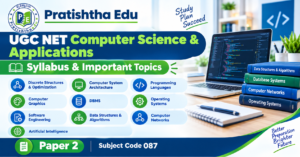
Major Areas Covered in Computer Science and Applications
The Computer Science and Applications syllabus covers several important areas of Computer Science. Candidates should understand the fundamental concepts of each unit before moving towards more difficult topics.
1. Discrete Structures and Optimization
This area includes mathematical and logical concepts that are important for Computer Science.
Candidates may need to study topics such as:
- Sets and relations
- Functions
- Mathematical logic
- Propositional and predicate logic
- Graph theory
- Trees
- Combinatorics
- Recurrence relations
- Boolean algebra
- Algebraic structures
- Optimization concepts
A strong understanding of discrete structures can also help candidates with algorithms, theory of computation and other technical areas.
2. Computer System Architecture
Computer architecture focuses on how computer systems are organised and how different components work together.
Important concepts include:
- Digital logic
- Number systems
- Boolean operations
- Computer organisation
- CPU organisation
- Memory hierarchy
- Input and output systems
- Instruction-level concepts
- Parallel processing
- Performance-related concepts
Candidates should focus on understanding how hardware components communicate and how instructions are processed within a computer system.
3. Programming Languages and Computer Graphics
Programming is an essential part of Computer Science preparation. Candidates should develop a clear understanding of programming concepts rather than relying only on memorisation.
Important areas may include:
- Programming paradigms
- Language concepts
- Object-oriented programming
- Functional programming concepts
- Logic programming
- Language translation
- Computer graphics fundamentals
- 2D and 3D transformations
- Viewing and rendering concepts
Students should practise programming-related questions regularly because conceptual clarity can improve accuracy in objective questions.
4. Database Management Systems
Database Management Systems is another important area of the Computer Science syllabus.
Candidates should understand:
- Database concepts
- Data models
- Relational databases
- Relational algebra
- SQL
- Normalisation
- Functional dependencies
- Transactions
- Concurrency control
- Database recovery
- Distributed databases
While studying DBMS, candidates should connect theoretical concepts with practical examples. Solving SQL and relational-algebra-based questions can also strengthen preparation.
5. System Software and Operating Systems
Operating Systems deals with the management of computer resources and provides an interface between users, applications and hardware.
Important topics include:
- Processes and threads
- CPU scheduling
- Process synchronisation
- Deadlocks
- Memory management
- Virtual memory
- File systems
- Input-output systems
- Protection and security
- System software concepts
Candidates should practise numerical and conceptual questions related to scheduling, memory management and deadlocks because these areas often require careful problem-solving.
6. Software Engineering
Software Engineering focuses on the systematic development, testing and maintenance of software.
Important concepts include:
- Software development life cycle
- Software process models
- Requirements engineering
- Software design
- Software testing
- Quality management
- Software maintenance
- Project management
- Risk management
- Software metrics
Candidates should understand the differences between major software development models and testing approaches.
7. Data Structures and Algorithms
Data Structures and Algorithms form a fundamental part of Computer Science.
Candidates should study topics such as:
- Arrays
- Linked lists
- Stacks
- Queues
- Trees
- Graphs
- Hashing
- Searching
- Sorting
- Algorithm analysis
- Complexity
- Recursion
- Algorithm design techniques
Students should not limit their preparation to definitions. They should practise tracing algorithms, analysing complexity and solving objective questions.
A strong foundation in UGC NET Computer Science Paper 2 topics such as data structures and algorithms can support preparation across several related areas.
8. Theory of Computation and Compiler Design
Theory of Computation focuses on mathematical models of computation and the limits of computational systems.
Important areas include:
- Finite automata
- Regular languages
- Regular expressions
- Context-free grammars
- Pushdown automata
- Turing machines
- Computability
- Decidability
- Complexity concepts
Compiler Design includes concepts related to the translation of source programs into executable forms.
Candidates should study:
- Lexical analysis
- Syntax analysis
- Semantic analysis
- Intermediate code generation
- Code optimisation
- Code generation
- Symbol tables
These topics require regular revision because many concepts are closely related.
9. Computer Networks
Computer Networks covers the principles used to connect computers and exchange information.
Important topics include:
- Network models
- OSI and TCP/IP models
- Physical layer concepts
- Data link layer
- Error detection and correction
- Medium access control
- Routing
- Transport protocols
- Congestion control
- Application-layer protocols
- Network security
Candidates should understand the functions of different layers and the differences between important protocols.
10. Artificial Intelligence and Related Areas
Artificial Intelligence introduces computational techniques used to solve problems that require reasoning, learning or decision-making.
Important areas include:
- Artificial Intelligence fundamentals
- Problem-solving techniques
- Knowledge representation
- Search techniques
- Machine learning concepts
- Neural networks
- Expert systems
- Natural language processing
- Pattern recognition
Candidates should focus on understanding the basic principles behind each technique and practise questions based on important definitions, algorithms and applications.
How to Prioritise the UGC NET Computer Science Syllabus
The entire syllabus should be covered systematically rather than studying only a few familiar units.
A practical approach is to divide topics into three groups:
Strong Areas
These are topics that the candidate already understands well. They can be revised quickly while focusing more time on question practice.
Moderate Areas
These topics require additional concept building and regular practice. Candidates can allocate fixed weekly study sessions to them.
Difficult Areas
Technically difficult topics should be identified early. Candidates can spend additional time understanding fundamentals, solving examples and revising repeatedly.
This method helps create a personalised UGC NET Computer Science preparation schedule instead of following the same timetable for every student.
How to Study Each Syllabus Unit
A simple unit-wise process can make preparation more organised:
Step 1: Read the syllabus topic carefully.
Step 2: Learn the basic concepts.
Step 3: Create short revision notes.
Step 4: Solve topic-wise questions.
Step 5: Attempt previous-year questions.
Step 6: Record mistakes and difficult concepts.
Step 7: Revise the complete unit after a fixed interval.
Step 8: Test your understanding through a mock test.
This process can be repeated for each major area of Computer Science.
Combine Paper 1 With Computer Science Preparation
Candidates should not postpone Paper 1 until the end of their preparation. A better approach is to allocate dedicated time to Paper 1 every week while continuing with Paper 2.
For example, a weekly schedule can include:
- Computer Science concept study
- Paper 1 aptitude practice
- Previous-year questions
- Revision
- Mock-test practice
- Error analysis
Maintaining this balance can prevent candidates from completing the technical syllabus while leaving insufficient time for Paper 1.
Use Previous-Year Questions With the Syllabus
Previous-year questions should be an important part of the preparation process.
After completing a unit, candidates can solve relevant questions and classify their mistakes into categories such as:
- Conceptual mistake
- Formula or definition mistake
- Calculation mistake
- Question-reading mistake
- Time-management issue
This analysis provides a clearer picture of preparation than simply counting the number of questions attempted.
Build a Revision Plan
Computer Science contains many
UGC NET Computer Science Preparation Strategy

Preparing for UGC NET Computer Science requires a structured approach because the subject includes multiple technical units along with the common Paper 1 syllabus. Candidates who study without a clear schedule may spend too much time on familiar topics and leave insufficient time for revision and practice.
A practical UGC NET Computer Science preparation strategy should combine concept building, previous-year questions, revision and mock tests. The goal should not be to complete the syllabus as quickly as possible, but to develop strong understanding and improve accuracy through consistent practice.
How to Start UGC NET Computer Science Preparation
The first step is to understand the complete syllabus and divide it into manageable study targets. Candidates should then identify their strong and weak areas before preparing a timetable.
A simple preparation cycle can be:
Understand → Study → Practise → Revise → Test → Analyse → Improve
This cycle can be repeated for every major subject.
Before starting a new unit, candidates should check the topics included in the syllabus. After studying the concepts, they should solve topic-wise questions and then move towards previous-year questions.
Create a Realistic Study Schedule
A timetable should be based on the candidate’s available time, academic background and examination timeline.
Instead of creating an unrealistic schedule with extremely long study hours, candidates should set daily targets that they can maintain consistently.
A study day can be divided into:
- Core Computer Science concepts
- Question practice
- Paper 1 preparation
- Revision
- Short breaks
- Error analysis
For example, a candidate with several hours available for preparation can divide the day between technical subjects and Paper 1 rather than spending the entire day on one topic.
Consistency is more important than creating a timetable that is difficult to follow.
How to Balance Paper 1 and Paper 2
Paper 2 is subject-specific, so Computer Science candidates naturally spend a significant amount of time studying technical topics. However, Paper 1 should also be included in the weekly preparation schedule.
A balanced approach can include:
Paper 2 Preparation
Focus on:
- Computer Science concepts
- Algorithms
- Programming
- DBMS
- Operating Systems
- Computer Networks
- Theory of Computation
- Compiler Design
- Software Engineering
- Computer Architecture
- Artificial Intelligence
Paper 1 Preparation
Focus on:
- Teaching aptitude
- Research aptitude
- Reading comprehension
- Communication
- Logical reasoning
- Data interpretation
- Information and Communication Technology
- People and environment
- Higher education-related topics
Candidates can dedicate specific days or daily time slots to Paper 1 depending on their preparation stage.
Subject-wise Preparation Strategy
Every Computer Science unit does not need to be studied in exactly the same way.
Data Structures and Algorithms
Start with fundamental data structures and then move towards algorithms and complexity analysis.
Practise:
- Searching
- Sorting
- Trees
- Graphs
- Stacks
- Queues
- Linked lists
- Hashing
- Recursion
- Complexity analysis
Candidates should solve questions by tracing algorithms rather than only memorising definitions.
Database Management Systems
For DBMS, focus on both conceptual and problem-solving areas.
Important preparation areas include:
- Relational algebra
- SQL
- Normalisation
- Functional dependencies
- Transactions
- Concurrency
- Recovery
- Database architecture
Regular SQL and relational-algebra practice can improve confidence in objective questions.
Operating Systems
Operating Systems requires conceptual clarity as well as numerical practice.
Candidates should focus on:
- Process management
- CPU scheduling
- Deadlocks
- Synchronisation
- Memory management
- Paging
- Virtual memory
- File systems
For numerical topics, candidates should solve multiple examples and analyse each mistake.
Computer Networks
Candidates should understand the role of different network layers and protocols.
Important areas include:
- OSI model
- TCP/IP model
- Routing
- Data link protocols
- Transport protocols
- Congestion control
- Network security
Comparing related protocols in a short revision table can make revision easier.
Theory of Computation
Theory of Computation requires regular problem-solving practice.
Candidates should practise:
- Finite automata
- Regular expressions
- Regular languages
- Context-free grammars
- Pushdown automata
- Turing machines
- Decidability
- Computability
Rather than reading these topics repeatedly, candidates should solve problems after understanding the underlying concepts.
Use Previous-Year Questions Strategically
Previous-year questions are an important part of UGC NET Computer Science preparation.
However, candidates should not simply solve questions and record their scores. They should analyse why an answer was correct or incorrect.
After completing a topic, follow this process:
Study the concept → Solve questions → Check answers → Identify mistakes → Revise the concept → Attempt similar questions again
Maintain an error notebook containing:
- Incorrect questions
- Correct concepts
- Frequently confused topics
- Important formulas
- Short explanations of mistakes
This notebook can become a valuable revision resource before the examination.
Importance of Mock Tests
Mock tests help candidates practise solving questions within a fixed time and identify areas that require additional preparation.
A good mock-test routine can include:
Initial Stage
Take topic-wise tests after completing individual units.
Intermediate Stage
Attempt mixed-subject tests after completing several units.
Final Stage
Take full-length mock tests under examination-like conditions.
After every test, analyse:
- Total score
- Accuracy
- Questions left unanswered
- Time spent
- Weak topics
- Repeated mistakes
Simply taking more tests does not guarantee improvement. The analysis after each test is equally important.
How to Improve Accuracy
Accuracy is particularly important in an objective examination. Candidates should avoid rushing through questions simply to increase the number attempted.
To improve accuracy:
- Read each question carefully.
- Identify keywords in the question.
- Eliminate clearly incorrect options.
- Avoid guessing when unsure.
- Review recurring mistakes.
- Practise timed questions.
- Revise frequently confused concepts.
Candidates should also distinguish between a knowledge problem and a time-management problem. The solution will be different for each.
Revision Strategy for Computer Science
Revision should begin from the early stages of preparation rather than waiting until the entire syllabus is complete.
A useful revision cycle can be:
First Revision: Within a few days of completing a topic
Second Revision: After completing the relevant unit
Third Revision: During mixed-topic practice
Final Revision: Before full-length mock tests and the examination
Short notes can include:
- Important definitions
- Algorithms
- Time complexities
- Protocol differences
- Operating-system concepts
- Database rules
- Automata concepts
- Important formulas
- Common mistakes
How to Handle Difficult Topics
Every candidate will have some topics that require more time than others.
Instead of repeatedly postponing difficult subjects, divide them into smaller concepts.
For example:
Difficult Topic → Basic Concept → Example → Practice Question → Previous-Year Question → Revision
Candidates can also discuss difficult concepts with faculty or use additional study resources when self-study is not sufficient.
Make a Weekly Preparation Review
At the end of every week, candidates should review their progress.
Ask:
- Which topics were completed?
- Which topics need revision?
- How many questions were solved?
- What mistakes were repeated?
- How did the mock test performance change?
- Which topic should receive more attention next week?
This weekly review makes the preparation process measurable and helps candidates adjust their timetable.
Preparation Should Be Consistent
A long preparation schedule can become difficult if students rely only on motivation. A consistent routine is more practical.
Even on days when candidates cannot study for many hours, completing a small target—such as revision, question practice or one topic—can help maintain continuity.
The objective should be to gradually improve:
Concept clarity + Question-solving ability + Accuracy + Revision + Time management
These five areas form the foundation of an organised Computer Science preparation strategy.
When Should You Join Coaching?
Candidates who need a fixed timetable, classroom guidance, subject-wise explanations, doubt support or regular testing may consider a structured UGC NET Computer Science course.
Before joining a programme, compare:
- Syllabus coverage
- Faculty support
- Class frequency
- Paper 1 and Paper 2 preparation
- Study material
- Previous-year question practice
- Mock tests
- Revision sessions
- Doubt-solving facilities
The right preparation format depends on the candidate’s learning style, academic foundation, and available study time.
UGC NET Computer Science Coaching and Classes in Bangalore
Candidates preparing for UGC NET Computer Science often look for a structured learning environment where they can study the syllabus systematically, clarify difficult concepts, and practise questions regularly. For students who prefer classroom learning, UGC NET Computer Science Classes in Bangalore can provide a fixed study routine along with subject-focused guidance.
However, choosing a coaching programme should not be based only on the location or course name. Candidates should understand what the programme actually provides and whether it supports their preparation requirements for both Paper 1 and Paper 2.
What Should You Look for in UGC NET Computer Science Coaching?
Before joining a coaching programme, candidates can consider several practical factors.
Complete Syllabus Coverage
Computer Science and Applications includes multiple technical areas. A structured programme should provide sufficient coverage of the syllabus instead of focusing only on a few popular topics.
Candidates should check whether the course includes important areas such as:
- Data Structures and Algorithms
- Operating Systems
- Database Management Systems
- Computer Networks
- Computer Architecture
- Programming
- Software Engineering
- Theory of Computation
- Compiler Design
- Artificial Intelligence
- Discrete Structures and Optimization
Complete coverage gives students a clear framework for progressing through the examination syllabus.
Experienced Subject Guidance
Computer Science includes many topics that can be difficult to understand through self-study alone. Faculty guidance can help students understand technical concepts, identify common mistakes and approach objective questions more effectively.
Candidates can ask about:
- Faculty background
- Subject expertise
- Teaching methodology
- Doubt-solving process
- Revision support
- Question-practice sessions
The goal should be to find a learning environment that matches the candidate’s academic needs.
Paper 1 and Paper 2 Preparation
A Computer Science coaching programme should not ignore Paper 1.
Students need to manage their preparation across both papers. While Paper 2 requires detailed subject knowledge, Paper 1 includes common aptitude and research-related areas.
A balanced programme can include:
Paper 1
- Teaching aptitude
- Research aptitude
- Reasoning
- Communication
- Comprehension
- Data interpretation
- ICT
- Higher education
- People and environment
Paper 2
- Core Computer Science concepts
- Algorithms and data structures
- Programming
- DBMS
- Operating Systems
- Networks
- Computer architecture
- Theory of Computation
- Compiler Design
- Software Engineering
- Artificial Intelligence
Candidates should check whether both components are incorporated into the preparation schedule.
Study Material and Revision Support
Good study material can make revision easier, especially when the syllabus contains a large number of technical concepts.
Students can look for material that includes:
- Unit-wise notes
- Important definitions
- Concept explanations
- Practice questions
- Previous-year questions
- Revision points
- Mock tests
Study material should support classroom learning rather than replace conceptual understanding.
Previous-Year Questions and Practice Tests
Regular question practice is an important part of preparation. Candidates should have opportunities to solve questions after completing individual topics.
A structured practice system may include:
Topic Test → Unit Test → Mixed Test → Full-Length Mock Test
This progression allows candidates to move from basic topic understanding to examination-level practice.
Previous-year questions can also help students understand how concepts are tested and identify areas that need more revision.
Doubt-Solving Support
Computer Science preparation can involve complex concepts where a small misunderstanding affects several related topics.
For example, a candidate who has difficulty understanding algorithm complexity may also face challenges while solving questions related to data structures and algorithm analysis.
Doubt-solving support can help students:
- Clarify difficult concepts
- Understand alternative approaches
- Correct conceptual mistakes
- Discuss difficult questions
- Strengthen weak areas
Candidates should check how doubt-solving is handled before joining a course.
Regular Revision and Mock Tests
A preparation programme should include revision rather than focusing only on completing new topics.
A useful cycle can be:
Learn → Practise → Revise → Test → Analyse
Mock tests can then be used to identify:
- Weak subjects
- Repeated mistakes
- Time-management issues
- Accuracy problems
- Topics requiring additional revision
This approach helps students understand their preparation progress more clearly.
Why Location Matters for Classroom Preparation
For students attending physical classes, location can influence the consistency of their preparation routine.
Candidates searching for a UGC NET Computer Science Institute in Bangalore may consider factors such as:
- Distance from home or college
- Daily travel time
- Class timings
- Classroom environment
- Study facilities
- Batch size
- Availability of doubt sessions
- Accessibility by public transport
A convenient location can make it easier to maintain regular attendance and follow a fixed study schedule.
UGC NET Computer Science Coaching at Pratishtha Edu
Pratishtha Edu provides academic and competitive examination coaching in Bangalore. Students interested in Computer Science preparation can explore a structured approach that combines subject learning, question practice and examination-oriented preparation.
The preparation approach can focus on developing a strong understanding of core Computer Science concepts while maintaining regular practice and revision.
Subject-focused Learning
Computer Science contains several interconnected subjects. A structured learning approach can help students progress through the syllabus systematically rather than studying unrelated topics randomly.
Paper 1 and Paper 2 Support
Candidates should prepare for both components of the examination. A balanced schedule can help students continue their Computer Science preparation while also giving regular attention to Paper 1.
Practice and Revision
Regular question practice and revision can help students identify areas that require additional attention.
Students can use practice sessions to review concepts, analyse mistakes and improve their approach to objective questions.
Doubt-solving and Guidance
Candidates may require additional explanation when dealing with difficult technical concepts. Guided doubt-solving can help students revisit challenging topics and understand them from a different perspective.
Who Can Consider Classroom Coaching?
Classroom coaching may be useful for candidates who:
- Prefer learning with a fixed timetable
- Need regular academic guidance
- Find it difficult to maintain self-study consistency
- Want structured syllabus coverage
- Prefer faculty-led explanations
- Need regular question practice
- Want scheduled revision and tests
Students who are comfortable with independent learning can also combine self-study with selected resources and mock tests.
How to Compare Different Coaching Options
Before enrolling, candidates can create a simple checklist.
| Factor | What to Check |
| Syllabus | Is the complete syllabus covered? |
| Faculty | Does the faculty have relevant subject expertise? |
| Classes | Are classes conducted according to a fixed schedule? |
| Paper 1 | Is Paper 1 included? |
| Paper 2 | Is Computer Science covered systematically? |
| Practice | Are topic-wise questions provided? |
| PYQs | Are previous-year questions discussed? |
| Tests | Are mock tests conducted regularly? |
| Revision | Are revision sessions included? |
| Doubts | Is doubt-solving available? |
| Study Material | Are useful notes and practice resources provided? |
| Location | Is the centre convenient for regular attendance? |
This comparison allows candidates to evaluate the course based on their own preparation requirements.
Build a Long-Term Preparation Routine
Joining a coaching programme is only one part of examination preparation. Candidates should also maintain a regular self-study routine outside classroom hours.
A productive routine can include:
Classroom Learning → Same-Day Revision → Question Practice → Weekly Revision → Mock Test → Error Analysis
Following this cycle consistently can help students convert classroom learning into exam-oriented preparation.
UGC NET Computer Science Study Plan for Paper 1 and Paper 2
A well-planned study schedule can make UGC NET preparation more manageable, especially when candidates need to prepare for both Paper 1 and Computer Science Paper 2. Instead of studying randomly, candidates should divide their available time between concept learning, question practice, revision and testing.
A practical UGC NET Computer Science study plan should also be flexible. Students with college, work or other responsibilities may need a different schedule from full-time aspirants.
The most important objective is to create a routine that can be followed consistently.
How to Divide Your Preparation Time
Candidates can divide their preparation into four major activities:
- Concept Learning
- Question Practice
- Revision
- Mock Tests and Analysis
During the initial stage, more time can be given to concept building. As the examination approaches, the focus can gradually move towards revision, previous-year questions and full-length tests.
A simple preparation progression is:
Concept Building → Topic Practice → Unit Revision → Mixed Questions → Mock Tests
Paper 1 Preparation Strategy
Paper 1 is common to candidates across different subjects. It tests areas related to teaching and research aptitude along with several general topics.
Candidates can prepare Paper 1 through regular short study sessions rather than postponing it until the end.
Teaching Aptitude
Focus on:
- Teaching methods
- Learning characteristics
- Evaluation systems
- Teaching effectiveness
- Learner characteristics
Research Aptitude
Important areas include:
- Research methods
- Research process
- Types of research
- Research ethics
- Referencing
- Data collection
- Basic research concepts
Reasoning and Comprehension
Candidates should practise questions involving:
- Logical reasoning
- Analytical reasoning
- Statements and conclusions
- Arguments
- Reading comprehension
- Interpretation of information
Data Interpretation
Regular practice can improve familiarity with:
- Tables
- Graphs
- Charts
- Percentages
- Ratios
- Data comparison
ICT and Higher Education
Candidates should revise important concepts related to:
- Information and Communication Technology
- Internet and digital learning
- Communication technologies
- Higher education systems
- Governance and related concepts
Paper 1 should be studied continuously so that candidates do not have to learn the entire syllabus during the final stage.
Paper 2: Computer Science Preparation Strategy
Paper 2 requires detailed preparation of Computer Science and Applications.
Candidates should divide the technical syllabus into individual units and assign realistic study targets.
For example:
Phase 1: Foundation
Start with fundamental concepts and familiar subjects.
Possible areas include:
- Programming
- Data Structures
- Discrete Mathematics
- Computer Architecture
Phase 2: Core Subjects
Move towards major technical units such as:
- Operating Systems
- DBMS
- Computer Networks
- Software Engineering
Phase 3: Advanced and Theory-based Areas
Then focus on areas such as:
- Theory of Computation
- Compiler Design
- Artificial Intelligence
- Advanced algorithmic concepts
The exact order can be adjusted according to the candidate’s academic background and comfort level.
A Practical Weekly Study Plan
Candidates can customise the following structure according to their available hours.
Monday
Paper 2: New Computer Science topic
Paper 1: Teaching aptitude
Practice: Topic-wise questions
Tuesday
Paper 2: Continue technical topic
Paper 1: Research aptitude
Practice: Previous-year questions
Wednesday
Paper 2: Second Computer Science topic
Paper 1: Reasoning
Revision: Monday and Tuesday topics
Thursday
Paper 2: Technical concept practice
Paper 1: Data interpretation or comprehension
Practice: Mixed questions
Friday
Paper 2: Difficult or weak topic
Paper 1: ICT or higher education
Revision: Weekly notes
Saturday
Computer Science: Mixed-topic practice
Paper 1: Mixed questions
Test: Topic or unit-level test
Sunday
Revision: Weekly revision
Test: Mock or mixed test
Analysis: Review mistakes and prepare the next week’s plan
This schedule is only a framework. Students should modify the number of study hours according to their individual circumstances.
Previous-Year Question Strategy
Previous-year questions should be used throughout the preparation period instead of being saved only for the final weeks.
A useful method is:
After Completing a Topic
Solve topic-specific questions.
After Completing a Unit
Attempt a mixed set from the complete unit.
After Completing Multiple Units
Solve questions combining different subjects.
During Final Preparation
Attempt full-length papers under timed conditions.
This gradual approach helps candidates move from concept learning to examination-level application.
Maintain a Question Error Log
Every incorrect question should not simply be marked as wrong and forgotten.
Create an error log with columns such as:
| Question | Topic | Reason for Mistake | Correct Concept | Revision Date |
| Question 1 | DBMS | Concept confusion | Normalisation rule | Next week |
| Question 2 | Networks | Protocol confusion | Layer function | Friday |
| Question 3 | Algorithms | Complexity error | Time complexity | Sunday |
This simple system can help identify recurring weaknesses.
Mock Test Strategy
Mock tests become increasingly important as preparation progresses.
Stage 1: Topic Tests
Take a short test after completing a topic.
Stage 2: Unit Tests
Once an entire unit is complete, attempt a broader test.
Stage 3: Mixed Tests
Combine questions from multiple Computer Science units.
Stage 4: Full-Length Tests
Attempt complete examination-style tests with appropriate time management.
After every test, record:
- Correct answers
- Incorrect answers
- Unattempted questions
- Time taken
- Weak topics
- Repeated mistakes
The purpose of a mock test is not only to obtain a score. It is also to understand what needs to be improved.
How to Improve Mock-Test Performance
If a candidate repeatedly makes mistakes in one subject, that topic should be added to the revision schedule.
For example:
Low accuracy in DBMS → Revise DBMS concepts → Solve topic questions → Attempt DBMS test → Analyse errors
Similarly:
Slow algorithm questions → Revise complexity → Practise tracing → Solve timed questions
This creates a feedback loop between testing and preparation.
Revision Strategy Before the Examination
During the final preparation period, candidates should avoid trying to learn every topic from the beginning again.
Instead, focus on:
- Short notes
- Difficult concepts
- Important formulas
- Algorithms
- Previous-year questions
- Mock-test mistakes
- Frequently confused topics
A final revision plan can be divided into multiple cycles.
First Revision
Review all completed units.
Second Revision
Focus on weak and frequently tested areas.
Third Revision
Use short notes and question practice.
Final Revision
Review important concepts without starting large new topics unless necessary.
Managing Difficult Computer Science Topics
Some subjects may require repeated revision.
Instead of spending an entire day on one difficult concept, divide it into smaller sections.
For example:
Operating Systems
Process → Scheduling → Synchronisation → Deadlocks → Memory Management → File Systems
Similarly:
Database Management Systems
Database Models → Relational Algebra → SQL → Functional Dependencies → Normalisation → Transactions
Breaking a large topic into smaller sections can make preparation more manageable.
Self-Study Along With Coaching
Even candidates attending UGC NET Computer Science classes should maintain a personal study schedule.
Classroom sessions can provide explanations and guidance, while self-study allows candidates to:
- Revise classroom concepts
- Complete practice questions
- Solve previous-year questions
- Prepare personal notes
- Identify doubts
- Take additional tests
A useful routine is to revise the day’s classroom topic on the same day whenever possible.
A Simple Daily Preparation Formula
Candidates who have limited study time can use a simple three-part routine:
Learn → Practise → Revise
For example:
Learn: 2 hours of a new Computer Science topic
Practise: 1 hour of questions
Revise: 30–45 minutes of previously studied material
The exact duration can be changed according to the candidate’s schedule.
Track Your Preparation Progress
A simple progress tracker can include:
| Area | Status |
| Syllabus coverage | Not Started / In Progress / Completed |
| Paper 1 | Not Started / In Progress / Completed |
| Previous-year questions | Pending / In Progress / Completed |
| Topic tests | Pending / In Progress / Completed |
| Full mock tests | Pending / In Progress / Completed |
| Revision | Pending / In Progress / Completed |
Updating this tracker every week can provide a clearer picture of preparation progress.
Stay Consistent Throughout Preparation
UGC NET Computer Science preparation is a long-term process. Candidates may have days when progress is slower than expected. Instead of abandoning the schedule, they can adjust the next week’s targets and continue.
The focus should remain on gradual improvement in:
- Conceptual understanding
- Question-solving accuracy
- Revision
- Time management
- Test performance
A consistent preparation routine can help candidates make better use of both classroom guidance and independent study.
Choosing UGC NET Computer Science Coaching in Bangalore
For candidates looking for classroom-based preparation, choosing the right learning environment is an important part of the preparation process. Bangalore has students from different academic and professional backgrounds, so candidates may have different requirements when selecting a Computer Science preparation programme.
Some students prefer classroom teaching because they benefit from direct explanations and regular interaction with faculty. Others may prefer a combination of classroom learning and self-study.
Before joining a UGC NET Computer Science coaching programme in Bangalore, candidates should consider the course structure, faculty support, study resources, class schedule, practice system and accessibility.
What Should Students Check Before Joining a Coaching Institute?
A coaching programme should support the complete preparation journey rather than focusing only on classroom lectures.
Complete Syllabus Coverage
The Computer Science and Applications syllabus contains several technical areas. Candidates should check whether the programme provides systematic coverage of the major units.
Important areas include:
- Discrete Structures and Optimization
- Computer System Architecture
- Programming Languages
- Computer Graphics
- Database Management Systems
- Operating Systems
- Software Engineering
- Data Structures and Algorithms
- Theory of Computation
- Compiler Design
- Computer Networks
- Artificial Intelligence
Students should also check whether sufficient time is provided for revision after completing the syllabus.
Faculty Guidance
Technical subjects can become easier to understand when concepts are explained systematically.
Students can check whether faculty support includes:
- Concept explanations
- Topic-wise examples
- Question-solving sessions
- Previous-year question discussions
- Doubt-solving
- Revision guidance
- Examination-oriented practice
Faculty interaction can be particularly useful for topics where students repeatedly make conceptual mistakes.
Regular Practice
Completing classroom lessons is only one part of preparation. Students should have opportunities to practise questions regularly.
A structured practice system can include:
Topic Questions → Unit Tests → Previous-Year Questions → Mixed Tests → Full-Length Mock Tests
This progression allows students to apply what they have learned and identify areas requiring additional preparation.
Importance of Paper 1 Support
Students joining Computer Science preparation should also pay attention to Paper 1.
Although Paper 1 is common across UGC NET subjects, it requires its own preparation strategy. A course that includes regular Paper 1 practice can help students maintain balance between general aptitude and subject-specific preparation.
Important Paper 1 areas include:
- Teaching aptitude
- Research aptitude
- Reasoning
- Communication
- Comprehension
- Data interpretation
- ICT
- People and environment
- Higher education
Candidates should avoid postponing Paper 1 preparation until the final stage.
Study Material for Computer Science Preparation
Study material can help candidates organise large amounts of technical information.
Useful resources may include:
- Unit-wise notes
- Topic summaries
- Practice questions
- Previous-year questions
- Revision material
- Mock tests
- Error-analysis notes
Students should use study material as a supplement to conceptual learning and question practice.
Short notes can be particularly useful during revision because candidates can quickly review important concepts without reading the complete material again.
Doubt-Solving Support
Computer Science includes several interconnected concepts. A misunderstanding in one area can sometimes affect preparation for related topics.
For example, understanding data structures can support algorithm preparation, while knowledge of operating-system concepts can help with questions involving processes, memory and scheduling.
A useful doubt-solving system allows students to discuss:
- Difficult concepts
- Incorrect answers
- Technical terminology
- Numerical problems
- Previous-year questions
- Mock-test mistakes
Candidates should check how doubts are handled before selecting a coaching programme.
Revision and Test Support
A structured course should ideally provide opportunities to revise topics after their initial completion.
A simple revision cycle can be:
Learn → Practise → Revise → Test → Analyse
Students can use test results to identify areas where additional revision is needed.
For example:
If DBMS accuracy is low, revise database concepts and practise more questions.
If Computer Networks questions take too much time, focus on protocol comparison and timed practice.
If Paper 1 reasoning accuracy is low, include additional reasoning practice in the weekly schedule.
This creates a preparation routine based on actual performance rather than assumptions.
Pratishtha Edu for UGC NET Computer Science Preparation
Pratishtha Edu is an academic and competitive examination coaching institute in Bangalore. Candidates exploring UGC NET Computer Science Classes in Bangalore can consider a structured classroom approach that combines concept learning, practice and revision.
The preparation process can be organised around the requirements of the examination, with attention to both subject knowledge and regular question practice.
Classroom Learning
Classroom sessions can help candidates follow a fixed learning schedule and study different Computer Science units systematically.
A planned sequence can make it easier to move from fundamental concepts to more advanced topics.
Subject-focused Preparation
Computer Science contains a broad range of technical subjects. A structured course can help candidates study each area according to the syllabus rather than moving between unrelated topics.
The preparation can include areas such as:
- Programming
- Data Structures and Algorithms
- DBMS
- Operating Systems
- Computer Networks
- Software Engineering
- Theory of Computation
- Compiler Design
- Computer Architecture
- Artificial Intelligence
Paper 1 and Paper 2 Preparation
Candidates should maintain preparation for both papers throughout the course.
Computer Science preparation can focus on technical concepts and Paper 2 practice, while regular Paper 1 sessions can cover teaching and research aptitude, reasoning, ICT and other relevant areas.
Question Practice
Regular question-solving can help students understand how theoretical concepts are applied in objective questions.
Practice can include:
- Topic-wise questions
- Previous-year questions
- Unit tests
- Mixed question sets
- Mock examinations
Revision Support
Revision sessions can help candidates revisit difficult concepts and strengthen areas where test performance remains low.
Students can also maintain their own revision notes to review important concepts between classes.
Learning Environment and Study Routine
A suitable learning environment can make it easier for students to follow a consistent preparation routine.
Candidates can consider factors such as:
- Classroom environment
- Class timings
- Accessibility
- Batch schedule
- Faculty interaction
- Study resources
- Test schedule
- Doubt-solving availability
For students attending physical classes, travel time is also worth considering. A convenient location can make regular attendance easier.
Why a Structured Routine Can Help
Many candidates begin preparation with a large amount of study material but struggle to maintain a consistent routine.
A structured programme can provide a sequence such as:
Syllabus → Classes → Practice → Revision → Tests → Analysis
Students can then supplement this routine with individual study.
The objective is not simply to attend classes but to continuously convert classroom learning into question-solving ability.
Self-Study After Classroom Sessions
Candidates should continue self-study even after attending coaching classes.
A simple same-day routine can include:
Step 1: Review the Class
Spend some time reviewing the concepts covered during the session.
Step 2: Complete Practice Questions
Solve questions related to the day’s topic.
Step 3: Record Difficult Areas
Write down concepts or questions that require clarification.
Step 4: Revise Earlier Topics
Spend a short amount of time reviewing previously completed units.
Step 5: Update Your Progress
Mark completed topics and identify the next preparation target.
This routine can help maintain continuity between classroom learning and independent preparation
Frequently Asked Questions About UGC Computer Science Coaching in Bangalore
1. What is UGC NET Computer Science?
UGC NET Computer Science and Applications is a UGC NET subject for candidates who want to qualify for opportunities such as Junior Research Fellowship (JRF) and Assistant Professor eligibility, subject to the applicable eligibility and recruitment rules. The examination includes Paper 1 and Paper 2, with Paper 2 focusing specifically on Computer Science and Applications.
A structured preparation plan can help candidates cover the syllabus, practise previous-year questions, revise important concepts, and improve performance through mock tests.
2. What is the subject code for UGC NET Computer Science and Applications?
The UGC NET subject Computer Science and Applications is listed under subject code 087. Candidates should always refer to the latest official NTA UGC NET information and syllabus before beginning or finalising their preparation strategy.
3. How should I prepare for UGC NET Computer Science Paper 2?
Paper 2 requires a systematic approach because the syllabus covers multiple areas of Computer Science and Applications. Candidates can begin by understanding the complete syllabus and then divide the subjects into manageable study units.
A practical preparation approach includes:
- Understanding concepts before memorising them
- Creating unit-wise study notes
- Solving previous-year questions
- Practising topic-wise questions
- Revising difficult concepts regularly
- Taking mock tests
- Maintaining an error log
- Revising important formulas, definitions and algorithms
- Tracking progress every week
Candidates should also avoid leaving Paper 1 until the final stage. Regular Paper 1 preparation alongside Paper 2 can make the overall study schedule more balanced.
4. Is coaching useful for UGC NET Computer Science preparation?
Coaching can provide a structured learning environment, regular classes, subject guidance, study material, and opportunities for question practice. It can be particularly useful for candidates who find it difficult to maintain a consistent self-study schedule.
However, coaching works best when it is combined with individual revision, previous-year question practice, mock tests and regular self-study.
When comparing UGC NET Computer Science Coaching in Bangalore, candidates should check the teaching approach, syllabus coverage, faculty support, study material, doubt-solving system, test practice, and revision support before enrolling.
5. What topics are included in the UGC NET Computer Science syllabus?
The Computer Science and Applications syllabus covers several major areas, including:
- Discrete Structures and Optimization
- Computer System Architecture
- Programming Languages and Computer Graphics
- Database Management Systems
- System Software and Operating Systems
- Software Engineering
- Data Structures and Algorithms
- Theory of Computation and Compiler Design
- Computer Networks
- Artificial Intelligence and related topics
Candidates should study the complete syllabus instead of preparing only the topics they find easier. Previous-year questions can also help identify frequently tested concepts and areas requiring additional practice.
6. How can I choose UGC NET Computer Science classes in Bangalore?
Before joining any coaching institute, candidates should evaluate whether the programme matches their preparation requirements.
Important factors include:
- Complete syllabus coverage
- Experienced subject faculty
- Paper 1 and Paper 2 support
- Concept-focused teaching
- Previous-year question practice
- Mock tests and assessments
- Doubt-solving support
- Revision sessions
- Study material
- Convenient class schedule
- Suitable learning environment
Candidates should also understand the course structure and available support before making an enrolment decision.
7. Can I prepare for Paper 1 and Paper 2 together?
Yes. Preparing for both papers simultaneously can help candidates maintain continuity and avoid last-minute pressure.
A simple weekly approach is to divide study time between:
Paper 1: Teaching aptitude, research aptitude, reasoning, communication, ICT, data interpretation, higher education, and other relevant areas.
Paper 2: Computer Science concepts, unit-wise practice, previous-year questions, problem-solving and revision.
The exact time division can be adjusted according to the candidate’s strengths, weaknesses, and preparation stage.
8. Where can I find UGC Computer Science coaching in Bangalore?
Candidates looking for classroom-based preparation can explore coaching options in Bangalore and compare factors such as faculty, course structure, syllabus coverage, practice tests, study material, and doubt-solving support.
Pratishtha Edu provides preparation support for UGC NET aspirants, including subject-focused learning, Paper 1 and Paper 2 preparation, question practice, revision, and guidance.
For candidates who prefer a structured classroom environment, the course is one of the available options for UGC NET Computer Science preparation in Bangalore.
Start Your UGC NET Computer Science Preparation with a Structured Plan

Preparing for UGC NET Computer Science requires more than simply completing the syllabus. Candidates need to build strong concepts, practise questions regularly, revise important topics, and evaluate their preparation through tests.
A well-planned preparation routine can include:
- Understanding the complete syllabus
- Creating a realistic study schedule
- Covering Paper 2 unit by unit
- Preparing Paper 1 alongside Paper 2
- Solving previous-year questions
- Taking regular mock tests
- Maintaining an error log
- Revising difficult topics
- Tracking weekly progress
- Improving accuracy and time management
For candidates searching for UGC NET Computer Science Coaching in Bangalore, Pratishtha Edu offers a classroom-based learning environment with subject-focused preparation and guidance.
Contact Pratishtha Edu
Pratishtha Edu
945, 23rd Main Rd, opposite the road of LIC Head Office, R.K Colony, Marenahalli, 2nd Phase, J. P. Nagar, Bengaluru, Karnataka 560078
Phone: 7676047382
Email: info@pratishthaedu.com
Website: www.pratishthaedu.com
Start your preparation with a clear study plan, consistent practice, and regular revision. The right preparation routine can help you approach the UGC NET examination with greater clarity and confidence.
::
Leave a Reply