
Preparing for the UGC-NET examination in Electronics and Communication requires more than simply completing the syllabus. Candidates need a combination of strong subject concepts, regular question practice, revision, mock tests, and a well-planned study routine.
For students searching for UGC Electronics & Communication Coaching in Bangalore, finding the right preparation approach can make the study process more organised. However, coaching is only one part of preparation. Consistent self-study, previous-year question practice, and regular revision are equally important.
This guide explains how to prepare for UGC-NET Electronic Science, understand the examination pattern, create an effective study plan, and evaluate coaching options in Bangalore.
What Is UGC-NET Electronic Science?
UGC-NET is a national-level eligibility examination conducted by the National Testing Agency (NTA) on behalf of the University Grants Commission (UGC).
The official NTA subject list identifies Electronic Science as subject code 088. Candidates from relevant electronics, communication, and allied academic backgrounds can refer to the latest official notification and syllabus to understand the applicable subject requirements.
The examination includes two papers:
- Paper I: Teaching and Research Aptitude
- Paper II: Subject-specific knowledge
Paper I evaluates general teaching and research aptitude, while Paper II focuses on the candidate’s selected subject.
For Electronic Science candidates, Paper II preparation requires consistent study because technical concepts need to be understood, practised and revised rather than memorised once.
Why Is UGC-NET Preparation Important?
UGC-NET preparation can become challenging when candidates try to study without a structured plan. The syllabus includes multiple areas, and students need to manage both general aptitude and subject-specific preparation.
A planned preparation strategy can help candidates:
- Understand the syllabus systematically
- Divide large topics into smaller sections
- Strengthen technical concepts
- Practise objective questions
- Identify weak areas
- Revise important topics regularly
- Improve time management
- Become familiar with mock tests
Instead of waiting until the final weeks, candidates can begin preparation early and gradually increase their question-solving and testing practice.
Start With the Official Syllabus
The first step should be understanding the latest syllabus and examination instructions.
Candidates should avoid relying only on old study material because examination information and instructions can change between different cycles.
Create a simple checklist containing all the relevant units and topics. Then divide them into:
Not Started → Learning → Practised → Revised
This makes it easier to monitor preparation progress.
Build Strong Subject Fundamentals
Electronics and communication-related subjects require conceptual clarity. Candidates should understand the principle behind a topic instead of relying completely on memorisation.
While preparing each topic, create short notes covering:
- Important definitions
- Fundamental concepts
- Key formulas
- Technical terms
- Important differences
- Applications
- Frequently practised question types
These notes can become useful during the final revision period.
Practise Questions Alongside Learning
Question practice should not be postponed until the entire syllabus is completed.
After finishing a topic, solve relevant questions and analyse the mistakes.
Ask yourself:
- Did I understand the concept?
- Can I apply it to an objective question?
- Did I make a calculation mistake?
- Did I misunderstand the question?
- Which part needs another revision?
This approach turns question practice into another form of learning.
Why Choose a Structured Preparation Approach?
Students preparing independently may sometimes find it difficult to maintain a fixed routine. A structured academic programme can provide a planned sequence for learning, practice, and revision.
When comparing UGC NET Electronics coaching in Bangalore, candidates can look at several factors instead of choosing a programme based only on promotional claims.
Important factors include:
- Faculty expertise
- Syllabus coverage
- Class structure
- Study material
- Doubt-solving support
- Question practice
- Previous-year question discussion
- Mock tests
- Revision sessions
The objective should be to find a preparation system that matches the student’s academic background and study requirements.
Preparing for Paper I Along With Paper II
A common preparation mistake is focusing entirely on the subject paper and leaving Paper I until the end.
Paper I should also be included in the weekly schedule.
Candidates can divide their study time between:
Paper II concepts + Paper II question practice + Paper I preparation + Revision
For example, a candidate may spend the main study session on subject preparation and reserve a shorter daily session for Paper I.
This approach keeps both papers active throughout the preparation period.
Build a Consistent Study Routine
There is no single number of study hours that works for every candidate.
A student who is studying full-time may have more available hours than someone balancing preparation with college or work.
Instead of focusing only on the number of hours, candidates should focus on productive study blocks.
A simple routine could include:
| Study Activity | Suggested Time |
| Subject concept study | 2–3 hours |
| Paper I preparation | 45–60 minutes |
| Question practice | 1–2 hours |
| Revision | 30 minutes |
| Mistake analysis | 30 minutes |
The schedule can be adjusted according to individual preparation levels.
The most important factor is consistency.
What Makes an Effective Preparation Strategy?
A practical UGC-NET preparation strategy should follow a continuous cycle:
Learn → Practise → Revise → Test → Analyse → Improve
First, understand the topic.
Then practise questions based on it.
After completing a group of topics, revise them.
Next, take a test to evaluate your understanding.
Finally, analyse mistakes and use the results to improve the next stage of preparation.
This cycle can be repeated throughout the preparation period.
Beginning Your Preparation in Bangalore
Candidates preparing in Bangalore have access to different learning options, including self-study, classroom coaching, and blended preparation methods.
The right option depends on factors such as:
- Academic background
- Available preparation time
- Preferred learning method
- Need for faculty guidance
- Access to study material
- Requirement for regular testing
Students who prefer structured academic support can compare coaching programmes based on their actual course structure rather than selecting one only because of advertisements or rankings.
For candidates exploring UGC-NET Electronic Science preparation in Bangalore, the first step should be to understand the syllabus, create a realistic timetable, and identify the areas where additional guidance is required.
Students who prefer structured guidance can explore UGC-NET coaching in Bangalore for regular classes, doubt support, and a planned preparation routine.
A Simple Starting Checklist
Before beginning serious preparation, make sure you have:
- The latest official syllabus
- A realistic weekly timetable
- Reliable study material
- A separate Paper I plan
- A subject-wise preparation tracker
- A previous-year question resource
- A mistake notebook
- A revision schedule
Starting with these basics can make the later stages of preparation much easier.
UGC-NET Exam Pattern: Paper I and Paper II
Understanding the examination pattern is one of the first steps in building an effective preparation strategy. Before starting detailed subject preparation, candidates should understand how the two papers are structured and how their preparation needs to be divided.
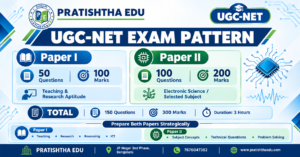
According to the NTA examination scheme, UGC-NET consists of two papers conducted in a single three-hour session. Paper I contains 50 questions carrying 100 marks, while Paper II contains 100 questions carrying 200 marks. The total is 150 questions for 300 marks. There is no break between the two papers. Candidates should always refer to the latest official NTA notification for the examination cycle they are appearing in.
| Paper | Questions | Marks | Main Area |
| Paper I | 50 | 100 | Teaching & Research Aptitude |
| Paper II | 100 | 200 | Selected Subject |
| Total | 150 | 300 | Both Papers |
The two papers require different preparation approaches. Paper I is broader and focuses on general aptitude, while Paper II requires deeper preparation in the selected subject.
Paper I: Teaching and Research Aptitude
Paper I is common to candidates across subjects. It tests areas connected with teaching aptitude, research aptitude, reasoning, communication and other general academic abilities.
Important areas include:
- Teaching aptitude
- Research aptitude
- Reading comprehension
- Communication
- Mathematical reasoning
- Logical reasoning
- Data interpretation
- Information and Communication Technology
- People and environment
- Higher education system
Candidates should avoid treating Paper I as a subject that can be completed only during the final weeks.
Regular short practice sessions can be more manageable than trying to cover the entire paper at the end.
How to Prepare for Paper I
Start by understanding the major units and identifying the areas where you are already comfortable.
Then divide the topics into three categories:
Strong: Topics that can be solved confidently.
Average: Topics where additional practice is required.
Weak: Topics that require conceptual study before question practice.
This classification can be updated every few weeks as your preparation improves.
A useful Paper I routine can include:
- One concept/topic each day
- 20–30 practice questions
- Weekly revision
- Regular previous-year question practice
- Short topic tests
The objective is to gradually improve both accuracy and speed.
Paper II: Electronic Science Preparation
Paper II carries a larger number of questions and focuses on the candidate’s selected subject. For candidates preparing in the electronics and communication domain, subject preparation should be systematic and concept-oriented.
The official UGC-NET resources should be used to verify the current syllabus before beginning preparation.
Instead of studying the syllabus as one large block, divide it into individual topics and create a preparation tracker.
Create a Subject-Wise Preparation Tracker
A simple tracker can look like this:
| Topic | Concept Study | Questions | Revision | Test |
| Topic 1 | ✓ | ✓ | ✓ | ✓ |
| Topic 2 | ✓ | ✓ | — | — |
| Topic 3 | ✓ | — | — | — |
| Topic 4 | ✓ | ✓ | ✓ | — |
This gives you a clear picture of your preparation instead of relying on memory.
Concept Learning Before Question Practice
One of the most important principles for technical preparation is to understand the concept before attempting a large number of questions.
For each topic, follow:
Understand → Note → Practise → Revise
For example, after studying a technical concept, write down the important principle or formula in your own words. Then solve questions based on it.
If you make repeated mistakes, return to the concept instead of simply memorising the correct answer.
How to Divide the Syllabus
A large syllabus can become overwhelming if candidates look at it as a single task.
Divide it into:
Unit-Level Targets
Set a realistic target for each week.
Topic-Level Targets
Break each unit into smaller topics.
Daily Targets
Choose two or three specific tasks instead of writing a long list of things to study.
For example:
Today’s target:
- Complete one technical topic
- Solve 25 related questions
- Revise yesterday’s topic
- Complete one Paper I practice set
This approach makes progress easier to measure.
Strong, Moderate, and Weak Topics
Not every topic requires the same amount of preparation time.
After your initial study cycle, classify topics as:
Strong Topics
You understand the concept and can solve questions accurately.
Action: Maintain them through periodic revision.
Moderate Topics
You understand the basics but make occasional mistakes.
Action: Increase question practice and revision.
Weak Topics
You struggle to understand the concept or consistently answer questions incorrectly.
Action: Re-study the fundamentals and seek additional explanation if required.
This classification prevents candidates from spending excessive time on topics they have already mastered.
Balancing Subject Preparation and Paper I
A balanced timetable can prevent one paper from being neglected.
For example:
| Day | Main Focus | Secondary Focus |
| Monday | Paper II | Paper I |
| Tuesday | Paper II | Revision |
| Wednesday | Paper II | Paper I |
| Thursday | Paper II | Questions |
| Friday | Revision | Paper I |
| Saturday | Mock/Topic Test | Error Analysis |
| Sunday | Weekly Revision | Weak Topics |
This is only a sample framework. Candidates should adjust it according to their available time and preparation level.
Use Previous-Year Questions Strategically
Previous-year questions should not be treated merely as a final-stage activity.
They can be introduced after completing individual topics.
For every question, try to identify:
- The concept being tested
- The correct method
- Why the other options are incorrect
- Whether the question exposed a knowledge gap
- Whether the mistake was conceptual or careless
Maintain a separate record of difficult questions.
During revision, revisit these questions instead of solving the same easy questions repeatedly.
Create a Revision System
Revision should happen throughout the preparation process.
A useful system is:
Daily Revision: 15–30 minutes
Weekly Revision: Review the week’s topics
Monthly Revision: Revisit completed units
Final Revision: Focus on short notes, formulas, mistakes and frequently tested concepts
This prevents older topics from being forgotten while new material is being studied.
Why Mock Tests Matter
Mock tests help candidates move from learning mode to examination mode.
However, simply taking a large number of tests is not enough.
After each test, analyse:
Accuracy
How many attempted questions were correct?
Time Management
Which sections consumed too much time?
Conceptual Gaps
Which topics caused repeated mistakes?
Guessing
How many answers were selected without sufficient confidence?
Unattempted Questions
Were they left because of lack of knowledge or lack of time?
This analysis should guide the next stage of preparation.
Avoid Changing Study Resources Frequently
Another common problem is continuously changing books, notes, teachers, and online resources.
Candidates may start with one resource, encounter a difficult topic, and immediately switch to another source.
This can create unnecessary repetition.
A better approach is to select a limited number of reliable resources and complete them systematically.
Additional resources should be used only when a particular concept needs further clarification.
Building a Long-Term Preparation Routine
A strong preparation routine should not depend on motivation every day.
Instead, create fixed study blocks.
For example:
Morning: Technical concept
Afternoon: Question practice
Evening: Paper I
Night: Revision
Students with different schedules can rearrange these sessions.
The important thing is to maintain regular contact with the syllabus.
Key Takeaways From Part 2
Before moving to the next stage, candidates should understand these points:
- UGC-NET has two papers.
- Paper I focuses on teaching and research aptitude.
- Paper II focuses on the selected subject.
- Include both papers in your preparation plan.
- Divide the syllabus into manageable units.
- Previous-year questions should be practised regularly.
- Mock tests should always be followed by analysis.
- Weak topics need targeted revision.
- A consistent routine is more useful than an unrealistic timetable.
A systematic approach can make technical preparation easier to manage and can help candidates identify where their preparation needs improvement.
How to Prepare Electronic Science Topics Effectively
How to Prepare for Electronic Science in UGC-NET
Preparing for Electronic Science requires more than simply reading the syllabus and memorising formulas. The subject includes conceptual topics, numerical problems, circuits, communication systems, digital concepts, and other technical areas that need regular practice.
A structured UGC NET Electronics preparation strategy should therefore combine conceptual learning, problem-solving, revision and previous-year question practice. Instead of trying to complete every topic at the same speed, candidates should identify important areas, understand their fundamentals, and gradually improve their accuracy.
The following approach can make subject preparation more organised and manageable.
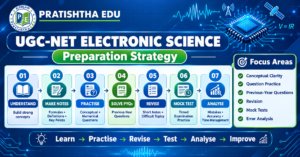
1. Start With Conceptual Understanding
Technical subjects become easier when the underlying concepts are clear. Before solving advanced questions, understand the basic principles behind each topic.
For example, while studying electronic circuits, do not focus only on remembering equations. Understand:
- What the circuit is designed to do
- How different components interact
- Why a particular formula is used
- What happens when circuit parameters change
- How the concept can appear in a numerical or conceptual question
This approach helps candidates handle questions that are presented in unfamiliar formats.
Build Your Fundamentals First
Divide the syllabus into manageable sections and study one concept at a time. After completing a concept, solve a small set of questions before moving to the next topic.
A useful sequence is:
Concept → Formula/Principle → Example → Practice Questions → Previous-Year Questions → Revision
This creates a connection between theoretical knowledge and examination practice.
2. Prioritise Topics Instead of Studying Randomly
One of the common problems during UGC NET Electronic Science preparation is studying topics randomly. A better approach is to create a topic tracker based on the official syllabus.
You can divide topics into three categories:
| Category | Preparation Approach |
| Strong | Revise regularly and practise advanced questions |
| Moderate | Spend additional time on concepts and practice |
| Weak | Relearn fundamentals and solve questions step by step |
This simple classification makes it easier to decide where your study time should go.
You should also update the tracker after completing each chapter. Mark topics as completed only when you have understood the concept and attempted relevant questions.
3. Make Short Revision Notes
Long study material can become difficult to revise during the final stages of preparation. Creating concise notes while studying can save considerable time later.
Your notes can include:
- Important formulas
- Definitions
- Key concepts
- Circuit-related points
- Important differences between concepts
- Frequently used equations
- Common mistakes
- Short tricks for calculations
- Questions that you found difficult
Do not try to copy your entire textbook into your notebook. The purpose of revision notes is to create a quick reference that can be reviewed repeatedly.
Use Diagrams Where They Help
For technical topics, diagrams can make revision faster. Circuit diagrams, block diagrams, signal representations and other visual explanations can help you recall relationships between different concepts.
Keep diagrams simple and label the important components clearly.
4. Practise Questions After Every Topic
Reading alone does not show whether you can actually apply a concept. Question practice should therefore be included immediately after learning a topic.
For each completed topic:
- Revise the concept.
- Review important formulas.
- Solve basic questions.
- Attempt moderate-level questions.
- Practise previous-year questions.
- Note the questions you answered incorrectly.
- Revisit the concept behind those mistakes.
This method gradually improves both accuracy and confidence.
5. Use Previous-Year Questions as a Learning Tool
Previous-year questions are useful not only for test preparation but also for understanding how concepts can be examined.
While solving them, pay attention to:
- Frequently tested concepts
- Question difficulty
- Numerical calculation requirements
- Conceptual variations
- Repeated themes
- Topics where mistakes occur frequently
Maintain a separate UGC NET Paper 2 Electronics preparation notebook for difficult or incorrectly answered questions. Revisiting these questions during revision can help identify recurring weaknesses.
6. Avoid Studying Too Many Resources
Having multiple books, PDFs, videos, and online sources may seem useful, but switching between resources constantly can make preparation less organised.
Choose reliable study material that covers the syllabus and use it consistently.
A practical resource structure can be:
One primary study source + class notes + previous-year questions + mock tests
Additional resources can be used when a particular concept needs further explanation.
7. Follow a Revision Cycle
Revision should not be postponed until the entire syllabus is completed.
A simple cycle can be:
First Revision: Within a few days of completing the topic
Second Revision: After completing the related unit
Third Revision: During full-syllabus revision
Final Revision: Before the examination
During later revisions, spend more time on weak areas and previously incorrect questions rather than rereading everything from the beginning.
Key Takeaways
An effective preparation method for Electronic Science should focus on conceptual clarity, syllabus tracking, question practice, previous-year questions, and repeated revision.
Instead of measuring preparation only by the number of chapters completed, measure it by how confidently you can explain a concept and solve questions based on it.
Quick Preparation Checklist
- Understand the concept before memorising formulas
- Follow the official syllabus
- Maintain strong, moderate, and weak topic lists
- Prepare short revision notes
- Practise questions after every topic
- Analyse previous-year questions
- Maintain an error notebook
- Revise regularly
- Avoid constantly changing study resources
- Take mock tests after completing sufficient portions of the syllabus
A consistent system makes UGC NET Electronics study preparation easier to track and helps candidates identify where improvement is actually required.
Paper I Strategy, Time Management and Study Plan
How to Balance Paper I and Paper II Preparation
Preparing for UGC-NET requires attention to both papers. Paper II is subject-specific and focuses on Electronic Science, while Paper I tests areas such as teaching aptitude, research aptitude, reasoning, communication, data interpretation, and ICT.
A common mistake is to spend almost all study time on the technical subject and leave Paper I for the final weeks. A better approach is to prepare both papers consistently from the beginning.
A practical study structure can be:
| Preparation Area | Suggested Focus |
| Paper I | Regular concept learning + question practice |
| Paper II | Core concepts + numerical/problem-solving practice |
| Previous-Year Questions | Both papers |
| Revision | Weekly + monthly |
| Mock Tests | Gradually increase frequency |
The exact time allocation can be adjusted according to your strengths, available study hours, and preparation stage.
Paper I Preparation Strategy
Paper I can be approached as a scoring-oriented practice area, but candidates should not rely only on memorisation.
Start by understanding the major units and then practise questions regularly.
Important Paper I Areas
- Teaching Aptitude
- Research Aptitude
- Reading Comprehension
- Communication
- Mathematical Reasoning
- Logical Reasoning
- Data Interpretation
- Information and Communication Technology
- People, Development and Environment
- Higher Education System
Instead of attempting all units simultaneously, complete one area and then move to the next while continuing short revision sessions.
How to Study Paper I
For each unit:
Learn the concept → Make short notes → Solve questions → Analyse mistakes → Revise
For reasoning and mathematical topics, regular practice is particularly useful because familiarity with question patterns can improve speed.
For theoretical units, concise notes and repeated revision can make recall easier.
How to Manage Paper II Electronic Science Preparation
Paper II requires deeper subject preparation because questions are directly connected to the selected subject.
Your study plan should include three components:
1. Concept Building
Understand the fundamentals of each unit before moving to advanced problems.
2. Problem Solving
Solve questions that require application of formulas, principles, and concepts.
3. Revision
Revisit completed topics instead of continuously moving forward without reviewing previous material.
This creates a cycle where new learning and revision happen together.
Create a Daily Study Routine
A daily timetable does not need to be extremely complicated. The important factor is consistency.
For example, a candidate studying for several hours a day could divide the session into:
Session 1 — Paper II Concepts
Study a new Electronic Science topic and prepare short notes.
Session 2 — Paper II Practice
Solve numerical, conceptual, and previous-year questions related to the topic.
Session 3 — Paper I
Study one Paper I concept and practise related questions.
Session 4 — Revision
Revise formulas, notes, and questions attempted earlier.
The duration of each session can be changed according to your personal schedule.
Weekly Study Plan
A weekly plan can provide more flexibility than a rigid daily timetable.
| Day | Main Focus |
| Monday | Paper II concept + Paper I |
| Tuesday | Paper II problem-solving + revision |
| Wednesday | New Paper II topic + Paper I practice |
| Thursday | Previous-year questions + weak topics |
| Friday | Paper II concept revision + Paper I |
| Saturday | Mixed question practice |
| Sunday | Weekly revision + mock/sectional test |
This structure can be modified according to the syllabus and the amount of time remaining before the examination.
Use a Weekly Performance Review
At the end of every week, spend a few minutes reviewing your preparation.
Ask yourself:
- Which topics did I complete?
- Which concepts are still unclear?
- How many qu
Previous-Year Questions, Mock Tests and Revision Strategy
Why Previous-Year Questions Matter in UGC-NET Preparation
Previous-year questions are an important part of preparation because they allow candidates to practise concepts in an examination-oriented format.
For UGC NET Electronic Science preparation, solving questions from earlier examinations can help you understand how theoretical concepts, numerical problems, and application-based questions may be presented.
However, previous-year questions should not be treated simply as a question bank. They should be used as a learning and analysis tool.
How to Use Previous-Year Questions Effectively
Do not wait until the entire syllabus is completed before solving PYQs.
A better approach is to practise them alongside topic preparation.
For example:
Complete a topic → Revise it → Solve topic-wise questions → Analyse mistakes → Revisit weak concepts
This method helps you discover gaps while there is still enough time to correct them.
Maintain a PYQ Analysis Sheet
After solving a set of questions, record:
| What to Track | Purpose |
| Correct answers | Identify strong areas |
| Incorrect answers | Find knowledge gaps |
| Unattempted questions | Identify difficult areas |
| Time taken | Improve speed |
| Repeated concepts | Prioritise revision |
| Calculation mistakes | Improve accuracy |
Over time, this sheet can become a useful revision resource.
Categorise Your Mistakes
Not every wrong answer happens for the same reason. Understanding the cause of a mistake is more useful than simply checking the correct answer.
Conceptual Mistakes
You did not understand the underlying concept correctly.
Solution: Revisit the relevant theory and solve basic questions again.
Formula-Based Mistakes
You knew the concept but forgot or incorrectly applied a formula.
Solution: Add the formula to your short revision notes and practise related problems.
Calculation Mistakes
The method was correct, but an arithmetic or calculation error affected the answer.
Solution: Practise similar numerical questions and slow down during calculation.
Question-Interpretation Mistakes
You misunderstood what the question was asking.
Solution: Read questions carefully and identify the exact requirement before solving.
Time-Pressure Mistakes
You knew the concept but could not complete the question comfortably within the available time.
Solution: Introduce timed practice gradually.
This classification makes your revision more targeted.
How to Use Mock Tests
Mock tests should become an important part of preparation after you have covered a reasonable portion of the syllabus.
At the beginning, sectional tests can be more useful than taking full-length tests frequently.
For example:
Topic Test → Unit Test → Sectional Test → Full-Length Mock
This progression allows you to build confidence before moving to complete examination simulations.
Don’t Focus Only on Mock Test Scores
A mock test score is only one part of the analysis.
After every test, ask:
- Which questions did I get wrong?
- Why did I get them wrong?
- Which questions took too much time?
- Which topics repeatedly caused mistakes?
- Did I make avoidable calculation errors?
- Which questions did I leave despite knowing the concept?
- Did I change correct answers unnecessarily?
The answers to these questions can be more useful for preparation than the score alone.
Create an Error Notebook
An error notebook can become one of the most useful resources during the final revision stage.
Keep short entries such as:
Topic: Digital Electronics
Study Material, Coaching Support and Preparation in Bangalore
How to Choose the Right Study Material
Selecting study material is an important part of UGC NET Electronics preparation. Candidates often collect multiple books, PDFs, video lectures, and online resources but end up using only a small portion of them.
Instead of collecting too many resources, create a simple and reliable study system.
Your core resources can include:
- Official syllabus
- Standard subject reference material
- Class or personal notes
- Previous-year questions
- Practice questions
- Mock tests
- Short revision notes
The objective should be complete syllabus coverage and repeated revision, rather than the number of resources collected.
Start With the Official Syllabus
Before selecting books or lectures, keep the current official syllabus as your checklist.
Divide the syllabus into individual units and track your progress.
A simple tracker can look like:
| Topic Status | Meaning |
| Not Started | Topic has not been studied |
| Learning | Currently studying |
| Practised | Questions have been attempted |
| Revised | Topic has been reviewed |
| Strong | Consistent performance in questions |
This prevents candidates from accidentally ignoring smaller topics while spending too much time on familiar areas.
How to Select Books and Online Resources
A useful resource should explain concepts clearly and provide enough practice.
Before committing to a resource, check:
Syllabus Coverage
Does it cover the relevant units and concepts?
Explanation Quality
Are difficult concepts explained in a way you can understand?
Practice Questions
Does the material provide sufficient questions after theoretical sections?
Revision Support
Are formulas, definitions, and important concepts easy to review?
Question Relevance
Does the practice material reflect the type of conceptual and numerical preparation required for the examination?
Avoid choosing resources only because they are lengthy. A concise resource that you understand and revise repeatedly can be more useful than several large collections of material.
Online Preparation for Electronic Science
Online learning can be useful for candidates who need flexibility.
It can provide access to:
- Recorded lectures
- Live classes
- Digital notes
- Practice tests
- Discussion sessions
- Revision sessions
- Topic-wise question practice
However, online preparation requires self-discipline.
A candidate can watch several hours of lectures without actually improving preparation if there is no question practice or revision afterward.
A useful rule is:
Lecture → Notes → Questions → Analysis → Revision
Do not measure preparation only by the number of videos completed.
Offline Coaching and Classroom Preparation
Classroom learning can provide a structured study environment for candidates who prefer direct interaction.
A structured coaching programme may help with:
- Regular classes
- Planned syllabus coverage
- Faculty guidance
- Doubt clarification
- Scheduled tests
- Study material
- Peer learning
- Preparation tracking
However, coaching should be treated as a support system rather than a replacement for individual study.
Even after attending classes, candidates need to revise concepts, practise questions, and analyse their performance independently.
How to Evaluate a Coaching Programme
Candidates comparing UGC NET Electronics classes in Bangalore can consider several practical factors before enrolling.
Faculty and Subject Expertise
Check whether the programme has instructors who can explain technical concepts clearly.
Syllabus Planning
Understand how the programme covers the syllabus and revision stages.
Practice System
Ask whether the programme includes topic-wise questions, previous-year questions, and mock tests.
Doubt Support
Find out how students can clarify difficult concepts.
Study Material
Check whether notes and practice resources are provided and whether they follow the relevant syllabus.
Batch Schedule
Choose a schedule that can realistically fit alongside college, work or other commitments.
Progress Monitoring
Regular tests and performance reviews can make it easier to identify weak areas.
Candidates should compare these practical features rather than selecting a programme only on promotional claims.
Preparing for UGC-NET in Bangalore
Bangalore has students and working professionals preparing for different competitive and eligibility examinations. For candidates preparing locally, the main challenge is often balancing classes, travel, college, employment and self-study.
A realistic schedule is therefore important.
For example:
Class/Study Session → Same-Day Revision → Question Practice → Weekly Review
If you attend a classroom session, review the topic on the same day while the concepts are still fresh.
If you are preparing independently, create fixed study hours and maintain them consistently.
Online vs Offline Preparation
Both approaches can work, depending on the candidate’s circumstances.
| Factor | Online Preparation | Offline Preparation |
| Flexibility | Usually higher | Depends on class schedule |
| Direct interaction | Depends on programme | Usually available in class |
| Travel | Not required | May be required |
| Recorded revision | Often available | Depends on institute |
| Classroom environment | Virtual | Physical |
| Self-discipline | Usually requires more | Structured schedule may help |
The important factor is not simply whether the preparation is online or offline. The preparation system should provide sufficient learning, practice, revision and assessment.
Combining Coaching With Self-Study
One of the most effective ways to use coaching is to combine classroom learning with independent practice.
A simple cycle is:
Attend Class → Review Notes → Solve Questions → Identify Doubts → Clarify Doubts → Revise
Do not wait until the end of the course to revise completed topics.
Weekly revision can prevent unfinished concepts from accumulating.
Create a Personal Resource Folder
Keep all preparation material organised in one place.
You can create folders such as:
01 — Syllabus
02 — Class Notes
03 — Paper I
04 — Paper II
05 — Previous-Year Questions
06 — Mock Tests
07 — Error Notes
08 — Final Revision
This simple organisation can save time and make revision easier during the final preparation stage.
Use Technology Carefully
Digital tools can support preparation, but they should not become a source of distraction.
Useful applications include:
- Digital note-taking tools
- PDF annotation
- Online test platforms
- Calendar reminders
- Spaced-revision tools
- Spreadsheet-based progress trackers
Use technology to organise your preparation rather than continuously searching for new study material.
When Should You Consider Coaching Support?
Candidates may consider structured coaching when they:
- Need a fixed study schedule
- Find certain technical topics difficult to understand independently
- Want regular tests and assignments
- Need guidance on syllabus coverage
- Prefer faculty-led explanations
- Struggle to maintain consistency while studying alone
On the other hand, candidates who already have strong subject fundamentals and a disciplined study routine may prefer a self-study or blended approach.
The choice should depend on individual preparation needs, schedule and learning preferences.
Part 6 Key Takeaways
Good preparation does not require collecting unlimited resources.
Focus on:
- Following the official syllabus
- Selecting limited but reliable study material
- Practising questions regularly
- Combining learning with revision
- Using previous-year questions
- Taking mock tests
- Keeping preparation resources organised
- Choosing online, offline or blended learning according to your needs
- Reviewing coaching programmes based on actual academic support
For candidates looking for UGC NET coaching in Bangalore, comparing syllabus coverage, faculty support, study material, tests, doubt-solving and class schedules can help them understand what a programme actually provides.
Career Opportunities After UGC-NET and Long-Term Career Planning
What Can You Do After Qualifying UGC-NET?
Qualifying UGC-NET can open different academic and research-related pathways, depending on the category in which a candidate qualifies, their educational background, and the eligibility requirements applicable at the time of recruitment or admission.
For candidates from Electronic Science, the qualification can be relevant to academic teaching, research, and further higher education pathways.
However, qualifying the examination should be viewed as an important academic milestone rather than an automatic guarantee of employment or admission.
1. Assistant Professor Pathway
One of the major reasons candidates prepare for UGC-NET is the opportunity to meet eligibility requirements for Assistant Professor positions, subject to the applicable rules and recruitment requirements of the institution.
After qualifying, candidates can monitor recruitment notifications from:
- Universities
- Colleges
- Higher education institutions
- Government institutions
- Other recognised academic organisations
Eligibility requirements can vary between institutions, so candidates should always check the specific recruitment notification before applying.
2. Junior Research Fellowship (JRF)
For candidates who qualify under the JRF category, the qualification can provide a pathway toward research opportunities, subject to the applicable rules and fellowship conditions.
Research-focused candidates may use the qualification as part of their longer-term academic plan.
A research pathway can involve:
UGC-NET/JRF → PhD or Research Programme → Research Experience → Academic/Research Career
The exact opportunities depend on the candidate’s academic background, institution, research area, and applicable regulations.
3. PhD and Research Opportunities
Candidates interested in research can explore doctoral programmes related to electronics, electronic science, communication systems, and other relevant areas.
Possible research directions can include areas such as:
- Communication systems
- Digital electronics
- Semiconductor technologies
- Signal processing
- Embedded systems
- Microwave and RF systems
- VLSI-related research
- Instrumentation
- Electronic devices
- Emerging technology areas
The exact research opportunities available will depend on the university, department, and current research projects.
4. Teaching and Academic Development
Candidates interested in teaching can gradually build their academic profile after qualification.
Along with the eligibility examination, useful areas for professional development can include:
- Subject knowledge
- Communication skills
- Presentation ability
- Academic writing
- Research skills
- Seminar participation
- Conference exposure
- Teaching experience where applicable
The examination is therefore one component of a broader academic career plan.
5. Research-Oriented Career Planning
Candidates interested in research should start developing research-oriented habits during preparation itself.
These can include:
Reading Academic Material
Develop the habit of understanding concepts beyond examination notes.
Following New Developments
Keep track of developments related to electronics, communication and associated technologies.
Building Technical Depth
Choose areas of interest and gradually develop deeper understanding.
Developing Academic Writing Skills
Research careers often involve technical reports, papers, proposals and presentations.
Choosing a Career Direction
Not every candidate will have the same career objective.
Some may be interested in teaching, while others may prefer research or higher education.
A simple planning framework can help:
| Career Interest | Preparation Focus |
| Teaching | Subject knowledge + academic skills |
| Research | Research aptitude + technical depth |
| PhD | Research area + university requirements |
| Academic Career | Teaching + research development |
| Further Study | Relevant postgraduate/doctoral opportunities |
This approach helps candidates connect examination preparation with their longer-term goals.
Why Subject Knowledge Still Matters After the Examination
Preparing for a national eligibility examination should not be limited to memorising information for the test.
Strong fundamentals can remain useful when candidates move toward teaching, rese
Final Preparation Checklist, FAQs and Action Plan
Final Preparation Checklist for UGC-NET Electronic Science
As the examination approaches, preparation should become more focused and organised. Instead of trying to learn everything again, use your notes, previous-year questions, mock-test analysis, and error notebook to identify the areas that need attention.
Use the following checklist during the final stage:
Syllabus Checklist
- Review the complete syllabus
- Mark completed and pending topics
- Identify weak units
- Revisit important concepts
- Check whether both Paper I and Paper II have received sufficient attention
Revision Checklist
- Revise short notes
- Review important formulas
- Revisit difficult concepts
- Practise previously incorrect questions
- Review your error notebook
- Solve selected previous-year questions
Test Checklist
- Attempt timed practice
- Take sectional tests
- Gradually include full-length mocks
- Analyse every test
- Track accuracy
- Identify time-consuming question types
What Should You Do in the Final Weeks?
The final weeks should focus more on revision and application than on collecting new study material.
A practical sequence is:
Revision → PYQs → Mock Test → Analysis → Weak-Topic Revision → Repeat
Avoid making major changes to your study resources at the last moment.
If a particular topic remains difficult, revise its fundamentals and practise a limited number of representative questions rather than spending excessive time searching for new resources.
Final-Day Preparation
The day before the examination should not be treated as another full study day.
Keep your preparation light and organised.
Review:
- Short notes
- Important formulas
- Key concepts
- Frequently made mistakes
- Examination-related instructions
Also check the official examination information provided by the relevant authority for current instructions regarding the examination centre, reporting requirements, and permitted items.
How to Choose UGC NET Coaching in Bangalore
Candidates searching for UGC Electronics & Communication Coaching in Bangalore may find multiple classroom and online programmes. Before selecting one, compare the actual academic support provided.
Consider these factors:
1. Syllabus Coverage
Check whether the programme follows the relevant Electronic Science syllabus systematically.
2. Faculty Support
Understand who teaches the subject and whether students can ask questions and clarify difficult concepts.
3. Study Material
Check whether notes and practice resources are provided in an organised format.
4. Previous-Year Questions
Ask whether PYQs are discussed topic-wise and explained rather than simply provided as answer sheets.
5. Test Series
Find out whether the programme includes topic tests, sectional tests, and full-length practice.
6. Revision Support
Check whether revision sessions are included after syllabus completion.
7. Class Schedule
Choose a schedule that can realistically fit around your college, work, or personal commitments.
8. Learning Format
Compare classroom, online, and blended learning according to your individual requirements.
The goal should be to select a preparation system that supports learning, practice, revision, and assessment.
Frequently Asked Questions
1. Is Electronic Science a UGC-NET subject?
Yes. Electronic Science is included among the subjects for the UGC-NET examination. Candidates should always refer to the latest official NTA subject list and examination documents for current subject details.
2. How should I prepare for UGC-NET Electronic Science?
Begin with the official syllabus, build strong fundamentals, prepare concise notes, practise topic-wise questions, solve previous-year questions, and gradually introduce mock tests.
3. Should I prepare Paper I and Paper II together?
Yes. A balanced approach can prevent Paper I from becoming a last-minute preparation task. You can divide your weekly study time between Paper I and the subject paper according to your strengths and preparation stage.
4. How important are previous-year questions?
Previous-year questions are useful for understanding question formats, practising concepts, and identifying areas that require additional revision. They should be combined with conceptual study rather than used as the only preparation resource.
5. When should I start taking mock tests?
Sectional and topic-wise tests can be introduced during preparation. Full-length mocks can gradually become more important after you have covered a substantial portion of the syllabus.
6. Can I prepare for the examination through self-study?
Yes, self-study is one possible preparation approach. The key requirements are a clear syllabus plan, suitable study resources, regular practice, revision, and performance analysis.
7. Should I join coaching for Electronic Science?
The decision depends on your preparation needs. Candidates who need structured classes, faculty guidance, regular tests, or doubt support may consider a coaching programme, while candidates with strong fundamentals and disciplined study habits may prefer self-study or a blended approach.
A Simple 30-Day Revision Framework
If you are entering the final revision phase, you can organise the month into four stages.
Week 1 — Concept Revision
Revise major Paper II topics and identify weak areas.
Week 2 — PYQ Practice
Solve previous-year questions and analyse recurring mistakes.
Week 3 — Mock Tests
Increase timed practice and complete sectional or full-length tests according to your preparation level.
Week 4 — Final Revision
Focus on short notes, formulas, difficult concepts, error logs, and selected questions.
The exact schedule can be adjusted depending on how much of the syllabus has already been completed.
Your Final Action Plan
A successful preparation routine does not need to be complicated.
Follow this cycle:
Understand → Practise → Analyse → Revise → Test → Improve
Keep your syllabus as the central checklist and avoid measuring progress only by study hours.
Instead, track:
- Topics completed
- Questions solved
- Accuracy
- Mock-test performance
- Weak areas
- Revision cycles
- Repeated mistakes
This gives you a clearer picture of your actual preparation.
UGC Electronics & Communication Coaching in Bangalore
For candidates looking for structured preparation in Bangalore, Pratishtha Edu provides an academic environment for students preparing for UGC-NET and other competitive examinations.
Before joining any programme, candidates should review the course structure, syllabus coverage, class schedule, faculty support, study material, tests a

Leave a Reply