The United States Medical Licensing Examination (USMLE) is a major examination pathway for medical students and graduates who plan to pursue medical licensure and clinical opportunities in the United States. For Indian medical students and international medical graduates, preparing for the USMLE requires a clear understanding of the examination steps, eligibility requirements, study resources, preparation strategy, and registration process.
Choosing the right preparation approach can make the study journey more structured and manageable. Students preparing from Bangalore can benefit from organized academic guidance, a practical study plan, regular preparation support, and focused exam preparation. USMLE Coaching in Bangalore can provide students with a structured environment to understand the examination requirements and plan their preparation according to their individual goals.
Pratishtha Edu provides preparation support for students looking for structured USMLE preparation in Bangalore, with a focus on systematic study planning and exam-oriented guidance. Before starting preparation, students should understand how the USMLE pathway works, which Step they need to prepare for, and what the current official requirements are.
Quick Overview of USMLE
| USMLE Information | Details |
| Examination | United States Medical Licensing Examination (USMLE) |
| Steps | Step 1, Step 2 CK, and Step 3 |
| Candidates | Eligible medical students and graduates |
| Preparation Areas | Medical concepts, clinical knowledge, question practice, and revision |
| Preparation Approach | Step-wise and structured preparation |
| Location for Guidance | Bangalore |
| Preparation Support | Exam-focused academic guidance |
The USMLE program consists of three Steps: Step 1, Step 2 CK, and Step 3. Each Step has a different purpose within the overall examination pathway. Students should always check the current official USMLE and relevant certification requirements before making decisions about registration or examination planning.
Why Structured USMLE Preparation Matters
USMLE preparation involves more than simply reading medical subjects. Students need to understand the examination format, organize their study schedule, select appropriate preparation resources, practice questions consistently, identify weak areas, and revise effectively.
A structured preparation approach can help students:
- Understand the requirements of each USMLE Step
- Organize subjects and study resources
- Create a realistic preparation schedule
- Balance concept learning with question practice
- Track progress and identify weaker areas
- Plan revision and practice assessments
- Stay updated with relevant examination information
For Indian medical students and graduates, having a clear preparation roadmap can also make it easier to organize USMLE preparation alongside academic or professional commitments.
Planning Your USMLE Preparation?
If you are looking for USMLE coaching in Bangalore and want to understand the available preparation options, course structure, and guidance at Pratishtha Edu, you can contact our team.
Call: 7676047382
Enquire About USMLE Preparation
https://pratishthaedu.com/usmle.html
What This USMLE Guide Covers
This complete guide will help you understand the major aspects of USMLE preparation, including:
- What is USMLE?
- USMLE Steps and examination structure
- USMLE eligibility for Indian students and international medical graduates
- USMLE syllabus and examination pattern
- How to prepare for USMLE
- USMLE preparation strategy
- Study plans and preparation resources
- Common USMLE preparation mistakes
- USMLE preparation in Bangalore
- Choosing structured USMLE coaching
- Frequently asked questions about USMLE
By understanding these areas before starting preparation, students can build a more organized approach and make informed decisions about their USMLE preparation journey.
What Is USMLE and How Does It Work?
The United States Medical Licensing Examination (USMLE) is a multi-step examination pathway used to assess the knowledge and clinical skills required for medical practice in the United States. For international medical graduates (IMGs), including medical students and graduates from India, understanding the USMLE structure is an important first step before planning their preparation.
USMLE preparation is not simply about completing a syllabus. Candidates need to understand what each Step tests, when to take it, how the Steps fit into the broader medical licensing pathway, and how their preparation should change from one stage to the next.
Understanding the USMLE Steps
The USMLE pathway consists of three major examinations:
| USMLE Step | Main Focus | General Purpose |
| Step 1 | Basic and foundational medical sciences | Tests understanding and application of foundational medical knowledge |
| Step 2 CK | Clinical knowledge | Assesses the ability to apply medical knowledge to patient care |
| Step 3 | Medical knowledge and clinical decision-making | Assesses whether candidates can apply medical knowledge in clinical practice |
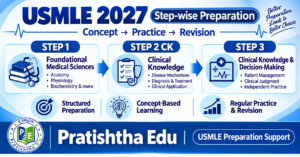
Each Step has a different purpose, so students should avoid preparing for all three examinations in the same way. The USMLE is a three-step examination pathway designed to assess knowledge and skills essential for medical practice.
USMLE Step 1
USMLE Step 1 focuses on foundational medical sciences and the application of scientific concepts to medicine. It requires candidates to connect basic science knowledge with clinical situations rather than relying only on memorization.
Important preparation areas can include:
- Anatomy
- Physiology
- Biochemistry
- Pathology
- Pharmacology
- Microbiology
- Immunology
- Genetics
- Behavioral and social sciences
- Foundational clinical concepts
A strong conceptual foundation can make later clinical preparation more manageable. Candidates should therefore focus on understanding mechanisms, integrating subjects, and practising application-based questions.
How to Approach Step 1 Preparation
A structured USMLE Step 1 preparation plan generally includes:
- Building a strong foundation in core medical concepts.
- Reviewing high-yield topics systematically.
- Practising clinical-style questions.
- Analysing incorrect answers.
- Revising weak areas regularly.
- Tracking progress through practice assessments.
The objective should be to develop understanding and application rather than simply increasing the number of hours spent studying.
USMLE Step 2 CK
Step 2 CK focuses more heavily on clinical knowledge and the application of medical concepts to patient-care situations.
Preparation commonly involves areas such as:
- Internal Medicine
- Pediatrics
- Surgery
- Psychiatry
- Obstetrics and Gynecology
- Preventive Medicine
- Emergency and clinical care concepts
Candidates need to become comfortable with clinical scenarios, diagnosis, investigation, management, and decision-making.
For Indian medical students and graduates, this stage can require a shift from predominantly foundational learning toward more clinically oriented problem-solving.
USMLE Step 3
Step 3 is the final examination in the USMLE sequence. It assesses whether candidates can apply medical knowledge and clinical reasoning in the context of independent patient care.
Preparation for Step 3 generally requires candidates to integrate clinical knowledge with decision-making skills.
Because Step 3 comes later in the overall pathway, its preparation should be planned according to the candidate’s academic background, clinical experience, and examination requirements.
How the Three USMLE Steps Connect
Although each examination has a different focus, the Steps are connected.
The progression can broadly be understood as:
Foundational Knowledge → Clinical Knowledge → Clinical Decision-Making
Step 1 establishes a foundation in medical sciences. Step 2 CK builds on that foundation by focusing more strongly on clinical knowledge and patient-care scenarios. Step 3 moves further toward the application of medical knowledge in clinical practice.
This progression is important when creating a long-term USMLE exam preparation strategy.
USMLE Preparation Requires a Step-Wise Strategy
One common mistake is treating USMLE preparation as a single examination with one fixed study method. Each Step has its own objectives, question style, and preparation requirements.
A more practical approach is to divide preparation into stages:
Stage 1: Understand the Examination
Before starting intensive preparation, understand:
- The purpose of the Step you are preparing for
- Eligibility requirements
- Examination format
- Major subject areas
- Available preparation resources
- Your expected preparation timeline
Stage 2: Build Your Foundation
Review important concepts and identify areas where your existing medical knowledge is strong or needs improvement.
Stage 3: Practise Questions
Question-based learning is an important component of preparation. Instead of looking only at the correct answer, candidates should understand why each option is correct or incorrect.
Stage 4: Review and Revise
Regular revision helps identify recurring weaknesses and prevents important concepts from being forgotten during a long preparation period.
Stage 5: Assess Your Progress
Practice tests and self-assessment can help candidates understand their preparation level and identify areas that require additional work.
USMLE Pathway for Indian Medical Students
Indian medical students and graduates considering the USMLE pathway should plan their preparation carefully rather than beginning with examination preparation alone.
The overall journey may involve several stages, including medical education, meeting applicable eligibility requirements, examination preparation, completing the relevant certification and application processes, and progressing toward residency or further professional opportunities.
Because requirements and procedures can change, candidates should always verify current eligibility and application information through the relevant official authorities before making important decisions.
When Should You Start USMLE Preparation?
There is no single preparation timeline that works for every candidate.
The ideal starting point can depend on:
- Current year of medical education
- Existing knowledge of basic sciences
- Clinical exposure
- Target examination
- Available study time
- Academic commitments
- Previous preparation
- Individual strengths and weaknesses
Students who start early can generally divide their preparation into smaller stages, allowing more time for revision and question practice.
Those preparing alongside medical college should create a realistic schedule that balances university studies with USMLE-specific preparation.
Building a Long-Term USMLE Study Strategy
A successful preparation plan should answer three basic questions:
What do I need to study?
Identify the subjects and concepts relevant to your target Step.
How will I study?
Select appropriate study resources, question banks, revision methods and practice assessments based on your preparation stage.
How will I measure progress?
Use question performance, revision results and practice assessments to identify strengths and weaknesses.
This approach can make USMLE preparation in Bangalore or any other location more structured because the focus remains on the candidate’s preparation needs rather than simply attending classes.
Key Takeaways
- USMLE is a multi-step examination pathway.
- Step 1 focuses on foundational medical sciences.
- Step 2 CK focuses on clinical knowledge.
- Step 3 assesses the application of medical knowledge and clinical decision-making.
- Each Step requires a different preparation approach.
- Indian medical students and graduates should understand the current eligibility and pathway requirements before beginning the process.
- A structured study plan can help candidates organise concepts, question practice, and revision more effectively.
Students looking for structured USMLE preparation in Bangalore can explore the USMLE preparation program offered by Pratishtha Edu and understand the available academic guidance before choosing their preparation approach.
USMLE Eligibility and Pathway for Indian Medical Students
For Indian medical students and medical graduates planning to pursue medical education, residency or medical practice in the United States, understanding USMLE eligibility is an important part of the preparation process.
The USMLE pathway for international medical students and graduates involves more than simply registering for an examination. Candidates need to understand their medical school’s eligibility, ECFMG Certification requirements, examination requirements and the registration process applicable to international applicants.
Because policies and procedures can change, students should always verify the latest requirements with the official USMLE and ECFMG sources before submitting an application.
Who Is Considered an International Medical Graduate?
An International Medical Graduate (IMG) is generally a physician whose basic medical degree was obtained from a medical school located outside the United States. Therefore, an Indian medical graduate who completes their medical education in India is considered an IMG for the relevant USMLE and ECFMG processes.
Being an IMG does not automatically mean that a candidate is eligible for every USMLE Step. Eligibility depends on meeting the requirements applicable to the particular examination and the candidate’s educational status.
USMLE Eligibility for Indian Medical Students
For Step 1 and Step 2 CK, students or graduates of medical schools outside the United States can be eligible if their medical school is listed in the World Directory of Medical Schools (WDOMS) with the appropriate ECFMG eligibility requirements and they satisfy the other applicable ECFMG criteria.
For students, ECFMG requires confirmation of their current enrollment status and relevant medical-science curriculum requirements. The medical school may need to certify the required information to ECFMG.
This means that Indian medical students should check their medical school’s current status before planning their examination application.
Medical School Eligibility Matters
One of the first things an Indian student should verify is whether their medical school meets the requirements for ECFMG Certification.
ECFMG states that the medical school must be listed in the World Directory of Medical Schools with an ECFMG Sponsor Note indicating that it meets the applicable eligibility requirements. The Sponsor Note also identifies the graduation years for which the school meets those requirements.
Therefore, students should not assume eligibility solely because they are studying medicine in India.
What Should Students Check?
Before starting the application process, candidates should verify:
- Their medical school’s listing in the World Directory of Medical Schools
- The applicable ECFMG Sponsor Note
- Their expected graduation year
- Their current student or graduate status
- ECFMG Certification requirements
- USMLE Step-specific eligibility requirements
- Current registration and application procedures
ECFMG Certification and USMLE
ECFMG Certification is an important part of the pathway for international medical graduates.
ECFMG determines whether an IMG is eligible for certification, and this eligibility continues to be relevant to USMLE registration. For international applicants, FSMB confirms ECFMG Certification eligibility as part of the USMLE registration process.
For ECFMG Certification, the medical science examination requirement includes passing USMLE Step 1 and Step 2 CK. Applicants must also satisfy the applicable certification requirements, which include medical education credential requirements and the relevant clinical and communication skills requirements.
USMLE Registration for International Medical Students and Graduates
The USMLE service structure changed in January 2026.
For students and graduates of medical schools outside the United States, FSMB now handles registration for Step 1, Step 2 CK and Step 3. ECFMG continues to determine whether international medical students and graduates meet the requirements for ECFMG Certification.
This distinction is important because students may see information online referring to older registration procedures.
Current Basic Process for International Applicants
A simplified pathway is:
Medical School Eligibility → ECFMG Certification Process → USMLE Eligibility Confirmation → Step 1 / Step 2 CK → ECFMG Certification Requirements → Step 3 Eligibility
The exact sequence and timing can vary according to the candidate’s circumstances and current requirements.
Step 1 and Step 2 CK Eligibility
For international medical students and graduates, Step 1 and Step 2 CK eligibility requires the candidate to fall within the applicable categories and satisfy the ECFMG requirements.
For students or graduates of medical schools outside the United States, the school must be listed in the World Directory of Medical Schools as meeting ECFMG eligibility requirements, along with other applicable criteria.
Candidates should therefore confirm their eligibility before selecting an examination date.
Step 3 Eligibility for IMGs
Step 3 has additional requirements.
According to the current USMLE information, an international medical graduate must have passed Step 1 and Step 2 CK and must have obtained ECFMG Certification with a valid and unexpired ECFMG Certificate, along with meeting the other applicable requirements.
The USMLE program also recommends that applicants for Step 3 have completed, or be near completion of, at least one year of postgraduate training in an accredited U.S. graduate medical education program that meets state licensing requirements.
A Simple USMLE Pathway for Indian Students
Indian students can understand the broad pathway through the following stages:
Step 1: Check Medical School Eligibility
Verify your medical school’s listing and ECFMG Sponsor Note in the World Directory of Medical Schools.
Step 2: Understand ECFMG Certification
Review the current ECFMG Certification requirements and determine which requirements apply to your situation.
Step 3: Plan Step 1 Preparation
Build a strong foundation in basic medical sciences and develop a structured question-practice and revision strategy.
Step 4: Complete Step 1
Apply through the appropriate current registration process and take the examination after meeting the applicable eligibility requirements.
Step 5: Prepare for Step 2 CK
Shift the focus toward clinical knowledge, patient-care scenarios and clinical decision-making.
Step 6: Complete ECFMG Certification Requirements
Meet the applicable examination, credential, and pathway requirements for ECFMG Certification.
Step 7: Understand Step 3 Requirements
After meeting the applicable Step 3 eligibility requirements, candidates can plan for the final USMLE Step.
Important Point for Indian Medical Students
USMLE eligibility should be checked before investing heavily in preparation.
A student may have strong academic performance and still need to verify whether their medical school, graduation year, and individual circumstances satisfy the applicable ECFMG requirements.
For this reason, students should use official sources when checking eligibility rather than relying only on information from coaching institutes, social media posts or older preparation blogs.
Documents and Information Students Should Keep Ready
The exact documentation depends on the candidate’s circumstances, but students should maintain accurate records related to:
- Medical school information
- Enrollment or graduation status
- Medical education credentials
- Identity documentation
- Examination applications
- ECFMG Certification application
- Relevant certification or pathway requirements
Candidates should follow the current instructions provided by the responsible organizations because application procedures can change.
How USMLE Coaching Can Help Indian Students
Understanding eligibility is the first step. The next challenge is creating an effective preparation plan.
Structured USMLE coaching in Bangalore can help students organise their preparation around:
- Step-specific objectives
- Subject-wise study plans
- Concept revision
- Question-solving practice
- Performance analysis
- Revision schedules
- Time management
- Exam-oriented preparation
However, coaching should support the candidate’s preparation rather than replace individual study and question practice.
Key Takeaways
- Indian medical students and graduates generally fall under the international medical student/graduate pathway.
- Medical school eligibility is an important requirement and should be checked through the World Directory of Medical Schools and applicable ECFMG information.
- ECFMG Certification remains an important part of the IMG pathway.
- Step 1 and Step 2 CK are part of the medical science examination requirements for ECFMG Certification.
- International applicants now register for USMLE Steps through FSMB under the 2026 service structure.
- Step 3 has additional eligibility requirements, including passing Step 1 and Step 2 CK and obtaining ECFMG Certification.
- USMLE and ECFMG requirements can change, so candidates should verify the latest official information before applying.
Students planning USMLE preparation in Bangalore can also explore structured academic guidance at Pratishtha Edu while independently verifying all official eligibility and application requirements.
USMLE 2027 Syllabus and Exam Pattern
Understanding the USMLE 2027 syllabus and exam pattern is an important step before beginning serious preparation. The USMLE examination pathway consists of Step 1, Step 2 CK and Step 3, with each Step assessing a different stage of medical knowledge and clinical decision-making.
For students planning USMLE preparation in 2027, it is important to understand both the major subject areas and the examination format applicable to their scheduled test date. USMLE specifications and testing procedures can be updated, so candidates should always check the latest official information before registering for an examination.
USMLE Exam Pattern at a Glance
| USMLE Step | Main Focus | Preparation Focus |
| Step 1 | Foundational medical sciences | Medical concepts, mechanisms and application |
| Step 2 CK | Clinical knowledge | Diagnosis, treatment and patient-care decisions |
| Step 3 | Clinical knowledge and decision-making | Patient management and clinical application |
Each Step has a different purpose. Therefore, candidates should not use the same study strategy for Step 1, Step 2 CK, and Step 3.
USMLE Step 1 Syllabus 2027
USMLE Step 1 assesses whether candidates can understand and apply important concepts from the sciences that form the foundation of medical practice.
The examination follows an integrated content approach. Questions can connect basic medical sciences with clinical situations, making conceptual understanding particularly important.
Major Step 1 Preparation Areas
Students preparing for Step 1 should build a strong understanding of areas such as:
- Anatomy
- Physiology
- Biochemistry
- Pathology
- Pharmacology
- Microbiology
- Immunology
- Genetics
- Behavioral sciences
- Biostatistics and epidemiology
- Organ-system-based medical concepts
The examination can integrate multiple subjects within a single clinical scenario. For example, a question may require candidates to connect physiology with pathology and pharmacology.
Step 1 Exam Pattern
Step 1 is conducted as a computer-based examination in a single testing session.
The exact number of questions, block structure, break allowance and testing duration should be confirmed from the latest official USMLE information applicable to the candidate’s 2027 test date.
Candidates should also become familiar with the official examination interface and question formats before test day.
Step 1 Question Format
Step 1 primarily uses multiple-choice questions based on medical and clinical scenarios.
Questions may require candidates to:
- Identify the underlying mechanism of disease
- Interpret clinical information
- Connect basic science concepts
- Analyse laboratory or diagnostic findings
- Apply pharmacological principles
- Understand physiological processes
- Select the most appropriate answer from multiple options
Therefore, Step 1 preparation should focus on conceptual understanding and application, rather than memorising isolated facts.
USMLE Step 2 CK Syllabus 2027
Step 2 CK focuses primarily on clinical knowledge and the application of medical knowledge to patient-care situations.
Compared with Step 1, preparation for Step 2 CK generally requires greater emphasis on clinical reasoning, diagnosis, investigation, management and patient care.
Major Step 2 CK Preparation Areas
Important clinical areas include:
- Internal Medicine
- Pediatrics
- Surgery
- Psychiatry
- Obstetrics and Gynecology
- Preventive Medicine
- Emergency medicine concepts
- Clinical pharmacology
- Diagnosis and management
- Patient safety
- Health promotion and disease prevention
Candidates should develop the ability to interpret patient information and determine the most appropriate next step in clinical care.
Step 2 CK Exam Pattern
Step 2 CK is conducted as a computer-based examination in a single testing session.
The exact examination specifications for a candidate’s 2027 test date should be confirmed using the latest official USMLE Step 2 CK resources.
Students should become comfortable with the question interface and different clinical question formats during their preparation.
Step 2 CK Question Formats
Step 2 CK can include clinical vignettes and different types of multiple-choice questions.
Candidates may encounter questions involving:
- Patient history
- Physical examination findings
- Laboratory results
- Imaging or diagnostic information
- Treatment decisions
- Clinical management
- Preventive care
- Patient safety
- Audio or visual information where applicable
Regular question practice can help students become more comfortable with clinical scenarios and time management.
USMLE Step 3 Syllabus 2027
Step 3 is the final examination in the USMLE sequence. It focuses on the application of medical knowledge and clinical decision-making in patient-care situations.
Preparation for Step 3 is more clinically oriented and requires candidates to integrate their medical knowledge with patient management.
Major Step 3 Preparation Areas
Preparation may include:
- Diagnosis
- Patient management
- Treatment decisions
- Preventive medicine
- Clinical decision-making
- Biostatistics
- Medical ethics
- Patient safety
- Pharmacology
- Clinical sciences
- Ambulatory patient care
Step 3 also includes computer-based case simulations, making it different from a preparation strategy based entirely on traditional multiple-choice questions.
Step 3 Exam Pattern
Step 3 is conducted over two testing days.
The examination includes multiple-choice questions and computer-based case simulations.
The exact number of blocks, questions, testing time, and case simulations applicable to the 2027 examination cycle should be checked on the latest official USMLE Step 3 information before scheduling the examination.
USMLE Subjects and Integrated Content Approach
The USMLE should not be approached like a traditional university examination where every subject is necessarily tested as a completely separate section.
The official content outlines use an integrated approach. Questions can combine knowledge from several disciplines and apply it to a clinical situation.
For example:
Pathology + Physiology + Pharmacology + Clinical Reasoning
may all be required to answer a single question.
This is why students preparing for the USMLE should learn to connect concepts instead of studying every subject completely in isolation.
USMLE Question Practice
Question-solving should form an important part of USMLE exam preparation.
Candidates can develop their question-solving skills by following a structured process:
1. Read the Clinical Scenario Carefully
Identify the patient’s age, symptoms, history, examination findings and other important information.
2. Identify the Main Question
Understand exactly what the question is asking before reviewing every answer option.
3. Apply Your Medical Knowledge
Connect the information in the question with the relevant medical concept.
4. Eliminate Incorrect Options
Remove answers that do not fit the clinical scenario.
5. Select the Best Answer
Focus on the option that most directly answers the question.
6. Review Your Mistakes
Do not simply record the correct answer. Understand why your selected answer was incorrect and what concept you missed.
7. Revise Weak Areas
Use your question performance to identify topics that require additional revision.
Why Understanding the USMLE Exam Pattern Matters
Understanding the exam structure before beginning preparation can make the study process more organised.
A Step 1 candidate needs a strong foundation in basic medical sciences and integrated concepts.
A Step 2 CK candidate needs greater emphasis on clinical reasoning and patient-care decisions.
A Step 3 candidate needs to combine clinical knowledge with patient management and decision-making, including preparation for computer-based case simulations.
Therefore, your preparation strategy should always match the USMLE Step you are planning to take.
How to Use the USMLE Syllabus for 2027 Preparation
Students can use the official content outline as a framework for creating their preparation plan.
Step 1: Review the Official Content Outline
Start by checking the latest official content outline for your target USMLE Step.
Step 2: Divide the Syllabus Into Study Areas
Organise topics according to subjects, systems, and clinical areas.
Step 3: Identify Your Weak Topics
Use question practice and assessments to determine which areas need additional attention.
Step 4: Combine Concepts With Questions
After studying a topic, solve relevant questions and analyse the explanations.
Step 5: Schedule Regular Revision
Revisit difficult topics throughout the preparation period instead of leaving revision until the final weeks.
Step 6: Practise the Examination Interface
Become familiar with the official testing environment and question formats before your examination.
Step 1 vs Step 2 CK vs Step 3
| Feature | Step 1 | Step 2 CK | Step 3 |
| Main focus | Foundational medical sciences | Clinical knowledge | Clinical decision-making |
| Preparation style | Concepts + application | Clinical reasoning + patient care | Patient management + decision-making |
| Question practice | Foundational and integrated questions | Clinical scenarios | Clinical questions + case simulations |
| Clinical emphasis | Moderate | High | Very high |
| Preparation objective | Build strong medical foundations | Apply knowledge to patient care | Integrate knowledge into clinical management |
The exact examination specifications can change. Candidates preparing for USMLE 2027 should therefore verify the latest official information before finalising their examination schedule.
USMLE 2027 Preparation Strategy Based on the Exam Pattern
Once candidates understand the syllabus, they can create a preparation plan around four major areas:
Concept Building
Develop a strong understanding of important medical concepts rather than relying entirely on memorisation.
Question Practice
Regularly solve examination-style questions to improve application and clinical reasoning.
Revision
Create a systematic revision schedule for difficult and frequently tested concepts.
Performance Analysis
Track mistakes and identify recurring weaknesses so you can use your preparation time more effectively.
This approach can make USMLE preparation in Bangalore more structured for students who want academic guidance alongside their individual study.
Key Takeaways
- USMLE Step 1 focuses on foundational medical sciences and their application.
- Step 2 CK focuses on clinical knowledge and patient-care decisions.
- Step 3 focuses on clinical knowledge, patient management, and decision-making.
- The USMLE uses an integrated approach to medical content.
- Question practice is an important part of preparation for every Step.
- Step 3 includes computer-based case simulations.
- Candidates preparing for the USMLE 2027 examination cycle should verify the latest official examination specifications before their test date.
- A Step-specific study plan can help candidates organise concepts, questions, revision, and assessments more effectively.
Students planning USMLE preparation in Bangalore can use the syllabus and exam pattern as a foundation to develop a structured, Step-specific study plan with appropriate academic guidance.
How to Prepare for USMLE 2027: Complete Preparation Strategy
Preparing for the USMLE requires consistency, conceptual understanding, clinical reasoning and regular question practice. Because Step 1, Step 2 CK and Step 3 have different objectives, candidates should create a preparation strategy according to the Step they are planning to take.
For students looking for USMLE preparation in Bangalore, a structured approach can help organise study time, revision, question practice and progress tracking. However, the final study plan should always be adapted to the candidate’s academic background, available time and individual strengths and weaknesses.
1. Start by Understanding Your Target Step
Before creating a timetable, identify the examination you are preparing for.
Step 1
Focus on:
- Foundational medical sciences
- Integrated concepts
- Pathophysiology
- Pharmacology
- Microbiology
- Physiology
- Pathology
- Question-based application
Step 2 CK
Focus more heavily on:
- Clinical knowledge
- Diagnosis
- Investigation
- Treatment
- Patient management
- Clinical reasoning
- Preventive medicine
- Question-solving speed
Step 3
Preparation should focus on:
- Clinical decision-making
- Patient management
- Diagnosis and treatment
- Preventive care
- Clinical scenarios
- Computer-based case simulations
Understanding this difference prevents candidates from using the same preparation method for every Step.
2. Build a Realistic USMLE Study Plan
A good study plan should be realistic rather than extremely demanding.
Before preparing your timetable, consider:
- Your medical college or work schedule
- Target examination date
- Existing medical knowledge
- Daily study availability
- Number of topics to cover
- Question-practice requirements
- Revision time
- Practice assessment schedule
Instead of planning only for the number of hours you will study, divide your day into specific activities.
A typical study day may include:
Concept Learning → Question Practice → Review of Mistakes → Revision
This creates a balanced preparation cycle.
3. Strengthen Your Medical Concepts
Conceptual understanding is one of the foundations of effective USMLE preparation.
Instead of memorising individual facts, try to understand:
- Why a disease develops
- How the disease affects the body
- Which symptoms and signs are expected
- How laboratory findings change
- Why a particular treatment works
- What complications may occur
For example, when studying a disease, connect:
Pathophysiology → Clinical Presentation → Diagnosis → Treatment
This integrated approach can make it easier to solve unfamiliar clinical questions.
4. Use Question Practice as a Learning Tool
Question practice should not be postponed until the final stage of preparation.
USMLE-style questions can help candidates understand how medical knowledge is applied to clinical scenarios.
After completing a question, review:
- Why the correct answer is correct
- Why the other options are incorrect
- Which concept was being tested
- Whether the mistake was due to knowledge, reasoning or careless reading
- Whether the topic needs revision
The goal is not simply to increase the number of questions completed. The goal is to learn from each question.
5. Maintain an Error and Revision Log
Keeping track of mistakes can revise more targeted.
Create categories such as:
| Type of Mistake | What to Record |
| Knowledge Gap | Concept you did not know |
| Concept Confusion | Two similar concepts confused |
| Clinical Reasoning | Incorrect interpretation of the case |
| Careless Error | Missed an important detail |
| Time Management | Took too long to reach an answer |
Review this log regularly.
If the same type of mistake appears repeatedly, give that topic additional attention.
6. Follow a Subject-Wise and System-Wise Approach
Studying subjects independently can be useful initially, but candidates should gradually integrate their knowledge.
For example:
Cardiovascular System
Study:
- Anatomy
- Physiology
- Pathology
- Pharmacology
- Clinical presentation
- Diagnosis
- Management
Respiratory System
Connect:
- Respiratory physiology
- Pulmonary pathology
- Pharmacology
- Clinical findings
- Diagnostic investigations
- Treatment principles
This system-based approach can help candidates connect foundational concepts with clinical scenarios.
7. Create a Daily USMLE Study Routine
A daily routine should include multiple types of learning rather than spending the entire day reading.
A sample routine could be:
| Study Activity | Suggested Focus |
| Concept Review | Learn or revise important topics |
| Question Practice | Solve USMLE-style questions |
| Explanation Review | Understand correct and incorrect options |
| Weak Area Revision | Review difficult concepts |
| Quick Recall | Revise previously studied material |
The exact number of hours should depend on the candidate’s schedule and preparation stage.
A student with college commitments may need a different routine from a graduate preparing full-time.
8. Use Active Recall and Spaced Revision
Simply reading the same material repeatedly may not be enough for long-term retention.
Active recall involves trying to retrieve information without looking at the answer first.
For example:
Instead of reading a list of complications repeatedly, close the book and ask yourself:
“What are the major complications of this condition?”
Then check your answer.
Spaced revision involves revisiting important concepts at planned intervals.
A simple revision cycle can be:
Learn → Recall → Practise → Revise → Re-test
This can help identify concepts that require additional attention.
9. Do Not Ignore Biostatistics and Epidemiology
Students sometimes focus heavily on major medical subjects and postpone biostatistics and epidemiology.
These areas should be included in the preparation schedule.
Important concepts may include:
- Sensitivity
- Specificity
- Positive predictive value
- Negative predictive value
- Risk
- Relative risk
- Odds ratio
- Study designs
- Screening concepts
- Basic statistical interpretation
Understanding the concepts and practising application-based questions can make preparation more effective.
10. Practise Time Management
Knowing the answer is only one part of examination preparation. Candidates also need to manage time effectively.
During practice sessions:
- Use timed question sets.
- Avoid spending too long on one difficult question.
- Practise reading clinical vignettes efficiently.
- Learn to identify key information.
- Review your time usage after each session.
Do not try to increase speed by rushing through every question.
The objective is to develop a balance between accuracy and efficient decision-making.
11. Take Practice Assessments
Practice assessments can help candidates understand their preparation progress.
Use them to evaluate:
- Knowledge gaps
- Question-solving ability
- Time management
- Weak subjects
- Exam endurance
- Improvement over time
After an assessment, spend time reviewing mistakes.
A practice test is more useful when the candidate analyses the reasons behind incorrect answers rather than focusing only on the score.
12. Prepare According to Your Timeline
A preparation strategy should change as the examination gets closer.
Early Preparation
Focus on:
- Concept building
- Subject coverage
- Understanding difficult topics
- Developing a study routine
Middle Preparation
Focus on:
- Increasing question practice
- Integrating subjects
- Revising weak areas
- Timed practice
Final Preparation
Focus on:
- Revision
- Practice assessments
- High-priority weak areas
- Exam interface familiarity
- Time management
Avoid introducing a large number of completely new resources immediately before the examination.
13. Common USMLE Preparation Mistakes
Candidates can make their preparation unnecessarily difficult by following an unstructured approach.
Mistake 1: Using Too Many Resources
Collecting multiple books, videos, notes, and question banks can create information overload.
Better approach: Select resources carefully and use them consistently.
Mistake 2: Delaying Question Practice
Waiting until the end to start questions reduces opportunities to learn from mistakes.
Better approach: Introduce question practice during the learning phase.
Mistake 3: Memorising Without Understanding
Memorisation alone may not prepare candidates for integrated clinical questions.
Better approach: Understand mechanisms and connect them with clinical presentations.
Mistake 4: Ignoring Weak Subjects
Students sometimes repeatedly study topics they already know well.
Better approach: Use question performance to identify weaker areas.
Mistake 5: Changing the Study Plan Frequently
Constantly changing resources or schedules can reduce consistency.
Better approach: Make a realistic plan and adjust it only when there is a clear reason.
Mistake 6: Ignoring Revision
Completing the syllabus does not mean that preparation is complete.
Better approach: Schedule revision throughout the preparation period.
14. USMLE Preparation Strategy for Indian Medical Students
Indian medical students may already have substantial medical knowledge from their MBBS curriculum. However, the USMLE requires candidates to apply knowledge within its specific examination framework.
Students can focus on:
- Connecting their MBBS concepts with USMLE-style questions
- Developing clinical reasoning
- Practising English-language clinical vignettes
- Becoming comfortable with the examination interface
- Identifying differences between university examination preparation and USMLE preparation
- Building a consistent question-solving routine
Students should also plan their USMLE preparation around their medical college schedule if they are preparing while continuing their studies.
15. When Should You Join USMLE Coaching?
Some students prefer independent preparation, while others benefit from structured academic guidance.
USMLE coaching in Bangalore can be considered when a student needs support with:
- Creating a study plan
- Understanding difficult concepts
- Maintaining preparation discipline
- Question-solving strategies
- Identifying weak areas
- Regular academic guidance
- Revision planning
Before joining a coaching program, candidates should understand the course structure, faculty support, study resources, class schedule and preparation methodology.
16. A Simple USMLE Preparation Formula
A practical preparation cycle can be remembered as:
Learn → Practise → Analyse → Revise → Repeat
Learn
Understand the medical concept.
Practise
Apply the concept through examination-style questions.
Analyse
Understand mistakes and identify knowledge gaps.
Revise
Review difficult concepts at planned intervals.
Repeat
Continue the cycle while gradually improving accuracy and efficiency.
This approach can be adapted to Step 1, Step 2 CK and Step 3 according to the specific requirements of each examination.
Final Checklist for USMLE 2027 Preparation
Before progressing toward your examination, review whether you have:
- Understood your target USMLE Step
- Checked the latest official eligibility requirements
- Reviewed the official content outline
- Created a realistic study schedule
- Selected appropriate preparation resources
- Started regular question practice
- Maintained an error log
- Scheduled revision sessions
- Practised timed question sets
- Completed practice assessments
- Reviewed your weak areas
- Became familiar with the current testing interface
- Verified the latest examination information before test day
Key Takeaways
Effective USMLE 2027 preparation is based on consistency, conceptual understanding, question practice, and regular revision.
Candidates should avoid focusing only on the number of study hours. The quality of learning, analysis of mistakes, and ability to apply medical knowledge are equally important.
A structured preparation strategy can help Indian medical students and graduates organise their study process and approach each USMLE Step according to its specific requirements.
For students looking for structured USMLE coaching in Bangalore, academic guidance can be combined with individual study, question practice, and regular revision to create a personalised preparation routine.
USMLE 2027 Study Plan and Preparation Resources
A well-planned study schedule can make USMLE 2027 preparation more organised and manageable. Instead of studying randomly, candidates should divide their preparation into clear stages covering concept building, question practice, revision and self-assessment.
The ideal study plan depends on the candidate’s target Step, medical background, available study hours and examination date. Therefore, the following framework should be treated as a flexible guide rather than a fixed timetable.
How to Create a USMLE 2027 Study Plan
Before creating your timetable, answer four questions:
- Which USMLE Step am I preparing for?
- How much time do I have before the examination?
- Which subjects are my strengths and weaknesses?
- How many hours can I realistically study each day?
Once these questions are clear, divide your preparation into manageable phases.
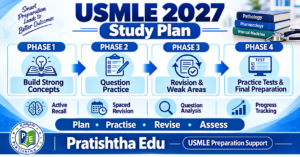
Phase 1: Foundation Building
The first phase should focus on understanding important concepts.
During this stage:
- Review core medical subjects.
- Understand difficult concepts.
- Create concise revision notes.
- Connect basic sciences with clinical applications.
- Begin solving a manageable number of questions.
- Identify weak areas.
Avoid spending the entire preparation period only reading textbooks or watching lectures. Question practice should gradually become part of your routine.
Phase 2: Question-Based Preparation
Once the basic concepts are reasonably strong, increase the amount of question practice.
Focus on:
- Clinical vignettes
- Integrated questions
- Subject-wise questions
- System-based questions
- Timed question sets
- Detailed explanation review
The purpose of this phase is not just to complete questions but to understand the reasoning behind each answer.
Phase 3: Revision and Weak-Area Improvement
After covering a substantial portion of the syllabus, identify recurring weak areas.
For example:
| Weak Area | Action |
| Pathology | Review concepts + practise questions |
| Pharmacology | Revise mechanisms and drug associations |
| Physiology | Revisit core mechanisms |
| Microbiology | Revise organisms and clinical associations |
| Clinical Reasoning | Increase case-based question practice |
| Biostatistics | Practise application-based questions |
Your revision plan should be based on actual performance rather than assumptions.
Phase 4: Final Preparation
The final stage should focus on:
- Revision
- Question practice
- Practice assessments
- Weak topics
- Time management
- Examination interface familiarity
- Maintaining a consistent routine
Avoid continuously adding new resources during the final stage unless there is a clear academic reason.
Sample Daily USMLE Study Plan
A daily schedule can be adjusted according to your personal availability.
| Time Block | Activity |
| Morning | Concept review |
| Late Morning | Subject/system study |
| Afternoon | Question practice |
| Evening | Review question explanations |
| Night | Revision and active recall |
Students attending medical college or other academic commitments can divide these activities into shorter sessions.
For example:
Before College: Quick revision
After College: Concept study
Evening: Question practice
Before Sleep: Active recall and revision
The most important factor is consistency.
Sample Weekly USMLE Study Plan
A weekly schedule can combine new learning, questions and revision.
Monday to Thursday
Focus on new concepts and related question practice.
Friday
Review difficult topics covered during the week.
Saturday
Complete a larger timed question session and analyse mistakes.
Sunday
Use the day for:
- Weekly revision
- Error-log review
- Weak-topic revision
- Planning the next week
The exact schedule can be changed according to your examination timeline.
How Many Hours Should You Study for USMLE?
There is no universal number of hours that guarantees successful preparation.
The appropriate study time depends on:
- Your current knowledge
- Target USMLE Step
- Examination date
- Medical college or work schedule
- Preparation stage
- Individual learning speed
A focused six-hour study day can be more productive than a poorly structured twelve-hour day.
Instead of asking only “How many hours should I study?”, also ask:
“What did I accomplish during those study hours?”
Track measurable activities such as:
- Topics completed
- Questions attempted
- Questions reviewed
- Weak areas identified
- Revision completed
How to Use USMLE Preparation Resources
Candidates have access to many different types of preparation resources. The challenge is choosing and using them effectively.
Common resource categories include:
- Core medical textbooks
- Review books
- Video lectures
- Question banks
- Flashcards
- Practice assessments
- Official USMLE sample questions
- Personal revision notes
The best resource combination can differ between candidates.
Avoid Resource Overload
One of the common preparation problems is collecting too many resources.
A student may use:
Book A + Book B + multiple video courses + several question banks + multiple flashcard systems
and eventually struggle to complete any of them properly.
A more practical approach is:
Primary Resource + Question Bank + Revision Notes + Practice Assessment
Choose resources that complement each other rather than unnecessarily repeating the same information.
USMLE Question Bank Strategy
Question banks should be used as a learning tool, not just as a score generator.
For every question, try to understand:
- What concept is being tested?
- What information in the case is important?
- Why is the correct option correct?
- Why are the other options incorrect?
- Did I make a knowledge or reasoning mistake?
Subject-Wise Question Practice
During the early stage, subject-wise or system-wise questions can help reinforce newly learned concepts.
For example:
Study Cardiovascular System → Solve Cardiovascular Questions → Review Mistakes → Revise
Mixed Question Practice
As the examination approaches, gradually introduce mixed question sets.
Mixed practice helps candidates move away from relying on the subject name to identify the answer.
A question should be solved based on the information provided in the clinical scenario.
How to Review Incorrect Questions
Incorrect questions are valuable learning opportunities.
Create a simple mistake log:
| Question | Mistake | Correct Concept | Revision Date |
| Q1 | Knowledge gap | Disease mechanism | Week 1 |
| Q2 | Clinical reasoning | Diagnostic approach | Week 2 |
| Q3 | Careless error | Key clinical clue | Week 2 |
Review this list regularly.
You can also mark questions as:
- High Priority: Concept completely unclear
- Medium Priority: Minor confusion
- Low Priority: Careless or reading error
This revises more targeted.
Flashcards and Active Recall
Flashcards can be useful for information that requires repeated recall.
Potential flashcard topics include:
- Drug mechanisms
- Side effects
- Microorganisms
- Clinical associations
- Diagnostic criteria
- Important pathways
- Medical facts that are difficult to retain
However, flashcards should support conceptual learning rather than replace it.
Use the principle:
Understand First → Memorise Where Necessary → Recall Regularly
Revision Strategy for USMLE 2027
Revision should begin during the preparation period rather than being left entirely for the end.
A simple cycle can be:
First Review
Review the topic soon after learning it.
Second Review
Revisit it after completing related questions.
Third Review
Review it during the weekly revision cycle.
Final Review
Revisit important weak areas during the final preparation stage.
This creates repeated exposure to difficult concepts without requiring you to relearn the entire syllabus.
Practice Tests and Self-Assessment
Practice assessments can help candidates understand their preparation progress.
Use them to evaluate:
- Accuracy
- Question-solving speed
- Knowledge gaps
- Clinical reasoning
- Test endurance
- Weak subjects
After completing an assessment, spend time analysing the result.
Ask:
Why did I get this question wrong?
rather than only asking:
What was my score?
When Should You Start Full-Length Practice?
Full-length or extended practice sessions should gradually become part of preparation as the examination gets closer.
Early preparation can focus more on learning and shorter question sets.
Later preparation can include:
Timed Questions → Longer Sessions → Practice Assessments → Final Review
This gradual progression helps candidates adapt to sustained examination-style concentration.
USMLE Study Plan for Indian Medical Students
Indian medical students often need to balance USMLE preparation with MBBS academic responsibilities.
A practical approach is to connect your medical curriculum with USMLE preparation where possible.
For example:
MBBS Topic → USMLE Concept Review → USMLE Questions → Revision
When a topic is being studied in medical college, candidates can use the opportunity to strengthen the same concept from a USMLE perspective.
However, university examinations and USMLE preparation have different objectives, so candidates should understand the requirements of both.
How Coaching Can Fit Into Your Study Plan
Students considering USMLE coaching in Bangalore can use structured classes as one component of their overall preparation.
Coaching may provide support through:
- Scheduled classes
- Concept explanations
- Academic guidance
- Study planning
- Question-solving sessions
- Revision support
- Performance discussions
Students should still maintain individual study time for revision, questions and self-assessment.
A useful structure can be:
Classroom Learning + Individual Study + Question Practice + Revision
Sample 12-Week Preparation Framework
The duration of preparation differs from candidate to candidate, but a 12-week framework can help demonstrate how study activities may be organised.
| Weeks | Primary Focus |
| 1–3 | Foundation and major concepts |
| 4–6 | System-wise learning + question practice |
| 7–9 | Mixed questions + weak-area improvement |
| 10–11 | Revision + timed practice + assessments |
| 12 | Final revision + exam readiness |
This framework can be expanded or shortened depending on the candidate’s preparation level and target examination.
How to Track Your USMLE Preparation
Maintain a simple weekly progress sheet.
Track:
- Topics completed
- Questions attempted
- Question accuracy
- Incorrect questions reviewed
- Weak subjects
- Revision completed
- Practice assessments completed
For example:
| Metric | Weekly Record |
| Topics Completed | Update weekly |
| Questions Attempted | Update weekly |
| Accuracy | Track trend |
| Weak Areas | List top priorities |
| Revision | Completed/Pending |
| Assessment | Score and analysis |
The purpose of tracking is to identify trends and improve your preparation strategy.
What to Do When Preparation Falls Behind
Falling behind a study plan does not necessarily mean the entire preparation strategy needs to be abandoned.
Instead:
- Identify why you fell behind.
- Separate essential topics from lower-priority tasks.
- Reduce unnecessary resource switching.
- Adjust the timetable realistically.
- Protect question practice and revision time.
- Continue tracking progress.
A flexible plan is generally easier to maintain than an unrealistic timetable.
Final USMLE 2027 Study Plan Checklist
Before moving into the final stage of preparation, check whether you have:
- Selected a target USMLE Step
- Reviewed the official content outline
- Created a realistic timetable
- Selected a manageable set of resources
- Started regular question practice
- Created an error log
- Scheduled weekly revision
- Practised timed questions
- Completed practice assessments
- Identified weak areas
- Reviewed incorrect questions
- Became familiar with the official testing interface
- Checked the latest examination information applicable to your test date
Key Takeaways
A successful USMLE 2027 study plan should combine four essential activities:
Concept Learning + Question Practice + Revision + Self-Assessment
There is no single timetable or resource combination that works for every candidate. The most useful plan is one that matches your target Step, preparation timeline, existing medical knowledge and daily availability.
Candidates looking for structured USMLE preparation in Bangalore can combine academic guidance with individual study, question practice, and regular revision to build a preparation routine suited to their needs.
USMLE Coaching in Bangalore: Structured Preparation and Academic Guidance
Preparing for the USMLE requires a long-term and organised approach. Students need to manage medical concepts, clinical reasoning, question practice, revision and examination preparation while also keeping track of their individual progress.
For candidates who prefer academic guidance, USMLE coaching in Bangalore can provide a structured learning environment alongside individual preparation.
The right approach depends on the student’s current level, target USMLE Step, preparation timeline and learning requirements. Coaching should therefore be viewed as academic support that complements self-study and regular question practice.
Why Consider USMLE Coaching in Bangalore?
Self-study can be effective, but some students prefer structured guidance because it can help them organise their preparation.
A structured coaching program may help with:
- Planning the preparation schedule
- Understanding difficult medical concepts
- Organising subjects systematically
- Developing question-solving skills
- Identifying weak areas
- Maintaining regular revision
- Discussing academic difficulties
- Following a consistent preparation routine
For students balancing medical college, internships or other responsibilities, having a structured academic schedule can also make preparation easier to organise.
What to Look for in a USMLE Coaching Program
Before choosing a coaching institute, students should understand what the program actually provides.
Important factors to consider include:
Step-Specific Preparation
The preparation requirements for Step 1, Step 2 CK and Step 3 are different. The academic approach should therefore be aligned with the Step being targeted.
Concept-Based Teaching
Classes should focus on understanding medical concepts and their clinical application rather than relying entirely on memorisation.
Question-Solving Practice
Students should have opportunities to apply concepts through examination-style questions and review the reasoning behind answers.
Revision Support
Regular revision can help students retain important concepts and identify areas that require additional study.
Academic Guidance
Students may benefit from guidance regarding study schedules, preparation priorities and progress tracking.
Individual Study Support
Coaching should complement individual study rather than replace it. Candidates still need dedicated time for self-study, question practice and revision.
USMLE Coaching at Pratishtha Edu
Pratishtha Edu provides academic preparation support for students planning to pursue the USMLE pathway.
The preparation approach can be structured around the candidate’s target Step and academic requirements.
Students can seek guidance related to:
- USMLE preparation planning
- Medical concept revision
- Step-specific preparation
- Clinical knowledge development
- Question-solving practice
- Revision strategies
- Preparation progress
- Examination-oriented study
The purpose of structured guidance is to help students create a more organised preparation process while continuing their own individual study.
A Structured Approach to USMLE Preparation
A practical coaching-supported preparation cycle can follow:
Learn → Practise → Analyse → Revise → Assess
Learn
Understand the relevant medical concepts through structured academic learning.
Practise
Apply those concepts through USMLE-style questions.
Analyse
Review correct and incorrect answers to understand the reasoning behind them.
Revise
Revisit difficult and frequently missed concepts.
Assess
Use practice assessments to monitor preparation progress and identify areas requiring further improvement.
This cycle can be repeated throughout the preparation period.
USMLE Step 1 Coaching
Students preparing for Step 1 need a strong foundation in medical sciences.
A structured preparation approach can focus on:
- Anatomy
- Physiology
- Biochemistry
- Pathology
- Pharmacology
- Microbiology
- Immunology
- Genetics
- Biostatistics
- Integrated organ-system concepts
The objective should be to understand how foundational concepts connect with clinical situations.
USMLE Step 2 CK Coaching
Step 2 CK preparation requires greater emphasis on clinical knowledge and patient-care situations.
Students can focus on:
- Internal Medicine
- Pediatrics
- Surgery
- Psychiatry
- Obstetrics and Gynecology
- Preventive medicine
- Diagnosis
- Investigation
- Treatment
- Patient management
- Clinical reasoning
Regular clinical question practice is an important part of this preparation.
USMLE Step 3 Preparation Support
Step 3 requires candidates to apply medical knowledge to clinical decision-making and patient management.
Preparation can include:
- Clinical decision-making
- Diagnosis and management
- Preventive care
- Patient safety
- Clinical scenarios
- Multiple-choice question practice
- Computer-based case simulation practice
Candidates should plan Step 3 preparation according to their eligibility, clinical experience and examination timeline.
How Pratishtha Edu Can Fit Into Your Preparation
Students can combine structured coaching with their own preparation routine.
A typical approach may look like:
Academic Classes
↓
Individual Concept Review
↓
Question Practice
↓
Mistake Analysis
↓
Revision
↓
Practice Assessment
This allows students to use coaching for academic guidance while retaining responsibility for their own preparation.
Who Can Consider Structured USMLE Preparation?
Structured preparation may be useful for:
- Medical students planning the USMLE pathway
- Indian medical graduates
- International medical graduates
- Students preparing for Step 1
- Candidates preparing for Step 2 CK
- Candidates planning Step 3 preparation
- Students who need help organising their study schedule
- Candidates who prefer guided academic preparation
Eligibility and examination requirements should always be verified through the latest official sources before beginning the application process.
Questions to Ask Before Joining USMLE Coaching
Before enrolling in any USMLE coaching institute in Bangalore, students can ask:
- Which USMLE Step does the program cover?
- What is the course duration?
- What is the class schedule?
- How are concepts taught?
- Is question-solving included?
- How is revision handled?
- Is academic progress monitored?
- What type of study guidance is provided?
- What resources are included?
- Does the program suit my current preparation level?
These questions can help students understand whether the course structure matches their individual requirements.
Why Individual Preparation Still Matters
Coaching alone cannot replace personal study.
USMLE preparation requires candidates to spend significant time on:
- Self-study
- Question practice
- Reviewing explanations
- Revising difficult concepts
- Practice assessments
- Analysing mistakes
A productive preparation model can therefore be:
Coaching + Self-Study + Question Practice + Revision
Students should create enough individual study time even when attending regular classes.
Planning Your USMLE Preparation in Bangalore
If you are searching for USMLE preparation in Bangalore, begin by identifying your target Step and expected preparation timeline.
Then consider:
- Your current medical knowledge
- Your academic commitments
- Your available study hours
- Your weak subjects
- Your preferred learning method
- Your need for academic guidance
- Your expected examination timeline
Once these factors are clear, you can select a preparation approach that fits your requirements.
Enquire About USMLE Preparation at Pratishtha Edu
If you are planning your USMLE journey and want to understand the available preparation support at Pratishtha Edu, you can contact the academic team to discuss your requirements.
Pratishtha Edu
USMLE Preparation Support in BangaloreCall: 7676047382
Students can enquire about the preparation structure, academic guidance, and available course options before making a decision.
Final Takeaway
Choosing a preparation method is an individual decision. Some candidates prefer independent study, while others may find structured academic guidance useful.
For students considering USMLE coaching in Bangalore, the important factors are a clear preparation plan, appropriate study resources, regular question practice, revision and consistent progress tracking.
Pratishtha Edu can be considered as one option for students seeking structured academic support while preparing for the USMLE pathway.
USMLE 2027 FAQs and Final Preparation Guide
Preparing for the USMLE is a long-term academic process that requires clear planning, consistent study, question practice, revision, and regular progress evaluation. For Indian medical students and graduates, understanding the examination pathway and choosing a suitable preparation approach can make the overall process more structured.
This section answers some of the most common questions about USMLE preparation in Bangalore, eligibility, preparation strategy, coaching, study resources, and planning for USMLE 2027.
Frequently Asked Questions About USMLE 2027
1. What is the USMLE?
The United States Medical Licensing Examination (USMLE) is a multi-step examination pathway used as part of the medical licensure process in the United States. The examination includes Step 1, Step 2 CK, and Step 3, with each step assessing different aspects of medical knowledge and clinical decision-making.
Students should understand the requirements applicable to their individual pathway before scheduling an examination.
2. What are the three USMLE Steps?
The USMLE pathway consists of three major steps:
- Step 1: Focuses primarily on foundational medical sciences and their application to medicine.
- Step 2 CK: Focuses on clinical knowledge and the application of medical knowledge in patient-care situations.
- Step 3: Assesses clinical knowledge and the ability to apply that knowledge in clinical decision-making.
Each step requires a different preparation strategy.
3. Can Indian medical students take the USMLE?
Eligible Indian medical students and graduates may pursue the USMLE pathway as international medical graduates (IMGs), subject to the applicable eligibility and certification requirements.
Eligibility can depend on the medical school, student’s status, documentation, and current requirements. Therefore, candidates should verify their individual eligibility through the relevant official USMLE and ECFMG information before registering.
4. What is the USMLE eligibility for Indian students?
Indian students should first verify whether their medical school and educational credentials meet the requirements applicable to IMGs.
The process may involve:
- Verifying medical school eligibility.
- Checking the applicable ECFMG certification requirements.
- Completing the required application and documentation process.
- Confirming eligibility for the relevant USMLE Step.
- Scheduling the examination after meeting the applicable requirements.
Because eligibility rules and administrative procedures can change, students should always check the latest official requirements before beginning the application process.
5. How should I start USMLE 2027 preparation?
Start by identifying the USMLE Step you are preparing for and understanding its current examination requirements.
A practical starting process is:
Understand the exam → Review the syllabus → Select study resources → Build a study schedule → Learn concepts → Practise questions → Analyse mistakes → Revise → Take practice assessments
Avoid starting with too many books, videos, question banks, or study resources at the same time. A focused preparation system is easier to maintain.
6. How long does USMLE preparation take?
There is no single preparation duration that works for every student.
Preparation time can depend on:
- Current medical knowledge
- Target USMLE Step
- Academic background
- Available study hours
- Previous question-solving experience
- Strengths and weaknesses
- Examination timeline
- Revision requirements
Instead of following an arbitrary number of months, students should create a preparation schedule based on their target examination date and current academic level.
7. What is the difference between USMLE Step 1 and Step 2 CK?
The main difference is the type of knowledge being assessed.
Step 1 focuses more heavily on foundational medical sciences and understanding the scientific basis of medicine.
Step 2 CK focuses more on clinical knowledge and applying that knowledge to patient-care situations.
Because of this difference, preparation methods should also be adapted to the specific Step being attempted.
8. Is USMLE coaching necessary?
USMLE coaching is not the same as examination eligibility and is not a substitute for individual preparation.
Some students may prefer structured academic guidance because it can help them organise:
- Study schedules
- Subject-wise preparation
- Concept revision
- Question-solving practice
- Error analysis
- Revision cycles
- Progress tracking
Students who are comfortable planning and monitoring their preparation independently may choose a self-study approach. Others may prefer structured USMLE coaching in Bangalore to supplement their preparation.
9. How can I prepare for USMLE in Bangalore?
Students preparing for USMLE in Bangalore can combine structured academic guidance with independent study.
A practical preparation approach includes:
- Understanding the current exam requirements
- Creating a realistic study plan
- Building strong medical concepts
- Practising examination-style questions
- Maintaining an error log
- Revising weak topics regularly
- Taking practice assessments
- Monitoring progress
- Adjusting the study plan when necessary
The objective should be consistent progress rather than simply increasing the number of study hours.
10. Where can I get USMLE coaching in Bangalore?
Students looking for structured academic support can explore the USMLE preparation program at Pratishtha Edu.
The preparation support can help students organise their study process around medical concepts, Step-specific preparation, question practice, revision, and examination-oriented planning.
Students can explore the available USMLE preparation in Bangalore and discuss their preparation requirements with the Pratishtha Edu team before selecting a suitable course structure.
11. What resources should I use for USMLE preparation?
USMLE preparation generally involves a combination of:
-
- Standard medical textbooks or reference material
- Step-specific review resources
- Question banks
- Practice questions
- Flashcards or active-recall tools
- Practice assessments
The exact resources should depend on the Step being attempted and the student’s preparation level.
Using a smaller number of reliable resources consistently is often easier to manage than continuously changing study material.
12. How do I choose a USMLE coaching program?
Before joining a coaching program, students should evaluate the academic structure rather than selecting a program only on promotional claims.
Consider asking:
- Is the program Step-specific?
- Does it include concept-based teaching?
- Is question-solving practice included?
- How are weak areas identified?
- Is revision part of the schedule?
- Is there academic progress tracking?
- Are study plans provided?
- What kind of individual guidance is available?
- Are the course schedule and fees clearly explained?
This can help students understand whether the program matches their individual preparation needs.
USMLE 2027 Preparation: Final Checklist
Before starting or continuing your preparation, review the following checklist:
| Preparation Area | What to Check |
| Target Step | Identify the USMLE Step you are preparing for |
| Eligibility | Verify the current applicable requirements |
| Syllabus | Review the relevant examination content |
| Study Plan | Create a realistic timeline |
| Concepts | Strengthen important medical concepts |
| Questions | Practise examination-style questions regularly |
| Revision | Schedule repeated revision |
| Weak Areas | Track and improve difficult topics |
| Practice Tests | Evaluate progress periodically |
| Exam Readiness | Review your overall preparation before the test |
A successful preparation system is built around consistency, active learning, question practice, analysis, and revision.
Final Takeaways for USMLE 2027
Preparing for USMLE 2027 requires more than simply collecting study materials. Students need a structured approach that connects medical concepts with question-solving, revision, clinical reasoning, and regular assessment.
For Indian medical students, it is also important to understand the applicable IMG pathway and verify current eligibility and examination requirements through official sources.
Whether you choose self-study, structured coaching, or a combination of both, your preparation should be based on your academic background, target Step, available time, and individual learning requirements.
Students looking for USMLE coaching in Bangalore can explore the USMLE preparation program offered by Pratishtha Edu and discuss their academic preparation requirements with the team.
Start Your USMLE 2027 Preparation
Pratishtha Edu
USMLE Preparation Support in Bangalore
Get guidance regarding:
- USMLE preparation structure
- Step-specific preparation
- Study planning
- Medical concept revision
- Question-solving practice
- Revision strategy
- Available preparation options
Call: 7676047382
Start planning your USMLE preparation with a structured approach.
Important Note
USMLE examination rules, eligibility requirements, registration procedures, testing policies, and examination specifications may change. Students should verify the latest information applicable to their examination date through the official USMLE and ECFMG resources before making registration or examination decisions.
Leave a Reply