Preparing for the SSC CHSL examination requires more than simply completing the syllabus. Candidates need a structured study plan, regular practice, previous-year question analysis, mock tests, revision, and proper guidance to improve both accuracy and speed. For students preparing in Bangalore, choosing the right learning environment can also make the preparation process more organised and consistent.
SSC CHSL coaching in Bangalore can be useful for candidates who want classroom guidance, subject-wise preparation, regular assessments, and a fixed study routine. However, coaching alone is not enough. Consistent self-study, practice, and revision are equally important for building confidence before the examination.
The Staff Selection Commission (SSC) conducts the Combined Higher Secondary (10+2) Level examination for eligible candidates seeking various Group C posts in government departments and offices. Since examination notifications, schedules, and eligibility requirements can change, candidates should always refer to the [official Staff Selection Commission website] for the latest information before applying.
For beginners, the first step should be understanding the examination structure and identifying the subjects that require more attention. English Language, General Intelligence, Quantitative Aptitude, and General Awareness are important areas of preparation, while subsequent stages may involve additional requirements depending on the post and the applicable notification.
Why Structured SSC CHSL Preparation Matters
One of the biggest challenges in competitive examinations is maintaining consistency. Students often begin preparation with enthusiasm but struggle to follow a regular timetable, revise completed topics, or analyse their mistakes. A structured preparation programme can help create a clear routine around learning, practice, and assessment.
A good preparation approach generally includes:
- Understanding the latest SSC CHSL syllabus and examination pattern
- Building strong fundamentals in each subject
- Practising previous-year questions regularly
- Taking topic-wise and full-length mock tests
- Tracking accuracy and solving speed
- Revising difficult topics at regular intervals
- Staying updated with important examination announcements
Candidates searching for SSC CHSL classes in Bangalore should therefore look beyond the classroom itself. Faculty support, study material, practice tests, doubt resolution, mentoring, and the overall learning environment are also important factors to consider.
Preparing for SSC CHSL with the Right Learning Approach
Every student has a different starting point. Some candidates may be comfortable with English and Reasoning but need additional practice in Quantitative Aptitude. Others may require more time for General Awareness and revision. Because of these differences, preparation should be flexible enough to address individual strengths and weaknesses.
At Pratishtha Edu, the focus is on creating a structured preparation environment where students can combine classroom learning with regular practice and self-study. Candidates can explore the dedicated SSC CHSL coaching programme in Bangalore to understand the available course and preparation support.
The goal should not simply be to finish the syllabus. The real objective is to understand concepts, practise different question types, reduce avoidable mistakes, and gradually improve performance through regular assessment.
What Is SSC CHSL?
The Staff Selection Commission Combined Higher Secondary (10+2) Level Examination, commonly known as SSC CHSL, is a national-level competitive examination conducted by the Staff Selection Commission for recruitment to various posts in central government departments and offices.
The examination is designed for candidates who meet the prescribed educational and other eligibility requirements mentioned in the relevant SSC notification. For students who have completed or are completing their 12th standard, SSC CHSL can be an important competitive examination to consider as part of their government job preparation.
Before joining SSC CHSL classes in Bangalore, candidates should first understand the examination structure, eligibility requirements, job roles and selection process. This helps students create a preparation plan based on the actual requirements of the examination rather than studying without a clear direction.
Important: SSC examination dates, vacancies, eligibility conditions, selection stages, and other requirements can change from one recruitment cycle to another. Candidates should check the latest notification released by the Staff Selection Commission before making application-related decisions.
SSC CHSL Posts and Career Opportunities
SSC CHSL recruitment has historically included different Group C positions in central government organisations. Depending on the recruitment cycle and vacancies, posts can include roles such as:
- Lower Division Clerk (LDC)
- Junior Secretariat Assistant (JSA)
- Data Entry Operator (DEO)
- Other posts notified by SSC for the particular recruitment cycle
The nature of work, department, pay level, and eligibility requirements can differ between posts. Candidates should therefore read the official notification carefully rather than relying only on information from coaching websites or older examination guides.
For students beginning their SSC CHSL preparation in Bangalore, understanding the target post can also help them remain focused during a long preparation cycle.
Who Can Apply for SSC CHSL?
SSC CHSL is primarily associated with candidates who have completed the required level of school education specified in the official notification. However, eligibility is not determined only by educational qualification. Age limits, nationality requirements, applicable relaxations, and post-specific conditions may also apply.
Candidates should verify:
- Required educational qualification
- Age limit
- Nationality or citizenship requirements
- Age relaxation, where applicable
- Post-specific educational or skill requirements
- Important application dates
- Documents required during the recruitment process
Because these conditions may be updated in different recruitment cycles, the latest official SSC notification should always be treated as the final reference.
Why Do Candidates Choose SSC CHSL?
For many 12th-pass candidates, SSC CHSL provides an opportunity to participate in a central government recruitment process without requiring a graduation degree for the basic eligibility of the examination.
Another reason candidates consider this examination is the variety of roles available through the recruitment process. However, candidates should understand that selection is competitive and preparation requires consistent effort.
A practical preparation routine can include:
- Understanding the syllabus
- Learning fundamental concepts
- Solving topic-wise questions
- Practising previous-year papers
- Taking regular mock tests
- Analysing mistakes
- Revising important concepts
- Improving speed and accuracy
This is where a structured SSC CHSL preparation strategy becomes useful. Instead of trying to complete every subject simultaneously, candidates can divide their preparation into manageable stages.
SSC CHSL Selection Process
The recruitment process can involve multiple stages depending on the post and the rules specified in the relevant notification. Candidates should therefore avoid preparing solely from information published for an older recruitment cycle.
The broad preparation areas candidates should be familiar with include objective-type examination preparation, subject-wise practice, speed and accuracy development, and any additional skill or qualifying requirements applicable to the post.
The exact stages, examination scheme and requirements should be checked in the latest official notification issued by SSC.
How Beginners Should Start Their Preparation
Students who are new to competitive examinations often make the mistake of immediately attempting difficult mock tests without first understanding the fundamentals.
A better approach is to begin with the basics.
Step 1: Understand the syllabus
Make a subject-wise list of topics and identify areas that you already know and topics that require more attention.
Step 2: Build your fundamentals
Spend the initial preparation period understanding concepts instead of focusing only on the number of questions solved.
Step 3: Start topic-wise practice
Once a concept is understood, solve questions based on that topic. This helps identify gaps before moving to more difficult questions.
Step 4: Introduce previous-year questions
Previous-year questions can help candidates understand the type and level of questions they may encounter during preparation.
Step 5: Begin mock-test practice
After building sufficient fundamentals, introduce regular mock tests and analyse performance rather than simply checking the final score.
Step 6: Revise consistently
Revision should be part of the preparation schedule from the beginning. Waiting until the final weeks to revise the entire syllabus can make preparation unnecessarily difficult.
For candidates looking for SSC CHSL coaching in Bangalore, these stages can be combined with classroom instruction, doubt-solving sessions, practice tests, and guided revision to create a more organised preparation routine.
SSC CHSL Syllabus and Exam Pattern
Understanding the SSC CHSL syllabus and exam pattern is one of the first steps towards organised preparation. Instead of studying every topic randomly, candidates can divide the syllabus into subjects, identify their weaker areas, and create a practical timetable around them.
The examination structure and requirements should always be checked against the latest notification issued by the Staff Selection Commission because the recruitment process, examination scheme, and other details can be revised between recruitment cycles.
For preparation purposes, candidates generally need to focus on four major areas in the objective examination:
- English Language
- General Intelligence
- Quantitative Aptitude
- General Awareness
Each subject tests a different set of skills. Therefore, using the same preparation method for all four sections may not be effective.
English Language
English is an important part of competitive examination preparation and requires a combination of grammar knowledge, vocabulary, comprehension, and regular question practice.
Important areas can include:
- Grammar
- Vocabulary
- Synonyms and antonyms
- Sentence improvement
- Error detection
- Fill in the blanks
- Cloze tests
- Reading comprehension
- Sentence arrangement
- Idioms and phrases
Candidates who are weak in English should first strengthen basic grammar rules rather than immediately attempting difficult questions.
A useful routine is to learn one concept, solve topic-based questions and then revise common mistakes. Reading regularly can also help improve vocabulary and comprehension.
For students attending SSC CHSL classes in Bangalore, English preparation can be combined with classroom explanations, practice worksheets, and timed tests.
General Intelligence
The General Intelligence section primarily requires logical thinking, pattern recognition, and the ability to identify relationships between different elements.
Preparation areas may include:
- Analogy
- Classification
- Series
- Coding-decoding
- Venn diagrams
- Blood relations
- Direction-based questions
- Mathematical operations
- Ranking and ordering
- Non-verbal reasoning
- Figure-based problems
The key to improving Reasoning performance is regular practice. Candidates should not only learn the method for solving a particular question but also practise different variations of the same concept.
With consistent practice, students can gradually improve their ability to recognise question patterns and solve them within a limited amount of time.
Quantitative Aptitude
Quantitative Aptitude is often considered one of the most practice-oriented sections. Candidates need conceptual understanding as well as calculation speed.
Important areas for preparation can include:
- Number system
- Percentage
- Ratio and proportion
- Average
- Profit and loss
- Simple and compound interest
- Time and work
- Time, speed and distance
- Algebra
- Geometry
- Mensuration
- Data interpretation
- Basic arithmetic concepts
Students should avoid trying to memorise formulas without understanding their application. A better approach is to understand the concept first and then solve questions with gradually increasing difficulty.
Calculation speed can also make a difference when candidates are solving questions under time pressure. Regular practice with previous-year questions and timed exercises can help identify calculation errors and frequently repeated concepts.
General Awareness
General Awareness requires a different preparation approach because the section covers a broad range of information.
Preparation can include areas such as:
- Current affairs
- History
- Geography
- Indian Polity
- Economics
- General Science
- Static General Knowledge
- Important national and international events
Candidates should maintain concise revision notes rather than collecting large amounts of information that become difficult to revise later.
Current affairs preparation should also be approached systematically. Instead of attempting to memorise everything, candidates can organise important information into categories such as government schemes, awards, appointments, sports, science and technology, national events and other relevant developments.
Subject-Wise Preparation Strategy
Each section needs a slightly different approach. A balanced study plan can look like this:
| Subject | Main Preparation Focus | Recommended Practice |
| English | Grammar, vocabulary and comprehension | Topic tests + revision |
| General Intelligence | Logical and analytical questions | Daily practice sets |
| Quantitative Aptitude | Concepts, formulas and calculations | Timed numerical practice |
| General Awareness | Static GK + current affairs | Daily revision |
| Overall | Speed and accuracy | Mock tests + analysis |
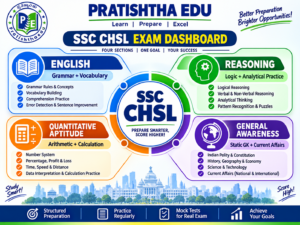
The purpose of this schedule is not to spend an equal amount of time on every subject. Candidates should adjust their timetable according to their current performance.
For example, a student who performs well in English but struggles with Quantitative Aptitude may need to allocate more practice time to Mathematics while maintaining regular English revision.
How to Use Previous-Year Questions
Previous-year questions are an important part of competitive examination preparation because they allow candidates to practise questions within a realistic examination context.
Instead of simply solving a large number of questions, candidates should analyse:
- Which topics appear frequently
- Which concepts cause repeated mistakes
- How much time is spent on each section
- Which questions can be solved quickly
- Which topics require additional revision
Maintaining a simple mistake notebook can be useful. Whenever a candidate makes an avoidable error, the question or concept can be recorded and revisited during weekly revision.
Importance of Mock Tests
Mock tests should gradually become a regular part of the preparation schedule.
Initially, candidates can use topic-wise tests to understand individual concepts. Once sufficient portions of the syllabus have been covered, sectional tests can be introduced. Full-length mock tests can then be used to assess overall preparation.
The purpose of a mock test is not simply to obtain a high score.
Candidates should analyse:
Attempted questions → Correct answers → Incorrect answers → Unattempted questions → Time spent → Reason for mistakes
This analysis provides much more useful information than the score alone.
Speed and Accuracy in SSC CHSL Preparation
Competitive examinations require candidates to work within a limited amount of time. Therefore, preparation should gradually develop both speed and accuracy.
However, increasing speed without controlling mistakes can reduce overall performance. Candidates should first aim for reliable accuracy and then gradually improve their solving time.
A practical progression is:
Concept clarity → Topic practice → Accuracy → Timed practice → Sectional tests → Full-length mock tests
This approach can help candidates build examination confidence without rushing into advanced practice too early.
Create a Subject-Wise Study Routine
A daily study routine can be divided into different blocks depending on the candidate’s schedule.
For example:
| Study Session | Suggested Activity |
| Morning | Quantitative Aptitude concepts |
| Midday | English practice |
| Evening | Reasoning practice |
| Night | General Awareness revision |
| Weekly | Mock test + performance analysis |
Students who attend SSC CHSL coaching in Bangalore can combine their classroom schedule with independent practice and revision at home. The objective should be to ensure that every subject receives regular attention throughout the preparation cycle.
Keep the Latest Official Information in Mind
Candidates should avoid relying completely on old preparation material for information related to eligibility, vacancies, examination dates, selection stages, or other official requirements.
The latest SSC notification and official updates should be checked regularly. This is particularly important when planning applications or preparing according to a particular recruitment cycle.
After understanding the syllabus, the next step is to develop a preparation strategy that converts the syllabus into a realistic daily and weekly study routine.
How to Prepare for SSC CHSL in Bangalore
Once you understand the syllabus and examination structure, the next step is to convert that information into a practical preparation routine. A good SSC CHSL preparation strategy should balance concept building, question practice, revision, mock tests, and performance analysis.
Candidates preparing in Bangalore may have different schedules. Some may be college students, some may be working, while others may be preparing for competitive examinations full-time. Therefore, there is no single timetable that works for everyone.
The important thing is to create a realistic routine that you can follow consistently.
Start With a Clear Study Plan
Before beginning daily preparation, divide the complete syllabus into smaller topics. This makes the preparation process easier to manage and helps you track your progress.
Instead of writing a timetable such as “study Mathematics for three hours”, create specific targets such as:
- Complete percentages and solve practice questions
- Revise important grammar rules
- Practise one reasoning topic
- Read and revise current affairs
- Attempt a short sectional test
Specific targets make it easier to measure whether the day’s preparation was productive.
A weekly review can then be used to identify completed topics and pending areas.
Build Your Fundamentals Before Increasing Difficulty
One common mistake made by beginners is starting with difficult questions before understanding the underlying concept.
The better approach is:
Learn → Practise → Review → Repeat
Start with basic questions and gradually increase the difficulty level. Once a topic becomes comfortable, introduce timed practice.
For example, in Quantitative Aptitude, a candidate can first understand percentage concepts, then solve basic questions, followed by mixed questions and finally timed sets.
The same approach can be used for English, Reasoning, and other sections.
Follow a Consistent Daily Routine
Consistency is more important than creating an unrealistic timetable.
A sample routine for a full-time candidate could be:
| Time | Activity |
| 7:00–8:30 AM | Quantitative Aptitude |
| 10:00–11:00 AM | English |
| 12:00–1:00 PM | General Intelligence |
| 3:00–4:00 PM | General Awareness |
| 6:00–7:00 PM | Previous-year questions |
| 8:00–8:30 PM | Revision |
Students and working professionals can reduce the duration of individual sessions while maintaining the same subject rotation.
The objective is to study consistently rather than attempting to complete a large portion of the syllabus in a single day.
Practise Previous-Year Questions
Previous-year questions are an important part of SSC CHSL preparation because they allow candidates to become familiar with the style of questions and practise applying concepts under realistic conditions.
Instead of solving questions without analysis, maintain a record of:
- Questions answered incorrectly
- Questions that took too much time
- Unclear concepts
- Calculation mistakes
- Questions solved through an inefficient method
Review this record regularly.
If the same type of mistake appears multiple times, that topic should be added to the revision schedule.
Use Topic-Wise Practice Before Full Mock Tests
Candidates do not need to begin their preparation with full-length mock tests immediately.
A gradual testing approach can be more manageable:
Stage 1: Topic-wise tests
Stage 2: Mixed-topic practice
Stage 3: Sectional tests
Stage 4: Full-length mock tests
Stage 5: Mock analysis and targeted revision
This progression helps candidates move from concept learning to examination-level practice.
Improve Speed Without Sacrificing Accuracy
Speed is important, but solving questions quickly is not useful if the number of incorrect answers also increases.
Candidates should first establish reliable accuracy and then work on reducing the time taken for familiar question types.
For Quantitative Aptitude and Reasoning, regular timed practice can help.
For English, candidates can work on reading speed, vocabulary recognition and familiarity with common grammar patterns.
For General Awareness, efficient revision is more important than spending excessive time reading new material every day.
Follow a Smart Revision System
Revision should begin during the preparation process rather than being postponed until the end.
A simple revision cycle can be:
Daily revision: Review what was studied that day.
Weekly revision: Revisit important concepts and mistakes from the week.
Monthly revision: Take mixed tests covering previously completed topics.
This creates repeated exposure to important concepts and reduces the chances of forgetting material that was studied several weeks earlier.
Maintain a Mistake Notebook
A mistake notebook can become one of the most useful tools during preparation.
It does not need to contain every question you solve. Instead, record questions or concepts where you:
- Made a conceptual mistake
- Used the wrong formula
- Misread the question
- Made a calculation error
- Took significantly more time than expected
- Forgot an important fact or rule
Before a mock test, spend some time reviewing this notebook. It can help identify recurring weaknesses that may otherwise go unnoticed.
How Mock Tests Can Improve Preparation
Mock tests should be treated as diagnostic tools rather than simply score-generating exercises.
After every test, analyse:
- Accuracy
How many attempted questions were correct? - Time management
Which section consumed the most time? - Question selection
Did you spend too long on questions that could have been skipped? - Weak topics
Which concepts produced the highest number of mistakes? - Avoidable errors
Were mistakes caused by calculation, reading or lack of knowledge?
This analysis should directly influence the following week’s study plan.
For candidates attending SSC CHSL classes in Bangalore, regular mock tests and performance analysis can be combined with classroom learning to create a more structured preparation cycle.
Balance Coaching With Self-Study
Joining a coaching programme does not eliminate the need for individual study.
Classroom sessions can provide explanations, structured lessons, practice material and academic guidance. Self-study gives candidates the time to revise concepts, solve questions and work on their individual weaknesses.
A productive routine can therefore follow:
Classroom learning → Self-study → Practice → Test → Analysis → Revision
Candidates searching for SSC CHSL coaching in Bangalore should consider whether the programme allows enough opportunity for practice, doubt resolution, testing, and independent revision.
Use Study Material Carefully
Having too many books, PDFs, videos, and online resources can make preparation confusing.
Instead of constantly switching between resources, choose a manageable set of study material and complete it properly.
A useful resource system can include:
- One reliable source for concepts
- Previous-year question papers
- Topic-wise practice sets
- Mock tests
- Short revision notes
- Current-affairs revision material
The focus should be on the quality of practice rather than the number of resources collected.
Prepare According to Your Weak Areas
Not every candidate needs the same study schedule.
Suppose a candidate’s performance looks like this:
| Section | Current Level | Action |
| English | Strong | Maintain through regular practice |
| Reasoning | Average | Increase topic-wise practice |
| Mathematics | Weak | Give additional concept-building time |
| General Awareness | Average | Daily revision |
This type of analysis helps prevent candidates from spending most of their study time on subjects they already perform well in.
Stay Consistent During the Final Phase
As the examination approaches, preparation should gradually shift from learning new concepts to revision, practice, and testing.
The final phase can focus on:
- Full-length mock tests
- Previous-year question revision
- Formula revision
- Grammar revision
- General Awareness revision
- Mistake notebook review
- Time-management practice
Avoid making major changes to your entire preparation strategy at the last moment.
The objective should be to enter the examination with familiarity, practice and a clear approach to time management.
SSC CHSL Preparation: A Simple Formula
A practical preparation cycle can be summarised as:
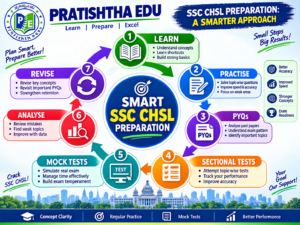
Concepts → Practice → Previous-Year Questions → Sectional Tests → Mock Tests → Analysis → Revision
Following this cycle consistently can make preparation more organised and measurable.
For students in Bangalore, the choice between self-study, online learning and classroom coaching will depend on individual requirements, schedule and learning preferences. The most important factor is having a preparation system that can be followed consistently.
How to Choose the Right SSC CHSL Coaching in Bangalore
Choosing a coaching programme is an important decision because the right learning environment can make preparation more organised. However, candidates should not select a coaching centre only because of advertisements, rankings or promotional claims.
Before joining an SSC CHSL coaching institute in Bangalore, students should compare practical factors such as faculty support, course structure, study material, test series, doubt-solving facilities, batch timings and the overall learning environment.
Different students have different requirements, so the most suitable programme will depend on their preparation level, schedule, and preferred learning method.
Check the Faculty and Teaching Approach
Faculty support is one of the first things candidates should evaluate.
A good classroom programme should help students understand concepts instead of simply providing answers to questions. Teachers should be able to explain different approaches, identify common mistakes and guide students towards more efficient problem-solving methods.
Before enrolling, candidates can consider:
- Whether subject-wise faculty is available
- How concepts are explained
- Whether students can ask questions during or after classes
- Whether difficult topics receive additional explanation
- Whether regular academic guidance is provided
For beginners, clear explanations can be particularly useful because building strong fundamentals is important before moving towards advanced practice.
Look at the Course Structure
A structured course should provide a clear progression from basic concepts to examination-oriented practice.
Ideally, students should understand:
Concept learning → Practice → Previous-year questions → Tests → Analysis → Revision
When comparing SSC CHSL classes in Bangalore, check whether the course has a defined syllabus-completion plan and whether sufficient time is allocated for revision and testing.
A course that only focuses on completing chapters may not provide enough opportunity for students to evaluate their preparation.
Check the Study Material
Study material should be relevant to the current examination requirements and easy to revise.
Candidates can check whether the programme provides:
- Subject-wise notes
- Practice questions
- Previous-year questions
- Topic-wise tests
- Revision material
- Mock tests
- Current-affairs resources where relevant
The quantity of material is less important than whether students can actually use it effectively during preparation.
Having several large sets of notes does not automatically improve preparation. Well-organised material that can be revised multiple times can be more practical.
Evaluate the Mock-Test System
Regular testing is an important part of competitive examination preparation.
Before joining a coaching programme, candidates should ask:
- How frequently are tests conducted?
- Are topic-wise tests available?
- Are sectional tests included?
- Are full-length mock tests provided?
- Is performance analysis available?
- Can students identify their weak topics?
A mock test should ideally be followed by analysis. Simply receiving a score without understanding the reason behind mistakes provides limited information.
Ask About Doubt Resolution
Students can understand a concept during class and still face difficulties while solving questions independently.
Therefore, doubt resolution should be considered when comparing an SSC CHSL coaching centre in Bangalore.
Useful questions include:
- Can students ask questions after class?
- Is there a dedicated doubt-solving session?
- How are difficult questions explained?
- Can students receive clarification on practice material?
Consistent doubt support can help prevent small conceptual gaps from becoming larger problems later in preparation.
Consider Batch Size and Classroom Environment
The classroom environment can influence how comfortably students participate and ask questions.
Candidates may want to consider:
- Batch size
- Classroom seating
- Interaction with faculty
- Availability of study space
- Overall learning environment
- Accessibility from their location
Students who prefer classroom learning may find it useful to visit the institute before enrolling and understand how the classes are conducted.
Check Course Timings
Bangalore students may have different schedules because of college, work or other commitments.
Therefore, batch timings should be checked before registration.
Candidates can compare:
- Morning batches
- Afternoon batches
- Evening batches
- Weekend options, if available
- Class duration
- Number of classes per week
A timetable is useful only when the student can consistently attend the sessions and still have sufficient time for self-study.
Compare Course Duration and Fees
Course fees should be considered alongside the overall programme structure rather than as the only deciding factor.
Before enrolling, candidates should understand what is included in the stated fee.
For example:
| Course Factor | What to Check |
| Duration | Total length of the programme |
| Classes | Number and frequency of sessions |
| Study Material | What resources are included |
| Tests | Topic, sectional and full-length tests |
| Doubt Support | Availability and process |
| Mentorship | Whether academic guidance is provided |
| Revision | Whether revision sessions are included |
Candidates should also confirm the latest fee structure directly with the coaching institute because fees, batches, and course offerings can change.
Check Location and Accessibility
For students choosing classroom preparation, location can affect attendance consistency.
Candidates searching for SSC CHSL coaching near JP Nagar or other parts of Bangalore should consider travel time before joining.
A centre that is easier to reach may make it more practical to attend classes regularly, especially when the course involves frequent classroom sessions.
Instead of selecting a centre only because it is close, candidates can consider the overall combination of:
Location + Course Structure + Faculty + Tests + Study Support
Classroom Coaching vs Online Coaching
Both classroom and online learning can be useful depending on the student’s learning style.
| Factor | Classroom Learning | Online Learning |
| Faculty interaction | Direct | Usually digital |
| Routine | Fixed schedule | More flexible |
| Doubt solving | Direct interaction | Platform-dependent |
| Peer environment | Present | Usually limited |
| Travel | Required | Not required |
| Self-discipline | Shared with classroom routine | Usually requires more self-management |
Students who need a fixed study routine may prefer classroom learning, while candidates with travel, work, or schedule constraints may prefer online learning.
There is no universal choice for every candidate. The important factor is selecting a learning format that the student can follow consistently.
What Should Beginners Look for in an SSC CHSL Institute?
Beginners can use a simple checklist before making a decision:
- Clear course structure
- Experienced subject faculty
- Updated study material
- Regular practice
- Previous-year question coverage
- Mock-test system
- Doubt-solving support
- Reasonable batch timings
- Suitable location
- Transparent fee information
- Revision and performance analysis
Candidates should also avoid making a decision based solely on claims such as “No.1”, “100% selection” or “guaranteed success” unless there is verifiable evidence supporting such claims.
Why a Structured Learning Environment Can Help
Competitive examination preparation often continues for several months. During this period, maintaining a consistent routine can be challenging, particularly for students preparing without a fixed schedule.
A structured learning environment can provide a regular timetable, planned lessons, and opportunities for practice and assessment.
However, coaching should work alongside individual effort. Students still need to revise lessons, solve questions, analyse tests, and maintain consistency outside the classroom.
Exploring SSC CHSL Coaching at Pratishtha Edu
Candidates looking for a structured SSC CHSL preparation programme in Bangalore can explore the programme offered by Pratishtha Edu.
The dedicated course page provides information about the programme and allows prospective students to check the current course details before enquiring.
The focus of preparation should remain on understanding concepts, regular practice, testing, revision, and continuous improvement rather than simply attending classes.
Candidates can review the available SSC CHSL coaching programme and contact Pratishtha Edu directly for current batch schedules, course details and fee information.
Why Choose Pratishtha Edu for SSC CHSL Preparation?
Choosing a coaching programme is an individual decision, and students should compare the course structure, learning support, schedule, and preparation resources before enrolling. For candidates looking for a structured SSC CHSL preparation programme in Bangalore, Pratishtha Edu provides a classroom-oriented learning environment designed to support regular study and examination preparation.
The purpose of a coaching programme should be more than completing the syllabus. Students also need opportunities to practise questions, clarify concepts, take tests, and identify areas that require additional revision.
Structured Classroom Learning
A fixed classroom schedule can help candidates develop consistency in their preparation.
At Pratishtha Edu, students can follow a structured learning routine where classroom sessions are combined with independent study and practice. This approach can be particularly useful for candidates who find it difficult to maintain a regular timetable through self-study alone.
Classroom learning also allows students to interact with faculty and clarify questions during their preparation.
Subject-Focused Preparation
SSC CHSL preparation involves multiple subjects, and each subject requires a different approach.
A structured programme can help students divide their preparation across areas such as:
- English Language
- General Intelligence
- Quantitative Aptitude
- General Awareness
Rather than treating the complete syllabus as one large target, students can work through individual topics and gradually build their preparation.
This also makes it easier to identify subjects that require additional practice.
Regular Practice and Question Solving
Understanding a concept is only the first stage of examination preparation. Candidates need to apply that concept by solving different types of questions.
Regular practice can help students:
- Understand common question patterns
- Improve calculation speed
- Identify recurring mistakes
- Become familiar with different question types
- Develop better time-management habits
Students can combine classroom explanations with individual practice to strengthen their understanding of important topics.
Mock Tests and Performance Analysis
Mock tests can provide a practical way to measure preparation.
Instead of looking only at the final score, candidates should analyse their performance after each test.
A useful analysis can include:
Total questions attempted → Correct answers → Incorrect answers → Unattempted questions → Time spent → Topics requiring revision
This approach helps convert test results into an actionable study plan.
For example, if a candidate repeatedly loses marks because of calculation mistakes, additional Quantitative Aptitude practice can be included in the following week’s schedule.
Similarly, repeated errors in grammar, vocabulary or reasoning concepts can indicate the need for targeted revision.
Doubt-Solving Support
Doubts are a normal part of competitive examination preparation. A question that seems simple to one student may require additional explanation for another.
Academic support can help students clarify:
- Difficult concepts
- Alternative methods of solving questions
- Errors in practice sets
- Formula applications
- Grammar rules
- Reasoning approaches
Candidates should use doubt-solving opportunities actively rather than allowing unresolved questions to accumulate.
Study Material and Practice Resources
Preparation becomes easier to manage when students have organised study resources.
Useful resources can include:
- Topic-wise study material
- Practice questions
- Previous-year questions
- Revision notes
- Sectional tests
- Full-length mock tests
The objective should be to use these resources consistently instead of collecting large quantities of material from multiple sources.
A simple preparation cycle can be:
Learn → Practise → Test → Analyse → Revise
This cycle can be repeated throughout the preparation period.
Guidance for Different Preparation Levels
Not every student begins at the same level.
A beginner may need more time to understand fundamental concepts, while a candidate who has already completed the syllabus may require more mock tests and revision.
Therefore, students should first identify their current preparation level.
For Beginners
Beginners can focus on:
- Understanding the complete syllabus
- Building basic concepts
- Developing a daily study routine
- Solving easy and moderate questions
- Starting topic-wise tests
For Intermediate Candidates
Candidates with basic knowledge can focus on:
- Previous-year questions
- Mixed-topic practice
- Sectional tests
- Improving accuracy
- Identifying weak subjects
For Advanced Preparation
Candidates who have already completed most of the syllabus can focus on:
- Full-length mock tests
- Time management
- Mistake analysis
- Revision
- Improving question selection
This approach allows preparation to become more focused instead of following exactly the same routine for every student.
Combining Classroom Learning With Self-Study
Joining a coaching programme should not replace independent preparation.
Students should use classroom sessions to understand concepts and then reinforce those concepts through self-study.
A balanced routine can look like:
Classroom lesson → Same-day revision → Practice questions → Weekly test → Performance analysis → Revision
This helps connect classroom learning with individual preparation.
Candidates should also maintain sufficient time for rest and other responsibilities. A study plan that is realistic and sustainable is more useful than an extremely demanding schedule that cannot be maintained.
A Focused Learning Environment in Bangalore
For candidates attending classroom coaching, the learning environment can influence daily consistency.
A focused environment can help students maintain a regular study routine and separate preparation time from other daily activities.
Students considering SSC CHSL classes in Bangalore can visit the institute, understand the classroom setup, ask about the current batch schedule, and review the course structure before making an enrolment decision.
Why Students Should Compare Before Joining
Before enrolling in any coaching programme, candidates should compare the features that matter to them.
A simple comparison checklist can include:
| Factor | Questions to Ask |
| Faculty | Who teaches each subject? |
| Classes | How frequently are sessions conducted? |
| Study Material | What resources are included? |
| Tests | How often are mock tests conducted? |
| Doubts | How can students get their questions resolved? |
| Revision | Are revision sessions available? |
| Location | Is the centre convenient to reach? |
| Timings | Do the batch timings suit your schedule? |
| Fees | What is included in the course fee? |
| Support | Is academic guidance available? |
This helps candidates make a decision based on their own preparation requirements rather than relying only on promotional claims.
Explore Pratishtha Edu’s SSC CHSL Programme
Candidates interested in structured preparation can visit the Pratishtha Edu SSC CHSL programme page to review the latest course information.
The course page should be treated as the primary source for current programme details, while candidates can contact the institute directly for the latest batch timings, fees, availability, and admission information.
Pratishtha Edu
SSC CHSL Preparation
Bangalore
Contact: 7676047382
The larger objective of any preparation programme should be to help candidates build a consistent routine, strengthen concepts, practise regularly, and understand their performance through testing and revision.
90-Day SSC CHSL Preparation Strategy
A well-planned preparation schedule can make it easier to cover the syllabus, practise questions, and revise important concepts without leaving everything until the final weeks. A 90-day SSC CHSL preparation strategy can be particularly useful for candidates who want a clear starting point and a measurable study routine.
The 90-day plan below is not a fixed timetable that every candidate must follow. Students who are beginners may need additional time for fundamentals, while candidates who have already covered a large portion of the syllabus can spend more time on mock tests and revision.
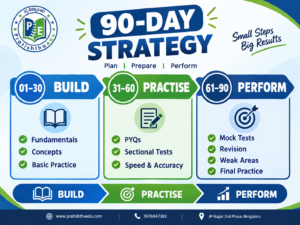
The main objective is to divide preparation into three stages:
Foundation → Practice → Revision & Mock Tests
Days 1–30: Build Your Foundation
The first 30 days should focus primarily on understanding concepts and creating a consistent study routine.
During this stage, candidates should avoid worrying too much about mock-test scores. The priority should be to understand the syllabus and develop confidence in basic concepts.
Week 1: Understand the Examination
Start by becoming familiar with:
- SSC CHSL syllabus
- Examination structure
- Subjects
- Topic distribution
- Previous-year questions
- Preparation resources
Create a subject-wise checklist and mark the topics you already understand and the areas where you need additional preparation.
Week 2: Start Core Concepts
Begin systematic preparation for English, Reasoning, and Quantitative Aptitude.
For General Awareness, start developing a daily reading and revision routine.
A simple daily structure can include:
- 1–2 hours of Quantitative Aptitude
- 1 hour of English
- 1 hour of General Intelligence
- 30–60 minutes of General Awareness
- 30 minutes of revision
The exact duration can be adjusted according to your personal schedule.
Week 3: Increase Topic-Wise Practice
Once the basic concepts have been introduced, increase question-solving practice.
For each topic:
Understand the concept → Solve basic questions → Solve mixed questions → Review mistakes
At this stage, maintain a mistake notebook.
Record questions where you:
- Applied the wrong formula
- Misunderstood the concept
- Made a calculation error
- Took too much time
- Forgot an important rule
Week 4: First Assessment
At the end of the first month, conduct a basic assessment.
You can use:
- Topic-wise tests
- Sectional tests
- Previous-year question sets
The objective is to identify your current preparation level.
Do not judge your complete preparation only through one test. Instead, look for patterns in your mistakes.
Days 31–60: Increase Practice and Accuracy
The second month should gradually move from learning concepts to applying them under time limitations.
By this stage, candidates should have completed a reasonable portion of the basic syllabus and should start increasing their practice volume.
Week 5: Previous-Year Question Practice
Begin solving previous-year questions more systematically.
Instead of simply counting how many questions you solved, categorise your mistakes.
For example:
| Mistake Type | Action |
| Conceptual mistake | Revise the topic |
| Calculation error | Practise similar questions |
| Time-consuming method | Learn an alternative approach |
| Misreading | Slow down and read carefully |
| Lack of knowledge | Add to revision notes |
This makes question practice more productive.
Week 6: Sectional Practice
Introduce regular sectional tests.
For example:
- English sectional test
- Reasoning sectional test
- Quantitative Aptitude sectional test
- General Awareness practice test
After each test, identify your weakest topics.
If Quantitative Aptitude is taking significantly more time than other sections, increase your mathematics practice during the following week.
Week 7: Improve Speed and Accuracy
At this stage, begin introducing timed practice.
Choose a set of questions and give yourself a fixed amount of time.
The objective is not simply to solve faster.
The goal is:
Higher accuracy + Better question selection + Controlled time
Candidates should learn to recognise when a question is taking too long and move on when appropriate.
Week 8: Mixed Practice
The eighth week can focus on combining different topics.
Instead of practising only percentages for several days, for example, candidates can solve mixed arithmetic questions.
Similarly, English practice can combine grammar, vocabulary and comprehension.
Mixed practice helps candidates transition from topic-based learning towards examination-style problem solving.
Days 61–90: Mock Tests, Revision and Final Preparation
The final 30 days should gradually shift towards examination-oriented practice.
The focus should now be on:
- Full-length mock tests
- Previous-year question revision
- Mistake analysis
- Formula revision
- Grammar revision
- General Awareness revision
- Time management
- Weak-topic improvement
Week 9: Start Full-Length Mock Tests
Begin taking full-length mock tests according to your preparation level.
After each test, spend sufficient time analysing the result.
Do not immediately start another mock test without understanding the previous one.
Ask:
- Which questions were incorrect?
- Why were they incorrect?
- Which section consumed the most time?
- Which topics need revision?
- Which questions should have been skipped?
- Were there avoidable mistakes?
Week 10: Target Weak Areas
Use mock-test analysis to create a targeted revision list.
For example:
Weak Mathematics topics: Percentage + Time & Work
Weak English topics: Error Detection + Vocabulary
Weak Reasoning topics: Series + Coding-Decoding
GA revision: Polity + Science + Current Affairs
The next week’s study schedule should give additional attention to these areas.
Week 11: Intensive Revision
Reduce the amount of new material you introduce.
Focus more on:
- Previously completed topics
- Mistake notebook
- Important formulas
- Grammar rules
- Frequently practised question types
- General Awareness notes
- Previous-year questions
This stage is about strengthening what you already know.
Week 12: Final Mock-Test and Revision Phase
The final week should focus on confidence, revision, and examination readiness.
Candidates can:
- Take selected full-length mock tests
- Review mistakes
- Revise short notes
- Practise time management
- Review formulas
- Revise important General Awareness topics
- Avoid unnecessary changes to their preparation strategy
Do not attempt to learn the entire syllabus from scratch during the final days.
Sample Weekly SSC CHSL Study Plan
A weekly routine can be structured like this:
| Day | Main Focus |
| Monday | Quantitative Aptitude + English |
| Tuesday | Reasoning + General Awareness |
| Wednesday | Quantitative Aptitude + English |
| Thursday | Reasoning + General Awareness |
| Friday | Mixed practice + Previous-year questions |
| Saturday | Sectional tests + Weak-topic revision |
| Sunday | Mock test + Complete analysis |
Candidates can adjust the schedule according to their available study time.
How Many Hours Should You Study for SSC CHSL?
There is no universal number of hours that guarantees successful preparation.
A student who studies for six focused hours may accomplish more than someone who spends ten hours studying without a clear plan.
Instead of focusing only on the number of hours, track:
- Topics completed
- Questions solved
- Accuracy
- Mock-test performance
- Revision completed
- Weak areas improved
For full-time preparation, candidates may create longer study sessions. Students or working professionals can use shorter but consistent sessions.
The most important factor is sustainability.
How to Combine Coaching and Self-Study
Candidates attending SSC CHSL classes in Bangalore can use the 90-day plan alongside classroom lessons.
A simple approach is:
Before class: Review the previous topic
During class: Understand new concepts
After class: Revise the lesson
Practice: Solve related questions
Weekly: Take a test
Weekend: Analyse performance
This prevents classroom learning from becoming passive learning.
The student should actively practise what is taught rather than depending completely on classroom sessions.
Track Your Progress Every Week
Maintaining a simple progress sheet can help candidates understand whether preparation is moving in the right direction.
Track:
| Metric | Weekly Check |
| Topics completed | ✓ |
| Questions solved | Number |
| Accuracy | Percentage |
| Tests attempted | Number |
| Weak topics | List |
| Revision completed | ✓ |
| Mock-test analysis | ✓ |
This makes preparation measurable and helps identify problems early.
Avoid These Common Preparation Mistakes
Even a detailed study plan can become ineffective if preparation habits are inconsistent.
Avoid:
Studying Without a Plan
Jumping randomly between subjects can make it difficult to measure progress.
Collecting Too Many Resources
Using multiple books and videos for the same topic can waste valuable preparation time.
Ignoring Previous-Year Questions
Candidates should understand the importance of practising questions from earlier examination cycles.
Taking Mock Tests Without Analysis
A test score alone does not explain why mistakes occurred.
Ignoring Revision
Completing a chapter once does not mean it will be remembered until the examination.
Focusing Only on Strong Subjects
Strong areas should be maintained, but weak areas usually need additional attention.
Comparing Your Preparation With Other Students
Every candidate starts at a different level. Focus on improving your own accuracy, speed, and consistency.
A Simple 90-Day Preparation Formula
The complete plan can be remembered through three stages:
Days 1–30: Learn and build fundamentals
Days 31–60: Practise and improve accuracy
Days 61–90: Test, analyse and revise
This structure can be adjusted depending on the candidate’s starting level and the time available before the examination.
For students looking for SSC CHSL preparation in Bangalore, a combination of structured classes, individual study, regular practice and mock-test analysis can create a more organised preparation routine.
Frequently Asked Questions About SSC CHSL Coaching in Bangalore
Candidates often have several questions before starting their SSC CHSL preparation. Understanding the examination, choosing a suitable learning method, and creating a realistic study routine can make the preparation process more organised.
Is SSC CHSL Coaching Necessary for Beginners?
Coaching is not compulsory for every candidate. Some students may be able to prepare independently with reliable study material, previous-year questions, mock tests, and a consistent timetable.
However, candidates who need a structured routine, classroom explanations, regular tests or additional academic support may consider joining a coaching programme.
The important factor is not simply whether a student joins coaching, but whether the chosen preparation method helps them understand concepts, practise regularly and identify their weaknesses.
How Long Does It Take to Prepare for SSC CHSL?
The preparation time depends on the candidate’s existing knowledge, available study hours, and familiarity with competitive examinations.
A beginner may require more time to build fundamentals, while a candidate who has already completed the syllabus may focus mainly on revision and mock tests.
A practical preparation cycle can include:
Foundation → Practice → Previous-Year Questions → Mock Tests → Analysis → Revision
Candidates should create a timetable according to their individual starting level rather than copying another student’s schedule.
Can I Prepare for SSC CHSL While Studying or Working?
Yes, candidates can organise their preparation around college or work commitments.
Instead of trying to study for very long hours, focus on consistent daily sessions.
For example:
- Morning: 60–90 minutes
- Evening: 90–120 minutes
- Weekend: Longer practice session + mock test
The exact schedule can be adjusted according to individual availability.
Consistency is generally more useful than creating a timetable that cannot be maintained.
Which Subjects Should I Focus on First?
Beginners can start by understanding the complete syllabus and then identifying their strengths and weaknesses.
English, General Intelligence, Quantitative Aptitude, and General Awareness should receive regular attention.
A candidate who is weak in Mathematics may need additional practice time, while a candidate who is already comfortable with Reasoning may use shorter sessions for maintenance and allocate more time to weaker areas.
The goal should be balanced preparation rather than spending equal time on every subject regardless of performance.
Are Previous-Year Questions Important for SSC CHSL Preparation?
Previous-year questions are useful for understanding question formats, practising concepts, and identifying areas that require additional attention.
Candidates should not simply solve the questions and move on.
After completing a practice set, review:
- Incorrect answers
- Questions that took too much time
- Repeated concepts
- Calculation mistakes
- Topics requiring revision
Maintaining a record of these observations can make future revision more focused.
How Important Are Mock Tests?
Mock tests are an important part of examination-oriented preparation.
They allow candidates to practise solving questions under time limitations and identify areas that need improvement.
However, the value of a mock test comes largely from the analysis after the test.
A useful process is:
Mock Test → Score → Mistake Analysis → Weak Topics → Revision → Next Test
Taking many tests without analysing mistakes may not provide the same learning value as taking fewer tests and reviewing them properly.
Should I Choose Classroom or Online SSC CHSL Coaching?
Both formats have different advantages.
Classroom learning can provide a fixed routine, direct interaction, and an in-person learning environment. Online learning can provide flexibility and reduce travel requirements.
Candidates should consider:
- Their daily schedule
- Preferred learning style
- Need for direct faculty interaction
- Travel time
- Self-discipline
- Availability of doubt support
- Access to tests and study material
The suitable option depends on the individual student’s circumstances.
What Should I Check Before Joining an SSC CHSL Coaching Institute?
Before enrolling, candidates can compare:
- Faculty and teaching approach
- Course duration
- Class timings
- Study material
- Previous-year question practice
- Mock-test system
- Doubt-solving support
- Revision sessions
- Location
- Course fees and inclusions
It is also useful to understand exactly what is included in the course rather than comparing institutes only on the basis of advertised fees.
Is SSC CHSL Coaching Available in JP Nagar, Bangalore?
Candidates looking for classroom preparation in South Bangalore can explore coaching options in and around JP Nagar.
Location should be considered along with course structure, faculty support, test practice, and batch timings. A convenient location can make regular attendance easier, but the overall programme should also match the student’s preparation requirements.
Candidates can visit Pratishtha Edu and check the latest SSC CHSL programme details, batch schedule, and admission information directly with the institute.
What Is the Best Way to Start SSC CHSL Preparation?
A simple starting process is:
Step 1: Read the latest official SSC notification.
Step 2: Understand the syllabus and examination structure.
Step 3: Identify your strong and weak subjects.
Step 4: Create a realistic weekly timetable.
Step 5: Start with basic concepts.
Step 6: Practise topic-wise questions.
Step 7: Add previous-year questions.
Step 8: Introduce sectional and full-length tests.
Step 9: Analyse mistakes.
Step 10: Revise regularly.
This approach gives beginners a clear path, rather than trying to study the entire syllabus at once.
Start Your SSC CHSL Preparation in Bangalore
Preparing for a competitive examination is a long-term process that requires consistency, practice, and regular evaluation. Whether you choose self-study, online learning, or classroom coaching, the basic preparation cycle remains similar:
Learn → Practise → Test → Analyse → Revise
Candidates looking for a structured learning environment can explore the SSC CHSL programme at Pratishtha Edu and check the latest course details, batch timings, and available support.
Pratishtha Edu’s dedicated SSC CHSL page provides programme information for candidates planning their preparation in Bangalore.
Get in Touch With Pratishtha Edu
Pratishtha Edu
SSC CHSL Coaching & Preparation
Bangalore
Contact: 7676047382
Website: pratishthaedu.com
Before enrolling, candidates should confirm the latest batch schedule, course fees, class timings, and programme inclusions directly with the institute.
Final Takeaway
SSC CHSL preparation becomes easier to manage when candidates have a clear understanding of the syllabus, a realistic study plan, and a regular system for practice and revision.
A structured approach can be built around four key areas:
Strong Fundamentals + Consistent Practice + Mock-Test Analysis + Regular Revision
Candidates should also keep checking the latest information from the Staff Selection Commission because examination dates, vacancies, eligibility requirements, and other recruitment details can change between examination cycles.
With a clear plan and consistent effort, candidates can make their preparation more organised and measurable as they work toward their SSC CHSL goals.
Leave a Reply