
Introduction
The Common Admission Test (CAT) is one of India’s most competitive MBA entrance examinations. It serves as the gateway to the prestigious Indian Institutes of Management (IIMs) and several other leading business schools across the country. Every year, lakhs of MBA aspirants appear for the examination to secure admission to top management institutes and build successful careers in business, consulting, finance, marketing, analytics, and entrepreneurship. Achieving a high percentile in CAT requires much more than basic aptitude; it demands conceptual clarity, strategic preparation, consistent practice, and effective time management.
Preparing for CAT can be challenging because the examination tests multiple skills simultaneously, including quantitative aptitude, logical reasoning, data interpretation, verbal ability, and reading comprehension. Unlike many competitive examinations that focus primarily on theoretical knowledge, CAT evaluates analytical thinking, problem-solving ability, decision-making skills, and the capability to perform accurately under strict time constraints. Therefore, students need a structured preparation strategy instead of random practice.
Bangalore has become one of the preferred destinations for MBA aspirants due to its strong educational ecosystem, experienced faculty, access to quality study resources, and competitive learning environment. The city is home to numerous educational institutions and offers students opportunities to participate in mock tests, group discussions, workshops, and peer learning activities that contribute significantly to CAT preparation.
While self-study can be effective for highly disciplined students, many aspirants benefit from expert mentoring, regular assessments, and systematic guidance. A well-designed coaching programme helps students understand concepts thoroughly, identify weak areas, improve speed and accuracy, and stay motivated throughout the preparation journey. Regular mock tests, sectional practice, and performance analysis also enable students to measure their progress and refine their examination strategy.
Students preparing for the MBA entrance examination often look for CAT Coaching in Bangalore to gain structured guidance, strengthen conceptual understanding, practice consistently, and develop effective test-taking strategies. Choosing the right CAT Coaching in Bangalore can provide the direction, mentorship, and disciplined study plan required to maximise performance and achieve a competitive CAT percentile.
What is the CAT Exam?
The Common Admission Test (CAT) is a national-level management entrance examination conducted annually for admission into postgraduate management programmes offered by the Indian Institutes of Management (IIMs) and many other reputed business schools in India. The examination is considered one of the most important MBA entrance tests because its scores are accepted by several leading institutions that offer postgraduate management education.
CAT is conducted every year by one of the IIMs on a rotational basis. The examination is computer-based and evaluates a candidate’s aptitude rather than subject-specific academic knowledge. Instead of testing memorisation, CAT assesses analytical ability, logical reasoning, quantitative aptitude, verbal communication, and decision-making under time constraints.
A good CAT percentile significantly improves the chances of receiving interview calls from top business schools. However, the admission process usually involves additional evaluation stages such as the Written Ability Test (WAT), Group Discussion (GD), Personal Interview (PI), academic profile assessment, and work experience evaluation. Therefore, CAT preparation should focus not only on achieving a high score but also on developing overall aptitude and communication skills.
Many students begin their preparation months in advance because the syllabus covers diverse topics that require continuous practice. Enrolling in CAT Coaching in Bangalore allows aspirants to follow a structured curriculum, receive expert guidance, participate in regular mock examinations, and improve their performance through detailed feedback.
CAT Full Form
CAT stands for Common Admission Test.
It is one of the most widely recognised MBA entrance examinations in India and is accepted by the Indian Institutes of Management along with numerous government, private, and autonomous management institutions.
Conducting Authority
The CAT examination is conducted annually by one of the Indian Institutes of Management (IIMs) on behalf of all IIMs. The responsibility of conducting the examination rotates among different IIMs each year, ensuring transparency and standardisation in the admission process.
Purpose of CAT Examination
The primary objective of CAT is to assess whether a candidate possesses the aptitude and analytical skills required for postgraduate management education. Rather than evaluating theoretical business knowledge, the examination measures a student’s ability to analyse information, solve quantitative problems, interpret data, and comprehend complex reading passages within a limited time.
A high CAT score enables students to apply for admission to:
- Indian Institutes of Management (IIMs)
- Leading Government MBA Colleges
- Autonomous Business Schools
- Private Management Institutions
- Universities offering MBA and PGDM programmes
Why is CAT Important?
Cracking CAT successfully can open doors to some of India’s most prestigious management institutions and significantly enhance career opportunities. Since admission to top MBA colleges is highly competitive, a strong CAT percentile often becomes the first major milestone for aspiring management professionals.
Students who prepare strategically and perform well in CAT gain access to quality education, experienced faculty, industry exposure, internship opportunities, and strong placement support. This is one of the key reasons why thousands of aspirants choose CAT Coaching in Bangalore to improve their preparation through structured learning and regular practice.
Admission to Prestigious IIMs
The Indian Institutes of Management are recognised among India’s top management institutions. Securing admission to an IIM provides students with world-class academic training, experienced faculty, global exposure, extensive alumni networks, and excellent placement opportunities. A high CAT percentile plays a crucial role in receiving interview calls from these institutions.
Opportunity to Study at Top Business Schools
Apart from the IIMs, CAT scores are accepted by numerous reputed business schools across India. Many universities and autonomous institutions use CAT scores as one of their primary admission criteria for MBA and PGDM programmes, giving candidates access to a wide range of specialisations and career paths.
Better Career Opportunities
Graduates from reputed management institutions often have access to careers in consulting, finance, marketing, operations, human resources, product management, analytics, and entrepreneurship. Employers value candidates who possess strong analytical thinking and business problem-solving skills, both of which are assessed during CAT preparation.
Higher Salary Potential
A quality MBA from a reputed institution can improve long-term career growth and earning potential. Although salary packages vary depending on the institute, industry, role, work experience, and market conditions, graduates from leading business schools generally have access to competitive placement opportunities and diverse career options.
Students should also review the admission process published by the Indian Institutes of Management (IIMs) to understand institute-specific selection criteria, interview stages, and admission requirements before applying to their preferred MBA programmes.
CAT Exam Highlights
| Particular | Details |
| Examination Name | Common Admission Test (CAT) |
| Conducting Authority | Indian Institutes of Management (IIMs) |
| Examination Level | National Level |
| Examination Mode | Computer-Based Test (CBT) |
| Duration | 120 Minutes |
| Number of Sections | 3 |
| Sections | Verbal Ability & Reading Comprehension (VARC), Data Interpretation & Logical Reasoning (DILR), Quantitative Aptitude (QA) |
| Question Types | MCQs and TITA (Type In The Answer) |
| Marking Scheme | +3 for Correct Answer, -1 for Incorrect MCQ, No Negative Marking for TITA Questions |
| Difficulty Level | Moderate to High |
| Score Accepted By | IIMs and many leading MBA/PGDM colleges across India |
Since examination dates, registration schedules, eligibility criteria, and important announcements may change from year to year, aspirants should regularly visit the Official CAT Website for the latest notifications and updates.
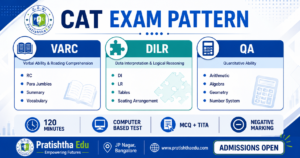
CAT Exam Pattern
Understanding the examination pattern is one of the first steps towards effective preparation. Before beginning the syllabus, every aspirant should clearly understand the structure of the examination, the number of sections, the marking scheme, and the time available for each section. Students enrolled in CAT Coaching in Bangalore are usually introduced to the exam pattern during the initial phase of preparation so they can develop an effective strategy from the beginning.
The CAT examination is conducted as a Computer-Based Test (CBT). Candidates are required to answer questions from three different sections within a total duration of 120 minutes. Each section has a fixed time limit, and candidates cannot switch between sections until the allotted time for that section is over.
The examination consists of both Multiple Choice Questions (MCQs) and Type In The Answer (TITA) questions. MCQs carry negative marking for incorrect responses, while TITA questions do not have negative marking, making them an excellent opportunity to improve the overall score.
Students preparing through CAT Coaching in Bangalore are encouraged to practice both question formats regularly so they become comfortable with the examination interface and improve their accuracy under timed conditions.
Sections in CAT Examination
1. Verbal Ability and Reading Comprehension (VARC)
The VARC section evaluates a candidate’s reading ability, vocabulary, grammar, comprehension, and logical understanding of written passages.
This section generally includes:
- Reading Comprehension
- Para Jumbles
- Para Summary
- Odd Sentence Out
- Sentence Completion
- Vocabulary-based Questions
Reading Comprehension usually carries the highest weightage in this section. Therefore, students should cultivate a daily reading habit by referring to newspapers, editorials, magazines, and business articles.
2. Data Interpretation and Logical Reasoning (DILR)
The DILR section measures analytical thinking, logical reasoning, and data interpretation skills.
Students can expect questions based on:
- Tables
- Charts
- Graphs
- Seating Arrangement
- Games & Tournaments
- Blood Relations
- Scheduling
- Venn Diagrams
- Caselets
- Data Sufficiency
Many aspirants find DILR challenging because the questions often require multiple logical steps. Regular sectional practice and mock tests conducted during CAT Coaching in Bangalore help students improve their problem-solving speed and confidence.
3. Quantitative Aptitude (QA)
The Quantitative Aptitude section tests mathematical concepts and numerical problem-solving abilities.
Major topics include:
- Arithmetic
- Algebra
- Geometry
- Number System
- Modern Mathematics
- Mensuration
- Profit & Loss
- Percentage
- Time & Work
- Probability
- Permutation & Combination
Rather than memorising formulas alone, students should focus on understanding concepts and practising a variety of question types to improve speed and accuracy.
CAT Marking Scheme
The CAT marking scheme is straightforward but requires careful attention during the examination.
| Response | Marks |
| Correct MCQ | +3 |
| Incorrect MCQ | -1 |
| Correct TITA | +3 |
| Incorrect TITA | No Negative Marking |
| Unattempted Question | 0 |
Since incorrect MCQ answers attract negative marking, students should avoid random guessing. However, educated elimination can be useful when two options can confidently be ruled out.
Complete CAT Syllabus
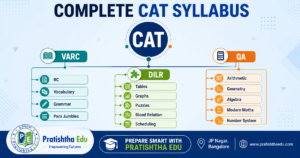
Although the official CAT notification does not prescribe a fixed syllabus, the examination follows a well-established pattern based on previous years’ papers. Aspirants preparing through CAT Coaching in Bangalore generally study the syllabus in a structured manner by dividing it into topic-wise modules and practising each section consistently.
Verbal Ability and Reading Comprehension (VARC) Syllabus
The VARC section focuses on language comprehension, logical interpretation, and verbal reasoning.
Reading Comprehension
Reading Comprehension forms the largest portion of the VARC section.
Students should practise passages from topics such as:
- Business
- Economics
- Psychology
- Philosophy
- Science
- Technology
- History
- Sociology
- Environment
Daily reading improves comprehension speed, vocabulary, and critical thinking.
Verbal Ability Topics
Important topics include:
- Para Jumbles
- Para Summary
- Odd One Out
- Sentence Completion
- Grammar Basics
- Vocabulary
- Reading Skills
- Critical Reasoning
- Sentence Arrangement
- Verbal Logic
Students enrolled in CAT Coaching in Bangalore usually solve hundreds of practice questions in this section to improve both speed and accuracy.
Data Interpretation and Logical Reasoning (DILR) Syllabus
The DILR section requires logical thinking combined with analytical ability.
Important topics include:
Data Interpretation
- Tables
- Line Graphs
- Pie Charts
- Bar Graphs
- Mixed Graphs
- Radar Charts
- Caselets
- Data Sufficiency
Logical Reasoning
- Seating Arrangement
- Circular Arrangement
- Linear Arrangement
- Blood Relations
- Coding-Decoding
- Games & Tournaments
- Team Formation
- Scheduling
- Selection Problems
- Venn Diagrams
- Puzzles
- Binary Logic
- Ranking
- Distribution
This section demands continuous practice because every set follows a different logic.
Quantitative Aptitude (QA) Syllabus
The Quantitative Aptitude section covers mathematical concepts taught up to Class 10 and Class 12 level, along with logical application.
Arithmetic
- Percentage
- Profit and Loss
- Simple Interest
- Compound Interest
- Time & Work
- Pipes & Cisterns
- Time, Speed & Distance
- Average
- Ratio & Proportion
- Partnership
- Mixture & Alligation
Arithmetic generally contributes a significant share of CAT questions.
Algebra
- Linear Equations
- Quadratic Equations
- Inequalities
- Functions
- Logarithms
- Progressions
- Polynomials
- Surds & Indices
Geometry
- Triangles
- Circles
- Quadrilaterals
- Polygons
- Coordinate Geometry
- Mensuration
- Area & Perimeter
- Volume
Number System
- Divisibility Rules
- Factors
- Multiples
- Remainders
- HCF & LCM
- Prime Numbers
- Cyclicity
- Units Digit
Modern Mathematics
- Probability
- Permutation & Combination
- Set Theory
- Binomial Theorem
- Sequence & Series
Students should first build strong conceptual foundations before moving to advanced-level questions.
Section-wise Weightage (Approximate)
The exact distribution of questions may vary each year. However, the following table provides an approximate idea based on recent CAT examination trends.
| Section | Important Topics | Approx. Questions | Difficulty Level |
| VARC | Reading Comprehension, Para Jumbles, Para Summary | 24 | Moderate |
| DILR | Data Interpretation, Seating Arrangement, Logical Reasoning | 22 | Moderate to High |
| QA | Arithmetic, Algebra, Geometry, Number System, Modern Maths | 22 | Moderate to High |
Note: Candidates should always refer to the latest CAT notification and examination updates before preparing their final strategy.
How to Prepare Each Section Effectively
A balanced preparation strategy is essential for achieving a high percentile. Instead of focusing only on favourite subjects, aspirants should allocate time to all three sections.
- VARC: Read newspapers, editorials, and business magazines daily while practising Reading Comprehension and Verbal Ability questions.
- DILR: Solve a variety of puzzle sets every day and analyse different approaches to each problem.
- QA: Revise formulas regularly, strengthen conceptual understanding, and practise topic-wise as well as mixed question sets.
Many students join CAT Coaching in Bangalore because structured classroom sessions, sectional tests, and expert feedback help them prepare all three sections systematically without overlooking weaker areas.
Best Books for CAT Preparation
Choosing the right study material is just as important as following a disciplined study schedule. Since CAT tests conceptual understanding, logical thinking, and analytical ability, students should rely on trusted books that explain concepts clearly and provide a sufficient number of practice questions. Most experienced mentors in CAT Coaching in Bangalore recommend limiting the number of books and revising them multiple times instead of purchasing numerous resources and leaving them incomplete.
A balanced preparation strategy should include separate books for Quantitative Aptitude, Data Interpretation & Logical Reasoning (DILR), and Verbal Ability & Reading Comprehension (VARC). Along with books, students should also solve previous years’ CAT questions and attempt regular mock tests.
Best Books for Quantitative Aptitude
| Book | Author | Why Recommended |
| How to Prepare for Quantitative Aptitude for CAT | Arun Sharma | Comprehensive theory with multiple difficulty levels |
| Quantitative Aptitude for CAT | Nishit K. Sinha | Excellent conceptual explanations and practice questions |
| Quantitative Aptitude Quantum CAT | Sarvesh K. Verma | Advanced-level practice for high percentile aspirants |
Students should begin with conceptual learning before attempting Level 2 and Level 3 problems.
Best Books for VARC
Strong reading skills are essential to score well in VARC.
Recommended books include:
- Word Power Made Easy – Norman Lewis
- High School English Grammar & Composition – Wren & Martin
- How to Prepare for Verbal Ability and Reading Comprehension for CAT – Arun Sharma & Meenakshi Upadhyay
In addition to books, students should develop the habit of reading newspapers, editorials, business magazines, and long-form articles every day to improve comprehension speed.
Best Books for DILR
Recommended resources include:
- How to Prepare for Data Interpretation for CAT – Arun Sharma
- Logical Reasoning and Data Interpretation for CAT – Nishit K. Sinha
Regular puzzle-solving and sectional tests are equally important because DILR performance improves primarily through consistent practice.
Additional Study Resources
Apart from books, aspirants should make use of:
- Previous Year CAT Question Papers
- Sectional Mock Tests
- Full-Length Mock Tests
- Formula Revision Notes
- Vocabulary Lists
- Daily Reading Material
- Error Log Notebook
- Performance Analysis Sheets
Students attending CAT Coaching in Bangalore often receive structured study material, chapter-wise assignments, mock examinations, and detailed performance reports that complement these standard books.
6-Month CAT Preparation Strategy

A six-month preparation plan provides sufficient time to build concepts, strengthen fundamentals, practise extensively, revise important topics, and improve examination temperament. While the exact preparation duration may vary depending on an individual’s background and available study time, six months is generally considered adequate for most aspirants preparing consistently.
Students joining CAT Coaching in Bangalore usually follow a structured monthly schedule that balances classroom learning with self-study, revision, and mock test practice.
Month 1 – Build Strong Fundamentals
The first month should focus on understanding concepts rather than solving difficult questions.
Students should:
- Understand the complete CAT syllabus.
- Learn the examination pattern and marking scheme.
- Build basic concepts in Arithmetic and Algebra.
- Start reading newspapers daily for VARC.
- Solve basic DILR sets.
- Prepare formula notes.
- Identify strengths and weak areas.
The primary objective of the first month is to establish a solid foundation that supports advanced learning later.
Month 2 – Strengthen Concepts Through Practice
Once the basics are clear, students should begin topic-wise practice.
Recommended activities include:
- Solve medium-level Quantitative Aptitude questions.
- Practise Reading Comprehension passages daily.
- Attempt Para Jumbles and Para Summary questions.
- Solve one DILR set every day.
- Begin sectional tests.
- Analyse mistakes after every practice session.
Students preparing through CAT Coaching in Bangalore often receive weekly assignments that help maintain consistency during this stage.
Month 3 – Increase Accuracy and Speed
By the third month, aspirants should gradually shift from learning concepts to applying them under timed conditions.
Focus areas include:
- Timed topic-wise practice.
- Mixed question sets.
- Sectional mock tests.
- Improve calculation speed.
- Reduce silly mistakes.
- Strengthen weak topics identified during previous months.
Rather than attempting every question, students should focus on selecting the right questions and solving them accurately.
Month 4 – Advanced-Level Preparation
The fourth month should concentrate on solving high-difficulty questions and improving problem-solving strategies.
Students should:
- Attempt advanced DILR sets.
- Solve high-level QA questions.
- Improve Reading Comprehension accuracy.
- Attempt one full-length mock every week.
- Analyse every mock in detail.
- Prepare short revision notes.
Many aspirants experience a performance plateau during this phase. Regular guidance from experienced mentors at CAT Coaching in Bangalore can help students overcome conceptual gaps and refine their examination strategy.
Month 5 – Mock Test Intensive Phase
Mock tests become the most important component of preparation during this month.
Students should:
- Attempt 2–3 full-length mocks every week.
- Review every incorrect answer.
- Improve time management.
- Develop an individual examination strategy.
- Focus on question selection.
- Strengthen weaker sections.
The purpose of mock tests is not merely to obtain scores but to understand patterns, improve decision-making, and build confidence for the actual examination.
Month 6 – Revision and Final Preparation
The final month should be dedicated to revision rather than learning entirely new concepts.
Students should:
- Revise formula notes.
- Practise previously incorrect questions.
- Solve previous year CAT papers.
- Attempt final mock examinations.
- Focus on accuracy rather than attempting maximum questions.
- Maintain a healthy sleep schedule.
- Avoid unnecessary stress.
A calm and disciplined approach during the final month often leads to better examination performance than trying to cover too many new topics.
Weekly Preparation Strategy
Along with the monthly schedule, students should also maintain a weekly routine.
| Day | Activity |
| Monday | Quantitative Aptitude + Reading Comprehension |
| Tuesday | DILR Practice + Vocabulary |
| Wednesday | QA Revision + RC Practice |
| Thursday | DILR + Para Jumbles |
| Friday | Mixed Practice |
| Saturday | Sectional Mock Test |
| Sunday | Full-Length Mock Test + Analysis |
A balanced weekly schedule ensures that no section is ignored and helps maintain consistency throughout the preparation journey.
Importance of Mock Test Analysis
Many aspirants spend considerable time taking mock tests but fail to analyse their performance. Mock analysis is often more valuable than the test itself because it reveals conceptual weaknesses, time-management issues, and recurring mistakes.
After every mock test, students should:
- Review every incorrect answer.
- Identify questions that consumed excessive time.
- Analyse skipped questions.
- Record common mistakes in a notebook.
- Revise related concepts.
- Modify the examination strategy accordingly.
Most CAT Coaching in Bangalore programmes include detailed mock analysis sessions where faculty members explain alternative approaches and suggest personalised improvement strategies.
Along with regular mock tests, solving Previous Year CAT Question Papers helps students understand the examination pattern, question trends, difficulty level, and time management strategies more effectively. Reviewing previous years’ papers also enables aspirants to identify frequently tested concepts and refine their preparation strategy.
Daily Study Plan for CAT Preparation
A well-planned daily routine is one of the biggest factors that determines success in the CAT examination. Many students spend long hours studying but fail to achieve the desired results because they do not follow a structured schedule. Instead of focusing only on the number of study hours, aspirants should concentrate on consistency, smart planning, revision, and regular practice.
Students enrolled in CAT Coaching in Bangalore generally follow a balanced study plan that combines classroom learning with self-study, mock tests, and revision. Whether you are a college student, a working professional, or a final-year graduate, following a disciplined daily routine can significantly improve your CAT preparation.
Below is a sample study plan that can be modified according to your availability.
Morning Session (6:30 AM – 8:30 AM)
Morning hours are usually the most productive because the mind is fresh and focused.
During this session, students should concentrate on conceptual learning.
Recommended activities include:
- Learn one new Quantitative Aptitude concept.
- Revise formulas from previous topics.
- Solve 15–20 QA questions.
- Maintain a formula notebook.
- Revise difficult concepts.
Concept building during the morning creates a strong foundation for solving advanced questions later in the day.
Afternoon Session (1:00 PM – 2:30 PM)
The afternoon session should focus on improving verbal ability and reading skills.
Students should:
- Read one newspaper editorial.
- Solve one Reading Comprehension passage.
- Practise Para Jumbles.
- Solve Para Summary questions.
- Learn 10–15 new vocabulary words.
Developing a daily reading habit improves comprehension speed and critical thinking, both of which are essential for a high VARC score.
Evening Session (5:30 PM – 7:30 PM)
The evening is an ideal time for DILR practice.
Recommended activities include:
- Solve two DILR sets.
- Analyse different approaches.
- Practise logical reasoning puzzles.
- Improve calculation speed.
- Review mistakes.
Students attending CAT Coaching in Bangalore often use this time to revise classroom concepts and complete faculty-assigned practice sets.
Night Session (9:00 PM – 10:00 PM)
The final study session should focus on revision rather than learning new topics.
Activities include:
- Revise formulas.
- Review incorrect questions.
- Update error notebook.
- Plan the next day’s study schedule.
- Read short revision notes.
Consistent revision helps improve long-term retention and reduces examination stress.
A disciplined study schedule becomes easier to follow when students have access to a dedicated study space such as the Pratishtha Library, where they can revise concepts and practise mock tests without distractions.
Weekly Practice Schedule
A weekly schedule ensures equal attention to all three sections.
| Day | Primary Focus | Secondary Focus |
| Monday | Quantitative Aptitude | Formula Revision |
| Tuesday | VARC | Vocabulary |
| Wednesday | DILR | Logical Reasoning |
| Thursday | Quantitative Aptitude | Reading Comprehension |
| Friday | Mixed Practice | Weak Topics |
| Saturday | Sectional Mock Test | Performance Analysis |
| Sunday | Full-Length Mock Test | Complete Revision |
Following a structured timetable helps students avoid spending excessive time on only one subject.
Time Management Strategy for CAT
Time management is one of the most important skills tested in CAT. Many candidates know the concepts but fail to score well because they spend too much time on difficult questions.
Students preparing through CAT Coaching in Bangalore are trained to balance speed with accuracy rather than attempting every question.
Some practical strategies include:
Understand the Question Before Solving
Read every question carefully before beginning calculations. Misinterpreting the question often leads to unnecessary mistakes.
Do Not Spend Too Much Time on One Question
If a question appears unusually lengthy or complicated, move to the next one and return later if time permits.
Attempt Easy Questions First
Solving easier questions first builds confidence and improves overall score.
Maintain Accuracy
Incorrect MCQ answers attract negative marking.
It is often better to leave a doubtful question than to make random guesses.
Analyse Mock Tests
Every mock test should be followed by detailed analysis.
Students should identify:
- Time-consuming questions
- Silly mistakes
- Weak concepts
- Incorrect question selection
- Speed issues
This analysis gradually improves examination performance.
Common Mistakes Students Make During CAT Preparation
Many aspirants work hard but repeat the same mistakes throughout their preparation journey. Avoiding these mistakes can significantly improve performance.
1. Studying Without a Proper Plan
Random preparation often leads to incomplete syllabus coverage.
Students should follow a structured study schedule instead of switching topics every day.
2. Ignoring Mock Tests
Many students postpone mock tests until the final month.
This reduces familiarity with the examination pattern.
Mock tests should be attempted regularly from the third month onward.
3. Ignoring Weak Areas
Some aspirants practise only their favourite subjects.
This strategy can reduce the overall percentile because CAT evaluates all three sections.
Students should allocate additional time to weaker topics.
4. Memorising Instead of Understanding Concepts
CAT focuses on logical application rather than rote learning.
Students should understand concepts deeply before solving advanced questions.
5. Poor Time Management
Spending excessive time on one difficult question affects the overall score.
Practising under timed conditions helps improve speed.
6. Not Analysing Mock Tests
Simply taking mock tests is not enough.
Students should carefully analyse every test to identify recurring mistakes and improve future performance.
7. Neglecting Reading Practice
Reading Comprehension contributes significantly to the VARC section.
Students should develop a daily reading habit by reading newspapers, editorials, and business magazines.
8. Lack of Consistency
Preparing only on weekends or studying irregularly often leads to poor retention.
Even three to four focused hours every day are generally more effective than long but inconsistent study sessions.
How to Improve Accuracy and Speed
Speed without accuracy can reduce the CAT score because of negative marking.
Students aiming for a high percentile should focus on both.
Here are some practical techniques:
- Build strong conceptual clarity.
- Solve previous year CAT questions.
- Practise sectional tests regularly.
- Attempt full-length mock tests.
- Maintain an error notebook.
- Revise formulas every week.
- Learn shortcut techniques only after mastering concepts.
- Focus on question selection.
- Improve mental calculation speed.
- Analyse every mock test thoroughly.
Students enrolled in CAT Coaching in Bangalore often receive personalised feedback after every mock test, helping them improve both speed and accuracy over time.
Importance of Revision
Revision is often overlooked during CAT preparation, but it plays a crucial role in long-term retention and exam performance. Without regular revision, even well-understood concepts may be forgotten over time.
An effective revision strategy should include:
- Weekly revision of completed topics.
- Monthly revision of formulas and shortcuts.
- Re-solving previously incorrect questions.
- Reviewing mock test mistakes.
- Revisiting difficult DILR sets and Reading Comprehension passages.
Students should reserve at least one day each week exclusively for revision. This habit strengthens conceptual understanding and boosts confidence before the examination.
Tips to Crack CAT in the First Attempt
Cracking CAT in the first attempt is a realistic goal for students who prepare with discipline, consistency, and the right strategy. Since the examination evaluates aptitude rather than memorisation, aspirants should focus on conceptual understanding, regular practice, and continuous self-assessment.
Students preparing through CAT Coaching in Bangalore often benefit from expert guidance, structured study plans, regular mock tests, and personalised mentoring. However, regardless of whether you prepare through coaching or self-study, following a systematic approach can significantly improve your chances of achieving a high percentile.
Below are some practical tips that can help aspirants prepare more effectively.
1. Understand the CAT Exam Before Starting Preparation
Before beginning your preparation, spend time understanding the examination pattern, syllabus, marking scheme, and sectional time limits.
Knowing the structure of the examination helps students create a realistic study plan and avoid unnecessary confusion later.
2. Build Strong Fundamentals
Many students immediately begin solving difficult questions without mastering the basics.
Instead, start with fundamental concepts in:
- Arithmetic
- Algebra
- Geometry
- Reading Comprehension
- Logical Reasoning
A strong conceptual foundation makes advanced-level questions much easier to solve.
3. Follow a Realistic Study Schedule
Instead of studying for long hours occasionally, maintain consistency.
A daily study plan of 3–5 focused hours is generally more effective than studying for 10–12 hours only on weekends.
Students attending CAT Coaching in Bangalore should revise classroom topics on the same day to improve retention.
4. Practice Questions Every Day
Daily practice is essential.
Try to solve:
- 20–25 QA Questions
- 2 Reading Comprehension Passages
- 2 DILR Sets
- Vocabulary Revision
- Formula Revision
Small daily improvements create significant long-term progress.
5. Read Newspapers Regularly
Reading newspapers develops:
- Reading Speed
- Vocabulary
- Analytical Thinking
- Comprehension Ability
Business newspapers, editorials, and opinion articles are especially useful for improving the VARC section.
6. Attempt Regular Mock Tests
Mock tests simulate the real examination environment.
Students should begin attempting sectional mocks after completing basic concepts and gradually progress to full-length mock examinations.
Simply taking mock tests is not enough—analysing every mock is equally important.
7. Analyse Every Mistake
Maintain an Error Analysis Notebook.
After every practice session, record:
- Incorrect Questions
- Silly Mistakes
- Weak Topics
- Time Management Issues
- Alternative Solution Methods
This habit prevents repeated mistakes.
8. Strengthen Weak Areas
Every aspirant has strengths and weaknesses.
Avoid spending all your time on favourite topics.
Instead:
- Allocate additional time to weaker sections.
- Revise weak concepts regularly.
- Seek faculty guidance whenever required.
Students preparing through CAT Coaching in Bangalore usually receive individual feedback that helps them improve weaker sections more efficiently.
9. Revise Regularly
Revision is one of the most overlooked aspects of CAT preparation.
Every week should include:
- Formula Revision
- Vocabulary Revision
- DILR Practice
- Previous Mistakes
- Mock Test Review
Consistent revision strengthens memory and boosts confidence before the examination.
10. Stay Healthy and Avoid Burnout
Preparing for CAT is a long journey.
Students should also focus on:
- 7–8 hours of sleep
- Healthy diet
- Short breaks
- Physical activity
- Stress management
A healthy body supports better concentration and decision-making during the examination.
Why Choose Pratishtha Edu for CAT Coaching in Bangalore?

Choosing the right coaching institute is an important decision because the quality of guidance, faculty support, and practice environment can influence a student’s preparation journey. While self-study works for some aspirants, many students prefer structured learning that combines classroom teaching with continuous assessment and mentorship.
Students looking for CAT Coaching in Bangalore should evaluate factors such as faculty experience, course structure, mock test quality, study material, batch size, and personalised guidance before enrolling in any institute.
At Pratishtha Edu, the focus is on helping students develop strong concepts, improve problem-solving skills, and build confidence through a systematic preparation approach.
Experienced Faculty
Experienced mentors explain concepts using simple methods and guide students through topic-wise preparation.
Regular doubt-clearing sessions ensure that students understand every concept before moving to advanced-level questions.
Comprehensive Classroom Training
The classroom programme is designed to cover the complete CAT syllabus in a structured manner.
Students receive:
- Concept-Based Learning
- Topic-wise Assignments
- Practice Questions
- Regular Revision Sessions
This organised approach helps students complete the syllabus on time.
High-Quality Study Material
Students receive carefully prepared study material covering:
- Quantitative Aptitude
- VARC
- DILR
- Practice Exercises
- Sectional Tests
- Previous Year Questions
The material is designed to support classroom learning and self-study.
Regular Mock Tests
Mock examinations help students become familiar with the actual CAT examination environment.
At Pratishtha Edu, students can regularly assess their preparation through:
- Sectional Tests
- Full-Length Mock Tests
- Performance Reports
- Detailed Solutions
- Faculty Feedback
Continuous assessment helps students improve speed, accuracy, and confidence.
Personal Mentorship
Every student learns differently.
Personalised mentoring helps students:
- Identify weak areas.
- Create study plans.
- Improve time management.
- Stay motivated.
- Track progress regularly.
Individual guidance often makes preparation more focused and effective.
Small Batch Size
Smaller batches allow faculty members to interact more closely with students.
Benefits include:
- Better classroom interaction.
- Faster doubt resolution.
- Individual attention.
- Improved learning experience.
Performance Analysis
Mock tests alone are not enough.
Faculty members analyse student performance and provide detailed suggestions for improvement based on:
- Accuracy
- Speed
- Question Selection
- Conceptual Understanding
- Time Management
This personalised feedback enables continuous improvement.
Dedicated Doubt-Clearing Sessions
Students often struggle with certain concepts despite regular practice.
Dedicated doubt sessions help them clarify concepts immediately without allowing confusion to accumulate.
Convenient Location in JP Nagar, Bangalore
Pratishtha Edu is conveniently located in JP Nagar, Bangalore, making it easily accessible for students from different parts of the city.
The institute also provides a focused learning environment supported by experienced faculty and structured preparation programmes.
Access to Pratishtha Library
Along with classroom coaching, students can also utilise the Pratishtha Library for self-study, revision, mock test practice, and uninterrupted preparation.
A distraction-free study environment often improves consistency and productivity during CAT preparation.
Students interested in exploring multiple MBA entrance options can also learn about our PGCET MBA Coaching in Bangalore programme. While CAT is accepted by IIMs and many leading business schools, Karnataka PGCET provides another pathway for admission to MBA colleges within the state. Understanding both examinations can help aspirants choose the preparation strategy that best aligns with their career goals.
Key Benefits of Joining CAT Coaching in Bangalore
Students considering CAT Coaching in Bangalore may benefit from structured preparation through:
- Experienced Faculty Guidance
- Complete CAT Syllabus Coverage
- Topic-wise Classroom Sessions
- High-Quality Study Material
- Regular Mock Tests
- Sectional Practice Tests
- Personal Mentorship
- Doubt-Clearing Sessions
- Performance Analysis
- Time Management Training
- Interview Preparation Guidance
- Peer Learning Environment
- Continuous Motivation
- Dedicated Study Support
With disciplined preparation, consistent practice, and expert guidance, aspirants can improve their confidence and maximise their chances of achieving a competitive CAT percentile.
Frequently Asked Questions (FAQs)
1. What is the CAT examination?
The Common Admission Test (CAT) is a national-level MBA entrance examination conducted annually by one of the Indian Institutes of Management (IIMs). It is accepted by all IIMs and several leading MBA and PGDM colleges across India. Students preparing through CAT Coaching in Bangalore often begin by understanding the examination pattern, syllabus, and selection process before starting their preparation.
2. Who is eligible to appear for the CAT examination?
Candidates who have completed a bachelor’s degree from a recognised university with the required minimum percentage, as specified in the official notification, are generally eligible to appear for CAT. Final-year undergraduate students who meet the official criteria can also apply. Aspirants should always refer to the latest official CAT notification for the most up-to-date eligibility requirements.
3. Is CAT Coaching in Bangalore necessary to crack the examination?
Coaching is not compulsory, but it can be beneficial for students who want structured preparation, expert guidance, regular mock tests, and personalised mentoring. CAT Coaching in Bangalore helps many aspirants improve conceptual clarity, maintain consistency, and identify areas that need improvement through continuous performance analysis.
4. How many months are required for CAT preparation?
The preparation time depends on the student’s academic background, aptitude, and daily study schedule. Many aspirants prepare for six to nine months with consistent effort. A well-planned study schedule that includes conceptual learning, mock tests, and revision can significantly improve performance.
5. What is considered a good CAT percentile?
A good CAT percentile varies depending on the target institute. Top IIMs generally require a high percentile, while many other reputed management institutes have different admission criteria. Apart from the CAT score, several institutions also consider academic performance, work experience, written ability tests, and personal interviews during the admission process.
6. Which section of CAT is the most difficult?
The difficulty level differs from one candidate to another. Some students find Data Interpretation and Logical Reasoning (DILR) challenging, while others struggle with Quantitative Aptitude or Reading Comprehension. Regular sectional practice and mock tests help improve confidence in every section.
7. Can working professionals prepare for CAT?
Yes. Many working professionals successfully prepare for CAT while managing full-time jobs. The key is to follow a disciplined daily schedule, utilise weekends effectively, revise regularly, and attempt mock tests consistently. Flexible study plans and expert guidance from CAT Coaching in Bangalore can also help working professionals manage their preparation efficiently.
8. How important are mock tests in CAT preparation?
Mock tests are one of the most important components of CAT preparation. They help students understand the examination pattern, improve time management, increase accuracy, and identify weak areas. Analysing every mock test is equally important because it provides valuable insights into performance and highlights areas that require additional practice.
9. Which books are best for CAT preparation?
Some of the widely recommended books include:
- How to Prepare for Quantitative Aptitude for CAT by Arun Sharma
- Logical Reasoning and Data Interpretation for CAT by Nishit K. Sinha
- Word Power Made Easy by Norman Lewis
- High School English Grammar & Composition by Wren & Martin
Students should also practise previous years’ questions and attempt regular mock tests along with these books.
10. Why choose Pratishtha Edu for CAT Coaching in Bangalore?
Pratishtha Edu provides a structured learning approach through experienced faculty, comprehensive classroom training, regular mock tests, topic-wise assignments, performance analysis, personalised mentorship, doubt-clearing sessions, and quality study material. Students looking for CAT Coaching in Bangalore can benefit from systematic preparation designed to improve conceptual understanding, speed, and accuracy.
Conclusion
Preparing for the Common Admission Test is a journey that requires patience, discipline, consistency, and a well-planned strategy. Since the examination evaluates analytical thinking, logical reasoning, quantitative aptitude, and verbal ability, aspirants should focus on building strong fundamentals before progressing to advanced-level questions. Regular revision, daily practice, sectional tests, and full-length mock examinations play an equally important role in achieving a competitive percentile.
A structured preparation plan helps students complete the syllabus on time while providing sufficient opportunities for revision and performance improvement. Instead of studying randomly, aspirants should follow a realistic timetable, analyse every mock test carefully, strengthen weaker sections, and continuously refine their examination strategy. Developing effective time-management skills and maintaining consistency throughout the preparation period can significantly improve overall performance.
For students who prefer guided learning, CAT Coaching in Bangalore offers the advantage of experienced faculty, organised classroom sessions, expert mentoring, regular assessments, and detailed performance analysis. Combined with dedicated self-study and continuous practice, these resources can help students prepare more confidently for the examination.
Whether you are a college student preparing alongside academics or a working professional balancing job responsibilities with MBA aspirations, success in CAT depends on commitment, smart preparation, and continuous improvement. Stay focused on your goals, practise consistently, learn from every mock test, and approach the examination with confidence.
If you are looking for structured guidance, personalised mentoring, and a systematic preparation strategy, Pratishtha Edu’s CAT Coaching in Bangalore can support your journey with experienced faculty, quality study material, regular mock tests, and continuous performance tracking to help you maximise your potential.
Final Call to Action
Ready to begin your MBA journey?
Join Pratishtha Edu’s CAT Coaching in Bangalore and prepare with experienced faculty, structured classroom programmes, comprehensive study material, regular mock tests, detailed performance analysis, and personalised mentorship. Whether your goal is admission to an IIM or another leading business school, consistent preparation with the right guidance can help you move closer to achieving your dream MBA.
Leave a Reply