
How to Crack CAT 2027 in First Attempt is the ultimate goal for every MBA aspirant preparing for the Common Admission Test (CAT). With the right preparation strategy, daily study plan, regular mock tests, and expert guidance, you can achieve a high percentile and secure admission to a top B-school. In this guide, Pratishtha Edu shares a complete roadmap to help you crack CAT 2027 confidently.
Preparing for the Common Admission Test (CAT) is a dream for thousands of MBA aspirants who wish to secure admission to prestigious management institutes such as the Indian Institutes of Management (IIMs) and other leading B-schools across India. Every year, lakhs of students compete for a limited number of seats, making CAT one of the most competitive MBA entrance examinations in the country. However, with the right CAT Preparation Strategy, disciplined practice, and consistent effort, achieving a high percentile is absolutely possible.
If you are wondering how to crack CAT 2027 in the first attempt, this comprehensive guide is designed to help you build a smart preparation plan from the very beginning. Whether you are a final-year student, a graduate, or a working professional, following a structured CAT Study Plan, practicing regular CAT Mock Tests, and focusing on conceptual clarity can significantly improve your chances of success.
Students searching for quality CAT Coaching in Bangalore often look for expert guidance, personalized mentoring, and a proven preparation methodology. Pratishtha Edu focuses on helping aspirants strengthen their fundamentals, improve problem-solving skills, and prepare confidently for every section of the CAT exam.
In this guide, you will learn the best CAT Preparation Tips, section-wise strategies, study plans, mock test techniques, common mistakes to avoid, and expert recommendations that can help you maximize your CAT score and move one step closer to your dream MBA college.
Why is CAT One of the Toughest MBA Entrance Exams?
Many students believe CAT is difficult because of the syllabus alone, but the real challenge lies in the level of competition and the way the exam evaluates candidates. Every year, several lakh aspirants appear for the CAT Exam, while only a small percentage secure admission to the top IIMs and premier management institutes. This intense competition means that even a slight improvement in accuracy, speed, and time management can make a significant difference in your final percentile.
Unlike many entrance exams, CAT is not only about knowledge—it also tests analytical thinking, logical reasoning, reading comprehension, and decision-making under time pressure. Candidates are expected to solve complex questions accurately within a limited duration, making a well-planned CAT Preparation Strategy essential.
Major Reasons Why CAT is Considered Difficult
1. Extremely High Competition
Every year, lakhs of MBA aspirants compete for admission to India’s best business schools. Since the number of seats is limited, students must outperform a large pool of talented candidates.
2. Percentile-Based Evaluation
CAT scores are evaluated using percentiles rather than simple marks. Your performance is measured relative to other candidates, which means even a few additional correct answers can improve your overall ranking significantly.
3. Time Management Pressure
The CAT Exam demands excellent time management. Candidates need to balance speed with accuracy while solving questions from multiple sections within a fixed time limit.
4. Sectional Cut-Offs
Scoring well overall is not enough. Most top management institutes require candidates to clear sectional cut-offs in VARC, DILR, and Quantitative Aptitude. Balanced preparation across all sections is therefore essential.
5. Changing Difficulty Level
The CAT Exam pattern may vary slightly from year to year. Students who rely only on memorization often struggle, while those with strong concepts and regular CAT Mock Tests adapt more effectively.
6. Application-Based Questions
Rather than testing rote learning, CAT evaluates a candidate’s ability to analyze information, interpret data, and solve practical problems. This is why conceptual clarity plays a vital role in CAT Preparation for Beginners.
Preparing with a clear roadmap, solving previous year papers, and following a disciplined CAT Study Plan can make the journey much more manageable. Students who combine self-study with expert guidance from a reputed CAT Coaching in Bangalore often find it easier to stay consistent and track their progress effectively.
Who Should Start Preparing for CAT 2027?
One of the most common questions among MBA aspirants is “When should I start preparing for CAT 2027?” The ideal answer depends on your academic background, current commitments, and target percentile. However, starting early provides enough time to build concepts, practice regularly, and improve through continuous revision and CAT Mock Tests.
The CAT Exam is suitable for a wide range of aspirants, and every category of student can benefit from a structured preparation strategy.
Final-Year Students
If you are currently pursuing your undergraduate degree, this is one of the best times to begin your CAT 2027 Preparation. Starting early allows you to strengthen your fundamentals gradually without unnecessary pressure. You can allocate a few hours daily to concept building, vocabulary improvement, quantitative aptitude, and logical reasoning while continuing your college studies.
Graduates
Graduates preparing full-time for CAT have the advantage of dedicating more hours to focused learning. With a well-organized CAT Study Plan, they can cover the syllabus comprehensively, revise multiple times, and attempt a greater number of CAT Mock Tests before the examination.
Working Professionals
Many working professionals successfully crack CAT every year while managing full-time jobs. The key lies in maintaining consistency, following a realistic timetable, and making effective use of weekends for revision and full-length mock tests. A flexible preparation approach and regular performance analysis can make balancing work and CAT preparation much easier.
Repeat Aspirants
Candidates appearing for CAT again already have experience with the exam pattern, but they should focus on improving weak areas rather than repeating the same preparation strategy. Analyzing previous performance, identifying mistakes, and attempting more sectional and full-length CAT Mock Tests can lead to a significant improvement in percentile.
Students Looking for Expert Guidance
Some aspirants prefer structured coaching to stay disciplined and receive regular mentorship. Students searching for CAT Coaching in Bangalore often look for experienced faculty, comprehensive study material, doubt-clearing sessions, and regular mock test analysis. A supportive learning environment can help aspirants remain motivated throughout their preparation journey.
No matter which category you belong to, success in CAT depends more on consistency than on the number of hours you study. A practical CAT Preparation Strategy, combined with regular practice and timely revision, can help you build confidence and perform at your best on exam day.
CAT 2027 Exam Overview & Step-by-Step Strategy to Crack CAT 2027 in First Attempt
CAT 2027 Exam Overview
Before beginning your CAT 2027 Preparation, it is essential to understand the structure of the examination. Many students immediately start solving questions without fully understanding the exam pattern. However, a clear understanding of the CAT exam helps you create a realistic CAT Study Plan, allocate time efficiently, and prepare strategically.
Although the official CAT notification is released every year, the overall structure of the examination generally remains similar. Aspirants should always verify the latest updates through the official CAT notification before finalizing their preparation strategy.
| Particulars | Details |
| Exam Name | Common Admission Test (CAT) |
| Exam Level | National Level MBA Entrance Exam |
| Conducting Body | Indian Institutes of Management (IIMs) |
| Exam Mode | Computer-Based Test (CBT) |
| Duration | Approximately 2 Hours |
| Sections | VARC, DILR & Quantitative Aptitude |
| Question Types | MCQ & Non-MCQ |
| Marking Scheme | +3 for Correct Answer, -1 for Incorrect MCQ (as per official pattern) |
| Admission | IIMs & Top MBA Colleges |
Note: The CAT examination pattern, eligibility criteria, important dates, and other details may change from year to year. Candidates are advised to check the Official CAT Website for the latest notification before starting their preparation.
Understanding this overview allows students to develop an effective CAT Preparation Strategy instead of preparing randomly. Whether you are planning self-study or joining CAT Coaching in Bangalore, knowing the exam pattern helps you focus on the right areas from the beginning.
Step-by-Step Strategy to Crack CAT 2027 in First Attempt

Thousands of students ask the same question every year—How to Crack CAT 2027 in First Attempt? The answer is not about studying for long hours; it is about studying smart, maintaining consistency, and following a structured plan.
Below is a proven preparation strategy that can help beginners, graduates, and working professionals prepare efficiently.
Step 1: Understand the Complete CAT Syllabus
The first step in every successful CAT Preparation Strategy is understanding the syllabus thoroughly.
Many aspirants start solving mock tests without knowing which topics carry the most weightage. This often leads to confusion and wasted effort. Instead, begin by listing all topics from the three sections:
Verbal Ability & Reading Comprehension (VARC)
- Reading Comprehension
- Para Jumbles
- Para Summary
- Odd Sentence Out
- Vocabulary
- Grammar Basics
Data Interpretation & Logical Reasoning (DILR)
- Tables
- Charts
- Graphs
- Seating Arrangements
- Puzzles
- Blood Relations
- Logical Grouping
Quantitative Aptitude (QA)
- Arithmetic
- Algebra
- Geometry
- Number System
- Modern Mathematics
- Profit & Loss
- Time & Work
- Percentages
Instead of trying to complete everything at once, divide the syllabus into manageable weekly targets. Students searching for CAT Preparation for Beginners often perform better when they focus on one concept at a time rather than rushing through multiple topics.
Step 2: Know Your Strengths & Weaknesses
Every CAT aspirant has different strengths. Some students are naturally strong in Quantitative Aptitude, while others perform better in Reading Comprehension or Logical Reasoning.
Before creating your CAT Study Plan, take a diagnostic mock test or solve a previous year’s paper to identify your current performance level.
Create three categories:
Strong Topics
These are the areas where your accuracy is already high. Continue practicing them regularly to maintain your confidence.
Moderate Topics
These topics require additional revision and regular practice. Allocate extra time each week to strengthen these concepts.
Weak Topics
Do not ignore weak areas. Break them into smaller concepts, learn the fundamentals, and gradually improve through practice questions and sectional tests.
This simple self-analysis helps you prepare more effectively and reduces unnecessary stress during your CAT 2027 Preparation.
Step 3: Build Strong Fundamentals Before Speed
One of the biggest mistakes students make is trying to solve advanced CAT questions before understanding the basics.
Remember, CAT is a concept-based examination. Strong fundamentals always outperform shortcut techniques.
For every chapter:
- Learn the theory first.
- Understand the formulas and concepts.
- Solve easy questions.
- Move to moderate-level problems.
- Finally, practice CAT-level questions.
Students preparing through CAT Coaching in Bangalore often benefit from expert guidance because mentors help them strengthen concepts before introducing advanced problem-solving techniques.
Concept clarity also helps during CAT Mock Tests, where students must apply logic under time pressure rather than rely on memorized formulas.
Step 4: Create a Practical CAT Study Plan
A realistic CAT Study Plan is one that you can follow consistently for several months.
Instead of studying for ten hours one day and skipping the next two days, aim for a consistent routine.
A balanced daily schedule should include:
- Concept learning
- Practice questions
- Reading newspapers or editorials
- Vocabulary building
- Revision
- Mock test analysis
Working professionals can study during early mornings and weekends, while college students can dedicate additional hours after classes.
Consistency is more valuable than studying excessively for a short period.
Why Planning Matters in CAT Preparation
Students often search for the Best Strategy to crack CAT because they believe there is a secret shortcut to success. In reality, there is no substitute for disciplined preparation.
A successful CAT aspirant usually follows a structured routine that includes:
- Daily concept revision
- Weekly sectional practice
- Monthly progress evaluation
- Regular CAT Mock Tests
- Performance analysis and improvement
Following a structured CAT Preparation Strategy helps reduce exam stress, improves confidence, and ensures that every topic is covered before the examination.
Students who combine disciplined self-study with expert guidance from Pratishtha Edu, one of the trusted names for CAT Coaching in Bangalore, often find it easier to stay motivated and monitor their progress throughout the preparation journey.
Step 5: Solve Previous Year CAT Question Papers
One of the most effective ways to improve your CAT 2027 Preparation is by solving previous year CAT question papers. Many students spend months learning concepts but fail to practice actual CAT-level questions. As a result, they struggle to understand the exam pattern, question difficulty, and time pressure during the final exam.
If your goal is to crack CAT 2027 in the first attempt, solving previous year papers should become a regular part of your CAT Study Plan.
Benefits of Solving Previous Year Papers
✔ Understand the latest CAT exam pattern
✔ Identify frequently tested concepts
✔ Improve problem-solving speed
✔ Learn time management
✔ Build confidence before the actual exam
✔ Reduce exam anxiety
Initially, solve the papers without worrying about time. Once you become familiar with the question types, start solving them under exam conditions. This approach helps improve both accuracy and speed.
A good strategy is to solve one previous year paper every week during the early phase of preparation and increase the frequency during the final months.
Step 6: Practice CAT Mock Tests Regularly
Many CAT toppers agree on one thing—CAT Mock Tests play a crucial role in achieving a high percentile.
No matter how much theory you study, your preparation remains incomplete until you start taking full-length mock tests.
Students searching for CAT Preparation Tips often focus only on completing the syllabus, but mock tests are equally important because they simulate the real exam environment.
Why Are CAT Mock Tests Important?
Improve Speed
Mock tests train your brain to solve questions quickly without compromising accuracy.
Improve Accuracy
Regular practice reduces careless mistakes and improves question selection.
Build Exam Confidence
The more mock tests you attempt, the more comfortable you become with the exam pattern.
Strengthen Time Management
Mock tests teach you how to distribute time among VARC, DILR, and Quantitative Aptitude effectively.
Identify Weak Areas
Performance analysis helps you understand which topics require additional practice.
Students enrolled in CAT Coaching in Bangalore often receive structured mock test schedules and detailed performance reports that help them continuously improve.
Step 7: Analyze Every Mock Test
Attempting mock tests alone is not enough. The real improvement comes from analyzing your performance after every test.
Many students take multiple CAT Mock Tests but immediately move to the next one without reviewing their mistakes. This limits their progress.
After every mock test, ask yourself:
- Which section consumed the most time?
- Which questions were answered incorrectly?
- Were the mistakes conceptual or calculation-based?
- Which topics need additional revision?
- Could any difficult questions have been skipped?
Maintain a notebook to record your mistakes. Reviewing this notebook regularly helps prevent repeating the same errors.
Performance analysis is one of the biggest differences between average aspirants and top performers.
Step 8: Improve Time Management Skills
Time management is one of the most important factors in the CAT Exam.
Even students with excellent concepts may struggle if they spend too much time on difficult questions.
To improve time management:
- Start with easier questions.
- Skip lengthy questions initially.
- Avoid getting stuck on one problem.
- Keep track of sectional timing.
- Practice under exam conditions regularly.
An effective CAT Preparation Strategy always includes time management practice along with concept building.
Remember, attempting more questions does not always result in a better score. Attempting the right questions accurately is far more important.
Section-wise CAT Preparation Strategy
Success in CAT depends on balanced preparation across all three sections. Instead of focusing only on your favorite subject, create a strategy that improves your overall performance.
VARC (Verbal Ability & Reading Comprehension) Preparation Strategy
The VARC section evaluates your reading ability, vocabulary, grammar, and comprehension skills.
Students often underestimate this section, but consistent practice can significantly improve performance.
Preparation Tips
- Read newspapers like The Hindu or The Indian Express daily.
- Practice Reading Comprehension passages from different topics.
- Improve vocabulary naturally through reading.
- Solve Para Jumbles and Para Summary questions regularly.
- Analyze incorrect answers after every practice session.
Reading for 30–45 minutes every day is one of the simplest yet most effective CAT Preparation Tips.
DILR (Data Interpretation & Logical Reasoning) Preparation Strategy
DILR is considered one of the most unpredictable sections in the CAT Exam.
Instead of memorizing tricks, focus on improving logical thinking and data analysis.
Preparation Tips
- Practice tables, graphs, and charts daily.
- Solve seating arrangement and puzzle-based questions.
- Attempt one DILR set every day.
- Learn multiple approaches for solving the same problem.
- Increase difficulty gradually.
Regular CAT Mock Tests are especially useful for improving DILR performance because they expose students to different types of logical reasoning questions.
Quantitative Aptitude (QA) Preparation Strategy
Quantitative Aptitude requires conceptual clarity, regular practice, and strong calculation skills.
Many students fear mathematics, but with consistent effort, this section becomes much easier.
Important Topics
- Arithmetic
- Algebra
- Geometry
- Number System
- Modern Mathematics
- Profit & Loss
- Time & Work
- Percentages
Preparation Tips
- Strengthen basic mathematical concepts first.
- Solve questions topic-wise.
- Maintain a formula notebook.
- Practice mental calculations.
- Revise regularly every week.
Students preparing through CAT Coaching in Bangalore often receive structured practice sheets and topic-wise assignments that help improve consistency and confidence.
Expert Tip from Pratishtha Edu
At Pratishtha Edu, we encourage students to follow a balanced approach instead of focusing only on one section. A combination of concept learning, previous year paper practice, regular CAT Mock Tests, and detailed performance analysis helps aspirants build confidence and improve steadily.
Whether you are preparing through self-study or looking for expert CAT Coaching in Bangalore, consistency, discipline, and regular revision remain the key ingredients for success.
Daily CAT Study Plan, 6-Month Preparation Plan & Best Books for CAT 2027
Daily Study Plan for CAT 2027

One of the biggest questions among MBA aspirants is, “How many hours should I study daily for CAT?” There is no fixed answer because every student’s schedule is different. A college student, a working professional, and a full-time CAT aspirant will have different study routines. However, what matters most is consistency rather than the number of hours studied.
If your goal is to crack the CAT 2027 in the first attempt, following a realistic Daily Study Plan for CAT can help you complete the syllabus systematically while leaving enough time for revision and CAT Mock Tests.
The ideal study plan should include concept learning, practice questions, reading, vocabulary improvement, revision, and mock test analysis.
Sample Daily Study Plan
| Time | Activity |
| 6:30 AM – 7:00 AM | Read Newspaper Editorial & Improve Vocabulary |
| 7:00 AM – 8:00 AM | VARC Practice (Reading Comprehension & Verbal Ability) |
| 10:00 AM – 11:30 AM | Quantitative Aptitude Practice |
| 2:00 PM – 3:00 PM | DILR Practice |
| 6:00 PM – 7:00 PM | Solve Previous Year CAT Questions |
| 8:00 PM – 9:00 PM | Revision & Formula Review |
| Weekend | Full-Length CAT Mock Test + Performance Analysis |
Students preparing through CAT Coaching in Bangalore often follow a structured timetable provided by experienced mentors. A disciplined routine not only improves learning but also builds confidence over time.
Smart Weekly Study Plan
Instead of studying randomly, divide your week into focused learning sessions.
Monday to Friday
- Learn new concepts
- Solve topic-wise questions
- Read editorials daily
- Practice vocabulary
- Revise formulas
Saturday
- Solve sectional tests
- Analyze weak areas
- Revise difficult topics
Sunday
- Attempt one full-length CAT Mock Test
- Analyze mistakes
- Prepare next week’s study schedule
Following this cycle consistently helps students stay motivated throughout their CAT 2027 Preparation journey.
6-Month CAT Preparation Plan

Students often search for CAT Preparation in 6 Months because many begin their preparation after graduation or while working. A well-structured six-month roadmap can help cover the syllabus effectively without unnecessary stress.
Month 1–2: Build Strong Fundamentals
The first two months should focus on understanding concepts rather than speed.
Your Goals
- Understand the CAT syllabus
- Build basics in QA, VARC, and DILR
- Improve reading habits
- Learn formulas
- Solve easy to moderate questions
Do not worry about mock test scores during this phase. Focus on learning.
Month 3–4: Strengthen Problem-Solving Skills
Once the basics are clear, increase your practice level.
Your Goals
- Solve sectional tests regularly
- Increase question-solving speed
- Practice medium and difficult questions
- Solve previous year CAT papers
- Attempt one mock test every week
This phase is crucial for developing confidence and improving overall accuracy.
Month 5: Intensive Practice
This is the stage where students should focus on maximizing their performance.
Your Goals
- Attempt 2–3 CAT Mock Tests every week
- Analyze every mock test thoroughly
- Improve weak sections
- Revise important concepts
- Practice time management
Performance analysis becomes more important than simply attempting more questions.
Month 6: Revision & Final Preparation
The final month should focus entirely on revision and exam temperament.
Your Goals
- Revise formulas daily
- Practice Reading Comprehension regularly
- Attempt full-length mock tests
- Improve accuracy
- Avoid learning new topics at the last moment
By this stage, your CAT Preparation Strategy should be complete, and your focus should shift toward confidence building.
Best Books for CAT Preparation
Choosing the right books is essential for effective preparation. Instead of collecting multiple resources, stick to a few trusted books and revise them thoroughly.
Best Books for VARC
Recommended books include:
- How to Prepare for Verbal Ability and Reading Comprehension for CAT by Arun Sharma & Meenakshi Upadhyay
- Word Power Made Easy by Norman Lewis
These books help improve reading comprehension, vocabulary, and verbal reasoning skills.
Best Books for Quantitative Aptitude
Recommended books:
- How to Prepare for Quantitative Aptitude for CAT by Arun Sharma
- Quantitative Aptitude for Competitive Examinations by R.S. Aggarwal (for fundamentals)
Focus on concept clarity before attempting advanced-level questions.
Best Books for DILR
Recommended books:
- How to Prepare for Data Interpretation for CAT by Arun Sharma
- Previous Year CAT Question Papers
- High-quality sectional practice material
Regular practice is the key to mastering DILR.
Revision Strategy for CAT 2027
Revision is often ignored by students, but it plays a crucial role in improving retention and confidence.
Daily Revision
- Revise formulas
- Review vocabulary
- Solve 10–15 mixed questions
Weekly Revision
- Revise all topics covered during the week
- Attempt one sectional test
- Analyze mistakes
Monthly Revision
- Attempt a full-length CAT Mock Test
- Review weak areas
- Update your study plan
- Track your progress
Students following a disciplined CAT Study Plan usually perform better because they revise consistently instead of trying to remember everything at the last moment.
Smart Preparation Checklist
Before moving to the next stage of your preparation, ensure that you have completed the following:
✔ Completed the CAT syllabus
✔ Prepared short notes for revision
✔ Solved previous year CAT papers
✔ Attempted regular CAT Mock Tests
✔ Improved Reading Comprehension skills
✔ Revised formulas every week
✔ Practiced DILR sets daily
✔ Improved calculation speed
✔ Followed a structured CAT Preparation Strategy
✔ Maintained consistency throughout the preparation journey
Expert Guidance from Pratishtha Edu
A structured study plan is one of the biggest factors behind a high CAT percentile. At Pratishtha Edu, students receive a well-organized preparation roadmap, expert mentoring, regular assignments, mock test analysis, and continuous performance tracking. Instead of studying without direction, aspirants learn through a systematic approach that helps them stay focused and improve steadily.
Students looking for CAT Coaching in Bangalore often choose institutes that emphasize concept clarity, consistent practice, and personalized guidance. With disciplined preparation and the right mentorship, achieving a high percentile becomes much more realistic.
Importance of CAT Mock Tests, Common Mistakes & Expert Tips to Crack CAT 2027
Why Are CAT Mock Tests Important?
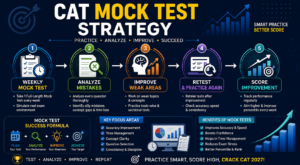
No matter how well you understand the syllabus, your CAT 2027 Preparation remains incomplete without attempting regular CAT Mock Tests. Many students spend months studying concepts but hesitate to take mock tests because they fear low scores. In reality, mock tests are designed to identify your weaknesses before the actual exam, giving you enough time to improve.
If you are serious about How to Crack CAT 2027 in First Attempt, make mock tests an essential part of your CAT Preparation Strategy. They simulate the real exam environment and help you develop the speed, accuracy, and confidence required to perform well on exam day.
Students preparing through CAT Coaching in Bangalore usually receive scheduled mock tests along with detailed performance reports, allowing them to track progress and improve consistently.
Benefits of CAT Mock Tests
Improve Accuracy
Mock tests help reduce silly mistakes by improving your understanding of question patterns and concepts.
Increase Speed
Regular practice trains your brain to solve questions quickly without sacrificing accuracy.
Develop Time Management Skills
One of the biggest challenges in CAT is completing all sections within the allotted time. Mock tests teach you how to divide your time wisely.
Build Confidence
The more mock tests you attempt, the more comfortable you become with the actual exam format.
Identify Weak Areas
Mock test analysis highlights topics that require additional practice, making your CAT Study Plan more effective.
How Many CAT Mock Tests Should You Attempt?
There is no fixed number, but quality matters more than quantity.
A practical approach is:
- Initial Stage: 1 mock test every two weeks.
- Intermediate Stage: 1 mock test every week.
- Final 2 Months: 2–3 full-length mock tests every week.
Remember, simply attempting mock tests is not enough. Spend sufficient time analyzing your performance after every test.
Common Mistakes Students Make During CAT Preparation
Many aspirants fail to achieve their target percentile not because they lack ability, but because they repeat avoidable mistakes. Understanding these mistakes early can save valuable time during your CAT 2027 Preparation.
1. Starting Preparation Too Late
Many students underestimate the CAT Exam and begin preparation only a few months before the exam. Starting early gives you enough time to build concepts and revise effectively.
2. Studying Without a Proper CAT Study Plan
Random preparation often leads to incomplete syllabus coverage and poor revision. A structured CAT Study Plan keeps your preparation organized and consistent
3. Ignoring Reading Habits
Students focusing only on Quantitative Aptitude often neglect Reading Comprehension. Reading newspapers, editorials, and business articles daily improves performance in the VARC section.
4. Skipping CAT Mock Tests
Some aspirants avoid CAT Mock Tests because they fear low scores. However, low scores during preparation are opportunities to learn and improve.
5. Not Analyzing Mock Tests
Taking mock tests without reviewing mistakes limits improvement. Analyze every incorrect answer to understand where you went wrong.
6. Using Too Many Study Materials
Collecting multiple books and online resources often creates confusion. Choose a few trusted resources and revise them thoroughly.
7. Ignoring Weak Areas
Many students repeatedly practice their favorite subjects while avoiding difficult topics. Balanced preparation across VARC, DILR, and QA is essential.
8. Focusing Only on Speed
Speed without accuracy can reduce your overall score due to negative marking. Aim for a balance between speed and precision.
9. Learning New Topics at the Last Moment
The final weeks before the CAT Exam should be dedicated to revision and mock tests rather than starting completely new topics.
10. Losing Confidence After Poor Mock Scores
Mock test scores are meant to improve your preparation, not judge your potential. Stay consistent and continue learning from every attempt.
Expert Tips from CAT Toppers
Although every topper follows a unique preparation journey, some habits are common among high-percentile scorers. Incorporating these habits into your CAT Preparation Strategy can significantly improve your performance.
Build Strong Fundamentals
Before attempting advanced questions, ensure that your basics are clear. Strong concepts make difficult questions easier to solve.
Read Every Day
Reading editorials, magazines, and business articles improves comprehension speed and vocabulary, directly benefiting the VARC section.
Solve Previous Year CAT Papers
Previous year papers help you understand question trends and frequently tested concepts.
Focus on Quality, Not Quantity
Instead of solving hundreds of random questions, practice a smaller number of high-quality questions and understand the solutions thoroughly.
Revise Regularly
Revision strengthens memory and prevents forgetting important formulas and concepts.
Maintain a Mistake Notebook
Record every mistake made during practice or CAT Mock Tests. Reviewing this notebook regularly helps eliminate repeated errors.
Stay Consistent
Success in CAT depends on consistent daily effort rather than studying for long hours occasionally.
Performance Improvement Strategy
If your mock test scores are not improving, do not panic. Instead, focus on continuous improvement through small daily changes.
Every Week
- Revise one completed topic.
- Attempt one sectional test.
- Analyze mistakes.
- Improve one weak area.
Every Month
- Attempt multiple CAT Mock Tests.
- Compare your progress.
- Update your CAT Study Plan.
- Adjust your preparation based on performance.
Small improvements every week can lead to a significant increase in your final percentile.
Motivation During CAT Preparation
Preparing for CAT is a long journey, and it is natural to experience periods of low motivation. During such times, remind yourself of your long-term goal—earning admission to a top MBA college and building a successful career.
Celebrate small achievements, such as completing a difficult topic or improving your mock test score. These milestones keep you motivated and reinforce consistent learning.
Students preparing with Pratishtha Edu benefit from regular mentorship, structured study plans, and continuous guidance that helps them stay focused throughout their preparation journey.
Expert Guidance from Pratishtha Edu
At Pratishtha Edu, we believe that every student has the potential to succeed with the right preparation strategy. Our approach emphasizes concept clarity, regular CAT Mock Tests, personalized mentoring, doubt-clearing sessions, and continuous performance tracking.
Students searching for CAT Coaching in Bangalore often look for more than classroom teaching—they seek guidance, motivation, and a structured roadmap. At Pratishtha Edu, aspirants receive all these elements in a supportive learning environment designed to help them perform confidently in the CAT Exam.
Why Choose Pratishtha Edu for CAT Coaching in Bangalore, FAQs & Conclusion
Why Choose Pratishtha Edu for CAT Coaching in Bangalore?

Choosing the right coaching institute is one of the most important decisions during your CAT 2027 Preparation. While self-study is beneficial, many aspirants prefer structured guidance, regular mentorship, and expert support to stay consistent throughout their preparation journey.
If you are looking for CAT Coaching in Bangalore, selecting an institute that focuses on concept clarity, mock test analysis, personalized mentoring, and continuous performance improvement can make a significant difference.
Pratishtha Edu follows a student-centric approach designed to help aspirants prepare confidently for the CAT Exam through structured learning and practical guidance.
Expert Faculty with Industry & Exam Experience
Learning from experienced faculty helps students understand concepts more effectively. Instead of focusing only on shortcuts, experienced mentors explain fundamental concepts, problem-solving techniques, and exam-oriented approaches.
At Pratishtha Edu, students receive guidance from faculty members who understand the CAT exam pattern and help aspirants prepare systematically.
Comprehensive Study Material
Quality study material saves valuable preparation time.
Students receive structured notes, topic-wise practice questions, sectional assignments, and revision material that simplify the preparation process.
Instead of searching across multiple online resources, aspirants can focus on a single, organized learning path.
Regular CAT Mock Tests & Performance Analysis
One of the strongest aspects of effective CAT Coaching in Bangalore is regular testing.
At Pratishtha Edu, students are encouraged to attempt frequent CAT Mock Tests followed by detailed performance analysis.
Performance reports help students identify:
- Strong areas
- Weak topics
- Accuracy level
- Time management issues
- Section-wise improvement opportunities
This systematic feedback allows aspirants to improve continuously before the actual CAT Exam.
Personalized Mentoring & Doubt Clearing Sessions
Every student learns differently.
Some require additional support in Quantitative Aptitude, while others need guidance in Reading Comprehension or Logical Reasoning.
Personal mentoring ensures that every aspirant receives individual attention and can clarify doubts without delay.
Small Batch Size
Smaller batches allow faculty members to interact more effectively with students.
Individual performance can be monitored regularly, making it easier to provide customized learning strategies and feedback.
Well-Structured CAT Preparation Strategy
Many aspirants fail not because they lack ability, but because they lack direction.
At Pratishtha Edu, students follow a structured CAT Preparation Strategy that includes:
- Daily learning targets
- Weekly revision
- Sectional practice
- Full-length CAT Mock Tests
- Performance tracking
- Regular doubt-clearing sessions
This organized approach helps students remain focused throughout their CAT 2027 Preparation.
Library & Focused Learning Environment
A distraction-free study environment plays an important role in exam preparation.
Students who require a dedicated place for self-study can benefit from structured learning spaces, allowing them to revise, practice, and prepare with better concentration.
Frequently Asked Questions (FAQs)
1. Can I crack CAT 2027 in my first attempt?
Yes. With a structured CAT Study Plan, regular CAT Mock Tests, and consistent practice, many students successfully crack CAT in their first attempt.
2. How many months are enough for CAT 2027 Preparation?
Most aspirants prepare for six to twelve months depending on their academic background, target percentile, and available study time.
3. Is coaching necessary for CAT?
No. Self-study is possible, but expert guidance, structured study plans, mock tests, and mentorship provided through CAT Coaching in Bangalore can help many students prepare more efficiently.
4. How many hours should I study every day?
Quality matters more than the number of hours. Most successful aspirants maintain a consistent schedule of focused study combined with regular revision and practice.
5. Which section is the most difficult in CAT?
The difficulty level varies from student to student. Some find Quantitative Aptitude challenging, while others struggle with DILR or VARC. Balanced preparation is the key to success.
6. Are CAT Mock Tests really important?
Absolutely. CAT Mock Tests improve speed, accuracy, confidence, and time management while helping students identify weak areas before the actual examination.
7. Can working professionals prepare for CAT?
Yes. Many working professionals crack CAT every year by following a realistic study schedule, utilizing weekends effectively, and maintaining consistency.
8. What percentile is considered good in CAT?
The answer depends on your target MBA college. Higher percentiles generally improve admission opportunities at top business schools.
9. Which is the Best CAT Coaching Institute in Bangalore?
Students should look for institutes that provide experienced faculty, structured study materials, regular mock tests, personalized mentoring, and performance analysis. Pratishtha Edu focuses on these essential aspects to support CAT aspirants throughout their preparation journey.
10. What is the best strategy to crack CAT 2027?
A successful strategy includes understanding the syllabus, building strong fundamentals, following a disciplined CAT Study Plan, attempting regular CAT Mock Tests, analyzing performance, and revising consistently.
Conclusion
Cracking CAT is not about studying for endless hours—it is about following the right strategy with discipline and consistency. Whether you are a college student, graduate, repeat aspirant, or working professional, success comes from understanding concepts, practicing regularly, and learning from every mock test.
If your goal is to crack CAT 2027 in the first attempt, begin your preparation early, follow a realistic CAT Preparation Strategy, revise consistently, and never underestimate the importance of CAT Mock Tests.
Students can also make use of the Pratishtha Library for uninterrupted self-study, revision, and mock test practice.
Students searching for reliable CAT Coaching in Bangalore often seek expert guidance, quality study material, and continuous performance tracking. Pratishtha Edu aims to provide a structured learning environment where aspirants can strengthen their concepts, improve problem-solving skills, and prepare confidently for one of India’s most competitive MBA entrance examinations.
With dedication, the right mentorship, and a consistent study plan, your dream of securing admission to a top MBA college can become a reality.
Ready to Start Your CAT Journey?
Take the first step toward your MBA dream with a structured preparation plan.
Join Pratishtha Edu for CAT Coaching in Bangalore and prepare with:
- ✔ Experienced Faculty
- ✔ Comprehensive Study Material
- ✔ Regular CAT Mock Tests
- ✔ Personalized Mentoring
- ✔ Performance Analysis
- ✔ Small Batch Size
- ✔ Dedicated Learning Environment
Start your preparation today and move one step closer to achieving a high CAT percentile.
Leave a Reply