
Preparing for the Graduate Aptitude Test in Engineering (GATE) requires a clear understanding of the syllabus, consistent practice, and a well-planned preparation strategy. For biotechnology students, the GATE Biotechnology paper can open opportunities for higher education, research, and advanced technical careers. However, covering a wide range of subjects and preparing effectively for a competitive examination can be challenging without proper planning and guidance. This is where GATE Biotechnology Coaching in Bangalore can help students follow a structured and focused preparation approach.
Bangalore is one of India’s leading education and technology hubs, attracting students from different parts of the country. With a strong academic environment and a large student community, the city has become a popular destination for aspirants preparing for competitive examinations. Choosing the right GATE Biotechnology coaching institute can help students understand the syllabus, strengthen their core concepts, practise previous year questions, and evaluate their progress through mock tests.
A well-planned GATE Biotechnology preparation strategy should combine conceptual learning, regular revision, problem-solving practice, and performance analysis. At Pratishtha Edu, students can receive academic guidance and structured support to help them approach their preparation in a more organised manner. Whether a student prefers GATE Biotechnology online coaching or classroom-based learning, the right learning environment can make preparation more systematic and consistent.
Why Choose GATE Biotechnology Coaching in Bangalore?
GATE Biotechnology covers several important areas of biotechnology and related subjects. Students need to understand concepts, remember key principles, apply their knowledge to numerical and conceptual questions, and manage their time effectively during the examination. Preparing for all these aspects independently can sometimes become difficult, especially when students are unsure about what to study first or how to evaluate their preparation.
Joining a suitable GATE Biotechnology coaching institute in Bangalore can provide students with a structured academic environment and a clear direction for their preparation.
Experienced Faculty Guidance
One of the major advantages of joining GATE Biotechnology coaching is access to experienced faculty guidance. Biotechnology includes several interconnected subjects, and students may face difficulty understanding complex concepts or identifying the most important areas for examination preparation.
Experienced faculty can help students:
- Understand difficult biotechnology concepts
- Build strong subject fundamentals
- Identify important topics from the syllabus
- Learn effective problem-solving approaches
- Clarify doubts during the preparation process
- Understand common mistakes made in competitive examinations
The guidance of faculty can also help students avoid spending too much time on low-priority topics while ensuring that important concepts are covered properly.
Structured Syllabus Coverage
A complete GATE Biotechnology syllabus includes multiple subjects and topics. Without a structured plan, students may study topics randomly or leave important areas for the final stage of preparation.
A planned coaching programme can help students follow a systematic sequence of topics. The preparation can generally move from fundamental concepts to advanced topics, followed by question practice, revision, and mock tests.
A structured approach helps students:
- Complete the syllabus systematically
- Track their preparation progress
- Allocate sufficient time to different subjects
- Identify topics that require additional practice
- Avoid last-minute preparation pressure
For students preparing for GATE BT in Bangalore, a structured study environment can make it easier to maintain consistency throughout the preparation journey.
Regular Classes and Consistent Learning
Consistency is one of the most important factors in GATE Biotechnology preparation. Studying for a few days and then taking long breaks can make it difficult to retain concepts and maintain momentum.
Regular GATE Biotechnology classes can help students follow a consistent learning routine. A fixed academic schedule encourages students to attend classes regularly, revise topics on time, and continue their preparation according to a planned schedule.
Regular classes may also help students maintain a better balance between:
- Concept learning
- Self-study
- Question-solving practice
- Revision
- Mock test preparation
Whether students choose GATE BT classroom coaching or GATE BT online classes, maintaining a consistent study routine remains essential for effective preparation.
Doubt-Solving Support
Doubts are a natural part of the learning process, especially when students are studying subjects such as molecular biology, biochemistry, genetics, microbiology, cell biology, and bioprocess engineering.
If doubts remain unresolved for a long time, they can affect the understanding of related topics. A proper doubt-solving system allows students to clarify their questions and continue their preparation with better conceptual understanding.
GATE Biotechnology doubt-solving support can help students:
- Clarify difficult concepts
- Understand the correct approach to questions
- Identify conceptual mistakes
- Improve confidence in important subjects
- Avoid repeating the same mistakes
This type of academic support can be particularly helpful during revision and test preparation.
Mock Tests and Test Series
Simply studying the syllabus is not enough for a competitive examination. Students also need to practise answering questions within a limited time.
Regular GATE Biotechnology mock tests and test series can help students evaluate their preparation. Mock tests can provide an opportunity to practise:
- Time management
- Question selection
- Accuracy
- Speed
- Examination strategy
After every test, students should analyse their performance instead of only checking their score. They should identify questions that were answered incorrectly, questions that took too much time, and concepts that require further revision.
Regular testing and analysis can help students gradually improve their overall examination performance.
Previous Year Question Paper Analysis
GATE Biotechnology previous year papers are an important part of preparation. They help students understand the types of questions asked in the examination and the level of conceptual understanding expected.
By solving previous year questions, students can:
- Understand the question pattern
- Identify frequently tested concepts
- Practise the application of theoretical knowledge
- Improve problem-solving skills
- Recognise their weak areas
A good preparation strategy should not treat previous year questions as something to be solved only at the end. They should be included regularly during subject-wise preparation.
Quality Study Material
Having the right study material can make preparation more organised. Students often waste valuable time searching for information from multiple sources or collecting too many books and notes.
Well-organised GATE Biotechnology study material can help students focus on important concepts and revise topics more efficiently. Study resources should ideally support:
- Concept building
- Topic-wise revision
- Formula and fact revision where applicable
- Question practice
- Previous year question analysis
However, study material should be used as a support for learning rather than as a replacement for understanding concepts.
A Competitive Learning Environment
The preparation environment can also influence a student’s consistency and motivation. Studying alongside other serious GATE aspirants can create a focused academic atmosphere.
A dedicated study environment can also help students maintain consistency during long-term GATE Biotechnology preparation. Students who prefer a focused space for self-study can explore Pratishtha Library as part of their regular preparation routine.
A competitive learning environment can encourage students to:
- Maintain regular study habits
- Compare their preparation progress
- Learn from different approaches
- Participate in discussions
- Stay motivated during long-term preparation
For many students, joining a dedicated coaching environment can provide the routine and academic discipline needed for a competitive examination.
Choosing the Right Learning Format: Online or Classroom Coaching
Students preparing for GATE Biotechnology may choose between online and offline learning based on their individual requirements.
GATE Biotechnology Online Coaching
Online coaching can be suitable for students who prefer flexible learning. Students can access classes from different locations and may have more flexibility in managing their study schedule.
Online learning can be useful for students who:
- Prefer studying from home
- Need flexible class timings
- Want to revise recorded lectures
- Are comfortable with digital learning platforms
GATE Biotechnology Offline Coaching
Classroom-based coaching can provide a more traditional learning environment. Students attend regular classes, interact directly with faculty, and participate in an academic environment with other aspirants.
Offline coaching may be suitable for students who:
- Prefer face-to-face interaction
- Need a fixed study routine
- Want direct faculty guidance
- Learn better through classroom discussions
The best choice depends on the student’s learning style, schedule, location, and preparation requirements. The most important factor is not simply whether the classes are online or offline, but whether the learning system provides proper academic guidance, regular practice, doubt-solving support, and performance evaluation.
What Makes a GATE Biotechnology Preparation Approach Effective?
A successful GATE Biotechnology preparation approach should be based on consistency rather than short-term study pressure. Students should create a realistic schedule that includes learning, practice, revision, and testing.
An effective preparation approach generally includes:
- Understanding the complete syllabus
- Building strong fundamentals
- Studying topics systematically
- Solving GATE Biotechnology previous year papers
- Taking regular mock tests
- Revising important concepts frequently
- Analysing mistakes after every test
Students should also remember that preparation strategies can differ from person to person. A plan that works for one student may not work equally well for another. Therefore, students should regularly evaluate their progress and make necessary changes to their study plan.
Why Is GATE Biotechnology Preparation Important?
GATE Biotechnology is an important competitive examination for students who want to pursue advanced education and build a career in biotechnology and related fields. The examination tests a student’s understanding of fundamental concepts, subject knowledge, analytical ability, and problem-solving skills.
For biotechnology graduates and students from related academic backgrounds, a good GATE score can support their plans for higher education, research, and specialised technical opportunities. However, achieving a good result requires more than simply reading textbooks. Students need a systematic GATE Biotechnology preparation strategy that includes concept building, regular practice, revision, and performance analysis.
Opportunities for Higher Education
One of the major reasons students prepare for GATE Biotechnology is the opportunity to pursue postgraduate education at reputed institutions.
A strong GATE score can help eligible candidates explore postgraduate programmes in areas related to:
- Biotechnology
- Bioengineering
- Biological Sciences
- Bioprocess Engineering
- Computational Biology
- Life Sciences
- Related interdisciplinary fields
Higher education allows students to develop advanced knowledge in their chosen area and can also help them explore specialised academic and research opportunities.
Students should always check the admission requirements, eligibility criteria, accepted GATE papers, and admission process of the specific institution or programme they are interested in.
Opportunities at IITs and IISc
Many GATE aspirants aim to pursue postgraduate education at premier institutions such as the Indian Institutes of Technology and the Indian Institute of Science.
Depending on the programme and admission requirements, GATE-qualified candidates may explore opportunities in areas related to:
- Biotechnology
- Bioengineering
- Biological Sciences
- Biomedical Engineering
- Bioprocessing
- Computational Biology
- Interdisciplinary research
Admission criteria can vary between institutions and programmes. Therefore, students should refer to the official admission information of the institution before making academic decisions.
Research and Academic Opportunities
Biotechnology is a research-oriented field with applications in healthcare, agriculture, pharmaceuticals, environmental science, food technology, and industrial biotechnology.
Students who develop a strong academic foundation through GATE Biotechnology preparation may explore further opportunities in:
- Research projects
- Postgraduate research
- Doctoral programmes
- Academic careers
- Scientific and technical roles
A strong understanding of fundamental subjects can be valuable for students who wish to continue in research and advanced scientific fields.
Career Development in Biotechnology
GATE Biotechnology preparation can also help students strengthen their understanding of core biotechnology subjects. Even when students are preparing primarily for the examination, the knowledge gained during preparation can support their long-term academic and professional development.
The biotechnology sector includes several areas such as:
- Pharmaceutical biotechnology
- Molecular biology
- Bioprocess technology
- Bioinformatics
- Agricultural biotechnology
- Environmental biotechnology
- Industrial biotechnology
A strong academic foundation can help students make more informed decisions about their future specialisation.
Stronger Conceptual Foundation
GATE preparation requires students to study fundamental concepts in detail. This can help students improve their understanding of subjects that are important for higher education and research.
Instead of studying topics only for memorisation, students should focus on:
- Understanding the basic principles
- Connecting related concepts
- Applying knowledge to questions
- Revising important topics regularly
- Learning from mistakes
This approach can make preparation more useful beyond the examination itself.
GATE Biotechnology Syllabus
Understanding the complete syllabus is the first step in creating an effective GATE Biotechnology study plan. Students should become familiar with the major subject areas and then divide the syllabus into smaller topics for systematic preparation.
The GATE Biotechnology paper generally includes General Aptitude, Engineering Mathematics, and core Biotechnology topics. The exact syllabus and examination details may be updated by the official examination authorities, so students should always verify the latest information from the official GATE website before beginning their preparation.
General Aptitude
The General Aptitude section tests skills related to language, numerical ability, and logical understanding.
Important areas may include:
- Verbal reasoning
- Reading comprehension
- Basic grammar and vocabulary
- Numerical ability
- Data interpretation
- Logical reasoning
- Quantitative aptitude
Although General Aptitude is common to GATE papers, students should not ignore it. Regular practice can help improve speed and accuracy in this section.
Engineering Mathematics
Engineering Mathematics covers mathematical concepts that may be useful for solving numerical and analytical questions.
Students may need to study areas such as:
- Linear algebra
- Calculus
- Differential equations
- Probability and statistics
- Numerical methods
- Mathematical applications related to the examination syllabus
Students should focus on understanding the basic concepts and practise different types of questions regularly.
Biochemistry
Biochemistry is an important area for Biotechnology aspirants. Students should develop a clear understanding of biological molecules and the biochemical processes associated with them.
Important areas may include:
- Biomolecules
- Proteins
- Carbohydrates
- Lipids
- Nucleic acids
- Enzymes
- Enzyme kinetics
- Metabolic pathways
- Bioenergetics
Conceptual clarity is particularly important because several topics in biochemistry are interconnected.
Microbiology
Microbiology focuses on microorganisms and their biological characteristics.
Students may study:
- Microbial classification
- Microbial growth
- Microbial physiology
- Bacterial structure
- Microbial genetics
- Microbial metabolism
- Viruses
- Microbial techniques
A systematic approach can help students connect the theoretical concepts with their applications.
Molecular Biology
Molecular Biology is a major part of Biotechnology preparation. Students should understand the molecular mechanisms involved in genetic information and cellular processes.
Important topics may include:
- DNA structure
- DNA replication
- Transcription
- Translation
- Gene regulation
- Genetic information flow
- Molecular mechanisms of cells
Students should focus on understanding the sequence and relationship between different biological processes.
Genetics
Genetics covers the principles of heredity and variation.
Important areas include:
- Mendelian genetics
- Genetic linkage
- Recombination
- Chromosomal inheritance
- Mutations
- Population genetics
- Quantitative genetics
Solving conceptual and numerical questions can help students improve their understanding of genetics.
Cell Biology
Cell Biology helps students understand the structure and functioning of cells.
Important topics may include:
- Cell structure
- Cell organelles
- Cell membrane
- Transport mechanisms
- Cell signalling
- Cell cycle
- Cell division
- Cellular communication
Students should focus on understanding how different cellular components work together.
Recombinant DNA Technology
Recombinant DNA technology is an important area of modern biotechnology.
Students may study:
- DNA cloning
- Vectors
- Restriction enzymes
- DNA ligation
- Gene libraries
- Polymerase Chain Reaction
- DNA sequencing
- Genetic engineering techniques
A combination of theoretical understanding and application-based question practice can be useful for this area.
Plant and Animal Biotechnology
This area includes biotechnology applications related to plants and animals.
Topics may include:
- Plant tissue culture
- Plant transformation
- Animal cell culture
- Transgenic organisms
- Applications of biotechnology
- Basic concepts of developmental and reproductive biotechnology
Students should understand both the basic concepts and their practical applications.
Bioprocess Engineering
Bioprocess Engineering combines biological knowledge with engineering principles.
Important areas may include:
- Bioreactors
- Fermentation
- Microbial growth kinetics
- Mass transfer
- Heat transfer
- Downstream processing
- Process control
Numerical practice can be particularly helpful in this section.
Bioinformatics
Bioinformatics applies computational methods to biological data.
Students may study:
- Biological databases
- Sequence analysis
- Sequence alignment
- Basic computational biology concepts
- Genomics
- Proteomics
This area demonstrates the interdisciplinary nature of modern biotechnology.
GATE Biotechnology Exam Pattern
Understanding the examination pattern is important because it helps students plan their preparation and examination strategy.
The examination generally includes different types of questions designed to test conceptual understanding, numerical ability, and analytical skills.
A simplified overview of the major sections is given below:
| Section | Major Areas |
| General Aptitude | Verbal Ability, Numerical Ability and Reasoning |
| Engineering Mathematics | Mathematical and Analytical Concepts |
| Biotechnology | Core Biotechnology Subjects |
The exact number of questions, marks, question types, marking scheme, and section-wise weightage may be updated by the examination authorities. Therefore, students should always verify the latest official GATE Biotechnology examination pattern before preparing their final strategy.
Why Understanding the Exam Pattern Matters
Knowing the exam pattern can help students:
- Plan their study time
- Understand the importance of different sections
- Practise the right types of questions
- Develop a time-management strategy
- Prepare for numerical and conceptual questions
- Analyse previous year papers more effectively
Students should avoid relying only on old information because examination patterns and official guidelines may change over time.
How to Organise the GATE Biotechnology Syllabus
After understanding the syllabus, students should divide the subjects into three broad categories:
Category 1: Strong Subjects
These are subjects in which the student already has a strong conceptual foundation. The focus should be on revision and regular question practice.
Category 2: Moderate Subjects
These subjects require additional concept building and practice. Students should allocate consistent study time to improve their understanding.
Category 3: Weak Subjects
Weak subjects should not be ignored. Students should begin with basic concepts and gradually move towards advanced topics and question practice.
This type of classification can help students create a more realistic GATE Biotechnology study plan.
Importance of Previous Year Questions
Once students complete a topic, they should practise relevant GATE Biotechnology previous year questions. This helps them understand how theoretical concepts are applied in the actual examination.
Students should analyse:
- Which concepts are repeatedly tested
- What type of questions are asked
- Which topics require numerical practice
- Which areas create difficulty
- How much time is required to solve questions
Previous-year papers should be used not only for practice but also to understand the examination approach.
Building a Balanced Preparation Plan
A balanced GATE Biotechnology preparation strategy should include all major components of preparation.
Students should divide their weekly schedule between:
- New topic learning
- Revision
- Previous year question practice
- Mock tests
- Mistake analysis
For example, a student may dedicate the first part of the week to learning new concepts, reserve specific days for question practice, and keep regular time for revision. The exact schedule can be adjusted according to the student’s academic background and available preparation time.
The most important factor is consistency. A realistic study plan followed regularly is generally more useful than an extremely demanding schedule that becomes difficult to maintain.
How to Choose the Best GATE Biotechnology Coaching Institute in Bangalore?
Choosing the right coaching institute is an important decision for students preparing for a competitive examination like GATE. The best GATE Biotechnology Coaching in Bangalore is not necessarily the institute with the biggest advertisements or the highest number of claims. Students should focus on the quality of academic support, faculty guidance, study structure, practice opportunities, and the overall learning environment.
Before joining a GATE BT coaching institute, students should carefully evaluate the following factors.
Faculty Experience and Academic Guidance
Faculty members play an important role in the learning process. Biotechnology includes a wide range of subjects, and students may need guidance to understand complex concepts and connect different topics.
When evaluating GATE Biotechnology faculty, students should consider:
- Subject knowledge
- Teaching experience
- Ability to explain complex concepts clearly
- Availability for doubt solving
- Understanding of competitive examination requirements
- Approach towards problem-solving and revision
Good faculty guidance can help students understand not only what to study but also how to study a particular subject effectively.
Complete Syllabus Coverage
A coaching programme should have a clear plan for covering the complete GATE Biotechnology syllabus. Students should ask whether the course provides sufficient time for all major subject areas.
A well-planned course should include:
- General Aptitude
- Engineering Mathematics
- Core Biotechnology subjects
- Topic-wise practice
- Previous Year Question Papers
- Revision sessions
- Mock tests
Students should avoid joining a programme where the syllabus is covered very quickly without enough time for concept building and practice.
Batch Size and Learning Environment
The batch size can influence the overall classroom experience. A very large batch may sometimes make it difficult for students to interact personally with faculty or ask questions comfortably.
Students should look for a learning environment where:
- Questions can be asked freely
- Doubts receive proper attention
- Students can participate in discussions
- Faculty can monitor academic progress
- The environment remains focused on preparation
A supportive learning environment can help students remain consistent during long-term preparation.
Quality of Study Material
Good study material can help students organise their preparation. Instead of collecting multiple books and resources, students should have access to reliable and relevant learning material.
Well-organised GATE Biotechnology study material can help students focus on important concepts and revise topics more efficiently. Students can also explore Study Materials for additional academic resources and preparation support.
GATE Biotechnology study material may include:
- Subject-wise notes
- Topic summaries
- Practice questions
- Previous year questions
- Revision material
- Mock test resources
However, students should remember that study material is most useful when combined with conceptual understanding and regular practice.
Mock Tests and Performance Analysis
A good GATE Biotechnology coaching programme should provide opportunities for regular testing. Mock tests help students understand their preparation level and develop examination skills.
A useful test series should help students evaluate:
- Accuracy
- Speed
- Time management
- Subject-wise performance
- Weak topics
- Common mistakes
The analysis after a test is as important as the test itself. Students should maintain a record of mistakes and revise the relevant concepts regularly.
Previous Year Question Discussion
GATE Biotechnology previous year papers are valuable preparation resources. Students should not only solve the questions but also understand the concepts behind them.
A coaching programme that includes PYQ discussion can help students:
- Understand the question approach
- Identify important concepts
- Learn different solving methods
- Recognise common question patterns
- Improve application-based understanding
Students should ideally solve PYQs after completing the relevant topic or subject.
Doubt-Solving Facility
Doubt solving is an important part of GATE BT preparation. Students may face difficulties while studying complex topics or solving numerical and application-based questions.
Before joining a coaching programme, students should understand how doubts are handled. They should look for an academic support system that allows them to:
- Ask questions during or after classes
- Clarify conceptual doubts
- Discuss difficult questions
- Understand mistakes
- Receive timely guidance
Regular doubt solving can prevent small misunderstandings from becoming major gaps in preparation.
Online and Offline Learning Options
Different students have different learning preferences. Some students prefer classroom interaction, while others need the flexibility of online learning.
When evaluating GATE Biotechnology online coaching, students should consider:
- Class quality
- Access to learning material
- Lecture availability
- Doubt-solving support
- Test access
- Revision facilities
For GATE BT classroom coaching, students should consider:
- Classroom environment
- Faculty interaction
- Batch schedule
- Location
- Travel time
- Academic support
The right format depends on the student’s learning style, daily schedule, and preparation needs.
Student Support and Academic Guidance
Preparation for GATE is a long-term process. Students may need guidance not only for academic topics but also for study planning, revision, test analysis, and preparation management.
A student-focused coaching environment can help aspirants:
- Create realistic study plans
- Track their progress
- Identify weak areas
- Plan revision
- Improve test performance
Students should choose a coaching institute that focuses on helping them develop a consistent preparation routine.
Location and Accessibility
For students choosing offline GATE Biotechnology classes in Bangalore, location is also an important factor.
Students should consider:
- Distance from home or college
- Daily travel time
- Class timings
- Accessibility
- Availability of study facilities
A convenient location can help students attend classes regularly and maintain consistency in their preparation.
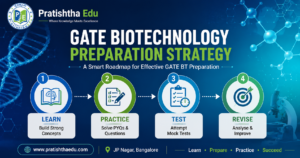
GATE Biotechnology Preparation Strategy
A well-planned GATE Biotechnology preparation strategy should include conceptual learning, question practice, revision, and regular performance evaluation. Students should avoid depending on last-minute preparation because the syllabus covers several subjects and requires consistent study.
The following strategy can help students approach their preparation in a systematic manner.
Understand the Complete Syllabus
The first step in GATE Biotechnology preparation is to understand the complete syllabus. Students should divide the syllabus into individual subjects and topics.
After creating a syllabus list, students can classify topics as:
- Easy
- Moderate
- Difficult
This classification can help students decide where to begin and how much time to allocate to different subjects.
Students should also identify the subjects in which they already have a strong academic foundation. These subjects can be revised more quickly, allowing additional time for weaker areas.
Build Strong Fundamentals
Strong fundamentals are essential for GATE Biotechnology preparation. Students should focus on understanding concepts instead of only memorising information.
While studying a topic, students should ask:
- What is the basic concept?
- How does the process work?
- Why does the process occur?
- How is the concept applied?
- What type of questions can be asked from this topic?
Conceptual learning can help students solve questions that are presented in unfamiliar formats.
For subjects such as Biochemistry, Molecular Biology, Genetics, Cell Biology, and Bioprocess Engineering, students should focus on understanding the relationship between different concepts.
Study One Topic at a Time
Students should avoid studying too many subjects simultaneously during the initial stage of preparation.
A better approach is to:
- Select one subject
- Divide it into smaller topics
- Study the concepts
- Solve practice questions
- Attempt relevant PYQs
- Revise the subject
This approach helps students complete subjects systematically and reduces confusion.
Solve GATE Biotechnology Previous Year Questions
Previous year questions should be an important part of the preparation strategy. Students should begin solving PYQs after gaining a basic understanding of a topic.
Students can also refer to official GATE previous year question papers for additional practice and to understand the types of questions asked in the examination.
While solving previous year questions, students should focus on:
- Understanding the question
- Identifying the relevant concept
- Applying the correct approach
- Checking the solution
- Analysing mistakes
Students should maintain a PYQ notebook or digital record of difficult questions and important concepts for future revision.
Take Regular GATE Biotechnology Mock Tests
Mock tests help students practise the examination environment. However, students should not wait until the final weeks of preparation before taking tests.
A gradual testing approach can be useful:
- Topic-wise tests during subject preparation
- Subject-wise tests after completing a subject
- Mixed-subject tests during revision
- Full-length tests during the final stage
After each test, students should analyse:
- Incorrect answers
- Unanswered questions
- Questions that took too much time
- Calculation mistakes
- Conceptual mistakes
- Questions answered through guessing
This analysis can provide valuable information about the student’s preparation.
Revise Consistently
Revision is essential because the GATE Biotechnology syllabus includes a wide range of topics. Without regular revision, students may forget concepts studied several weeks or months earlier.
A practical revision approach can include:
- Short revision after completing a topic
- Weekly revision of important concepts
- Monthly revision of completed subjects
- Full revision before the examination
Students can use short notes, concept maps, important formulas, diagrams, and mistake notebooks to make revision more efficient.
Analyse Your Mistakes
Mistake analysis is one of the most overlooked parts of preparation. Students often focus on their test scores but do not carefully examine why they made mistakes.
After a test, students should classify mistakes such as:
Conceptual Mistakes
The student did not understand the underlying concept.
Solution: Revisit the topic and study the concept again.
Silly Mistakes
The student knew the concept but made an avoidable error.
Solution: Slow down and improve question-reading accuracy.
Time-Management Mistakes
The student spent too much time on one question.
Solution: Practise time management and learn when to move to the next question.
Question-Interpretation Mistakes
The student misunderstood what the question was asking.
Solution: Read questions carefully and practise different question formats.
A mistake notebook can help students track recurring errors and prevent them from repeating the same mistakes.
Creating a Daily Study Routine
A realistic daily routine is important for long-term preparation. Students should create a schedule based on their college, work, or other responsibilities.
A daily study routine may include:
- Concept learning
- Question practice
- Revision
- PYQ solving
- Doubt clarification
Students do not necessarily need to study for extremely long hours every day. A consistent and focused study routine is generally more sustainable than an unrealistic schedule.
The study plan should also include breaks and sufficient time for rest. Maintaining physical and mental freshness can help students remain consistent throughout the preparation journey.
How GATE Biotechnology Coaching Can Support Preparation
A structured coaching programme can support students by providing academic guidance, a planned syllabus schedule, regular practice, and performance evaluation.
At Pratishtha Edu, the objective of a student-focused preparation approach is to help aspirants follow a more organised learning process. Support such as structured classes, subject guidance, practice resources, doubt-solving assistance, and test preparation can help students manage the different stages of GATE Biotechnology preparation more effectively.
However, coaching alone does not guarantee success. Students must also attend classes regularly, revise consistently, solve questions, analyse their performance, and maintain discipline throughout their preparation.
Recommended Study Plan for GATE Biotechnology
A well-planned study schedule can help students manage the extensive GATE Biotechnology syllabus in a more organised manner. However, every student has a different academic background, learning speed, and amount of time available for preparation. Therefore, the following six-month GATE Biotechnology study plan should be used as a general framework and adjusted according to individual requirements.
The objective of a six-month plan should not be to study everything at the same time. Instead, students should gradually move through concept building, subject preparation, question practice, revision, and mock tests.
Month 1–2: Build Strong Basic Concepts
The first two months should focus on understanding the fundamentals of the major subjects.
Students should begin by reviewing the complete GATE Biotechnology syllabus and identifying their strong and weak areas. After that, they can create a subject-wise preparation schedule.
During this phase, students should focus on:
- Understanding basic concepts
- Completing important fundamental topics
- Creating concise study notes
- Solving basic practice questions
- Identifying difficult topics
- Revising topics regularly
Subjects such as Biochemistry, Molecular Biology, Cell Biology, Genetics, and Microbiology may require strong conceptual understanding. Students should avoid rushing through these subjects without understanding the basic principles.
At this stage, students should focus more on learning than on achieving high mock test scores.
Suggested Approach for the First Two Months
| Focus Area | Preparation Activity |
| Syllabus | Understand and divide the complete syllabus |
| Concepts | Study fundamental topics |
| Notes | Create short revision notes |
| Practice | Solve basic and topic-wise questions |
| Revision | Revise completed topics regularly |
The first two months create the foundation for the rest of the preparation. Students who build strong fundamentals during this phase may find advanced question practice easier later.
Month 3–4: Complete Core Subjects and Practise PYQs
The third and fourth months should focus on completing the remaining core subjects and increasing question-solving practice.
By this stage, students should have already covered a significant portion of the fundamental topics. The focus can now gradually shift towards:
- Completing the remaining syllabus
- Solving GATE Biotechnology previous year questions
- Practising numerical questions
- Revising previously completed subjects
- Identifying weak areas
- Taking topic-wise and subject-wise tests
Students should not wait until the end of the preparation to solve PYQs. Previous year questions should be solved alongside subject preparation.
For example, after completing a particular topic, students can solve the relevant questions from previous examinations. This approach helps students understand how concepts are tested.
Suggested Approach for Months 3 and 4
| Focus Area | Preparation Activity |
| Core Subjects | Complete remaining major topics |
| PYQs | Solve topic-wise and subject-wise questions |
| Practice | Increase question-solving speed |
| Revision | Revise earlier subjects |
| Testing | Take regular topic and subject tests |
Students should maintain a record of questions that they find difficult. These questions can be revised again during the final months.
Month 5: Revision and Mock Test Practice
The fifth month should focus heavily on revision and performance evaluation.
By this stage, students should aim to have completed most of the syllabus. The focus should now move towards identifying knowledge gaps and improving examination performance.
Students should:
- Revise important subjects
- Solve mixed-topic questions
- Attempt regular mock tests
- Analyse test performance
- Revise mistakes
- Improve time management
Mock Test Analysis
After every mock test, students should carefully review their performance.
They should analyse:
- Total score
- Accuracy
- Time spent
- Incorrect questions
- Unattempted questions
- Conceptual mistakes
- Repeated mistakes
The purpose of a mock test is not only to obtain a score. The real benefit comes from understanding how the performance can be improved.
If a student repeatedly makes mistakes in a particular topic, that topic should be added to the revision schedule.
Month 6: Full Revision and Test Practice
The final month should focus on consolidating preparation rather than learning a large number of new topics.
Students should revise:
- Important concepts
- Short notes
- Frequently tested topics
- Previous year questions
- Mistake notebooks
- Important numerical approaches
Full-length GATE Biotechnology mock tests can be attempted regularly during this stage.
Students should also practise developing an examination strategy. They should understand:
- Which questions to attempt first
- How much time to spend on difficult questions
- When to skip a question
- How to avoid unnecessary mistakes
The final month should also focus on maintaining confidence and avoiding unnecessary stress.
Six-Month GATE Biotechnology Study Plan
| Preparation Stage | Main Focus |
| Month 1–2 | Basic Concepts and Fundamental Subjects |
| Month 3–4 | Core Subjects, PYQs and Regular Practice |
| Month 5 | Revision and Mock Tests |
| Month 6 | Full Revision and Test Practice |
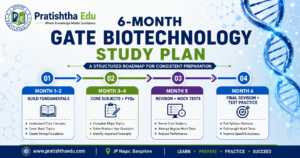
This plan can be adjusted based on the student’s academic background and the amount of time available before the examination.
How to Manage College or Work Alongside GATE Preparation
Many GATE Biotechnology aspirants prepare while attending college or managing other responsibilities. In such cases, time management becomes important.
Students can divide their available time into smaller study sessions.
For example:
Weekdays
- Concept learning
- Short revision
- Practice questions
Weekends
- Longer study sessions
- Subject revision
- Mock tests
- Performance analysis
Students should create a realistic timetable rather than copying a schedule designed for someone with completely different responsibilities.
The most important factor is consistency. Even a few focused hours of study every day can become valuable when maintained over a long preparation period.
Benefits of Joining GATE Biotechnology Coaching
Self-study can be an effective method for many students. However, some students benefit from structured academic guidance and a planned learning environment.
Joining GATE Biotechnology Coaching can provide support in different stages of preparation.
Expert Academic Guidance
Students may sometimes find it difficult to decide:
- Which topic to study first
- How much time to allocate to each subject
- Which resources to use
- How to approach difficult topics
- When to start mock tests
Faculty guidance can help students develop a more organised approach to these questions.
Experienced faculty can also help explain complex concepts and guide students towards more effective problem-solving methods.
Structured Preparation
A structured programme can provide students with a planned sequence of learning.
Instead of spending time creating a complete preparation system from the beginning, students can follow an academic schedule that includes:
- Classes
- Topic coverage
- Practice
- Revision
- Tests
This structure can help students maintain a regular preparation routine.
Regular Practice
Regular practice is essential for competitive examinations. A coaching environment can encourage students to solve questions consistently rather than postponing practice until the end of the syllabus.
Regular practice can help improve:
- Accuracy
- Speed
- Concept application
- Question-solving confidence
Students should combine classroom learning with independent practice to obtain the maximum benefit from coaching.
Doubt-Solving Support
Students may face doubts while studying different biotechnology subjects. Timely doubt-solving can help prevent gaps in understanding.
A proper academic support system can help students:
- Clarify difficult concepts
- Understand incorrect answers
- Discuss challenging questions
- Improve conceptual understanding
Students should actively ask questions instead of allowing doubts to accumulate.
Mock Tests and Test Series
Regular GATE Biotechnology mock tests can help students understand their preparation level.
A structured test programme can provide opportunities for:
- Topic-wise testing
- Subject-wise testing
- Mixed-topic testing
- Full-length examination practice
The performance analysis after each test can help students identify areas that need improvement.
Study Material and Revision Support
Organised study material can help students save time and focus on relevant concepts.
Students may use study resources for:
- Learning concepts
- Revising important topics
- Practising questions
- Reviewing mistakes
However, students should avoid collecting too many resources. The goal should be to understand and revise reliable material consistently.
Students looking for additional academic resources can also explore NPTEL Biotechnology courses to strengthen their understanding of selected biotechnology and related subjects.
Personalised Academic Guidance
Every student has different strengths and weaknesses. Some students may be strong in molecular biology but require more practice in bioprocess engineering. Others may need additional support in mathematics or general aptitude.
Personalised academic guidance can help students identify:
- Strong subjects
- Weak subjects
- Topics requiring more revision
- Test performance gaps
- Areas requiring additional practice
At Pratishtha Edu, a student-focused preparation approach can help aspirants organise their preparation around their academic needs. Structured learning, regular practice, doubt-solving support, and test preparation can provide a more systematic framework for GATE Biotechnology preparation.
However, students should remember that coaching is a support system. The outcome also depends on regular attendance, self-study, consistent revision, question practice, and disciplined preparation.
Creating a Personal Revision System
Students should create a simple system to track their preparation.
A preparation tracker may include:
| Area | Status |
| Syllabus Completion | Completed / Pending |
| Topic Revision | Completed / Pending |
| PYQ Practice | Completed / Pending |
| Mock Test | Attempted / Pending |
| Mistake Analysis | Completed / Pending |
This simple system can help students understand their actual progress instead of relying only on how much time they have spent studying.
Staying Consistent During Long-Term Preparation
GATE Biotechnology preparation can take several months, and motivation may not remain the same every day. Students should therefore focus on developing a routine rather than depending only on motivation.
Helpful habits include:
- Following a realistic study schedule
- Setting weekly goals
- Tracking progress
- Taking regular breaks
- Revising consistently
- Learning from mistakes
- Avoiding unnecessary comparison with others
Preparation should be viewed as a long-term process. Small improvements made consistently can contribute significantly to overall performance.
GATE Biotechnology Preparation Without Coaching vs With Coaching
Students preparing for GATE Biotechnology often wonder whether coaching is necessary for achieving their preparation goals. The answer depends on several factors, including a student’s academic foundation, self-discipline, available study time, learning style, and ability to create and follow a structured preparation plan.
Some students are comfortable preparing independently, while others benefit from faculty guidance, structured classes, regular tests, and academic support. Both approaches can work when followed with consistency and dedication.
The following comparison can help students understand the difference between self-study and structured coaching support.
| Without Coaching | With Coaching |
| Students need to create their own study plan | Students can follow a structured study schedule |
| Self-planning is required | Academic planning and guidance are available |
| Doubts may take more time to resolve | Faculty support can help clarify doubts |
| Students need to find and organise study resources | Organised study material may be available |
| Test schedule must be created independently | Regular mock tests and test series may be provided |
| Students analyse their own performance | Faculty guidance can support test analysis |
| Preparation strategy is self-created | Students can receive guidance on preparation methods |
| Progress tracking is managed independently | Structured academic monitoring may be available |
Preparing Without Coaching
Self-study can be a suitable option for students who are disciplined, comfortable with independent learning, and capable of creating a realistic study plan.
Students preparing independently should focus on:
- Understanding the complete syllabus
- Selecting reliable study resources
- Creating a realistic timetable
- Studying concepts systematically
- Solving previous year questions
- Taking regular mock tests
- Analysing mistakes
- Revising consistently
The main challenge of self-study is not always access to information. Today, students can find a large amount of information online. The bigger challenge is selecting relevant resources, maintaining consistency, and knowing whether the preparation is progressing in the right direction.
Students preparing independently should avoid collecting too many books, notes, videos, and online resources. Too many resources can sometimes create confusion and reduce the time available for actual study and revision.
Preparing With Coaching
A structured GATE Biotechnology coaching programme can provide academic support throughout different stages of preparation.
Students may benefit from:
- Planned syllabus coverage
- Faculty guidance
- Regular classes
- Doubt-solving support
- Organised study material
- Previous year question discussion
- Mock tests
- Performance analysis
Coaching can be particularly useful for students who find it difficult to create and follow their own preparation schedule.
However, joining a coaching programme does not replace self-study. Students still need to revise concepts, solve questions, practise PYQs, and analyse their performance regularly.
Which Approach Is Better?
There is no single preparation method that is best for every student.
Self-study may be suitable for students who:
- Have strong fundamentals
- Can maintain discipline independently
- Are comfortable selecting study resources
- Can create and follow a preparation plan
Coaching may be helpful for students who:
- Need structured preparation
- Prefer faculty guidance
- Want regular classes
- Need doubt-solving support
- Benefit from a competitive learning environment
- Want regular mock tests and academic evaluation
The best approach is the one that helps a student study consistently and improve continuously.
Frequently Asked Questions About GATE Biotechnology Coaching
Which is the best GATE Biotechnology Coaching in Bangalore?
The best GATE Biotechnology coaching institute depends on the student’s individual requirements. Students should evaluate factors such as faculty experience, syllabus coverage, study material, doubt-solving support, mock tests, previous year question practice, class format, and learning environment before choosing an institute.
Students looking for GATE Biotechnology Coaching in Bangalore should focus on the quality of academic support rather than choosing an institute only based on advertisements or general claims.
Is coaching necessary for GATE Biotechnology preparation?
Coaching is not compulsory for every student. Many students prepare through self-study, while others benefit from structured coaching and faculty guidance.
Students who are disciplined and comfortable with independent preparation may be able to prepare effectively on their own. However, students who need a structured study plan, regular academic guidance, doubt-solving, and test support may find coaching useful.
The most important factors are consistent preparation, conceptual understanding, regular practice, revision, and performance analysis.
How long does it take to prepare for GATE Biotechnology?
The preparation time depends on the student’s academic foundation, available study time, and familiarity with the syllabus.
A focused six-month preparation plan can provide a structured framework for many students. However, some students may prefer to begin preparation earlier, especially if they need additional time to build their fundamentals.
A longer preparation period can provide more time for:
- Concept building
- Syllabus completion
- Previous year question practice
- Revision
- Mock tests
Students should choose a preparation timeline that is realistic for their individual situation.
What subjects are included in the GATE Biotechnology syllabus?
The GATE Biotechnology syllabus generally includes General Aptitude, Engineering Mathematics, and core Biotechnology subjects.
Important subject areas may include:
- Biochemistry
- Microbiology
- Molecular Biology
- Genetics
- Cell Biology
- Recombinant DNA Technology
- Plant and Animal Biotechnology
- Bioprocess Engineering
- Bioinformatics
The exact syllabus and examination requirements may change, so students should always verify the latest official information before starting their preparation.
Can Biotechnology students prepare for GATE without coaching?
Yes, Biotechnology students can prepare through self-study if they have the discipline and planning required for long-term preparation.
Students preparing without coaching should create a structured plan that includes:
- Syllabus study
- Concept building
- Question practice
- Previous year papers
- Mock tests
- Revision
- Mistake analysis
However, students who face difficulty in creating a study plan or resolving academic doubts may benefit from structured GATE Biotechnology coaching.
Does Pratishtha Edu provide GATE Biotechnology Coaching in Bangalore?
Pratishtha Edu is an educational institute that provides guidance and preparation support for students preparing for competitive and entrance examinations. Students interested in GATE Biotechnology coaching should contact the institute directly to confirm the latest course details, available batches, class format, faculty information, and admission-related information.
The right coaching programme should help students follow a systematic preparation approach that combines concept learning, regular practice, doubt solving, revision, and mock test preparation.
Is GATE Biotechnology online coaching better than classroom coaching?
Both online and classroom coaching have their own advantages.
Online coaching can provide flexibility and may be suitable for students who prefer learning from home or require flexible schedules.
Classroom coaching can provide direct interaction with faculty and a structured academic environment.
The better option depends on the student’s learning preferences, schedule, location, and academic requirements.
How important are GATE Biotechnology mock tests?
Mock tests are an important part of examination preparation. They help students practise answering questions under time constraints and evaluate their preparation.
Mock tests can help students improve:
- Time management
- Accuracy
- Speed
- Question selection
- Examination confidence
Students should also analyse their performance after every test to identify areas that require improvement.
Are GATE Biotechnology previous year papers important?
Yes, previous year papers are valuable preparation resources. They help students understand the types of questions asked and the level of conceptual application expected.
Students should use previous year papers to:
- Practise questions
- Identify important concepts
- Understand question patterns
- Analyse weak areas
- Improve problem-solving skills
PYQs should be combined with concept study and regular revision.
What are the career opportunities after GATE Biotechnology?
GATE Biotechnology preparation can support students who wish to explore higher education and research opportunities in biotechnology and related fields.
Depending on their qualifications, interests, and institutional eligibility requirements, students may explore areas such as:
- Biotechnology
- Bioengineering
- Bioprocess Engineering
- Biological Sciences
- Bioinformatics
- Pharmaceutical Biotechnology
- Research and Development
Career opportunities can vary based on the student’s educational qualifications, specialisation, experience, and further academic choices.
How can students improve their GATE Biotechnology preparation?
Students can improve their preparation by following a consistent and structured approach.
Important habits include:
- Understanding the complete syllabus
- Building strong fundamentals
- Studying regularly
- Solving previous year questions
- Taking mock tests
- Analysing mistakes
- Revising consistently
- Maintaining a realistic study plan
Students should focus on continuous improvement instead of comparing their preparation with others.
What should students look for in GATE Biotechnology study material?
Good study material should be clear, relevant, and aligned with the examination syllabus.
Students should look for material that supports:
- Concept learning
- Topic-wise revision
- Question practice
- Previous year question analysis
- Short revision
Students should avoid depending on too many sources. A limited number of reliable resources, used consistently, can be more useful than collecting a large amount of material.
What is the role of General Aptitude in GATE Biotechnology preparation?
General Aptitude is an important part of the GATE examination. Students should practise it regularly instead of leaving it for the final stage.
Regular practice can help improve:
- Numerical ability
- Verbal ability
- Logical reasoning
- Reading comprehension
- Speed and accuracy
Students can include short General Aptitude practice sessions in their weekly study plan.
How should students revise before the GATE Biotechnology examination?
Revision should be planned throughout the preparation rather than postponed until the final month.
Students can use:
- Short notes
- Important concepts
- Mistake notebooks
- Previous year questions
- Mock test analysis
During the final stage, students should focus on consolidating what they have already studied and avoid unnecessary confusion by continuously changing their study resources.
Conclusion
Preparing for the GATE Biotechnology examination requires a combination of strong conceptual understanding, regular practice, consistent revision, and effective time management. Since the syllabus covers multiple areas of biotechnology, students need a systematic approach to complete the syllabus and prepare effectively for the examination.
For students searching for GATE Coaching in Bangalore, choosing the right learning environment can help make the preparation journey more organised. Students specifically preparing for Biotechnology can then explore specialised GATE Biotechnology Coaching in Bangalore options based on their subject requirements. Faculty guidance, structured classes, study material, doubt-solving support, previous year question practice, mock tests, and regular performance analysis can support students during different stages of preparation.
However, coaching is only one part of the preparation process. Students also need to attend classes regularly, revise concepts, solve questions, practise previous year papers, analyse their mistakes, and maintain consistency throughout their preparation.
A practical GATE Biotechnology preparation strategy should begin with understanding the complete syllabus and building strong fundamentals. Students can then gradually move towards subject-wise preparation, PYQ practice, revision, mock tests, and full-length examination practice. Creating a realistic six-month study plan can also help students manage their time and track their progress more effectively.
At Pratishtha Edu, students preparing for competitive examinations can explore structured academic guidance and preparation support. A student-focused learning approach can help aspirants follow a more organised preparation routine and work towards improving their conceptual understanding and examination readiness.
Whether a student chooses self-study, GATE Biotechnology online coaching, or GATE BT classroom coaching, the key factors remain the same: consistency, discipline, conceptual clarity, regular practice, and continuous improvement.
With the right preparation strategy and a consistent approach, students can work towards their academic goals and explore future opportunities in higher education, research, and biotechnology-related fields.
Leave a Reply