
The UGC NET Management 2027 examination is an important opportunity for candidates seeking to build an academic, teaching, research, or higher education career in the field of Management. Conducted through the National Testing Agency (NTA) on behalf of the University Grants Commission, the UGC NET examination evaluates candidates across Paper 1 and their chosen subject in Paper 2.
For Management aspirants, understanding the syllabus and examination structure before starting preparation can make the entire study process more organised. The subject covers a wide range of areas, including management principles, organisational behaviour, human resource management, marketing, financial management, strategic management, operations, entrepreneurship, business environment, and research-related concepts.
Before beginning your preparation, it is important to understand the UGC NET Management Syllabus 2027, eligibility requirements, exam pattern, important topics, and preparation strategy. Candidates should also regularly check the official UGC NET website for the latest notification, examination schedule, syllabus updates, and other official announcements.
Whether you are preparing for the examination for the first time or planning to improve your previous performance, a systematic approach can help you manage the extensive syllabus more effectively. Along with subject preparation, candidates should also give adequate attention to Paper 1, previous year questions, mock tests, revision, and time management.
What is UGC NET Management 2027?
UGC NET Management 2027 is the Management subject examination conducted under the UGC-NET framework for candidates interested in qualifying for academic and research-oriented opportunities. Management is one of the subjects offered under UGC NET, and candidates are assessed through subject-specific questions in Paper 2 along with the common Paper 1.
The examination is particularly relevant for candidates who want to develop a career in higher education, teaching, research, and related academic fields.
Management as a subject covers both theoretical and practical concepts. Therefore, preparation requires more than simply memorising definitions. Candidates should understand management principles and learn how different concepts are applied in organisational and business situations.
The major areas of preparation include:
- Principles and functions of management
- Organisational behaviour
- Human resource management
- Marketing management
- Financial management
- Operations and production management
- Business environment
- International business
- Strategic management
- Entrepreneurship
- Research methodology
- Business research concepts
A clear understanding of these areas can help candidates build a strong foundation for further preparation.
Why is UGC NET Management Important?
Qualifying UGC NET can be an important step for candidates interested in pursuing an academic or research-oriented career. Depending on the applicable rules and eligibility conditions, qualification can support opportunities related to Assistant Professor positions, Junior Research Fellowship (JRF), and higher research studies.
For Management graduates and postgraduates, the examination also provides an opportunity to strengthen their understanding of important business and organisational concepts.
Preparation for the examination can help candidates develop several useful skills, including:
- Analytical thinking
- Research skills
- Problem-solving ability
- Academic writing
- Conceptual understanding
- Business awareness
- Critical thinking
However, qualifying for UGC NET should not be viewed as an automatic guarantee of employment. Candidates should always check the eligibility requirements and recruitment rules applicable to the specific institution or position they wish to pursue.
Who Should Prepare for UGC NET Management?
UGC NET Management can be considered by candidates who have an appropriate academic background and satisfy the eligibility conditions prescribed in the latest official notification.
It can be particularly relevant for:
- Management postgraduate students
- MBA and related postgraduate degree holders
- Candidates interested in teaching Management
- Students planning to pursue research in Management
- Candidates interested in JRF opportunities
- Aspirants planning to pursue a PhD
- Candidates interested in academic and higher-education careers
Before applying, candidates should carefully verify the current eligibility requirements rather than relying only on information from older examination cycles.
What Does the UGC NET Management Preparation Include?
Effective UGC NET Management Preparation requires a combination of conceptual learning, regular practice, revision, and self-assessment.
A good preparation process can be divided into the following stages:
Understand the Syllabus → Learn Concepts → Prepare Notes → Solve PYQs → Take Mock Tests → Analyse Mistakes → Revise
Candidates should begin by studying the official syllabus and dividing it into smaller units. Instead of trying to complete the entire syllabus at once, focus on one topic at a time and gradually build your subject knowledge.
Along with Management, candidates should not completely ignore Paper 1. Regular Paper 1 practice can help maintain a balance between general aptitude preparation and subject-specific preparation.
Candidates looking for structured academic guidance can also explore UGC NET Coaching in Bangalore and other preparation resources according to their individual learning requirements.
How to Start UGC NET Management Preparation
The first step is to become familiar with the complete syllabus and examination pattern. Once you understand what needs to be studied, create a realistic study schedule based on your available time.
Start with the fundamental concepts of Management and gradually move towards more advanced topics. While studying, prepare concise notes that can be used during revision.
For example, while studying organisational behaviour, connect concepts such as motivation, leadership, communication, group behaviour, and organisational culture rather than treating each topic as an isolated definition.
Similarly, while studying Marketing Management, understand how concepts such as segmentation, targeting, positioning, consumer behaviour, product, pricing, promotion, and distribution are connected.
This concept-based approach can make revision easier and improve your ability to apply knowledge while solving examination questions.
Building a Strong Foundation for UGC NET Management
A strong foundation is particularly important because Management includes several interconnected areas. Concepts studied in one section can often help you understand topics in another section.
For example, understanding organisational behaviour can support your preparation for Human Resource Management. Similarly, knowledge of the business environment and organisational strategy can help you understand strategic management more effectively.
Therefore, avoid preparing every topic only through isolated definitions. Instead, try to understand:
Concept → Application → Example → Related Topic → Question Practice
Candidates should also maintain a separate revision section for important definitions, theories, models, management thinkers, formulas where applicable, and frequently confusing concepts.
Using reliable UGC NET Study Material alongside your primary preparation resources can also help organise revision, provided the material is aligned with the prescribed syllabus and current examination requirements.
A consistent preparation routine, combined with proper resources and regular practice, can make the broad UGC NET Management syllabus much easier to approach.
UGC NET Management 2027 Highlights and Eligibility Criteria
Before starting detailed preparation, candidates should understand the basic features of the examination. Knowing the exam structure helps you plan your study time and understand how Paper 1 and Paper 2 contribute to the overall examination.
UGC NET Management 2027 Highlights
The following table provides a quick overview of UGC NET Management 2027:
| Particular | Details |
| Examination | UGC NET |
| Subject | Management |
| Subject Code | 17 |
| Conducting Agency | National Testing Agency (NTA) |
| Examination Mode | Computer-Based Test |
| Papers | Paper 1 and Paper 2 |
| Paper 1 | General Teaching & Research Aptitude |
| Paper 2 | Management |
| Question Type | Multiple Choice Questions |
| Language | English and Hindi, subject to applicable examination rules |
| Negative Marking | As per the latest official notification |
| Official Information | NTA UGC NET |
Candidates should verify the latest examination notification before applying because examination-related details, dates, and applicable rules may be updated for a particular cycle. For accurate information, always refer to the official UGC NET notification and the official UGC NET website.
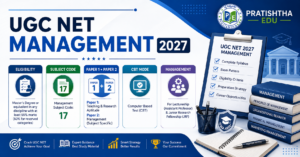
UGC NET Management Eligibility Criteria 2027
Understanding eligibility is an important step before beginning the application process. Candidates should check the latest official requirements carefully because eligibility may depend on educational qualifications, marks, category, and other applicable conditions.
Educational Qualification
Candidates generally need to have a recognised postgraduate degree or an equivalent qualification in the relevant field as prescribed under the UGC-NET eligibility rules.
Management graduates and candidates with relevant postgraduate qualifications should carefully check the subject-specific eligibility requirements before selecting Management as their UGC NET subject.
Candidates who are currently pursuing their qualifying postgraduate degree may also be eligible under the conditions specified in the official notification. Such candidates must satisfy the required qualification within the prescribed period.
Minimum Marks
The minimum marks requirement depends on the applicable UGC-NET rules and category of the candidate.
Candidates should check the latest notification for the exact percentage requirements applicable to:
- General category candidates
- Other eligible reserved categories
- Candidates with applicable relaxations
Do not rely on eligibility percentages mentioned in older preparation materials without checking the latest official notification.
Age Limit
The age criteria can differ depending on the purpose for which a candidate is applying.
For candidates interested in JRF, an applicable upper-age limit may be prescribed, along with relaxations for eligible categories according to the prevailing rules.
There is generally a different eligibility framework for candidates appearing for Assistant Professor eligibility. Candidates should therefore carefully check the latest official notification before applying.
Age Relaxation
Eligible candidates may receive age relaxation according to the rules applicable to their category and the specific UGC-NET qualification they are seeking.
The exact relaxation should always be verified from the current notification because rules can change between examination cycles.
Who Can Apply for UGC NET Management?
Candidates who satisfy the prescribed educational and other eligibility conditions can apply for UGC NET Management.
Before submitting the application form, candidates should verify:
- Their postgraduate qualification
- Required marks
- Category-related eligibility
- JRF age requirements, where applicable
- Subject selection
- Other conditions mentioned in the official notification
Checking these requirements in advance can help candidates avoid problems during the application process.
UGC NET Management Subject Code
Management is listed as Subject Code 17 under UGC NET.
Candidates should select the correct subject while completing the application form and verify the subject code from the latest official information before submission.
Choosing the correct subject is important because Paper 2 is based on the selected subject and its prescribed syllabus.
UGC NET Management: Paper 1 and Paper 2
The UGC NET examination includes two papers that candidates need to prepare for.
Paper 1
Paper 1 is common for candidates across different UGC NET subjects and focuses on general teaching and research aptitude.
Important areas include:
- Teaching Aptitude
- Research Aptitude
- Reading Comprehension
- Communication
- Mathematical Reasoning
- Logical Reasoning
- Data Interpretation
- Information and Communication Technology
- People, Development and Environment
- Higher Education System
Candidates should include Paper 1 in their regular study schedule instead of leaving it entirely for the final stage.
Paper 2
Paper 2 is subject-specific and focuses on Management.
This paper requires detailed knowledge of Management concepts and topics prescribed in the official syllabus.
The major areas of preparation include:
- Management principles
- Organisational behaviour
- Human resource management
- Marketing management
- Financial management
- Operations management
- Business environment
- International business
- Strategic management
- Entrepreneurship
- Research methodology
How to Check UGC NET Management Eligibility Before Applying
Before filling out the application form, candidates should follow a simple verification process:
Step 1: Check the latest official UGC-NET notification.
Step 2: Verify your postgraduate qualification.
Step 3: Check the minimum marks requirement applicable to your category.
Step 4: Review the JRF age criteria if you are applying for JRF.
Step 5: Confirm that Management is the appropriate subject for your academic background.
Step 6: Read all instructions provided in the official application notification.
This process can help candidates make an informed decision before submitting their application.
Why Understanding Eligibility Matters
Eligibility should be checked before investing significant time in preparation. A candidate may have strong Management knowledge but still need to satisfy specific academic and procedural requirements to appear for the examination.
Therefore, candidates should treat the latest official notification as the primary source of information for eligibility.
If you need additional academic resources while preparing, you can also explore Study Material designed to support structured learning and revision.
Candidates who prefer a dedicated environment for regular study can also consider Pratishtha Library as part of their preparation routine.
A clear understanding of eligibility, subject selection, and available preparation resources can help candidates begin their UGC NET Management preparation with greater confidence.
UGC NET Management 2027 Important Dates and Exam Pattern
After understanding the eligibility requirements, candidates should become familiar with the examination schedule and detailed pattern of UGC NET Management 2027. Knowing the examination structure in advance helps you plan your preparation, revision, and mock-test practice more effectively.
UGC NET Management 2027 Important Dates
The exact dates for the UGC NET Management 2027 examination should be taken from the latest official notification issued by the National Testing Agency. Candidates should avoid relying on unofficial websites or dates from previous examination cycles.
| Examination Event | Date |
| Official Notification | To be announced |
| Application Form Begins | To be announced |
| Last Date to Submit Application | To be announced |
| Application Correction Window | To be announced |
| Admit Card | To be announced |
| UGC NET Examination | To be announced |
| Provisional Answer Key | To be announced |
| Answer Key Challenge Window | To be announced |
| Result Declaration | To be announced |
Candidates should regularly check the official UGC NET website and the latest official UGC NET notification for confirmed dates, instructions, and examination updates.
Important Application Steps
The application process generally involves the following steps:
- Check the latest official notification.
- Register through the prescribed application portal.
- Enter personal and academic details.
- Select the appropriate UGC NET subject.
- Upload the required documents.
- Pay the applicable examination fee.
- Review all details carefully.
- Submit the application form.
- Save the confirmation page and relevant records.
Candidates should carefully check all information before submitting the application to avoid errors during the application process.
UGC NET Management Exam Pattern 2027
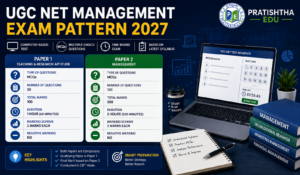
Understanding the UGC NET Management Exam Pattern is essential because it helps candidates decide how much time should be allocated to Paper 1 and Paper 2.
The examination consists of two papers:
- Paper 1 – General Teaching and Research Aptitude
- Paper 2 – Management
Both papers are conducted as part of the same examination process.
UGC NET Paper 1 Exam Pattern
Paper 1 is common to candidates across different UGC NET subjects. It evaluates teaching and research aptitude along with reasoning, comprehension, communication, data interpretation, ICT, and other prescribed areas.
The major areas include:
- Teaching Aptitude
- Research Aptitude
- Reading Comprehension
- Communication
- Mathematical Reasoning and Aptitude
- Logical Reasoning
- Data Interpretation
- Information and Communication Technology
- People, Development and Environment
- Higher Education System
Candidates should prepare Paper 1 alongside their Management preparation instead of postponing it until the final stage.
UGC NET Paper 2 Management Exam Pattern
Paper 2 is the subject-specific paper for candidates appearing in Management.
The questions are based on the prescribed UGC NET Management Syllabus 2027 and cover different areas of Management.
Major preparation areas include:
- Management principles
- Organisational behaviour
- Human resource management
- Marketing management
- Financial management
- Operations management
- Business environment
- International business
- Strategic management
- Entrepreneurship
- Research methodology
Paper 2 requires detailed subject knowledge, so candidates should study each unit systematically and regularly practise questions related to the topics they have completed.
UGC NET Management Marking Scheme
Candidates should understand the marking system before beginning extensive mock-test practice.
The examination uses objective-type questions, and candidates should attempt questions carefully rather than relying on random guessing.
The current examination rules should always be verified from the latest official notification, particularly for details related to:
- Number of questions
- Marks per question
- Total marks
- Examination duration
- Negative marking
- Question paper language
- Examination instructions
Candidates should avoid relying on outdated information from previous examination cycles.
UGC NET Management Question Types
The Management paper can test candidates on different forms of subject knowledge, including:
Concept-Based Questions
These questions check your understanding of important Management concepts, principles, theories, and terminology.
Application-Based Questions
These questions may require you to apply a Management concept to a business or organisational situation.
Match-the-Following Questions
Candidates may need to connect concepts such as:
Management Thinker → Theory
or
Concept → Definition
or
Author/Model → Contribution
Statement-Based Questions
These questions provide multiple statements and ask candidates to identify the correct combination.
Chronology-Based Questions
Candidates may need to arrange Management theories, thinkers, developments, or events in the correct sequence.
Because different question formats can be used, preparation should include both conceptual study and regular question practice.
How to Prepare According to the UGC NET Management Exam Pattern
Once you understand the exam structure, your preparation should be divided into three major areas.
1. Management Subject Preparation
Spend the majority of your subject-specific preparation time covering the prescribed Management syllabus.
Focus on understanding concepts rather than memorising isolated definitions.
2. Paper 1 Preparation
Reserve regular time for Paper 1 topics such as teaching aptitude, research aptitude, reasoning, comprehension, ICT, and data interpretation.
3. Practice and Revision
After completing a topic, solve relevant questions and revise the concepts where mistakes occur.
A simple preparation cycle is:
Learn → Practise → Analyse → Revise
UGC NET Management Preparation: Paper 1 vs Paper 2
Candidates should maintain a balance between the two papers.
A sample study routine could look like this:
| Study Activity | Focus |
| Session 1 | Management concepts |
| Session 2 | Management unit/topic |
| Session 3 | Paper 1 |
| Session 4 | PYQs and revision |
The exact time allocation can be adjusted according to your strengths and weaknesses.
If you already have a strong background in Management, you can devote more time to weaker areas such as Paper 1, research methodology, or specific Management units where your accuracy is low.
Why Previous Year Questions Matter
Once you have completed a topic, begin solving UGC NET Management Previous Year Questions related to that area.
PYQs can help you understand:
- How concepts are tested
- Which areas need deeper study
- Your level of preparation
- Common question patterns
- Topics where you make repeated mistakes
For example, after completing Human Resource Management, solve relevant questions before moving completely to the next unit.
Do not simply record your score. Analyse every incorrect answer and identify why you selected the wrong option.
How Mock Tests Fit Into Your Preparation
Mock tests should be introduced gradually.
During the initial stage, use topic-wise tests. As your syllabus coverage improves, move towards sectional tests and eventually full-length tests.
A useful progression is:
Topic Test → Sectional Test → Full-Length Mock → Mistake Analysis → Revision
The purpose of a mock test is not only to measure your score. It should also help you improve:
- Accuracy
- Time management
- Question selection
- Conceptual clarity
- Examination confidence
Regular practice combined with reliable UGC NET Study Material can make revision and self-assessment more organised.
UGC NET Management Exam Preparation Timeline
A simple preparation cycle can be divided into three stages.
Stage 1: Syllabus Coverage
Understand the syllabus and complete the fundamental concepts of each unit.
Stage 2: Practice
Start solving PYQs and topic-wise questions after completing individual units.
Stage 3: Revision and Testing
Move towards full-length mock tests, revision notes, and repeated practice of weak areas.
This approach prevents candidates from leaving all revision and question practice until the final weeks.
UGC NET Management Syllabus 2027: Complete Unit-Wise Syllabus

The UGC NET Management Syllabus 2027 covers a broad range of concepts related to management, business, organisations, finance, marketing, human resources, operations, strategy, entrepreneurship, and research. Candidates should study the syllabus systematically instead of trying to memorise all topics at once.
Before starting preparation, always compare your study material with the official UGC NET syllabus and the latest examination notification so that you are preparing according to the applicable syllabus.
Unit 1: Management, Principles and Functions
This unit focuses on the basic concepts, principles, functions, and approaches of management.
Important areas include:
- Meaning, nature, scope, and significance of management
- Management as an art, science, and profession
- Functions of management
- Planning and decision-making
- Organising and staffing
- Directing and controlling
- Principles of management
- Management thought and evolution of management theories
- Classical, neo-classical, and modern approaches
- Contributions of major management thinkers
- Authority, responsibility, delegation, and decentralisation
- Coordination and control
- Managerial roles and skills
- Corporate governance and management practices
A strong understanding of basic management principles is important because these concepts are connected with several other areas of the UGC NET Management syllabus.
Unit 2: Organisational Behaviour
Organisational Behaviour focuses on how individuals and groups behave within organisations.
Important topics include:
- Meaning and scope of organisational behaviour
- Individual behaviour
- Personality
- Perception
- Attitudes and values
- Learning
- Motivation
- Theories of motivation
- Leadership
- Leadership theories and approaches
- Group dynamics
- Team development
- Communication
- Organisational conflict
- Conflict management
- Power and politics
- Organisational culture
- Organisational climate
- Organisational change
- Stress management
- Workplace behaviour
Candidates should focus on understanding major theories and their practical applications rather than memorising definitions alone.
Unit 3: Human Resource Management
Human Resource Management deals with managing people and developing human resources within an organisation.
Important areas include:
- Meaning and importance of HRM
- Human resource planning
- Job analysis
- Job description and job specification
- Recruitment
- Selection
- Placement and induction
- Training and development
- Career planning
- Performance appraisal
- Performance management
- Compensation management
- Incentives and rewards
- Employee welfare
- Employee engagement
- Industrial relations
- Grievance handling
- Labour-related issues
- Human resource development
- Strategic human resource management
Candidates should understand the relationship between HR policies and organisational performance.
Unit 4: Marketing Management
Marketing Management focuses on identifying customer needs, creating value, and developing strategies to reach target markets.
Important topics include:
- Meaning, nature, and scope of marketing
- Marketing concepts and philosophies
- Marketing environment
- Consumer behaviour
- Market segmentation
- Targeting
- Positioning
- Marketing mix
- Product decisions
- Product life cycle
- Branding
- Packaging and labelling
- Pricing decisions
- Promotion
- Advertising
- Sales promotion
- Personal selling
- Public relations
- Distribution channels
- Retailing
- Digital marketing
- Relationship marketing
- Services marketing
- Customer relationship management
While preparing Marketing Management, candidates should connect theoretical concepts with practical business situations.
Unit 5: Financial Management
Financial Management focuses on planning, managing, and controlling the financial resources of an organisation.
Important areas include:
- Meaning and objectives of financial management
- Financial planning
- Time value of money
- Capital budgeting
- Investment decisions
- Cost of capital
- Capital structure
- Sources of finance
- Working capital management
- Dividend decisions
- Risk and return
- Financial analysis
- Ratio analysis
- Leverage
- Profit planning
- Cash management
- Receivables management
- Inventory management
Candidates should pay particular attention to concepts involving calculations and numerical applications. Regular practice can improve speed and accuracy in these areas.
How to Study the UGC NET Management Syllabus Effectively
The syllabus becomes easier to manage when it is divided into smaller study blocks. Instead of attempting several units simultaneously, candidates can complete one major topic, revise it, and then move to the next.
A useful approach is:
Understand → Make Notes → Practise Questions → Revise → Test Yourself
While preparing, maintain separate notes for:
- Important definitions
- Management theories
- Major thinkers
- Models and frameworks
- Important concepts
- Formulas and calculations
- Frequently confused topics
- Previous year question patterns
Candidates can also use structured UGC NET Study Material to supplement their preparation, provided the material is updated and aligned with the prescribed syllabus.
Regular revision is particularly important because the Management syllabus contains many interconnected concepts. Revisiting completed topics at regular intervals can improve retention and help candidates identify areas that require additional practice.
UGC NET Management Syllabus 2027: Units 6–10 and Important Topics
The remaining areas of the UGC NET Management Syllabus 2027 cover operations, business environment, strategic management, entrepreneurship, and research. These sections require both conceptual understanding and regular question practice.
Unit 6: Operations and Production Management
Operations and Production Management deals with the planning, organisation, and control of processes involved in producing goods and delivering services.
Important topics include:
- Meaning and scope of operations management
- Production systems
- Types of production
- Production planning and control
- Capacity planning
- Facility location
- Plant layout
- Productivity
- Work study
- Inventory management
- Materials management
- Quality management
- Total Quality Management
- Statistical quality control
- Supply chain management
- Logistics management
- Scheduling
- Maintenance management
- Operations strategy
- Service operations management
Candidates should understand how operations decisions influence productivity, cost, quality, and customer satisfaction.
Unit 7: Business Environment and International Business
This area focuses on the external factors that influence business organisations and the growing importance of international business.
Important topics include:
- Meaning and components of business environment
- Economic environment
- Political and legal environment
- Social and cultural environment
- Technological environment
- Competitive environment
- Government and business
- Globalisation
- Liberalisation and privatisation
- International trade
- Foreign exchange
- Balance of payments
- Foreign direct investment
- International financial institutions
- International business strategies
- Multinational corporations
- International market entry strategies
- Global business environment
Candidates should understand how changes in the external environment can affect business decisions and organisational strategies.
Unit 8: Strategic Management
Strategic Management focuses on long-term planning and the development of strategies that help organisations achieve their objectives.
Important areas include:
- Meaning and importance of strategic management
- Strategic management process
- Vision and mission
- Environmental analysis
- SWOT analysis
- Internal and external analysis
- Competitive analysis
- Corporate-level strategy
- Business-level strategy
- Functional strategies
- Competitive advantage
- Growth strategies
- Diversification
- Strategic alliances
- Mergers and acquisitions
- Strategy implementation
- Strategic control
- Evaluation of strategies
- Corporate governance
- Business ethics
Candidates should understand how organisations formulate, implement, and evaluate strategies in changing business environments.
Unit 9: Entrepreneurship and Small Business Management
This unit focuses on entrepreneurship, innovation, new venture creation, and the management of small businesses.
Important topics include:
- Meaning and nature of entrepreneurship
- Entrepreneurial characteristics
- Types of entrepreneurs
- Entrepreneurial motivation
- Entrepreneurial process
- Opportunity identification
- Business idea generation
- Innovation and creativity
- Business plan
- Feasibility analysis
- New venture creation
- Sources of entrepreneurial finance
- Startup management
- Small business management
- Family business
- Social entrepreneurship
- Women entrepreneurship
- Entrepreneurial ecosystem
- Government support for entrepreneurship
- Problems faced by small businesses
Candidates should focus on both entrepreneurial concepts and their practical application in business situations.
Unit 10: Research Methodology and Business Research
Research Methodology is an important area for candidates preparing for UGC NET because research aptitude is relevant to both examination preparation and future academic work.
Important topics include:
- Meaning and nature of research
- Objectives of research
- Types of research
- Research approaches
- Research process
- Research problem
- Research questions
- Literature review
- Research design
- Exploratory research
- Descriptive research
- Experimental research
- Qualitative and quantitative research
- Sampling methods
- Probability and non-probability sampling
- Data collection methods
- Primary and secondary data
- Questionnaire and interview methods
- Hypothesis formulation
- Variables
- Measurement and scaling
- Data analysis
- Interpretation of research findings
- Research report writing
- Research ethics
- Plagiarism
- Citation and referencing
Candidates should practise research-related questions regularly because these topics require clarity of concepts as well as familiarity with research terminology.
UGC NET Management Important Topics
The complete syllabus is extensive, so candidates should identify important areas that require repeated revision and practice.
Management and Organisational Behaviour
Give particular attention to:
- Management theories
- Management thinkers
- Functions of management
- Motivation theories
- Leadership theories
- Group behaviour
- Organisational culture
- Conflict management
- Organisational change
Human Resource Management
Important areas include:
- Human resource planning
- Recruitment and selection
- Training and development
- Performance appraisal
- Compensation
- Employee relations
- Strategic HRM
Marketing Management
Focus on:
- Marketing concepts
- Consumer behaviour
- Segmentation, targeting, and positioning
- Marketing mix
- Product life cycle
- Pricing
- Promotion
- Distribution
- Digital marketing
- Relationship marketing
Financial Management
Candidates should revise:
- Capital budgeting
- Cost of capital
- Capital structure
- Working capital
- Dividend decisions
- Risk and return
- Financial analysis
- Leverage
Strategic Management
Important areas include:
- SWOT analysis
- Environmental analysis
- Competitive strategies
- Corporate strategies
- Business-level strategies
- Strategic implementation
- Strategic control
- Competitive advantage
Research Methodology
Candidates should give special attention to:
- Research design
- Research methods
- Sampling
- Hypothesis
- Data collection
- Measurement and scaling
- Data analysis
- Research ethics
- Report writing
How to Identify High-Priority Topics
Candidates should not assume that a topic is important only because it appears frequently in preparation books. A better approach is to compare the official syllabus with UGC NET Management Previous Year Questions and analyse the topics that repeatedly require practice.
Create three categories:
High Priority: Topics that require frequent revision and question practice.
Medium Priority: Topics that are understood but need periodic revision.
Revision Priority: Topics where you make repeated mistakes in tests or PYQs.
This approach allows you to spend more time on areas that actually need improvement instead of giving equal study time to every topic.
Creating Unit-Wise Revision Notes
Short and organised notes can make revision much easier during the final preparation stage.
For every unit, maintain notes containing:
- Key concepts
- Important theories
- Major thinkers
- Important models
- Definitions
- Formulas, wherever applicable
- Commonly confused concepts
- Previous year question references
- Mistakes made during practice
Avoid copying entire chapters into your revision notebook. The purpose of revision notes is to help you quickly recall important information before tests and examinations.
A combination of official syllabus analysis, reliable UGC NET Study Material, previous year questions, and regular revision can help candidates cover the Management syllabus in a structured manner.
UGC NET Management Preparation Strategy 2027

A well-planned UGC NET Management Preparation Strategy can help candidates complete the syllabus systematically while maintaining enough time for revision and practice. Since the Management syllabus includes multiple areas, preparation should focus on conceptual clarity, regular practice, previous year questions, and mock-test analysis.
Instead of trying to study everything at once, divide your preparation into manageable phases and set realistic weekly targets.
Step 1: Understand the Complete Syllabus
Begin your preparation by downloading or reviewing the latest official syllabus. Divide the syllabus into individual units and subtopics.
Make a checklist of all topics and mark each one as:
- Not Started
- In Progress
- Completed
- Revised
- Needs More Practice
This simple system can help you track your progress and prevent important topics from being overlooked.
Step 2: Build Your Management Fundamentals
Start with the fundamental concepts before moving to more complex topics.
Understand the basic principles of:
- Management
- Organisational Behaviour
- Human Resource Management
- Marketing
- Finance
- Operations
- Strategic Management
- Entrepreneurship
- Business Environment
- Research Methodology
A strong conceptual foundation can make advanced topics easier to understand and remember.
Step 3: Prepare Unit-Wise Notes
Prepare concise notes while studying each unit. Include important definitions, theories, models, thinkers, formulas, examples, and concepts that you find difficult.
Avoid making extremely lengthy notes. Your revision notes should be easy to read when you are preparing for mock tests or revising the complete syllabus.
Step 4: Practise UGC NET Management Previous Year Questions
Once you complete a topic, solve relevant UGC NET Management Previous Year Questions.
PYQs help you understand how theoretical concepts are converted into examination questions. They can also reveal areas where your conceptual understanding needs improvement.
After every practice session, review incorrect answers and identify the reason for each mistake.
Step 5: Focus on Conceptual Understanding
Management preparation should not depend entirely on memorisation.
For every important concept, try to understand:
Meaning → Theory → Characteristics → Application → Example → Question Pattern
For example, while studying leadership theories, understand what each theory proposes, how the theories differ, and how questions can be framed around them.
Step 6: Prepare Paper 1 Alongside Management
Paper 2 should receive significant attention because it is your chosen subject, but Paper 1 should also be included in your daily or weekly study schedule.
Important Paper 1 areas include:
- Teaching Aptitude
- Research Aptitude
- Reasoning
- Reading Comprehension
- Communication
- Data Interpretation
- ICT
- Higher Education
- People, Development and Environment
Regular Paper 1 practice can help prevent the common mistake of leaving the entire paper for the final stage.
UGC NET Management Study Plan
A flexible study plan can be divided into three major phases.
Phase 1: Syllabus Completion
Focus on understanding and completing the prescribed Management syllabus.
During this phase:
- Study concepts systematically
- Prepare short notes
- Complete units one by one
- Practise basic questions
- Begin Paper 1 preparation
Phase 2: Practice and Strengthening
After completing a significant portion of the syllabus, increase question practice.
Focus on:
- Previous year questions
- Topic-wise tests
- Sectional tests
- Difficult concepts
- Repeated mistakes
- Revision notes
Phase 3: Revision and Mock Tests
The final stage should focus more heavily on revision and examination practice.
Use:
- Full-length mock tests
- Previous year papers
- Short revision notes
- Formula revision
- Important theories
- Weak-topic practice
Do not spend the entire final stage learning completely new material. Prioritise revision and accuracy.
3-Month UGC NET Management Study Plan
Candidates with approximately three months available for preparation can follow a flexible schedule.
Month 1: Build the Foundation
Focus on completing the fundamental Management concepts and beginning Paper 1.
Study topics systematically and prepare concise notes.
At the end of each week, revise the topics covered during that week.
Month 2: Complete the Syllabus and Practise
Complete the remaining major units and increase PYQ practice.
Start taking topic-wise and sectional tests.
Pay special attention to topics where your accuracy is low.
Month 3: Revision and Mock Tests
Use the final month primarily for revision and testing.
Take regular full-length mock tests and analyse your performance after every test.
Revise:
- Important theories
- Management thinkers
- Key concepts
- Formulas
- Difficult topics
- Frequently repeated mistakes
Daily Study Routine for UGC NET Management
There is no single study schedule that works for every candidate. Your routine should depend on your available time, academic background, and preparation level.
A sample routine can include:
| Study Session | Activity |
| Session 1 | Management concept study |
| Session 2 | Unit-wise topic preparation |
| Session 3 | Paper 1 preparation |
| Session 4 | PYQs or practice questions |
| Session 5 | Revision and mistake analysis |
Candidates with limited daily study time can combine shorter sessions rather than trying to follow an unrealistic timetable.
Best Books and Study Resources for UGC NET Management
Choosing the right study resources is important, but using too many books can make preparation unnecessarily complicated.
Candidates should ideally maintain a limited resource set consisting of:
- One reliable source for Management concepts
- A current UGC NET Management syllabus
- A good collection of previous year questions
- Practice or mock-test resources
- Concise revision notes
- Reliable UGC NET Study Material
Before purchasing or using any preparation book, check whether its content matches the latest syllabus.
Avoid depending entirely on outdated editions because Management concepts, examination patterns, and syllabus requirements can change.
How to Use Study Material Effectively
Study material should support your preparation rather than replace active learning.
A useful method is:
Read → Understand → Make Notes → Practise → Revise
Do not simply read the same material repeatedly without testing yourself.
After completing a topic, close your notes and try to recall the major concepts. Then solve questions to check whether you can apply what you have learned.
How to Improve Accuracy in UGC NET Management
Accuracy is particularly important when candidates are attempting a large number of objective questions.
To improve accuracy:
- Read questions carefully
- Identify keywords
- Eliminate clearly incorrect options
- Avoid unnecessary guessing
- Review repeated mistakes
- Practise similar question types
- Analyse mock-test performance
Maintain a mistake notebook containing questions or concepts that you repeatedly get wrong.
Review this notebook regularly during revision.
How to Manage Revision Effectively
Revision should not be postponed until the end of your preparation.
A simple revision cycle can be:
First Revision → After Completing a Topic
Second Revision → After Completing the Unit
Third Revision → During Mock-Test Preparation
Final Revision → Before the Examination
This spaced revision approach can help reinforce concepts and reduce the amount of information you need to relearn at the last moment.
Candidates can also use a structured Study Material resource and a suitable study environment such as Pratishtha Library to maintain consistency during their preparation.
UGC NET Management Previous Year Questions and Mock Test Strategy
Solving UGC NET Management Previous Year Questions is one of the most useful ways to understand the examination and improve preparation. Previous year questions help candidates identify how Management concepts are tested and which areas require additional revision.
Instead of solving PYQs only after completing the entire syllabus, candidates should start practising them after completing individual topics or units.
How to Use Previous Year Questions Effectively
Follow a structured approach while solving previous year questions:
- Complete a topic or unit.
- Solve relevant PYQs.
- Check your answers.
- Analyse incorrect responses.
- Identify the concept behind each mistake.
- Revise the topic.
- Attempt similar questions again.
Do not focus only on your score. The main purpose of PYQ practice is to understand question patterns and identify gaps in your preparation.
Maintain a PYQ Mistake Notebook
Create a separate section for questions you answer incorrectly or concepts that repeatedly confuse you.
For each mistake, record:
- Question topic
- Correct answer
- Reason for the correct answer
- Why your selected option was incorrect
- Related concept
- Revision date
This can become a valuable resource during the final revision stage.
UGC NET Management Mock Test Strategy
Regular UGC NET Management Mock Test practice can help candidates improve accuracy, speed, and confidence.
Begin with topic-wise tests and gradually move towards complete mock tests.
A useful progression is:
Topic Test → Unit Test → Sectional Test → Full-Length Mock Test
During the early preparation stage, focus more on understanding your mistakes. As the examination approaches, pay greater attention to time management and question selection.
How to Analyse a Mock Test
After completing a mock test, divide your questions into four categories:
| Category | Meaning |
| Correct & Confident | Strong area |
| Correct but Uncertain | Needs revision |
| Incorrect | Requires concept review |
| Not Attempted | Needs further practice |
This analysis is more useful than simply checking your total score.
Common Mistakes to Avoid in UGC NET Management Preparation
Many candidates struggle not because they lack study material, but because their preparation approach is inconsistent.
1. Studying Without the Syllabus
Starting preparation without understanding the complete syllabus can lead to unnecessary study and missed topics.
Always keep the prescribed syllabus available while preparing.
2. Depending Only on Memorisation
Management includes many theories, models, and definitions, but memorisation alone is not enough.
Try to understand how concepts work and how they are applied.
3. Ignoring Paper 1
Focusing entirely on Management and postponing Paper 1 can create unnecessary pressure during the final stage.
Include Paper 1 regularly in your preparation routine.
4. Using Too Many Books
Collecting multiple books does not necessarily improve preparation.
Choose reliable resources and complete them properly before adding additional material.
5. Avoiding Previous Year Questions
Reading theory without solving questions makes it difficult to understand how concepts are tested.
Start PYQ practice as soon as you complete individual topics.
6. Taking Mock Tests Without Analysis
A mock test is valuable only when you analyse your mistakes.
After every test, identify weak topics and revise them.
7. Leaving Revision Until the End
The Management syllabus is extensive, so delaying revision can make it difficult to retain previously studied topics.
Use regular revision cycles throughout your preparation.
UGC NET Management Career Opportunities

Qualifying UGC NET Management can support candidates interested in academic and research-oriented career paths, subject to the applicable eligibility and recruitment requirements.
Assistant Professor
Candidates who qualify the relevant UGC NET eligibility requirements may pursue opportunities related to teaching in higher education institutions, subject to institutional recruitment rules and other applicable qualifications.
Junior Research Fellowship
Candidates who qualify for JRF according to the applicable criteria may pursue research opportunities and can explore academic research in areas related to Management.
PhD and Research
UGC NET qualification can also be useful for candidates planning to pursue doctoral-level research.
Management offers several potential research areas, including:
- Human Resource Management
- Marketing
- Finance
- Organisational Behaviour
- Strategic Management
- Operations Management
- Entrepreneurship
- International Business
- Consumer Behaviour
- Business Analytics
Academic and Research Careers
Candidates with a strong academic background in Management may explore careers in:
- Universities
- Colleges
- Research institutions
- Business schools
- Academic projects
- Research organisations
- Higher education
The exact opportunities available to a candidate depend on their qualifications, UGC NET result category, institution-specific requirements, and applicable recruitment rules.
Skills to Develop Alongside UGC NET Management Preparation
Preparing for the examination can also be an opportunity to develop skills that are useful for academic and professional growth.
Important skills include:
- Research methodology
- Analytical thinking
- Communication
- Academic writing
- Data interpretation
- Presentation skills
- Critical thinking
- Problem-solving
- Time management
Candidates interested in an academic career should especially develop research and communication skills alongside their examination preparation.
How to Stay Consistent During Preparation
Consistency is more important than studying for extremely long hours for a few days and then taking extended breaks.
Set realistic weekly targets and monitor your progress.
A simple weekly review can include:
- Topics completed
- Topics pending
- PYQs attempted
- Mock-test score
- Accuracy percentage
- Weak areas
- Topics requiring revision
If your performance is not improving, do not simply increase the number of study hours. First identify the reason behind the problem and change your preparation method accordingly.
A balanced combination of syllabus coverage, UGC NET Management Preparation, PYQs, mock tests, revision, and reliable study resources can help candidates approach the examination with greater confidence.
UGC NET Management 2027: Final Preparation Tips and Frequently Asked Questions
A successful UGC NET Management Preparation Strategy requires consistency, conceptual clarity, regular practice, and repeated revision. Candidates should focus on completing the syllabus systematically rather than trying to cover everything at the last moment.
The final stage of preparation should be used to strengthen weak areas, revise important concepts, solve previous year questions, and take mock tests under examination-like conditions.
Final Revision Strategy for UGC NET Management
During the final revision stage, focus on high-value concepts and topics where you have made mistakes previously.
Revise:
- Management theories and principles
- Important management thinkers
- Organisational behaviour theories
- Human Resource Management concepts
- Marketing concepts and models
- Financial management formulas and concepts
- Operations management
- Strategic management frameworks
- Entrepreneurship concepts
- Research methodology
- Paper 1 important topics
Avoid spending excessive time creating new notes during the final stage. Use concise revision notes and previously prepared study material.
One-Week Revision Strategy
During the final week, candidates can organise their revision around short and focused sessions.
| Day | Main Focus |
| Day 1 | Management and Organisational Behaviour |
| Day 2 | Human Resource Management |
| Day 3 | Marketing Management |
| Day 4 | Financial and Operations Management |
| Day 5 | Business Environment and Strategic Management |
| Day 6 | Entrepreneurship and Research Methodology |
| Day 7 | Important concepts, mistakes and Paper 1 revision |
The exact schedule can be adjusted according to your preparation level and weaker areas.
Tips for the Day Before the Examination
Candidates should avoid attempting to learn large amounts of new material immediately before the examination.
Instead:
- Revise short notes
- Review important concepts
- Go through frequently repeated mistakes
- Keep examination documents ready
- Check the examination centre details
- Follow the instructions provided on the admit card
- Get adequate rest
- Avoid unnecessary last-minute stress
A calm and organised approach can help you perform more effectively.
UGC NET Management Frequently Asked Questions
Is UGC NET Management difficult?
The difficulty level can vary from candidate to candidate. The Management syllabus is broad and includes several theoretical and application-based concepts. With systematic preparation, regular revision, PYQ practice, and mock tests, candidates can improve their understanding and examination performance.
How should I start UGC NET Management Preparation?
Start by understanding the latest syllabus and examination pattern. Divide the syllabus into units, study the concepts systematically, prepare concise notes, solve previous year questions, and regularly revise completed topics.
How important are previous year questions for UGC NET Management?
Previous year questions are highly useful for understanding question patterns, identifying important concepts, and evaluating preparation. Candidates should solve PYQs after completing individual topics and analyse their mistakes carefully.
Should I prepare Paper 1 and Paper 2 together?
Yes. It is generally better to include Paper 1 in your preparation schedule rather than leaving it entirely for the final stage. A balanced study routine can help you prepare for both papers systematically.
How many hours should I study for UGC NET Management?
No fixed number of hours guarantees success. Your study time should depend on your current knowledge, available preparation period, and personal schedule. Consistent and focused study is generally more useful than following an unrealistic timetable.
Which topics should I revise more frequently?
Give additional revision time to concepts you frequently get wrong in PYQs and mock tests. Important theories, models, formulas, management thinkers, research concepts, and difficult topics should also be included in regular revision.
Are mock tests necessary for UGC NET Management?
Mock tests are useful for improving speed, accuracy, time management, and examination confidence. More importantly, candidates should analyse their mock-test performance and revise the concepts responsible for incorrect answers.
Can I prepare for UGC NET Management without coaching?
Yes, candidates can prepare through self-study if they have a clear study plan, reliable resources, the latest syllabus, previous year questions, and regular practice. Coaching can provide additional structure and guidance, but consistent self-study remains an important part of preparation.
Candidates who prefer structured academic guidance can explore suitable UGC NET Coaching in Bangalore based on their learning requirements.
UGC NET Management Preparation Checklist
Before the examination, make sure you have:
- Completed the prescribed syllabus
- Revised all major units
- Solved previous year questions
- Attempted mock tests
- Analysed your mistakes
- Prepared concise revision notes
- Revised important theories and concepts
- Practised Paper 1
- Reviewed difficult topics
- Organised your examination documents
Final Thoughts on UGC NET Management 2027
The UGC NET Management 2027 examination requires a planned and consistent approach. Because the syllabus covers multiple areas of Management, candidates should avoid relying solely on last-minute preparation.
Start with the official syllabus, build strong conceptual knowledge, prepare concise notes, practise previous year questions, and regularly evaluate your progress through mock tests.
A combination of UGC NET Management Preparation, Paper 1 practice, revision, PYQs, and reliable UGC NET Study Material can help candidates develop a structured preparation routine.
Candidates should also keep checking the official UGC-NET information for the latest notification, eligibility requirements, examination dates, syllabus updates, and other important instructions.
With consistent preparation, regular self-assessment, and focused revision, candidates can approach the UGC NET Management examination with greater confidence and better preparation.
Leave a Reply