
Preparing for UGC NET Management requires more than simply completing the syllabus. Candidates need a clear understanding of the examination structure, strong conceptual knowledge, regular practice, effective revision, and a realistic preparation plan. For students in Bengaluru, choosing the right learning environment can also make preparation more organized and consistent.
If you are searching for UGC NET Management Coaching in Bangalore, it is useful to first understand what the examination demands and what type of preparation approach can support your goals. Whether you are preparing for Assistant Professor eligibility, aiming for JRF, or building a stronger academic foundation in Management, a structured study plan can help you use your preparation time more effectively.
This guide covers the major aspects of UGC NET Management preparation, including eligibility, examination pattern, Management Paper 2, syllabus, preparation strategy, study resources, mock tests, online and offline learning options, and factors to consider while selecting a coaching institute.
For the latest application details, examination updates and official notifications, candidates should always refer to the official UGC NET website.
Understanding UGC NET Management
The University Grants Commission National Eligibility Test (UGC NET) is conducted by the National Testing Agency (NTA) for determining eligibility for Assistant Professor and Junior Research Fellowship (JRF), subject to the applicable rules and conditions.
Management is one of the subjects available for candidates appearing for UGC NET. The subject requires preparation across multiple areas, including management concepts, organizational behaviour, human resource management, marketing, finance, operations, strategic management, entrepreneurship, business environment and research-related topics.
Students should always refer to the official UGC NET examination information for the latest eligibility requirements, examination notices, syllabus and other updates before making important preparation decisions.
Why UGC NET Management Preparation Requires a Structured Approach
UGC NET Management covers a wide range of concepts. Simply reading individual topics without a study sequence can make revision difficult, particularly when candidates have to balance Paper 1 and Management Paper 2.
A structured preparation approach can help candidates divide the syllabus into manageable sections and track their progress.
A practical preparation cycle can include:
- Understanding the complete syllabus
- Dividing topics into smaller study units
- Building conceptual understanding
- Making concise revision notes
- Solving previous year questions
- Practising topic-wise questions
- Taking mock tests
- Analysing mistakes
- Revising regularly
Candidates can also use reliable UGC NET study material and practice resources to supplement classroom or self-study preparation.
Who Can Prepare for UGC NET Management?
UGC NET Management can be relevant for postgraduate students, graduates pursuing higher academic goals and candidates interested in teaching or research careers, depending on the applicable eligibility requirements.
Students from Management-related academic backgrounds may already be familiar with several concepts covered in the syllabus. However, familiarity with a topic does not necessarily mean that the topic can be answered accurately in an examination. Questions can test conceptual clarity, application, comparison and analytical understanding.
For this reason, preparation should focus on both what to study and how to practise.
Candidates planning to appear for the examination should verify their qualification, subject eligibility and other requirements through the latest official notification before applying.
UGC NET Management Paper 1 and Paper 2
UGC NET preparation involves two papers. Paper 1 focuses on general teaching and research aptitude, while Paper 2 is subject-specific.
For Management candidates, Paper 2 requires focused preparation across the prescribed Management syllabus. This makes time management particularly important because students need to maintain preparation for both papers.
A balanced approach can include dedicated study sessions for Management concepts along with regular Paper 1 practice.
For example, a weekly routine could include:
- Management theory and concepts on dedicated study days
- Paper 1 practice during shorter daily sessions
- Previous year questions after completing individual topics
- Weekly revision of completed units
- Mock tests at regular intervals
Students looking for UGC NET Management Classes in Bangalore should therefore consider whether the learning plan addresses both conceptual preparation and examination practice.
Why Conceptual Understanding Matters in Management
Management is a subject where many topics are connected. Understanding one concept can make it easier to understand related theories, models and applications.
For example, topics in Organizational Behaviour can connect with Human Resource Management, while strategic management can involve concepts related to business environment, marketing, operations and organizational decision-making.
Instead of memorising isolated definitions, candidates can improve their preparation by asking:
- What does the concept mean?
- Why is it important?
- How is it different from related concepts?
- Where can it be applied?
- Which theories or models are associated with it?
- What type of questions have appeared from the topic?
This approach can make revision more meaningful and help candidates identify areas that require additional practice.
Choosing the Right Learning Support
Students searching for a UGC NET Management Coaching Institute in Bangalore may find several types of preparation options, including classroom programmes, online classes, self-study resources and blended learning.
The right choice depends on individual study habits, schedule, learning requirements and available resources.
Before joining a programme, students can evaluate factors such as:
- Faculty experience
- Subject-specific teaching
- Availability of study material
- Previous year question practice
- Mock-test support
- Doubt-solving facilities
- Revision sessions
- Batch schedule
- Learning environment
- Accessibility
The purpose of evaluating these factors is not simply to select a coaching brand, but to understand whether the preparation system fits the student’s actual requirements.
Preparing With a Long-Term Goal
UGC NET Management preparation can be approached as a long-term academic goal rather than a short-term attempt to complete a list of chapters.
Candidates preparing for JRF may need particularly consistent practice because their preparation involves aiming for a higher level of performance within the same examination framework. Students interested in teaching and research can also use their preparation to strengthen their understanding of Management as an academic discipline.
A clear plan can therefore combine:
Concepts → Practice → Revision → Mock Tests → Analysis → Improvement
This cycle should continue throughout the preparation period.
UGC NET Management Eligibility and Examination Structure
Before starting a detailed preparation plan, candidates should understand the eligibility requirements and examination structure of UGC NET. Knowing these fundamentals helps students plan their preparation according to their academic background and target.
Candidates should always check the latest notification published by the National Testing Agency because examination rules, dates and eligibility conditions can be updated from time to time.
Educational Qualification for UGC NET
The educational qualification is an important factor when applying for UGC NET. Candidates generally need to meet the prescribed postgraduate qualification requirements for the subject in which they intend to appear.
Students who have completed or are pursuing a relevant postgraduate programme should carefully check the latest eligibility conditions before submitting their application.
For Management candidates, the relevant postgraduate qualification and applicable subject requirements should be verified against the latest official notification.
It is also important to check whether the qualification is from a recognised institution and whether the candidate satisfies the percentage or other conditions applicable to their category.
Students should avoid relying only on information from coaching websites when checking eligibility. The official UGC NET eligibility information and latest NTA notification should be treated as the primary reference.
Age Limit and JRF Eligibility
Age-related requirements can differ depending on whether a candidate is applying with the objective of qualifying for JRF or appearing for Assistant Professor eligibility.
Candidates interested in JRF should carefully review the latest age-related provisions and relaxation rules applicable to their category.
Those preparing primarily for Assistant Professor eligibility should also check the current rules rather than relying on older examination information.
Because regulations can change between examination cycles, students should verify the latest information before applying.
Understanding the UGC NET Examination Pattern
A clear understanding of the examination pattern can make preparation more systematic.
The examination consists of two papers:
- Paper 1: General Teaching and Research Aptitude
- Paper 2: Subject-specific paper
For Management candidates, Paper 2 focuses specifically on the prescribed Management syllabus.
Paper 1 is common to candidates across subjects, whereas Paper 2 requires specialised preparation according to the selected subject.
This means a Management candidate should not spend the entire preparation period studying only Management topics. Paper 1 also requires regular practice.
UGC NET Paper 1
Paper 1 assesses areas associated with teaching and research aptitude and other general academic skills.
The syllabus includes areas such as:
- Teaching Aptitude
- Research Aptitude
- Reading Comprehension
- Communication
- Mathematical Reasoning
- Logical Reasoning
- Data Interpretation
- Information and Communication Technology
- People, Development and Environment
- Higher Education System
Candidates can prepare Paper 1 alongside their Management studies instead of leaving it entirely for the final stage.
For example, a student may spend the major part of a daily study session on Management Paper 2 and reserve a shorter session for Paper 1 practice.
Regular practice is particularly useful for areas such as reasoning, data interpretation and numerical questions, where familiarity with question patterns can improve speed and accuracy.
UGC NET Management Paper 2
Management Paper 2 is the subject-specific component for candidates selecting Management.
The paper covers multiple areas of Management and requires candidates to develop both conceptual understanding and question-solving ability.
Major areas include:
- Management and Organisation
- Organisational Behaviour
- Human Resource Management
- Strategic Management
- Marketing Management
- Financial Management
- Operations Management
- Business Environment
- International Business
- Entrepreneurship
- Research Methodology
- Related Management concepts and applications
Candidates should study the syllabus systematically instead of selecting topics only on the basis of perceived difficulty.
A good starting point is to divide the syllabus into units and then further divide each unit into individual topics.
How to Approach Management Paper 2
A useful preparation method is to follow three stages for every major topic.
Stage 1: Learn the Concept
Start with the basic theory and terminology. Make sure you understand the meaning of important concepts before moving to advanced questions.
Stage 2: Connect Related Topics
Management topics are often interconnected. Try to identify relationships between theories, models, functions and applications.
For example, Human Resource Management can be connected with Organizational Behaviour, while strategic decisions can involve marketing, finance and operations.
Stage 3: Practise Questions
After studying a topic, solve relevant questions instead of waiting until the entire syllabus is complete.
This helps identify whether you actually understand the concept or have only memorised the material.
Management Paper 2 Preparation and Previous Year Questions
Previous year questions can be an important part of UGC NET Management preparation.
Rather than simply checking the correct answer, candidates should analyse why an option is correct and why the other options are incorrect.
A useful question-analysis method is:
Question → Concept → Correct Answer → Reason → Related Topic → Revision
Maintain a record of questions that you answer incorrectly. Over time, this can become a personalised revision list.
Students attending UGC NET Management Classes can also use classroom tests and practice sessions to identify areas where additional revision is required.
Balancing Paper 1 and Paper 2
One common preparation challenge is deciding how much time should be allocated to each paper.
There is no single timetable that works for every candidate. The schedule can depend on academic background, preparation level, available study hours and familiarity with the syllabus.
A candidate who already has a strong Management background may need more time for Paper 1 practice, while another student may need additional time to strengthen Management fundamentals.
A simple weekly structure could include:
| Preparation Area | Suggested Focus |
| Management concepts | Regular study |
| Paper 1 | Daily or frequent practice |
| Previous year questions | After topic completion |
| Revision | Weekly |
| Mock tests | At planned intervals |
| Error analysis | After every test |
The purpose of such a schedule is to maintain consistency rather than study a large number of topics without revision.
Should You Choose Online or Offline Preparation?
Candidates have different learning preferences. Some students prefer the flexibility of UGC NET Management Online Coaching, while others learn better through classroom interaction.
Online learning can provide flexibility for students managing college, work or other commitments. Offline classes can provide a fixed learning schedule and direct classroom interaction.
When comparing online and offline options, consider:
- Class timings
- Faculty interaction
- Doubt-solving support
- Availability of recorded sessions
- Study material
- Test series
- Revision support
- Travel time
- Personal learning style
The important factor is whether the selected format allows you to maintain a consistent study routine.
Building a Preparation Plan After Understanding the Exam
Once candidates understand eligibility, Paper 1, Management Paper 2 and the overall examination structure, the next step is to create a topic-wise preparation plan.
Instead of beginning with random chapters, divide the Management syllabus into manageable sections and assign realistic study targets.
A simple cycle can be followed:
Study → Practise → Analyse → Revise → Test
Repeating this cycle throughout the preparation period can help students monitor their progress and identify weak areas before the examination.
UGC NET Management Syllabus: Important Areas to Cover

A strong preparation plan begins with a clear understanding of the syllabus. UGC NET Management covers a broad range of concepts from different areas of Management, so candidates should avoid studying topics randomly.
The syllabus should be divided into manageable sections, studied systematically and revised regularly. Along with theoretical concepts, candidates should also practise questions to understand how different Management topics are tested.
For students preparing for Management Paper 2, syllabus analysis can help identify the relationship between different subjects and create a more practical study schedule.
Management and Organisational Behaviour
Management fundamentals provide the foundation for several other areas of the subject.
Candidates should develop a clear understanding of concepts related to management functions, organisational structures, decision-making and managerial roles.
Important areas to study include:
- Principles and functions of management
- Management theories
- Planning and decision-making
- Organisational structure
- Authority and responsibility
- Delegation
- Centralisation and decentralisation
- Leadership
- Coordination and control
- Organisational effectiveness
Organisational Behaviour focuses on how individuals and groups behave within organisations.
Important concepts include:
- Individual behaviour
- Personality
- Perception
- Learning
- Motivation
- Group behaviour
- Team development
- Leadership theories
- Communication
- Conflict management
- Organisational culture
- Organisational change
These concepts should not be treated as completely separate topics. Understanding the connection between individual behaviour, leadership, motivation and organisational performance can make revision easier.
Human Resource Management
Human Resource Management is another major area that candidates should study carefully.
The subject involves understanding how organisations attract, develop, manage and retain employees.
Important topics include:
- Human resource planning
- Job analysis
- Recruitment
- Selection
- Training and development
- Performance appraisal
- Compensation management
- Employee engagement
- Career planning
- Industrial relations
- Labour welfare
- Strategic human resource management
- Human resource development
Candidates should pay attention to differences between similar concepts. For example, recruitment and selection are related but represent different stages of the hiring process.
Similarly, training, development, career planning and performance management should be understood individually as well as in relation to one another.
Marketing Management
Marketing is an important component of Management preparation and includes both foundational concepts and strategic applications.
Candidates should study areas such as:
- Marketing concepts and approaches
- Marketing environment
- Consumer behaviour
- Market segmentation
- Targeting
- Positioning
- Product decisions
- Branding
- Pricing
- Distribution
- Promotion
- Marketing communication
- Services marketing
- Digital marketing
- Relationship marketing
- Marketing strategy
When studying marketing concepts, candidates can improve retention by connecting theoretical ideas with practical examples.
For instance, understanding segmentation becomes easier when students consider how companies identify different customer groups and develop products or communication strategies for them.
Financial Management
Financial Management requires candidates to understand both concepts and numerical applications.
Important areas can include:
- Financial management objectives
- Time value of money
- Capital budgeting
- Cost of capital
- Capital structure
- Working capital management
- Dividend decisions
- Financial analysis
- Risk and return
- Sources of finance
Students should not completely avoid numerical topics.
A good approach is to first understand the underlying concept and then practise the relevant calculation-based questions.
Maintain a separate notebook for formulas, frequently used concepts and mistakes made during practice. This can make final revision more efficient.
Operations and Production Management
Operations Management focuses on the planning and management of processes through which products and services are created and delivered.
Important areas include:
- Production systems
- Operations strategy
- Capacity planning
- Facility location
- Facility layout
- Production planning
- Inventory management
- Quality management
- Supply chain management
- Productivity
- Scheduling
- Process management
Candidates should understand the practical purpose of each concept instead of memorising definitions without context.
For example, inventory management can be studied by understanding why organisations maintain inventory, what problems excessive inventory can create and how inventory decisions influence operational efficiency.
Strategic Management
Strategic Management focuses on long-term organisational decisions and competitive positioning.
Important areas include:
- Strategic planning
- Vision and mission
- Environmental analysis
- Internal analysis
- Competitive analysis
- Business-level strategy
- Corporate-level strategy
- Functional strategies
- Strategy implementation
- Strategic control
- Competitive advantage
Frameworks and strategic models should be studied with their purpose and application.
When preparing for objective questions, candidates should also learn to distinguish between similar strategic concepts and identify which framework is appropriate for a particular situation.
Business Environment and International Business
Management decisions are influenced by the external environment in which an organisation operates.
Candidates should therefore understand areas such as:
- Economic environment
- Political environment
- Legal environment
- Social environment
- Technological environment
- Business policy
- Globalisation
- International trade
- Foreign investment
- International markets
- Cross-cultural management
These topics can sometimes overlap with strategy, marketing and finance.
Creating connections between related units can help candidates revise multiple areas together.
Entrepreneurship and Innovation
Entrepreneurship involves understanding how business ideas are developed, evaluated and converted into ventures.
Important topics include:
- Entrepreneurship concepts
- Entrepreneurial characteristics
- Entrepreneurial process
- Opportunity identification
- Business ideas
- Innovation
- Start-up development
- Business planning
- Small business management
- Social entrepreneurship
- Entrepreneurial finance
Candidates should understand the difference between entrepreneurship and innovation while also recognising how the two can work together in business development.
Research Methodology
Research-related topics are particularly important because research aptitude is also relevant to the broader UGC NET examination.
For Management candidates, research methodology can include:
- Research concepts
- Research design
- Research problem
- Research objectives
- Hypothesis
- Variables
- Sampling
- Data collection
- Primary and secondary data
- Qualitative research
- Quantitative research
- Data analysis
- Interpretation
- Research ethics
- Report writing
Candidates should understand the complete research process rather than memorising isolated terminology.
For example:
Research Problem → Objectives → Research Design → Data Collection → Analysis → Interpretation → Report
Understanding this sequence can make several research concepts easier to remember.
How to Divide the Management Syllabus
A large syllabus becomes easier to manage when it is divided into smaller study groups.
One practical method is to create four preparation categories.
Category 1: Core Management
Include:
- Management principles
- Organisational Behaviour
- Human Resource Management
- Strategic Management
Category 2: Functional Management
Include:
- Marketing
- Finance
- Operations
Category 3: Business and Entrepreneurship
Include:
- Business Environment
- International Business
- Entrepreneurship
- Innovation
Category 4: Research and Analytical Areas
Include:
- Research Methodology
- Data-related concepts
- Research design
- Sampling
- Analysis and interpretation
This grouping can help students create a study sequence instead of moving randomly between unrelated chapters.
How to Make Syllabus-Based Study More Effective
Completing a chapter once does not mean that the topic is permanently prepared.
After finishing each topic, follow a simple process:
Read → Understand → Make Notes → Practise Questions → Review Mistakes → Revise
For example, after completing Marketing Management, a candidate can solve topic-wise questions immediately rather than waiting several weeks.
Maintain three lists throughout preparation:
- Strong Topics
- Topics Requiring Revision
- Weak Topics
Update these lists after every test.
This approach gives students a clearer picture of their preparation progress.
Use Previous Year Questions Alongside the Syllabus
Previous year questions should not be treated only as a final-stage activity.
After completing each major topic, solve relevant questions and analyse the concepts tested.
For example, after completing Human Resource Management, review questions related to recruitment, training, performance management and compensation.
This helps candidates understand how theoretical concepts are converted into objective questions.
Students can also use UGC NET Management preparation resources to combine syllabus study with regular question practice.
Creating a Realistic Weekly Study Plan
A weekly plan should include new learning as well as revision.
For example:
| Day | Main Focus |
| Monday | Management concepts + Paper 1 |
| Tuesday | Human Resource Management |
| Wednesday | Marketing Management + questions |
| Thursday | Finance/Operations |
| Friday | Strategic Management |
| Saturday | Research Methodology + revision |
| Sunday | Mock test + mistake analysis |
This is only a sample framework. Candidates should adjust the schedule according to their available study hours and preparation level.
The most important factor is consistency.
What to Do After Completing the Syllabus
Once the first complete reading of the syllabus is finished, preparation should gradually shift towards practice and revision.
At this stage, candidates should:
- Solve more previous year questions
- Take topic-wise tests
- Start full-length mock tests
- Revise short notes
- Identify repeated mistakes
- Strengthen weak topics
- Improve question-solving speed
- Continue Paper 1 practice
A candidate who studies the syllabus repeatedly without testing their understanding may not get an accurate picture of their preparation level.
The next stage is therefore practice-oriented preparation.
Moving From Syllabus Completion to Exam Preparation
Completing the Management syllabus is only one stage of the preparation journey. The next challenge is converting knowledge into accurate answers within the examination environment.
This requires regular practice, mock tests, revision and performance analysis.
How to Choose UGC NET Management Classes in Bangalore
After understanding the examination pattern and syllabus, the next important decision is choosing a preparation method that matches your learning style and academic goals.
Students searching for UGC NET Management Classes in Bangalore may find classroom programmes, online courses, hybrid learning options and self-study resources. Instead of choosing a programme only because of its name or promotional claims, candidates should evaluate the actual academic support available.
A good preparation environment should help students understand concepts, practise questions, revise regularly and identify areas that need improvement.
Faculty Experience and Subject Knowledge
Faculty plays an important role in any competitive examination preparation programme.
For Management preparation, students should look for teachers who can explain concepts clearly and connect theoretical topics with practical examples.
Important factors to consider include:
- Subject knowledge
- Teaching experience
- Ability to explain difficult concepts
- Use of examples and case-based explanations
- Question-solving approach
- Doubt-solving support
- Revision methodology
Management includes several interconnected areas. A faculty member should therefore be able to explain not only individual concepts but also relationships between different topics.
For example, concepts from Organizational Behaviour may connect with Human Resource Management, while strategic decisions can involve marketing, finance and operations.
Management-Specific Study Material
Study material should be aligned with the prescribed syllabus rather than consisting of large amounts of unrelated information.
Useful resources can include:
- Topic-wise notes
- Concept summaries
- Previous year questions
- Practice questions
- Mock tests
- Revision notes
- Important formulas
- Topic-wise assessments
Students should also check whether the study material is updated according to the current examination cycle.
A large quantity of material is not necessarily useful if students cannot revise it efficiently. Concise, structured and syllabus-focused resources can make revision easier.
Previous Year Question Practice
Previous year questions can help candidates understand the type of concepts tested and identify areas requiring additional preparation.
A useful coaching programme should provide opportunities to practise questions regularly.
Instead of simply completing a question paper, students should analyse their performance.
After every practice session, ask:
- Which questions did I answer incorrectly?
- Was the mistake conceptual or due to careless reading?
- Did I know the topic but choose the wrong option?
- Did I spend too much time on a question?
- Does the topic need another revision?
This type of analysis can turn mistakes into useful learning opportunities.
Mock Tests and Performance Analysis
Mock tests can help students become familiar with examination-style questions and improve time management.
However, simply taking a large number of tests is not enough.
A useful test cycle is:
Attempt → Check → Analyse → Revise → Reattempt
For example, if a candidate repeatedly makes mistakes in Financial Management, the solution may not be taking more random tests. The candidate may first need to revise the relevant concepts and then practise targeted questions.
Students should therefore look for programmes that provide both testing and performance analysis.
Doubt-Solving Support
Doubt-solving is particularly important when studying subjects containing theories, models, numerical applications and similar-looking concepts.
Students should know how and when they can ask questions.
Depending on the learning format, doubt support may include:
- Classroom discussions
- Faculty doubt sessions
- Online doubt support
- Discussion groups
- Individual academic guidance
- Scheduled revision sessions
Before joining a programme, candidates can ask about the actual process for resolving academic doubts.
Online UGC NET Management Coaching
Online learning can be useful for students who need flexibility in their preparation schedule.
UGC NET Management Online Coaching may allow students to attend classes from home and revisit recorded lessons where available.
Online preparation can be particularly convenient for candidates who:
- Have college or work commitments
- Live far from the coaching centre
- Prefer flexible study hours
- Want to review recorded classes
- Prefer learning from home
However, online learning requires self-discipline. Students need to maintain a fixed study schedule and complete assignments or practice tests consistently.
Offline Classroom Preparation
Classroom learning provides a more structured environment for students who prefer face-to-face teaching.
UGC NET Management Offline Coaching in Bangalore can be useful for candidates who prefer direct interaction with faculty and fellow students.
Potential advantages of classroom learning include:
- Fixed class schedules
- Direct faculty interaction
- Immediate discussion of doubts
- Classroom-based practice
- Peer learning
- A dedicated academic environment
The usefulness of an offline programme ultimately depends on the quality of teaching, academic support and the student’s consistency.
Online vs Offline: Which Factors Should You Compare?
There is no single learning format that suits every candidate.
Instead of asking which format is universally better, compare the features that matter to your preparation.
| Factor | Online Learning | Offline Learning |
| Flexibility | Generally higher | Usually follows fixed timings |
| Faculty interaction | Online | Face-to-face |
| Travel | No regular travel required | Travel may be required |
| Learning environment | Home or chosen location | Classroom environment |
| Recorded sessions | May be available | Depends on institute |
| Peer interaction | Digital | In-person |
| Self-discipline | Important | Structured schedule may help |
Candidates should select the format that they can follow consistently for the entire preparation period.
What to Check Before Joining a Management Coaching Institute
Students searching for a UGC NET Management Coaching Institute in Bangalore can use a simple checklist before making a decision.
1. Check the Syllabus Coverage
Ask whether the programme covers the complete Management syllabus and how much time is allocated to each unit.
2. Understand the Class Schedule
Check class timings and ensure they fit your college, work or personal schedule.
3. Ask About Study Material
Find out whether notes, practice questions, previous year questions and revision resources are included.
4. Check the Test Schedule
Regular testing is important for tracking progress.
5. Understand Doubt Support
Ask how students can get their academic doubts resolved.
6. Check Revision Support
A preparation programme should allow sufficient time for revision instead of focusing only on first-time syllabus completion.
7. Consider Location and Accessibility
For classroom students, travel time can affect the overall study routine. A convenient location may make regular attendance easier.
What Makes a Preparation Environment Useful?
A useful learning environment is not limited to classroom teaching.
Students generally need several components working together:
Teaching + Study Material + Practice + Tests + Revision + Doubt Support
If one component is missing, students may have to compensate through additional self-study.
For example, good classroom teaching combined with regular practice can help students strengthen concepts. Similarly, strong study material becomes more useful when students actually use it for revision and question practice.
Local Preparation and Study Routine
Students preparing in Bengaluru may also consider how their daily study environment affects consistency.
Having access to a quiet study space can be useful for revision, mock tests and focused self-study.
For students who need a dedicated place to study outside class hours, Pratishtha Library can be considered as an additional study environment, subject to its current facilities and availability.
The goal should be to create a routine where students have dedicated time for:
- Classes
- Self-study
- Question practice
- Revision
- Mock tests
- Error analysis
Avoid Choosing Coaching Only on Promotional Claims
Before enrolling, students should look beyond statements such as “best”, “top” or “number one”.
Instead, ask practical questions:
- What exactly is included?
- How is the syllabus taught?
- How frequently are tests conducted?
- Is doubt support available?
- Are revision sessions included?
- Is study material provided?
- Are previous year questions discussed?
- What happens if a student misses a class?
- Is online or recorded support available?
This gives candidates more useful information than relying only on promotional language.
Finding a Preparation Approach That Fits You
Different students begin with different levels of preparation.
A student with a strong Management background may need more question practice and revision, while someone new to the subject may need more conceptual teaching.
Similarly, a working candidate may require flexible online classes, whereas another student may prefer a fixed classroom schedule.
Therefore, while evaluating UGC NET Management Coaching near me, consider your own:
- Preparation level
- Available study hours
- Learning style
- Academic background
- Travel requirements
- Budget
- Target examination timeline
The objective should be to find a preparation system that you can follow consistently.
From Choosing Classes to Building a Preparation Strategy
Selecting a suitable learning environment is only the beginning. The next step is using the available academic support effectively.
Students should combine classes with self-study rather than depending entirely on classroom hours.
A productive routine can look like:
Attend Class → Review Notes → Practise Questions → Analyse Mistakes → Revise → Take Test
Following this cycle regularly can help candidates turn classroom learning into measurable preparation progress.
UGC NET Management Preparation Strategy for 2026
Once you understand the syllabus and choose a suitable learning format, the next step is creating a preparation strategy that you can follow consistently.
UGC NET Management preparation is not only about studying a large number of topics. Candidates also need to remember concepts, solve questions accurately, manage time and revise previously studied material.
A practical preparation cycle can be built around five stages:
Learn → Practise → Analyse → Revise → Test
Repeating this cycle throughout the preparation period can help students identify weaknesses and improve their performance gradually.
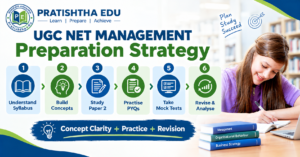
Step 1: Understand the Complete Syllabus
Before beginning detailed study, keep the latest syllabus available and divide it into individual units and topics.
Avoid starting preparation by randomly selecting chapters.
Create a simple checklist containing:
- Management fundamentals
- Organisational Behaviour
- Human Resource Management
- Marketing
- Financial Management
- Operations Management
- Strategic Management
- Business Environment
- International Business
- Entrepreneurship
- Research-related topics
Mark every topic as:
Not Started | In Progress | Completed | Needs Revision
This gives you a clear picture of your progress.
Step 2: Assess Your Current Preparation Level
Before creating a timetable, identify what you already know.
Take a small diagnostic test or solve questions from different Management topics.
You may find three types of topics:
Strong Topics
These are areas where you can understand and answer questions confidently.
Moderate Topics
You understand the basic concepts but make mistakes in application-based or confusing questions.
Weak Topics
You have limited understanding or struggle to remember the concepts.
This classification helps you allocate your study time more effectively.
Step 3: Create a Realistic Daily Study Schedule
A study plan should be realistic rather than excessively ambitious.
If you plan ten hours of study every day but can realistically maintain only four or five hours, the timetable may become difficult to follow.
Instead, divide your available time into focused sessions.
For example:
| Study Session | Activity |
| Session 1 | Management concept learning |
| Session 2 | Paper 1 practice |
| Session 3 | Management questions |
| Session 4 | Revision |
| Session 5 | Short test or error analysis |
The exact number of hours can be adjusted according to your academic schedule.
The important point is to maintain regular study rather than depending on occasional long study sessions.
Step 4: Give Priority to Conceptual Understanding
Management contains many definitions, theories, models and frameworks.
Memorising everything without understanding the underlying concept can make revision difficult.
When studying a topic, try to answer:
- What does the concept mean?
- What is its purpose?
- What are its key characteristics?
- How is it different from similar concepts?
- Where can it be applied?
- What type of question can be asked from it?
For theoretical topics, create short notes using keywords rather than copying entire chapters.
Step 5: Prepare Management Paper 2 Systematically
Management Paper 2 requires dedicated subject preparation.
Instead of studying multiple large units simultaneously, divide them into smaller topic groups.
For example, while studying Human Resource Management, you can organise your preparation around:
HR Planning → Recruitment → Selection → Training → Performance Management → Compensation → Employee Development
After completing each topic, solve relevant questions.
This allows you to connect theory with examination practice.
Step 6: Study Paper 1 Alongside Paper 2
One mistake candidates can make is postponing Paper 1 preparation until the final stage.
Paper 1 should be included in the regular weekly schedule.
You can rotate areas such as:
- Teaching Aptitude
- Research Aptitude
- Logical Reasoning
- Data Interpretation
- Communication
- ICT
- Reading Comprehension
- Higher Education
- People and Environment
Short but regular practice can be more manageable than trying to complete Paper 1 in a few days.
Step 7: Use Previous Year Questions Regularly
Previous year questions can help candidates understand how concepts are converted into examination questions.
After completing a topic, solve related questions.
For example, after studying motivation theories, practise questions related to the relevant theories and their applications.
Do not stop after checking the answer.
For every incorrect question, identify:
What did I think? → What is the correct concept? → Why was my answer wrong?
Maintain an error notebook containing:
- Incorrect questions
- Confusing concepts
- Important facts
- Frequently repeated mistakes
- Topics requiring revision
This notebook can become particularly useful before mock tests and final revision.
Step 8: Follow Topic-Wise Practice
Before jumping directly into full-length tests, build confidence through topic-wise practice.
For example:
Marketing Practice
Complete a topic → solve questions → review mistakes → revise.
Finance Practice
Study the concept → learn relevant formulas → solve numerical questions → analyse errors.
Organisational Behaviour Practice
Study theories → compare concepts → solve objective questions → revise confusing areas.
Topic-wise practice allows candidates to identify weaknesses while the relevant material is still fresh.
Step 9: Start Mock Tests After Building the Basics
Mock tests become more useful once candidates have covered a substantial portion of the syllabus.
Initially, students can take shorter tests.
Later, move towards full-length examination-style tests.
After each mock test, record:
- Total score
- Correct answers
- Incorrect answers
- Unattempted questions
- Time spent
- Weak topics
- Repeated mistakes
The purpose of a mock test is not only to obtain a score. It is also to identify what needs improvement.
Step 10: Analyse Every Mock Test
Test analysis is one of the most useful parts of preparation.
Suppose you get a question wrong from Strategic Management.
Do not simply write the correct answer and move on.
Instead:
- Identify the topic.
- Review the concept.
- Understand why your answer was incorrect.
- Check whether similar concepts are confusing you.
- Solve a few additional questions.
- Add the concept to your revision list.
This process can turn mistakes into targeted revision.
Step 11: Build a Revision System
Revision should begin from the first weeks of preparation.
Do not wait until the complete syllabus is finished.
A simple revision cycle can be:
Daily Revision → Weekly Revision → Monthly Revision
Daily Revision
Spend a short period reviewing what you studied that day.
Weekly Revision
Review important concepts and questions studied during the week.
Monthly Revision
Revisit completed units and check whether you can still answer questions accurately.
This approach reduces the amount of material that has to be relearned before the examination.
Step 12: Make Short Revision Notes
Short notes are particularly useful for theories, models, formulas and comparisons.
For example, instead of writing several pages about a Management theory, create a compact note containing:
- Theory name
- Main contributor
- Key idea
- Important characteristics
- Related concepts
- Possible areas of confusion
For Financial Management, maintain a separate formula sheet.
For Research Methodology, create tables comparing research terms and methods.
Step 13: Improve Accuracy Before Speed
Candidates sometimes focus on solving questions as quickly as possible.
However, speed without accuracy can reduce overall performance.
During early preparation, focus first on understanding and correctly answering questions.
Once accuracy improves, gradually work on reducing the time required to solve questions.
A useful progression is:
Understanding → Accuracy → Consistency → Speed
This approach is more practical than trying to maximise speed from the beginning.
Step 14: Manage Difficult Topics
Every candidate will have topics that feel difficult.
Avoid completely ignoring them.
Instead, break difficult topics into smaller sections.
For example:
Difficult Unit → Smaller Topic → Basic Concept → Example → Practice Questions → Revision
If the topic remains unclear after self-study, use faculty guidance, doubt-solving sessions or additional study resources.
Students attending UGC NET Management Classes can make a list of difficult topics and discuss them during available doubt-solving sessions.
Step 15: Use Active Recall
Active recall means trying to remember information without continuously looking at the study material.
After completing a topic, close your notes and ask yourself:
- What were the main concepts?
- Which theories did I study?
- What are their differences?
- Can I explain the concept without looking at the notes?
- Can I solve a basic question from the topic?
This can reveal gaps in understanding more effectively than simply rereading the same material.
Step 16: Use Spaced Revision
Instead of revising a topic only once, review it at increasing intervals.
For example:
Day 1 → Day 3 → Day 7 → Day 15 → Day 30
The exact schedule can be adjusted according to your preparation timeline.
The purpose is to revisit important information before it becomes difficult to recall.
Step 17: Maintain a Weak-Topic List
Create a dedicated list of topics where you repeatedly make mistakes.
For example:
Weak Topics
- Capital budgeting
- Leadership theories
- Sampling methods
- Strategic analysis
- Consumer behaviour
Review this list every week.
As your understanding improves, move topics from the weak list to the revision list.
This creates a simple way to monitor progress.
Step 18: Combine Coaching With Self-Study
Coaching can provide structured teaching, but candidates should not depend entirely on classroom hours.
A productive routine can be:
Class → Same-Day Review → Self-Study → Questions → Doubt Resolution → Revision
If you attend a two-hour class but do not review the material afterwards, much of the learning opportunity may be lost.
Self-study is therefore an essential part of any preparation strategy.
A Sample Weekly Management Preparation Plan
A balanced weekly plan could look like this:
| Day | Management Focus | Additional Practice |
| Monday | Management concepts | Paper 1 |
| Tuesday | HRM | Topic-wise questions |
| Wednesday | Marketing | Paper 1 |
| Thursday | Finance | Numerical practice |
| Friday | Strategic Management | Previous year questions |
| Saturday | Research/Business topics | Revision |
| Sunday | Mock test | Complete analysis |
This is a framework rather than a fixed timetable. Candidates should modify it according to their available hours and preparation level.
How to Stay Consistent During Long Preparation
Long-term examination preparation can become difficult when students focus only on the final result.
Instead, set smaller weekly goals.
For example:
This Week
- Complete two Management topics
- Practise 100 questions
- Revise one completed unit
- Take one Paper 1 test
- Analyse one mock test
Small measurable targets can make preparation easier to track.
What to Do in the Final Stage
As the examination approaches, avoid starting large amounts of completely new material unless necessary.
Prioritise:
- Revision
- Previous year questions
- Mock tests
- Error notebook
- Short notes
- Weak topics
- Time management
The final stage should increasingly focus on strengthening what you have already studied.
A Practical Preparation Formula
A simple framework for UGC NET Management preparation is:
Concepts + Previous Year Questions + Revision + Mock Tests + Error Analysis = Structured Preparation
No single method guarantees examination success. Consistent implementation of the preparation process is what matters.
Students looking for UGC NET Management Preparation support should therefore evaluate whether their chosen learning system provides opportunities for concept learning, practice, revision and testing.
How to Prepare for UGC NET Management Paper 2
Management Paper 2 is the subject-specific part of the UGC NET examination, so candidates need a focused approach to cover its broad syllabus effectively.
Unlike general aptitude preparation, Management Paper 2 requires candidates to develop a strong understanding of theories, concepts, models, applications, and relationships between different areas of Management.
A practical approach is to divide preparation into three stages:
Concept Building → Question Practice → Revision and Testing
Students should gradually move from understanding individual topics to solving mixed questions from multiple units.
Understand the Complete Paper 2 Syllabus First
Before starting detailed preparation, go through the latest prescribed Management syllabus and divide it into individual topics.
Create a checklist such as:
- Management fundamentals
- Organisational Behaviour
- Human Resource Management
- Marketing Management
- Financial Management
- Operations Management
- Strategic Management
- Business Environment
- International Business
- Entrepreneurship
- Research-related areas
Mark each topic according to your preparation level.
For example:
Green: Strong understanding
Yellow: Requires more practice
Red: Needs detailed study
This simple classification can help you decide where to spend additional preparation time.
Start With Conceptual Foundations
Candidates should not immediately begin with difficult objective questions.
Start by understanding the basic concepts of each unit.
For example, before studying advanced Strategic Management questions, make sure you understand concepts such as:
- Strategy
- Vision
- Mission
- Objectives
- Competitive advantage
- Strategic analysis
- Strategy formulation
- Strategy implementation
Once the foundation is clear, advanced questions become easier to analyse.
The same approach can be applied to Marketing, HRM, Finance and other Management areas.
Give Attention to Interconnected Topics
One advantage of understanding Management as an interconnected subject is that concepts from one unit can support learning in another.
For example:
Organisational Behaviour → Human Resource Management
Marketing → Consumer Behaviour → Strategic Management
Finance → Investment Decisions → Business Strategy
Operations → Supply Chain → Business Performance
When revising, identify these relationships rather than treating every unit as an isolated chapter.
This can also make revision more efficient because one concept may help you remember several related areas.
How to Prepare Different Management Subjects
Different parts of Paper 2 may require slightly different study methods.
Management and Organisational Behaviour
Focus on:
- Definitions
- Management theories
- Functions
- Leadership theories
- Motivation
- Personality
- Perception
- Group behaviour
- Organisational culture
- Conflict
- Organisational change
Create comparison tables for theories that are easily confused.
Human Resource Management
Focus on the complete employee-management cycle:
Planning → Recruitment → Selection → Training → Development → Performance → Compensation → Retention
Understand the purpose of each process and the differences between related HR concepts.
Marketing Management
Study both basic and strategic concepts.
Give attention to:
- Segmentation
- Targeting
- Positioning
- Consumer behaviour
- Product decisions
- Pricing
- Distribution
- Promotion
- Branding
- Services marketing
- Digital marketing
Use practical examples while studying abstract marketing concepts.
Financial Management
Financial topics require a combination of conceptual understanding and numerical practice.
Maintain a separate formula notebook covering relevant calculations.
After learning a formula, solve multiple questions rather than memorising the formula alone.
For every numerical question, understand:
What is given? → What is required? → Which concept applies? → Which formula or method is appropriate?
Operations Management
Focus on understanding processes and relationships.
Important areas can include:
- Production systems
- Capacity
- Inventory
- Quality
- Scheduling
- Productivity
- Supply chain
- Facility planning
Use diagrams or flowcharts where they make a process easier to remember.
Strategic Management
Strategic Management often involves theories, frameworks and analytical concepts.
For each framework, understand:
- Purpose
- Components
- Application
- Interpretation
- Differences from similar frameworks
Avoid memorising model names without understanding what they are used for.
Business Environment and International Business
For these topics, focus on relationships between organisations and their external environment.
Understand economic, political, legal, technological and social influences along with international business concepts.
Entrepreneurship
Study the entrepreneurial process from opportunity identification through business development.
Connect concepts such as innovation, entrepreneurship, business planning and start-up development.
Use Previous Year Questions as a Learning Tool
Previous year questions should be integrated into Paper 2 preparation.
Do not wait until the final weeks to start solving them.
After completing a topic:
Study Topic → Solve Questions → Analyse Answers → Revise Concept
If a question is incorrect, identify the exact reason.
For example:
Concept not understood
or
Two theories confused
or
Question misunderstood
or
Careless mistake
This classification helps you identify the actual problem.
Build a Management Question Bank
Instead of solving questions and forgetting them, create your own topic-wise question bank.
Organise it into sections:
Section A: Easy Questions
Questions testing basic concepts and definitions.
Section B: Conceptual Questions
Questions requiring deeper understanding.
Section C: Application-Based Questions
Questions where candidates need to apply a Management concept.
Section D: Difficult or Confusing Questions
Questions where you made mistakes or found two options difficult to distinguish.
Revisiting Section D during revision can be particularly useful.
How to Prepare for UGC NET JRF Management
Candidates targeting JRF may want to follow a more intensive preparation routine because they need to aim for a higher level of performance.
UGC NET JRF Management Coaching in Bangalore may be considered by candidates who prefer structured academic guidance for this goal.
However, coaching alone does not replace individual preparation.
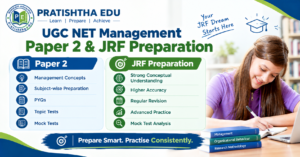
JRF-oriented preparation should include:
- Strong conceptual understanding
- Complete syllabus coverage
- Extensive question practice
- Regular mock tests
- Detailed error analysis
- Multiple revision cycles
- Consistent Paper 1 preparation
The focus should be on improving overall accuracy and depth rather than simply attempting a large number of questions.
NET and JRF Preparation: What Should Be Different?
The syllabus itself remains the foundation, but candidates targeting JRF may choose to make their preparation more intensive.
A useful comparison is:
| Preparation Area | NET-Oriented Preparation | JRF-Oriented Preparation |
| Syllabus | Complete coverage | Complete coverage |
| Concepts | Strong understanding | Strong and deeper understanding |
| Practice | Regular | More extensive |
| Mock tests | Regular | Frequent and detailed |
| Error analysis | Important | Highly important |
| Revision | Multiple cycles | Multiple intensive cycles |
| Accuracy | Priority | Very high priority |
These are preparation approaches rather than separate examinations.
Improve Question-Solving Accuracy
Knowing the answer is only one part of effective preparation.
Candidates also need to read questions carefully.
Watch for words such as:
- Correct
- Incorrect
- Not
- Most appropriate
- Least likely
- Only
- Mainly
- Best explanation
A single word can change the meaning of a question.
During practice, develop the habit of reading the complete question before looking at the options.
Learn to Eliminate Incorrect Options
Multiple-choice questions sometimes become easier when candidates eliminate clearly incorrect options.
For example, if you know that two options do not match the definition or theory being tested, remove them before comparing the remaining choices.
However, elimination should be based on conceptual understanding rather than guessing patterns.
Practise identifying:
What makes this option correct?
and
What makes the other options incorrect?
This can strengthen conceptual clarity.
Create Comparison Tables for Confusing Concepts
Management contains several concepts that candidates can easily mix up.
Create comparison tables for:
- Leadership theories
- Motivation theories
- Management approaches
- Research methods
- Sampling methods
- Marketing concepts
- Strategic frameworks
- HR processes
For example:
| Concept | Main Focus | Key Difference |
| Recruitment | Attracting candidates | Precedes selection |
| Selection | Choosing candidates | Follows recruitment |
| Training | Improving current skills | Usually role-focused |
| Development | Broader capability building | Longer-term focus |
Creating such comparisons can revise faster.
Combine Paper 1 With Management Paper 2
Candidates should maintain a balance between the two papers.
A practical weekly approach could include:
Management Paper 2: Main subject study
Paper 1: Daily or frequent practice
Previous Year Questions: Topic-wise
Mock Test: Weekly or according to preparation stage
Revision: Every week
This prevents Paper 1 from becoming a last-minute burden.
Use Mock Tests to Measure Progress
Once you have covered sufficient syllabus content, start taking regular mock tests.
Do not focus only on the score.
Record:
- Accuracy
- Time taken
- Weak units
- Frequently incorrect concepts
- Questions that took too long
- Guess-based answers
Then use this information to plan the following week’s revision.
For example:
If Marketing accuracy is strong but Finance accuracy is weak, the next revision cycle can allocate more time to Finance.
Follow a Three-Level Revision System
A useful revision system can be divided into three levels.
Level 1: Quick Revision
Review short notes and important concepts.
Level 2: Question Revision
Solve previously incorrect and marked questions.
Level 3: Test Revision
Take a mixed test and analyse performance.
Repeat this cycle regularly.
What to Do When You Are Behind the Study Plan
Falling behind schedule does not mean that preparation has failed.
Instead of trying to complete everything at once, reassess the remaining syllabus.
Divide topics into:
Essential to Cover → Requires Practice → Requires Revision
Then create a revised timetable.
Avoid spending several days trying to perfect one difficult topic while leaving multiple major areas untouched.
Balanced syllabus coverage is important.
Build an Exam-Focused Study Routine
A productive routine can combine learning and testing.
For example:
Morning: New Management concepts
Afternoon: Paper 1 or question practice
Evening: Revision and previous year questions
Weekend: Mock test + detailed analysis
Students can adjust this structure according to their college, work and personal schedule.
The objective is to create a routine that can be maintained consistently.
How Coaching Can Support Paper 2 Preparation
A structured programme can help candidates organise their preparation through scheduled classes, subject-focused teaching, study material, practice questions, tests and doubt support.
Students considering UGC NET Management Paper 2 Coaching in Bangalore should check whether the programme provides subject-specific preparation rather than only general competitive-exam guidance.
Before enrolling, ask whether the programme includes:
- Complete syllabus coverage
- Management-specific faculty
- Previous year questions
- Practice tests
- Mock examinations
- Revision sessions
- Doubt-solving support
- Study material
These factors can help candidates understand what academic support they are actually receiving.
Final Checklist for Management Paper 2
Before moving towards the final revision stage, check whether you have:
- Completed the prescribed syllabus
- Revised major Management theories
- Practised previous year questions
- Created short notes
- Prepared formula sheets where required
- Identified weak topics
- Taken mock tests
- Analysed mistakes
- Revised Paper 1 regularly
- Practised time management
If some areas remain incomplete, prioritise them according to their importance and your current preparation level.
From Paper 2 Preparation to Final Exam Readiness
Paper 2 preparation becomes more effective when learning, practice and revision work together.
The goal should not simply be to finish chapters. Candidates should gradually reach a stage where they can recognise concepts, distinguish between similar options, solve questions accurately and revise important material efficiently.
A practical cycle is:
Complete Topic → Practise Questions → Review Mistakes → Revise → Test Again
Repeating this process can help turn syllabus knowledge into examination readiness.
Online vs Offline UGC NET Management Preparation
After understanding the syllabus, Paper 2 strategy and JRF preparation approach, candidates also need to decide how they want to study.
Students preparing for UGC NET Management generally consider three options:
- Online learning
- Offline classroom learning
- A combination of coaching and self-study
Each option has different practical considerations. The most suitable format depends on a student’s schedule, learning preferences, location, preparation level and ability to maintain consistency.
Benefits of Online UGC NET Management Classes
Online preparation can provide flexibility for candidates who cannot attend a physical classroom regularly.
With UGC NET Management Online Coaching, students may be able to attend classes from home and, where available, review recorded lessons later.
Online learning can be convenient for:
- Working candidates
- College students
- Candidates living far from a coaching centre
- Students with changing schedules
- Candidates who prefer learning from home
However, flexibility also requires discipline.
Students should maintain fixed study hours rather than continuously postponing classes or revision.
A useful online routine can be:
Attend Class → Review the Lesson → Make Notes → Practise Questions → Revise
Benefits of Offline Classroom Learning
Classroom learning can provide a structured academic environment.
Students who prefer direct interaction may find UGC NET Management Offline Coaching in Bangalore useful for maintaining a fixed preparation routine.
Possible benefits include:
- Direct interaction with faculty
- Classroom discussions
- Immediate clarification of doubts
- Regular attendance
- Peer interaction
- A dedicated learning environment
- Scheduled tests and revision
The usefulness of classroom preparation depends on factors such as teaching quality, faculty support, study material, test practice and consistency.
Online vs Offline: Consider Your Personal Routine
Instead of choosing a format only because it is popular, consider how you actually study.
Ask yourself:
- Can I study consistently at home?
- Do I need direct interaction with teachers?
- How much travel time will classroom learning require?
- Do I have a fixed daily schedule?
- Will recorded classes help me revise?
- Do I prefer learning independently or within a classroom?
- Can I complete assignments and tests without supervision?
The answers can help you decide which format fits your preparation routine.
Hybrid Preparation: Combining Classes and Self-Study
Some students may prefer a combination of structured teaching and independent preparation.
A hybrid approach can involve:
Classes → Self-Study → Practice → Revision → Mock Tests
For example, students may use classes to understand difficult concepts and then spend additional time independently solving questions and revising notes.
The advantage of this approach is that classroom learning does not replace self-study.
Both can work together.
Creating a Dedicated Study Environment
A focused study environment can make regular preparation easier.
Students should ideally have access to a place where they can:
- Read without unnecessary distractions
- Attend online classes
- Solve mock tests
- Review notes
- Practise questions
- Revise for extended periods
Candidates who do not have a suitable environment at home may consider a dedicated study space or library.
For students using Pratishtha Library, features such as a quiet study environment, seating and dedicated study facilities can support regular self-study, depending on the current facilities and membership availability.
Why Consistent Self-Study Matters
Coaching classes can provide direction, but examination preparation also requires individual study.
A student may attend several classes every week, but without reviewing the lessons and practising questions, the learning may not become strong enough for examination use.
After every class, try to complete three activities:
1. Review
Go through the class notes on the same day or as soon as practical.
2. Practise
Solve questions related to the topic.
3. Revise
Return to the topic after a few days.
This simple routine can help maintain continuity.
Managing Study Time Effectively
Time management does not necessarily mean studying for the maximum number of hours.
It means using your available time efficiently.
For example, if you have four hours available, divide them into focused blocks rather than studying continuously without a plan.
A sample routine could be:
| Time Block | Activity |
| 60 minutes | Management concepts |
| 45 minutes | Question practice |
| 45 minutes | Paper 1 |
| 30 minutes | Revision |
| 30 minutes | Previous year questions |
| 30 minutes | Error analysis |
Students can modify these blocks according to their own schedule.
Use Study Blocks Instead of Random Study
Before starting a study session, decide exactly what you want to complete.
Instead of writing:
“Study Management”
write:
“Complete Leadership Theories + Solve 25 Questions + Review Mistakes.”
The second target is measurable.
At the end of the session, you can clearly determine whether the task was completed.
This makes preparation easier to monitor.
Avoid Multitasking During Study Sessions
Competitive examination preparation requires concentration.
During focused study sessions, minimise unnecessary distractions such as:
- Social media notifications
- Unrelated browsing
- Frequent phone checking
- Unplanned conversations
- Switching between multiple study topics
If you are attending an online class, keep the class-specific material ready before starting.
After the class, immediately record important doubts or concepts that require revision.
How to Use Study Material Efficiently
Having multiple books and notes does not automatically improve preparation.
Too many resources can sometimes make revision difficult.
A practical resource system can include:
Primary Study Material + Previous Year Questions + Practice Tests + Short Revision Notes
Use additional resources only when a concept requires clarification.
The objective should be to understand and revise the material effectively rather than collect as many resources as possible.
Managing Previous Year Questions
Previous year questions can be used at different stages.
During Initial Preparation
Solve topic-wise questions after completing individual concepts.
During Mid-Stage Preparation
Mix questions from multiple topics.
During Final Revision
Use previously marked questions to identify weak areas.
This changes previous year questions from a one-time activity into a continuous learning resource.
How to Track Your Preparation Progress
Maintain a simple progress sheet.
Track:
- Topics completed
- Topics pending
- Questions attempted
- Questions answered correctly
- Mock-test scores
- Weak areas
- Revision dates
For example:
| Area | Status | Next Action |
| Marketing | Completed | Revise |
| HRM | In Progress | Complete remaining topics |
| Finance | Weak | More practice |
| Strategy | Completed | Previous year questions |
| Paper 1 | Ongoing | Continue daily practice |
Updating this once or twice a week can help you see where your preparation stands.
Preparing Alongside College or Work
Many candidates cannot dedicate their entire day to examination preparation.
Students managing college or employment should create a timetable around their fixed commitments.
For example:
Before College/Work: Short revision session
After College/Work: Main Management study session
Evening: Question practice
Weekend: Mock test + revision
The exact schedule is less important than maintaining consistency.
How Students in Bangalore Can Reduce Preparation Distractions
For students attending classroom programmes, travel time should be considered while planning the daily routine.
If travelling to classes takes significant time, use the remaining study hours efficiently.
You can use travel time, where practical, for lighter activities such as:
- Reviewing flashcards
- Listening to recorded explanations
- Reading short notes
- Revising definitions
More demanding activities such as mock tests and numerical practice should generally be completed in a suitable study environment.
Choosing a Coaching Location
Students searching for UGC NET Management Coaching near me may naturally consider distance and accessibility.
Location is one factor, but it should not be the only factor.
Before choosing a classroom programme, consider:
- Travel time
- Class schedule
- Faculty
- Course coverage
- Study material
- Test series
- Doubt support
- Revision sessions
- Overall learning environment
A convenient location can make regular attendance easier, but academic support should also match your preparation requirements.
What to Expect From a Structured Coaching Programme
A structured programme can organise different parts of preparation into a sequence.
For example:
Syllabus Coverage
↓
Concept Classes
↓
Topic-Wise Practice
↓
Previous Year Questions
↓
Revision
↓
Mock Tests
↓
Performance Analysis
Students should ask whether the programme actually follows a process like this or simply provides lectures.
The difference is important because examination preparation involves more than classroom teaching.
How to Use Coaching Time Productively
Students can make better use of classes by preparing before attending them.
Before a class:
- Review the previous topic
- Read the topic name
- Note down existing doubts
- Keep study material ready
During the class:
- Focus on explanations
- Mark important concepts
- Ask relevant doubts
- Note difficult areas
After the class:
- Review notes
- Solve questions
- Revise difficult concepts
- Update your preparation tracker
This turns classroom time into part of a larger preparation cycle.
Preparing for Mock Tests in a Study Environment
Mock tests should be attempted in conditions that resemble the actual examination as much as possible.
During a test:
- Keep your study material away
- Avoid unnecessary interruptions
- Follow the planned time limit
- Attempt questions carefully
- Record your final performance
Afterwards, analyse the test in detail.
Do not immediately start another test without understanding the mistakes from the previous one.
Building a Sustainable Routine
Preparation can extend over several months, so the routine should be sustainable.
Avoid creating an unrealistic timetable that leaves no time for rest or other responsibilities.
A sustainable routine should provide enough time for:
Learning + Practice + Revision + Testing + Rest
Consistency over a longer period is more practical than short periods of extreme study followed by burnout or missed preparation days.
Common Mistakes to Avoid
Candidates can improve their preparation by avoiding common study mistakes.
Studying Without a Syllabus
Without a clear syllabus checklist, important areas may be missed.
Collecting Too Many Resources
Too many books and notes can make revision difficult.
Avoiding Previous Year Questions
Theory should be followed by question practice.
Postponing Revision
Revision should begin during preparation, not only at the end.
Taking Tests Without Analysis
A mock-test score is less useful if mistakes are never reviewed.
Ignoring Paper 1
Paper 1 should remain part of the weekly routine.
Depending Entirely on Coaching
Classes provide academic support, but self-study and practice remain essential.
Creating Your Complete Preparation System
By this stage, candidates should have four major components in place:
- Learning System
Classes, books and study material.
- Practice System
Previous year questions and topic-wise questions.
- Revision System
Short notes, error lists and scheduled revision.
- Testing System
Mock tests and performance analysis.
Together, these components create a more complete preparation framework.
Preparing With a Clear Goal
Whether your objective is Assistant Professor eligibility, JRF or simply strengthening your academic preparation in Management, define your target clearly.
Your target can influence how you plan:
- Study hours
- Question practice
- Mock-test frequency
- Revision cycles
- Weak-topic preparation
A clear goal can also make it easier to measure progress.
Moving Towards Final Revision
As your syllabus completion increases, gradually reduce the time spent on first-time learning and increase the time devoted to:
- Previous year questions
- Mock tests
- Revision
- Weak topics
- Short notes
- Error analysis
This transition should happen gradually rather than suddenly at the end.
The final stage of preparation should be based on what your practice data tells you needs improvement.
Final Preparation Framework
A complete routine can be summarised as:
Learn the concept
↓
Practise questions
↓
Check mistakes
↓
Revise the topic
↓
Take a test
↓
Analyse performance
↓
Strengthen weak areas
↓
Repeat
This process can be followed whether you choose classroom learning, online preparation or a combination of both.
UGC NET Management Preparation at Pratishtha Edu
Choosing the right learning environment can make preparation more organised, especially when the Management syllabus includes multiple subjects, theories, models, concepts and application-based questions. A structured programme can help students follow the syllabus systematically instead of studying topics randomly.
For students looking for UGC NET Management Coaching in Bangalore, the focus should be on understanding concepts, regular practice, previous-year question analysis, revision and mock-test performance rather than simply completing classroom sessions.
At Pratishtha Edu, students preparing for UGC NET Management can follow a structured approach that combines classroom learning with self-study, practice and revision. The objective is to create a routine in which students know what to study, when to revise it and how to evaluate their progress.
Management-Focused Preparation
Management requires understanding rather than memorising isolated definitions. Topics such as organisational behaviour, human resource management, marketing, finance, operations, strategic management and business environment are interconnected.
A Management-focused preparation approach should therefore include:
- Topic-wise syllabus coverage
- Concept explanation with practical examples
- Previous-year question practice
- Regular revision
- Topic-wise tests
- Full-length mock tests
- Doubt-solving support
- Performance analysis
This approach can be particularly useful for students who are preparing for both UGC NET Management Paper 2 and Paper 1.
Concept-Based Learning
A strong conceptual foundation helps students understand why an answer is correct instead of relying only on memorisation.
For example, while studying organisational behaviour, students should understand the relationship between motivation, leadership, group behaviour and organisational structure. Similarly, marketing preparation should connect concepts such as consumer behaviour, segmentation, targeting, positioning and marketing strategy.
This type of learning makes revision more meaningful because one concept can help recall several related topics.
Practice and Mock Tests
Preparation becomes more effective when learning is followed by regular testing.
Students should gradually move from:
Concept Learning → Topic Practice → PYQs → Section Tests → Mock Tests → Analysis → Revision
Mock tests should not be treated only as a way to measure marks. They can also reveal which topics require additional revision, where mistakes are occurring and whether enough time is being spent on individual questions.
Doubt-Solving and Revision Support
Students may understand a topic during the first reading but face difficulty when solving questions later. This is why doubt-solving and revision should be part of the preparation routine.
Instead of leaving difficult topics for the final weeks, maintain a separate list of doubts and weak areas. Review this list regularly and update it as your preparation progresses.
Final Revision Strategy for UGC NET Management
The final stage of preparation should be different from the initial learning stage. At this point, the focus should gradually shift from learning everything again to revising important concepts, solving questions and improving accuracy.
Revise High-Priority Topics
Prepare a revision checklist covering all major Management units. Give additional attention to topics where your mock-test performance is consistently weak.
Do not spend the entire final phase studying only your favourite subjects. Maintain balanced coverage so that neglected units do not become last-minute problems.
Revisit Previous Year Questions
Previous-year questions can help you understand how concepts are tested. While revising, do not simply remember the correct option. Ask yourself:
- Why is this option correct?
- Why are the other options incorrect?
- Which concept is being tested?
- Have I seen a similar question before?
- Do I need to revise the underlying topic?
This turns question practice into active revision.
Analyse Mock Test Performance
After every mock test, maintain a simple record of:
| Area | What to Track |
| Correct answers | Strong topics |
| Wrong answers | Conceptual mistakes |
| Unattempted questions | Knowledge or time issue |
| Repeated mistakes | Topics requiring revision |
| Time taken | Speed and question selection |
| Accuracy | Overall test performance |
The purpose of analysis is to identify patterns and make the next study session more productive.
Use Short Notes and an Error Notebook
During preparation, maintain short revision notes for important theories, models, formulas, researchers, concepts and confusing topics.
An error notebook can be even more useful during the final revision stage. Record questions you repeatedly get wrong and revise the reason behind each mistake.
How to Choose a Suitable Management Coaching Programme in Bangalore
Searching for UGC NET Management Coaching near me can provide many options, but location alone should not decide your choice.
Before joining any programme, compare the learning support carefully.
Check Faculty and Syllabus Coverage
Check whether the programme covers the complete Management syllabus and whether classes provide sufficient explanation of important concepts.
A good preparation plan should not focus only on frequently searched topics. Complete syllabus coverage is important because questions can come from different areas.
Review Study Material and Tests
Ask whether students receive Management-specific study material, previous-year questions, practice questions and mock tests.
The quality of practice material matters because preparation should continue outside classroom hours.
Consider Class Timings and Location
Your coaching schedule should fit your college, job or personal routine.
For students travelling across Bangalore, travel time is also an important factor. A convenient location can make it easier to maintain regular attendance and combine classes with self-study.
Compare Online and Offline Support
Students should compare online and offline learning according to their personal requirements.
If flexibility is important, online classes may be convenient. If direct classroom interaction and a fixed study routine are more useful, offline classes may be preferable.
The important point is to choose a format that you can follow consistently for the entire preparation period.
Frequently Asked Questions About UGC NET Management
Is UGC NET Management difficult for beginners?
The difficulty can vary from student to student. Beginners may initially find the syllabus broad because Management covers several areas. A structured study plan, concept-based learning, and regular question practice can make the preparation more manageable.
What qualification is required for UGC NET Management?
Eligibility depends on the applicable UGC NET rules and the candidate’s educational qualification. Students should always verify the latest eligibility requirements through the official examination information before applying.
Can I prepare for Paper 1 and Paper 2 together?
Yes. A balanced timetable can include both papers. Since Paper 2 is subject-specific, many students choose to give it substantial study time while maintaining regular Paper 1 practice.
Is online coaching suitable for UGC NET Management?
Online learning can be suitable for students who need flexibility because of college, work, or travel. However, it requires consistent self-discipline. Students should check whether the programme provides recorded or live learning, study material, tests, and doubt support.
How much time is needed for UGC NET Management preparation?
There is no single preparation period that works for everyone. It depends on your existing knowledge, available study hours, syllabus familiarity, and target. Students starting from the basics may need more time for concept building, while students with prior Management knowledge may spend more time on practice and revision.
Can UGC NET Management preparation help with JRF preparation?
Yes, the same Management syllabus forms an important part of UGC NET JRF preparation. Candidates targeting JRF should pay particular attention to conceptual depth, question accuracy, revision and mock-test performance. However, students targeting JRF should pay particular attention to conceptual depth, question accuracy, revision, and mock-test performance.
How should I revise before the examination?
During the final stage, focus on short notes, important concepts, previous-year questions, mock-test analysis, and repeatedly weak areas. Avoid trying to learn a large number of completely new topics at the last moment.
Start Your UGC NET Management Preparation in Bangalore

Preparing for UGC NET Management is a long-term process that requires more than simply attending classes. The strongest preparation routine combines concept clarity, syllabus coverage, Paper 1 practice, Management Paper 2 preparation, previous-year questions, mock tests, and repeated revision.
If you are comparing UGC NET Management Classes in Bangalore, look beyond advertisements and compare the actual learning support, faculty guidance, study material, practice system, doubt-solving process and study environment.
For students who prefer a structured classroom-based approach, Pratishtha Edu provides academic guidance for competitive and entrance examinations. Students can combine coaching with focused self-study and use a dedicated study environment such as Pratishtha Library when they need uninterrupted preparation time.
The goal is simple: understand the syllabus, build strong Management concepts, practise consistently, analyse your mistakes, and revise strategically.
Begin With a Clear Preparation Plan
Before joining a programme, prepare a simple checklist:
- Understand the UGC NET exam structure
2. Download and organise the Management syllabus
3. Divide the syllabus into manageable units
4. Create a Paper 1 and Paper 2 study routine
5. Start solving previous-year questions
6. Take regular topic-wise tests
7. Track weak areas
8. Revise systematically
9. Take full-length mock tests
10. Analyse every test before moving to the next one
A consistent routine can help turn a large syllabus into manageable weekly targets.
Pratishtha Edu
Pratishtha Edu
#945 Laxminarayan Complex, 2nd Floor, JP Nagar 2nd Phase, Bengaluru 560078
Call: 7676047382 | 8660208963
Website: www.pratishthaedu.com
Build strong concepts. Practise consistently. Revise strategically. Prepare with confidence for UGC NET Management.
Leave a Reply