
UGC NET in HRM and Law Coaching in Bangalore can provide structured preparation support for candidates preparing for teaching, research, and higher-education opportunities. A focused preparation plan helps candidates understand the syllabus, examination pattern, previous-year questions, study material and the skills required for Paper 1 and Paper 2.
The UGC NET examination is an important national-level eligibility test for candidates who want to build careers in teaching, research and higher education. For students and professionals interested in Human Resource Management and Law, focused preparation can help them understand the subject syllabus, examination pattern, previous-year questions and the skills required for Paper 1 and Paper 2.
Choosing the right preparation approach is especially important when candidates are preparing for a competitive examination alongside college, work or other academic responsibilities. A structured study plan, reliable study material, regular practice and proper revision can make preparation more organized and measurable.
Understanding UGC NET HRM and Law
Human Resource Management and Law involve a broad range of concepts related to people management, organizations, employment relationships, labour practices and legal frameworks. Candidates preparing for the subject need to develop both conceptual understanding and question-solving ability.
The preparation process generally involves two complementary areas. The first is Paper 1, which covers common teaching and research aptitude areas. The second is Paper 2, which focuses on the candidate’s selected subject and requires deeper subject-specific preparation.
A good preparation strategy should therefore not focus only on memorizing information. Candidates should understand concepts, revise them regularly, solve previous-year questions and evaluate their performance through practice tests.
Who Should Prepare for HRM and Law?
This preparation path can be relevant for candidates whose academic or professional interests are connected with areas such as:
- Human Resource Management
- Human Resource Development
- Industrial Relations
- Labour Welfare
- Organizational Behaviour
- Employment-related legal concepts
- Management and administration
- Teaching and research
- Higher education and academic careers
Candidates should always check the latest official eligibility requirements and subject information before beginning their application or examination preparation.
Why a Structured Preparation Plan Matters
The UGC NET syllabus contains multiple areas that need to be studied systematically. Trying to complete everything without a timetable can make revision difficult, particularly when candidates have limited preparation time.
A structured plan can divide preparation into smaller goals such as:
- Understanding the complete syllabus
- Identifying important topics
- Building fundamental concepts
- Creating concise revision notes
- Solving previous-year questions
- Taking topic-wise tests
- Attempting full-length mock tests
- Revising weak areas
Students looking for UGC NET preparation can also combine classroom learning with self-study so that concepts covered during classes are reinforced through independent practice.
Paper 1 and Paper 2 Preparation
One of the important aspects of preparation is maintaining a balance between Paper 1 and the subject-specific paper.
Paper 1 focuses on common areas related to teaching and research aptitude, while Paper 2 tests knowledge of the candidate’s selected subject. The National Testing Agency’s examination information states that Paper 1 contains 50 questions carrying 100 marks and Paper 2 contains 100 questions carrying 200 marks, with a total examination duration of 180 minutes.
This makes it important to allocate preparation time according to both papers rather than concentrating entirely on one section.
Candidates can begin with fundamental concepts and gradually move towards advanced topics, previous-year questions and mock-test practice. Regular revision is particularly useful because the syllabus covers several interconnected concepts.
Building the Right Foundation
Before joining UGC NET HRM and Law classes in Bangalore, candidates can evaluate the type of academic support they actually need. Some students may need stronger conceptual teaching, while others may benefit more from test practice, doubt-solving sessions or structured revision.
An effective learning environment may include:
- Experienced subject faculty
- Complete syllabus coverage
- Paper 1 and Paper 2 guidance
- Concept-based teaching
- Previous-year question practice
- Topic-wise tests
- Mock examinations
- Revision sessions
- Doubt-solving support
- Updated study material
The objective should be to create a preparation system where learning, practice and revision work together instead of treating them as separate activities.
Starting Your UGC NET HRM and Law Preparation in Bangalore
Bangalore has students and working professionals preparing for a wide range of national-level examinations. For candidates who prefer classroom-based guidance, choosing a suitable coaching environment can provide a fixed study routine and access to faculty support.
Pratishtha Edu provides preparation support for students working towards different competitive and academic examinations. Candidates can explore the institute’s UGC NET coaching options in Bangalore and choose a preparation approach that fits their subject and learning needs.
For students who prefer a dedicated study environment outside regular classes, Pratishtha Library can also support consistent self-study through a structured study space.
The most important first step is not simply completing a large number of chapters. It is understanding the examination, creating a realistic timetable, and developing a consistent cycle of learning, practice, and revision.
UGC NET HRM and Law Exam Pattern and Eligibility
Understanding the examination structure is one of the first steps in effective preparation. Before starting topic-wise study, candidates should know how Paper 1 and Paper 2 are organized, how marks are distributed and how much time is available during the examination.
The National Testing Agency conducts UGC NET to determine eligibility for Assistant Professor, Junior Research Fellowship (JRF) and related academic opportunities according to the applicable rules and eligibility conditions. Candidates should always refer to the official UGC NET information bulletin for the latest examination rules, eligibility requirements and application instructions.
UGC NET Examination Pattern
The examination consists of two papers conducted in a single three-hour session. Paper 1 evaluates common teaching and research aptitude, while Paper 2 evaluates knowledge of the subject selected by the candidate.
According to the NTA examination information, Paper 1 contains 50 questions carrying 100 marks, while Paper 2 contains 100 questions carrying 200 marks. Therefore, the examination has a total of 150 questions and 300 marks. The total duration is 180 minutes.
| Paper | Questions | Marks | Main Area |
| Paper 1 | 50 | 100 | Teaching & Research Aptitude |
| Paper 2 | 100 | 200 | Selected Subject |
| Total | 150 | 300 | Paper 1 + Paper 2 |
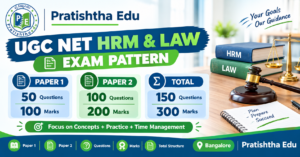
There is no separate time limit for the two papers during the examination session. Candidates should therefore develop a time-management strategy that allows sufficient time for both sections.
Paper 1: Teaching and Research Aptitude
Paper 1 is common to all candidates and focuses on areas associated with teaching and research aptitude.
Preparation may involve topics such as:
- Teaching aptitude
- Research aptitude
- Reading comprehension
- Communication
- Mathematical reasoning
- Logical reasoning
- Data interpretation
- Information and communication technology
- People and environment
- Higher education system
Candidates should not treat Paper 1 as a secondary component simply because it is common to all subjects. Consistent practice can help candidates become familiar with different question formats and improve their ability to manage time.
Students can use UGC NET study material along with practice questions to organize Paper 1 preparation and revise important concepts systematically.
Paper 2: HRM and Law
Paper 2 is subject-specific and carries a larger share of the total marks. Candidates preparing in this area need to develop a strong understanding of concepts related to Human Resource Management and the associated subject areas prescribed for the examination.
Preparation can include areas such as:
- Human Resource Management
- Human Resource Development
- Organizational Behaviour
- Recruitment and Selection
- Training and Development
- Performance Management
- Compensation and Benefits
- Industrial Relations
- Labour Welfare
- Strategic Human Resource Management
- Employment-related legal concepts
- Labour and industrial laws
- Relevant management and organizational concepts
Candidates should use the latest applicable syllabus rather than relying only on older notes or coaching material. The official UGC NET syllabus should be checked before preparing a detailed study schedule.
Understanding the Marks Distribution
Paper 2 carries 200 marks, compared with 100 marks in Paper 1. This means candidates need to dedicate substantial preparation time to their selected subject while maintaining regular Paper 1 practice.
A simple weekly distribution could include:
| Preparation Area | Suggested Weekly Focus |
| Paper 1 concepts | Regular study sessions |
| HRM concepts | Dedicated subject sessions |
| Law-related topics | Dedicated revision sessions |
| Previous-year questions | Regular practice |
| Mock tests | Weekly or scheduled practice |
| Revision | Short daily + longer weekly revision |
These are planning suggestions rather than official requirements. Each candidate can adjust the schedule according to their available study time and existing subject knowledge.
UGC NET HRM and Law Eligibility
Eligibility is an important area to verify before applying for the examination. Academic qualifications, category-related provisions, age requirements and JRF conditions can be subject to the rules applicable to the particular examination cycle.
Candidates should therefore check the current NTA notification and information bulletin instead of depending on information from old websites or unofficial sources.
Educational Qualification
Candidates generally need to meet the prescribed postgraduate qualification requirements or other qualifications recognized under the applicable UGC NET rules.
The exact percentage requirements and category-wise provisions should be verified from the current examination notification because eligibility rules can vary according to the applicable regulations and examination cycle.
For this reason, candidates should review the National Testing Agency UGC NET guidelines before submitting an application.
Age Limit and JRF
Age-related conditions can differ depending on whether a candidate is applying for JRF or only seeking eligibility for Assistant Professor. The applicable age limit, relaxation provisions and cutoff date should be checked in the current official notification.
Candidates should not rely on an old examination cycle’s age criteria when planning for a future session.
Subject Selection
Selecting the appropriate subject is another important step. Candidates should ensure that their postgraduate qualification and academic background satisfy the applicable subject eligibility requirements.
Before beginning intensive Paper 2 preparation, candidates should confirm:
- Their qualifying examination
- Relevant postgraduate subject
- Required percentage
- Category-specific provisions, if applicable
- JRF eligibility, where relevant
- Current examination-cycle requirements
How to Use the Exam Pattern for Your Study Plan
Knowing the examination structure can help candidates divide their preparation more effectively.
A practical sequence is:
First: Understand the complete syllabus.
Second: Divide Paper 1 and Paper 2 into manageable units.
Third: Complete the basic concepts before moving to intensive question practice.
Fourth: Solve previous-year questions after completing individual topics.
Fifth: Start timed tests to improve speed and accuracy.
Sixth: Analyse incorrect answers and revise weak areas.
This approach prevents preparation from becoming limited to reading notes. Active question-solving and revision are equally important for developing examination readiness.
What Candidates Should Check Before Joining Coaching
Students comparing UGC NET HRM and Law coaching should look beyond advertisements and compare the actual academic support offered by an institute.
Useful factors to check include:
- Whether the syllabus is covered systematically
- Whether Paper 1 and Paper 2 are both supported
- Faculty experience in the relevant subject
- Availability of doubt-solving sessions
- Previous-year question practice
- Mock-test frequency
- Revision support
- Study material
- Classroom or online learning options
- Progress tracking
A coaching program should complement self-study rather than replace it. Candidates still need regular individual revision and practice outside classroom hours.
Key Takeaways
The examination has two papers: a common Paper 1 and a subject-specific Paper 2. Paper 1 carries 100 marks, while Paper 2 carries 200 marks, making both sections important components of the overall preparation plan.
Before beginning detailed preparation, candidates should verify the latest syllabus, eligibility criteria, JRF conditions and examination instructions through official sources.
Once the examination structure is clear, the next step is to understand exactly what to study. The next part of this guide will cover the important syllabus areas, including Human Resource Management, Human Resource Development, organizational concepts, labour-related topics and the areas candidates should prioritize during Paper 2 preparation.
UGC NET HRM and Law Syllabus: Important Topics to Prepare
After understanding the examination pattern and eligibility requirements, the next step is to become familiar with the syllabus. A clear understanding of the syllabus helps candidates divide the subject into manageable sections and prevents important areas from being overlooked during preparation.
For candidates preparing for HRM and Law, Paper 2 requires systematic study of concepts related to human resources, organizational behaviour, employment relationships, industrial relations and relevant legal areas. Instead of trying to memorize every topic at once, candidates can divide the syllabus into units and prepare each area through concepts, examples, previous-year questions and revision.
Understanding the Paper 2 Syllabus
Paper 2 is subject-specific and carries 200 marks. Because it contributes a larger share of the total marks than Paper 1, candidates should create a dedicated study schedule for the selected subject.
The syllabus can be approached through major conceptual areas such as:
- Human Resource Management
- Human Resource Development
- Organizational Behaviour
- Recruitment and Selection
- Training and Development
- Performance Management
- Compensation Management
- Industrial Relations
- Labour Welfare
- Strategic Human Resource Management
- Employment and labour-related laws
- Organizational and management concepts
Candidates should always compare their preparation material with the latest official UGC NET syllabus before finalizing their study plan. This helps ensure that preparation is based on the applicable examination cycle rather than outdated notes.
Human Resource Management Topics
Human Resource Management is an important area for candidates building a strong foundation in people-management concepts. Preparation should move from basic definitions and principles to practical organizational applications.
Important areas to study include:
Human Resource Planning
Candidates should understand the purpose of HR planning, workforce requirements, forecasting, manpower planning and the relationship between organizational objectives and human resources.
Recruitment and Selection
This area can include:
- Recruitment sources
- Internal and external recruitment
- Selection processes
- Screening
- Interviews
- Selection methods
- Placement
- Induction and orientation
Understanding the difference between recruitment and selection is important because the two processes perform different functions within an organization.
Training and Development
Preparation can include the concepts of employee training, development programs, learning methods, training needs assessment and evaluation.
Candidates should also understand how organizations identify skill gaps and design development initiatives according to employee and organizational requirements.
Performance Management
Important concepts may include:
- Performance appraisal
- Performance management
- Performance standards
- Feedback
- Evaluation methods
- Employee development
- Goal setting
Candidates should understand both the theoretical concepts and their practical applications in organizations.
Compensation and Benefits
This area involves understanding how organizations design compensation systems and reward employees.
Preparation may cover:
- Wages and salaries
- Incentives
- Rewards
- Benefits
- Compensation structure
- Employee motivation
- Internal and external equity
Conceptual clarity is particularly useful when solving application-based questions.
Human Resource Development
Human Resource Development focuses on developing employee capabilities and supporting organizational growth.
Candidates should study concepts related to:
- Employee development
- Career development
- Training
- Organizational development
- Learning systems
- Talent development
- Competency development
- Knowledge management
A useful preparation technique is to create short comparison notes for concepts that appear similar. For example, candidates can differentiate training, development, career development and organizational development through their objectives, duration and application.
Organizational Behaviour
Organizational Behaviour connects individual and group behaviour with workplace performance.
Important areas can include:
Individual Behaviour
Study concepts related to:
- Personality
- Perception
- Attitude
- Learning
- Motivation
- Job satisfaction
Group Behaviour
Preparation can include:
- Group formation
- Group dynamics
- Teamwork
- Leadership
- Communication
- Conflict
- Decision-making
Organizational-Level Concepts
Candidates can also revise:
- Organizational culture
- Organizational climate
- Change management
- Power
- Politics
- Organizational effectiveness
These concepts are easier to remember when studied through practical workplace examples rather than isolated definitions.
Industrial Relations and Labour Welfare
Industrial relations is another area that requires systematic preparation.
Candidates should understand the relationship between employees, employers and institutions involved in workplace relations.
Important areas include:
- Industrial relations concepts
- Trade unions
- Collective bargaining
- Industrial disputes
- Worker participation
- Grievance handling
- Discipline
- Labour welfare
- Employee relations
While studying this section, candidates should maintain separate notes for important concepts, definitions, processes and legal provisions.
Law and Employment-Related Topics
Candidates preparing for the Law component should give special attention to legal concepts that relate to employment, labour relations and workplace practices.
Depending on the applicable syllabus, preparation may involve areas such as:
- Labour and employment law
- Industrial relations legislation
- Workplace rights and responsibilities
- Employment relationships
- Social security-related provisions
- Labour welfare
- Dispute resolution
- Legal aspects of workplace management
Because laws and regulations can change, candidates should use updated study material and verify important legal provisions from authoritative sources.
For current legal information, an external reference such as the India Code portal can be useful when checking the text of applicable legislation.
Strategic Human Resource Management
Strategic HRM connects human resource practices with wider organizational objectives.
Candidates should understand:
- Strategic HR planning
- HR strategy
- Business strategy and HR alignment
- Talent management
- Competency management
- Workforce planning
- Organizational performance
- Strategic employee development
Questions from this area may require candidates to understand relationships between concepts rather than simply remember definitions.
Paper 1 Preparation Alongside Paper 2
Candidates should not postpone Paper 1 until the end of their preparation.
While Paper 2 requires detailed subject knowledge, Paper 1 covers common areas that all candidates need to prepare.
Important Paper 1 areas include:
- Teaching aptitude
- Research aptitude
- Reading comprehension
- Communication
- Mathematical reasoning
- Logical reasoning
- Data interpretation
- Information and communication technology
- People and environment
- Higher education system
A balanced timetable can therefore divide study time between Paper 1 and the selected subject.
For example:
| Study Session | Main Focus |
| Morning | Paper 2 concept study |
| Afternoon/Evening | Paper 1 practice |
| Evening | Subject questions |
| Night | Short revision |
| Weekly | Mock test + analysis |
This is only a sample structure. Students should adjust the timetable according to their daily availability and preparation level.
How to Organize the Syllabus
One of the easiest ways to manage a broad syllabus is to divide it into four preparation stages.
Stage 1: Concept Building
Start with basic definitions, theories, principles and frameworks.
Stage 2: Detailed Study
Move to advanced concepts, comparisons, applications and interconnected topics.
Stage 3: Question Practice
Use previous-year questions and topic-wise tests to identify how concepts are tested.
Stage 4: Revision and Testing
Revise short notes and regularly attempt timed mock tests.
This four-stage approach makes the syllabus easier to manage and also creates a clear transition from learning to examination practice.
Creating Your HRM and Law Study Notes
Good notes should be concise enough for revision but detailed enough to retain important concepts.
A useful note-making format can include:
Topic → Definition → Key Concepts → Important Theories → Examples → Previous-Year Questions → Revision Points
Candidates can also maintain separate notebooks or digital folders for:
- HRM concepts
- HRD
- Organizational Behaviour
- Industrial Relations
- Labour and employment law
- Paper 1
- Previous-year questions
- Mock-test mistakes
This organization can make final revision much faster.
Syllabus Checklist for Candidates
Before moving to intensive practice, candidates should be able to answer these questions:
- Have I downloaded or checked the latest syllabus?
- Have I divided the syllabus into manageable units?
- Have I identified my strong and weak areas?
- Have I started Paper 1 preparation?
- Have I covered the fundamental HRM concepts?
- Have I organized law-related notes?
- Have I started solving previous-year questions?
- Have I created a revision schedule?
- Have I planned regular mock tests?
If several answers are still “No,” candidates can use the next stage of preparation to build those areas before moving entirely toward full-length tests.
Key Takeaways
Treat the syllabus as a preparation roadmap, not just a list of topics. Candidates need to understand the relationship between HRM concepts, organizational behaviour, human resource development, industrial relations and relevant legal areas.
At the same time, Paper 1 should receive regular attention because it contributes 100 marks to the examination.
Once the syllabus has been divided into manageable sections, the next challenge is deciding how to study each topic, how much time to allocate, and how to combine classes with self-study and practice.
How to Prepare for UGC NET HRM and Law
Knowing the syllabus is only the beginning. The next step is to turn the syllabus into a practical preparation plan you can follow consistently.
Candidates preparing for HRM and Law often have to manage multiple topics at the same time. Human Resource Management, Human Resource Development, Organizational Behaviour, Industrial Relations, labour-related concepts and Paper 1 all require regular attention. A structured routine can make this preparation more manageable.
The objective should not be to study for a large number of hours for a few days and then stop. Consistency, revision and regular question practice are more useful for long-term preparation.
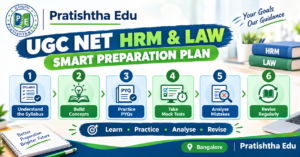
Step 1: Start With the Complete Syllabus
Before creating a timetable, keep the latest syllabus in front of you.
Divide the syllabus into smaller sections and mark each topic as:
- Not Started
- Currently Studying
- Completed
- Needs Revision
- Strong Area
This simple tracking system helps candidates identify their actual progress instead of relying on the number of hours studied.
For students beginning UGC NET preparation, it is also useful to keep separate sections for Paper 1 and Paper 2 so that one paper does not completely replace the other in the study schedule.
Step 2: Assess Your Current Preparation Level
Before starting intensive study, attempt a few topic-wise questions or a diagnostic test.
Your objective is not to achieve a high score at this stage. Instead, identify:
- Topics you already understand
- Topics requiring detailed study
- Areas where you make repeated mistakes
- Topics that take too much time
- Concepts that you confuse with each other
For example, a candidate may have good knowledge of recruitment and selection but find industrial relations or labour-related concepts difficult. That information can then be used to adjust the timetable.
Step 3: Divide Your Study Time Between Paper 1 and Paper 2
Paper 2 has 100 questions carrying 200 marks, while Paper 1 has 50 questions carrying 100 marks.
Because both papers contribute to the total score, preparation should include regular practice for each.
A sample daily structure could look like this:
| Session | Suggested Activity |
| Session 1 | Paper 2 concept study |
| Session 2 | HRM/Law topic practice |
| Session 3 | Paper 1 concepts or questions |
| Session 4 | Previous-year questions |
| Session 5 | Revision and error analysis |
Candidates do not have to follow these exact sessions. The timetable should be adapted to college, work and other daily responsibilities.
Step 4: Build Strong HRM Concepts
Start Paper 2 preparation with fundamental concepts before moving into complex theories and applications.
A possible sequence is:
HRM Basics → HR Planning → Recruitment → Selection → Training → Performance Management → Compensation → Industrial Relations → HRD → Strategic HRM
While studying each topic, focus on four questions:
- What does the concept mean?
- What are its main features?
- How is it different from related concepts?
- How can it be applied in an organization?
This method helps move preparation beyond simple memorization.
Step 5: Study Law Through Concepts and Application
Legal topics can sometimes appear difficult because candidates have to remember terminology, provisions and their practical implications.
Instead of reading legal material repeatedly without practice, divide each topic into:
Concept → Important provision → Key terminology → Practical application → Questions → Revision
Maintain a separate list of provisions or legal concepts that you repeatedly forget.
Candidates should use updated legal resources when studying current provisions. For official legislative texts, the India Code database can be used as an external reference where relevant.
Step 6: Use Previous-Year Questions Regularly
Previous-year questions are useful because they allow candidates to understand how concepts are tested.
Do not wait until the entire syllabus is finished before solving them.
A better sequence is:
Complete Topic → Revise Topic → Solve Related Questions → Analyse Mistakes → Revisit Weak Concept
For every incorrect answer, ask:
- Did I misunderstand the concept?
- Did I misread the question?
- Did I confuse two similar terms?
- Did I make a calculation or reasoning error?
- Did I choose the answer because of incomplete knowledge?
Maintain an error notebook containing the questions or concepts you repeatedly get wrong.
Step 7: Create a Weekly Study Plan
A weekly plan can make a large syllabus easier to manage.
Sample Weekly Plan
| Day | Paper 1 | Paper 2 | Practice |
| Monday | Teaching Aptitude | HRM Fundamentals | Topic Questions |
| Tuesday | Research Aptitude | Recruitment & Selection | PYQs |
| Wednesday | Communication | Training & Development | Topic Test |
| Thursday | Reasoning | Performance Management | PYQs |
| Friday | Data Interpretation | Industrial Relations | Practice Set |
| Saturday | ICT / Higher Education | HRD / Strategic HRM | Mixed Questions |
| Sunday | Revision | Weekly Revision | Mock Test + Analysis |
This schedule is an example rather than a fixed requirement. Candidates with limited study hours can reduce the number of daily topics while maintaining the same preparation cycle.
Step 8: Follow the Learn–Practice–Revise Cycle
A useful preparation system is:
Learn
Understand the concept through class, textbook, notes or reliable study material.
Practice
Solve questions immediately after studying the topic.
Revise
Return to the topic after a suitable interval and test your recall.
This cycle is more useful than reading the same chapter repeatedly without testing your understanding.
Students using UGC NET study material should also avoid collecting too many books and notes. A smaller set of reliable resources, used consistently, is generally easier to revise.
Step 9: Start Mock Tests at the Right Stage
Mock tests should become part of preparation after candidates have developed sufficient familiarity with the syllabus.
Initially, use topic-wise tests. Later, move to mixed tests and finally full-length examination simulations.
A useful progression is:
Topic Test → Unit Test → Mixed Test → Full-Length Mock
During every mock test, record:
- Total score
- Correct answers
- Incorrect answers
- Unattempted questions
- Time spent
- Topics causing mistakes
The score itself is only one part of mock-test analysis. Understanding why mistakes happened is equally important.
Step 10: Improve Time Management
The complete examination duration is 180 minutes.
Candidates should therefore practice answering questions within a controlled time limit.
During mock tests, identify questions that:
- Can be answered immediately
- Require moderate thinking
- Need more time
- Should be revisited later
Avoid spending excessive time on a single difficult question when several other questions remain.
Time management should be developed gradually through repeated timed practice rather than only during the final weeks.
A 90-Day Preparation Framework
Candidates who have around three months can divide preparation into three broad phases.
Month 1: Foundation
Focus on:
- Understanding the syllabus
- Building basic concepts
- Starting Paper 1
- Creating notes
- Beginning topic-wise questions
Month 2: Practice
Focus on:
- Completing remaining topics
- Solving previous-year questions
- Topic-wise tests
- Revising completed units
- Identifying weak areas
Month 3: Revision and Testing
Focus on:
- Full syllabus revision
- Full-length mock tests
- Error analysis
- Short notes
- Repeatedly difficult topics
- Time-management practice
Candidates with more or less preparation time can expand or compress these phases.
Common Preparation Mistakes to Avoid
Studying Without a Syllabus
Without a clear syllabus checklist, candidates may spend too much time on a few familiar topics.
Ignoring Paper 1
Focusing exclusively on the subject paper can leave Paper 1 preparation until too late.
Collecting Too Many Resources
Using multiple books, PDFs and videos for the same topic can create confusion and reduce revision time.
Avoiding Previous-Year Questions
Reading concepts without solving questions does not show whether you can apply what you have studied.
Taking Mock Tests Without Analysis
A mock test is most useful when candidates review incorrect and uncertain answers afterward.
Leaving Revision Until the End
Revision should begin while the syllabus is still being completed rather than being postponed until the final stage.
Combining Coaching With Self-Study
For candidates attending UGC NET HRM and Law classes in Bangalore, classroom learning can provide a structured academic routine. However, individual practice remains an essential part of preparation.
A productive routine can be:
Class → Same-Day Revision → Practice Questions → Doubt Identification → Weekly Revision → Mock Test
Candidates can use classroom sessions to understand difficult concepts and then use self-study time to strengthen those concepts through practice.
For students who prefer a dedicated study environment, Pratishtha Library can provide a separate space for focused self-study and revision.
Track Your Progress Every Week
At the end of each week, record:
- Topics completed
- Topics pending
- Questions attempted
- Accuracy percentage
- Mock-test performance
- Repeated mistakes
- Topics requiring revision
A simple progress sheet can reveal whether preparation is actually moving forward.
The goal should be measurable improvement in understanding, accuracy and time management rather than simply increasing the number of study hours.
Key Takeaways
Effective preparation requires more than completing the syllabus. Candidates should combine concept building, question practice, revision, mock tests and error analysis throughout their preparation period.
A consistent study cycle can be summarized as:
Understand → Practice → Analyse → Revise → Test → Improve
Once this routine is established, the next step is to identify the right study materials, previous-year questions, mock tests and revision resources for HRM and Law preparation.
UGC NET HRM and Law Study Material and Practice Resources
Once a study routine is established, the next important step is selecting the right preparation resources. The quality of study material matters, but using too many resources at the same time can make preparation unnecessarily complicated.
Candidates preparing for HRM and Law should aim for a simple resource system that covers the syllabus, provides sufficient conceptual explanations and gives enough opportunities for question practice.
A practical resource cycle can be:
Syllabus → Study Material → Class Notes → Previous-Year Questions → Mock Tests → Revision
This approach keeps preparation focused and makes it easier to identify gaps.
How to Choose UGC NET Study Material
Good study material should match the applicable syllabus and provide sufficient depth for the subject.
Before selecting a book, PDF, class notes or online resource, check whether it:
- Covers the relevant syllabus
- Explains concepts clearly
- Uses updated information
- Includes examples where necessary
- Provides practice questions
- Supports revision
- Avoids unnecessary information outside the examination scope
Students using UGC NET study material should avoid changing their primary resource every few weeks. Switching between multiple sources can make revision difficult.
A better approach is to select one primary source for each major area and use additional resources only when a concept requires clarification.
Maintain Separate Resources for Paper 1 and Paper 2
Paper 1 and Paper 2 have different preparation requirements.
Paper 1 preparation generally benefits from regular practice in areas such as teaching aptitude, research aptitude, reasoning, communication, data interpretation and other common topics.
Paper 2 requires detailed subject preparation.
Therefore, candidates can maintain separate folders or notebooks for:
Paper 1 Resources
- Concept notes
- Practice questions
- Reasoning sets
- Data interpretation questions
- Previous-year questions
- Mock tests
Paper 2 Resources
- HRM notes
- HRD notes
- Organizational Behaviour
- Industrial Relations
- Labour-related topics
- Strategic HRM
- Law-related notes
- Previous-year questions
- Subject mock tests
Keeping these resources separate makes revision more organized.
Why Previous-Year Questions Are Important
Previous-year questions can help candidates understand how the syllabus is converted into actual examination questions.
They can be used to identify:
- Frequently tested concepts
- Question formats
- Conceptual differences
- Application-based questions
- Areas requiring additional revision
- Personal strengths and weaknesses
However, previous-year questions should not be treated as a list of questions to memorize.
The more useful approach is to understand why an answer is correct.
For example, if a question relates to performance management, candidates should revise the underlying concept after solving the question rather than remembering only the correct option.
How to Use Previous-Year Questions Effectively
Follow a four-step process:
Step 1: Solve
Attempt the question without immediately checking the answer.
Step 2: Check
Compare your answer with the correct answer.
Step 3: Understand
Read the relevant concept again, especially if the answer was incorrect.
Step 4: Record
Add the difficult concept to your revision or error notebook.
This method transforms previous-year questions into a learning resource instead of just a testing resource.
Create a Previous-Year Question Notebook
A separate PYQ notebook can contain:
| Column | What to Record |
| Topic | Related syllabus area |
| Question | Short reference |
| Your Answer | Selected option |
| Correct Answer | Correct option |
| Mistake | Why the answer went wrong |
| Revision Date | When to review again |
Candidates do not need to copy every question. They can record only difficult, confusing or repeatedly tested concepts.
Importance of Mock Tests
Mock tests help candidates move from learning mode to examination mode.
A mock test can provide information about:
- Accuracy
- Speed
- Time management
- Weak topics
- Question-selection habits
- Revision gaps
Candidates should gradually move from small topic tests to complete examination simulations.
Recommended Testing Sequence
Topic Test
Use immediately after completing a topic.
↓
Unit Test
Use after completing several connected topics.
↓
Mixed Test
Combine different syllabus areas.
↓
Full-Length Mock
Attempt the complete examination format under timed conditions.
This progression allows candidates to develop confidence before attempting repeated full-length tests.
How to Analyse a Mock Test
Completing a mock test is only half the process.
After each test, divide questions into four categories:
Correct and Confident
These questions generally require only normal revision.
Correct but Uncertain
Review the concept because the correct answer may have been selected through elimination or guessing.
Incorrect Due to Concept
Return to the relevant study material and revise the topic.
Incorrect Due to Carelessness
Identify issues such as misreading, calculation errors or selecting an option too quickly.
This analysis can provide more useful information than the total score alone.
Maintain an Error Log
An error log is one of the simplest ways to improve repeated mistakes.
Record:
- Question topic
- Type of mistake
- Correct concept
- Correct answer
- Date of revision
For example:
Topic: Recruitment and Selection
Mistake: Confused recruitment with selection
Action: Revise definitions and process differences
Over time, this creates a personalized revision list based on actual performance.
Revision Strategy for HRM and Law
Revision should happen at multiple levels rather than only once before the examination.
Daily Revision
Spend a short amount of time reviewing the concepts studied that day.
Weekly Revision
Review important topics completed during the week.
Monthly Revision
Revisit larger units and solve mixed questions.
Final Revision
Use concise notes, marked questions, error logs and important concepts.
Candidates can use the following cycle:
Learn → Revise → Practice → Test → Analyse → Revise Again
Use Short Notes for Final Revision
Short notes are particularly useful when the syllabus contains numerous definitions, theories, classifications and related concepts.
For HRM, short notes can include:
- Important theories
- HR processes
- Definitions
- Models
- Comparisons
- Key principles
For Law-related topics, notes can include:
- Important concepts
- Key terminology
- Relevant provisions
- Important distinctions
- Practical applications
Avoid copying entire chapters into revision notes. The objective is to create a compact resource that can be reviewed quickly.
How to Avoid Resource Overload
One common preparation problem is collecting too many resources.
Candidates may have:
- Multiple books
- Coaching PDFs
- Telegram notes
- YouTube videos
- Online articles
- Question banks
- Mock-test platforms
Having more resources does not automatically make preparation better.
Instead, create a three-level resource system:
Primary Resource
Your main textbook, class notes or structured course material.
Practice Resource
Previous-year questions and topic-wise question banks.
Testing Resource
Mock tests and full-length examination simulations.
Additional resources should be added only when they solve a specific learning problem.
Digital Resources and Online Learning
Online resources can supplement classroom preparation, particularly when candidates need additional explanations or revision.
However, candidates should verify whether the information is current and relevant to the examination syllabus.
For legal topics, official government or authoritative sources should be preferred when checking legislation and legal provisions.
For examination-related information, candidates should refer to official NTA resources rather than relying entirely on third-party websites.
Using Coaching Material Effectively
Candidates attending structured classes can use classroom notes as the foundation of their preparation.
A useful routine is:
Attend Class → Revise Within 24 Hours → Mark Doubts → Solve Questions → Revisit Difficult Areas
This prevents classroom learning from becoming passive.
Students looking for UGC NET coaching in Bangalore should also check whether the institute provides supporting resources such as practice questions, revision sessions, mock tests and doubt-solving opportunities.
Self-Study and Library Support
Self-study is an important part of competitive examination preparation. Even when candidates attend coaching classes, they need dedicated time for revision and question practice.
A focused study environment can help candidates maintain a consistent routine.
Students using Pratishtha Library can use dedicated study time for activities such as:
- Reading subject material
- Revising class notes
- Solving PYQs
- Attempting mock tests
- Preparing short notes
- Reviewing mistakes
The aim is to create a regular study habit rather than simply spending more hours at a study facility.
Resource Checklist
Before moving into intensive revision, candidates can check whether they have:
- Latest syllabus
- Reliable Paper 1 material
- Subject-specific Paper 2 material
- Previous-year questions
- Topic-wise practice sets
- Mock tests
- Revision notes
- Error notebook
- Current legal reference material where applicable
- Weekly progress tracker
If these resources are organized properly, preparation becomes easier to monitor.
Key Takeaways
The right resources should make preparation simpler, not more complicated. Candidates should prioritize syllabus-aligned study material, previous-year questions, regular mock tests and focused revision.
A strong resource strategy can be summarized as:
One reliable source for learning + PYQs for understanding questions + Mock tests for examination practice + Short notes for revision.
Choosing UGC NET HRM and Law Coaching in Bangalore
Once candidates understand the syllabus, preparation strategy and study resources, the next question is whether they should prepare completely through self-study or take structured academic support.
There is no single preparation method that works identically for every student. Some candidates are comfortable studying independently, while others benefit from scheduled classes, faculty guidance, regular tests, and a fixed study routine.
For candidates considering UGC NET HRM and Law coaching, the important step is to evaluate what type of academic support matches their preparation requirements.
Self-Study vs Coaching
Both self-study and coaching can be part of an effective preparation plan.
Self-Study
Self-study can be suitable for candidates who:
- Already understand the subject fundamentals
- Can maintain a regular timetable
- Know how to use the syllabus effectively
- Can select reliable study resources
- Are comfortable analysing their own mistakes
- Can maintain consistency without external supervision
The main requirement is discipline. Candidates need to create their own study schedule, revision system, and testing routine.
Structured Coaching
Structured classes may be useful for candidates who:
- Need guidance to understand difficult concepts
- Prefer a fixed study schedule
- Want regular faculty interaction
- Need support with syllabus planning
- Want organized practice sessions
- Prefer guided revision
- Benefit from regular mock tests and performance analysis
Coaching should complement self-study rather than replace it.
What to Look for in a Coaching Institute
Before enrolling, candidates should compare the actual academic features of different institutes instead of selecting a program based only on advertisements.
Important factors include:
Experienced Faculty
Faculty members should be able to explain concepts clearly and connect theoretical topics with examination-oriented questions.
Candidates can ask about:
- Faculty experience
- Subject specialization
- Teaching methodology
- Doubt-solving availability
- Revision support
Complete Syllabus Coverage
A course should have a clear plan for completing the applicable syllabus within the available preparation period.
Ask whether the program covers:
- Paper 1
- Paper 2
- HRM concepts
- HRD
- Organizational Behaviour
- Industrial Relations
- Relevant Law topics
- Revision
- Question practice
- Mock tests
A clear course plan can help candidates understand what they will study and when.
Concept-Based Teaching
Simply providing notes is not enough for every learner.
Candidates should look for classes that explain:
- Definitions
- Theories
- Models
- Comparisons
- Practical applications
- Important concepts behind questions
Conceptual understanding can make revision and question-solving easier.
Paper 1 and Paper 2 Support
Because the examination includes both papers, candidates should understand how an institute divides preparation between them.
Paper 1 contains 50 questions for 100 marks, while Paper 2 contains 100 questions for 200 marks.
A structured program may therefore include separate schedules for:
Paper 1 → Common aptitude preparation
Paper 2 → Subject-specific preparation
Candidates should check whether both components are included in the course they are considering.
Previous-Year Question Practice
Question practice should be integrated into the course rather than being left entirely for the final stage.
Useful academic support can include:
- Topic-wise questions
- Unit-wise tests
- Previous-year questions
- Practice worksheets
- Mixed question sets
- Full-length mock tests
After completing a topic, candidates should ideally get an opportunity to test their understanding through questions.
Mock Tests and Performance Analysis
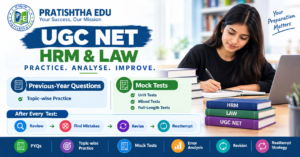
Mock tests are useful only when candidates analyse their performance afterward.
A coaching program can support this process through:
- Regular test schedules
- Timed examinations
- Score reports
- Topic-wise performance
- Error analysis
- Revision recommendations
Candidates can then identify whether their main problem is conceptual knowledge, accuracy or time management.
Doubt-Solving Support
Difficult concepts can sometimes remain unresolved when students rely entirely on independent study.
Before joining a program, candidates can ask:
- How are doubts handled?
- Are doubt sessions scheduled?
- Can students ask questions after class?
- Is faculty support available during revision?
- Are difficult questions discussed after tests?
Regular doubt resolution can help prevent small misunderstandings from becoming repeated mistakes.
Classroom and Online Learning Options
Candidates have different learning preferences.
Classroom Preparation
Classroom learning may provide:
- Fixed study timings
- Direct faculty interaction
- Classroom discussions
- Peer learning
- A structured academic environment
It may be useful for students who find it easier to maintain consistency through scheduled classes.
Online Preparation
Online learning may provide:
- Flexible study schedules
- Recorded classes
- Remote access
- Revision flexibility
- Reduced travel requirements
Candidates who work or have college commitments may prefer greater flexibility.
The choice should depend on the candidate’s schedule, learning preferences and ability to maintain consistent study habits.
What to Ask Before Enrolling
Before joining any program, candidates can prepare a simple checklist.
Ask the institute:
- Is Paper 1 included?
- How is Paper 2 covered?
- Is the complete syllabus included?
- Are previous-year questions discussed?
- How frequently are mock tests conducted?
- Is doubt-solving available?
- Are revision classes provided?
- Is study material included?
- Are classes classroom-based, online or both?
- How is student progress monitored?
These questions can help candidates compare programs based on actual academic support.
Preparing With Pratishtha Edu
Pratishtha Edu is an academic and competitive-examination coaching institute in Bangalore. Students exploring preparation support can review the available UGC NET coaching options in Bangalore and understand the academic structure before deciding which preparation format suits them.
A structured preparation approach can combine:
- Paper 1 guidance
- Subject-focused Paper 2 preparation
- Concept-based classes
- Previous-year question practice
- Mock tests
- Revision
- Doubt-solving
- Self-study
Candidates should choose the features that match their individual preparation needs rather than selecting a program solely because of its promotional claims.
Creating a Coaching + Self-Study Routine
Even with regular classes, self-study remains important.
A simple weekly routine can be:
Monday–Friday: Classes + same-day revision
Saturday: Topic-wise practice + previous-year questions
Sunday: Mock test + performance analysis + weekly revision
Candidates can adjust this structure according to their class schedule.
The important point is to avoid leaving all revision until the end of the course.
Use a Dedicated Study Environment
A consistent environment can make it easier to follow a daily preparation routine.
Students who need a quiet place for independent study can use Pratishtha Library for activities such as:
- Revising class notes
- Reading study material
- Solving previous-year questions
- Taking mock tests
- Preparing short notes
- Reviewing difficult topics
A dedicated study space can be particularly useful when candidates find it difficult to maintain concentration at home.
Coaching Is Only One Part of Preparation
Joining a coaching program does not automatically complete the preparation process.
Candidates still need to:
- Attend classes consistently
- Revise concepts
- Solve questions
- Complete assignments
- Analyse mock tests
- Maintain short notes
- Revise weak areas
- Follow the syllabus
The most productive approach is generally a combination of guided learning and independent practice.
Questions to Ask Yourself Before Choosing a Program
Before making a decision, candidates can evaluate their own preparation needs:
Do I need faculty support for difficult concepts?
Can I follow a self-study schedule consistently?
Do I need regular tests to track progress?
Do I prefer classroom interaction or flexible online learning?
Do I already have reliable study material?
Do I need help dividing the syllabus into manageable sections?
The answers can help candidates determine which type of preparation support fits their situation.
Key Takeaways
The right preparation environment depends on the candidate’s academic background, available time, learning style, and level of subject familiarity.
When comparing coaching options, look at the complete academic system rather than only the course name. Faculty support, syllabus coverage, study material, previous-year questions, mock tests, revision, and doubt-solving can all be relevant factors.
A balanced preparation model can be summarized as:
Guidance + Self-Study + Practice + Revision + Testing
Career Opportunities After UGC NET HRM and Law
Qualifying UGC NET can open different academic and research-related pathways, depending on the candidate’s eligibility, category, qualification, NET result and the requirements of the institution or recruitment process.
For candidates with an interest in Human Resource Management and Law, the qualification can be relevant to careers connected with teaching, research, higher education, human resources and related academic fields.
However, candidates should understand that qualifying the examination does not automatically guarantee a particular job. Recruitment, admission to research programs and employment opportunities depend on the applicable rules and the requirements of individual institutions.
Teaching and Academic Opportunities
One of the major purposes of UGC NET is to establish eligibility for Assistant Professor positions in eligible higher-education institutions, subject to the applicable recruitment rules.
Candidates interested in teaching can explore opportunities in areas related to their academic qualification and the subject in which they have qualified.
Potential academic work may involve:
- Classroom teaching
- Tutorials and academic discussions
- Student mentoring
- Assignment evaluation
- Academic content development
- Examination-related responsibilities
- Departmental activities
The actual eligibility for a particular teaching position depends on the institution’s recruitment notification and applicable regulations.
Junior Research Fellowship
Candidates who qualify for JRF and satisfy the applicable requirements may pursue research-related opportunities.
JRF can provide a pathway toward advanced academic research and doctoral-level study, subject to admission requirements and the rules of the university or research institution.
Research-oriented work can involve:
- Literature review
- Research methodology
- Data collection
- Data analysis
- Academic writing
- Research publications
- Conference participation
- Dissertation or thesis work
Candidates interested in research should develop skills beyond examination preparation, including academic writing, research methodology and critical analysis.
Research Opportunities in HRM
Human Resource Management offers several areas for academic research.
Candidates interested in research can explore topics such as:
Employee Engagement
Research may examine factors affecting employee engagement, workplace participation and organizational commitment.
Training and Development
Possible research areas include employee learning, skill development, training effectiveness and professional development.
Performance Management
Research can explore performance evaluation systems, employee feedback, goal setting and organizational performance.
Compensation and Rewards
Research may examine compensation structures, incentives, employee motivation and reward systems.
Organizational Behaviour
Candidates can study areas such as leadership, motivation, organizational culture, teamwork, employee satisfaction and workplace behaviour.
These are examples of potential research areas rather than prescribed career requirements.
Career Areas Related to Human Resources
Candidates with an academic background in HRM may also explore professional roles in the broader human-resource sector, depending on their qualifications and experience.
Possible areas include:
- Human Resource Management
- Recruitment
- Talent Acquisition
- Learning and Development
- Employee Relations
- Performance Management
- Compensation and Benefits
- HR Operations
- Organizational Development
- Training and Corporate Learning
UGC NET itself is an academic eligibility examination; professional HR roles may have additional qualifications, experience, or employer-specific requirements.
Law and Labour-Related Academic Areas
Candidates with relevant academic backgrounds may also explore research and teaching areas connected with employment relationships, industrial relations and labour-related legal studies.
Possible academic areas include:
- Labour law
- Employment relations
- Industrial relations
- Labour welfare
- Workplace regulations
- Social security
- Dispute resolution
- Employment policy
Because legal provisions can change, candidates involved in research or teaching should rely on updated legislation and authoritative legal resources.
Opportunities in Higher Education
Higher education institutions require professionals for more than classroom teaching alone.
Depending on qualifications and institutional requirements, candidates may encounter roles or activities related to:
- Academic teaching
- Research assistance
- Curriculum-related work
- Student support
- Academic administration
- Examination coordination
- Research projects
- Training and development
The specific responsibilities and eligibility requirements vary between institutions.
Building an Academic Profile
Candidates who want to develop a long-term academic career can work on their profile beyond the examination.
Useful areas include:
Research Skills
Develop familiarity with:
- Research methodology
- Literature review
- Research design
- Data interpretation
- Academic referencing
- Research writing
Academic Writing
Practice writing:
- Research papers
- Literature reviews
- Conference papers
- Academic articles
- Research proposals
Presentation Skills
Teaching and academic careers can also benefit from clear communication and presentation abilities.
Candidates can practice explaining complex concepts in a simple and structured way.
UGC NET and PhD Pathways
For candidates interested in doctoral research, qualifying UGC NET may form part of an academic pathway, depending on the applicable category and current rules.
Admission to a PhD program is governed by the relevant university or institution’s admission process. Candidates should therefore check the current admission notification rather than assuming that NET qualification alone guarantees admission.
Before applying, verify:
- University eligibility
- Subject requirements
- Research area
- Admission procedure
- Entrance requirements, where applicable
- Interview requirements
- Category-specific rules
Skills That Can Strengthen Your Career
Examination preparation develops subject knowledge, but candidates can also build complementary professional skills.
Communication
Useful for teaching, presentations, interviews and workplace interaction.
Research
Important for academic studies, doctoral work and research projects.
Analytical Thinking
Helps candidates understand complex organizational and legal concepts.
Data Interpretation
Useful for research, HR analytics and academic analysis.
Writing
Important for teaching material, reports, research papers and academic communication.
Digital Skills
Knowledge of productivity tools, presentation software, online learning platforms and basic data tools can support academic and professional work.
Career Planning During Preparation
Candidates do not have to wait until after the examination to think about their longer-term direction.
A simple career planning exercise can include three questions:
Where do I want to work?
For example, higher education, research, corporate HR or related areas.
What qualification do I need?
Identify the academic, professional or research qualifications relevant to that direction.
What skills do I need to develop?
Consider communication, research, data analysis, teaching or professional HR skills.
This can help candidates connect examination preparation with broader academic or career development.
Teaching vs Research vs HR Career Paths
These pathways can involve different day-to-day responsibilities.
| Career Direction | Common Focus |
| Teaching | Education, classroom instruction and student support |
| Research | Research projects, academic writing and analysis |
| HR | People management, recruitment and employee development |
| Labour/Employment Studies | Workplace relations, policy and legal concepts |
| Academic Administration | Institutional and academic coordination |
The table is intended to show differences in work focus, not to rank one pathway above another.
What to Do After Qualifying
After receiving a qualifying result, candidates should check the current opportunities and requirements relevant to their category.
Possible next steps can include:
- Checking eligibility for academic recruitment
- Exploring research opportunities
- Identifying suitable universities or institutions
- Preparing an academic CV
- Developing research interests
- Applying for relevant positions
- Exploring professional HR opportunities where applicable
Candidates should verify individual job or university requirements before applying.
Preparing for a Long-Term Academic Career
If teaching or research is the intended direction, preparation should continue beyond the examination.
Candidates can gradually develop:
- Subject expertise
- Research methodology
- Academic writing
- Presentation skills
- Teaching ability
- Digital learning skills
- Professional communication
This creates a broader academic profile instead of focusing only on examination performance.
A Practical Career Development Roadmap
A candidate can think about career development in stages:
Stage 1: Build subject knowledge
↓
Stage 2: Prepare for UGC NET
↓
Stage 3: Develop research and communication skills
↓
Stage 4: Explore teaching, research or relevant professional opportunities
↓
Stage 5: Continue professional and academic development
The exact route will vary according to the candidate’s qualification, interests and career requirements.
Key Takeaways
UGC NET can form part of different academic and professional pathways for eligible candidates. Teaching and research are important academic directions, while candidates with relevant qualifications may also explore HR, labour relations and related professional areas.
The examination should therefore be viewed as one component of a longer-term development plan.
Strong subject knowledge, research ability, communication, writing and practical skills can complement examination preparation and support future academic or professional goals.
UGC NET in HRM and Law Coaching in Bangalore: FAQs, Checklist & Final Preparation Guide
Preparing for UGC NET in HRM and Law requires more than simply completing the syllabus. A strong preparation process combines conceptual understanding, Paper 1 practice, Paper 2 preparation, previous-year questions, mock tests, revision and regular performance analysis.
By this stage, candidates should have a clear understanding of the syllabus, exam pattern, study resources, preparation strategy and career opportunities discussed throughout this guide. The next step is to convert that understanding into a consistent daily routine.
Frequently Asked Questions About UGC NET HRM and Law
1. What should I study first for UGC NET HRM and Law?
Start by understanding the complete syllabus and dividing it into manageable units. Build your Paper 2 preparation around major HRM, HRD, organizational behaviour, industrial relations, labour welfare and law-related concepts.
At the same time, begin Paper 1 preparation with topics such as teaching aptitude, research aptitude, reasoning, communication, data interpretation and other relevant areas.
Avoid studying randomly from multiple resources. Create a unit-wise checklist and mark every topic as:
- Not Started
- In Progress
- Completed
- Revised
- Practiced
This simple system helps you identify unfinished portions before the examination.
2. How should I balance Paper 1 and Paper 2 preparation?
Paper 2 generally requires deeper subject-specific preparation, while Paper 1 requires regular practice across different aptitude-based areas.
A practical routine can include:
- Paper 1: Daily practice and revision
- Paper 2: Main conceptual study
- PYQs: Regular question practice
- Mock tests: Weekly or according to your preparation stage
- Revision: Short daily and weekly sessions
Instead of completely finishing one paper before starting the other, maintain a parallel preparation routine.
3. Are previous-year questions important?
Previous-year questions can help candidates understand the type of concepts being tested and identify areas that require additional preparation.
Do not use PYQs only as a test. Use them as a learning tool.
For every question you answer incorrectly, identify:
- Which topic the question belongs to.
- Why your answer was incorrect.
- Which concept needs revision.
- Whether the mistake was conceptual, factual or due to time pressure.
- Whether a similar question should be added to your revision notebook.
Maintaining a PYQ error notebook can make revision more focused.
4. How many mock tests should I take?
There is no fixed number of mock tests that is suitable for every candidate.
The important factor is mock-test analysis.
After each test, review:
- Correct answers
- Incorrect answers
- Unattempted questions
- Time spent
- Topics causing repeated mistakes
- Questions answered through guesswork
- Areas requiring revision
A useful progression is:
Topic Test → Unit Test → Mixed Test → Full-Length Mock
Taking a large number of mocks without analysing mistakes may provide less value than taking fewer tests and reviewing them properly.
5. Is coaching necessary for UGC NET HRM and Law preparation?
Coaching is not the only route to preparation. Some candidates prefer self-study, while others benefit from structured classes, faculty guidance, study material, doubt-solving and regular tests.
If you are considering UGC NET in HRM and Law Coaching in Bangalore, compare the academic support offered rather than choosing only on the basis of advertisements.
Check whether the preparation support includes:
- Complete syllabus coverage
- Paper 1 guidance
- Paper 2 subject preparation
- Concept-based teaching
- Previous-year question practice
- Mock tests
- Doubt-solving sessions
- Revision support
- Study material
- Regular performance tracking
The right preparation method depends on your current level, available study time and learning style.
6. How should I revise UGC NET HRM and Law?
Revision should begin before the syllabus is completely finished.
A simple revision cycle can be:
Daily Revision → Weekly Revision → Unit Revision → Full Syllabus Revision
During revision, avoid reading every chapter from the beginning again. Instead, focus on:
- Short notes
- Important concepts
- Previous-year questions
- Mistake notebooks
- Frequently confused terms
- Important laws and concepts
- Mock-test errors
- Difficult topics
Repeated active recall and question practice can make revision more efficient than passive reading.
7. Can I prepare through online or offline classes?
Both online and offline learning can be used as part of a preparation strategy.
Online classes can provide flexibility, while classroom learning may provide a fixed study schedule and direct interaction with faculty and other learners.
Candidates can also combine classes with independent study, practice tests and a dedicated study environment.
For students who prefer a structured study atmosphere, Pratishtha Library can be used alongside their regular preparation routine.
Final UGC NET HRM and Law Preparation Checklist
Before moving into the final stage of preparation, check whether you have completed the following:
Syllabus
- Complete Paper 1 syllabus mapped
- Complete Paper 2 syllabus mapped
- Important topics identified
- Difficult units marked for additional revision
Study Material
- Reliable study material selected
- Short notes prepared
- Important concepts highlighted
- Unnecessary resources removed
Practice
- Previous-year questions solved
- Topic-wise questions practiced
- Unit tests completed
- Mixed tests attempted
- Full-length mocks practiced
Revision
- Daily revision routine followed
- Weekly revision completed
- Mistake notebook maintained
- Difficult topics revised repeatedly
- Important concepts recalled without looking at notes
Exam Readiness
- Time-management strategy tested
- Mock-test performance reviewed
- Weak areas identified
- Accuracy improved through practice
- Revision schedule prepared for the final stage
Build a Consistent Study Routine
The most important part of preparation is consistency.
A candidate may have excellent study material and coaching support, but progress depends on how regularly that material is studied and practiced.
A practical daily routine can include:
Concept Learning → Question Practice → Revision → Error Analysis
For example, after learning an HRM topic, solve related questions instead of immediately moving to another chapter. At the end of the day, revise the concepts studied and record serious mistakes.
At the end of each week, review your progress and adjust the following week’s schedule.
Start Your UGC NET HRM and Law Preparation in Bangalore

Candidates looking for UGC NET in HRM and Law Coaching in Bangalore can combine classroom guidance with self-study, previous-year question practice, mock tests and regular revision.
Pratishtha Edu can support candidates through structured UGC NET preparation, while Pratishtha Library can provide a dedicated environment for focused self-study and revision.
The objective should not be to collect more and more resources. It should be to understand the syllabus, study systematically, practice regularly, and improve based on performance.
For your preparation, focus on these five areas:
Understand → Study → Practice → Analyse → Revise
Final Takeaway
UGC NET HRM and Law preparation becomes more manageable when the entire syllabus is divided into smaller targets and studied through a structured routine.
Keep your preparation focused on:
- Strong Paper 1 fundamentals
- Thorough Paper 2 preparation
- Previous-year questions
- Regular mock tests
- Short notes and revision
- Error analysis
- Consistent time management
Whether you choose self-study, online learning, offline classes or a combination of different methods, maintain a measurable preparation plan.
A structured approach can help you identify what you know, what needs improvement and what should be revised before the examination.
Start with the syllabus, follow a realistic study plan, practice consistently and keep improving your preparation based on your performance.
Leave a Reply