
Choosing the right academic path after Class 10 is an important decision, especially for students planning to pursue Science in Class 11. Physics, Chemistry, Mathematics and Biology introduce students to deeper concepts, new problem-solving methods and a more demanding academic routine. For students who may later appear for JEE, NEET, or other competitive examinations, building strong fundamentals from the beginning can make the learning journey more structured.
11th Science Foundation Coaching in Bangalore is designed to help students understand these concepts systematically while managing school-level studies and future competitive-exam preparation. Instead of focusing only on memorising formulas or completing chapters, a good foundation program should develop conceptual understanding, regular practice, problem-solving ability, and consistent revision.
For parents and students, choosing a coaching program is not only about finding a nearby institute. Factors such as teaching methodology, faculty support, batch size, study material, doubt-solving, assessments, and individual academic guidance can make a significant difference.
Quick Answer: A Class 11 Science foundation program helps students strengthen their fundamentals in Physics, Chemistry, Mathematics and/or Biology while developing the skills required for board examinations and future competitive exams such as JEE and NEET.
Why Class 11 Is the Right Time to Build a Strong Science Foundation
Class 11 is more than just another academic year. For many Science students, it is the stage where school-level concepts begin connecting with the fundamentals required for higher education and competitive examinations.
Students who develop a clear understanding of concepts during this stage can approach Class 12 and competitive-exam preparation with greater confidence. On the other hand, gaps in fundamental topics can become more difficult to manage when the syllabus becomes more advanced.
The transition from Class 10 to Class 11
The move from Class 10 to Class 11 can feel challenging because students encounter more detailed concepts and a different style of learning.
In Class 10, students may be able to prepare effectively by concentrating on important questions and examination patterns. Class 11 Science generally requires a stronger focus on understanding concepts, applying formulas, solving numerical problems, and connecting different topics.
For example, Physics requires students to understand relationships between physical quantities rather than simply remember formulas. Chemistry combines conceptual understanding with calculations and reactions, while Mathematics requires continuous problem-solving practice.
This is why establishing a consistent study routine early can be valuable.
Why Science subjects become more concept-based
The Science curriculum in Class 11 introduces several fundamental ideas that become important in higher classes and competitive examinations.
Students may encounter topics such as mechanics and thermodynamics in Physics, atomic structure and chemical bonding in Chemistry, and functions, trigonometry and coordinate geometry in Mathematics. PCB students also need to develop a strong understanding of Biology concepts and learn how to study NCERT-based content effectively.
The objective of foundation learning should therefore be to answer three questions:
- What is the concept?
- Why does it work?
- How can I apply it to a question or real problem?
This approach can help students move from memorisation to genuine understanding.
How early preparation can help with JEE, NEET and board exams
Students targeting JEE or NEET often need to manage multiple academic priorities at the same time. School examinations require attention to the prescribed curriculum, while competitive exams demand extensive practice and application.
A well-planned foundation approach can connect these requirements instead of treating them as completely separate goals.
For PCM students, a strong Class 11 foundation can support future preparation in Physics, Chemistry, and Mathematics. For PCB students, it can strengthen Physics, Chemistry and Biology fundamentals required for NEET-oriented preparation.
The key is not simply starting competitive-exam preparation early. It is about learning the fundamentals correctly, practising regularly, and identifying weak areas before they become larger gaps.
Building the right study habits in Class 11
Academic success in Science is not based only on the number of hours a student studies. Effective learning also depends on consistency.
Students can benefit from developing habits such as:
- Revising concepts soon after they are taught
- Solving questions regularly instead of only before examinations
- Maintaining a list of difficult topics
- Asking doubts instead of leaving concepts unclear
- Taking periodic tests
- Reviewing mistakes after every test
- Revising older chapters while progressing through the syllabus
These habits can become particularly useful when the academic workload increases in Class 12.
What Should Students Expect From a Good Foundation Program?
A useful foundation program should go beyond simply completing the syllabus. Students should receive a structured learning process that combines concept teaching, practice, revision, assessment, and doubt resolution.
Parents can look for a program that provides:
Concept-focused teaching: Difficult topics should be explained in a way that students can understand and apply.
Regular practice: Students should have sufficient opportunities to solve both basic and application-based questions.
Assessment: Periodic tests can help identify areas where additional preparation is required.
Doubt support: Students should have a clear way to ask questions and resolve conceptual difficulties.
Revision: Important topics should be revisited regularly rather than being taught once and forgotten.
Academic guidance: Students should understand how to manage school studies alongside their longer-term academic goals.
For this reason, when comparing Class 11 Science coaching in Bangalore, students and parents should look beyond advertisements and evaluate the actual learning system offered by the institute.
What Is 11th Science Foundation Coaching?
An 11th Science Foundation program is a structured learning approach designed to help students build strong fundamentals in their Science subjects while developing the skills required for higher classes and competitive examinations.
For a student entering Class 11, foundation coaching is not simply about finishing the syllabus faster. The objective is to develop conceptual clarity, problem-solving ability, regular study habits, and confidence before the academic difficulty increases in Class 12.
A well-designed Class 11 Science Foundation Course in Bangalore can combine school-level learning with the fundamentals that students may need for examinations such as JEE and NEET.
Concept Building Instead of Rote Learning
Science subjects become easier when students understand the logic behind a concept rather than trying to memorise every formula or answer.
For example, in Physics, students need to understand how different quantities are related and how formulas are applied to numerical problems. Chemistry requires a combination of concepts, calculations and reactions, while Mathematics requires repeated practice and logical thinking.
A foundation-focused approach therefore encourages students to:
- Understand the basic concept before solving questions
- Learn how and when to apply formulas
- Practise questions of different difficulty levels
- Connect new topics with previously learned concepts
- Review mistakes and learn from them
This method can make the transition from school-level Science to competitive-exam-oriented preparation more manageable.
Board Preparation With Competitive-Exam Fundamentals
One common concern among Class 11 students and parents is whether school studies and competitive-exam preparation can be managed together.
The two do not necessarily need to be treated as completely separate preparation tracks.
Strong conceptual learning can support both. When students understand the fundamentals properly, they can use the same knowledge for school examinations and gradually develop the application skills required for competitive tests.
A balanced foundation program should therefore maintain a connection between:
School syllabus → Concept clarity → Practice → Application → Revision → Assessment
This approach is particularly useful for students who want to prepare for future JEE or NEET examinations without neglecting their Class 11 academic performance.
Who Should Join a Class 11 Science Foundation Course?
Foundation coaching can be useful for different types of students. The right choice depends on the student’s academic goals, current understanding, and preferred learning style.
Students Aiming for JEE
Students planning to appear for JEE can use Class 11 to develop a strong base in Physics, Chemistry, and Mathematics.
JEE preparation involves more than remembering formulas. Students need to understand concepts, solve numerical problems, identify different approaches, and work accurately under time constraints.
Starting with fundamentals can help students become familiar with this style of problem-solving gradually instead of trying to develop it at the last moment.
A Class 11 JEE foundation approach can focus on:
- Physics concepts and numerical problem-solving
- Chemistry fundamentals and application
- Mathematics problem-solving techniques
- Regular practice
- Chapter-wise tests
- Error analysis
- Revision of previously studied topics
Students Preparing for NEET
For students considering medicine as a career, Class 11 is an important stage for building a strong foundation in Physics, Chemistry, and Biology.
NEET preparation requires students to combine conceptual understanding with extensive practice and careful revision. Biology also demands disciplined NCERT-based study, while Physics and Chemistry require regular numerical and conceptual practice.
A structured NEET foundation approach can help students develop:
- Strong Biology fundamentals
- Clear Chemistry concepts
- Physics problem-solving skills
- Regular NCERT revision
- Practice through topic-wise questions
- Test-taking habits
Students should not think of foundation preparation as simply studying for an entrance examination years in advance. The more practical objective is to develop the academic habits and conceptual base that will be required later.
Students Focused on School and Board Performance
Not every Class 11 Science student plans to appear for JEE or NEET.
Some students may primarily want to perform well in their school examinations, build stronger fundamentals, or prepare for higher education in Science.
For these students, foundation coaching can provide additional academic support through:
- Concept clarification
- Regular practice
- Structured revision
- Doubt-solving
- Chapter-wise assessments
- Guidance on difficult topics
The focus can remain on strengthening the student’s understanding without unnecessarily adding competitive-exam pressure.
Students Who Need Stronger Science Fundamentals
Students who find certain Science topics difficult can also benefit from structured support.
For example, a student may understand basic Physics but struggle with numerical problems. Another student may find Chemical Bonding confusing or have difficulty applying mathematical concepts to unfamiliar questions.
Instead of waiting until these gaps become larger, students can work on them during Class 11 itself.
A good academic support system should help identify:
What the student knows → What the student does not understand → Why the student is struggling → What practice is needed → Whether the student has improved
This makes foundation learning more personalised and practical.
PCM and PCB Students: What Changes?
The right foundation approach can also depend on the Science stream a student chooses.
PCM Foundation for Class 11
PCM generally refers to Physics, Chemistry, and Mathematics.
Students choosing PCM may be interested in engineering, JEE, or other Mathematics and Science-related academic pathways.
Their preparation generally requires a strong focus on:
- Physics concepts and numerical problems
- Chemistry fundamentals
- Algebra
- Trigonometry
- Coordinate Geometry
- Functions
- Logical and analytical problem-solving
Consistent Mathematics practice is particularly important because students may encounter unfamiliar question patterns that cannot be solved through memorisation alone.
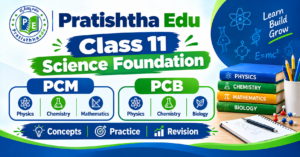
PCB Foundation for Class 11
PCB generally refers to Physics, Chemistry, and Biology.
Students choosing PCB may be interested in medicine, NEET, and other Biology-related academic pathways.
Their preparation can include:
- Physics numerical practice
- Chemistry concepts and reactions
- Biology conceptual understanding
- NCERT-focused study
- Diagram and terminology-based learning
- Regular revision and testing
For PCB students, maintaining a consistent Biology revision routine can be especially important because of the volume of concepts that need to be retained.
JEE or NEET Foundation: When Should Students Start?
There is no single starting point that is perfect for every student.
For students entering Class 11, however, beginning with a structured foundation can provide more time to understand concepts and identify weaknesses.
The goal should not be to create unnecessary academic pressure. Instead, students should gradually build their preparation through:
Learn → Practise → Test → Analyse → Revise → Improve
This cycle can be repeated throughout Class 11.
Students should also maintain a balance between coaching, school assignments, self-study, rest, and revision. A sustainable routine is generally more useful than an extremely intensive schedule that a student cannot maintain.
What Makes a Foundation Course Effective?
Before enrolling, students and parents should ask a few practical questions:
- Are the concepts explained clearly?
- Is there enough question practice?
- Are regular tests conducted?
- Are test results analysed?
- Can students ask doubts easily?
- Is revision included in the academic plan?
- Does the teaching complement school studies?
- Is the batch size suitable for individual attention?
- Are students given appropriate study material?
- Is there academic guidance when a student struggles?
These questions can help families compare different 11th Science coaching options in Bangalore based on actual learning support rather than advertisements alone.
Ultimately, the purpose of foundation coaching is simple: help students build the knowledge, skills, and confidence they need before the academic journey becomes more demanding.
What Do Students Study in a Class 11 Science Foundation Course?
One of the first questions students and parents ask before joining a foundation program is: What exactly will be taught?
A well-structured Class 11 Science program should focus on building a strong understanding of the subjects students study at school while gradually developing the conceptual and problem-solving skills needed for higher-level examinations.
Depending on whether a student chooses PCM or PCB, the academic focus can vary. PCM students generally concentrate on Physics, Chemistry, and Mathematics, while PCB students focus on Physics, Chemistry, and Biology.
The teaching plan should ideally combine concept explanation, examples, question practice, revision, and regular assessment instead of treating each chapter as something to be completed and forgotten.
Physics Foundation for Class 11 Students
Physics is often considered one of the most application-oriented subjects in Class 11. Students need to understand relationships between physical quantities and learn how to apply concepts to numerical and conceptual problems.
A strong Physics foundation can help students become comfortable with both basic and progressively challenging questions.
Important Physics Areas
Depending on the academic curriculum and learning plan, students may work on topics such as:
- Units and measurements
- Motion in a straight line
- Motion in a plane
- Laws of motion
- Work, energy and power
- System of particles and rotational motion
- Gravitation
- Mechanical properties of matter
- Thermodynamics
- Kinetic theory
- Oscillations
- Waves
These topics form an important base for advanced Physics in later classes.
How Students Can Improve Physics Problem-Solving
Reading a Physics chapter once is rarely enough. Students need to practise applying the concepts.
A useful approach is:
Understand the concept → Learn the relevant formula → Understand the variables → Solve basic questions → Attempt application-based problems → Analyse mistakes
For students planning JEE preparation, gradually increasing the difficulty of numerical problems can help them become more comfortable with unfamiliar question patterns.
For board-focused students, conceptual clarity and accurate presentation remain equally important.
Chemistry Foundation for Class 11 Students
Chemistry combines conceptual learning, calculations, reactions, and logical understanding. Class 11 introduces several fundamental ideas that students will continue using in Class 12 and competitive examinations.
A strong foundation can help students understand why a chemical process occurs instead of simply memorising reactions.
Important Chemistry Areas
A Class 11 Chemistry foundation may include topics such as:
- Some Basic Concepts of Chemistry
- Structure of Atom
- Classification of Elements and Periodicity
- Chemical Bonding and Molecular Structure
- Thermodynamics
- Equilibrium
- Redox Reactions
- Organic Chemistry fundamentals
- Hydrocarbons
- States of Matter and related concepts
The exact sequence may vary depending on the curriculum and academic plan.
Building a Strong Chemistry Base
Students can divide Chemistry learning into three broad approaches:
Physical Chemistry: Focuses on concepts, formulas, calculations, and numerical practice.
Organic Chemistry: Requires students to understand basic principles, structures, reactions, and reaction patterns.
Inorganic Chemistry: Requires conceptual understanding along with careful revision of important facts and trends.
A balanced study routine should give students sufficient practice in all three areas.
For competitive-exam preparation, students should also learn to identify the information provided in a question, select the correct concept, and solve it systematically.
Mathematics Foundation for Class 11 PCM Students
Mathematics is one of the most practice-intensive subjects for PCM students. Students may understand a concept during class but still struggle when they encounter a question presented in an unfamiliar way.
This is why consistent problem-solving is an essential part of a strong Mathematics foundation.
Important Mathematics Areas
Class 11 Mathematics commonly includes areas such as:
- Sets and functions
- Trigonometric functions
- Complex numbers and quadratic equations
- Linear inequalities
- Permutations and combinations
- Binomial theorem
- Sequences and series
- Straight lines
- Conic sections
- Introduction to three-dimensional geometry
- Limits and derivatives
- Statistics
- Probability
These concepts can become important building blocks for advanced Mathematics and future entrance-exam preparation.
How to Build Mathematics Problem-Solving Skills
Students should avoid relying only on solved examples.
A better learning cycle is:
Concept → Solved example → Basic questions → Moderate questions → Challenging questions → Error analysis → Revision
Students should maintain a record of questions they could not solve independently. Revisiting these problems after a few days can help identify whether the difficulty was caused by a conceptual gap, calculation error or incorrect approach.
For students targeting JEE, gradually learning to solve multi-step problems is particularly valuable.
Biology Foundation for Class 11 PCB Students
Biology is an important part of the PCB stream and plays a major role in NEET preparation.
Although Biology may appear more theory-oriented than Physics or Mathematics, students still need strong conceptual understanding. Simply reading chapters repeatedly may not always be enough.
Students should learn how concepts connect with one another and develop a systematic revision strategy.
Important Biology Areas
A Class 11 Biology foundation can include topics such as:
- The Living World
- Biological Classification
- Plant Kingdom
- Animal Kingdom
- Morphology of Flowering Plants
- Anatomy of Flowering Plants
- Structural Organisation in Animals
- Cell Structure and Function
- Biomolecules
- Cell Cycle and Cell Division
- Plant Physiology
- Human Physiology
These areas introduce concepts that can remain important throughout higher-level Biology studies.
Building an Effective Biology Study Routine
Students preparing for NEET should develop the habit of studying Biology carefully and revising it regularly.
A practical routine can include:
- Read the prescribed textbook content carefully.
- Understand the concept before attempting questions.
- Mark important terms and diagrams.
- Solve topic-wise questions.
- Review incorrect answers.
- Revise previously studied chapters at regular intervals.
Regular revision is particularly important because Biology contains a large number of concepts, terms, and interconnected processes.
PCM vs PCB: Which Foundation Approach Is Right for You?
The choice between PCM and PCB depends largely on a student’s interests, strengths, and future academic goals.
| PCM | PCB |
| Physics | Physics |
| Chemistry | Chemistry |
| Mathematics | Biology |
| Useful for many engineering pathways | Useful for medicine and Biology-related pathways |
| Strong emphasis on numerical problem-solving | Strong emphasis on Biology concepts and revision |
Students should avoid selecting a stream simply because it is considered popular or difficult. Their interests, academic strengths, and long-term goals should also be considered.
Parents can support students by discussing career interests and academic preferences rather than making the decision based only on marks.
How Foundation Coaching Connects Different Science Subjects
One advantage of a structured foundation approach is that students can begin to recognise connections between subjects.
For example, Mathematics can support Physics through calculations and mathematical modelling. Chemistry uses mathematical concepts in areas such as mole calculations and equilibrium, while Biology can connect Chemistry concepts with processes occurring inside living organisms.
This interconnected learning can make Science more meaningful.
Instead of studying each subject as an isolated collection of chapters, students can gradually develop the ability to ask:
What is the concept? How does it work? Where can I apply it? How is it connected to another topic?
This type of thinking can become valuable for both school examinations and competitive examinations.
Why Regular Practice Matters More Than Last-Minute Preparation
Completing a syllabus is only one part of academic preparation.
Students also need enough time to practise, revise and identify weak areas. If a difficult chapter is left until the end of the academic year, there may be limited time to correct the underlying problem.
A structured routine can therefore follow:
Learn → Practise → Test → Analyse → Revise
This cycle should continue throughout the academic year.
Regular tests can also help students understand their progress. More importantly, students should spend time analysing why an answer was wrong instead of looking only at the final score.
Building a Strong Foundation Across Physics, Chemistry, Mathematics and Biology
The purpose of foundation learning is not to make Class 11 unnecessarily stressful. It is to help students develop the skills required to handle increasingly complex academic content.
Whether a student chooses PCM or PCB, the most useful foundation usually includes:
- Clear conceptual understanding
- Consistent question practice
- Regular revision
- Doubt-solving support
- Periodic assessments
- Mistake analysis
- Time-management skills
- A sustainable self-study routine
With the right approach, Class 11 can become an opportunity to strengthen fundamentals rather than simply a year of completing chapters.
For students and parents comparing Class 11 Science coaching options in Bangalore, understanding exactly what is taught—and how it is taught—can be just as important as comparing fees or location.
How Class 11 Foundation Coaching Helps With JEE and NEET Preparation
For students who are planning to appear for JEE or NEET after Class 12, Class 11 provides an important opportunity to develop the academic foundation required for competitive examinations.
JEE and NEET preparation is not only about studying a large syllabus. Students need to understand concepts, apply them to different types of questions, practise consistently, manage time, and learn from their mistakes.
This is where a structured Class 11 foundation program can be useful.
Instead of waiting until Class 12 to start serious preparation, students can gradually develop the required skills while completing their regular school curriculum.

JEE Foundation for Class 11 Students
JEE preparation requires a strong understanding of Physics, Chemistry, and Mathematics. Many topics introduced in Class 11 become important building blocks for more advanced concepts in Class 12.
For students interested in engineering and other technical fields, developing these fundamentals early can make future preparation more organised.
Building Strong Physics Fundamentals
JEE Physics requires students to understand concepts and apply them to numerical problems.
Class 11 topics such as motion, laws of motion, work and energy, rotational motion, gravitation, and thermodynamics can provide an important foundation for advanced learning.
Students should gradually learn to:
- Understand the physical meaning of formulas
- Identify the information given in a question
- Select the appropriate concept
- Build a solution step by step
- Check units and calculations
- Analyse incorrect answers
The objective should be to develop problem-solving ability, rather than simply memorising formulas.
Strengthening Chemistry for JEE
Chemistry preparation requires students to approach different areas of the subject differently.
Physical Chemistry involves calculations and conceptual application. Organic Chemistry requires students to understand fundamental principles and reaction patterns. Inorganic Chemistry requires conceptual clarity combined with systematic revision.
A strong Class 11 foundation can help students become comfortable with these different learning approaches.
Regular practice is particularly useful because students may encounter questions that combine multiple concepts.
Developing Mathematics Problem-Solving Skills
Mathematics can be one of the most practice-intensive parts of JEE preparation.
Students need to become comfortable with questions that may require multiple steps or different approaches.
Topics such as functions, trigonometry, sequences, coordinate geometry, permutations and combinations, probability, and introductory calculus can provide important building blocks for future preparation.
The focus should therefore be on:
Understanding → Practice → Application → Speed → Accuracy
Students should first develop accuracy and conceptual understanding before trying to solve every question as quickly as possible.
NEET Foundation for Class 11 Students
Students planning to pursue medicine often begin preparing for NEET while studying Class 11.
NEET preparation requires strong foundations in Physics, Chemistry, and Biology, along with regular revision and extensive question practice.
A structured foundation approach can help students gradually develop the habits required for this preparation.
Building a Strong Biology Base
Biology is a major part of NEET preparation, making conceptual understanding and systematic revision particularly important.
Students should learn to read the prescribed material carefully, understand terminology, pay attention to diagrams and regularly revise previously studied chapters.
Rather than waiting until the entire syllabus is complete, students can use short and consistent revision cycles.
For example:
Learn a chapter → Practise questions → Review mistakes → Revise → Take a test
Repeating this process throughout the year can make revision more manageable.
Strengthening Chemistry for NEET
Chemistry requires a balanced approach to concepts, calculations, reactions, and factual information.
Students should build clarity in fundamental topics before moving towards more complex questions.
Regular question practice can also help students recognise common patterns and identify areas that need additional revision.
Improving Physics for NEET
NEET Physics requires students to apply concepts to numerical and conceptual questions.
Students who are uncomfortable with numerical problems should not avoid them. Instead, they can begin with basic questions and gradually increase the difficulty.
A useful progression is:
Basic concept → Simple numerical → Application-based question → Mixed practice → Timed test
This can help students become more confident with Physics over time.
Building Competitive-Exam Skills From Class 11
One of the biggest benefits of starting foundation preparation early is that students have more time to develop the skills behind competitive-exam performance.
These skills include:
Conceptual Clarity
Students should understand the reasoning behind a concept rather than depending entirely on memorised answers.
Problem-Solving
Regular exposure to different question types helps students learn how to approach unfamiliar problems.
Time Management
Students gradually need to learn how to divide their available time between learning, practice, revision, and tests.
Accuracy
In competitive examinations, avoiding unnecessary mistakes can be as important as knowing the concept.
Test Analysis
A test should not end when the score is calculated.
Students should ask:
- Which questions did I get wrong?
- Was the mistake conceptual or due to calculation?
- Did I misunderstand the question?
- Did I spend too much time on a particular problem?
- Which topics require another revision?
This process can turn tests into a learning tool rather than simply a method of measuring marks.
Balancing School Studies With JEE or NEET Preparation
One concern parents often have is whether competitive-exam preparation will negatively affect school performance.
The solution is not necessarily to study for longer hours. It is to create a structured routine.
Students can divide their academic time into four broad activities:
School learning → Foundation practice → Revision → Testing
For example, after learning a concept at school, students can strengthen the same topic through additional questions. Later, they can revisit it during revision.
This creates a connection between school learning and competitive preparation instead of treating them as two unrelated workloads.
Avoiding the Backlog Problem
Backlogs can become one of the biggest challenges in Class 11.
If a student continuously postpones difficult chapters, the pending syllabus can grow while new topics continue to be taught.
A simple approach is to identify backlogs early and divide them into smaller tasks.
For example:
Pending chapter → Important concepts → Basic questions → Advanced practice → Test → Revision
Students do not necessarily need to complete an entire backlog in one day. Consistent progress can be more sustainable.
Why Regular Tests Matter in Foundation Preparation
Tests provide students with information about their current preparation.
A good assessment system should not focus only on marks. It should help students identify strengths and weaknesses.
Regular assessments can evaluate:
- Conceptual understanding
- Question-solving ability
- Accuracy
- Time management
- Chapter retention
- Application of concepts
After each test, students should ideally analyse their mistakes and create a small revision plan.
This creates a continuous improvement cycle:
Test → Analyse → Identify Weakness → Revise → Practise → Retest
How Parents Can Support JEE or NEET Preparation in Class 11
Parents play an important role in helping students maintain a healthy academic routine.
Instead of focusing only on marks, parents can discuss questions such as:
- Which topics are you finding difficult?
- Are you able to complete your practice work?
- Are you keeping up with revision?
- Which subjects need more support?
- Are you getting your doubts resolved?
- Are you able to maintain a consistent routine?
This approach can help students view academic support as guidance rather than pressure.
Is Starting JEE or NEET Foundation in Class 11 Too Early?
For most students, the purpose of Class 11 foundation preparation should not be to create constant examination pressure.
The objective is to build the foundation gradually.
Students can begin by understanding their school concepts thoroughly, practising appropriate questions and developing regular revision habits. As their confidence improves, they can gradually attempt more challenging problems and timed assessments.
Starting early can therefore be less about studying everything immediately and more about giving students enough time to learn concepts properly.
What Should Students Look For in a JEE or NEET Foundation Program?
Before choosing a coaching program, students and parents should consider whether it provides:
- Experienced and supportive faculty
- Clear concept-based teaching
- Appropriate study material
- Regular tests
- Doubt-solving support
- Performance analysis
- Revision sessions
- Individual academic guidance
- A manageable study schedule
- A learning environment that encourages questions
The right program should support the student’s long-term academic development rather than simply increasing the number of hours spent in class.
Start Building Your Class 11 Science Foundation Early
JEE and NEET preparation becomes a long-term process once students enter Class 11. Building strong fundamentals, maintaining consistency and identifying weak areas early can make the journey more organised.
Whether a student is targeting engineering, medicine, board examinations or another Science-related career, the priority should be strong conceptual learning.
If you are exploring Class 11 Science coaching in Bangalore for JEE or NEET foundation, compare the teaching approach, faculty support, study material, testing system, and doubt-solving facilities before making a decision.
Looking for guidance for your Class 11 Science journey? Connect with Pratishtha Edu to understand the learning options available for your academic goals.
How to Choose the Best 11th Science Foundation Coaching in Bangalore
Choosing a coaching program for Class 11 Science is an important decision for both students and parents. With different institutes offering board preparation, JEE foundation, NEET foundation and integrated learning programs, it can be difficult to decide which option is actually suitable.
The right coaching centre is not necessarily the one with the biggest advertisement or the most aggressive promises. A better approach is to compare the quality of teaching, academic support, practice system, student attention, and overall learning environment.

Before enrolling in a program, consider the following factors.
1. Check the Teaching Methodology
Teaching methodology can have a major impact on how well a student understands Science subjects.
A good program should focus on more than completing chapters. Teachers should explain concepts clearly, use examples, encourage questions and provide sufficient practice.
For Class 11 students, this is particularly important because the transition from Class 10 can introduce a different level of conceptual difficulty.
Look for a learning approach that includes:
- Concept explanation
- Worked examples
- Question-solving practice
- Application-based questions
- Regular revision
- Doubt clarification
- Periodic assessments
The objective should be to help students understand why a concept works and how it can be applied.
2. Consider Faculty Experience and Student Support
Teachers play a central role in a student’s learning experience.
Instead of judging faculty only by years of experience, students and parents should consider whether teachers can explain difficult concepts in a simple and structured manner.
A supportive teacher should be approachable when students have doubts and should be able to identify where a student is struggling.
Parents can ask:
- Who teaches Physics, Chemistry, Mathematics, and Biology?
- How are difficult topics explained?
- Can students ask questions during or after class?
- Is additional doubt support available?
- How does the faculty track student progress?
The quality of interaction between students and teachers can sometimes be more valuable than simply increasing the number of classroom hours.
3. Look at Batch Size and Individual Attention
Batch size is another factor worth considering.
In a very large classroom, some students may hesitate to ask questions or may find it difficult to receive individual attention.
A smaller or appropriately sized batch can make it easier for teachers to:
- Identify learning gaps
- Answer student questions
- Monitor participation
- Provide feedback
- Understand individual difficulties
However, batch size should not be considered in isolation. The quality of teaching and the overall academic support system also matter.
Students should ideally feel comfortable asking questions without worrying that they are slowing down the class.
4. Evaluate the Study Material
Good study material should support classroom teaching rather than simply provide a large collection of questions.
For Class 11 Science students, useful material may include:
- Concept notes
- Formula summaries
- Solved examples
- Practice questions
- Chapter-wise exercises
- Revision material
- Previous-style examination questions
- Topic-wise tests
The difficulty level should also be appropriate.
Students should first become comfortable with fundamental questions before moving towards more challenging application-based problems.
For JEE and NEET-oriented students, additional competitive-exam practice can be introduced progressively.
5. Check the Testing and Assessment System
Regular testing is an important part of academic improvement.
A coaching program that conducts tests but does not analyse the results may not provide the full benefit of assessment.
Parents and students should ask:
What happens after the test?
A useful assessment system should help students understand:
- Which topics they have mastered
- Which concepts require revision
- Where they are losing marks
- Whether mistakes are conceptual or due to calculation
- How their performance is changing over time
A simple cycle can be:
Test → Analyse → Identify Weak Areas → Practise → Revise → Retest
This approach turns testing into a learning process.
6. Make Sure Doubt-Solving Is Available
Students will naturally have questions while studying Science.
Sometimes a small doubt in one chapter can create difficulty in later topics if it is not resolved.
For example, if a student does not understand a basic Physics concept, more advanced numerical problems may become difficult. Similarly, gaps in fundamental Chemistry or Mathematics concepts can affect later chapters.
Before joining a program, find out:
- How can students ask doubts?
- Is doubt support available outside regular classes?
- Can students approach teachers individually?
- Is there a dedicated doubt-solving session?
- How quickly are academic questions addressed?
Accessible doubt support can make a significant difference to a student’s confidence.
7. Look for a Structured Revision Plan
Students often learn new chapters continuously but do not spend enough time revising older ones.
A good academic plan should therefore include revision at regular intervals.
Revision can take different forms:
- Short topic revisions
- Chapter-wise revision
- Formula revision
- Practice tests
- Mixed-topic tests
- Error-based revision
- Pre-examination revision
For competitive-exam preparation, revision becomes even more important because students need to retain concepts over a long period.
A structured revision plan can help prevent previously studied topics from being forgotten.
8. Check Whether Board and Competitive Preparation Are Balanced
If a student is preparing for JEE or NEET, it is important to understand how the coaching program manages school-level academics.
Students should not have to choose between understanding their Class 11 syllabus and preparing for future competitive examinations.
A balanced program can connect the two by using:
School concepts → Deeper understanding → Additional practice → Competitive application → Testing
This approach can help students strengthen their academic foundation without creating unnecessary duplication of effort.
Parents should ask how the program supports students who need to manage school assignments, internal assessments and competitive preparation together.
9. Consider the Learning Environment
The environment in which students study can influence their consistency and motivation.
A useful learning environment should encourage:
- Regular attendance
- Focused study
- Healthy academic competition
- Asking questions
- Discipline
- Consistent practice
- Respectful communication
Students should feel that they can ask questions and discuss academic difficulties without hesitation.
For Class 11 students, a supportive environment can be particularly useful because they are adapting to a more demanding academic stage.
10. Compare Fees With the Overall Value
Course fees are an important consideration for families, but comparing only the price may not give a complete picture.
Instead, consider what is included in the program.
For example:
- Number of classes
- Faculty access
- Study material
- Test series
- Doubt support
- Revision sessions
- Academic counselling
- Performance analysis
- Additional practice resources
A lower fee does not automatically mean better value, just as a higher fee does not automatically mean better teaching.
The better question is:
What academic support is the student actually receiving for the fee being paid?
11. Check Location and Daily Travel Time
For offline coaching, location can have a practical impact on a student’s routine.
Long daily travel can reduce the time available for:
- Self-study
- Homework
- Revision
- Sleep
- Practice questions
Parents should therefore consider the complete daily schedule rather than choosing an institute based only on its reputation or course offering.
If the coaching centre is conveniently located, students may find it easier to maintain consistent attendance and study habits.
12. Ask About Academic Progress Tracking
A good learning system should not treat every student in the same way.
Students may have different strengths and weaknesses.
One student may perform well in Chemistry but struggle with Mathematics. Another may understand concepts but make frequent calculation mistakes.
Academic progress tracking can help identify these differences.
Useful indicators may include:
- Test performance
- Attendance
- Chapter completion
- Question-solving accuracy
- Weak topics
- Revision needs
- Improvement over time
Parents can then have a clearer understanding of where their child needs additional support.
13. Attend a Demo or Counselling Session Before Enrolling
Whenever possible, students and parents should experience the teaching approach before making a final decision.
A demo class or academic counselling session can help answer questions that advertisements cannot.
During the session, notice:
- How clearly the teacher explains concepts
- Whether students are encouraged to ask questions
- How difficult questions are approached
- Whether the teaching pace feels comfortable
- Whether the environment suits the student
A student who understands the teaching style is more likely to make a confident decision.
Questions Parents Should Ask Before Choosing a Coaching Centre
Before enrolling their child, parents can use this simple checklist:
Academic Questions
- Which subjects are included?
- Is the course designed for PCM, PCB or both?
- Does it support board preparation?
- Is JEE or NEET foundation included?
Teaching Questions
- Who are the faculty members?
- What is the teaching methodology?
- What is the typical batch size?
- How are doubts handled?
Assessment Questions
- How frequently are tests conducted?
- Is performance analysed?
- Are revision sessions provided?
- How are weak areas identified?
Student Support Questions
- Is individual guidance available?
- Can parents receive academic updates?
- Is additional support available for students who fall behind?
Asking these questions can help families make a more informed decision.
Why Choosing the Right Foundation Program Matters
Class 11 creates the foundation for many concepts students will encounter in Class 12 and beyond.
The goal of coaching should therefore not simply be to complete the syllabus quickly. Students should finish the year with stronger concepts, better problem-solving ability, improved study habits and greater confidence.
Whether the student’s goal is JEE, NEET, board examinations or another Science-related pathway, the right academic environment can make the learning process more organised.
For students exploring 11th Science Foundation Coaching in Bangalore, the best choice is ultimately the program that matches their academic goals, learning requirements and long-term plans.
Explore Class 11 Science Foundation Support at Pratishtha Edu
If you are looking for structured academic support for Class 11 Science, Pratishtha Edu can be considered as an option for students who want to strengthen their concepts and prepare systematically for the next stage of their academic journey.
Students and parents can connect with the academic team to understand the available program, subjects, learning approach, and support options before making an enrolment decision.
Want to understand the right Class 11 Science learning plan for your child?
Book a counselling session with Pratishtha Edu and discuss your academic goals with the team.
11th Science Foundation Coaching at Pratishtha Edu
Choosing a Class 11 Science program is an important decision because the concepts students learn at this stage can influence their preparation for Class 12, board examinations, and future competitive exams.
At Pratishtha Edu, the focus can be built around a structured learning approach that helps students strengthen their Science fundamentals, practise regularly, and develop the academic habits required for long-term preparation.
The objective of a foundation program should not be limited to completing chapters. Students should gradually become more confident in understanding concepts, solving questions, identifying mistakes, and revising important topics.
A Concept-Focused Approach to Class 11 Science
Class 11 introduces students to a more detailed level of Science. Instead of relying only on memorisation, students need to understand concepts and learn how to apply them.
A concept-focused learning approach can help students:
- Understand difficult topics step by step
- Connect concepts with practical questions
- Develop better problem-solving skills
- Identify weak areas through regular practice
- Revise important concepts systematically
- Become more confident while attempting questions
This approach can be particularly useful for students who want to prepare for future competitive examinations while maintaining their school-level academic performance.
Physics, Chemistry, Mathematics and Biology Support
A Class 11 Science foundation program should provide students with an organised approach to the subjects included in their chosen stream.
Physics
Physics requires conceptual understanding as well as numerical practice.
Students can work on fundamental topics, learn how to apply formulas and gradually develop the ability to solve conceptual and numerical questions.
The focus should be on understanding the reasoning behind a solution rather than simply remembering the final formula.
Chemistry
Chemistry requires students to combine concepts, calculations, reactions, and regular revision.
Students can develop their foundation by understanding the basics first and then moving towards more application-based questions.
A structured approach can help students build confidence across Physical, Organic, and Inorganic Chemistry.
Mathematics
For PCM students, Mathematics requires consistent practice.
Students can strengthen their skills through:
- Concept-based learning
- Solved examples
- Topic-wise practice
- Application-based questions
- Regular revision
- Mistake analysis
The goal is to gradually improve both accuracy and problem-solving ability.
Biology
For PCB students, Biology requires careful conceptual learning and consistent revision.
Students can work on understanding important processes, terminology, and diagrams while developing a systematic approach to textbook-based preparation.
Regular revision and topic-wise practice can help students retain concepts over a longer period.
Board Preparation With a Strong Foundation
Students entering Class 11 often want to perform well in their school examinations while also keeping future career options open.
A foundation-focused approach can support both objectives by strengthening the concepts that students encounter in their regular curriculum.
Instead of maintaining completely separate preparation systems, students can use a learning cycle such as:
Classroom Learning → Concept Clarity → Practice → Revision → Assessment
This can help students understand their school subjects more deeply while gradually developing the skills required for higher-level questions.
Support for Future JEE and NEET Preparation
Students planning to appear for JEE or NEET can use Class 11 to develop the fundamentals they will need later.
For JEE-oriented students, the focus can gradually develop around Physics, Chemistry, and Mathematics, with emphasis on conceptual understanding and problem-solving.
For NEET-oriented students, students need a strong base in Physics, Chemistry, and Biology, combined with regular revision and question practice.
The purpose of foundation learning is not to create unnecessary pressure at an early stage. Instead, students can gradually build the knowledge and habits required for more intensive preparation later.
Regular Practice and Assessment
Learning a concept is only the beginning.
Students need opportunities to apply what they have learned through questions and assessments.
Regular practice can help students:
- Understand how concepts are used
- Identify common mistakes
- Improve calculation accuracy
- Become familiar with different question patterns
- Build confidence
- Track academic progress
Tests can provide another layer of feedback.
After an assessment, students should ideally review incorrect and unanswered questions to understand what went wrong.
A simple improvement cycle is:
Learn → Practise → Test → Analyse → Improve
Repeating this process can help students develop more consistent study habits.
Doubt-Solving and Academic Guidance
Doubts are a normal part of learning Science.
A student may understand most of a chapter but struggle with one particular concept. If that doubt remains unresolved, it can make subsequent topics more difficult.
Accessible academic support can therefore help students address difficulties at the right time.
Students should feel comfortable asking:
- Why does this formula work?
- How should this numerical be approached?
- Why is this answer incorrect?
- Which concept should be used here?
- How can I improve in this topic?
The aim of doubt-solving should be to help students understand the underlying concept rather than simply provide an answer.
A Structured Learning Environment for Class 11 Students
Students entering Class 11 are adapting to a new academic level. They need a learning environment where they can focus on their studies, ask questions and maintain consistency.
A structured environment can encourage students to develop habits such as:
- Attending classes regularly
- Completing assigned practice
- Revising lessons
- Tracking difficult topics
- Taking tests seriously
- Analysing mistakes
- Maintaining a consistent self-study routine
These habits can become valuable as students move towards Class 12 and future entrance examinations.
Helping Students Prepare With a Long-Term Perspective
Every student does not have the same academic goal.
Some may be focused primarily on school and board examinations. Others may be considering engineering, medicine or another Science-related career.
A foundation program should therefore allow students to build strong fundamentals without assuming that every student needs the exact same preparation strategy.
At Pratishtha Edu, students and parents can discuss their academic goals and understand which type of learning support may be appropriate for their Class 11 journey.
Why Start Building Your Foundation in Class 11?
Waiting until the final year to identify weak concepts can make preparation more difficult.
Class 11 gives students time to:
- Understand fundamental concepts
- Develop regular study habits
- Practise different question types
- Identify weak subjects
- Improve problem-solving ability
- Build a revision routine
- Gradually prepare for future competitive examinations
The goal is not to rush through everything early. The goal is to build a strong academic base one concept at a time.
Is Pratishtha Edu Right for Your Class 11 Science Journey?
The right coaching program depends on the student’s academic needs, goals and preferred learning style.
Before enrolling, students and parents can discuss:
- The subjects they need support with
- Their academic goals
- Board and competitive-exam requirements
- Current strengths and weaknesses
- Practice and assessment needs
- Doubt-solving requirements
Understanding these factors can help families make a more informed decision.
If you are exploring 11th Science Foundation Coaching in Bangalore, speaking with an academic counsellor can be a useful first step before choosing a program.
Start Your Class 11 Science Journey With Pratishtha Edu
A strong foundation begins with the right concepts, consistent practice, and the willingness to improve.
If you are a student or parent looking for structured support for Class 11 Science, connect with Pratishtha Edu to understand the available learning options and discuss your academic goals.
Ready to Build a Stronger Science Foundation?
Book a Counselling Session with Pratishtha Edu
Discuss your Class 11 Science goals, understand the learning approach and find out how the program can fit into your academic plan.
Is 11th Science Foundation Coaching Worth It?
Class 11 is an important stage in a student’s academic journey, especially after choosing the Science stream. Students now have to deal with deeper concepts, regular problem-solving, larger syllabi, and more consistent revision.
But is foundation coaching necessary for every student?
Not necessarily. A good foundation program can be helpful for students who need structured learning, regular practice, doubt-solving support or guidance for future competitive exams. At the same time, students who are comfortable with self-study and already have strong academic support may prefer an independent approach.
The right decision should depend on the student’s goals, learning style, current academic level, and the type of support they need.
When Can Foundation Coaching Be Useful?
A structured Class 11 Science program can be particularly useful in the following situations.
1. When Students Need a Structured Study Routine
Class 11 requires a different approach compared with Class 10. Students have more chapters to cover, concepts become deeper, and regular revision becomes increasingly important.
A coaching program can provide a planned learning schedule that helps students remain consistent instead of studying only before school examinations.
2. When Students Find Science Concepts Difficult
Some students may understand basic concepts but struggle when questions become application-based.
For example, a student may remember a Physics formula but find it difficult to understand when and how to apply it. Similarly, Chemistry and Mathematics often require students to connect multiple concepts while solving problems.
Concept-focused teaching and guided practice can help students gradually improve their understanding and confidence.
3. When Students Are Planning for JEE or NEET
Students who want to prepare for JEE or NEET can benefit from developing strong fundamentals from Class 11 itself.
The purpose of foundation preparation is not simply to make students solve advanced competitive-exam questions from day one. It is about developing conceptual understanding, problem-solving ability, and study discipline that can support more intensive preparation later.
For PCM students, this can include stronger foundations in Physics, Chemistry and Mathematics.
For PCB students, the focus can include Physics, Chemistry, and Biology along with strong NCERT-based understanding and regular practice.
4. When Students Need Regular Doubt Support
One unanswered doubt can sometimes create difficulty in the next few topics.
Regular doubt-solving support gives students an opportunity to identify where they are getting stuck and clear the concept before moving further.
This can be particularly useful in subjects such as Physics, Mathematics, and Chemistry, where chapters are often interconnected.
5. When Students Need Regular Testing
Completing a chapter is only one part of preparation. Students also need to know whether they can actually apply what they have learned.
Regular tests can help students understand:
- Which topics they have understood well
- Which concepts need more practice
- How accurately they solve questions
- How effectively they manage time
- Where they are making repeated mistakes
- Which chapters require additional revision
A good testing system should not only provide marks. It should help students understand their academic progress.
When Students May Not Need Traditional Coaching
It is also important to understand that coaching is not the only way to succeed in Class 11 Science.
Some students are comfortable with self-study and already have:
- Strong conceptual understanding
- Good study discipline
- Access to quality learning resources
- Regular academic support
- A proper revision routine
- The ability to identify and resolve their own doubts
For such students, independent preparation may work well.
However, even strong students can benefit from periodic assessments, expert guidance, or doubt-solving support when the syllabus becomes more advanced.
The goal should not be to join coaching simply because everyone else is doing it. The goal should be to choose a learning method that genuinely supports the student’s academic needs.
What Should Students Expect From a Good Foundation Program?
Choosing a coaching centre is not only about the number of classes or the amount of study material provided.
A useful foundation program should help students build understanding, consistency, and confidence.
Clear Concept Building
Teachers should explain the logic behind a topic instead of encouraging students to simply memorise formulas or answers.
The objective should be to help students understand:
Concept → Example → Practice → Application → Revision
This approach can make learning more meaningful and help students handle unfamiliar questions.
Regular Practice
Science subjects require continuous practice.
A well-planned program should provide enough opportunities for students to practise different types of questions instead of depending entirely on classroom teaching.
Practice may include:
- Basic concept questions
- Application-based questions
- Numerical problems
- Chapter-wise exercises
- Mixed-topic questions
- Revision tests
Regular Tests and Performance Analysis
Tests are most useful when students receive meaningful feedback.
After an assessment, students should be able to understand:
What did I get wrong?
Why did I get it wrong?
Which concept should I revise?
How can I avoid the same mistake next time?
This turns testing into a learning tool rather than simply a marks-based activity.
Doubt-Solving Support
Students should have a clear way to ask questions whenever they face difficulty.
Good academic support should encourage students to ask doubts without hesitation. Clearing small gaps early can prevent them from becoming larger problems later.
Revision and Backlog Management
Class 11 can become challenging if students continuously postpone difficult chapters.
A good academic plan should include revision and help students deal with unfinished topics before they become a major backlog.
Academic Guidance
Students and parents may have questions such as:
- Is PCM or PCB suitable for the student?
- How much time should be given to school studies?
- When should competitive-exam preparation become more intensive?
- How should weak subjects be improved?
- How often should revision be done?
Academic guidance can help students make these decisions more systematically.
How Parents Can Evaluate a Coaching Centre
Parents should look beyond advertisements, discounts, and promises while selecting an institute.
Instead, focus on the actual learning experience.
Ask About the Teaching Method
Find out how teachers explain difficult concepts and whether classes include problem-solving and application-based learning.
Understand the Batch Size
A smaller or well-managed batch can make it easier for students to interact with teachers and ask questions.
However, batch size alone should not determine the decision. The quality of teaching and level of student support are equally important.
Check the Testing System
Ask:
- How frequently are tests conducted?
- Are tests chapter-wise or cumulative?
- Is performance analysed?
- Are mistakes discussed?
- Is additional support provided for weak areas?
Ask About Study Material
Good study material should complement classroom teaching rather than simply add more pages for students to complete.
Parents can ask whether the material supports:
- School examinations
- Concept practice
- Competitive-exam fundamentals
- Revision
- Regular testing
Understand Doubt Support
Ask how students can clear doubts outside regular teaching sessions.
This is particularly important for Class 11 because students are learning several new concepts simultaneously.
Compare Learning Support, Not Just Fees
Fees are naturally an important consideration for families.
However, comparing only the lowest fee may not give a complete picture.
Instead, compare the overall value:
Teaching + Faculty + Practice + Tests + Doubt Support + Study Material + Guidance
A different fee structure may provide better academic support, while a lower-cost option may not necessarily provide everything a particular student needs.
A Simple Checklist Before Enrolling
Before selecting a Class 11 Science coaching program, students and parents can use this checklist:
Are the concepts taught clearly?
Are Physics, Chemistry, Mathematics and/or Biology covered according to the student’s stream?
Is there regular question practice?
Are tests conducted regularly?
Is test performance analysed?
Is doubt-solving support available?
Is there a proper revision plan?
Does the program balance board studies with competitive-exam fundamentals?
Are teachers accessible when students need academic helpIs the study material useful and manageable?
Is the learning environment comfortable for students?
Does the coaching schedule fit with school timings?
Is the overall fee reasonable for the support provided?
Can the student attend a demo class or counselling session before making a decision?
If most of these questions have satisfactory answers, the program may be worth considering.
Make Class 11 a Strong Starting Point
Class 11 does not need to become a race to finish the syllabus as quickly as possible.
It should be a stage where students learn how to understand concepts, solve problems, revise effectively, and maintain consistency.
Whether a student is preparing for school examinations, planning for JEE or NEET, or simply wants to become stronger in Science, the fundamentals developed during Class 11 can make future academic preparation more manageable.
The right support system can help students stay organised, identify learning gaps, and build confidence step by step.
For students looking for Class 11 Science coaching in Bangalore, the important thing is to choose a program that matches their individual academic goals rather than selecting an institute only because of advertisements or popularity.
Start Your Class 11 Science Journey With Pratishtha Edu
At Pratishtha Edu, the focus is on helping students develop a strong academic foundation through concept-focused learning, regular practice, assessments, doubt support, and academic guidance.
Students can explore support for Physics, Chemistry, Mathematics and Biology according to their chosen Science stream, while also building fundamentals that can support future JEE or NEET preparation.
If you are a student or parent planning for Class 11 Science, speaking with the academic team can help you understand the available learning approach and decide whether it is suitable for your goals.
Ready to Take the Next Step?
Book a Counselling Session
Get guidance about the right Class 11 Science learning path for your academic goals.
Talk to the Academic Team
Have questions about subjects, foundation preparation, study support or admissions? Connect with the academic team for guidance.
Pratishtha Edu — Build Strong Concepts. Prepare With Confidence.
Frequently Asked Questions About Class 11 Science Foundation Coaching
Choosing the right Science coaching program for Class 11 can raise several questions for both students and parents. The following FAQs cover some of the most common questions about foundation programs, JEE and NEET preparation, subjects, study support and choosing a coaching centre in Bangalore.
Is Class 11 Science Foundation Coaching Necessary for Every Student?
No. Foundation coaching is not compulsory for every student.
Students who are disciplined, comfortable with self-study and have strong academic support may be able to prepare independently. However, structured coaching can be useful for students who need regular classes, concept clarification, practice, testing, doubt support or guidance for competitive exams.
The decision should depend on the student’s academic goals, learning style and current level of preparation.
When Should Students Start Science Foundation Coaching?
Class 11 is a suitable time to start building a strong Science foundation because students begin studying more advanced concepts in Physics, Chemistry, Mathematics and Biology.
Starting early can give students enough time to understand concepts, practise questions, revise regularly and gradually develop the skills required for future competitive examinations.
The focus should be on understanding concepts rather than simply trying to complete the syllabus quickly.
Can Class 11 Foundation Coaching Help With JEE Preparation?
Yes. A well-planned foundation program can help students develop the fundamentals required for future JEE preparation.
For PCM students, this generally involves strengthening Physics, Chemistry and Mathematics concepts, improving problem-solving skills and developing regular practice habits.
However, foundation coaching should not be treated as a guarantee of a particular JEE result. A student’s performance also depends on consistent self-study, practice, revision, testing, and long-term effort.
Can Class 11 Foundation Coaching Help With NEET Preparation?
Yes. Students planning for NEET can use Class 11 to build strong fundamentals in Physics, Chemistry, and Biology.
A good program can help students understand concepts, practise questions, strengthen NCERT-based learning, and develop a regular study routine.
Since NEET preparation continues over multiple academic stages, students should focus on building a strong base rather than trying to master everything immediately.
Is Foundation Coaching Useful for Board Examinations?
Yes. Strong conceptual understanding can support both board examinations and future competitive-exam preparation.
Students should understand their school syllabus thoroughly, practise important question formats and revise regularly. A good program should complement board preparation rather than make students ignore their school curriculum.
Which Subjects Are Covered in a Class 11 Science Foundation Course?
The subjects depend on the student’s chosen stream.
For PCM, the main subjects are:
- Physics
- Chemistry
- Mathematics
For PCB, the main subjects are:
- Physics
- Chemistry
- Biology
Some students may also need additional support based on their school syllabus, board requirements, or competitive-exam goals.
What Is the Difference Between Regular Class 11 Tuition and Foundation Coaching?
Regular tuition often focuses primarily on helping students understand their school syllabus and prepare for examinations.
Foundation coaching can have a broader approach. Along with school-level concepts, it may focus on deeper understanding, problem-solving, regular assessments, and fundamentals useful for future competitive examinations such as JEE or NEET.
The right choice depends on the student’s academic requirements.
How Many Hours Should a Class 11 Science Student Study Every Day?
There is no single number of hours that works for every student.
Study time depends on the school schedule, coaching hours, academic level, homework, revision requirements, and individual learning speed.
Instead of focusing only on the number of hours, students should focus on consistent and productive study.
A balanced routine can include:
- Reviewing classroom concepts
- Completing assigned practice
- Revising older topics
- Solving questions
- Clearing doubts
- Preparing for upcoming tests
Quality and consistency are more important than simply sitting with books for long hours.
How Important Are Regular Tests in Class 11?
Regular tests are very important because they show whether students can apply what they have learned.
Tests can help identify:
- Conceptual gaps
- Repeated mistakes
- Weak chapters
- Time-management issues
- Accuracy problems
- Topics requiring additional revision
Students should use test results as feedback for improvement rather than looking at marks alone.
What Should Parents Check Before Choosing a Science Coaching Centre?
Parents should consider more than location and fees.
Important factors include:
- Teaching methodology
- Faculty experience
- Batch size
- Study material
- Regular testing
- Doubt-solving support
- Revision strategy
- Academic guidance
- Board and competitive-exam balance
- Learning environment
- Schedule and travel time
- Overall value for the student
A demo class or counselling discussion can also help parents understand whether the teaching approach is suitable.
Can Students Prepare for JEE or NEET Along With School Studies?
Yes, but students need proper planning.
The key is to avoid treating school studies and competitive preparation as two completely separate workloads. A strong understanding of the Class 11 syllabus can support both.
Students should maintain a realistic schedule that includes school work, coaching, self-study, practice and revision.
Starting with consistent daily preparation is generally more manageable than trying to cover a large backlog later.
What If a Student Is Weak in Physics, Chemistry, Mathematics or Biology?
Being weak in a subject at the beginning of Class 11 does not mean the student cannot improve.
The first step is to identify the reason behind the difficulty.
It could be:
- Weak previous concepts
- Lack of practice
- Difficulty understanding the teacher’s explanation
- Fear of numerical problems
- Poor revision habits
- Unclear basic concepts
Once the specific problem is identified, students can work on it through concept revision, guided practice, doubt solving, and regular testing.
Is Class 11 Science Coaching Available for Both CBSE and Karnataka State Board Students?
Foundation support can be useful for students from different school boards, but the teaching approach and academic requirements may vary depending on the student’s syllabus.
Students should check whether the coaching program is designed to support their particular board curriculum while also providing the appropriate foundation for future competitive preparation.
How Can Students Avoid Backlogs in Class 11 Science?
The best way to manage a backlog is to prevent small pending topics from becoming a large unfinished syllabus.
Students can follow a simple approach:
- Attend classes regularly.
- Review concepts on the same day.
- Complete assigned practice on time.
- Clear doubts quickly.
- Revise older chapters every week.
- Take regular tests.
- Create a separate plan for pending topics.
Consistency is usually more effective than trying to complete a large backlog in a few days.
Is It Too Early to Start JEE or NEET Foundation in Class 11?
No. Class 11 is actually an important stage for building the fundamentals required for these examinations.
However, early preparation should be balanced and realistic. Students should not feel pressured to study advanced material without understanding their Class 11 concepts first.
A strong foundation should focus on concept clarity, regular practice, problem-solving, and consistent revision.
Why Is Class 11 Considered Important for Science Students?
Class 11 introduces many concepts that become important for higher-level Science studies and competitive examinations.
Students begin working with more detailed topics, complex problems, and interconnected concepts.
Developing good academic habits during this year can make it easier to handle Class 12 studies and future entrance-exam preparation.
How Can Pratishtha Edu Help Class 11 Science Students?
Pratishtha Edu focuses on helping students build a strong academic foundation through concept-focused learning, regular practice, assessments, doubt-solving support, and academic guidance.
Students can receive support across Physics, Chemistry, Mathematics and Biology according to their selected Science stream, while developing fundamentals that can support future JEE or NEET preparation.
Students and parents can connect with the academic team to understand the available program and determine whether it matches their academic goals.
Ready to Build a Strong Class 11 Science Foundation?
Choosing the right academic support at the beginning of Class 11 can help students develop stronger concepts, better study habits, and greater confidence.
If you are exploring Class 11 Science coaching in Bangalore, take time to understand the teaching approach, student support, testing system, and overall learning environment before deciding.

Take the Next Step With Pratishtha Edu
Get guidance about the right Science foundation program based on your academic goals.
Have questions about Class 11 Science, PCM, PCB, JEE or NEET foundation preparation? Connect with the Pratishtha Edu academic team for guidance.
Pratishtha Edu — Build Strong Concepts. Prepare With Confidence.
Leave a Reply