Introduction
Railway jobs are a popular career choice for candidates seeking stable government employment in India. Every year, thousands of aspirants prepare for different Railway Recruitment Board (RRB) examinations to secure positions in various railway departments. These examinations offer opportunities for candidates with different educational qualifications, from 10th and 12th pass students to graduates and technical diploma holders.
Preparing for railway examinations requires more than just reading textbooks. Candidates need to understand the examination pattern, syllabus, eligibility criteria, and selection process. Regular practice in Mathematics, General Intelligence and Reasoning, General Awareness and General Science is equally important for improving accuracy and performance.
Choosing the right RRB Exam Coaching can help candidates follow a structured preparation approach. Students often look for proper subject guidance, regular practice sessions, mock tests, and doubt-solving support to prepare effectively for competitive examinations.
For aspirants searching for RRB Coaching in Bangalore, finding suitable coaching support is an important part of their preparation journey. Bangalore has students and job seekers preparing for various central government recruitment examinations, including railway recruitment. Many candidates prefer learning environments where they can strengthen their basic concepts, practise exam-oriented questions, and understand different examination requirements.
Whether you are planning to appear for RRB NTPC, RRB Group D, Assistant Loco Pilot (ALP), Technician or Junior Engineer examinations, understanding the recruitment process is the first step towards effective preparation.
This complete guide explains the major Railway Recruitment Board examinations, eligibility requirements, selection procedures, important subjects, syllabus, and preparation strategies. It also covers key factors candidates should consider when choosing railway exam coaching and planning their journey toward a railway government job.
Different Types of Railway Recruitment Board (RRB) Examinations
The Railway Recruitment Board conducts various recruitment examinations to select eligible candidates for different positions in Indian Railways. Each examination has its own educational requirements, job responsibilities, selection stages, and examination pattern. Candidates should understand these differences before choosing an examination and starting their preparation.
Students looking for RRB coaching should first identify which railway recruitment examination matches their educational qualifications, interests, and career goals.
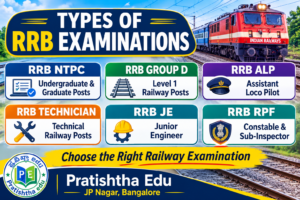
1. RRB NTPC (Non-Technical Popular Categories)
RRB NTPC is one of the major railway recruitment examinations for candidates interested in non-technical positions in Indian Railways. It offers opportunities for undergraduate and graduate candidates, depending on the post.
Some positions recruited through RRB NTPC include:
- Junior Clerk cum Typist
- Accounts Clerk cum Typist
- Junior Time Keeper (where notified)
- Trains Clerk
- Commercial cum Ticket Clerk
- Goods Train Manager
- Station Master
- Senior Clerk cum Typist
Important areas of preparation:
- Mathematics
- General Intelligence and Reasoning
- General Awareness
- Computer-based examination practice
- Typing or aptitude preparation for posts where applicable
Candidates preparing for RRB NTPC should focus on improving calculation speed, reasoning ability, general knowledge, and time management. Students looking for RRB NTPC Coaching in Bangalore can explore structured preparation guidance to understand the examination pattern, important subjects, and practice requirements.
RRB NTPC Undergraduate and Graduate Level Posts
RRB NTPC recruitment is divided into undergraduate-level and graduate-level posts. Undergraduate-level posts are intended for candidates who meet the prescribed Class 12 qualification, while graduate-level posts require a recognised university degree.
The responsibilities of NTPC employees vary according to the post. Some positions involve clerical and administrative work, while others are related to train operations, station management, commercial activities, and railway operations.
Candidates should understand the difference between undergraduate and graduate-level vacancies before applying. The available posts, qualifications, age limits, and selection stages should always be checked in the latest RRB NTPC notification.
2. RRB Group D Examination
RRB Group D recruitment provides opportunities for candidates interested in various Level 1 railway positions. These jobs involve supporting railway operations, maintenance, and other departmental activities.
Some commonly notified positions include:
- Track Maintainer Grade IV
- Pointsman
- Assistant in different railway departments
- Assistant Track Machine
- Assistant Bridge
- Assistant P-Way
Important areas of preparation:
- Mathematics
- General Intelligence and Reasoning
- General Science
- General Awareness and Current Affairs
Candidates should regularly practise numerical problems, reasoning questions and basic science topics. Physical fitness is also important because relevant Group D recruitment processes include a Physical Efficiency Test. Students looking for SSC and RRB Coaching in Bangalore can explore suitable preparation guidance for competitive railway examinations and understand the subjects required for their selected recruitment.
RRB Group D Job Responsibilities and Physical Preparation
RRB Group D employees perform important supporting duties across different railway departments. Depending on the allotted position, their responsibilities may include track maintenance, assisting technical teams, supporting railway infrastructure work, and helping with day-to-day railway operations.
Apart from written examination preparation, candidates should also understand the physical requirements of Group D recruitment. The Physical Efficiency Test evaluates candidates against prescribed physical tasks. Therefore, aspirants should maintain physical fitness alongside their regular academic preparation.
Candidates should check the official recruitment notification for the applicable PET requirements, medical standards, and other selection conditions.
3. RRB ALP (Assistant Loco Pilot)
The RRB Assistant Loco Pilot examination is conducted to recruit candidates for Assistant Loco Pilot positions in Indian Railways. This role involves assisting in locomotive operations and following railway safety procedures.
Candidates generally need the prescribed ITI, diploma, or other relevant technical qualifications according to the official recruitment notification.
Important preparation areas:
- Mathematics
- General Intelligence and Reasoning
- General Science
- Basic Science and Engineering
- Relevant technical subjects
- Computer-based aptitude preparation, where applicable
Candidates preparing for ALP should pay special attention to technical knowledge and the specific requirements of different examination stages.
4. RRB Technician Examination
RRB Technician recruitment is intended for candidates interested in technical positions across different railway departments. Technicians support the maintenance, inspection, and functioning of railway equipment and systems.
Depending on the notified post and grade, educational requirements may include ITI, relevant technical qualifications, or other prescribed credentials.
Important preparation areas:
- Mathematics
- General Intelligence and Reasoning
- General Science
- General Awareness
- Technical knowledge related to the relevant trade
Candidates should study their trade-specific subjects carefully and practise questions based on the prescribed examination syllabus.
5. RRB JE (Junior Engineer) Examination
The RRB Junior Engineer examination is conducted for technical positions in different engineering departments of Indian Railways. It is suitable for candidates with the required engineering diploma or degree qualifications, as specified in the recruitment notification.
Some engineering disciplines include:
- Civil Engineering
- Mechanical Engineering
- Electrical Engineering
- Electronics Engineering
- Other notified technical disciplines
Important preparation areas:
- General Awareness
- Physics and Chemistry
- Basics of Computers and Applications
- Environmental and Pollution Control
- Technical subjects related to the selected engineering discipline
Candidates preparing for RRB JE should develop strong technical concepts and regularly practise engineering-related questions.
6. RPF Recruitment Examination
The Railway Protection Force (RPF) conducts recruitment for positions such as Constable and Sub-Inspector. These positions are related to railway security and the protection of passengers, railway property, and railway premises.
Important preparation areas:
- General Awareness
- Arithmetic
- General Intelligence and Reasoning
- Physical fitness
- Examination-specific preparation
Candidates should understand that RPF recruitment has its own notification, eligibility conditions and selection procedure. Physical measurements and physical efficiency requirements are particularly important for relevant posts. Candidates looking for RRB RPF Coaching in Bangalore should understand the written examination, physical requirements, and selection stages before starting their preparation.
Difference Between RPF Constable and Sub-Inspector Recruitment
RPF recruitment generally provides opportunities for eligible candidates through Constable and Sub-Inspector positions. Although both roles are associated with railway security, their educational qualifications, responsibilities, and recruitment requirements are different.
RPF Constables assist with railway security duties, passenger safety, and the protection of railway property. Sub-Inspectors have additional responsibilities related to supervision, security operations, and maintaining law and order within their assigned areas.
Candidates interested in RPF recruitment should identify the position they wish to apply for and prepare according to its prescribed written examination, physical standards, physical efficiency requirements, and medical conditions.
Choosing the Right RRB Examination
Before beginning railway exam preparation, candidates should compare different examinations based on their educational qualifications, technical background, age requirements, and career interests.
For example, candidates interested in non-technical railway positions may consider RRB NTPC, while those with relevant technical qualifications may explore ALP, Technician or JE recruitment. Candidates interested in railway security services can consider RPF recruitment.
Understanding these examination categories helps aspirants select an appropriate preparation path and focus on the subjects and skills required for their chosen railway recruitment examination.
Preparing for railway examinations requires a clear understanding of the syllabus, regular practice, and consistent preparation. If you are looking for guidance for RRB NTPC, Group D, ALP, Technician, JE, or RPF examinations, connect with Pratishtha Edu to enquire about available learning and preparation support. Contact our team today to know more about suitable preparation options.
RRB Exam Eligibility, Age Limit and Selection Process
Before applying for any Railway Recruitment Board examination, candidates should understand the eligibility requirements, age limits, educational qualifications and selection procedures. Every RRB recruitment notification specifies the conditions candidates must fulfil to participate in the selection process.
The eligibility criteria may differ depending on the post, recruitment category, and examination. Therefore, candidates should always check the latest official Railway Recruitment Board notification before submitting an application.
1. Educational Qualification for RRB Examinations
Educational qualifications are among the most important eligibility requirements for railway recruitment. Different RRB posts require different levels of education and technical qualifications.
Some general qualification categories include:
- 10th Pass: Certain Level 1 railway positions require candidates to have passed Class 10 or possess another prescribed qualification.
- 12th Pass: Undergraduate-level NTPC positions may require candidates to have completed Class 12.
- Graduation: Graduate-level NTPC positions generally require a recognised university degree.
- ITI or Diploma: Certain technical posts, including relevant ALP and Technician positions, require prescribed ITI or diploma qualifications.
- Engineering Degree or Diploma: RRB Junior Engineer recruitment generally requires relevant engineering qualifications according to the notified discipline.
Candidates should carefully check whether their qualification matches the specific railway post before applying.
Candidates should verify the latest eligibility conditions, examination details, and recruitment updates through the Official Railway Recruitment Board Website before submitting their applications.
2. RRB Exam Age Limit
The age limit for railway recruitment examinations depends on the post and the particular recruitment notification. Different examinations may have different minimum and maximum age requirements.
Candidates should consider the following factors:
- Minimum age prescribed for the post.
- Maximum age limit mentioned in the notification.
- Age relaxation for eligible reserved categories.
- Applicable relaxation for other notified categories.
- Date of birth calculation based on the official cut-off date.
Age relaxation may be available to eligible candidates belonging to SC, ST, OBC-NCL, PwBD and other categories as per government recruitment rules.
It is important not to assume that the age limit is identical for RRB NTPC, Group D, ALP, Technician, JE and RPF recruitment.
3. RRB NTPC Selection Process
The RRB NTPC selection process generally involves different stages depending on the post applied for.
These may include:
- Computer Based Test 1 (CBT 1).
- Computer Based Test 2 (CBT 2).
- Computer-Based Aptitude Test (CBAT) for applicable posts.
- Typing Skill Test for applicable posts.
- Document Verification.
- Medical Examination.
Candidates should prepare Mathematics, General Intelligence and Reasoning, and General Awareness according to the relevant examination pattern.
The requirements for typing skill tests and computer-based aptitude tests depend on the NTPC post. Candidates should identify the applicable test for their selected post and include it in their preparation plan.
4. RRB Group D Selection Process
The RRB Group D recruitment process generally includes the following stages:
- Computer Based Test (CBT).
- Physical Efficiency Test (PET).
- Document Verification.
- Medical Examination.
The CBT evaluates candidates’ knowledge of Mathematics, General Intelligence and Reasoning, General Science, and General Awareness and Current Affairs.
Candidates who qualify in the applicable computer-based examination may be called for the physical efficiency stage. Therefore, preparation should include both academic practice and physical fitness.
Candidates should prepare for the CBT and PET separately. Regular physical activity and practice of the prescribed physical tasks can help candidates understand the demands of the recruitment process.
5. RRB ALP Selection Process
The Assistant Loco Pilot recruitment process involves multiple examination stages to evaluate candidates’ general knowledge, technical understanding, and aptitude.
The selection stages generally include:
- CBT 1.
- CBT 2.
- Computer-Based Aptitude Test (CBAT).
- Document Verification.
- Medical Examination.
CBT 2 includes relevant technical knowledge, making technical subject preparation especially important for ALP aspirants.
6. RRB Technician Selection Process
The selection process for RRB Technician positions generally involves a Computer Based Test followed by further recruitment formalities.
Depending on the notified post, the process may include:
- Computer Based Test.
- Document Verification.
- Medical Examination.
The examination generally evaluates Mathematics, General Intelligence and Reasoning, General Science and General Awareness, along with relevant technical knowledge wherever prescribed.
7. RRB JE Selection Process
Candidates applying for Railway Junior Engineer positions should prepare for the technical and non-technical sections of the recruitment examination.
The selection process generally includes:
- CBT 1.
- CBT 2.
- Document Verification.
- Medical Examination.
The second computer-based examination places significant emphasis on technical subjects related to the candidate’s engineering discipline.
8. RPF Recruitment Selection Process
Railway Protection Force recruitment has a separate selection procedure for Constable and Sub-Inspector positions.
The process generally includes:
- Computer-Based Test.
- Physical Measurement Test (PMT).
- Physical Efficiency Test (PET).
- Document Verification.
- Medical Examination.
Candidates should prepare for the written examination while maintaining the physical fitness required for the relevant recruitment category.
The physical measurement and efficiency requirements may differ according to the candidate’s category and the recruitment post. Aspirants should check the prescribed standards in the latest RPF recruitment notification before beginning physical test preparation.
Importance of Understanding RRB Eligibility and Selection Criteria
Understanding the eligibility requirements and selection process helps candidates avoid mistakes during the application and preparation stages. It also allows them to select suitable railway examinations based on their educational qualifications and career interests.
Candidates preparing for different railway recruitment examinations should follow the latest official notifications, understand the subjects included in their selected examination, and develop a consistent study routine. A clear understanding of these requirements provides a strong foundation for effective RRB exam preparation.
RRB Exam Syllabus and Important Subjects for Railway Recruitment
Understanding the syllabus is one of the most important steps when preparing for Railway Recruitment Board examinations. Different railway posts have different examination patterns, but several subjects are common across major RRB recruitment examinations.
Candidates preparing for RRB NTPC, Group D, ALP, Technician and other railway examinations should understand the subjects included in their respective notifications. A clear understanding of the syllabus helps students organise their studies, identify important topics, and allocate sufficient time to each subject.
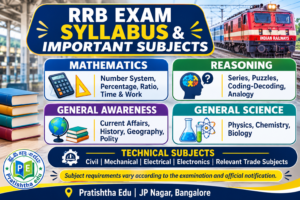
The major subjects commonly included in RRB examinations are Mathematics, General Intelligence and Reasoning, General Awareness, and General Science. Technical recruitment examinations may also include additional trade-specific or engineering-related subjects.
1. Mathematics
Mathematics is an important subject in several Railway Recruitment Board examinations. Questions generally test numerical ability, calculation speed, accuracy and problem-solving skills.
Candidates should develop a strong understanding of basic mathematical concepts and practise different types of questions regularly.
Important Mathematics topics include:
- Number System
- Simplification
- LCM and HCF
- Decimals and Fractions
- Ratio and Proportion
- Percentage
- Profit and Loss
- Simple and Compound Interest
- Time and Work
- Time, Speed and Distance
- Average
- Mensuration
- Algebra
- Geometry
- Trigonometry
- Data Interpretation
Regular practice is essential for improving calculation speed and solving questions within the examination time limit.
2. General Intelligence and Reasoning
General Intelligence and Reasoning evaluates a candidate’s logical thinking, analytical ability, and problem-solving skills. This subject is included in several RRB recruitment examinations.
Candidates should practise different reasoning question patterns to improve their ability to identify relationships, understand patterns, and solve problems accurately.
Important Reasoning topics include:
- Analogy
- Classification
- Number Series
- Alphabet Series
- Coding and Decoding
- Blood Relations
- Direction and Distance
- Ranking and Order
- Syllogism
- Venn Diagrams
- Statement and Conclusion
- Mathematical Operations
- Puzzles
- Non-Verbal Reasoning
- Data Sufficiency
Solving previous examination questions and practising timed exercises can help candidates improve their reasoning performance.
3. General Awareness
General Awareness is an important section that evaluates candidates’ knowledge of national and international events, history, geography, economics, and other general subjects.
Students should develop a habit of reading reliable news sources and revising important facts regularly.
Important General Awareness topics include:
- Current Affairs
- Indian History
- Indian Geography
- Indian Polity
- Indian Constitution
- Indian Economy
- General Knowledge
- Important Government Schemes
- Sports and Awards
- Important Days
- Science and Technology Developments
- Indian Railways and Its Developments
Candidates should revise current affairs consistently rather than studying everything at the last moment.
4. General Science
General Science is particularly important in railway examinations such as RRB Group D and other relevant recruitment tests. Questions generally cover basic concepts from Physics, Chemistry and Biology.
Students should concentrate on understanding fundamental scientific principles and practising objective questions.
Important General Science topics include:
Physics
- Motion and Force
- Work, Energy and Power
- Electricity
- Magnetism
- Light
- Sound
- Heat and Temperature
- Units and Measurements
Chemistry
- Atoms and Molecules
- Elements and Compounds
- Acids, Bases and Salts
- Metals and Non-Metals
- Chemical Reactions
- Periodic Table
- Everyday Chemistry
Biology
- Human Body Systems
- Nutrition
- Cell Structure
- Diseases and Prevention
- Plants and Animals
- Human Health
- Environment and Ecology
Candidates should focus on basic concepts and their practical applications while preparing for science-related questions.
5. Technical Subjects for RRB ALP and Technician Examinations
Candidates preparing for technical railway recruitment examinations need to study additional subjects according to their educational qualifications and selected trade.
Technical knowledge is particularly important in the relevant stages of RRB ALP and Technician recruitment.
Some important technical preparation areas include:
- Basic Electrical Engineering
- Electrical Circuits
- Electronics Fundamentals
- Mechanical Engineering Basics
- Engineering Drawing
- Workshop Calculations
- Measurements and Instruments
- Basic Engineering Concepts
- Relevant ITI Trade Subjects
The exact subjects depend on the recruitment post, trade, and official examination syllabus.
6. Technical Subjects for RRB Junior Engineer Examination
RRB JE candidates need to prepare for technical subjects related to their engineering discipline. A strong understanding of engineering fundamentals is important for answering subject-specific questions.
Some major technical disciplines include:
Civil Engineering
- Building Materials
- Surveying
- Soil Mechanics
- Structural Engineering
- Hydraulics
- Transportation Engineering
- Environmental Engineering
Mechanical Engineering
- Engineering Mechanics
- Thermodynamics
- Strength of Materials
- Fluid Mechanics
- Manufacturing Processes
- Machine Design
- Heat Transfer
Electrical Engineering
- Electrical Machines
- Network Theory
- Power Systems
- Electrical Measurements
- Basic Electronics
- Control Systems
- Electrical Circuits
Electronics Engineering
- Electronic Devices
- Digital Electronics
- Analog Circuits
- Communication Systems
- Signals and Systems
- Microprocessors
- Electronic Measurements
Candidates should follow the technical syllabus prescribed for their specific engineering discipline rather than preparing for unrelated subjects.
7. Computer-Based Test and Aptitude Preparation
Most major railway recruitment examinations use computer-based tests as part of their selection process. Candidates should become familiar with answering objective questions on a computer within a fixed time limit.
Depending on the recruitment post, additional aptitude or skill-based assessments may also be conducted.
Preparation should include:
- Practising online objective questions.
- Improving question-solving speed.
- Understanding negative marking where applicable.
- Managing examination time effectively.
- Reviewing incorrect answers.
- Practising computer-based mock examinations.
- Developing accuracy under timed conditions.
For applicable RRB ALP posts, candidates should also understand the requirements of the Computer-Based Aptitude Test.
How to Prepare Each Subject Effectively
A balanced study plan is important for covering the complete RRB examination syllabus. Candidates should avoid spending all their preparation time on only one subject.
Mathematics requires regular numerical practice, while Reasoning improves through consistent problem-solving exercises. General Awareness requires daily learning and revision, whereas General Science becomes easier when candidates understand fundamental concepts.
Candidates preparing for technical posts should also allocate sufficient time to their respective technical subjects.
By understanding the syllabus and following a systematic preparation routine, railway aspirants can build a stronger foundation for their chosen RRB recruitment examination.
How to Prepare for RRB Exams: Effective Study Strategy
Preparing for Railway Recruitment Board examinations requires a well-planned study routine, consistent practice, and regular revision. Whether you are preparing for RRB NTPC, Group D, ALP, Technician, or JE, following a systematic approach can help you improve your performance and build confidence.
1. Understand the Exam Pattern Before Starting
Before beginning your preparation, understand the exam pattern, subjects, marking scheme, and selection stages of your chosen examination. Different RRB posts have different requirements, so students should avoid following the same preparation strategy for every exam.
Read the latest official notification carefully and identify the subjects that require more attention.
2. Build Strong Fundamentals in Every Subject
Start your preparation by strengthening the basic concepts of Mathematics, Reasoning, General Awareness, and General Science. Instead of immediately solving difficult questions, understand the fundamental methods and practise simple problems first.
A strong foundation will help you solve questions more confidently and reduce calculation errors during the examination.
3. Follow a Daily Study Timetable
A fixed timetable helps candidates maintain consistency and complete the syllabus within the available preparation period. Divide your study hours according to your strengths and weaknesses.
For example, your daily routine can include:
- Mathematics practice to improve calculation speed.
- Reasoning exercises to develop logical thinking.
- General Awareness preparation through regular reading and revision.
- General Science study to understand important concepts.
- Previous-year question practice to understand examination trends.
Make sure your timetable includes short breaks and sufficient time for revision.
4. Practise Previous-Year Question Papers
Solving previous-year RRB question papers is an important part of railway exam preparation. It helps candidates understand the question format, difficulty level, frequently tested topics, and time requirements.
While practising, try to solve questions within the actual examination time limit. After completing each paper, review your answers and identify topics where you are making mistakes.
5. Take Regular Mock Tests
Mock tests help candidates understand their preparation level and improve examination performance. They also provide practical experience of solving questions under time pressure.
After every mock test, analyse:
- Questions answered incorrectly.
- Questions that took too much time.
- Topics that need additional practice.
- Accuracy and overall performance.
- Areas where speed needs improvement.
Do not focus only on your mock test score. Use the results to improve your preparation.
6. Give Importance to Current Affairs and General Knowledge
General Awareness is an important section in several railway examinations. Candidates should regularly follow national and international news, government schemes, sports events, awards, important appointments, and major developments.
Prepare short notes on important topics and revise them frequently. Regular preparation is more effective than trying to study a large amount of current affairs just before the examination.
7. Revise Important Topics Regularly
Revision helps students retain concepts and avoid forgetting previously studied topics. Keep separate notes for important formulas, reasoning methods, scientific facts, and general knowledge.
Set aside time every week to revise completed chapters. Revisit difficult questions and practise them until you can solve them accurately.
8. Avoid Common Preparation Mistakes
Many candidates struggle because they do not follow a consistent preparation strategy. Avoid these common mistakes:
- Studying without understanding the examination pattern.
- Ignoring weaker subjects.
- Depending only on shortcuts without learning basic concepts.
- Skipping previous-year question papers.
- Taking mock tests without analysing mistakes.
- Collecting too many study materials without completing them.
- Avoiding revision until the final weeks.
A focused preparation plan, regular practice, and continuous improvement can make your railway examination preparation more organised and effective.

Benefits of Joining RRB Exam Coaching in Bangalore
Preparing for Railway Recruitment Board examinations requires more than simply studying textbooks. Candidates need to understand the examination pattern, practise different question types, manage their time effectively, and revise important topics regularly. For students who need structured preparation and academic guidance, joining a suitable coaching institute can be helpful.
Choosing the right coaching support can make the preparation process more organised, especially for candidates who are preparing for competitive examinations for the first time.
1. Structured Preparation and Proper Study Planning
One of the major benefits of joining an RRB coaching institute is having a structured approach to preparation. Instead of studying different subjects randomly, candidates can follow a planned learning schedule.
A structured study plan helps students cover the important subjects systematically, track their progress, and dedicate sufficient time to each section.
2. Better Understanding of Mathematics and Reasoning
Mathematics and General Intelligence and Reasoning require regular practice. Students may find topics such as percentage, time and work, number series, coding-decoding, puzzles, and data interpretation challenging.
Guidance from experienced educators can help students understand concepts, learn different problem-solving methods, and improve their speed and accuracy.
3. Subject-Wise Guidance for Railway Examinations
Different railway examinations have different subject requirements. For example, RRB NTPC and Group D focus on general competitive examination subjects, while ALP, Technician, and JE examinations may require additional technical knowledge.
Subject-wise preparation helps candidates understand what to study for their selected examination and avoid spending unnecessary time on unrelated topics.
4. Regular Practice and Performance Assessment
Consistent practice is essential for competitive examination preparation. Candidates should regularly solve practice questions, previous-year papers, and mock tests.
A good coaching programme should provide opportunities for regular assessment so students can understand their preparation level, identify weak areas, and work on improving their performance.
5. Doubt-Solving and Individual Attention
Students often face difficulties while learning mathematical concepts, solving reasoning questions, or understanding scientific topics. Having access to doubt-solving support can help them clarify concepts instead of carrying confusion into later chapters.
Individual attention is particularly useful for candidates who need additional practice in specific subjects or topics.
6. Time Management and Exam Preparation Techniques
Railway examinations are competitive, and candidates need to solve questions within a limited time. Knowing the correct answer is not always enough; students must also learn how to manage time effectively.
Regular timed practice can help candidates:
- Improve question-solving speed.
- Avoid spending too much time on difficult questions.
- Maintain accuracy under examination pressure.
- Understand question selection strategies.
- Develop confidence before the actual examination.
7. Guidance for Different RRB Examinations
Candidates preparing for NTPC, Group D, ALP, Technician, JE, and other railway recruitment examinations should select preparation resources according to their eligibility and examination requirements.
Proper guidance can help students understand the differences between examinations, identify relevant subjects, and prepare according to the latest official syllabus and selection process.
8. Online and Offline Learning Flexibility
Students in Bangalore may prefer different learning methods depending on their college schedule, employment, travel time, and personal study routine.
Online learning can provide flexibility, while offline classroom learning may offer direct interaction with educators.Candidates should choose a learning mode that allows them to attend classes consistently and dedicate enough time to self-study. Students who prefer classroom-based learning can explore Offline Coaching in Bangalore to understand available learning options and choose a suitable study environment.
Choosing the right learning environment can make your preparation more organised. Visit Pratishtha Edu to explore educational programmes and enquire about available learning options, guidance, and course details in Bangalore.
How to Choose the Right RRB Coaching Centre in Bangalore
Before joining any coaching institute, candidates should consider the following factors:
- Faculty experience and subject knowledge.
- Coverage of the latest RRB examination syllabus.
- Availability of regular practice sessions.
- Previous-year question paper discussions.
- Mock tests and performance analysis.
- Doubt-clearing support.
- Suitable class timings and learning modes.
- Study materials and preparation guidance.
The right coaching support should help candidates build strong concepts, practise consistently, and understand the requirements of their chosen railway examination. However, success ultimately depends on individual effort, regular revision, and disciplined preparation.
RRB Exam Preparation for College Students, Working Professionals and Beginners
Railway recruitment examinations attract candidates from different educational and professional backgrounds. Some students begin preparing immediately after completing their 10th or 12th standard, while others start after graduation or alongside their jobs.
The preparation strategy may differ depending on a candidate’s educational qualification, available study hours, and selected RRB examination. A practical study plan can help candidates balance their preparation with other responsibilities.
1. RRB Exam Preparation for College Students
College students can start preparing for suitable railway examinations while continuing their regular education. Starting early gives them enough time to understand the syllabus, strengthen basic concepts, and practise different types of questions.
Students should focus on:
- Building strong fundamentals in Mathematics and Reasoning.
- Studying General Science and General Awareness regularly.
- Practising previous-year question papers.
- Maintaining short notes for important formulas and concepts.
- Following a weekly revision schedule.
College students should also check the educational qualification and age requirements of the examination before applying.
2. RRB Exam Preparation for Working Professionals
Working professionals may find it challenging to manage preparation alongside their job responsibilities. However, a realistic timetable and consistent daily practice can help them use their available time effectively.
A suitable preparation routine may include:
- Studying important concepts before or after working hours.
- Practising Mathematics and Reasoning every day.
- Reading current affairs during available breaks.
- Taking mock tests on weekends.
- Revising important topics regularly.
Working candidates should focus on consistency rather than trying to complete the entire syllabus in a short period.
3. RRB Exam Preparation for Beginners
Candidates preparing for railway examinations for the first time should begin by understanding the examination structure and syllabus. It is important to develop basic knowledge before moving towards advanced questions and timed practice.
Beginners can follow these steps:
- Select the RRB examination according to your educational qualification.
- Understand the latest examination pattern and syllabus.
- Start with basic Mathematics and Reasoning concepts.
- Develop knowledge of General Science and General Awareness.
- Practise topic-wise questions after completing each chapter.
- Gradually begin solving previous-year papers and mock tests.
- Review mistakes and revise completed topics.
Following these steps can help beginners develop a clear understanding of the examination and improve their preparation gradually.
4. RRB Preparation After 10th and 12th
Candidates who have completed their 10th or 12th standard can explore railway posts for which they meet the prescribed educational qualifications.
Depending on the recruitment notification, opportunities may include certain Group D, undergraduate NTPC, and other eligible technical or non-technical posts.
Candidates should carefully check the required qualifications, age limit, medical standards, and other eligibility conditions before applying.
5. RRB Preparation After Graduation
Graduates can explore graduate-level NTPC posts and other railway recruitment opportunities for which their qualifications are accepted.
Their preparation should include regular practice in Mathematics, Reasoning, and General Awareness, along with post-specific requirements such as typing tests or aptitude tests wherever applicable.
Candidates with technical degrees or diplomas may also explore relevant technical recruitment examinations, depending on the official notification.
How to Start Your RRB Exam Preparation in Bangalore
Starting preparation for a Railway Recruitment Board examination requires the right information, suitable study resources, and a consistent learning routine. Candidates should first identify the railway post they are interested in and understand its eligibility requirements, syllabus, and selection process.
For students looking for structured guidance, selecting an appropriate coaching institute can be an important step towards organised preparation.
1. Identify the Right Railway Examination
Before joining a preparation programme, decide which examination matches your educational qualification and career interests. Depending on the eligibility conditions mentioned in the official notification, candidates can explore:
- RRB NTPC: For eligible undergraduate and graduate-level non-technical posts.
- RRB Group D: For eligible Level 1 railway positions.
- RRB ALP: For Assistant Loco Pilot recruitment.
- RRB Technician: For eligible technical and trade-related positions.
- RRB JE: For Junior Engineer recruitment in relevant technical disciplines.
Understanding these differences will help you focus on the appropriate syllabus and preparation requirements.
Before applying, candidates should check the latest recruitment details and submit their applications through the Official RRB Application Portal.a
2. Choose Suitable Study Resources
Select reliable books, study materials, practice questions, and previous-year papers according to the latest examination syllabus. Avoid collecting too many resources because completing and revising a limited number of quality materials is often more useful than switching between multiple books.
3. Follow a Consistent Preparation Schedule
Prepare a realistic timetable that includes concept learning, question practice, revision, and mock tests. Give additional attention to subjects in which you need improvement.
Regular study, self-assessment, and timely revision can help you gradually develop the knowledge and confidence required for competitive examinations.
4. Consider Professional Guidance
Candidates searching for railway exam preparation support in Bangalore should compare coaching institutes based on faculty experience, syllabus coverage, study materials, practice sessions, doubt-solving facilities, and available learning modes.
Candidates can also visit Pratishtha Edu to explore its educational programmes and available learning resources.
Pratishtha Edu is located in JP Nagar, Bengaluru, and provides educational and competitive examination coaching support. Candidates interested in preparation guidance can contact the institute to enquire about course availability, class schedules, and suitable learning options.
5. Contact Pratishtha Edu for Course Enquiries
Students who want to explore coaching opportunities can contact Pratishtha Edu for further information.
Pratishtha Edu
Address: Pratishtha edu, 15, 23rd Main Rd, opposite road of LIC Head office, R.K Colony, Marenahalli,
2nd Phase, J. P. Nagar,
Bengaluru, Karnataka 560078
Phone: 7676047382 / 8660208963
Website: https://pratishthaedu.com/
For more information about available educational programmes and coaching options, contact Pratishtha Edu directly. Our team can help you with course enquiries, class schedules, and available learning options. Call or send a WhatsApp message to get further details.
Final Words
Preparing for railway recruitment examinations requires patience, discipline, and continuous improvement. Whether you are targeting RRB NTPC, Group D, ALP, Technician, or JE, begin with a clear understanding of the examination and follow a structured preparation strategy.
Strengthen your fundamentals, practise previous-year questions, take regular mock tests, and revise important topics. With consistent effort and the right academic guidance, you can work towards your railway career goals with greater confidence.
Leave a Reply