The Reserve Bank of India (RBI) Grade B Officer examination is one of the most competitive banking examinations in India. Every year, thousands of graduates prepare for this examination to secure an officer position in India’s central bank. Candidates planning to appear for the RBI Grade B 2027 examination should understand the complete syllabus, subject-wise topics, exam pattern and selection process before starting their preparation.
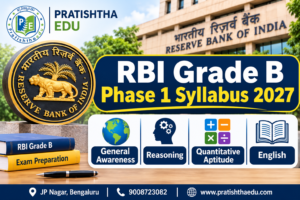
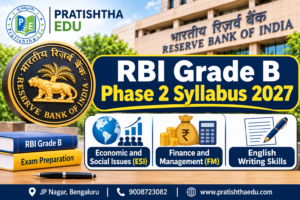
The RBI Grade B Syllabus 2027 generally covers different subjects across Phase 1 and Phase 2 examinations. For the General Cadre, Phase 1 includes General Awareness, English Language, Quantitative Aptitude and Reasoning Ability. Phase 2 focuses on Economic and Social Issues (ESI), Finance and Management (FM), and English (Writing Skills).
Understanding the RBI Grade B Phase 1 Syllabus 2027 and RBI Grade B Phase 2 Syllabus 2027 helps candidates identify important topics, organise their study schedules, and focus on the subjects that require more attention. A systematic preparation approach, regular revision, mock tests and current affairs analysis can help aspirants improve their performance in the examination.
This guide covers the complete RBI Grade B syllabus for Phase 1 and Phase 2, including the exam pattern, subject-wise topics, important chapters, study materials, and preparation strategies to help candidates plan their RBI Grade B 2027 preparation effectively.
Candidates looking for structured preparation support can explore our RBI Grade B Coaching in Bangalore programme.
RBI Grade B Exam Pattern 2027
Before understanding the subject-wise syllabus, candidates should first understand the RBI Grade B Exam Pattern 2027. Knowing the examination structure helps aspirants understand the number of selection stages, marks distribution, question formats, and time requirements for each paper. It also helps candidates plan their preparation according to the requirements of Phase 1 and Phase 2.
For the General Cadre, the RBI Grade B selection process generally consists of three stages: Phase 1 (Preliminary Examination), Phase 2 (Main Examination) and Interview. Candidates must qualify at each stage to proceed to the next stage of the recruitment process.
RBI Grade B Selection Process 2027
The selection process for RBI Grade B General Cadre includes the following stages:
- Phase 1 Examination: An online objective examination consisting of four sections: General Awareness, English Language, Quantitative Aptitude and Reasoning Ability.
- Phase 2 Examination: An online examination consisting of three papers: Economic and Social Issues (ESI), English (Writing Skills), and Finance and Management (FM).
- Interview: Candidates shortlisted based on their Phase 2 performance are called for the final interview.
RBI Grade B Phase 1 Exam Pattern 2027
The Phase 1 examination is the first stage of the RBI Grade B recruitment process. It evaluates candidates’ general awareness, English language skills, numerical ability, and logical reasoning. The examination is conducted online and consists of objective-type multiple-choice questions.
According to the latest notified 2026 General Cadre examination pattern, Phase 1 carries a total of 200 marks and has an overall duration of 120 minutes. Separate time limits are allotted to individual tests.
| Subjects | Examination Type |
| General Awareness | Objective |
| English Language | Objective |
| Quantitative Aptitude | Objective |
| Reasoning Ability | Objective |
| Total | 200 Marks |
Candidates must secure the minimum qualifying marks prescribed by RBI in individual tests as well as in aggregate. The examination authority decides the cut-off marks for shortlisting candidates for Phase 2.
RBI Grade B Phase 2 Exam Pattern 2027
Phase 2 is an important stage of the RBI Grade B selection process. It evaluates candidates’ understanding of economic and social issues, financial concepts, management principles, and English writing skills.
The latest notified 2026 General Cadre pattern consists of three papers carrying 100 marks each, making the total 300 marks.
| Paper | Subject | Marks | Duration |
| Paper I | Economic and Social Issues (ESI) | 100 | 120 Minutes |
| Paper II | English (Writing Skills) | 100 | 90 Minutes |
| Paper III | General Finance and Management (FM) | 100 | 120 Minutes |
| Total | 3 Papers | 300 | 330 Minutes |
Paper I (ESI) and Paper III (Finance and Management) contain both objective and descriptive questions. Paper II (English Writing Skills) is entirely descriptive, and candidates have to type their answers using a computer keyboard.
RBI Grade B Interview and Final Selection
Candidates who qualify in Phase 2 are shortlisted for the interview based on the aggregate marks obtained in all three Phase 2 papers. The interview carries 75 marks and evaluates candidates’ communication skills, subject knowledge, awareness of economic developments, and suitability for the officer position.
Before the interview, shortlisted candidates also undergo a Personality Assessment conducted by RBI. This assessment does not carry any marks and is not included in the final selection criteria.
The final merit list for the General Cadre is prepared using the marks obtained in Phase 2 and the interview, subject to the prescribed selection requirements.
Important Points About RBI Grade B Exam Pattern
Candidates preparing for the examination should remember the following points:
- Phase 1 is an objective-type online examination carrying 200 marks.
- Phase 1 includes General Awareness, English Language, Quantitative Aptitude, and Reasoning Ability.
- Phase 2 consists of three papers carrying a total of 300 marks.
- ESI and Finance and Management include objective and descriptive sections.
- English (Writing Skills) is a descriptive paper.
- The interview carries 75 marks.
- Personality Assessment is conducted before the interview and carries no marks.
- Phase 2 and interview marks are considered for final merit preparation.
Understanding these examination stages will help candidates prepare according to the requirements of each paper. In the next section, we will discuss the complete RBI Grade B Phase 1 Syllabus 2027, including General Awareness, English Language, Quantitative Aptitude and Reasoning Ability.
Note: The examination pattern and marks mentioned above are based on the latest notified 2026 General Cadre scheme. The RBI Grade B 2027 recruitment notification will be the final authority for the 2027 examination pattern and any changes.
RBI Grade B Phase 1 Syllabus 2027 – Complete Subject-Wise Topics
The RBI Grade B Phase 1 Syllabus 2027 is divided into four major sections: General Awareness, English Language, Quantitative Aptitude and Reasoning Ability. The Phase 1 examination is conducted online and tests candidates on their general knowledge, language proficiency, numerical ability and logical reasoning skills.
Candidates preparing for the RBI Grade B preliminary examination should understand the important topics covered in each section. Regular practice, current affairs preparation, conceptual understanding and time management are essential to perform well in this stage. A subject-wise understanding of the syllabus also helps aspirants identify their strengths and weaknesses and prepare an effective study schedule.
RBI Grade B General Awareness Syllabus
General Awareness is an important section of the RBI Grade B Phase 1 examination. It evaluates candidates’ knowledge of current events, banking developments, financial awareness and important national and international developments. Candidates should regularly follow newspapers, government publications, RBI announcements and economic news to improve their preparation.
Important topics covered under General Awareness include:
- Current Affairs – National and International News
- Banking and Financial Awareness
- Reserve Bank of India Functions and Policies
- Monetary Policy and Banking Regulations
- Indian Economy and Economic Developments
- Government Schemes and Initiatives
- Union Budget and Economic Survey
- Financial Institutions and Organisations
- Important Reports and Indexes
- National and International Organisations
- Important Appointments and Awards
- Summits, Conferences and Agreements
- Science and Technology Developments
- Sports News and Important Events
- Static General Knowledge
Candidates should give special attention to banking awareness, RBI policies, financial developments and economic current affairs. Reading monthly current affairs compilations and revising important events regularly can help improve performance in this section.
RBI Grade B English Language Syllabus
The English Language section evaluates candidates’ reading comprehension, grammar, vocabulary and communication skills. A strong understanding of English is important not only for Phase 1 but also for the descriptive English paper in Phase 2.
Important topics covered under the English Language section include:
- Reading Comprehension
- Error Detection
- Sentence Correction
- Fill in the Blanks
- Cloze Test
- Para Jumbles
- Sentence Rearrangement
- Vocabulary and Word Usage
- Synonyms and Antonyms
- Idioms and Phrases
- Phrase Replacement
- Sentence Completion
- Grammar and Tenses
- Active and Passive Voice
- Direct and Indirect Speech
Candidates should develop a regular reading habit by following newspapers, editorials and quality English articles. Practising comprehension passages, grammar exercises and vocabulary questions can help improve accuracy and reading speed.
RBI Grade B Quantitative Aptitude Syllabus
Quantitative Aptitude tests candidates’ numerical ability, calculation speed and problem-solving skills. This section requires a clear understanding of mathematical concepts and regular practice of different types of questions.
Important topics covered under Quantitative Aptitude include:
- Number System
- Simplification and Approximation
- Percentage
- Ratio and Proportion
- Average
- Profit and Loss
- Simple Interest and Compound Interest
- Time and Work
- Pipes and Cisterns
- Time, Speed and Distance
- Mixture and Alligation
- Partnership
- Data Interpretation
- Quadratic Equations
- Number Series
- Probability
- Permutation and Combination
- Mensuration
Data Interpretation, arithmetic, and number-based questions are important areas for regular practice. Candidates should focus on improving calculation speed, learning shortcut techniques, and solving questions within the given time limit.
RBI Grade B Reasoning Ability Syllabus
Reasoning Ability evaluates candidates’ logical thinking, analytical skills and ability to solve problems using given information. This section includes questions based on arrangements, relationships, patterns, and logical conclusions.
Important topics covered under Reasoning Ability include:
- Puzzles
- Seating Arrangements
- Syllogism
- Coding and Decoding
- Inequality
- Blood Relations
- Direction and Distance
- Ranking and Order
- Alphanumeric Series
- Input and Output
- Data Sufficiency
- Logical Reasoning
- Statement and Assumption
- Statement and Conclusion
- Cause and Effect
- Machine Input and Output
- Order and Sequence
- Tabulation
Candidates should practise different types of puzzles, seating arrangements and logical reasoning questions regularly. Solving timed practice sets and analysing mistakes can help improve accuracy and confidence in this section.
Important Preparation Tips for RBI Grade B Phase 1
Candidates should prepare all four sections systematically instead of concentrating on only one subject. Since each section tests a different skill, a balanced preparation strategy is important for achieving a good overall score.
The following preparation tips can help candidates improve their Phase 1 performance:
- Prepare Current Affairs Daily: Read important national, international, banking, and economic news regularly.
- Practise Quantitative Aptitude: Solve arithmetic and data interpretation questions to improve calculation speed.
- Improve English Reading Skills: Read editorials and practise comprehension passages to develop vocabulary and understanding.
- Practise Reasoning Questions: Solve puzzles, seating arrangements and logical reasoning exercises regularly.
- Attempt Mock Tests: Take sectional and full-length mock tests to understand the examination format and improve time management.
- Revise Important Topics: Maintain short notes for formulas, banking terms, current affairs and important concepts.
- Analyse Your Performance: Identify weak areas after every mock test and work on improving them.
A proper understanding of all four subjects can help candidates prepare effectively for the preliminary examination. Aspirants should also remember that Phase 1 is only the first stage of the selection process, so preparation for Phase 2 should not be ignored.
Note: The topic lists above are commonly followed preparation areas, not an exhaustive official topic-wise list published by RBI for 2027. Candidates should check the official recruitment notification and examination information handout for the applicable examination details.
RBI Grade B Phase 2 Syllabus 2027 – Complete Subject-Wise Topics
The RBI Grade B Phase 2 Syllabus 2027 is an important part of the RBI Grade B Officer selection process. After qualifying for Phase 1, candidates need to prepare for three major papers: Economic and Social Issues (ESI), English (Writing Skills), and General Finance and Management (FM). These papers evaluate candidates’ understanding of the Indian economy, financial systems, social developments, management concepts and written communication skills.
Unlike Phase 1, which mainly focuses on objective questions, Phase 2 requires candidates to develop conceptual knowledge, analytical thinking and descriptive answer-writing abilities. Candidates should understand the subject-wise syllabus and prepare each paper with a proper study plan.
RBI Grade B Economic and Social Issues (ESI) Syllabus
Economic and Social Issues is one of the major papers in the RBI Grade B Phase 2 examination. It tests candidates’ understanding of India’s economic development, social structure, government policies and international economic developments.
Candidates should focus on understanding economic concepts, analysing government initiatives and following important developments related to the Indian economy.
Important topics covered under the ESI syllabus include:
- Growth and Development
- Measurement of Economic Growth
- National Income and Per Capita Income
- Poverty Alleviation and Employment Generation
- Sustainable Development
- Environmental Issues
- Economic Growth and Development Indicators
- Human Development and Inclusive Growth
- Indian Economy
- Economic History of India
- Economic Reforms Since 1991
- Industrial and Labour Policies
- Monetary Policy and Fiscal Policy
- Union Budget and Economic Survey
- Indian Money and Financial Markets
- Role of RBI in Economic Development
- Public Finance
- Political Economy
- Industrial Developments in India
- Indian Agriculture
- Services Sector in India
- Globalisation
- Opening Up of the Indian Economy
- Balance of Payments
- Export and Import Policy
- International Economic Institutions
- International Monetary Fund (IMF)
- World Bank
- World Trade Organization (WTO)
- Regional Economic Cooperation
- International Economic Issues
- Social Structure in India
- Multiculturalism
- Demographic Trends
- Urbanisation and Migration
- Gender Issues
- Social Justice
- Social Development
- Population and Employment Trends
Candidates should regularly study economic current affairs, government schemes, RBI publications, the Union Budget and the Economic Survey. Understanding the relationship between economic policies and social development is particularly useful for both objective and descriptive questions.
RBI Grade B English (Writing Skills) Syllabus
English (Writing Skills) is the second paper in the RBI Grade B Phase 2 examination. This paper evaluates candidates’ ability to communicate ideas clearly, understand given topics and present information in a structured manner.
The examination focuses on written expression, comprehension and the ability to develop relevant arguments. Candidates should practise writing on economic, financial, social and contemporary topics.
Important topics and writing areas include:
- Essay Writing
- Precis Writing
- Reading Comprehension
- Paragraph Writing
- Descriptive Writing
- Business and Economic Topics
- Social and Environmental Issues
- Banking and Financial Developments
- Current Affairs-Based Writing
- Analytical and Opinion-Based Writing
Candidates should develop a regular reading habit and practise writing essays on important national and international developments. Improving grammar, vocabulary, sentence structure and clarity of expression can help candidates perform better in this paper.
4.3 RBI Grade B General Finance and Management (FM) Syllabus
The General Finance and Management paper evaluates candidates’ understanding of financial institutions, banking operations, financial markets, management principles and organisational behaviour.
A strong understanding of finance and management concepts is important for candidates preparing for the RBI Grade B examination. Aspirants should focus on theoretical concepts as well as their practical applications in the Indian financial system.
- Financial System
- Structure and Functions of Financial Institutions
- Functions and Role of the Reserve Bank of India
- Indian Banking System
- Financial Institutions such as NABARD, SIDBI, EXIM Bank and NHB
- Developments in the Global Financial System
- Role of Information Technology in Banking and Finance
- Digital Banking and Financial Innovations
- Financial Inclusion
- Financial Markets
- Money Market
- Capital Market
- Primary and Secondary Markets
- Government Securities Market
- Foreign Exchange Market
- Derivatives Market
- Financial Market Regulations
- Recent Developments in Indian Financial Markets
- General Topics in Finance
- Financial Risk Management
- Basics of Derivatives
- Financial Inclusion
- Alternate Sources of Finance
- Public-Private Partnership (PPP)
- Corporate Governance in Banking
- Union Budget
- Basics of Accounting
- Financial Statements
- Inflation and Monetary Developments
- Management
- Fundamentals of Management
- Principles of Management
- Organisational Behaviour
- Motivation and Leadership
- Human Resource Management
- Communication
- Corporate Governance
- Ethics at the Workplace
- Organisational Development
- Management and Decision-Making
Candidates should focus on understanding financial concepts, banking regulations, management theories and important developments in the financial sector. Regular revision and practising descriptive answers can help improve preparation for this paper.
Important Preparation Tips for RBI Grade B Phase 2
Preparing for Phase 2 requires a balanced approach because each paper tests different knowledge and skills. Candidates should focus on conceptual clarity, current affairs, analytical thinking and regular answer-writing practice.
The following preparation tips can help aspirants prepare effectively:
- Understand Economic Concepts: Study important topics related to economic growth, inflation, monetary policy, fiscal policy and the Indian economy.
- Follow RBI Publications: Read RBI reports, policy announcements, financial publications and important economic updates.
- Study Government Policies: Keep track of government schemes, the Union Budget and Economic Survey.
- Improve Answer-Writing Skills: Practise writing structured answers with relevant examples, facts and explanations.
- Prepare Finance and Management: Understand banking operations, financial markets, management principles and organisational behaviour.
- Practise English Writing: Regularly practise essays, precis writing and comprehension exercises.
- Revise Important Topics: Maintain short notes for economic concepts, financial terms, government initiatives and management theories.
- Attempt Mock Tests: Practise objective and descriptive questions to evaluate your preparation and improve time management.
A systematic understanding of all three papers can help candidates prepare more effectively for the main examination. Aspirants should also connect theoretical concepts with current economic and financial developments to improve their understanding of the subjects.
Note: The topics listed above are based on the latest available RBI Grade B General Cadre syllabus structure for 2026. The final RBI Grade B 2027 notification should be checked for any changes or additional topics.
RBI Grade B Subject-Wise Important Topics 2027
Preparing for the RBI Grade B examination requires more than simply covering every subject in the syllabus. Candidates should identify important topics, understand their concepts and revise them regularly. A subject-wise preparation strategy helps aspirants manage their time effectively and focus on areas that need additional practice.
The following RBI Grade B Important Topics are priority areas based on the examination syllabus and commonly followed preparation practices. They are useful for planning revision, but they should not be treated as a prediction of questions or a guarantee of what will appear in the 2027 examination.
Important Topics for RBI Grade B Phase 1
Phase 1 tests candidates across General Awareness, English Language, Quantitative Aptitude and Reasoning Ability. Aspirants should maintain a balance between conceptual preparation, current affairs and regular practice.
General Awareness
General Awareness is an important section because it covers current developments as well as banking, finance and economic knowledge. Candidates should give special attention to:
- Current affairs and important national and international events
- RBI notifications, policies and circulars
- Banking and financial awareness
- Monetary policy and important economic developments
- Government schemes and financial inclusion initiatives
- Union Budget and Economic Survey
- Reports, indices and rankings
- Important appointments, awards and summits
- Important developments in the banking and financial sector
English Language
Candidates should focus on improving reading comprehension, grammar and vocabulary. Important preparation areas include:
- Reading comprehension
- Cloze test
- Error detection
- Sentence improvement
- Para jumbles
- Fill in the blanks
- Vocabulary and contextual usage
- Sentence rearrangement
Regular reading of newspapers and quality editorial content can help improve comprehension and vocabulary.
Quantitative Aptitude
Quantitative Aptitude requires conceptual clarity, calculation speed and accuracy. Candidates should prioritise:
- Data interpretation
- Percentage
- Ratio and proportion
- Profit and loss
- Simple and compound interest
- Time and work
- Time, speed and distance
- Average
- Number series
- Quadratic equations
- Simplification and approximation
- Mixture and allegation
Practising different types of questions and solving timed quizzes can help candidates improve their calculation speed.
Reasoning Ability
Reasoning Ability tests logical thinking and problem-solving skills. Important preparation areas include:
- Seating arrangement
- Puzzles
- Syllogism
- Inequality
- Coding and decoding
- Blood relations
- Direction sense
- Order and ranking
- Alphanumeric series
- Input-output
- Logical reasoning
Candidates should practise puzzles and seating arrangements regularly because these topics require familiarity with different question patterns.
Important Topics for RBI Grade B Phase 2
Phase 2 requires deeper subject knowledge, analytical understanding and descriptive writing skills. Candidates should focus on understanding economic concepts, financial developments and management principles instead of relying only on memorisation.
Economic and Social Issues (ESI)
ESI covers India’s economic development, social structure and important national and international economic issues. Candidates should prioritise:
- Economic growth and development
- National income and per capita income
- Poverty and unemployment
- Sustainable development
- Indian economic reforms since 1991
- Monetary policy and fiscal policy
- Union Budget and Economic Survey
- Agriculture, industry and services sectors
- Globalisation and international trade
- Balance of Payments
- IMF, World Bank and WTO
- Demographic trends and urbanisation
- Social justice and gender-related issues
- Government initiatives related to economic and social development
Candidates should connect static economic concepts with current developments to develop a better understanding of the subject.
Finance and Management (FM)
Finance and Management requires candidates to understand the financial system, banking operations and management concepts. Important topics include:
- Indian financial system
- Functions and role of RBI
- Banking structure in India
- Financial institutions
- Financial markets
- Money market and capital market
- Monetary policy instruments
- Banking regulations and supervision
- Financial inclusion
- Risk management
- Corporate governance
- Principles of management
- Leadership and motivation
- Communication and organisational behaviour
- Human resource development
Aspirants should also follow important developments in the banking and financial sector to understand how theoretical concepts are applied in practice.
English (Writing Skills)
The English paper in Phase 2 evaluates candidates’ ability to understand a topic and communicate their ideas effectively. Candidates should practise:
- Essay writing
- Precis writing
- Reading comprehension
- Clear and structured expression
- Logical presentation of arguments
- Grammar and vocabulary
- Writing on economic, financial and social issues
Regular writing practice can help candidates improve their ability to present ideas in a clear, organised and concise manner.
5.3 Static Topics and Current Affairs for RBI Grade B
Both static subjects and current affairs are important for RBI Grade B preparation. Static topics help candidates understand fundamental concepts, while current affairs provide information about recent economic, financial and social developments.
Candidates should prepare static subjects such as Indian Economy, financial markets, banking regulations, management principles and economic concepts alongside current affairs.
For current affairs, aspirants should regularly follow:
- RBI monetary policy announcements
- Important RBI circulars and notifications
- Union Budget and Economic Survey
- Government schemes and policy updates
- Banking and financial sector developments
- National and international economic news
- Reports published by important national and international institutions
Instead of collecting information from too many sources, candidates should follow a limited number of reliable sources and revise their notes consistently.
5.4 Descriptive Preparation for RBI Grade B Phase 2
Descriptive preparation is an important part of Phase 2, particularly for the English Writing Skills paper and the descriptive components of ESI and FM. Candidates should develop the ability to explain concepts, analyse issues and present arguments in a structured manner.
Some useful practice areas include:
- Indian economic growth and development
- Inflation and monetary policy
- Banking sector reforms
- Financial inclusion in India
- Digital banking and financial technology
- Government policies and economic development
- Employment and poverty-related challenges
- Sustainable development
- Financial stability and regulation
- Management and leadership in organisations
Candidates should practise writing answers with a clear introduction, relevant points, supporting examples and a suitable conclusion. Reading economic news and analysing important policy developments can also improve the quality of descriptive answers.
5.5 How to Prioritise Important Topics for RBI Grade B 2027
Aspirants should not ignore any subject while preparing for the examination. However, they can organise their study schedule by dividing topics according to conceptual difficulty, revision requirements and their current level of preparation.
A practical approach is to:
- Complete the basic concepts of every subject before moving to advanced topics.
- Give regular attention to General Awareness and economic current affairs.
- Practise Quantitative Aptitude and Reasoning questions under time limits.
- Revise ESI and Finance concepts with short notes.
- Practise descriptive writing every week.
- Attempt mock tests and analyse mistakes after each test.
- Revise previously covered topics instead of continuously adding new study material.
The RBI Grade B Subject-wise Syllabus should be used as the foundation of preparation. Candidates should refer to the official RBI notification for the applicable examination scheme and syllabus when the 2027 notification is released.
RBI Grade B Syllabus PDF, Books and Study Materials
Preparing for the RBI Grade B examination requires the right study materials, reliable sources, and a systematic revision plan. Candidates should select books and resources according to the RBI Grade B Syllabus 2027 and avoid collecting too many books for the same subject.
A combination of standard reference books, RBI publications, government reports, newspapers, and mock tests can help candidates build a strong foundation for Phase 1 and Phase 2.
RBI Grade B Syllabus PDF 2027
Candidates should refer to the official RBI notification to understand the examination pattern, subjects, marks distribution and syllabus for the recruitment year.
The RBI Grade B Syllabus PDF should be downloaded from the official RBI website once the 2027 notification is released. Aspirants can use the latest available notification as a reference while preparing, but should verify the syllabus and examination pattern against the 2027 notification before finalising their study plan.
The following official resources can help candidates access important examination-related information:
- RBI Official Website: https://www.rbi.org.in/
- RBI Opportunities – Recruitment Information: https://opportunities.rbi.org.in/
- Union Budget: https://www.indiabudget.gov.in/
- Economic Survey: https://www.indiabudget.gov.in/economicsurvey/
Candidates should give preference to official RBI notifications and publications whenever they need accurate information about the examination.
Best Books for RBI Grade B Phase 1 Preparation
Phase 1 preparation requires a combination of concept-based learning, question practice, and current affairs revision. Candidates can refer to the following books and resources for different subjects.
General Awareness
- Manorama Yearbook – General knowledge and important developments.
- Pratiyogita Darpan – Current affairs and general awareness.
- Newspapers such as The Hindu or The Indian Express – National, international, and economic news.
- RBI website and publications – Banking, monetary policy and financial awareness.
English Language
- Objective General English by S. P. Bakshi
- High School English Grammar and Composition by Wren and Martin
- Editorials from reputed newspapers for reading comprehension and vocabulary practice.
Quantitative Aptitude
- Quantitative Aptitude for Competitive Examinations by R. S. Aggarwal
- Fast Track Objective Arithmetic by Rajesh Verma
Reasoning Ability
- A Modern Approach to Verbal and Non-Verbal Reasoning by R. S. Aggarwal
- Analytical Reasoning by M. K. Pandey
Candidates should use these books selectively and practise questions according to the level and pattern of the RBI Grade B examination.
Best Books for RBI Grade B Phase 2 Preparation
Phase 2 requires a deeper understanding of economics, finance, management and current developments. Aspirants should focus on conceptual clarity and the ability to apply their knowledge while writing descriptive answers.
Economic and Social Issues (ESI)
Useful books and resources include:
- Indian Economy by Ramesh Singh
- Indian Economy by Nitin Singhania
- NCERT Economics textbooks for building basic concepts
- Union Budget and Economic Survey
- RBI reports and publications
- Government reports related to economic and social development
Finance and Management (FM)
Candidates can refer to:
- Indian Financial System by Bharati V. Pathak
- Financial Management by Prasanna Chandra
- Principles and Practice of Management by L. M. Prasad
- RBI publications and banking-related reports
- Official material covering financial institutions, markets and management concepts
English (Writing Skills)
For the English paper, candidates should focus more on regular writing practice than on collecting multiple books.
Useful preparation resources include:
- Editorial articles from reputed newspapers
- Practice material for essay writing
- Precis-writing exercises
- Reading comprehension practice
- Grammar and vocabulary reference books
The objective should be to improve clarity, accuracy, organisation and the ability to express ideas effectively.
Important RBI Publications and Study Resources
RBI publications are particularly useful for candidates preparing for ESI and Finance. They help aspirants understand the functioning of the Indian economy, banking system and financial markets.
Candidates preparing for other banking examinations can also explore our Banking Coaching in Bangalore programme.
Candidates should regularly refer to:
- RBI Annual Report: Provides information about the central bank’s activities and developments in the financial system.
- RBI Monetary Policy Statements: Help candidates understand interest rates, inflation and monetary policy decisions.
- Financial Stability Report: Covers financial stability and developments in the financial sector.
- Report on Trend and Progress of Banking in India: Provides information about the performance and condition of the banking sector.
- Union Budget: Helps candidates understand government expenditure, taxation and fiscal policy.
- Economic Survey: Provides an overview of India’s economic performance and major policy developments.
Candidates do not need to memorise every detail from these publications. They should identify relevant information, understand important concepts and prepare concise revision notes.
How to Select the Right Study Material for RBI Grade B
Choosing the right resources is an important part of an effective preparation strategy. Too many books, websites and current affairs sources can create confusion and make revision difficult.
Candidates should follow these guidelines:
- Select one main reference book for each subject and use additional resources only when necessary.
- Follow the latest official RBI notification for the applicable syllabus and examination pattern.
- Use RBI publications for banking, finance and monetary policy-related topics.
- Read a reliable newspaper regularly for economic and social developments.
- Prepare short notes for important concepts, reports, schemes and current affairs.
- Practise previous-year questions to understand the examination level and question formats.
- Attempt mock tests and analyse performance to identify weak areas.
- Revise completed topics regularly instead of continuously adding new study materials.
The right combination of books, official reports, current affairs and practice tests can make RBI Grade B preparation more organised and effective.
How to Prepare for RBI Grade B 2027 – Study Plan and Preparation Strategy
Preparing for the RBI Grade B examination requires a well-planned strategy, consistent study hours and regular revision. Since the examination includes both objective and descriptive papers, candidates should develop conceptual knowledge, problem-solving skills, current affairs awareness and answer-writing ability.
A structured RBI Grade B Preparation Strategy can help aspirants cover the complete syllabus, manage their time effectively and prepare for both Phase 1 and Phase 2.
Understand the Complete RBI Grade B Syllabus
Before starting preparation, candidates should understand the subjects and topics covered in both examination phases. Dividing the syllabus into smaller sections makes it easier to track progress and complete topics systematically.
For Phase 1, candidates should focus on:
- General Awareness
- English Language
- Quantitative Aptitude
- Reasoning Ability
For Phase 2, candidates should prepare:
- Economic and Social Issues (ESI)
- Finance and Management (FM)
- English Writing Skills
Candidates should identify their strong and weak subjects and allocate study time accordingly.
7.2 Create a Daily Study Timetable for RBI Grade B 2027
A realistic timetable helps candidates maintain consistency and avoid last-minute preparation pressure. Aspirants should divide their daily study hours between conceptual learning, practice, current affairs and revision.
The following is an illustrative daily study schedule for candidates who can dedicate approximately 6–7 hours to preparation.
| Study Session | Subject or Activity | Suggested Time |
| Session 1 | General Awareness and Current Affairs | 1 hour |
| Session 2 | Economic and Social Issues | 1 hour |
| Session 3 | Quantitative Aptitude and Reasoning | 1.5 hours |
| Session 4 | Finance and Management | 1 hour |
| Session 5 | English Language and Writing Practice | 1 hour |
| Session 6 | Revision and Mock Test Analysis | 1 hour |
Candidates who are working or studying alongside preparation can adjust the timetable according to their availability. Consistency and regular revision are more important than following a fixed number of study hours.
Follow a Phase-Wise RBI Grade B Preparation Strategy
Preparing for Phase 1 and Phase 2 together can help candidates develop a balanced understanding of the examination. However, they should adjust their preparation priorities as the examination approaches.
Phase 1 Preparation Strategy
- Complete the basic concepts of Quantitative Aptitude and Reasoning Ability.
- Practise English grammar, vocabulary and reading comprehension.
- Read daily current affairs and revise banking awareness.
- Solve topic-wise questions after completing each chapter.
- Attempt sectional tests to improve speed and accuracy.
- Take full-length mock tests and analyse mistakes.
Phase 2 Preparation Strategy
- Study ESI topics such as economic growth, inflation, poverty and employment.
- Understand financial institutions, banking systems, and monetary policy.
- Prepare Finance and Management concepts with regular revision.
- Follow RBI reports, the Economic Survey, and the Union Budget.
- Practise descriptive answers and essays on relevant economic and financial topics.
- Improve writing speed, structure and clarity through timed practice.
Candidates should not completely ignore Phase 2 while preparing for Phase 1. Building a foundation in ESI and FM early can make the later stages of preparation more manageable.
7.4 Importance of Mock Tests and Previous Year Question Papers
Mock tests and previous-year question papers are important tools for understanding the examination pattern and evaluating preparation progress.
Candidates should use mock tests to:
- Understand the level and format of questions.
- Improve time management.
- Identify weak topics and recurring mistakes.
- Develop accuracy under examination conditions.
- Evaluate subject-wise performance.
- Build confidence before the actual examination.
After every mock test, candidates should analyse incorrect answers, understand the concepts behind them, and revise the topics that need improvement.
Previous-year question papers can also help aspirants understand the types of questions asked in different subjects. However, candidates should not depend only on repeated questions because the actual examination may test concepts in different ways.
Current Affairs Preparation for RBI Grade B 2027
Current affairs play an important role in RBI Grade B preparation, particularly for General Awareness and the current-affairs-related portions of ESI and Finance.
Candidates should regularly follow:
- RBI monetary policy announcements and important notifications
- Banking and financial sector news
- Government schemes and economic initiatives
- Union Budget and Economic Survey
- Inflation, GDP and employment-related developments
- National and international economic events
- Important reports, indices and financial institutions
Instead of reading multiple newspapers and websites, candidates should select reliable sources and prepare concise notes. Weekly and monthly revision can help improve retention and recall.
7.6 Common Mistakes to Avoid During RBI Grade B Preparation
Many candidates study for long hours but do not follow a systematic preparation plan. Avoiding common mistakes can make preparation more focused and productive.
- Ignoring the Official Syllabus
Starting preparation without understanding the syllabus can lead to unnecessary study and incomplete coverage. Candidates should use the official syllabus as their preparation checklist.
- Collecting Too Many Books and Resources
Using too many books and websites can create confusion. It is better to select limited, reliable resources and revise them multiple times.
- Neglecting Phase 2 Preparation
Focusing only on Phase 1 can create difficulties later. Candidates should build a foundation in ESI, Finance, and Management alongside their objective preparation.
- Avoiding Mock Tests
Reading theory alone is not enough. Regular mock tests help candidates understand their performance and improve examination readiness.
- Not Practising Descriptive Writing
Candidates should develop writing skills through regular essay, precis, and descriptive answer practice.
- Skipping Revision
Without revision, candidates may forget previously studied concepts and current affairs. A weekly revision schedule can help maintain consistency.
RBI Grade B Preparation with Expert Guidance
Preparing for a competitive examination like RBI Grade B can become challenging when candidates have difficulty understanding complex subjects, managing study schedules or identifying the right preparation resources.
At Pratishtha Edu, candidates can explore structured coaching support for RBI Grade B preparation in Bangalore. Expert academic guidance, subject-wise learning, regular practice, mock tests and doubt-clearing support can help aspirants prepare in a more organised manner.
Explore our RBI Grade B Coaching Programme for course details and admission enquiries.
Candidates looking for RBI Grade B Coaching in Bangalore can explore the available course details and enquire about preparation support.
For course details, eligibility, and admission enquiries, visit our RBI Grade B Coaching Programme.
Candidates can also read our RBI Grade B Coaching in Bangalore – Complete Preparation Guide for 2027 to understand the overall preparation process.

Final Preparation Checklist for RBI Grade B 2027
Before appearing for the examination, candidates should review their preparation using the following checklist:
- Complete the Phase 1 syllabus.
- Cover the Phase 2 syllabus.
- Revise important banking and financial awareness topics.
- Read relevant RBI publications and economic reports.
- Practise Quantitative Aptitude and Reasoning regularly.
- Attempt sectional and full-length mock tests.
- Analyse previous-year question papers.
- Practise descriptive writing under time limits.
- Revise short notes and current affairs regularly.
- Check the latest official RBI notification for examination updates.
A consistent preparation routine, proper study materials, regular mock tests and effective revision can help candidates approach the RBI Grade B 2027 examination with better preparation and confidence
Frequently Asked Questions (FAQs) About RBI Grade B Syllabus 2027
- What is the RBI Grade B Syllabus 2027?
The RBI Grade B syllabus for the General Cadre covers four subjects in Phase 1: General Awareness, English Language, Quantitative Aptitude, and Reasoning Ability. Phase 2 includes Economic and Social Issues (ESI), Finance and Management (FM), and English Writing Skills. Candidates should check the official 2027 notification for the confirmed syllabus.
- What are the subjects in RBI Grade B Phase 1?
RBI Grade B Phase 1 consists of four subjects:
- General Awareness
- English Language
- Quantitative Aptitude
- Reasoning Ability
- What is included in the RBI Grade B Phase 2 Syllabus 2027?
Phase 2 for the General Cadre includes three papers:
- Economic and Social Issues (ESI)
- English (Writing Skills)
- General Finance and Management (FM)
- Is the RBI Grade B examination conducted in two phases?
Yes. The RBI Grade B selection process for the General Cadre generally includes Phase 1, Phase 2, and an Interview. Candidates must qualify at the required stages according to the official recruitment notification.
- Is the RBI Grade B syllabus different for Phase 1 and Phase 2?
Yes. Phase 1 primarily tests objective aptitude, English, and General Awareness. Phase 2 focuses on economics, social issues, finance, management, and descriptive English writing skills.
- Which subjects are important for RBI Grade B Phase 1?
All four Phase 1 subjects are important. Candidates should give regular attention to General Awareness, Quantitative Aptitude, Reasoning Ability, and English Language while improving their speed and accuracy through practice.
- Which topics should I study for RBI Grade B ESI?
Important ESI preparation areas include economic growth, national income, poverty, unemployment, sustainable development, Indian economic reforms, monetary and fiscal policy, globalisation, international trade and social issues.
- Which books are useful for RBI Grade B preparation?
Candidates can refer to Ramesh Singh’s Indian Economy, S. P. Bakshi’s Objective General English, R. S. Aggarwal’s Quantitative Aptitude for Competitive Examinations and Bharati V. Pathak’s Indian Financial System. RBI publications, newspapers, the Union Budget, and the Economic Survey are also useful resources.
- Where can I download the RBI Grade B Syllabus PDF?
Candidates should visit the official RBI website at https://www.rbi.org.in/ or the RBI Opportunities recruitment portal at https://opportunities.rbi.org.in/ to check the official notification and download the syllabus when the 2027 notification is released.
- How many months are required to prepare for RBI Grade B?
Preparation time depends on a candidate’s existing knowledge, study hours, and familiarity with the subjects. Candidates should create a realistic study plan that provides sufficient time for syllabus coverage, practice, revision, and mock tests.
- Is current affairs important for RBI Grade B 2027?
Yes. Current affairs are important for General Awareness and also support preparation for ESI and Finance. Candidates should follow RBI updates, banking news, government schemes, economic developments, and important national and international events.
- Can I prepare for RBI Grade B without coaching?
Yes. Candidates can prepare through self-study using the official syllabus, standard books, RBI publications, previous-year papers, and mock tests. However, structured coaching and expert guidance may help candidates who need subject support, regular practice, and a planned preparation schedule.
Conclusion: Start Your RBI Grade B 2027 Preparation with the Right Strategy
Understanding the complete RBI Grade B Syllabus 2027 is the first step towards building an effective preparation plan. Candidates should focus on covering Phase 1 and Phase 2 subjects, strengthening fundamentals, staying updated on current affairs, and practising mock tests regularly.
A disciplined study routine, suitable learning resources, and consistent revision can help aspirants improve their preparation. Candidates should also keep checking the official RBI website for the latest recruitment notification, syllabus, and examination updates for 2027.
Explore more competitive examination preparation programmes at Pratishtha Edu.
For candidates looking for structured preparation support, Pratishtha Edu offers RBI Grade B coaching in JP Nagar, Bangalore, with academic guidance and preparation support.
Begin your RBI Grade B preparation with Pratishtha Edu.
- Website: https://pratishthaedu.com/
- RBI Course Details: https://pratishthaedu.com/rbi.html
- Contact: 7676047382 / 8660208963
- Email: info@pratishthaedu.com
- Address: Pratishtha edu, 15, 23rd Main Rd, opposite road of LIC Head office, R.K Colony, Marenahalli,
- 2nd Phase, J. P. Nagar,
- Bengaluru, Karnataka 560078
Leave a Reply